When CEO Vivienne Vance was trapped inside her burning private jet at Redwood International Airport
Part 2
The first person to say my old name wasn’t Walter Merrick.
It was Silas Whitmore.
I heard him through the radio, his voice barely audible beneath the roar of the fire.
“Captain Marcus Vance?”
I closed my eyes.
Eleven years disappeared in a single breath.
Then the airport erupted into questions.
“Captain Vance?”
“Is that the Alaskan rescue commander?”
“I thought he was dead.”
Someone behind the fire line muttered that the story had been classified, that nobody outside a handful of military officials was supposed to know the details.
I handed the radio back to the firefighter.
“I’m just trying to keep people alive,” I said.
But the name was already loose.
And names, once released, have a way of finding the people who have spent years running from them.
By the time the fire was contained, ambulances had carried Vivienne and the other survivors away, and the wreckage was surrounded by investigators, fire crews, and airport police.
I sat on the rear step of my maintenance truck with a blanket over my shoulders.
My hands wouldn’t stop shaking.
Not from the cold.
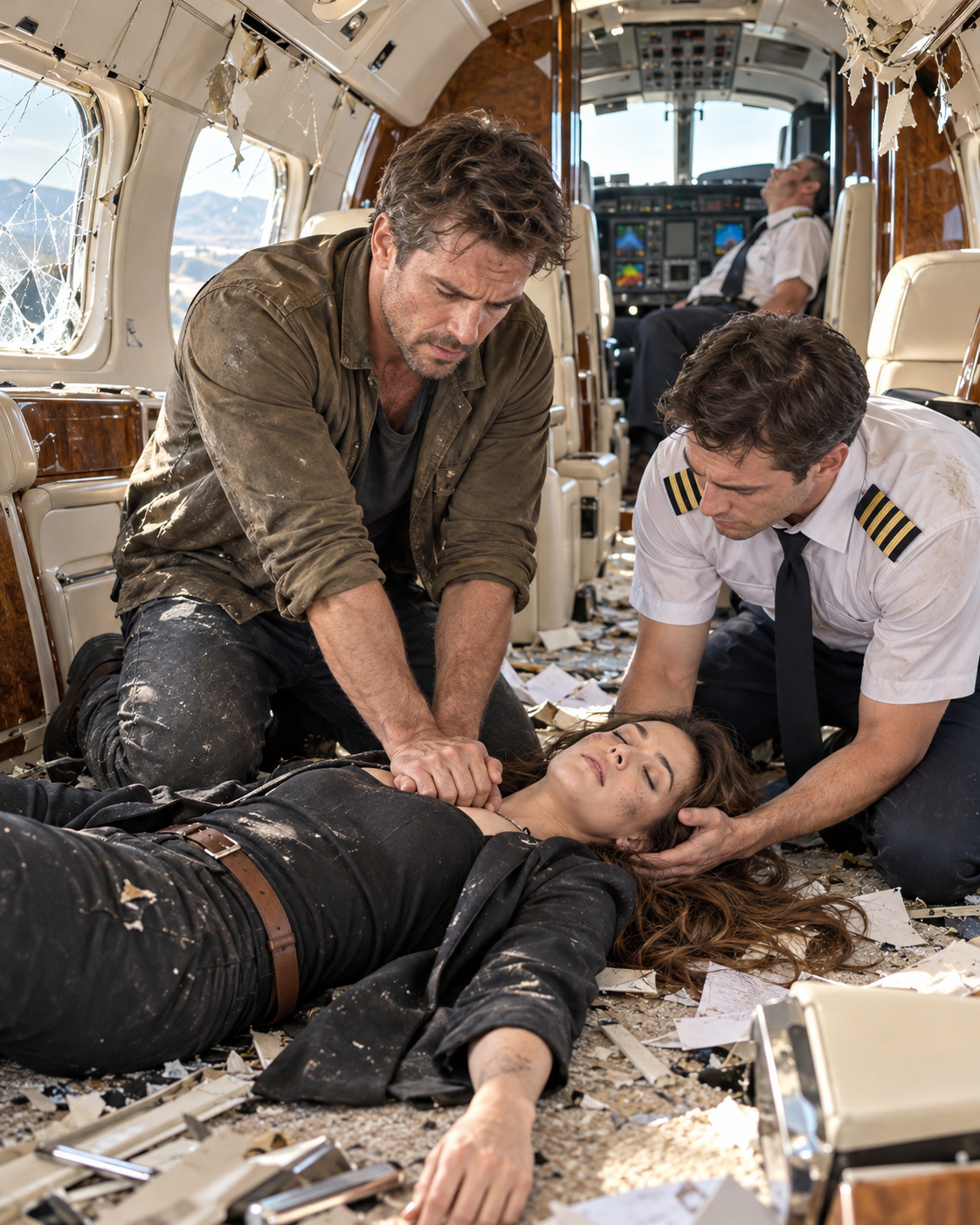
I had spent years teaching myself that the past was a locked room, that the right routine and enough ordinary days could keep the door shut.
Now the door had been ripped off its hinges.
A young security officer approached me with a bottle of water.
Julian Ellison was in his early thirties, with tired eyes and the careful manner of someone who had learned that the truth rarely arrived in a convenient order.
“Captain,” he said.
“Marcus.”
He hesitated, then nodded.
“Marcus. The director wants you in the operations building.”
“Of course he does.”
“There’s something else. The hospital called. Ms. Vance is asking about the person who pulled her out.”
“Tell her I’m glad she’s alive.”
“I did. She said that wasn’t an answer.”
Despite everything, I almost smiled.
“She sounds like herself.”
Julian studied me for a moment.
“People are saying you were the best search-and-rescue commander the Air Force had.”
“People say a lot of things.”
“They also say you vanished after a classified recovery mission in Alaska.”
I looked at him.
“Then people should learn when to stop talking.”
He accepted the rebuke without flinching.
“Understood. But someone may start asking questions whether we want them to or not.”
He was right.
In the operations building, Silas stood beside Walter Merrick, both men looking as though they had walked into a room and discovered that a ghost had been sitting there all along.
Walter was the first to speak.
“I recognized your voice before I recognized the situation.”
“I wish you hadn’t.”
“I heard you coordinate a night recovery in Alaska during a blizzard. You were twenty-nine, and you got six people off a mountain after two aircraft had gone down.”
“That was a long time ago.”
“It was the kind of operation people build careers around.”
I looked at the floor.
“Some careers end differently.”
Silas folded his arms.
“Captain, I need to understand what happened out there. You breached a secured perimeter, commandeered emergency communications, and entered a burning aircraft without authorization.”
“Then write me up.”
“This isn’t a joke.”
“No. It isn’t.”
My voice hardened before I could stop it.
“Three people were trapped in that aircraft. The fuel was spreading, the fire was moving toward the cabin, and the access route was blocked. I made a decision.”
Silas stared at me.
“And if you had died?”
I thought of Maya’s note beside the toaster.
Dinner at six.
“Then I would have died doing the thing I knew how to do.”
For a moment, nobody spoke.
Walter removed his headset and rubbed his eyes.
“Marcus, we all read the official report.”
“Then you know what it says.”
“It says the Alaskan prototype recovery was compromised by a command failure, that you disregarded a withdrawal order, and that the resulting losses were your responsibility.”
“That’s what it says.”
“And you accepted it.”
“I did.”
“Why?”
I looked at the three chairs around the table.
Because the truth had names attached to it.
Because the truth could destroy the lives of men and women who had trusted me.
Because a secret military operation had left my team exposed to a danger nobody outside the mission was supposed to know existed, and I had made a choice about what the public would hear afterward.
I had accepted the blame so the investigation would end before it reached the people I had sworn to protect.
But there was another reason, one I had never said aloud.
I had been exhausted.
Not physically.
Something deeper had broken inside me that night, and the military had given me a way to turn that break into a sentence: guilty, dismissed, forgotten.
“I had my reasons,” I said.
Walter looked unconvinced.
Silas, to his credit, did not demand more.
Instead, he said, “You’re suspended pending an investigation into the perimeter breach.”
“I expected that.”
“But no one is filing a criminal complaint tonight. You saved lives, and I won’t pretend otherwise.”
I nodded.
That was as close to gratitude as I was likely to receive from him.
Julian Ellison waited outside the room.
He fell into step beside me as I headed for the exit.
“One thing doesn’t make sense,” he said.
“What?”
“That aircraft. The pilots reported a hydraulic landing gear failure, but the fire marshal’s preliminary assessment suggests the crash sequence began with abnormal braking behavior.”
I stopped walking.
“Abnormal how?”
“Uneven deceleration. The aircraft pulled sideways after touchdown. The investigators are still working through the data.”
“Have they isolated the brake assembly?”
“Not yet.”
“Then don’t let anyone move it until they photograph the valve positions, the hydraulic connections, and every damaged fitting.”
Julian raised an eyebrow.
“You think the accident was caused by the brakes?”
“I think the aircraft behaved in a way that deserves an explanation.”
He watched me carefully.
“That’s a very specific answer from a maintenance technician.”
I started walking again.
“Mechanical failures don’t care about job titles.”
He caught up with me at the door.
“Neither do conspiracies.”
That made me stop.
He lowered his voice.
“Vivienne Vance was due to announce an acquisition tomorrow morning. Her company was buying a major aircraft systems manufacturer. If the deal closes, her brother Julian loses a company he has been trying to control for years.”
“Her brother?”
“Julian Vance. Different Julian from me, obviously.”
“I gathered that.”
“He has been publicly attacking the acquisition for weeks. Claims Vivienne is overpaying, that she’s risking the company, that she should step aside.”
“People fight over money every day.”
“True. But someone who wants to stop a deal doesn’t always have to win an argument. Sometimes they only have to make the person signing it disappear.”
I looked back toward the runway.
The jet’s silver tail was still visible beyond the fire engines, blackened and twisted beneath the floodlights.
“Don’t accuse anyone without evidence,” I said.
“I’m not accusing anyone.”
Julian paused.
“I’m asking why the brake assembly might be the one thing somebody doesn’t want us to examine.”
The following morning, I went to the hospital because Vivienne had refused to leave until she saw me.
She was sitting upright in a private recovery room, her left leg immobilized, a bandage above her eyebrow, and a laptop open on the bed beside her.
Even injured, she looked like someone who had no intention of letting a hospital schedule dictate her day.
“You came,” she said.
“You asked.”
“I asked six times.”
“I was busy.”
“Doing what?”
“Trying to keep my job.”
For the first time, she laughed.
It was a small, painful sound, but it changed her face.
“Sit down, Marcus.”
I took the chair beside the window.
She studied me for several seconds.
“When I was inside that aircraft, I heard you telling me to look at you. I remember your voice more clearly than I remember the explosion.”
“I was trying to keep you conscious.”
“You knew exactly what you were doing.”
“I knew enough to get you out.”
“No. You knew how to read a failing structure, how to calculate the risk, how to move someone without worsening an injury, and when to abandon the plan because the building—or in this case, the aircraft—was about to come apart.”
She leaned forward, wincing.
“That isn’t ordinary experience.”
I looked at the window.
“Nobody is ordinary at everything.”
“Captain Vance.”
My jaw tightened.
“Who told you?”
“I have people who know people. Your name came up in a preliminary incident briefing, and when I heard it, I thought there had to be another Marcus Vance.”
She tapped her laptop.
“Then I found the public records, the old commendations, the references to the Alaska mission, and the abrupt end of your military career.”
“You shouldn’t have been able to find much.”
“I couldn’t. That made me more curious.”
“Curiosity can be dangerous.”
“So can silence.”
Her eyes held mine.
“I owe you my life. I won’t pretend that gives me the right to demand your history. But I need to understand one thing.”
“What?”
“Did you save me because you recognized me?”
I shook my head.
“I didn’t know who was in that cabin until I found you.”
“Then why did you go in?”
I thought of the flight attendant, the injured passenger, the heat rolling across the floor.
“Because somebody was still calling for help.”
Vivienne went quiet.
For the first time since I had entered the room, the CEO disappeared, and I saw only a woman who had come close enough to death to understand how small the distance between a normal day and a final breath could be.
“My brother would say that’s a foolish reason,” she said.
“Your brother sounds like a man who has never had to make the choice.”
She looked down at her hands.
“Julian believes everything has a price. Loyalty. Courage. Even family.”
“Maybe that’s why he has trouble understanding people.”
Her gaze sharpened.
“What do you know about my brother?”
“Nothing beyond what Julian Ellison told me.”
“Then perhaps we should find out whether he knows something about the aircraft.”
I stood.
“Let the investigators do their work.”
“I will. But if this was more than an accident, I want the truth.”
“So do I.”
As I turned toward the door, she called after me.
“Marcus.”
I looked back.
“Thank you for bringing me out.”
For a moment, I couldn’t speak.
I had received medals once, speeches, handshakes, and the sort of praise that made a room stand and applaud.
None of it had stayed with me.
Her quiet gratitude did.
“You’re welcome,” I said.
Outside the hospital, Julian Ellison was waiting beside his car.
He held up his phone.
“We got the first photographs from the wreckage.”
I studied the images.
The aircraft’s right side was charred almost beyond recognition, but the left landing gear assembly had survived enough to reveal its position at impact.
Julian enlarged one photograph.
“Look at the brake valve.”
I leaned closer.
The valve sat at an angle that seemed almost insignificant.
A quarter-turn.
No shattered housing.
No obvious impact deformation.
Just a small adjustment that should never have been there.
My stomach tightened.
“Who photographed this?”
“An investigator. Before the assembly was moved.”
“Good. Get me the original file, not a screenshot.”
“Why?”
“Because I want the metadata, the scale reference, and the angle of the fitting. I need to know whether the valve shifted during the crash or before it.”
Julian studied my face.
“You think someone touched it.”
“I think a machine leaves a story in the damage. Sometimes you have to know what the machine was supposed to do before you can see what someone made it do.”
I looked again at the valve.
A quarter-turn was almost nothing.
But in the wrong place, at the wrong time, almost nothing could kill everyone aboard an aircraft.
And if someone had deliberately altered that valve, then Vivienne Vance had not survived an accident.
She had survived an attempt to murder her.
Part 3
The original photographs arrived that afternoon.
I spread them across a conference table in a secure maintenance room while Julian Ellison stood beside me with a notepad and a cup of coffee he had forgotten to drink.
I had spent years learning to inspect damaged aircraft without allowing the obvious damage to distract me from the first failure.
A crushed wing could tell you where an aircraft had struck the ground.
It could not always tell you why the aircraft had lost control.
I studied the brake valve, then the surrounding fittings, then the wear marks on the housing.
“There’s the problem,” I said.
Julian leaned forward.
“Where?”
“The valve should have been secured against accidental rotation. Look at the witness mark along the retaining collar.”
He squinted at the photograph.
“That line?”
“Yes. It doesn’t align with the original position. The valve was deliberately rotated approximately a quarter-turn before the impact.”
“Could the collision have moved it?”
“Not without leaving a different pattern of damage. The collar is intact. The fastener marks are clean, and the housing shows no evidence of the force you’d expect from an impact-driven shift.”
I moved to the next photograph.
“The adjustment would have changed the brake pressure response during rollout. Not necessarily enough to trigger an immediate warning, but enough to create an abnormal pressure imbalance under the right conditions.”
Julian’s expression changed.
“So the crew might not have known until the aircraft touched down.”
“Exactly. They could have approached normally, then found the aircraft pulling sideways when they needed the brakes most.”
He stared at the photographs.
“Someone made a tiny adjustment and turned a landing into a fire.”
“Someone may have.”
I pointed at the valve.
“But photographs establish a discrepancy, not the identity of whoever caused it. We need the maintenance records, access logs, component history, and a proper forensic examination.”
Julian nodded.
“I’ll make sure the investigators have all of it.”
He hesitated.
“What about the acquisition?”
I looked at him.
“Don’t get ahead of the evidence.”
“I’m not. But the aircraft was carrying the one executive whose death could have stopped the deal.”
“Then we find out who knew the flight schedule, who had access to the aircraft, and who benefited.”
That evening, Vivienne arranged a meeting with her company’s general counsel and two independent board members.
She was still using a cane, and the bruising beneath her eyes had darkened, but she refused to postpone the discussion.
I attended because the investigators wanted my technical observations documented, not because I wanted to sit among executives who looked at my canvas jacket as though it had been dragged in from the street.
Julian Vance joined by video from his office.
He was handsome in the polished, expensive way of a man who had never needed to wonder whether the next month’s rent would clear.
His tie was perfect.
His expression was not.
“Vivienne, this is ridiculous,” he said. “You’re recovering from a traumatic event, and now you’re turning a mechanical failure into a conspiracy.”
Vivienne placed a photograph on the table.
“The brake valve was found in a position inconsistent with the manufacturer’s documented setting.”
“Crashes damage equipment.”
“The retaining collar shows no impact deformation.”
“Then perhaps your airport maintenance staff failed to secure it.”
I felt every eye in the room turn toward me.
I had heard that kind of accusation before.
Blame the lowest-ranking person in the room.
Make the truth expensive enough that nobody wants to pursue it.
Vivienne looked directly at her brother.
“Are you accusing the technician who pulled me out of a burning aircraft of causing the crash?”
“I’m saying we don’t know what happened.”
“For once, Julian, we’re in agreement.”
She slid a second photograph across the table.
“This is the original inspection image, taken before the assembly was moved. Independent investigators are examining the valve, the maintenance history, and the access records. We will not assign blame until their findings are complete.”
Julian’s smile tightened.
“And the acquisition?”
“Will proceed according to the board’s legal obligations and the evidence.”
“You’ll destroy the company chasing ghosts.”
“No,” Vivienne replied. “Someone tried to destroy the company by making sure I never reached tomorrow morning. I’m simply refusing to help them finish the job.”
The room fell silent.
I watched Julian’s face.
For a fraction of a second, his eyes moved toward the photograph, not with confusion, but with recognition.
It was a tiny movement.
Most people would have missed it.
I didn’t.
Neither, apparently, did Vivienne.
She closed the folder.
“Before this meeting ends, I want the flight manifest, every maintenance entry, and the complete record of personnel who accessed the aircraft in the forty-eight hours before departure.”
Her brother leaned toward the camera.
“You have no idea what you’re accusing me of.”
“Then you have nothing to fear from an investigation.”
The screen went dark a moment later.
Nobody spoke until the general counsel cleared his throat.
I gathered my photographs.
Vivienne caught my eye.
“You saw it too.”
“I saw him react to the image.”
“Is that enough?”
“No. It’s enough to know which questions to ask next.”
She nodded.
“Then ask them.”
The investigation took four days to uncover what someone had spent months trying to hide.
The aircraft’s maintenance records showed that a contractor had performed a routine inspection shortly before departure.
The contractor’s access credentials had been used at an unusual time, but the technician whose name appeared on the authorization had been hundreds of miles away.
Someone had copied his credentials.
Security footage revealed a person entering the hangar in a borrowed maintenance uniform, keeping their face turned away from the cameras.
Investigators traced the access to a temporary security badge requested through an intermediary connected to one of Julian Vance’s private consulting firms.
That alone was not enough to prove he had ordered the sabotage.
But then they found the payments.
A shell company had transferred money to the contractor whose credentials were copied.
Messages recovered from a device seized under warrant described the acquisition as a problem that had to be stopped before the board vote.
One message included a photograph of the aircraft’s service schedule.
Another instructed the recipient to make the change appear consistent with a routine adjustment.
The wording was chilling in its simplicity.
No threats.
No dramatic confession.
Just a few cold sentences about pressure, timing, and plausible deniability.
The investigators also recovered a message sent after the crash.
Confirm the deal is dead.
That was when the case changed.
Julian Vance was taken in for questioning.
He denied ordering anyone to harm his sister, claimed the payments were related to legitimate consulting work, and insisted that someone had fabricated the messages to frame him.
But the evidence kept growing.
The contractor eventually admitted that he had arranged the unauthorized access after being promised a substantial payment.
He said he had been told the aircraft would suffer a manageable mechanical disruption, forcing Vivienne to miss the acquisition meeting and creating enough uncertainty to delay the deal.
He claimed he had not been told anyone would be killed.
I listened to the summary in the airport’s conference room and felt no satisfaction.
People often imagine that uncovering the truth brings relief.
Sometimes it brings only a clearer picture of how easily someone can convince themselves that another person’s life is an acceptable price.
Julian Ellison closed his notebook.
“He’s going to claim he never intended the crash to become fatal.”
“He can make that argument in court,” I said.
“But the aircraft didn’t care what he intended.”
“No.”
I looked out at the runway, where crews had begun replacing the damaged lights.
“Neither did the people trapped inside.”
The next morning, Vivienne held a press conference.
She stood at a lectern with her cane resting beside her and a thin folder in her hands.
Behind her were the company’s independent directors, its legal counsel, and representatives of the investigation.
She didn’t describe the explosion in dramatic detail.
She didn’t turn her survival into a victory speech.
Instead, she explained that evidence had uncovered deliberate interference with an aircraft brake system and that investigators were pursuing the people responsible.
She announced that the acquisition would proceed under independent oversight, with additional security controls and a full audit of the company’s maintenance and access procedures.
Then she looked directly into the cameras.
“I owe my life to a man who had every reason to stay out of danger and every reason to let trained responders handle the emergency. He went in because people were trapped inside, and he refused to leave them there.”
She paused.
“His name is Marcus Vance. He served as an elite Air Force search-and-rescue commander, and he has spent eleven years living quietly after accepting responsibility for an operation whose full details remain classified.”
I stiffened.
She continued before anyone could interrupt.
“I will not disclose protected military information, and I will not pretend to know every reason he chose to leave that life behind. What I can say is that his actions at Redwood International Airport saved lives, and the attempt to diminish him because of his civilian job would be an insult to everyone who has ever done difficult work without expecting applause.”
For the first time in eleven years, I heard someone describe my past without turning it into a verdict.
I should have felt proud.
Instead, I thought of Maya.
I thought of the mornings when she had asked why I never talked about my younger years, and the evenings when she had watched me go quiet whenever a military aircraft crossed the sky.
I had told myself I was protecting her by keeping the past away.
Perhaps I had also been protecting myself from the possibility that she might look at me and see a man who had once been brave and had later become afraid.
My phone vibrated.
A message from Maya appeared on the screen.
Dad, are you still coming home for dinner?
I stared at it for a long moment.
Then I typed, Yes. I promise.
The investigation into Julian Vance continued, and the evidence eventually led to criminal charges related to the sabotage scheme.
The courts would determine his guilt.
I had no desire to become the face of the case, and Vivienne respected that.
She also made sure the airport’s internal review distinguished my unauthorized actions from the decisions that had contributed to the emergency.
Silas Whitmore called me into his office one final time.
He stood behind his desk, looking older than he had during the crash.
“I owe you an apology,” he said.
I hadn’t expected that.
“For what?”
“For treating your job as proof that you couldn’t possibly know what you were doing. I was responsible for keeping the airport safe, and I let the uniform you wore matter more than the lives in front of us.”
I considered his words.
“You were trying to keep people from rushing into a burning aircraft.”
“I was. But you saw a danger I hadn’t accounted for, and I dismissed you before I understood it.”
He slid a document across the desk.
The airport was withdrawing its disciplinary suspension and formally recognizing my actions during the rescue.
“I can’t undo what happened,” he said. “But I can make sure the record reflects the truth.”
I signed the acknowledgment.
Then I handed the pen back.
“That’s enough.”
Walter Merrick met me outside the office.
He looked as if he wanted to say something grand, something about honor and sacrifice and the man he remembered from Alaska.
Instead, he simply held out his hand.
“I’m glad you’re still here, Marcus.”
I shook it.
“So am I.”
Julian Ellison walked with me to the maintenance bay.
“Do you think you’ll ever tell people what happened in Alaska?”
“Some people already know what they need to know.”
“That’s not quite an answer.”
“It’s the only one I have.”
He accepted that.
At the edge of the bay, he stopped and looked at my old canvas jacket.
“You know, you could probably get a different one now.”
I glanced down at the frayed cuffs.
“This one still works.”
He laughed.
It was the first easy laugh I had heard at the airport since the crash.
That evening, I drove home through streets washed gold by the setting sun.
For eleven years, I had treated the drive home as the boundary between the life I had lost and the life I was allowed to keep.
That night, it felt different.
I parked outside our house and sat for a moment with my hands resting on the steering wheel.
Through the kitchen window, I could see Maya moving around the stove, her hair tied back, one sock sliding down her ankle.
She had started dinner without me.
When I walked inside, she turned so quickly that the spoon in her hand nearly flew across the room.
“You’re late.”
“I know.”
“You said six.”
“I know.”
She looked at my face, searching for an explanation.
I had given her a thousand small reassurances over the years, but I had rarely given her the truth about myself.
This time, I decided to start.
“Something happened at work,” I said. “A plane crashed, and people were trapped inside. I went in to help.”
Her expression changed.
“You’re hurt?”
“No. Not badly.”
“Dad.”
“I’m okay, Maya.”
She set the spoon down.
“Everyone at school is talking about a plane crash. Someone said a maintenance worker rescued the CEO.”
I looked at her.
“News travels fast.”
“Was that you?”
I could have hidden behind a joke.
I could have told her the details were complicated, that she didn’t need to worry, that everything was fine.
Instead, I nodded.
“Yes.”
She stared at me as if she were seeing a stranger wearing her father’s face.
“Why didn’t you tell me you could do something like that?”
I sat at the kitchen table.
“Because I spent a long time trying to forget that part of my life.”
“Why?”
The question was gentle.
That made it harder.
I told her about the Air Force, about search-and-rescue missions, about the cold and the fear and the terrible decisions that sometimes followed people home long after the danger had passed.
I didn’t tell her classified details, and I didn’t pretend that every choice I had made was right.
I told her that I had once believed being strong meant never letting anyone see how much something hurt.
I told her that I had confused being forgotten with being forgiven.
And I told her that when her mother died, I had been so afraid of losing the last good thing in my life that I had built walls around everything that reminded me of who I used to be.
Maya listened without interrupting.
When I finished, she sat down across from me.
“Do you still feel guilty about Alaska?”
I looked at my hands.
“Sometimes.”
“Even after everything you did today?”
“Today doesn’t erase yesterday.”
She considered that.
“Maybe it doesn’t have to.”
I looked up.
She reached across the table and took my hand.
“I don’t need you to be a hero, Dad. I just need you to come home.”
The words struck deeper than the explosion had.
I squeezed her fingers.
“I know.”
“Good. Because the pasta is getting cold.”
I laughed, and to my surprise, she laughed too.
We ate dinner at the kitchen table while the sky darkened beyond the window.
She told me about her chemistry test, her friends, and an argument at school that she had somehow turned into a story about a missing cafeteria fork.
I listened.
Really listened.
For years, I had believed that my promise to come home meant avoiding danger, avoiding attention, and keeping every painful part of my history out of our lives.
Now I understood that a promise was not the same thing as a guarantee.
It was a commitment to return whenever you could, to tell the truth when silence became a wall, and to let the people you loved know who you were, even when you were still learning how to forgive yourself.
After dinner, Maya helped me wash the plates.
Before going upstairs, she paused beside me and leaned her head against my shoulder.
“I’m proud of you,” she said.
I closed my eyes.
For eleven years, I had imagined that hearing those words might finally make the past loosen its grip.
It didn’t happen all at once.
The memories remained.
The guilt remained.
Some nights, Alaska still returned in dreams of white mountains and broken radio signals.
But something had changed.
I no longer had to carry every memory alone.
A week later, I returned to the maintenance bay.
The damaged aircraft had been removed, the runway repairs were nearly complete, and the airport had returned to its familiar rhythm of engines, rolling suitcases, and hurried footsteps.
I wore the same faded canvas jacket.
My truck still rattled.
My thermos still leaked if I forgot to tighten the lid.
Nobody had turned my life into a fairy tale, and I didn’t want them to.
Vivienne sent a short letter thanking me again and informing me that her company would fund additional emergency-response training for airport ground crews, including the workers whose names rarely appeared in official reports.
She didn’t offer me a corner office.
She didn’t ask me to become a public spokesman.
She simply made sure the people who kept the airport running would be better prepared when the next emergency came.
That mattered more to me than a ceremony.
On my way out of the hangar one evening, I passed a new maintenance worker struggling to secure a heavy equipment panel.
I stopped and showed him how to brace it properly before tightening the bolts.
He thanked me and went back to work.
No cameras.
No applause.
Just one person helping another do a difficult job a little more safely.
I realized that I didn’t have to choose between the man I had been and the father I had become.
The captain who had run into the burning aircraft was still part of me.
So was the man who made pancakes on Sundays, checked homework at the kitchen table, and tried to remember which vegetables Maya would actually eat.
Neither one canceled out the other.
I had spent eleven years believing that my past was a shadow I had to outrun.
But shadows don’t disappear just because you stop looking at them.
Sometimes, the only way forward is to turn around, face what is there, and decide what kind of man you want to be when you walk away.
That night, I drove home beneath a darkening sky.
Maya had left the porch light on.
I could see it from the end of the street, a small, steady glow against the gathering darkness.
I parked, stepped out, and heard her call from inside the house.
“Dad! You’re home!”
For the first time in eleven years, I didn’t feel as though I had escaped something.
I felt as though I had arrived.
I opened the door and found her waiting in the kitchen, holding up two plates and wearing the crooked smile that had carried me through more difficult nights than she would ever know.
“Dinner?” she asked.
I hung my faded jacket beside the door.
“Wouldn’t miss it.”
And as I sat down across from my daughter, I finally understood the truth I had spent half my life trying to avoid: courage is not the absence of fear, and redemption is not the erasure of the past.
Sometimes courage is running into a burning aircraft when strangers need you.
Sometimes redemption is telling your child why you were afraid.
And sometimes the bravest thing a man can do is stop trying to disappear, come home before dinner gets cold, and allow himself to be loved by the one person who never needed him to be a legend.