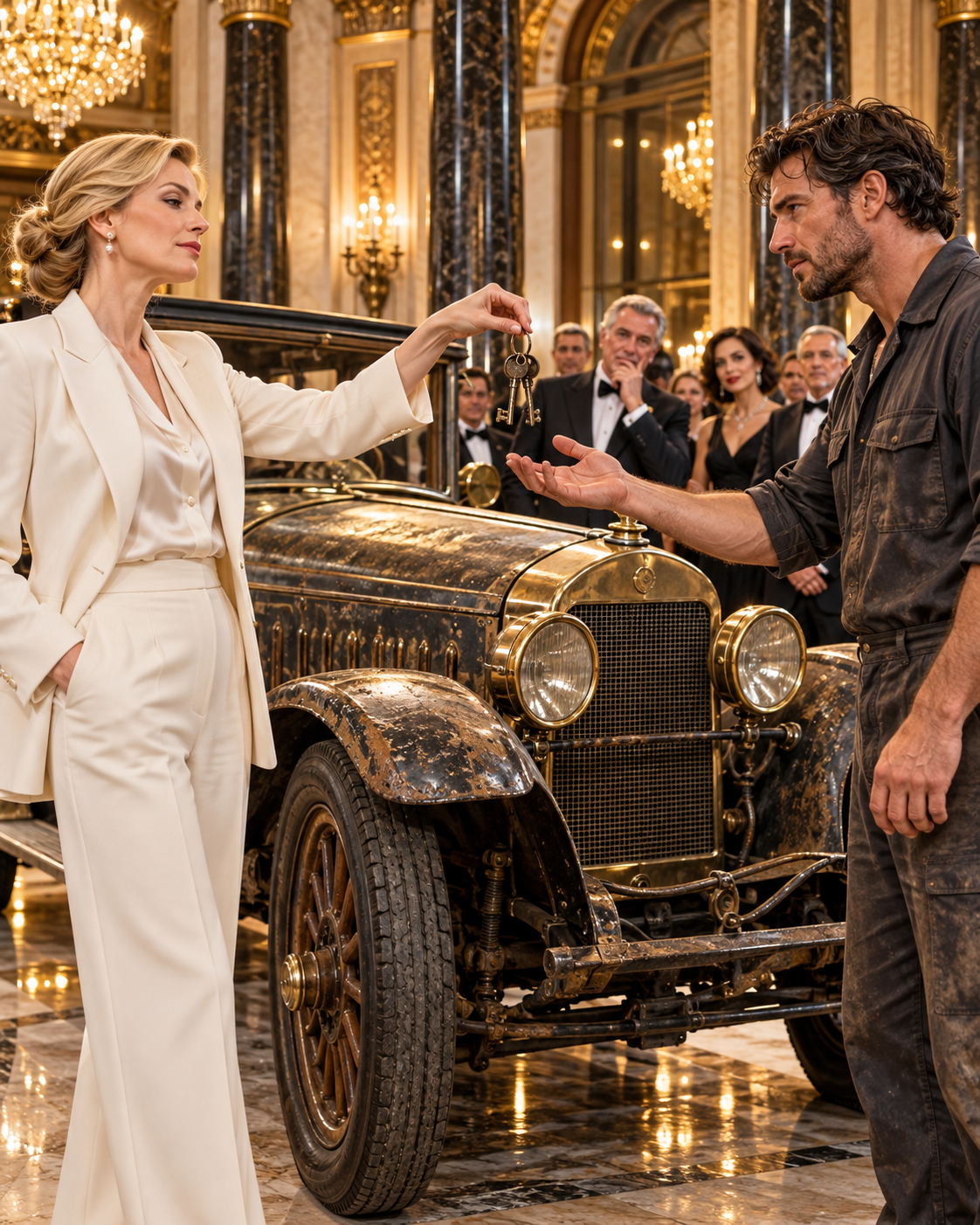
When Camilla Sterling laughed at me inside her father’s marble auction hall and tossed me the keys to a dust-covered
The envelope felt heavier than it should have.
I stood beneath the fluorescent lights of my garage, surrounded by the smell of oil, metal, and warm rubber, while Camilla watched me with the same nervous expression I had seen on Chloe’s face the first time she asked whether her mother was really never coming home.
“Open it,” Camilla whispered.
I turned the envelope over.
There was no return address.
No date.
Only my name, written in Arthur Sterling’s unmistakable handwriting.
My fingers hesitated at the seal.
I had spent months reading Arthur’s private thoughts, learning about his childhood, his regrets, his fears, and his complicated love for the daughter he believed he had failed.
But nowhere in those pages had he mentioned me.
Not once.
I broke the seal.
Inside was a single folded letter.
Dear Daniel,
If you are reading this, then the machine has finally found its way into honest hands.
I stopped breathing for a moment.
Camilla stepped closer.
“How did he know your name?”
“I don’t know.”
I kept reading.
Arthur explained that he had been watching my work for nearly a year before his death.
At first, I thought that meant he had seen me at the estate.
He hadn’t.
He had found my restoration shop long before that.
He had quietly visited several times, sometimes sitting in his car across the street, watching me repair engines and teach neighborhood kids basic mechanical skills after school.
Then I reached the sentence that made my chest tighten.
“I watched you repair a boy’s truck for free because his mother could not afford the parts.”
I remembered that truck.
A battered blue pickup belonging to a teenager named Marcus, whose mother worked two jobs.
I had forgotten the incident almost completely.
Arthur hadn’t.
He wrote that he had spent decades searching for someone who understood the difference between owning something valuable and knowing its value.
He believed he had finally found that person.
But there was more.
Arthur revealed that the prototype had never been intended merely as an experimental automobile.
It contained a mechanical energy-recovery system that could dramatically reduce fuel consumption without relying on the technology his company had been developing at the time.
The system had been considered too disruptive.
If released, it could have destroyed billions of dollars in planned investments.
Arthur had buried the design rather than sell it to competitors or allow his own executives to bury it permanently.
But he had kept the original machine because he believed the technology might someday belong to people who actually needed it.
Then I reached the final paragraph.
“Daniel, if the world finds the car, they will call it a miracle.
They will fight over patents, museums, money, and credit.
Do not let them forget the reason I hid it.
Technology means nothing if ordinary people cannot afford the future it creates.”
I lowered the letter.
Camilla was crying.
“My father knew you?”
“He knew of me.”
“No,” she said softly.
“He knew exactly who you were.”
That distinction stayed with me.
For the next several days, I couldn’t stop thinking about Arthur’s warning.
The nine million dollars had changed my life, but the letter changed the meaning of the money.
I had planned to use my share to expand the restoration academy.
Now I wondered whether the prototype could do something larger.
Evelyn Thorne agreed.
When I showed her Arthur’s letter, she became unusually quiet.
“If the engineering claims are accurate,” she said, “this isn’t just an artifact.”
“What is it?”
“A door.”
We brought together a small group of engineers, historians, and manufacturing specialists.
The original prototype was too fragile to operate safely, so we studied its architecture and reconstructed the energy-recovery system separately.
For months, nothing worked.
We burned through components.
We broke test assemblies.
We argued over calculations.
There were mornings when I wanted to throw the entire project into a corner and return to ordinary restoration work.
Then Chloe would walk into the garage with her backpack and ask how the “magic car” was doing.
I would smile and tell her it was stubborn.
She always answered the same way.
“Then keep fixing it.”
It reminded me of Clara.
She had said something similar during the worst months of her illness.
Not about a car.
About life.
“Don’t confuse something being broken with something being finished.”
I had carried those words for three years without realizing how much they had shaped me.
One evening, after everyone had gone home, I found myself sitting alone beneath the prototype.
I could still see Clara in my mind.
Her tired smile.
Her hand resting in mine.
The hospital window behind her.
For the first time since her death, I allowed myself to cry without trying to stop.
I wasn’t crying because I missed her.
I would always miss her.
I was crying because I realized I had finally begun building something again.
Not because I had forgotten her.
Because I hadn’t.
A year after the auction, our reconstructed system finally worked.
It wasn’t perfect.
It wasn’t revolutionary in the way newspapers later described it.
But it was real.
The prototype’s forgotten principle could be adapted into simpler systems for older vehicles, agricultural equipment, and small engines.
Machines that working families depended on every day.
The first public demonstration happened at my academy.
There were no chandeliers.
No champagne.
Just mechanics, students, teachers, parents, and a row of folding chairs.
Camilla sat in the second row.
When the demonstration succeeded, the room erupted.
I looked at her.
She wasn’t clapping.
She was staring at the old photograph of Arthur that hung beside the workshop entrance.
Later that evening, she approached me.
“I used to think my father was ashamed of where he came from.”
“He wasn’t.”
“I know.”
She looked at the students repairing engines behind us.
“He was ashamed of what he had become.”
I didn’t correct her.
She was finally understanding him.
The Sterling Foundation eventually funded scholarships for young mechanics, welders, machinists, electricians, and fabricators.
Camilla insisted that every program carry no family name.
She didn’t want statues.
She didn’t want buildings named after Arthur.
She said her father had spent too much of his life turning a name into a monument.
Now she wanted the money to disappear into opportunities.
At first, the media treated her transformation like a publicity campaign.
Then something strange happened.
She kept doing it after the cameras left.
She visited vocational schools without photographers.
She sat with families whose homes had been lost after medical bills.
She listened to workers who had spent decades building companies they could never afford to invest in themselves.
She stopped introducing herself as Arthur Sterling’s daughter.
She began introducing herself simply as Camilla.
Months passed.
The academy grew.
My little garage became a full training center.
Students who had once been suspended from school were rebuilding transmissions.
Kids who had been told they would never amount to anything were learning precision welding.
One of them, Marcus, eventually became an instructor.
He still had the blue pickup.
He kept it parked outside my shop as a reminder of the first time someone had believed in him.
Then, one rainy Thursday afternoon, Evelyn called me.
Her voice sounded different.
“We found another document.”
I froze.
“What kind?”
“Not another letter.”
She paused.
“A blueprint.”
I drove to her office.
She placed an old folder on the table.
The paper was brittle and covered in Arthur’s handwriting.
Across the top were six words.
PROJECT SECOND CHANCE.
My stomach tightened.
“What is this?”
Evelyn turned the page.
“It’s dated twenty-eight years ago.”
Beneath the title was a drawing of an engine system.
It looked remarkably similar to the one we had spent months reconstructing.
But underneath it was something else.
A list of names.
Engineers.
Machinists.
Factory workers.
And one name that made no sense.
Clara Bennett.
My wife’s maiden name.
I couldn’t move.
The room seemed to tilt.
“That’s impossible.”
Evelyn stared at me.
“Are you sure?”
“I was married to her.”
She slowly pushed another sheet across the table.
It contained a short note from Arthur.
“Clara believes technology should belong to the people who need it most.
If I fail, find someone who understands what she understood.”
My hands began to shake.
Clara had never told me about Arthur Sterling.
Not once.
She had worked in engineering before becoming ill, but she had always kept her professional life separate from mine.
I had assumed that was because she wanted our home to be different from our work.
Now I wondered if she had been protecting me.
Or protecting someone else.
That night, I went home and opened the old box containing Clara’s belongings.
I had avoided it for years.
Her scarves were still folded inside.
Her old notebook sat beneath a stack of photographs.
I opened it.
Most pages contained technical sketches I didn’t recognize.
Then I saw the same symbol Arthur had drawn on his blueprint.
A small circle crossed by two lines.
My heart began pounding.
I turned page after page.
Near the back was a sentence written in Clara’s handwriting.
“Arthur thinks the prototype is the beginning.
He’s wrong.
The real invention is what comes after.”
I sat on the bedroom floor until dawn.
Chloe found me there.
“Dad?”
I looked up.
She was holding two cups of cocoa.
“Are you sad?”
I wiped my eyes.
“A little.”
“Because of Mom?”
I nodded.
She sat beside me.
“Maybe she left you clues because she knew you’d need them.”
Children sometimes say things adults are too frightened to believe.
I held her close.
For the first time, Clara’s death felt connected to a story that had started long before I knew it existed.
The next morning, I called Camilla.
She arrived within an hour.
I showed her the documents.
She read them in silence.
Then she looked at me.
“My father knew your wife.”
“Apparently.”
“Why would he never tell me?”
“Maybe he was trying to protect you.”
She shook her head.
“That sounds like him.”
We spent the next week tracing old records.
We discovered that Clara had briefly consulted for one of Arthur’s private research groups almost three decades earlier.
She had been young.
Brilliant.
And fiercely opposed to allowing breakthrough technology to become another luxury reserved for wealthy people.
Arthur had admired her.
But there was no evidence of wrongdoing.
No conspiracy.
No secret crime.
Just two people who had believed in the same impossible idea.
Then we found the final piece.
Arthur had written a note after Clara left the project.
“She refuses to let me finish it alone.
She says the machine must outlive us.
Perhaps she is right.”
I read those words over and over.
Clara hadn’t abandoned the dream.
She had simply walked away from the billionaire who wanted to control it.
Years later, she married me.
We built a quiet life.
And when she became sick, she stopped talking about work.
Maybe she thought there was no point.
Maybe she knew she would never see the project completed.
Or maybe she had trusted that someday, someone else would find it.
I looked at Chloe that evening and understood something that broke my heart.
Clara had not left behind a fortune.
She had left behind a direction.
We eventually established the Clara Bennett Initiative through the foundation.
Its purpose was simple.
Fund practical engineering for ordinary people.
Low-cost tools.
Repairable machines.
Energy-saving equipment.
Training for communities that large corporations overlooked.
We refused to patent the core principle ourselves.
Instead, we released the research publicly under an open license with protections against exclusive ownership.
Some investors called us foolish.
Some companies threatened lawsuits.
A few wealthy collectors tried to buy the rights.
We refused.
Camilla refused.
Evelyn refused.
And I refused.
Because Arthur’s final lesson had finally become clear.
A legacy wasn’t what you managed to keep.
It was what you were willing to give away.
Years after the auction, the original prototype returned to the academy.
Not as a museum piece.
Not behind velvet ropes.
It sat in the center of our workshop where students could study it.
The paint was still faded.
The scars were still visible.
And I never let anyone polish them away.
One afternoon, Camilla stood beside it with Chloe.
“Your father once gave this away as an insult,” Camilla said.
Chloe smiled.
“And it became important.”
Camilla looked at me.
“No.”
She rested her hand on the battered hood.
“It became important because someone finally understood what it was worth.”
I smiled.
“That’s different.”
She nodded.
“Much different.”
Years later, people would write books about Arthur Sterling.
They would mention the nine-million-dollar auction.
They would call the prototype one of the great lost machines of the twentieth century.
They would tell stories about the billionaire who hid a technological breakthrough.
But those stories always missed the part I cared about most.
Arthur’s greatest creation wasn’t the machine.
It wasn’t his company.
It wasn’t the fortune.
It was the chance he left behind for people he would never meet.
And Clara’s greatest gift wasn’t a secret blueprint.
It was the belief that a person’s value had nothing to do with how much they owned.
Sometimes I still think about that afternoon at the auction.
Camilla’s cold smile.
The laughter.
The keys flying through the air.
The moment I caught them.
If she had chosen kindness that day, perhaps none of this would have happened.
But I don’t resent her anymore.
Because sometimes the smallest act of cruelty becomes the doorway through which truth enters.
A year after the academy opened, Camilla asked me one final question.
“Do you think my father knew this would happen?”
I looked at the prototype.
Then I looked at Chloe, who was teaching a twelve-year-old girl how to rebuild a carburetor.
“No,” I said.
“I think he only hoped someone would understand.”
Camilla smiled through tears.
“And did someone?”
I nodded.
“Eventually.”
That evening, after everyone left, I locked the garage and walked past the prototype one last time.
A small envelope sat on the workbench.
There was no name on it.
No explanation.
Only the same symbol Clara had drawn in her notebook decades earlier.
I stood there in the dark, listening to the rain against the roof.
Then I noticed something written beneath the symbol in faded ink.
Three words.
“THE SECOND MACHINE.”
I stared at it for a long time.
Because suddenly, I understood.
Arthur Sterling’s hidden prototype had never been the end of the story.
It had only been the first door.
And somewhere, perhaps hidden in another forgotten garage, another machine was waiting for someone to find it.
This time, I knew exactly where I would begin looking.
… The Story continues in the Comments! 👇