When a professional MMA fighter humiliated me in front of hundreds of people at Redwood Combat Club
Part 2
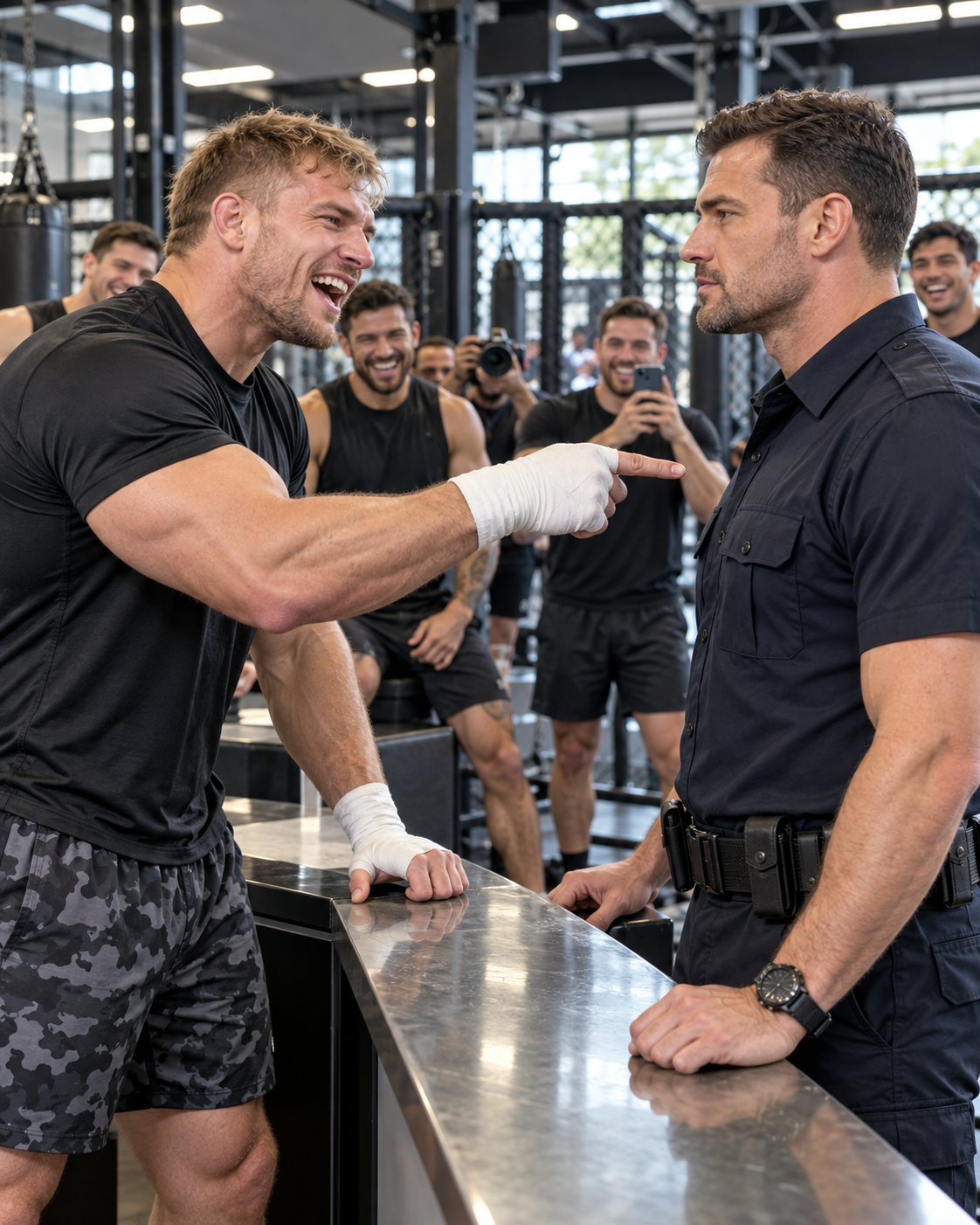
Trent came at me before anyone could say another word.
He moved fast, just as he should have. He was a professional fighter, strong and explosive, with years of training behind every step.
His first strike came high.
I moved my head a few inches to the side.
His second followed immediately, a sweeping punch designed to catch me as I retreated.
I didn’t retreat.
I stepped inside its arc.
The sound of his glove cutting through empty air was almost comically loud in the sudden silence.
Trent’s eyes widened.
He tried to recover with a third strike, then a fourth, his shoulders tightening as he chased the target he expected me to be.
But I wasn’t where he wanted me.
I shifted my weight, angled my hips, and let his momentum carry him past the position he was trying to occupy.
My hands found their places almost automatically.
One controlled grip.
A turn.
A step that denied him the balance he needed.
Then I took him down.
There was no dramatic slam, no wild scramble, no moment when I needed to overpower him with brute strength.
I simply put him where he could no longer use the weapons he had brought into the cage.
His back touched the canvas.
I followed him down, secured my position, and worked around his attempts to turn.
Trent bucked hard.
I adjusted.
He tried to shove me away.
I changed my angle.
He was strong, but strength without position was like trying to push a locked door by leaning against the wrong wall.
Within seconds, I had his back and established a tight body triangle.
I didn’t strike him once.
I didn’t need to.
The hold was controlled, my weight balanced, and every movement calculated to prevent him from escaping without causing unnecessary harm.
Trent twisted.
Nothing.
He tried to turn toward me.
Nothing.
Then he stopped moving for half a second.
I felt the instant his confidence cracked.
“Get off!” he shouted.
I kept the pressure steady.
He grabbed at my arm, tried to turn his shoulders, and kicked his feet against the canvas.
The camera was still rolling.
So was the silence.
The man who had walked into the club laughing at my badge was now struggling to find a way out of a position he had never expected to be in.
“Tap if you need to,” I told him.
He shook his head violently, still trying to save face.
Then he made one last desperate attempt to turn.
I adjusted just enough to keep the position secure.
“Tap,” I repeated, my voice calm.
His hand struck the canvas.
Once.
Twice.
Three times.
“Stop! Stop! I’m tapping!”
I released him immediately and moved away, giving him room to sit up.
The entire exchange had lasted about twenty seconds.
For several moments, neither of us spoke.
Trent remained on the canvas, breathing hard, his face pale beneath the overhead lights.
I stood, stepped back, and waited until he was fully clear before offering him a hand.
He stared at it as if the gesture were another insult.
Then he pushed himself up without taking it.
The cameraman slowly lowered his equipment.
Someone near the fence whispered, “Holy hell.”
From outside the cage, I heard Chloe call my name.
“Dad?”
I turned.
She was looking at me with wide eyes, but there was no fear in them now.
Only confusion.
And something else.
A question she had been carrying for longer than either of us understood.
I climbed out of the octagon and walked toward her.
“Are you okay?” I asked.
She nodded, then looked over my shoulder at Trent.
“How did you do that?”
Before I could answer, the main-floor doors swung open.
Arthur Barrett, the gym’s director, strode inside with two staff members behind him.
Arthur was in his late fifties, broad-shouldered, gray-haired, and permanently unimpressed by people who mistook volume for authority.
He took in the scene in one glance: Trent on the canvas, the cameraman still recording, the crowd pressed around the cage, and me standing barefoot beside my daughter.
His eyes settled on my face.
For a long moment, he said nothing.
Then he exhaled.
“Well,” he muttered. “I was hoping I’d never see that again.”
Trent finally found his voice.
“That guy jumped me!”
Arthur turned toward him.
“You challenged him in my gym, in front of a camera, after being asked to follow a basic safety rule.”
“He choked me out!”
“You tapped. He released you immediately.”
Trent’s face flushed.
“Do you know how bad this looks?”
Arthur folded his arms.
“Not nearly as bad as it would have looked if he hadn’t let go the instant you tapped.”
That silenced him.
Arthur directed the crowd back toward the training areas, ordered the cameraman to stop filming members without permission, and asked one of his staff to make sure Trent had no injuries.
I expected Arthur to turn on me next.
Instead, he looked at Chloe.
“You all right, kiddo?”
She nodded.
“Your dad has always been good at keeping his head when things get ugly,” he told her.
I shot him a warning look.
Arthur understood immediately and said no more.
But Chloe had heard enough to know that there was a story here.
And she was going to want the whole thing.
The video went online before midnight.
Trent’s manager uploaded a short clip that was supposed to show a cocky fighter teaching a disrespectful security guard a lesson.
Instead, the footage showed Trent ignoring the rules, taunting a father in front of his child, charging forward, and tapping out less than half a minute later without landing a clean strike.
The internet did what the internet always does.
It replayed the moment.
It slowed the takedown.
It zoomed in on my face.
It argued about whether the sequence was luck, skill, or some secret technique nobody had seen before.
By morning, the clip had millions of views.
By noon, strangers had given me nicknames I didn’t want.
Some called me the Ghost.
Others called me the Retired King.
A few insisted I was a former champion who had disappeared after a scandal.
They weren’t entirely wrong.
My phone rang so often that I finally switched it off.
Then my employer called.
I worked for a private security company that assigned personnel to gyms, event venues, and commercial properties. My supervisor had seen the footage and was worried about the company’s reputation.
“You engaged in an unsanctioned physical confrontation while on duty,” he told me.
“He challenged me,” I replied.
“That doesn’t change the policy.”
“I understand.”
“We’re placing you on temporary suspension while we review the incident.”
I looked at the kitchen table, where Chloe’s spelling worksheet sat beside a bowl of untouched cereal.
“Understood,” I said again.
The call ended.
I stood in the quiet kitchen, staring at the phone in my hand, and felt the old fear return.
Not fear of fighting.
Fear of losing the small, ordinary life I had worked so hard to protect.
The bills would not stop because a video had gone viral.
Chloe would still need lunch money, school supplies, and a father who could tell her everything would be okay without lying.
And now, as if the universe had decided the humiliation wasn’t complete, someone had identified my old fight record.
A local sports account posted an image from eight years earlier.
My younger face stared back at me from the screen, bruised and exhausted, standing beneath arena lights with a championship belt draped over my shoulder.
The caption read: Who is the security guard who submitted Trent Vance? Former MMA contender Daniel Mercer vanished after the tragic fight that ended another man’s career.
By the time Chloe came home from school, several parents had already seen it.
She didn’t mention the whispers in the hallway.
She didn’t mention the boy who had asked whether her dad was a secret killer.
She simply placed her backpack beside the door, came into the kitchen, and stood watching me for a long time.
“Dad,” she said finally, “what happened eight years ago?”
I had been afraid of that question since the moment I stepped into the cage.
Now there was no way around it.
I pulled out a chair.
“Come sit with me, sweetheart.”
She sat down slowly.
I folded my hands on the table, searching for words that would not turn an old tragedy into a bedtime story.
“There are things about my life before you were old enough to remember,” I began, “that I should have told you a long time ago.”
Chloe looked straight at me.
“Then tell me everything.”
So I did.
Part 3
Eight years earlier, before I became the man who checked visitor logs and packed school lunches, I had been Daniel Mercer, a professional mixed martial artist on the edge of the biggest opportunity of my career.
Fighting had been my life since I was a teenager.
I had spent years learning how to fall without panicking, how to breathe when my lungs burned, how to remain calm when someone stronger than me tried to force me into a mistake.
I wasn’t famous, but I was respected.
I had won enough fights to earn a reputation for patience, technical precision, and a kind of stubborn composure that frustrated opponents who wanted me to make emotional decisions.
I loved the sport.
I loved the discipline.
I loved the quiet that settled over my mind when every problem narrowed to a single moment and every movement had a purpose.
Then came the fight that changed everything.
My opponent was Marcus Reed, a talented fighter with a young family and a career that had finally begun to gain momentum.
We had trained in the same circles for years.
We weren’t close friends, but we respected each other, and neither of us entered the cage expecting anything other than a hard, fair contest.
The fight was close.
Too close for either of us to feel comfortable.
Late in the match, we exchanged positions during a scramble near the fence. I applied a technique I had practiced thousands of times, believing I had the angle and control I needed.
Marcus moved unexpectedly.
I adjusted.
For one fraction of a second, the position went wrong.
The referee stopped us almost immediately, but Marcus had already suffered a serious injury.
I remember the sound of the crowd fading.
I remember the medical staff rushing into the cage.
I remember sitting against the fence afterward, staring at my hands while people told me I had done nothing intentionally wrong.
Marcus survived.
But the injury forced him into retirement, ending the career he had fought so hard to build.
No official finding blamed me for deliberate misconduct, and nobody accused me of trying to hurt him.
That didn’t make the outcome easier to live with.
I could still hear the sound of his breathing in my memory.
I could still see the expression on his wife’s face as she followed the medical team out of the arena.
For months, I replayed every movement, searching for the one decision that might have changed everything.
Eventually, I understood that an accident was not the same as cruelty.
But understanding something in your mind doesn’t mean your heart is ready to accept it.
I stopped fighting.
Promoters called.
Coaches argued.
People told me I was wasting my prime, that every fighter faced risks, that I couldn’t abandon my career because one terrible thing had happened.
They were probably right about some of it.
But I had begun to fear the person I became whenever I entered a cage.
I didn’t trust myself to carry that weight and still be the husband and father I wanted to be.
So I walked away.
My wife, Emily, supported me, though she never asked me to give up the sport she knew I loved.
She told me that I didn’t have to punish myself forever for something I had never intended.
I promised her I would find a way to believe that someday.
Then, years later, I lost her.
The grief left no room for ambition.
Chloe was still little, and she needed a father who could wake up every morning, make breakfast, and be there when the world frightened her.
I took whatever honest work I could find.
Security became a way to pay the bills and keep a steady schedule.
I put away the fight gear, stopped watching old footage, and learned how to be content with a life in which nobody knew my name.
For a while, it worked.
Then Trent Vance walked into Redwood Combat Club.
When I finished telling Chloe the story, the kitchen was silent except for the hum of the refrigerator.
She stared at the table.
“Did you hurt him on purpose?” she asked.
“No.”
“Did you want to?”
“No, sweetheart. Never.”
She swallowed.
“Then why did you stop?”
I looked down at my hands.
“Because I was afraid that if I kept fighting, one day I’d make another mistake I couldn’t take back. And because after your mom died, I didn’t want to spend any more of my life chasing something that could take me away from you.”
Chloe was quiet for so long that I began to wonder whether I had said too much.
Then she reached across the table and took my hand.
“I wish you’d told me before everyone else did.”
The words hurt because they were true.
“I know,” I whispered. “I’m sorry.”
She squeezed my fingers.
“I don’t think you’re a bad person, Dad.”
My throat tightened.
“You don’t have to decide that tonight.”
“I’m not deciding. I know you.”
She looked at me with the fierce certainty only a child can possess.
“You make me breakfast even when you’re late. You sit through my terrible science presentations. You check under my bed when I have nightmares, even though you say monsters aren’t real.”
A small, broken laugh escaped me.
“They aren’t.”
“I know. But you still check.”
She climbed out of her chair and wrapped her arms around me.
“I don’t care if you used to be a fighter. I just don’t want you to disappear inside yourself again.”
I held her as tightly as I dared.
For eight years, I had believed that protecting Chloe meant keeping my past locked away where it could never touch her.
That night, I finally understood that secrets could become walls even when they were built with love.
“I won’t disappear,” I promised. “And from now on, you can ask me anything.”
She rested her head against my shoulder.
“Good. Because I have a lot of questions about that body triangle thing.”
I laughed for real then, and for the first time since the video went viral, the air in the room felt lighter.
The days that followed were difficult, but they weren’t the disaster I had feared.
My employer completed its review and eventually reinstated me, acknowledging that the footage showed a confrontation initiated by Trent and that I had released him as soon as he tapped.
Still, the suspension had exposed how fragile my carefully constructed life could be.
Arthur Barrett refused to let the story end with a viral clip.
He called me into his office a few days later.
The room was small and cluttered with old fight posters, framed photographs, and training schedules that had been marked up so many times they looked like maps of forgotten cities.
Arthur closed the door.
“I’ve known who you were since the day you applied for the security position,” he said.
I stared at him.
“What?”
“I recognized your name. Then I saw you move a heavy equipment case without twisting your back, and I knew the rest.”
“Why didn’t you say anything?”
“Because you didn’t come here asking to be a fighter.”
He leaned back in his chair.
“You came here asking for a job that let you pick up your daughter from school. I figured you had earned the right to decide what your life looked like.”
I looked at the floor.
“I never wanted that video to happen.”
“I know.”
“I didn’t want to fight him.”
Arthur raised an eyebrow.
“You didn’t throw a punch. You controlled him, stopped when he tapped, and made sure he was safe. I’ve seen professionals with ten times your experience show less restraint.”
He paused.
“But the video isn’t why I called you here.”
He slid a piece of paper across the desk.
It was a formal offer to become Redwood Combat Club’s head grappling coach.
I read it once.
Then again.
“I can’t do this,” I said.
“Can’t, or won’t?”
I looked up.
Arthur’s voice softened.
“You’ve spent eight years treating your skill like a loaded weapon that has to stay locked away. But grappling isn’t just about hurting people. Done properly, it’s about control, responsibility, and knowing when to stop.”
He tapped the offer.
“We have young athletes who need someone who can teach them those things. Not somebody who thinks winning means making the other person afraid. Somebody who understands what it costs when things go wrong.”
I thought of Marcus.
I thought of the hospital corridor, the arena lights, and the years I had spent trying to erase the worst day of my life by erasing everything that came before it.
Then I thought of Chloe, telling me she didn’t want me to disappear inside myself again.
“What about my security job?” I asked.
“We’ll help you sort out the transition. Your reinstatement is already in motion, and I’ll put the offer in writing so you can make a sensible decision instead of gambling your family’s future on a feeling.”
Arthur gave me a tired smile.
“I’m not asking you to become the man you were eight years ago, Daniel. I’m asking you to consider what the man you’ve become could give these kids.”
I took the offer home.
Chloe was at the kitchen table, working on a school project about people who had changed their communities.
She glanced at the paper.
“What’s that?”
I sat beside her.
“A job offer.”
“Doing what?”
“Teaching grappling.”
Her pencil stopped moving.
“At the gym?”
I nodded.
“Head coach.”
For a moment, she said nothing.
Then her face broke into a smile so bright that I felt something inside me finally loosen.
“Does that mean I’ll get to see you teach?”
“If I accept.”
“Then you should.”
I studied her carefully.
“You’re not worried?”
She considered that.
“I was worried when I didn’t know what was happening. I’m still a little worried because fighting looks scary.”
She returned to her project, then looked back at me.
“But you said the important part isn’t knowing how to win. It’s knowing how to stop.”
I felt the words settle somewhere deep.
“That’s right.”
“Then teach them that.”
I accepted the position the following Monday.
The first morning I walked onto the training floor as a coach, I felt the same old nervousness that used to arrive before a fight.
Only this time, I wasn’t preparing to prove I was better than somebody else.
I was preparing to help someone else become better than they had been yesterday.
My first class consisted of eight teenagers, two nervous adults, and a former college wrestler who seemed convinced that every technique could be improved by applying more force.
I taught them balance.
I taught them patience.
I taught them how to recognize when a position was lost instead of risking an injury trying to save their pride.
Most importantly, I taught them to release a hold the instant their partner tapped.
“Being able to control someone doesn’t make you powerful,” I told them during our first session. “Knowing when to let go does.”
One of the teenagers raised his hand.
“Coach, is that what you did to Trent Vance?”
I took a breath.
“Yes.”
“Was he actually that good?”
A few students snickered.
I shook my head.
“He’s a professional fighter. He has skills I don’t have, and I have skills he didn’t expect. Never confuse one moment with the whole person.”
They quieted.
“Your job isn’t to humiliate somebody because you can. Your job is to leave the mat with everyone able to come back tomorrow.”
I saw Arthur watching from the doorway.
He gave me a small nod.
Weeks passed.
The online frenzy gradually moved on to something newer, louder, and easier to argue about.
Trent eventually released a statement admitting that he had underestimated me and that the encounter had been his idea. He didn’t become my friend, and I didn’t need him to.
What mattered was that the club returned to normal.
The reception desk was still there.
The visitor log still needed signatures.
The floors still needed cleaning, and someone still had to remind people not to leave their water bottles in the locker room.
My old security badge stayed in a drawer at home, not as a trophy, but as a reminder of the life I had built when I believed I needed to become invisible to be a good father.
Chloe began coming to the gym on certain afternoons after school.
Sometimes she did her homework in the corner.
Sometimes she watched my classes.
Occasionally, she asked to learn a basic movement, and I showed her how to do it safely, without pressure or expectation.
She wasn’t interested in becoming a fighter.
She liked art, science, and a boy in her class who apparently had the personality of a damp sock.
I was grateful for all three.
One evening, several months after the incident, I found her sitting alone beside the octagon after my last class.
The gym lights had dimmed, and the last students were gathering their bags.
She ran her fingers along the fence.
“Dad?”
“Yeah?”
“Do you still think about Marcus?”
The question caught me off guard.
“Sometimes. More than sometimes.”
“Are you still sad about what happened?”
I sat beside her.
“Yes.”
She looked at the empty cage.
“Does teaching make it better?”
I considered the question carefully.
“It doesn’t change what happened to him. And it doesn’t make the past disappear. But it reminds me that something painful doesn’t have to be the last thing you do with what you’ve learned.”
Chloe nodded slowly.
“Maybe someday you could tell him that.”
I looked at her.
It was the kind of thing a child said simply, without realizing how much courage it could require from an adult.
Maybe someday, I thought.
Not to ask Marcus to forgive me.
Not to make him responsible for my peace.
Just to acknowledge that his life had changed, that I had never forgotten him, and that I hoped he had found happiness beyond the sport we once shared.
I didn’t know whether I would ever be ready.
But for the first time, I no longer believed I had to punish myself until I was.
Chloe slipped her hand into mine.
“Can we go home now?”
I smiled.
“Absolutely.”
We walked out together, past the reception desk where the whole thing had begun.
The visitor log lay open beneath the desk lamp.
Beside it, my old radio had been replaced with a newer model, and my new coaching credentials hung on the wall in a simple black frame.
Nothing about the room looked extraordinary.
That was what made me love it.
For years, I had thought courage meant walking into a cage without fear.
Now I understood that sometimes courage meant walking away, sometimes it meant admitting what you had done wrong, and sometimes it meant returning to the very place you had once abandoned to help someone else avoid the same mistakes.
Trent Vance had wanted a spectacle.
He wanted a frightened man, a humiliating clip, and a little girl who would remember her father as someone who could be pushed around.
Instead, he had exposed a past I was finally ready to face.
And the strangest part was that the victory I remembered most clearly wasn’t the moment Trent tapped the canvas.
It was the night my daughter sat across from me at our kitchen table and decided that the truth didn’t make her love me less.
She loved me enough to ask me not to hide anymore.
Years from now, Chloe might forget how many views the video received, what Trent wore that night, or how long it took me to secure the position.
She might even forget the exact words I spoke in my first class.
But I hoped she would remember the lesson beneath all of it.
Strength isn’t the ability to make another person helpless.
It is the discipline to protect them when you could hurt them, the humility to admit when you’re afraid, and the courage to let the people you love see the parts of you that aren’t easy to explain.
As we reached the parking lot, Chloe slipped her arm through mine.
“Dad?”
“Yeah, sweetheart?”
“I’m glad you didn’t stay hidden.”
I looked down at her, beneath the soft glow of the parking lot lights, and felt the last of that old, heavy silence begin to lift.
“So am I,” I said.
Then we went home, together, and for the first time in eight years, I no longer felt as though I was running away from the man I used to be.
I was finally learning how to live with him.