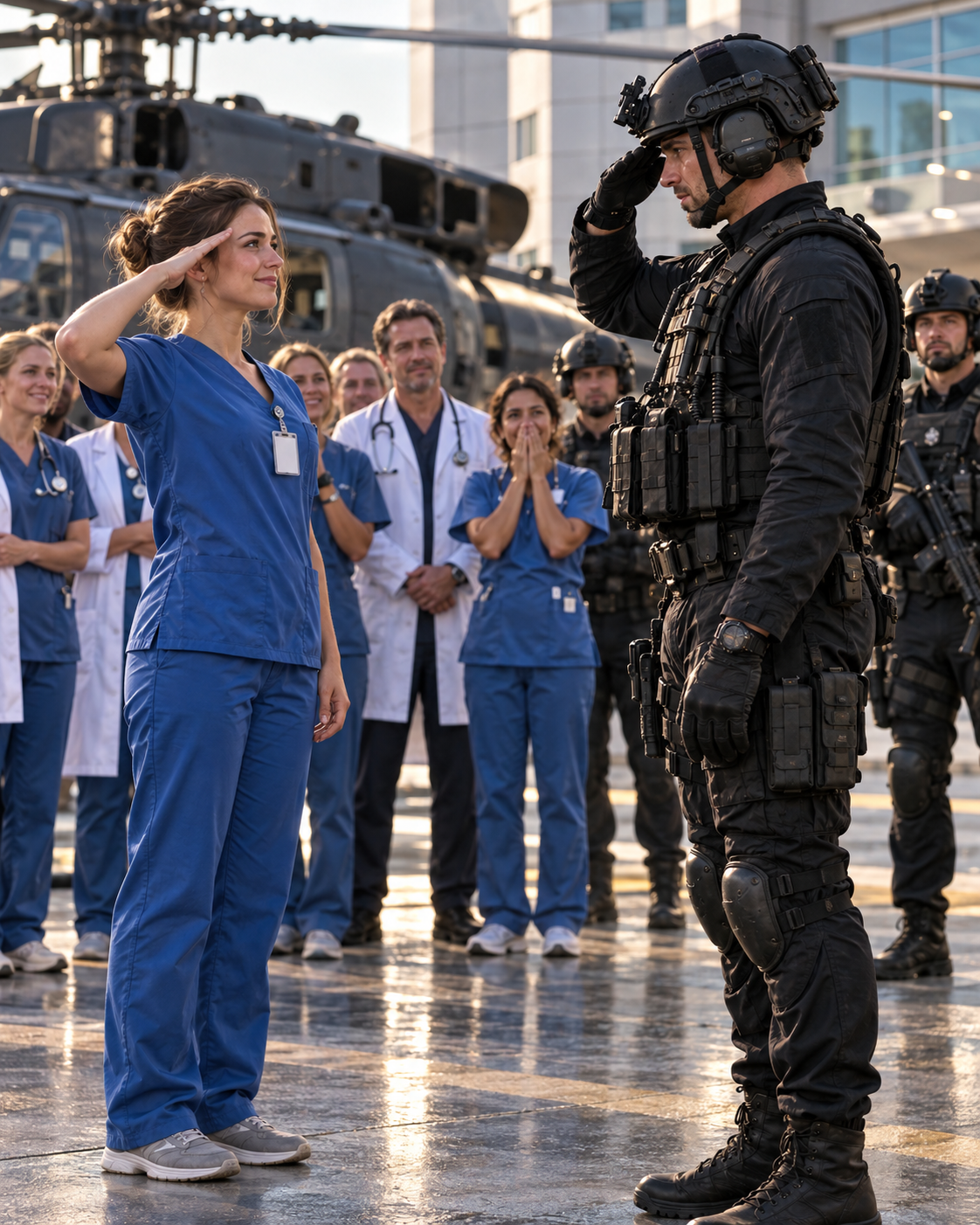
When a matte-black Black Hawk dropped onto Providence Regional Medical Center’s roof during a storm
Part 2
The helicopter lifted into the storm before I could study the photograph long enough to understand what I was seeing.
Rain lashed the windows, the rotors hammered above us, and the city of Everett disappeared beneath a curtain of black clouds.
Reed sat opposite me with two armed operatives between us.
“Tell me what happened to Holden,” I demanded.
“He attempted to move restricted research material without authorization. There was an accident.”
“An accident involving the most tightly controlled biological program in the country’s history?”
“These events are rarely convenient, Major.”
“Neither are cover-ups.”
His eyes narrowed.
“Careful, Cross.”
I almost laughed.
For three years, I had answered to Abby Foley, a nurse whose greatest daily crisis was an overflowing medication cart.
Now the director of a classified defense program was warning me to be careful as if my survival had been an act of disobedience.
I leaned back and closed my eyes, conserving my strength for what I suspected would be a long night.
We landed in Seattle less than twenty minutes later.
The rain had turned bitterly cold, and the skyline glowed through the mist as a military transport carried us to a restricted facility beneath Harborview Medical Center.
The entrance was hidden beyond a secure service corridor, behind doors guarded by people who did not look at each other when they spoke.
Elevators descended below the ordinary hospital floors into a subterranean complex that smelled of disinfectant, cold metal, and stale air.
The lights were too bright.
The walls were too white.
And the security cameras followed every movement with mechanical patience.
I had seen facilities like this before.
They were designed to make people believe that control was the same thing as safety.
A physician in protective equipment met us outside the quarantine wing.
“Major Cross?”
“Evelyn,” I corrected automatically.
He hesitated, then nodded.
“I’m Dr. Samuel Price. Holden is in isolation. His condition has deteriorated rapidly, and the first-line treatment hasn’t helped.”
“Has an independent public health team reviewed the findings?”
Price glanced at Reed.
“Director Reed authorized the current response.”
“That wasn’t my question.”
For a moment, Price said nothing.
Then he lowered his voice.
“Not yet.”
I stared at him.
Reed stepped between us.
“We don’t have time for bureaucratic delays.”
“An unverified diagnosis is not a reason to bypass independent review,” I said. “It’s a reason to move faster without pretending certainty.”
His face hardened.
“Your job is to help Holden.”
“My job is to prevent people from dying because someone in authority is more afraid of embarrassment than the truth.”
Neither man replied.
Price finally led me through another set of doors, where I could see a patient lying in a sealed isolation room.
Gregory Holden looked twenty years older than the man in my memory.
His hair had thinned, his skin had gone gray beneath the harsh light, and a medical monitor tracked the small, uneven movements that proved he was still alive.
I put on the required protective equipment and entered under the supervision of the medical team.
When Holden heard my voice, his eyelids fluttered.
For a moment, he looked confused.
Then his eyes widened.
“Evelyn?”
“I’m here.”
He tried to lift his hand, but the effort exhausted him.
“You shouldn’t have come.”
“That’s a strange thing to say to the person you asked for.”
A weak, almost embarrassed smile crossed his face.
“I didn’t know who else to trust.”
The words settled heavily between us.
I remembered sitting beside him in the Atlas lab after a sixteen-hour shift, listening to him complain about the bland coffee and the arrogance of the project’s sponsors.
I remembered how he had insisted that the research was intended to prevent future attacks.
I remembered the way his face changed when he saw the first containment breach alert.
For three years, I had wondered whether Holden had lied to me from the beginning or whether he, too, had learned too late what the project was becoming.
“Tell me what happened,” I said.
He struggled to speak, so I listened while Price summarized the available medical findings and explained that Holden’s condition was worsening despite supportive care.
The suspected exposure had not yet been conclusively characterized, and there was no verified, approved treatment specific to the suspected agent.
I asked for the clinical records, the available laboratory assessments, and the timeline of Holden’s symptoms.
Then I reviewed the scientific notes I had preserved in memory from the Atlas response, comparing the unusual findings with an idea I had once proposed and abandoned because we lacked sufficient evidence to test it safely.
It was a conceptual countermeasure based on a synthetic phage approach, designed to recognize a vulnerable feature of the suspected agent rather than indiscriminately damaging surrounding biological material.
It had never passed the validation required for clinical use.
It was not a miracle cure.
It was a hypothesis with an uncertain chance of helping a man who might not survive the next hour.
“I need the infectious disease specialists to review this with me,” I told Price. “And I need confirmation that the proposed treatment can be prepared and handled safely within the hospital’s approved protocols.”
Price nodded.
“Agreed.”
Reed interrupted.
“How long?”
“Long enough to do it responsibly.”
“He’s dying.”
“And if we administer something unverified without understanding the risk, we may make him worse.”
For a moment, I thought Reed would order me to proceed regardless.
Instead, he turned away and spoke quietly to one of his operatives.
I could not hear the words, but I saw the man leave the observation area with the speed of someone who had been waiting for an instruction.
That was the first moment I became certain something was wrong.
I spent the next hour working with the clinical team, reviewing the evidence and weighing options with Price and the specialists.
The countermeasure was not a secret antidote locked inside my head, no matter what Reed believed.
It was an unproven scientific direction, and treating Holden would require informed clinical judgment, institutional oversight, and a willingness to accept uncertainty without concealing it.
Holden’s condition continued to deteriorate.
When the team reached a decision, we proceeded under emergency medical authorization, with the treating physicians directing the intervention and carefully monitoring his response.
I stood behind the isolation barrier while Price and the clinicians carried out the plan.
Minutes dragged past.
The monitor continued its irregular rhythm.
Then, gradually, Holden’s readings stopped deteriorating.
They did not suddenly become perfect.
His condition remained critical, and no one declared him cured.
But his immediate decline appeared to have slowed.
Price looked up from the monitor.
“We may have bought him time.”
I let out the breath I had been holding.
Relief moved through me so sharply that I had to place one hand against the wall.
I had seen too many people die while everyone in the room waited for a number to change.
This time, a number had changed in the direction we needed.
Holden was still fighting.
I returned to the observation area to speak with him when he was able to respond.
He looked toward the window separating us from the room beyond.
“Did Reed bring you?”
“Yes.”
Holden’s face tightened.
“Then you’ve walked straight into his trap.”
My relief disappeared.
“What are you talking about?”
“He didn’t come to save Seattle.”
Holden’s voice was little more than a rasp.
“He came for your countermeasure.”
I glanced at the door.
“Explain.”
“Atlas was never destroyed as completely as the official report claimed. Some of the material was accounted for, but the people funding the project wanted the research preserved. They wanted to own the only means of controlling the weapon they had helped create.”
I felt cold despite the layers of protective clothing.
“Who ordered it?”
Holden closed his eyes.
“Reed.”
The name sounded impossible in the quiet room.
“He authorized the original project,” Holden continued. “When you ordered the facility sealed, he lost control of it. Your report identified the failures, but he made sure the final investigation blamed your decision instead of his orders.”
“Why didn’t you tell me?”
“Because I was a coward.”
His admission held no drama, only exhaustion.
“I told myself I could correct it from inside the program. I thought I could recover the research, document the truth, and give it to someone who would stop him. But I waited too long.”
“How did you become exposed?”
“I tried to move the remaining material out of a private storage site. I thought I could secure it before Reed’s people arrived.”
His breath grew shallow.
“I was wrong.”
I looked through the glass at the dark observation windows, imagining the men standing behind them and the orders being given while the rest of us concentrated on keeping Holden alive.
“What does Reed intend to do with the countermeasure?”
Holden opened his eyes and looked directly at me.
“Use it to convince the people who pay for his programs that Atlas can be controlled. A weapon and its supposed solution become a single bargaining chip. He wants the world to fear the threat and depend on him to manage it.”
“That’s insane.”
“Power doesn’t need to be sane. It only needs people who benefit from believing it is necessary.”
For a few seconds, I couldn’t speak.
Then Holden reached toward the bedside table and pointed weakly at a folder Price had brought in with the medical records.
“Look at the authorization history.”
I examined the relevant documentation with Price’s permission.
Several decisions had been entered under Reed’s authority before the incident was formally reported, and access restrictions had been placed on information that should have been available for independent safety review.
It was not enough by itself to prove every part of Holden’s story, but it was enough to justify an urgent investigation.
I began to understand why Reed had arrived at my hospital with armed men instead of a medical team.
He had not come to ask for my help.
He had come to make sure I did not leave with the only idea that might undermine his plan.
Through the observation window, I saw Reed watching me.
When our eyes met, he did not look surprised.
He looked disappointed.
Then he entered the room and closed the door behind him.
“Holden is confused,” he said. “His condition is affecting his judgment.”
“His medical condition doesn’t explain your authorization history.”
“You don’t understand the bigger picture.”
“I understand that you want control over something you should never have allowed to exist.”
Reed stepped closer.
“The world is not protected by good intentions, Major. It’s protected by leverage.”
“And what happens when someone uses the leverage?”
“We prevent the worst outcome.”
“By creating the possibility of one?”
His expression turned flat.
“You’ve always had difficulty understanding necessity.”
I recognized the tone.
I had heard it from men who believed moral questions were an inconvenience and that a classified label could turn an atrocity into an administrative decision.
Reed glanced at the sealed chamber where Holden lay.
“The countermeasure remains under government control. You’ll provide the research, and the team will take custody of the material.”
“After independent review.”
“That isn’t going to happen.”
“Then neither is your plan.”
For the first time, his expression changed.
The impatience disappeared, replaced by something colder.
“You seem to have forgotten what happened the last time you disobeyed an order.”
I had not forgotten.
I remembered every siren, every sealed door, every face I had been forced to leave behind.
I also remembered that refusing him had been the only decision I had made during the Atlas operation that I did not regret.
Reed turned toward the observation room and gave a short instruction to his team.
Two operatives moved toward the records station.
Another stepped toward the corridor leading to the containment wing.
And I realized I had only minutes before the hospital’s emergency became a crime scene controlled by the man who had caused it.
Part 3
I did not run toward the exit.
That was the first thing my old training taught me.
A frightened person ran toward freedom.
A commander looked at the room, counted the people who still depended on her, and decided what freedom would cost.
Holden was too weak to move without assistance, and the medical team had patients to protect.
I could not simply abandon them because Reed had revealed himself as a threat.
I asked Price to make an immediate report through the facility’s independent emergency oversight channel, including the clinical findings, the authorization discrepancies, and Holden’s allegations.
I told him to preserve the medical records and keep his team focused on patient safety.
“Do not make any decisions based solely on what I’ve told you,” I said. “Document what you can verify, and get outside authorities involved.”
Price looked frightened.
“Will they listen?”
“They will have to answer for what they ignore.”
It was not a guarantee.
It was the only honest promise I could make.
I also sent a short, encrypted emergency message through an old professional contact whose duty had never depended on Reed’s chain of command.
The message contained the location of the facility, the evidence I had reviewed, and a request for independent intervention.
I didn’t know whether the contact would receive it in time.
But if Reed intended to bury the truth, he would have to do it while other people were watching.
Then I turned toward the control station.
The facility’s automated security system had been designed to isolate unsafe areas when sensors, access controls, or emergency procedures indicated a serious risk.
It could be overridden by authorized personnel, but it was supposed to default to containment when critical systems reported a conflict.
Reed’s operatives were trying to gain access to restricted records while his team assumed control over the treatment area.
Their actions had already triggered multiple alerts.
I had no intention of hurting anyone, but I knew that the next few minutes would determine whether the facility remained a medical center or became a private laboratory with a government seal on the door.
An alarm sounded overhead.
A warning appeared on the nearest display.
I looked at the heavy emergency oxygen cylinder secured beside the wall, then at the command interface that controlled access to the observation suite.
The security system had been compromised by conflicting orders, and the men trying to override it were creating more instability with every action.
I made a decision.
I drove the cylinder into the external control panel, shattering the interface and cutting off the local override.
The sound was enormous.
Sparks flashed behind the protective casing, and the overhead lights changed from white to red.
A voice announced that the facility had entered a level-one security lockdown.
Reed spun toward the door.
“What have you done?”
“What the system was designed to do,” I answered. “Contain the threat.”
The observation-room doors sealed.
His operatives rushed toward them, but the access controls no longer accepted their local commands.
Emergency barriers engaged between the restricted laboratory wing and the outer corridor.
Nobody inside the room could enter the treatment area, and nobody on my side could open the doors without authorization from the central safety system.
It was an imperfect measure.
It bought time; it did not solve the crisis.
I could hear Reed shouting through the glass.
“Cross! Open this door!”
I looked at him through the observation window.
For three years, I had imagined what I would say if I ever stood face-to-face with the people who had turned the Atlas disaster into a convenient lie.
I had rehearsed speeches in my apartment, in the shower, and in the silence after night shifts.
Now, with his men trapped behind a sealed barrier, all I could think about was how tired I was of powerful people confusing obedience with trust.
“You said you came to save Seattle,” I told him through the intercom. “So let the medical team do their jobs.”
“You don’t know what you’re doing!”
“Neither did the people who started Atlas. That didn’t stop them from giving orders.”
I left him shouting behind the glass.
Price had already begun moving the patients in accordance with the facility’s emergency procedures, while qualified personnel assessed the damaged interface and worked to confirm the safety of the affected areas.
Holden remained under medical supervision.
Before I left, I went back to the isolation room.
He was awake, barely.
“Evelyn?” he whispered.
“I’m here.”
“Did he get the research?”
“No.”
A small crease appeared between his eyebrows.
“Don’t let them call this an accident again.”
I took his hand through the approved barrier, careful not to interfere with his care.
“I won’t.”
He seemed to relax.
Then his eyes moved toward the ceiling as if he were listening to something no one else could hear.
I wanted to tell him that I forgave him for his cowardice, but forgiveness was a word too large for a moment in which the truth was still being uncovered.
Instead, I told him what he deserved to hear.
“You still have time to tell them everything.”
His fingers tightened around mine.
“I will.”
I left him in the care of Price and the medical staff, then made my way toward the hazardous-materials disposal area.
The route was intended for trained personnel operating under strict safety controls, and I followed the facility’s posted procedures rather than improvising my way through a contaminated environment.
My identity was already compromised.
Reed knew who I was, his operatives had seen my face, and the system that had sheltered my old life had been replaced by an emergency response designed to keep people inside.
I could not return to Everett and pretend that the night had never happened.
At the final controlled exit, I surrendered the protective equipment as required and underwent the screening available before authorized staff cleared me to leave the restricted area.
My hands shook as I washed them.
Not from the cold.
I had been frightened before, in places far worse than that underground facility, but I had never felt so acutely the weight of choosing the next step without knowing who would punish me for it.
I put on a plain coat from the emergency supplies, left the blue scrubs and the broken name badge behind, and walked through the approved exit once the safety officers released me.
Outside, the rain had weakened to a fine, freezing mist.
Seattle was beginning to wake.
Delivery trucks rumbled along wet streets, the first commuters emerged from buses, and a coffee shop on the corner switched on its lights.
People hurried past with their collars turned up, worried about traffic, work, and whether the weather would clear by lunch.
No one looked twice at the woman in a dark coat walking away from the hospital.
For a moment, I stood beneath the streetlight and watched them.
The world had not ended.
A man was still fighting for his life underground, a dangerous secret remained in government custody, and the director who had tried to seize it was trapped behind a security barrier.
But somewhere beyond the facility, my emergency report was moving toward people who could investigate it independently.
I could not guarantee justice.
I could not undo the deaths caused by Atlas.
I could not restore the three years I had spent hiding from a past that was never entirely mine to carry.
All I could do was make sure the next decision belonged to people who understood that lives were not bargaining chips.
My phone vibrated in my pocket.
For one absurd second, I thought it might be an ordinary message from a coworker asking whether I could cover another shift.
Instead, the screen displayed a single line from my old contact.
Your report has been received. Independent response is being mobilized. Do not return to the facility.
I deleted the message after memorizing its contents.
I had no guarantee the response would arrive before Reed’s allies found a way around the lockdown.
I had no guarantee the evidence would survive.
But I had made the truth harder to bury.
I walked toward the growing crowd, moving among strangers who carried warm coffee and folded umbrellas and had no idea how close their ordinary lives had come to a catastrophe.
My reflection appeared briefly in a shop window.
Without the glasses, without the badge, and without the posture I had used to make myself invisible, I barely recognized the woman looking back.
Abby Foley had given me three years in which to remember what it felt like to help people without being ordered to sacrifice them.
Major Evelyn Cross had taught me what to do when a threat returned.
Neither identity could save me from the past.
But together, they had brought me to a choice I could finally live with.
I had once believed that surviving meant disappearing so completely that the world could never ask anything of me again.
Now I understood that survival was not the same as hiding, and silence was not the same as peace.
Sometimes, the only way to keep a terrible secret contained was to refuse to let the people who created it decide what the truth was allowed to be.
The traffic light changed.
The crowd began to cross.
I stepped into it and vanished among hundreds of ordinary lives, carrying no badge, no rank, and no promise that the future would be kind.
For the first time in three years, I was not trying to become invisible because I was afraid of who I had been.
I was choosing to disappear until I could decide who I wanted to become.
Behind me, beneath the city, the alarms continued to sound.
Ahead of me, the morning opened like a door.
And somewhere between the two, the woman called Evelyn Cross finally began to breathe again.