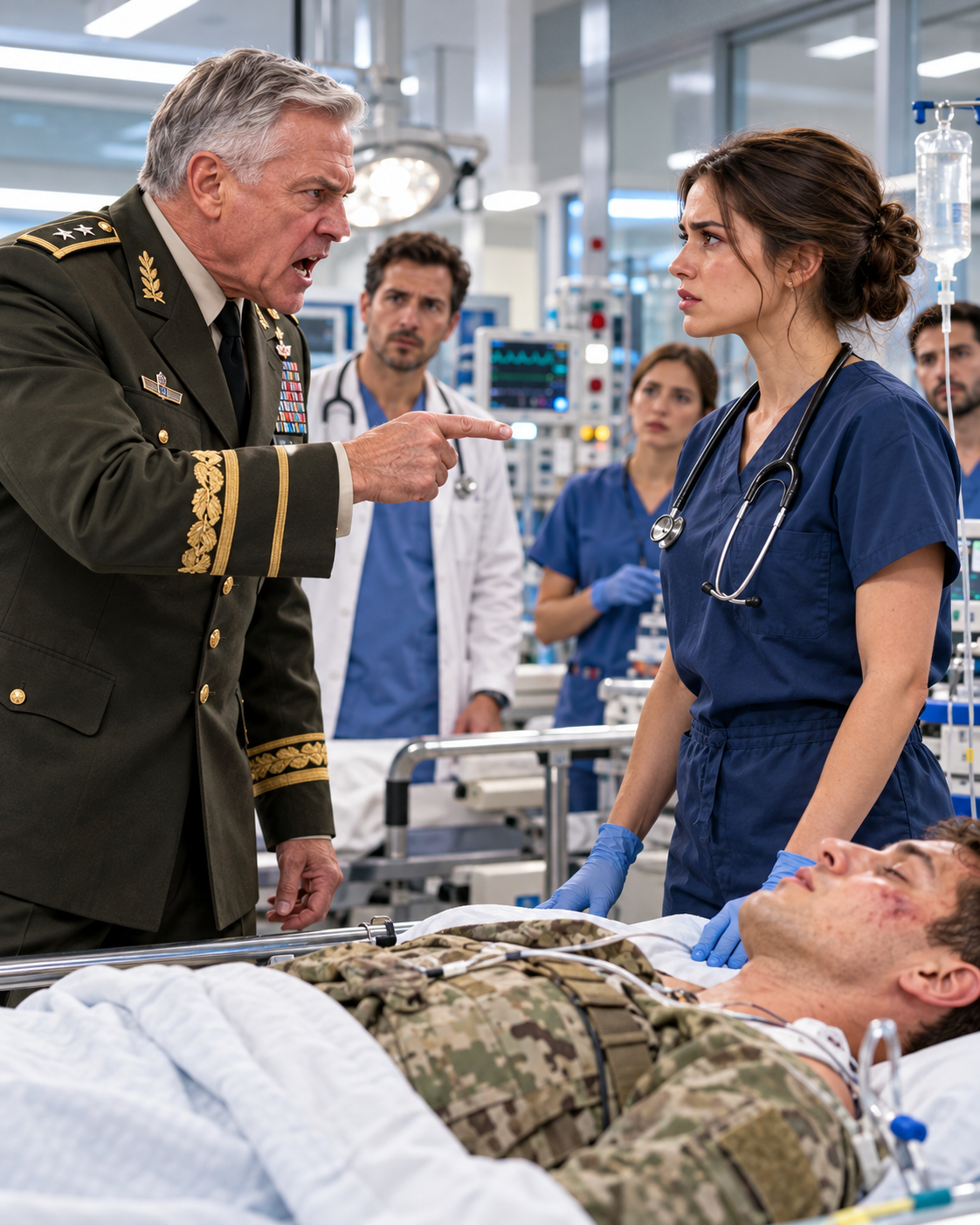
When a four-star general stormed into Trauma Room 3 and sneered that I was “just a nurse” while his son was dying on my table
Part 2
I finished securing the supplies before I faced him.
“Your son is with the surgeon now, General. If you need an update, someone will come speak with you as soon as they have one.”
“I’m not here to ask about Christopher.”
That surprised me, although not as much as it should have.
He removed his service cap and held it against his side, suddenly looking older than he had when he entered the room.
“I need to ask you about Kandahar.”
The sound of a distant ambulance siren rose beyond the hospital windows, and for a moment, the present seemed to thin around me.
I could almost smell the dust again.
Nine years earlier, I had been twenty-eight years old, a young combat nurse assigned to a forward operating base where every day brought the possibility that the next casualty would overwhelm our capacity to save anyone.
I had believed in the military medical system with the unquestioning faith of someone who had not yet learned how easily a career could be dismantled by people who never witnessed the decisions they judged.
Then came the attack.
The first explosion shook the medical station so violently that ceiling panels fell around us.
The second tore through the outer perimeter, sending wounded soldiers toward our aid station faster than we could clear the beds.
Radios crackled with conflicting reports, the power flickered, and the air filled with smoke and the metallic smell of blood.
We had one surgeon available when the first wave arrived, and he was critically injured before he could begin operating.
Within minutes, the medical station was flooded with casualties.
Some were walking wounded who needed treatment but could survive the wait.
Others had injuries that demanded immediate intervention.
And eleven men lay in front of me whose chances of survival depended on whether someone recognized what could still be done for them.
Major Leonard Vance arrived near the end of the first wave.
He was General Vance’s former aide-de-camp, a senior officer with multiple injuries and rapidly deteriorating vital signs.
His injuries were devastating.
I remember kneeling beside him while the distant thud of explosions shook the ground beneath my boots.
He gripped my wrist with a strength that surprised me.
“Don’t let the others die trying to save me,” he whispered.
I told him to conserve his strength, because that was what nurses said when the truth was too terrible to offer.
But I understood what he was asking.
I also understood the choices in front of me.
The eleven other soldiers had injuries that offered a substantially better chance of survival with immediate treatment.
Several needed rapid hemorrhage control, urgent airway support, or evacuation before their conditions worsened.
Major Vance needed resources and specialist intervention we could not provide in time.
I could stay with him and direct everything toward an officer whose survival odds were extremely poor, or I could triage the casualties according to urgency, available resources, and likelihood of benefit.
There was no choice that felt clean.
There was only the choice I believed would save the most lives.
I made it.
I directed our limited personnel toward the eleven soldiers, assigned interventions, coordinated evacuation, and moved between patients as quickly as I could.
I returned to Major Vance whenever I had the chance.
I did not abandon him.
I did not stop caring because his chances were poor.
But eventually, despite everything we attempted, he died.
I still remembered the exact moment I realized his pulse was gone.
I remembered the terrible silence that seemed to follow, even though the room was still full of shouting.
And I remembered standing afterward with blood on my sleeves, counting the surviving soldiers because I needed proof that the chaos had not swallowed everyone.
Eleven men had lived.
I believed that fact would matter.
For a while, I believed that doing the right thing under impossible circumstances was what the system existed to recognize.
Instead, a medical review board questioned whether I had exceeded my authorized scope of practice during the mass-casualty event.
The case file contained clinical findings, casualty records, statements from surviving personnel, and an explanation of the triage decisions made under extraordinary conditions.
But the process did not unfold in a vacuum.
Major Vance had been a respected officer, and his death carried weight beyond the medical station.
People wanted explanations, and some wanted a person they could hold responsible.
My actions became a convenient place to direct questions that had no comforting answers.
I was ordered to submit reports, attend interviews, and explain decisions I had already replayed in my mind a thousand times.
I cooperated with every request.
I believed the facts would speak for themselves.
Then the paperwork reached General Arthur Vance.
He was not the only person involved in the review, but his approval helped finalize the decision that ended my military medical career.
He signed off on my discharge after reviewing the recommendation, without reading the full case file that documented why I had made those choices.
I learned the result through official correspondence.
There was no dramatic confrontation, no opportunity to stand in front of him and explain what had happened.
There was only a formal decision, a carefully worded explanation, and the sudden realization that years of service could be reduced to a conclusion written by people who had never knelt beside those dying men.
I left the military with my credentials under scrutiny and my future uncertain.
I rebuilt my life one shift at a time, earning the trust of colleagues who judged me by the work I did rather than the uniform I no longer wore.
I became a trauma nurse at a civilian hospital, where emergencies did not care about rank and a patient’s body did not respond to authority.
I stopped expecting anyone from my former life to apologize.
I certainly never expected General Vance to walk into my trauma room and ask me to save his son.
Now he stood before me, holding his cap with both hands.
“I signed the decision,” he said.
I kept my expression still.
“Yes, you did.”
“I was given the recommendation. I approved it. I never read the complete file.”
The admission came out unevenly, as though he had rehearsed it in his mind and discovered that the actual words were heavier than he expected.
“I thought I was approving a routine personnel decision. I knew Leonard had died, and I knew there were questions about the treatment he received. I trusted the process.”
I looked at him for a long moment.
“Did you ever ask what happened to the eleven men who survived?”
He lowered his eyes.
“No.”
“Did you ask whether Major Vance’s injuries were survivable with the resources available?”
“No.”
“Did you ask why I made the decision I made?”
His silence answered before he did.
“I should have.”
I leaned against the counter, suddenly aware of how tired I was.
For nine years, I had imagined what I might say if I ever saw the man whose signature had helped end my military career.
I had rehearsed speeches in my car after difficult shifts and imagined delivering them with perfect composure.
But standing in front of him, I discovered that the truth did not need an audience to become real.
“You weren’t there,” I told him. “You didn’t see the casualties arriving. You didn’t see the people we could still save. You didn’t have to decide who received the next available intervention while someone else was dying in front of you.”
His eyes shone, but he did not interrupt.
“I knew Major Vance was a person, not a statistic. I knew he had people who loved him. I knew what his death would mean to his family and to the men who served under him.”
My voice remained steady, though I could feel the old grief rising.
“And I knew the other eleven men had a better chance if we acted quickly. I made the decision that gave them that chance.”
I paused, allowing him to hear what the official report had never managed to convey.
“Those eleven men weren’t numbers on a triage sheet, General. They were sons, husbands, fathers, and friends. They were people who still had a chance to go home.”
He swallowed hard.
“I understand that now.”
“No,” I said quietly. “You understand it because your son almost died tonight. That’s not the same as understanding what happened in Kandahar.”
He accepted the words without defending himself.
For the first time, I saw something in him that had not been present when he entered the trauma room.
Not weakness.
Not surrender.
The beginning of accountability.
“I am sorry,” he said.
I had waited years to hear those words from someone who had the power to make a difference.
Yet when they finally came, they did not undo the past or restore the career I had lost.
They simply acknowledged that the past had been real.
I nodded once.
“Your apology matters, General. But it doesn’t change what happened.”
“I know.”
A nurse appeared at the doorway and told him the surgical team would provide an update when possible.
The general thanked her, then looked back at me.
“I won’t ask you to forgive me tonight.”
“Good,” I replied. “Because tonight, I’m going back to work.”
He stepped aside, and I returned to the nursing station.
As I completed Christopher’s documentation, I thought about Major Vance, the eleven men who survived, and the years I had spent believing that the worst consequence of my decision was losing my place in the Army.
I was beginning to understand that the deepest injury had been something else.
It was the time I had spent doubting whether I had done the right thing.
And that was a wound no discharge order could explain.
Part 3
Hours passed before the update came.
I was checking medication orders when Dr. Okonkwo approached the nursing station, his surgical cap still in his hand.
“Christopher made it through surgery,” he said. “We controlled the bleeding. He’s stable, and we’re transferring him to intensive care for close monitoring.”
For the first time since the alarms had begun, I allowed myself to take a full breath.
“Thank you for letting me know.”
“You were right to act when you did,” he replied. “The decompression bought him time, and the chest tube helped us understand what we were dealing with. Your early recognition made a difference.”
He moved on to update the next family, leaving me with the quiet relief that came whenever a patient survived the worst of an emergency.
I did not know whether Christopher would remember anything from that night.
He might never know how close he had come to dying, or how many small decisions had carried him from the edge of catastrophe toward recovery.
That was all right.
My job had never been to make patients remember me.
It had been to give them a chance to keep living.
General Vance returned to the nursing station a little later.
The sharpness had gone from his face, replaced by the exhausted look of a father who had spent hours imagining a future without his child.
“He’s alive,” he said.
“I heard. I’m glad.”
He nodded, then reached into the inside pocket of his uniform and produced a business card.
“This is the Army Surgeon General’s office. I have a direct line of communication with the people who can review your case.”
I looked at the card but did not take it immediately.
“What are you offering?”
“A formal review of your military medical credentials. A complete review this time, with the full record, the testimony, and the circumstances of the Kandahar incident.”
He paused.
“If the findings support it, I will do everything within my authority to help restore your credentials. If the board’s process was flawed, I will push for that to be addressed as well.”
His voice grew firmer, but not louder.
“I cannot promise you a particular outcome. I can promise that I will not let this disappear into a stack of paperwork.”
I finally accepted the card.
The paper felt surprisingly light between my fingers.
“Why now?” I asked.
He looked down at his hands.
“Because tonight, I watched you save my son after I told you that you weren’t qualified to do it. And because I realized I had done something similar nine years ago. I judged a decision without understanding the conditions under which it was made.”
He took a breath.
“I have spent my career telling other people to take responsibility for their decisions. I cannot keep doing that if I refuse to take responsibility for mine.”
I studied him, searching for the familiar signs of a man trying to protect his reputation.
I found no easy way to know whether his remorse would survive the morning, when his son was recovering and the immediate fear had faded.
But I also knew that accountability was not measured by how convincing a person sounded during the worst night of his life.
It was measured by what he did after the night was over.
“I’ll think about it,” I said.
He nodded, accepting that I owed him neither gratitude nor an answer.
“There is something else,” he added.
I waited.
“Four of the men you saved in Kandahar are still serving in the Army.”
For a moment, I forgot the card in my hand.
He continued carefully, as though he understood that each word carried something more significant than a simple personnel update.
“One of them became a command sergeant major. They remember what happened. Some of them have spoken about you over the years.”
I felt my throat tighten.
For nine years, I had carried the memory of that night mostly alone.
I had remembered the faces, the decisions, the blood, and the man who had died despite my efforts.
I had never known whether the eleven survivors remembered me at all.
“Are they well?” I asked.
“From what I’ve been told, yes.”
I looked down at the card.
The men I had saved had gone on to become people with careers, families, responsibilities, and lives that had continued long after the medical station disappeared behind them.
One had risen to a position of leadership.
The others had continued serving.
They were not merely eleven names in an old report.
They were eleven futures that had remained possible.
“I’m glad,” I said, and my voice broke slightly on the last word.
General Vance stood quietly beside me.
Then, without asking for forgiveness again, he placed his cap beneath his arm and walked toward the elevators.
I returned to my shift.
There were medications to verify, patients to assess, and families waiting for answers.
The hospital continued moving around me, indifferent to the fact that an old chapter of my life had just cracked open.
I put the card in my pocket and kept working.
For the first time in years, I was not afraid of what the past might ask of me.
Three weeks later, a formal letter arrived from the Department of Defense.
It requested a meeting to discuss the full reinstatement of my military medical credentials and the review of the circumstances surrounding my discharge.
I read it once at the kitchen table after a long shift, then read it again more slowly.
The letter was careful and official, full of procedural language that reminded me how much of my life had once been decided by documents like it.
But this time, the document was not closing a door.
It was asking whether I wanted to open one.
I placed it inside a folder with the old paperwork I had kept from Kandahar.
For years, I had avoided looking at those pages because they brought back the feeling of standing alone in a room full of people who had already decided what my choices meant.
Now I could look at them without feeling that I had to defend every second of that night.
I knew the review might be difficult.
There would be interviews, questions, records to examine, and decisions that would not necessarily go the way I hoped.
Even if my credentials were restored, the years I had lost would remain lost.
I could not return to the Army as the person I had been before Kandahar, because that person had spent too long believing that a single institutional decision could define the worth of an entire life.
But perhaps I could return on different terms.
Perhaps I could help ensure that future medical personnel would be judged according to the realities of emergency care rather than the comfort of people who had never faced those realities.
Perhaps I could help change the review process so that a nurse forced to make an impossible choice would not have to spend the next decade wondering whether doing the right thing had ruined everything.
Or perhaps I would remain exactly where I was, working in civilian trauma care, saving patients one shift at a time.
For the first time, both possibilities felt like choices rather than punishments.
I did not immediately accept the meeting.
I did not reject it either.
I placed the letter carefully in the folder and left it on my desk, where I could consider it when I was ready.
Then I went back to work.
Christopher Vance eventually left intensive care, and I heard that his recovery was progressing well.
I never needed him or his father to turn my life into a story about a hero.
I had spent enough years learning that heroism was often a word people used when they wanted to avoid discussing the difficult decisions that came before the outcome.
What mattered was that Christopher had survived.
What mattered was that eleven soldiers had survived in Kandahar.
What mattered was that Major Leonard Vance had not been forgotten, even if the circumstances of his death had once been used to judge me unfairly.
And what mattered most was that I no longer needed someone else’s approval to believe I had tried to do the right thing.
Sometimes, late at night, I still remembered the general standing in Trauma Room 3, demanding a real doctor while his son’s life slipped away.
I remembered the contempt in his voice and the sudden recognition in his eyes when he understood who I was.
But I remembered something else, too.
When Christopher’s condition deteriorated, the general had stopped being a general.
He had become a father watching his child die.
And I had stopped being the nurse he dismissed.
I had become the person standing between his son and the possibility of never going home.
That night did not erase the harm he had caused me.
It did not make the past fair, and it did not guarantee that the system would finally acknowledge its mistake.
But it gave us both a chance to confront a truth we had avoided for too long.
Authority could sign a document.
It could open doors or close them.
It could shape a career, silence a voice, and make a person question everything they believed about themselves.
But it could not change what had happened in that medical station, where eleven men had been given a chance to live because someone had made a decision under impossible conditions.
Nor could it change what happened in Trauma Room 3, where a nurse ignored an insult, trusted her training, and acted before another human being ran out of time.
I had once believed that justice meant someone in power finally declaring that I had been right.
Now I understood that justice could begin with that acknowledgment, but it could not end there.
It had to include the freedom to decide what came next.
So I left the folder on my desk.
I left the business card in the drawer beside it.
And I went back to the work I had chosen for myself, carrying the memory of the men who had survived and the man we had lost, without allowing either memory to dictate the rest of my life.
The future was no longer something I had to earn from the people who had misunderstood my past.
It was something I was finally free to choose.
And for the first time in nine years, that felt like a kind of homecoming.