“We gave your son’s surgery money to your sister. Her business needed it more.”
The question hung in the air.
My father stared at the screen, his lips parting slightly, but no words came out.
My fiancé, Daniel, waited a few seconds before answering his own question.
“If that deadline passes, the hospital will submit the complete transaction history to law enforcement. The people who authorized the transfers could face criminal charges. And if the donations were solicited specifically for your grandson’s medical treatment, this could become a case of charitable fraud and financial misconduct.”
My mother shook her head violently.
“No. No, you don’t understand. We’re his grandparents. We would never do anything to hurt him.”
Daniel closed one of the documents.
“Then you should have thought about that before moving money that didn’t belong to you.”
My sister, Vanessa, suddenly slammed her palm against the table.
“This is ridiculous! Everyone is acting like I’m some kind of criminal. I didn’t ask them to give me the money. Dad offered it!”
I turned toward her.
“You knew where it came from.”
She opened her mouth, then closed it.
For the first time that evening, she had no clever response.
I looked at my father. “How much?”
He stared at his plate.
“How much of my son’s surgery money did you give her?”
Daniel answered before he could.
“Forty-eight thousand, seven hundred and twenty dollars.”
My stomach dropped.
I had known the amount raised was close to fifty thousand dollars. What I hadn’t known was that nearly all of it had disappeared.
Forty-eight thousand dollars.
That was the money people had donated after reading about my little boy’s condition. Money from coworkers, neighbors, church members, old friends, and strangers who had never even met him.
A retired teacher had sent twenty dollars with a handwritten note.
A single mother had donated fifty dollars and said she hoped my son would grow up healthy.
A group of children at his elementary school had organized a small bake sale.
And my own parents had treated all of it like their personal savings account.
“Where is the money now?” I asked.
Vanessa crossed her arms.
“It’s in the boutique. We already spent some of it.”
“What does that mean?”
“Renovations. Inventory. The lease. Marketing. Normal business expenses.”
I felt something inside me break.
My son had been sleeping with a stuffed dinosaur beside him, asking whether his heart would be fixed before his next birthday.
Meanwhile, his aunt had been buying display shelves and choosing paint colors.
Daniel reached for my hand.
“There’s something else,” he said quietly.
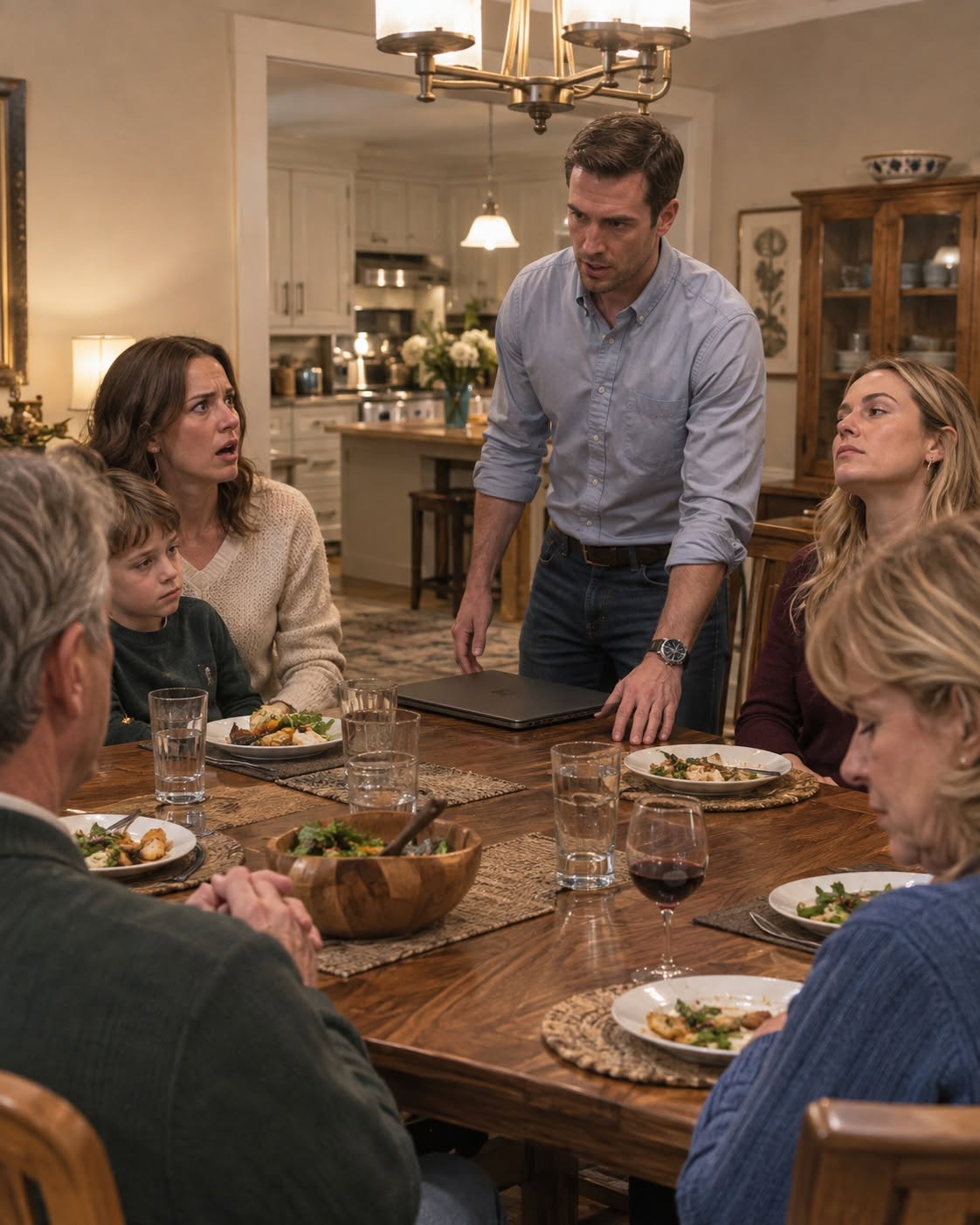
I turned to him.
He looked uncomfortable, as though he had been carrying information he desperately wished wasn’t true.
“The hospital didn’t just flag the missing donations. They also identified a separate transfer made after the original money was moved.”
My father looked up sharply.
“Daniel, that’s enough.”
“No,” Daniel replied. “It’s time she knows.”
He clicked on another document.
A transaction appeared on the screen.
The amount was $12,500.
The date was three days after my parents had assured me that the hospital payment was being processed.
I frowned.
“What is this?”
Daniel zoomed in on the recipient information.
“It went into an account registered to your mother.”
I turned toward her.
“Mom?”
She began crying harder.
“That wasn’t what you think.”
“Then tell me what it was.”
She covered her face.
Vanessa suddenly looked at our mother, then at our father.
And that was when I realized something.
My sister wasn’t surprised.
She knew about this transfer, too.
“Dad,” I whispered. “You told me Vanessa received the money for her business. Why did another twelve thousand dollars go to Mom?”
My father pushed his chair backward.
“This dinner is over.”
“No,” I said, standing up. “It isn’t.”
For seven years, I had been the daughter who avoided arguments, the sister who forgave everything, and the person who always found a reason to understand my family’s behavior.
I had listened when they said Vanessa needed more attention because she was struggling.
I had accepted it when they missed my son’s birthday because Vanessa had a business meeting.
I had even apologized when my mother accused me of making family gatherings uncomfortable by talking too much about my son’s medical condition.
But this was different.
This wasn’t about favoritism.
This was about my child’s life.
Daniel opened the document again.
“Your mother transferred that twelve thousand five hundred dollars to an account that was later used to pay off a personal credit card.”
My mother lowered her hands.
“It was temporary.”
“Whose credit card?” I asked.
Nobody answered.
Daniel looked at the records.
“Your father’s.”
I stared at him.
My father had accumulated substantial credit card debt over the previous two years. I remembered my mother once mentioning that they were having financial difficulties, but they had always insisted everything was under control.
Apparently, it wasn’t.
“You used my son’s surgery money to pay your debt?”
My father finally raised his voice.
“We were drowning! You have no idea what we’ve been dealing with!”
I almost laughed.
Not because anything was funny, but because the sheer selfishness of his words was unbearable.
“My son needs heart surgery, Dad. What exactly do you think I’ve been dealing with?”
He looked away.
Then Vanessa spoke.
“Can everyone stop pretending I’m the villain here? Dad said the money would be replaced before the hospital needed it. He told me it was basically an early inheritance.”
“An inheritance?” I repeated.
She shrugged.
“I was going to pay them back.”
“With what?”
“My business profits.”
I looked at her boutique’s promotional photos on her phone, still sitting beside her glass.
The elegant shelves. The expensive lighting. The imported clothing.
Everything looked beautiful.
And every piece of it seemed to be built on my son’s stolen chance at a healthy life.
Daniel closed his laptop.
“We’re leaving.”
My mother rushed toward me.
“Please, sweetheart. Don’t let this destroy our family.”
I stepped away from her.
“You already destroyed something. You just didn’t expect anyone to find out.”
We left without finishing dinner.
In the car, I stared through the window as the familiar streets passed by.
I didn’t cry immediately.
I was too angry, too frightened, and too exhausted.
Then my phone vibrated.
It was a message from my seven-year-old son, Ethan.
He was staying with our neighbor, Mrs. Collins, while we attended dinner.
His message contained a picture of his stuffed dinosaur tucked into bed.
Underneath it, he had written:
“Mommy, I told Mr. Dino that the doctors are going to fix my heart. He says we should be brave.”
I pressed the phone against my chest.
And finally, I cried.
Daniel pulled into a quiet parking lot and turned off the engine.
He didn’t tell me everything would be okay.
He didn’t make promises he couldn’t guarantee.
He simply held my hand.
“We’re going to get him the care he needs,” he said. “Whatever happens with your family, Ethan comes first.”
For the first time that night, I believed someone.
The following morning, we went directly to the hospital.
Ethan’s cardiologist, Dr. Patel, had been trying to reach us for several days.
When we entered his office, he stood up immediately.
“I wish I had better news,” he said.
My heart began pounding.
“Is Ethan getting worse?”
“His condition is stable at the moment, but we cannot keep postponing the procedure indefinitely. We’ve been waiting for the promised payment arrangements to be finalized.”
Daniel placed a copy of the hospital’s correspondence on the desk.
“We need to clarify something. The money was raised through donations for Ethan’s surgery, but it never reached the hospital.”
Dr. Patel nodded.
“We discovered discrepancies when the expected funds failed to arrive. Our finance department contacted the family members listed as representatives.”
I felt embarrassed.
“They were supposed to be helping me.”
Dr. Patel’s expression softened.
“Please don’t apologize for someone else’s actions. You need to understand that your son’s medical care is our priority.”
He explained that the hospital had a limited emergency assistance program. It couldn’t cover everything, but the hospital could potentially arrange a temporary financial review while our case was investigated.
There was still hope.
Not certainty.
Hope.
And at that moment, hope was enough to keep me standing.
Daniel spent the afternoon coordinating with the hospital’s financial department.
He also contacted an attorney specializing in financial misconduct and charitable fund disputes.
The attorney, Rebecca Morgan, reviewed the documents and immediately noticed something unusual.
“Who controlled the fundraising account?” she asked.
“My parents,” I answered. “They offered to manage it because I was constantly at the hospital with Ethan.”
“Did you sign anything authorizing them to use the money for other purposes?”
“No.”
“Did the donors agree to support your sister’s business?”
“Of course not.”
Rebecca nodded.
“Then we need to preserve every record. Don’t threaten them, don’t negotiate informally, and don’t allow anyone to delete messages or alter documents.”
She requested copies of the fundraising announcements, bank statements, hospital invoices, and messages from my parents.
By the end of the day, we had a folder containing more evidence than I had ever imagined.
But the biggest shock was still waiting.
Two days later, Rebecca called.
“I found something in the original fundraising arrangement that you need to see.”
We met her at her office that afternoon.
She placed a printed document on the table.
It was a bank authorization form.
My signature appeared at the bottom.
I frowned.
“That’s impossible. I never signed this.”
Rebecca turned the paper toward me.
“Look closely at the date.”
It was dated nearly three months earlier.
I remembered that week clearly. Ethan had been admitted to the hospital after experiencing a frightening episode of chest pain. I had spent almost every night beside his bed.
My parents had told me they needed my signature on some paperwork to help coordinate the donations.
They had brought a stack of documents to the hospital.
I had signed several pages without reading every line because I trusted them.
But this particular document was different.
It authorized my father to manage a designated fundraising account and make certain financial decisions.
“Does this mean they were allowed to transfer the money?”
Rebecca shook her head.
“Not necessarily. The wording gives him administrative authority, but it does not automatically authorize him to divert restricted donations for personal or unrelated purposes. We need to examine the original account terms and the donors’ instructions.”
I felt sick.
My parents hadn’t simply taken advantage of my trust.
They had used my desperation.
Then Rebecca pointed to another section.
“There’s a second issue. This form contains a handwritten amendment.”
She zoomed in on the document.
The amendment stated that the funds could be temporarily reassigned with the approval of two family representatives.
My father’s signature was there.
So was my mother’s.
But beneath their signatures was a third name.
Vanessa.
I stared at it.
“Why was my sister listed?”
Rebecca looked at me carefully.
“That’s what we need to establish.”
That evening, Daniel and I returned home and began searching through old emails and messages.
At 11:43 p.m., Daniel found something.
It was an email from my father to Vanessa, sent the day before the first transfer.
The subject line read: THE PLAN.
I opened it.
The message was short.
“Once the boutique is running, we’ll put everything back. Your sister won’t notice because she trusts us. Just make sure you don’t mention the hospital account.”
My hands began shaking.
There was another email, sent several days later.
This one contained a spreadsheet showing the money divided into three categories.
Vanessa’s business expenses.
My father’s credit card debt.
My mother’s personal savings account.
At the bottom, someone had written:
“Replace before surgery date.”
I read the words repeatedly.
They had never been confused about whose money it was.
They had never believed the transfers were legitimate.
They had planned to take it, use it, and hope nobody noticed until they could somehow replace it.
Except they couldn’t.
Vanessa’s boutique was already struggling.
The rent was higher than expected, sales were disappointing, and she had spent far more on renovations than she had originally budgeted.
My father’s credit card debt was even worse.
And my mother had apparently used part of her transfer to cover overdue household expenses.
They had gambled with my son’s medical future.
The next morning, Rebecca sent a formal demand for the return of the funds and preservation of all related records.
She also informed the relevant authorities that the transactions were being disputed.
I expected my parents to panic.
I didn’t expect what happened next.
At 9:15 a.m., Vanessa called me.
I almost ignored it.
But something in her voice made me answer.
“You have to tell your lawyer to stop.”
“Why?”
“Because the bank froze the boutique account.”
I closed my eyes.
“That isn’t my decision anymore.”
“Are you insane? Do you know what this is doing to me?”
I said nothing.
She continued, her voice rising.
“I have employees. I have a lease. I have suppliers waiting for payments. If the business closes, everyone loses!”
I finally answered.
“Ethan has a heart condition, Vanessa.”
She went silent.
“Your nephew,” I continued. “The little boy who used to follow you around asking you to play superheroes. The child who sent you a drawing for your birthday. Do you remember him?”
“Don’t do this.”
“You took money meant to keep him alive.”
“I didn’t think it would get this far!”
“That is exactly the problem. You didn’t think about him at all.”
She hung up.
Three hours later, my mother appeared at our front door.
She looked exhausted.
Her eyes were swollen, and her hair was disheveled.
“Please,” she said. “Can we talk?”
I stepped outside and closed the door behind me.
She glanced toward the house.
“Can I see Ethan?”
“Not right now.”
Her expression crumpled.
“He’s my grandson.”
“And I’m his mother.”
She nodded slowly.
“I know.”
For several seconds, neither of us spoke.
Then she reached into her handbag and pulled out a small envelope.
“I have something for you.”
Inside was a bank transfer receipt for $8,000.
“It’s from my savings,” she said. “I wanted to start returning the money.”
I looked at the receipt.
“Where did you get this?”
“I had some money put aside.”
I couldn’t help wondering why she had savings while claiming the family was drowning in debt.
But I didn’t ask.
Instead, I said, “The hospital needs the money, Mom. Not me.”
“I know.”
She began crying.
“Your father says everything will work out if you withdraw the complaint.”
I stared at her.
“So that’s why you’re here?”
“No. I came because I miss you.”
I wanted desperately to believe her.
I wanted the mother who used to sit beside my bed when I was sick. The woman who had taught me to ride a bicycle. The person I had called first when Ethan was born.
But I couldn’t separate those memories from what she had done.
“Did you know about the email?” I asked.
Her face changed.
“What email?”
“The one where Dad told Vanessa I wouldn’t notice.”
She looked down.
That was answer enough.
“I thought it would be temporary,” she whispered.
“Mom, you watched me cry because the hospital kept asking about the payment. You watched me explain to Ethan that the doctors needed more time. And you knew where the money was.”
She couldn’t look at me.
“I was afraid.”
“So was I.”
I handed the envelope back.
“Please return the money directly through the legal process. I don’t want anything that can later be used to say I accepted a private settlement.”
She left without another word.
That night, Ethan developed a fever.
It wasn’t directly related to his heart condition, according to the emergency physician, but it was enough to send us rushing back to the hospital.
As I sat beside his bed, listening to the steady rhythm of the monitor, I realized how little time we had spent simply being happy.
Every birthday had been planned around appointments.
Every family vacation had been replaced by medical consultations.
Even ordinary childhood moments had become precious because we never knew what tomorrow might bring.
Ethan opened his eyes.
“Mommy?”
“I’m here, sweetheart.”
“Are you sad?”
I smiled through my tears.
“Just a little tired.”
He reached for my hand.
“When my heart is fixed, can we go to the beach?”
I nodded.
“Absolutely.”
“Can we build a really big sandcastle?”
“The biggest one.”
He thought about it.
“And can Grandma come?”
The question hurt more than anything my parents had said.
I brushed his hair away from his forehead.
“We’ll see, sweetheart. First, we’re going to get you healthy.”
He smiled and closed his eyes.
I sat there until morning.
The following afternoon, Rebecca called with an unexpected development.
The hospital had received a direct payment of $20,000.
It came from a personal account belonging to Vanessa.
I was stunned.
“Where did she get that money?”
Rebecca explained that Vanessa had apparently borrowed against her remaining personal savings and sold some of her business inventory to raise it.
It wasn’t the entire amount, but it was a significant step.
There was also another development.
My father had contacted the attorney’s office and requested a meeting.
He wanted to discuss returning the remaining money.
Rebecca advised me not to attend alone or make any promises.
The meeting took place two days later.
My father arrived looking much older than I remembered.
He carried a folder and sat across from us.
For a long time, he said nothing.
Then he slid a check across the table.
It was for $15,000.
“I sold my truck,” he said.
I looked at him.
He had loved that truck. It was the vehicle he had spent years restoring in the garage.
“Why now?”
He swallowed.
“Because I finally understood that I wasn’t going to be able to fix this with excuses.”
I didn’t respond.
He continued.
“I told myself I was helping Vanessa get established. I thought she would become successful quickly. I thought I could replace everything before Ethan needed the operation.”
“And when you realized you couldn’t?”
He stared at his hands.
“I kept lying.”
The honesty was almost more painful than the lies.
“Why did you pay off your credit card?” I asked.
His eyes filled with tears.
“Because I was afraid of losing the house.”
I waited.
“I had borrowed money for years. I was behind on payments. Your mother didn’t know how bad things had become until the bank threatened foreclosure.”
I looked at him in disbelief.
“So you chose to risk your grandson’s life to protect your house?”
He nodded.
There was no defense left.
“I was selfish,” he whispered. “I kept telling myself I was doing it for the family. But the truth is, I was protecting myself.”
For the first time since the dinner, I saw my father without the authority he had always carried.
He wasn’t a powerful man making decisions.
He was a frightened man finally facing the consequences of his choices.
But recognizing his fear didn’t erase what he had done.
Rebecca explained that the money would be credited toward the outstanding amount, but repayment would not automatically end the investigation.
My father nodded.
“I understand.”
Before leaving, he looked at me.
“Will you ever forgive me?”
I took a breath.
“I don’t know, Dad. And I can’t promise you that.”
He nodded again.
Then he walked out.
A week later, the hospital confirmed that enough money had been secured to proceed with Ethan’s surgery.
The original donations, the recovered funds, and a combination of emergency assistance and additional community support had finally made the procedure possible.
I received the call while sitting in the hospital cafeteria.
For a few seconds, I couldn’t speak.
Then I covered my mouth and began sobbing.
Daniel rushed over.
“What happened?”
I looked at him.
“They scheduled it.”
He wrapped his arms around me.
“Ethan’s surgery?”
I nodded.
For the first time in months, we allowed ourselves to celebrate.
Not loudly.
Not extravagantly.
We simply sat together, holding each other, grateful that our little boy still had a chance.
The night before surgery, Ethan asked whether the doctors would be able to hear his heart.
“They’ll be listening very carefully,” I told him.
“Can you tell them to be gentle?”
I kissed his forehead.
“I’ll tell them.”
He handed me his stuffed dinosaur.
“Mr. Dino can stay with you. He gets scared too.”
I laughed through my tears.
“I think we both need him.”
The next morning, the nurses prepared him for surgery.
I held his little hand until they wheeled him away.
“Mommy?”
“Yes, baby?”
“Remember the beach?”
“I remember.”
“Don’t forget.”
“I won’t.”
The doors closed.
And suddenly, the world became very quiet.
Hours passed.
Daniel stayed beside me, holding my hand whenever I began to shake.
At one point, I looked at the clock and realized it had been almost six hours.
I couldn’t eat.
I couldn’t read.
I couldn’t even concentrate on the television playing in the waiting room.
I simply watched the doors.
Finally, Dr. Patel appeared.
He removed his surgical cap and smiled.
“The procedure went well.”
I stood so quickly that my chair nearly fell backward.
“Is he okay?”
“He’s stable. The repair was successful, and we’re happy with what we’ve seen so far.”
My knees weakened.
Daniel caught me before I fell.
I buried my face against his shoulder and cried harder than I ever had.
Ethan had made it through.
He still had a difficult recovery ahead, but the immediate danger had passed.
For the first time in a long time, I could imagine a future that didn’t revolve around hospital emergencies.
Two days later, I was finally allowed to sit beside his bed in the intensive care unit.
He looked small beneath the blankets.
His eyes opened slowly when he heard my voice.
“Mommy?”
I leaned forward.
“I’m here.”
“Did they fix it?”
I smiled.
“They did, sweetheart.”
He looked around.
“Where’s Mr. Dino?”
I held up the stuffed dinosaur.
“Right here.”
He smiled weakly.
“See? I told him.”
I laughed and kissed his forehead.
And in that moment, nothing else mattered.
Not the boutique.
Not the bank accounts.
Not the investigation.
My son was alive.
But the story wasn’t over.
Three months later, the legal investigation reached its conclusion.
The financial records established that my parents and Vanessa had knowingly redirected money that had been raised for Ethan’s medical treatment.
The authorities determined that the original fundraising restrictions and the misleading statements made to donors were significant.
My parents agreed to a formal restitution arrangement, and Vanessa was required to return the remaining amount connected to her business.
The case resulted in criminal proceedings against those responsible for the unauthorized diversion. My father received a sentence that included probation, restitution, and community service after cooperating with investigators and acknowledging his role. My mother was also held accountable for her part in the transfers.
Vanessa’s boutique closed.
She sold its remaining inventory and surrendered the lease.
For months, I heard from relatives who believed I should have shown more compassion.
One aunt told me that my parents were getting older and didn’t deserve to spend their remaining years dealing with legal trouble.
A cousin said Vanessa had lost her dream.
Someone else suggested that family problems should stay private.
I listened to all of them.
Then I asked one question.
“Would you have told me to keep quiet if the money had been taken from your child’s surgery?”
Nobody ever gave me a convincing answer.
The hardest part wasn’t the investigation.
It was accepting that the people I had spent my entire life trusting had been willing to gamble with my child’s future.
I eventually began therapy.
Not because I wanted revenge, but because I didn’t want their decisions to determine the kind of person I became.
Daniel proposed again a few months after Ethan came home.
He had actually proposed once before, but we had postponed the wedding because of the medical crisis.
This time, he didn’t bring a photographer or arrange an elaborate surprise.
He simply took my hand while Ethan was playing with his toy cars on the living room floor.
“I know we’ve been through more than most couples face in a lifetime,” he said. “But I still want every ordinary day with you. The boring mornings, the grocery shopping, the school pickups, all of it.”
I smiled.
“Even the days when I burn dinner?”
“Especially those.”
Ethan looked up.
“Are you getting married?”
Daniel laughed.
“Hopefully.”
Ethan considered this seriously.
“Can I be the ring boy?”
I looked at Daniel.
Then at our son.
“Yes,” I whispered. “You can.”
We got married the following spring in a small garden ceremony.
There were no grand decorations, no expensive reception, and no attempt to impress anyone.
Ethan walked down the aisle carrying the rings.
His steps were still a little cautious, but his smile was enormous.
When the ceremony ended, he ran toward us and shouted, “Now we’re officially a team!”
Everyone laughed.
I did too.
And for the first time, the word family felt warm again.
My parents weren’t invited.
That decision had taken months to make.
My mother had written several letters apologizing, and my father had completed his first restitution payment.
I didn’t hate them.
But I wasn’t ready to let them back into our lives.
Eventually, I agreed to one supervised visit between my mother and Ethan, after discussing it with his therapist.
She arrived carrying a small wooden box.
Inside was a handmade dinosaur toy.
Ethan was delighted.
“Grandma, it’s a T. rex!”
She smiled, but her eyes filled with tears.
“I thought you’d like it.”
He hugged her.
I watched from the doorway.
After a while, she approached me.
“I know I can’t ask you to trust me again,” she said. “But I want you to know that I’ve been thinking about what you said.”
I waited.
She took a breath.
“I kept telling myself that I was protecting the family. But I was protecting the life I wanted to keep. I was afraid of losing comfort, and I let you and Ethan carry the consequences.”
It was the first apology I had heard from her that didn’t include an excuse.
I nodded.
“Thank you for saying that.”
She looked toward Ethan.
“Do you think there’s ever a chance?”
“I don’t know,” I answered honestly. “But if there is, it will have to be built slowly. And it will have to be based on honesty.”
She accepted that.
For now, that was enough.
A year after the surgery, Ethan returned to school full-time.
His recovery had been remarkable, although he still needed regular checkups and had to follow certain activity recommendations from his doctors.
One afternoon, his teacher called me.
She explained that Ethan had volunteered to help organize a fundraiser for a classmate whose family was struggling with medical expenses.
I asked him about it when he got home.
“Why did you want to help?” I asked.
He shrugged.
“Because sometimes people need help. And it’s nice when somebody cares.”
I hugged him.
He had no idea how much those simple words meant to me.
The fundraiser eventually raised several thousand dollars.
This time, we worked directly with the hospital’s financial assistance office and established transparent donation procedures.
Every contribution was documented.
Every payment went to its intended purpose.
No family member had control over the money simply because they were trusted.
And no one had to wonder where the donations went.
On the anniversary of Ethan’s surgery, Daniel and I took him to the beach.
The weather was perfect.
The water glittered beneath the afternoon sun, and Ethan ran across the sand with a bucket in each hand.
“Mommy! Daddy! Look!”
He had built a small castle.
It wasn’t particularly impressive.
One wall was crooked, and the tower kept collapsing.
But he was proud of it.
I sat beside Daniel and watched our son laugh.
For a moment, I remembered the night he had asked whether we could ever build a sandcastle together.
I remembered how close we had come to losing that ordinary little dream.
Daniel slipped his hand into mine.
“What are you thinking about?”
I watched Ethan add another handful of sand to his tower.
“How strange it is,” I said, “that the people who were supposed to protect him almost became the reason we lost him.”
Daniel squeezed my hand.
“Sometimes the hardest lesson is learning that being related to someone doesn’t automatically make them safe.”
I nodded.
That evening, after Ethan fell asleep, I opened the old fundraising folder.
I still kept the handwritten notes from the original donors.
The retired teacher’s twenty-dollar contribution.
The single mother’s fifty dollars.
The children’s bake-sale photograph.
And a message from a stranger who had written:
“I don’t know your family, but I believe every child deserves a chance.”
I read that sentence twice.
Then I placed the notes in a small wooden box beside Ethan’s medical records.
Not because I wanted to remember what my parents had done.
But because I never wanted to forget what everyone else had done.
People who had no obligation to help had shown more kindness than the family who had promised to protect us.
That was the part of the story I wanted Ethan to remember when he was old enough to understand.
Not the betrayal.
Not the courtroom.
Not the boutique that had closed.
The kindness.
The strangers who gave what they could.
The doctors who refused to give up.
The man who sat beside me through every frightening hour.
And the little boy who kept believing he would see the beach.
A few weeks later, my mother sent another letter.
This time, I didn’t immediately put it away.
She wrote that she had started volunteering at a local community center, helping families understand hospital assistance programs.
She said she had learned how frightening medical bills could be, especially for parents already struggling to care for sick children.
At the end, she wrote:
“I cannot undo what I did. I know that. But I hope I can spend the rest of my life becoming someone who would never make that choice again.”
I folded the letter and placed it in the drawer.
I wasn’t ready to forgive her completely.
Maybe I never would be.
But I had finally learned that forgiveness wasn’t the same as reopening the door and pretending nothing had happened.
And love didn’t require me to put my child in danger just to keep other people comfortable.
Months later, Ethan asked me something while we were reading a bedtime story.
“Mommy, if Grandma made a big mistake, does that mean she’s a bad person forever?”
I closed the book.
I thought carefully before answering.
“No, sweetheart. People can make terrible choices, and sometimes they can learn and become better. But when someone hurts another person, they have to take responsibility for what they did.”
“Even if they’re family?”
“Especially when they’re family.”
He nodded.
Then he pulled the blanket up to his chin.
“I’m glad my heart is better.”
I kissed his forehead.
“Me too, baby.”
As I turned off the light, I realized something I wished I had understood much earlier.
Trust is not something people are entitled to simply because they share your last name.
It is something they earn through their actions, protect through their honesty, and sometimes lose through choices they cannot take back.
My parents had believed that family meant they could make decisions for me without consequences.
My sister had believed that her dreams mattered more than someone else’s survival.
And I had once believed that keeping the peace was more important than standing up for myself.
We were all wrong in different ways.
But the greatest lesson came from the little boy who had never asked for anything extraordinary.
He had only wanted to grow up.
To run on a beach.
To build a crooked sandcastle.
To wake up on his next birthday with a healthy heart.
And thanks to the kindness of people who understood that a child’s life was worth more than a business opportunity, he got that chance.
I sometimes think about the sentence my mother spoke at that dinner.
“We gave your son’s surgery money to your sister. Her business needed it more.”
She had said it with a smile.
As though taking hope away from a sick child was an ordinary family decision.
I wish I could tell my younger self what I know now:
You do not have to accept betrayal to prove that you are loving.
You do not have to sacrifice your child’s safety to preserve a relationship.
And you should never feel guilty for demanding accountability when someone abuses your trust.
Because family should be the people who help you carry the heaviest burdens, not the people who quietly add more weight while telling you to smile.
That night, my parents chose a boutique over their grandson’s heart.
But in the end, the people who truly cared about him helped give him something far more valuable than money.
They gave him a future.
And that is what I will spend the rest of my life protecting.