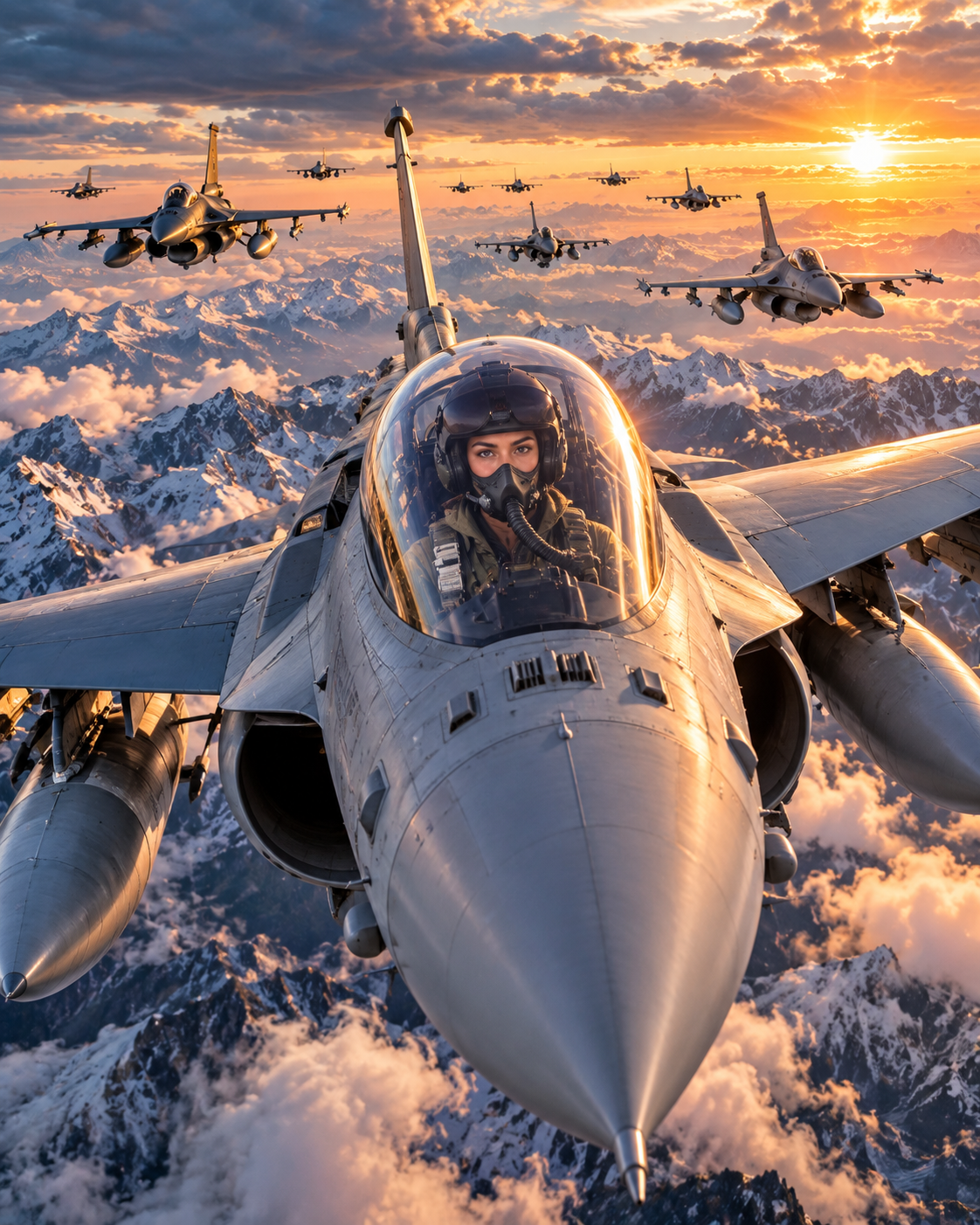
Twenty enemy fighters locked onto my F-16 at 31,000 feet, and when I stumbled back onto the airbase at dawn
The room seemed to shrink around me.
I read the note again, hoping the words would rearrange themselves into something less disturbing.
They did not.
“Before my first deployment?” I asked. “That’s impossible.”
Colonel Mercer pulled out a chair but did not sit.
“Your first operational deployment was five years ago. The note is dated six years ago.”
I looked at the photograph again.
The aircraft was partially obscured by smoke, but the markings were unmistakable.
I remembered seeing them during my first months of training, when instructors showed us intelligence photographs of foreign squadrons and warned us never to underestimate a pilot simply because their aircraft looked old.
“Who had access to my callsign back then?”
“That’s what we’re trying to establish.”
“You’re avoiding my question, sir.”
His jaw tightened.
“Because I don’t have an answer I can prove.”
The intelligence officer nearest the screen introduced himself as Major Thomas Reed.
He was younger than Mercer, with tired eyes and a habit of pressing his thumb against the edge of his notebook whenever he was thinking.
He explained that the note had been recovered from a decommissioned foreign airbase during a classified intelligence operation.
The original file contained only a partial translation, a photograph, and a reference to a pilot identified as Vixen.
No first name.
No unit.
No explanation.
Until my transmission the previous night, the reference had remained an unresolved intelligence fragment.
“Why didn’t anyone tell me?” I asked.
“Because we didn’t know it was about you,” Reed said.
I wanted to believe him.
I also wanted to believe that the twenty fighters had turned away because I had frightened them with a callsign.
But I had spent enough time in military aviation to know that unexplained behavior rarely remained unexplained forever.
“Who authorized my mission?”
Mercer answered too quickly.
“I did.”
“Did you know there were hostile aircraft operating in that sector?”
“We had indications of increased activity.”
“Twenty fighters isn’t increased activity. It’s a formation.”
His expression hardened.
“Your mission profile was within approved parameters.”
“Then why was I alone?”
The question hung between us.
Mercer looked toward the closed door.
“That’s classified.”
I laughed once, without humor.
“I nearly died in the dark, and you’re telling me the reason I was alone is classified?”
“Captain, I am telling you that you are alive, and I intend to keep you that way.”
It was the kind of answer that sounded protective until you realized it revealed nothing.
I stood.
“I want access to the original mission authorization.”
“Denied.”
“Then I want a written explanation for the intelligence gap.”
“Captain Hayes, you’re exhausted. Go home.”
I stared at him.
For a moment, I saw something beneath his stern expression that did not belong there.
Guilt.
Not the ordinary guilt of a commander who had sent someone into danger, but something older, heavier, and more personal.
I left without saluting.
Outside, the morning had grown bright, and the airfield was alive with the familiar rhythm of engines, maintenance carts, and shouted instructions.
The normality of it felt obscene.
A few hours earlier, twenty aircraft had been prepared to kill me.
Now someone was washing a coffee stain from a workbench as though nothing had happened.
I drove home with the radio turned off.
Lily was waiting at the kitchen table in her pajamas, her hair tied into two uneven ponytails.
She had drawn an airplane with enormous wings and a tiny smiling pilot.
Beside it, in careful letters, she had written: WELCOME HOME, MOM.
When she saw me, she ran so fast that her chair fell backward.
I dropped my bag and caught her.
She wrapped her arms around my waist, squeezing hard enough to hurt.
“You’re late,” she whispered.
“I know, sweetheart.”
“You promised.”
The words pierced me more deeply than any missile warning.
I knelt until we were eye to eye.
“I’m sorry.”
She studied my face with the solemn suspicion only a child can manage.
“Did your plane get lost?”
For a second, I could not speak.
“Something like that.”
She touched the small scar beneath my chin, a souvenir from an old training accident.
“Did you get scared?”
I could have told her that pilots were trained to remain calm, that fear was simply another signal to process, that I had done everything my instructors had taught me.
Instead, I told her the truth.
“Yes. I was very scared.”
She considered this.
“Did you come home anyway?”
“I did.”
“Then you’re brave.”
I held her close and closed my eyes.
Children had a way of making complicated things painfully simple.
For Lily, bravery meant being afraid and coming home.
For the military, bravery was often measured in missions completed, risks accepted, and objectives achieved.
For me, that morning, bravery meant admitting that I had almost not made it back.
I spent the day sleeping in short, restless intervals.
Every time I closed my eyes, I heard the radar warning tones.
Every time I drifted toward sleep, I saw the twenty symbols vanishing from my display.
By evening, curiosity had become stronger than exhaustion.
I returned to base and requested the public portions of my flight record, along with the maintenance log and communications transcript.
The administrative officer told me the records were still under review.
I asked again.
He gave me a careful smile and said he would contact me.
He never did.
At 21:16, an unknown number appeared on my personal phone.
I almost ignored it.
Then a message arrived.
Stop asking about the old engagement. You were never supposed to survive it.
I read it three times.
The sender had included no name, no explanation, and no demand.
Just a warning.
I called the number.
It had already been disconnected.
I reported the message through the proper channels, but I did not tell Mercer.
I could not explain why.
Perhaps I wanted one piece of the mystery that belonged only to me.
Perhaps I no longer trusted the people whose job was to protect me.
The following morning, Major Reed found me outside the operations building.
He looked as though he had not slept.
“I need to show you something,” he said.
We drove to a secure records facility on the far side of the base, where he presented a document from the year before my first deployment.
It was a personnel assessment bearing my name.
Most of it was ordinary: training results, psychological evaluations, instructor recommendations.
One paragraph had been blacked out.
The redaction had been marked for permanent retention.
“Who removed this?” I asked.
Reed turned the page.
“Your original evaluator.”
The signature at the bottom belonged to a man named Lieutenant Colonel Andrew Cole.
I remembered him.
He had been one of my instructors, a quiet, brilliant pilot who believed that the best aviators were not the ones who enjoyed combat, but the ones who understood its cost.
He had died in a training accident six years earlier.
Or so I had been told.
“Why is a dead man’s signature on a restricted file?”
Reed lowered his voice.
“Because the record was modified after his reported death.”
A chill moved through me.
“Are you suggesting Cole is alive?”
“No. I’m suggesting someone used his credentials.”
He showed me a second document.
It was a summary of the hostile engagement eighteen months earlier, the one that had made my callsign famous.
The official version said I had encountered four enemy interceptors during a reconnaissance mission, defended myself, and returned safely after damaging two opposing aircraft.
But the original mission request described a different objective.
It stated that my aircraft was expected to draw hostile attention away from a separate intelligence platform operating in the same region.
The platform’s identity had been removed.
So had the name of the officer who approved the operation.
I read the paragraph twice.
“They used me as bait.”
Reed did not deny it.
“They believed the risk was acceptable.”
“And they never told me.”
“They classified the operational details.”
“That isn’t the same as telling a pilot what she’s flying into.”
He looked down.
“No, it isn’t.”
For a long moment, neither of us spoke.
Then I asked the question I had been avoiding since the photograph appeared.
“Was last night’s mission another diversion?”
Reed hesitated.
That was all the answer I needed.
He explained that intelligence analysts had detected unusual communications activity near the border, but the source was uncertain.
My reconnaissance flight had been approved to gather additional information.
What he did not know was why the mission had been assigned to me alone.
I returned to the operations building and demanded a meeting with Mercer.
This time, he did not make me wait.
He was standing beside his desk, holding a paper cup of coffee he had not touched.
“I know about the old mission,” I said.
He closed his eyes briefly.
“Then you know why I can’t discuss every detail.”
“I know you sent me into a fight without telling me I was being used to protect another aircraft.”
“I made a decision based on the intelligence available.”
“You made a decision about my life without giving me the information I needed to protect it.”
He set the coffee down.
“Do you think I don’t understand that?”
“Then explain last night.”
He looked older than he had two days earlier.
“The hostile formation wasn’t simply patrolling the border. They were responding to a signal.”
“What signal?”
“We don’t know.”
“That’s convenient.”
His expression sharpened.
“Be careful, Captain.”
“No, sir. I’ve been careful for eighteen months. I’ve kept my mouth shut about a mission that still wakes me up at night because I believed the people who sent me there were acting in good faith.”
My voice broke, and I hated that it did.
“I have a daughter who asks whether my plane gets lost. I cannot keep pretending that the decisions made in this building don’t follow me home.”
Mercer looked away.
For the first time, he seemed less like a commanding officer and more like a man standing in front of a mistake he could never undo.
“I didn’t know the formation would be that large,” he said.
“But you knew there was a risk.”
“Yes.”
“And you sent me anyway.”
He did not answer.
I left his office with my hands shaking.
That evening, I collected Lily from school and took her to a small park near our house.
She climbed onto the swings while I pushed her gently, watching the sun sink behind the rooftops.
“Mom?”
“Yes?”
“When you fly, do you ever see other people?”
“Sometimes.”
“Do they know you’re there?”
I thought about the twenty radar locks.
“Sometimes they do.”
She kicked her feet forward.
“Do you think they get scared too?”
The question caught me off guard.
“I think they do.”
She nodded, satisfied.
“Then maybe they’re just trying to go home too.”
I stood behind the swing long after she stopped moving.
I had spent my career thinking of enemy pilots as threats, targets, or unknowns on a display.
It was easy to forget that every cockpit contained a human being with someone waiting for them somewhere.
That night, I opened the drawing she had given me and placed it beside my bed.
I had survived because twenty men had chosen not to fight.
Whatever their reasons, they had made a decision that allowed me to return to my daughter.
I owed them at least the dignity of remembering that they were people, not shadows in my radar display.
Two days later, Major Reed called.
“We found the source of the callsign reference,” he said.
I sat down.
“Tell me.”
“It came from an intercepted message transmitted shortly before your first deployment.”
“Who sent it?”
“We have a likely identification, but we need to verify the original recording.”
“Can you play it?”
A pause.
“Not over the phone.”
I drove to the facility immediately.
Reed met me in a small room with no windows.
On the table sat a recorder and a folder bearing a classification marking I had never seen before.
He explained that the message had been intercepted years earlier during an intelligence operation targeting an unknown network of military intermediaries.
The recording was damaged, but a few phrases had survived.
He pressed play.
Static filled the room.
Then a man’s voice emerged, low and deliberate.
“Do not engage the pilot designated Vixen.”
A second voice asked why.
The first answered, “Because the last time we tried, two aircraft were lost, and the person who authorized the engagement disappeared before sunrise.”
I leaned forward.
“Who was the first speaker?”
“We believe it was a foreign intelligence officer.”
“And the second?”
“Unknown.”
The recording continued.
“If Vixen appears, withdraw. Do not pursue. Do not test the warning.”
Then came a phrase that made the blood drain from my face.
“She is not the objective.”
Reed stopped the recording.
I stared at him.
“What does that mean?”
“We don’t know.”
“Someone gave orders not to engage me before I became famous. Someone used my callsign before I had earned it.”
“That’s what the evidence suggests.”
I walked to the window, though there was nothing to see beyond the concrete wall outside.
For eighteen months, I had believed that my survival had created the legend.
Now I wondered whether the legend had been waiting for me all along.
Reed opened the folder and showed me an old organizational chart.
Several names had been crossed out.
One remained legible.
Andrew Cole.
My former instructor.
The man whose signature had appeared on my altered personnel file.
The man officially dead for six years.
“That can’t be right,” I whispered.
Reed’s voice softened.
“His death was never independently confirmed outside the original reporting unit.”
I remembered Cole standing beside my aircraft years earlier, tapping the canopy with two fingers.
“Never confuse confidence with control, Hayes,” he had told me. “The sky doesn’t care how certain you are.”
He had been the first instructor to recognize my ability to remain calm under pressure.
He had also been the first person to warn me that institutions could make dangerous decisions and then bury the consequences beneath paperwork.
At the time, I had thought he was simply cynical.
Now I wondered what he had seen.
“Where do we find him?” I asked.
“We don’t know if he’s alive.”
“Then find out.”
Reed closed the folder.
“If we pursue this, the inquiry will expand beyond your mission.”
“Good.”
“It could affect your career.”
I thought about the warning message, the redacted report, and the twenty fighters that had turned away in the darkness.
“My career nearly ended at 31,000 feet. I’m done pretending the truth is a greater threat than what happened.”
The investigation took weeks.
I was removed from flight status pending a review, a decision that left me feeling as though someone had amputated a part of my life.
Every morning, I drove to the base and watched other pilots prepare their aircraft.
Every evening, I came home and helped Lily with her homework.
She never asked why I was no longer flying.
She simply seemed pleased that I was there when she woke up.
At first, I resented the grounding.
Then I began to understand how much of my identity I had built around being the person who could always return to the sky.
Without the aircraft, I had to face the fear I had carried since the first engagement.
Not fear of dying.
Fear that the people making decisions above me had already decided what my life was worth.
The investigation eventually uncovered evidence that the old reconnaissance program had used selected pilots to draw hostile attention away from sensitive intelligence operations.
The practice had not been formally authorized in the way the missions were presented to us.
A small group of officers had manipulated mission descriptions, concealed intelligence gaps, and relied on pilots’ trust to keep the operation moving.
My old engagement had exposed the arrangement when an unexpected hostile response nearly destroyed my aircraft.
Afterward, the legend of Vixen had spread through opposing squadrons, making me an unpredictable target.
Some pilots believed I had exceptional tactical skill.
Others thought I was part of a secret program they did not understand.
The truth was less dramatic and more disturbing.
My reputation had become a shield for people who had placed me in danger.
The enemy feared what I represented.
My own command feared what I might discover.
And somewhere between those two fears, the actual pilot had nearly disappeared.
Colonel Mercer was eventually called before a formal review board.
He admitted approving the missions but denied knowing that the operational details had been deliberately concealed from me.
The board found serious failures in oversight and recommended disciplinary action against several officers.
Mercer was removed from his command while the investigation continued.
Before he left the base, he asked to see me.
We met in the same office where I had demanded answers.
He looked exhausted.
“I owe you an apology,” he said.
I waited.
“I believed I was protecting the larger mission. I convinced myself that you didn’t need every detail because you were an excellent pilot.”
“You believed my ability to survive meant you could take greater risks with my life.”
He lowered his eyes.
“Yes.”
For a moment, I wanted to hate him.
It would have been easier if he had been cruel, if he had treated me as a number and felt nothing afterward.
Instead, he looked like a man who had finally understood the human cost of his own reasoning.
“I can’t tell you that I forgive you,” I said.
“I wouldn’t ask you to.”
“But I hope you understand that competence isn’t consent.”
He nodded slowly.
“You’re right.”
I left the office without shaking his hand.
Not because I wanted revenge, but because some apologies were only the beginning of accountability.
Three months after the night of the twenty radar locks, Reed called me into the intelligence building.
The original intercepted recording had been authenticated.
More importantly, investigators had recovered a second message, transmitted through a different channel shortly after my first dogfight.
It contained a name and a location.
Andrew Cole.
He had survived the accident that supposedly killed him, but he had disappeared from official records after reporting irregularities in the reconnaissance program.
The evidence suggested that he had been working outside the formal chain of command to expose the people responsible.
I listened to the recovered message alone.
Cole’s voice sounded older than I remembered, but it was unmistakably his.
“Rebecca, if you are hearing this, then the warning has failed, or you have found your way back to the question I told you never to stop asking.”
I gripped the edge of the table.
“I couldn’t stop them from using your callsign. I tried to make it a warning, something that would keep you alive until the truth could be brought into the light.”
He paused, and I heard a faint mechanical hum in the background.
“You were never supposed to become a legend. You were supposed to become a witness.”
The recording ended.
I sat motionless for several seconds.
A witness.
Not a weapon.
Not bait.
Not the ghost story that frightened twenty enemy fighters into turning away.
A witness.
For the first time, the strange pieces of my life began to form a shape I could almost understand.
The callsign had been planted in hostile intelligence channels before my career began.
The old warning had been intended to discourage anyone from engaging me.
After the dogfight, my survival gave the warning credibility.
And after the mission at 03:47, the legend had become strong enough to protect me from a formation that could have destroyed my aircraft.
But Cole’s message left one question unanswered.
Why had he risked everything to protect me?
The investigation’s final report offered a partial explanation.
Years earlier, Cole had identified evidence that a covert intelligence program was manipulating reconnaissance missions to support operations that had never received proper authorization.
He had objected.
He had been ignored.
When he discovered that junior pilots were being sent into danger without complete mission information, he began preserving records and quietly alerting people who might one day expose the arrangement.
My name appeared in his notes because I was among the pilots whose assignments had been altered.
He had tried to protect me without telling me what he knew, believing that silence would keep me outside the investigation.
Instead, silence had made me vulnerable.
His warning had saved my life, but it had also allowed the people responsible to continue operating longer than they should have.
Even his attempt to help me had carried a cost.
That was the hardest truth of all.
Good intentions did not erase the consequences of secrecy.
And a person could be trying to protect you while still denying you the right to understand your own danger.
I was eventually cleared to return to flying after the review board completed its assessment.
On the morning of my first flight back, I stood beside my F-16 and ran my fingers along the cool metal beneath the canopy.
The aircraft looked exactly as it had before.
I did not.
Lily had slipped a folded piece of paper into my flight bag the night before.
I opened it and found another drawing.
This time, the airplane had two figures inside it.
One was wearing a helmet.
The other had a small pink bow.
Beneath the picture, she had written, “You don’t have to be fearless. Just come home.”
I tucked it into my pocket.
When I climbed into the cockpit, the familiar smells of metal, fuel, and heated electronics surrounded me.
For a moment, the old fear returned.
Then I remembered that fear was not a weakness to be hidden.
It was a reminder that the life I was risking mattered to someone beyond the boundaries of a mission.
I completed the flight safely and landed before noon.
The ground crew gave me a quiet round of applause, which embarrassed me more than any public ceremony could have.
I thanked them and walked away before anyone could turn my return into another legend.
That evening, I sat alone beside the airfield and watched the sun sink beneath the horizon.
The sky was calm, almost gentle.
I thought about the twenty pilots who had turned away, each of them carrying a story about a woman they had never truly known.
I hoped they had all made it home.
I hoped they had children, parents, partners, or friends waiting for them.
I hoped that, somewhere beyond the border, one of them had looked at the sunrise and felt grateful for another day.
The world would probably continue telling the story of Vixen as a tale of fearlessness, a lone pilot who had frightened twenty enemies without firing a shot.
I could not control what people believed.
But I knew the truth.
I had been terrified.
I had wanted to turn back.
I had thought of my daughter and wondered whether she would remember my voice.
And I had survived because, for reasons I still did not fully understand, twenty other human beings had chosen not to pull the trigger.
That did not make me invincible.
It made me lucky.
It made me responsible for what I had learned.
And it reminded me that the most dangerous lies are often the ones told in the name of protecting someone.
A week later, an envelope arrived at my house with no return address.
Inside was a photograph of Andrew Cole standing beside a small aircraft at an unfamiliar airfield.
He looked older, thinner, and alive.
On the back, in handwriting I recognized immediately, were six words.
The twenty were not the threat.
I read the sentence until the paper trembled between my fingers.
Then I turned the photograph over again.
In the background, barely visible beneath the wing of the aircraft, stood a man wearing the uniform of an American officer.
His face had been circled in red ink.
I knew him.
He had sat on the review board that cleared me to fly.
Before I could call Reed, my phone vibrated with a message from an unknown number.
If you want to know why they let you live, come alone.
Below it was an airfield location and a time.
I looked through the kitchen doorway at Lily, who was coloring another airplane at the table, humming softly to herself.
For eighteen months, I had believed the sky held the secret to my survival.
Now I understood that the truth had been waiting on the ground all along.
I folded the photograph, placed it beside Lily’s drawing, and stared at the clock.
Tomorrow, I would have to decide whether finding the truth was worth risking the one thing I had fought so hard to return to.
And for the first time since that terrible night at 03:47, I feared that coming home might not mean I was safe.