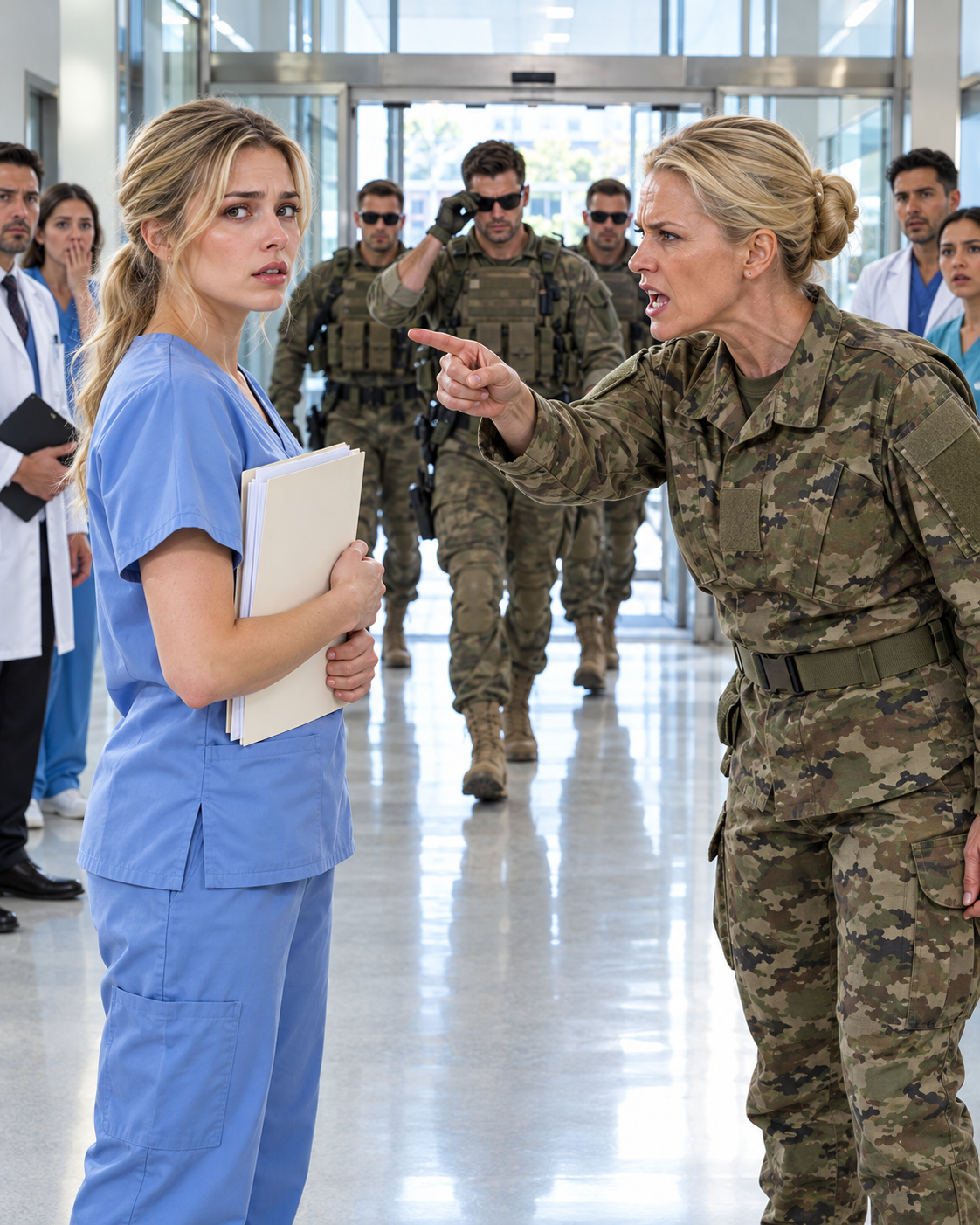
Three days after Chief Surgeon Evelyn Thorne threw me out of an operating room in front of an entire trauma team
The moment the hospital doors closed behind us, Nathan’s expression changed.
The warmth I remembered from the mountains vanished, replaced by the grim focus of a man who had spent too many years learning that bad news rarely arrived alone.
“We need to get you somewhere secure,” he said.
I looked toward the parking lot, where an unmarked black SUV waited beside the curb.
“You’re going to have to do better than that. What exactly happened?”
Nathan glanced at the men behind him.
“Three weeks ago, an intelligence analyst discovered unauthorized access to archived records from your final deployment. The access originated from a private security contractor that officially dissolved two years ago.”
I felt the blood drain from my face.
“What contractor?”
“Blackridge Strategic.”
The name struck like a fist to the chest.
Blackridge had supplied transport and logistical support during our mountain extraction, including the vehicle that was supposed to carry our wounded team to the designated evacuation point.
That vehicle never arrived.
We had spent hours stranded in hostile territory because someone had redirected it to another location without notifying our command.
At the time, the investigation blamed a communications failure.
I had never believed that explanation.
“Why would anyone be looking for me now?” I asked.
“Because you were the only person on the team who documented the original evacuation discrepancy before the report was sealed.”
I remembered the small notebook I had kept inside my medical bag, where I recorded treatment times, casualty movements, and every change in our evacuation instructions.
After the mission, investigators questioned me about the missing transport and a set of coordinates that had appeared in two conflicting orders.
I gave them everything I had.
Then I returned to civilian life, convinced the investigation had ended.
“Where is that notebook?” Nathan asked.
“At my apartment.”
“Did anyone else know you kept it?”
“Only the investigator who interviewed me.”
Nathan exchanged a look with his second-in-command, Sergeant Cole Mercer.
That look frightened me more than his explanation.
“What aren’t you telling me?”
Nathan took a slow breath.
“The analyst who found the records was killed two days ago in what local authorities classified as a burglary. His apartment was searched, but the intruders took almost nothing except his laptop and a folder containing your name.”
The parking lot suddenly seemed too open.
A cold wind moved across my face, carrying the distant sound of traffic.
“Do they know where I live?”
“We believe someone tried to find out.”
He opened the SUV’s rear door.
I didn’t get in.
“Nathan, I’m not going to disappear without understanding what’s happening.”
For a moment, I saw the younger officer I remembered, the man who had trusted me when the world was collapsing around us.
Then he nodded.
“Fair enough. But we discuss the rest somewhere private.”
Before I could answer, a sharp crack echoed from the far side of the parking garage.
One of the operators grabbed my arm and pulled me behind the concrete pillar beside the entrance.
Another moved toward the SUV while Nathan turned toward the sound.
People screamed inside the hospital.
My heart hammered so violently that I could feel each beat in my throat.
“Stay down,” Nathan ordered.
I crouched behind the pillar, my hands instinctively searching for medical supplies that weren’t there.
A security guard appeared at the garage entrance, shouting that a vehicle had struck a barrier.
No second shot followed.
Within seconds, the operators had secured the immediate area, and Nathan crouched beside me.
“Are you hurt?”
“No.”
He studied my face.
“That sound could have been an accident, but we aren’t taking chances.”
As they moved us into the SUV, I caught sight of a man standing near a gray sedan at the opposite end of the lot.
He wore a dark jacket and held a phone against his ear.
For one brief instant, his gaze met mine.
Then he turned away.
I couldn’t explain why, but something about his posture felt familiar.
I had seen that same stillness on the mountainside, just before our evacuation orders changed.
“Nathan,” I whispered, pointing toward the sedan.
He looked over his shoulder, but the vehicle was already pulling away.
“Did you recognize him?”
“I’m not sure.”
It was the truth, and it frightened me more than a certain answer would have.
We drove to a secure facility outside the city, where the team had arranged temporary protection while military investigators examined the threat.
I sat in a small conference room beneath harsh fluorescent lights, staring at a photograph Nathan placed on the table.
It showed our old extraction team gathered beside a transport helicopter months before the mission.
There were seven of us in the photograph.
Five operators, Nathan, and me.
I touched the edge of the picture.
“What happened to Elias?”
Nathan’s jaw tightened.
Elias Ward had been our communications specialist, a quiet man who joked about everything except his family.
He had died during the extraction, killed when the team came under fire before the evacuation route collapsed.
“We reopened the case after the analyst was killed,” Nathan said. “Some of the original communications logs were altered.”
I looked up.
“Altered how?”
“Someone removed the transmission that redirected our transport. The replacement record made it appear that our team had changed its own evacuation coordinates.”
I remembered the radio operator’s voice, strained by static, repeating instructions that contradicted our original plan.
We had assumed the confusion was caused by damaged equipment.
“You think Elias knew?”
“I think he may have discovered something before he died.”
Nathan slid another photograph toward me.
It showed Elias standing outside a warehouse beside a civilian contractor wearing a Blackridge jacket.
The image was grainy, but the date stamp was clear.
Two days before our mission.
My mouth went dry.
“Why wasn’t this investigated?”
“It was buried in a separate intelligence file that nobody knew existed until last week.”
I leaned back, struggling to reconcile the evidence with the memory of the man who had shared his last chocolate bar with me during a freezing night on the ridge.
Elias had been more than a teammate.
He had been the person who stayed awake to keep me company after nightmares dragged me out of sleep.
When I once asked him why he never seemed afraid, he had smiled and said, “Fear is fine, Doc. Just don’t let it hold the radio.”
If he had been involved in something, I needed to know whether he had betrayed us or tried to save us.
Nathan’s phone vibrated.
He read the message, then looked at me.
“Your apartment has been entered.”
I stood so abruptly that my chair scraped across the floor.
“What?”
“Local officers found the door damaged. They haven’t confirmed what was taken.”
“My patients’ records aren’t there. I have nothing worth stealing.”
“Apparently, someone disagrees.”
I pressed my fingers against my forehead.
The apartment held almost nothing from my military years except a locked metal case containing my old notebook, a few photographs, and the commendation I had never learned how to display.
If someone wanted the notebook, they had found the right place.
“Take me there,” I said.
“No,” Nathan replied.
The answer was immediate, but his voice remained gentle.
“Not until the scene is cleared. You can tell investigators what belongs to you, and they’ll recover it if it’s safe.”
I hated that he was right.
For five years, I had built a life around the belief that I could leave the past behind simply by working hard enough in the present.
Now that past had reached through my front door.
I sat down again.
“Then tell me what you need from me.”
Nathan placed a blank sheet of paper on the table.
“Everything you remember about the evacuation orders. Every detail, even the ones you thought were insignificant.”
So I began.
I described the first transmission, the sudden change in coordinates, the delayed transport, and the moment our team realized the promised extraction was never coming.
I remembered that Elias had stepped away from the radio just before the final transmission arrived.
He had returned pale and unusually quiet.
At the time, I thought he was frightened.
Now I wondered whether he had heard something that changed everything.
Then another memory surfaced.
“Wait,” I said. “Elias asked me to keep something for him.”
Nathan leaned forward.
“What?”
“A small memory card. He said it contained personal photographs because his equipment was being inspected, and he didn’t want to lose them.”
“Did you keep it?”
I closed my eyes, searching the years between the mountains and my apartment.
I had returned from deployment with a box of personal belongings.
Most of it had remained untouched in storage because I couldn’t bear to sort through it.
“I might have.”
Nathan immediately contacted the investigator overseeing the case.
An hour later, a protective team escorted us to a storage facility where my belongings had been moved after I left the service.
The box was still there, covered in dust.
Inside were photographs, old letters, a cracked wristwatch, and a medical pouch with a torn zipper.
My fingers trembled when I found the memory card taped beneath its inner lining.
For a long moment, I couldn’t move.
Elias had hidden it where he knew I would keep it safe.
Not because I was a soldier.
Because I was someone he trusted.
The investigators copied the files onto an isolated computer.
Most contained ordinary photographs and fragments of corrupted data, but one audio file remained intact.
Nathan pressed play.
Static filled the room.
Then Elias’s voice emerged, low and hurried.
“If anything happens to our team, the evacuation change was not an accident. Blackridge received new coordinates from someone inside our command structure. I have evidence, but I don’t know who I can trust.”
A pause followed.
Then he spoke again.
“The original transmission was authenticated with a senior officer’s credentials. If they’re willing to sacrifice us to protect the contract, they’ll do it again.”
The recording ended.
Nobody spoke for several seconds.
I stared at the computer, feeling grief rise through me with a force I hadn’t experienced since the mission itself.
Elias hadn’t abandoned us.
He had been trying to expose the betrayal, and he had died before he could tell us everything.
Nathan’s expression was grim.
“This changes the investigation.”
“Can you identify the officer?”
“Not from this recording alone.”
He turned to the investigators.
“Preserve the original. No external transfers until the forensic team verifies every copy.”
I looked at him.
“You think someone inside the system is still involved.”
“I think we have enough evidence to stop assuming everyone with authority deserves our trust.”
His words brought me back to Crestview.
Dr. Thorne’s contempt had hurt, but it had been a small wound compared with the one left by a mission that had never made sense.
Still, the lesson was familiar.
A title could establish responsibility, but it could never guarantee integrity.
The next morning, I was informed that federal investigators wanted to interview me formally.
Nathan accompanied me to a secure office where a civilian investigator named Rebecca Shaw waited with a folder of documents.
She was direct, patient, and careful not to promise answers before she had evidence.
“We’ve identified irregularities in the original mission records,” she explained. “The altered evacuation order passed through an account belonging to Colonel Marcus Hale, who was responsible for coordinating the contractor’s support.”
I recognized the name.
Hale had attended our post-mission briefing and assured us that the failed extraction would be investigated thoroughly.
I remembered him shaking my hand while telling me that my medical work had saved lives.
The thought that he might have known why those lives had been placed in danger made my stomach turn.
“Do you have proof he knowingly changed the order?” I asked.
“Not yet,” Rebecca said. “The credentials could have been misused. We need the original transmission and corroborating evidence before we draw conclusions.”
That answer mattered to me.
I had seen innocent people blamed because someone needed a convenient explanation.
I wasn’t going to help repeat that mistake.
The memory card gave investigators a direction, but it didn’t give them the whole truth.
Over the following days, they traced payments between Blackridge’s former executives and a network of shell companies.
The investigation uncovered evidence that someone had been selling restricted operational information to hostile intermediaries.
The failed evacuation appeared to have been part of a larger effort to conceal those transactions.
Our team had been sent into danger because someone feared we had stumbled upon evidence of the scheme.
Elias had discovered the truth.
I had unknowingly preserved a piece of it.
And now someone wanted both of us silenced, even though one of us had been dead for three years.
During that time, Crestview continued to call.
The hospital administrator left messages asking when I planned to return, while colleagues sent cautious texts that seemed designed to discover how much I intended to reveal.
Dr. Thorne sent a single message.
“I hope you are safe. We should discuss what happened.”
I read it twice.
Then I put my phone away.
I wasn’t ready to forgive her, and I wasn’t interested in making her humiliation the center of my life.
What mattered was whether the patient I had warned her about was recovering.
I called the nursing supervisor and asked for an update.
He told me the man had been transferred out of intensive care and was beginning rehabilitation.
Relief loosened something in my chest.
Whatever had happened in that operating room, the patient was alive.
That was the only part of the story that truly mattered.
On the sixth day, Rebecca called with a breakthrough.
Investigators had recovered an archived transmission from a secondary server.
It showed that the evacuation coordinates had been altered before our team ever reached the mountain.
The change had been approved using Colonel Hale’s credentials, but a separate access log revealed that a Blackridge executive had entered the system shortly beforehand.
The evidence suggested a coordinated conspiracy, but it still did not establish who had given the final order.
Then Rebecca mentioned a name that made Nathan go completely still.
“Daniel Cross.”
Cross had been Blackridge’s regional operations director.
He had also been the civilian liaison who visited our base shortly before the mission.
I remembered him standing beside the transport vehicles, smiling as he assured us that everything was ready.
I remembered Elias watching him from across the staging area.
And I remembered one final detail.
Just before we deployed, Elias had pulled me aside and asked whether I still had the small notebook in which I recorded medical and evacuation timelines.
I had told him yes.
He had looked relieved, then frightened.
At the time, I thought he was worried about the mission.
Now I understood that he had been trying to ensure someone would remember what actually happened.
Rebecca told us Cross had recently resurfaced under a different identity and might be connected to the threats against me.
The gray sedan from the hospital parking lot was now part of the investigation.
Security footage had captured its registration, and investigators were tracing its ownership.
For the first time, the threat had a face.
But knowing who might be hunting us did not make the situation safer.
It made the danger feel more personal.
Two days later, a new message arrived through an encrypted channel that the investigators had been monitoring.
It contained a single sentence.
“Tell Clara the mountain should have stayed buried.”
I read it once, then again.
My hands went cold.
Nathan stood beside me, his expression hardening.
“They know we recovered the recording.”
“Then they know we’re getting close.”
He nodded.
“And that means they’ll make mistakes if they panic.”
For the first time since leaving Crestview, I felt something stronger than fear.
I felt determination.
I had spent years believing that survival meant learning to live without answers.
Now I understood that some questions stayed alive because someone had deliberately buried them.
I wouldn’t let Elias’s final act of courage disappear into another sealed file.
The investigation accelerated.
Within days, federal agents arrested Daniel Cross at a private residence outside Washington.
They recovered encrypted drives, financial records, and communications linking him to the altered evacuation orders.
Cross initially denied knowing anything about our mission.
Then investigators showed him the recovered audio file and the transaction records.
His story began to collapse.
He admitted that Blackridge had diverted resources to protect an unauthorized intelligence operation and that our team had been placed at risk because Elias discovered evidence of it.
But Cross insisted that he had not acted alone.
He claimed someone inside the military command structure had approved the plan.
That claim reopened the investigation into Colonel Hale.
The evidence against Hale grew, but Rebecca refused to speculate about his guilt until the records could be authenticated.
I respected her caution.
The truth was finally emerging, and I wanted it to survive scrutiny rather than collapse under the weight of anger.
A week later, investigators confirmed that Hale had knowingly authorized the altered evacuation plan after receiving payments from Blackridge’s executives.
He had expected the mission to fail without attracting attention.
He had underestimated the people he sent into danger.
And he had never imagined that a combat medic’s notebook would preserve details he believed would disappear.
Hale was taken into custody pending prosecution.
The news reached me while I sat in a quiet room at the secure facility, holding the old photograph of our team.
I traced Elias’s face with my thumb.
“You were right,” I whispered. “Someone finally listened.”
Nathan stood by the window, his hands folded behind his back.
“I wish we’d found it sooner.”
“So do I.”
We remained silent for a while.
There was no celebration, no triumphant speech, and no way to bring back the man who had tried to save us.
Justice could establish what happened.
It could not return the years we had spent wondering why our friend died.
Eventually, I asked Nathan what would happen to me now.
“The immediate threat appears contained,” he said. “Investigators will continue assessing the risk, but you should be able to return to your life with appropriate precautions.”
My life.
The phrase felt unfamiliar.
For days, I had moved between secure rooms, interviews, and evidence reviews, surrounded by people who understood the world I had tried to leave behind.
Now I had to decide whether I could return to the hospital and stand beneath the same fluorescent lights as before.
I wasn’t afraid of nursing.
I was afraid of discovering that I no longer knew how to be the person I had worked so hard to become.
Nathan seemed to read the question on my face.
“You don’t owe anyone a return to normal,” he said. “But you also don’t have to let those people decide what normal means for you.”
I thought about my patients, the elderly man who always asked for extra blankets, the frightened teenager who wanted someone to explain every procedure, and the countless ordinary moments that had made civilian nursing feel worthwhile.
“I want to go back,” I said. “Not for Dr. Thorne. For them.”
Nathan nodded.
“Then go back on your terms.”
When I returned to Crestview, the hospital seemed quieter than I remembered.
People looked up as I entered, and conversations faltered before resuming in hushed voices.
Some knew fragments of the military investigation.
Others had heard exaggerated rumors about armed operators, secret missions, and government agents.
I ignored the speculation and walked straight to the nursing station.
My patients needed care.
That had not changed.
The nursing supervisor greeted me with obvious relief and handed me the updated assignments.
Then he hesitated.
“Dr. Thorne asked to speak with you.”
I looked toward the corridor leading to the surgical department.
“All right.”
She was waiting in an empty consultation room, standing beside a window overlooking the ambulance entrance.
Without the surgical team around her, she seemed less imposing.
For a moment, neither of us spoke.
Then she said, “I owe you an apology.”
I waited.
“I questioned your judgment in front of the team without understanding your background. I treated your role as evidence that your observations were less valuable than mine.”
Her voice faltered slightly.
“That was wrong.”
I studied her face.
She looked genuinely uncomfortable, but discomfort alone did not erase what had happened.
“You didn’t need to know about my military service to listen when I said a patient was crashing,” I replied.
She lowered her eyes.
“No. I didn’t.”
That was the first honest thing she had said to me in years.
She explained that the hospital had begun reviewing its trauma protocols, including how nurses could escalate urgent concerns when a physician dismissed them.
She also admitted that she had been afraid of losing control in the operating room and had mistaken my warning for a challenge to her authority.
I understood fear.
I had felt it on the mountain, in the parking garage, and every time an investigator uncovered another piece of the conspiracy.
But fear did not excuse using power to silence someone trying to help.
“I can’t tell you that everything is fine,” I said. “I haven’t forgotten what happened.”
“I wouldn’t expect you to.”
“And I don’t want an apology because you’ve learned something about my past. I want the next nurse you work with to be heard even if she has never served in the military, never received a commendation, and never had a title anyone recognizes.”
Dr. Thorne held my gaze.
“You’re right.”
For the first time, I believed she understood at least part of what she had done.
We left the room without an embrace or a dramatic promise.
Trust, like a damaged artery, could not be repaired simply because someone finally acknowledged the injury.
It required careful work.
In the weeks that followed, Crestview introduced a formal escalation process for clinical concerns and began reviewing incidents in which staff members had felt pressured to remain silent.
Dr. Thorne participated in the review, though the changes did not erase the hospital’s responsibility to its employees or patients.
I returned to my shifts, determined to judge the workplace by what changed rather than what people said.
Some colleagues approached me with sincere apologies.
Others avoided me, embarrassed by their silence when Dr. Thorne had ordered me out of the operating room.
I did not demand that they admire me.
I only expected them to treat me and one another with basic professional respect.
One afternoon, I was helping a new nurse prepare a patient for transfer when she hesitated before reporting a concerning change in his condition.
“Are you sure?” she asked. “The attending said he was stable.”
I looked at the monitor, then at the patient’s face.
“If something doesn’t look right, say so,” I told her. “You don’t need to be the most senior person in the room to recognize that something has changed.”
She swallowed nervously and called the attending.
The physician returned, reassessed the patient, and ordered additional tests that revealed an evolving complication.
The patient received treatment before his condition became critical.
Later, the young nurse thanked me in the hallway.
I thought of the mountain, of Elias, and of the many times I had watched frightened people struggle to speak when someone more powerful told them to be quiet.
“Don’t thank me,” I said gently. “Remember how this felt, and make room for the next person who needs to speak.”
Months passed.
The investigation led to criminal proceedings against those responsible for the conspiracy, while the military reviewed the failures that had allowed the altered orders to pass unnoticed.
I was asked to provide testimony about the evacuation and the records I had preserved.
Standing before the investigators, I spoke about Elias, the missing transport, and the hours we spent fighting to keep one another alive.
I did not describe us as heroes.
We had been tired people doing difficult work under terrible circumstances.
Some of us survived.
Some did not.
The difference between those outcomes had never been a measure of anyone’s worth.
After the hearing, Nathan walked with me outside the building.
“You know,” he said, “the guys still talk about you.”
I smiled faintly.
“Hopefully not about my bedside manner.”
He laughed, and for the first time in months, the sound did not carry an undertone of grief.
“They talk about how you kept going when the rest of us were ready to give up.”
I looked toward the street.
“I was scared, Nathan.”
“I know.”
“I thought if I stopped moving, I’d lose someone else.”
He was quiet for a moment.
“Maybe that’s why we survived. You were scared, and you kept moving anyway.”
I thought about those words long after we parted.
Courage had never felt like fearlessness to me.
It had felt like shaking hands that continued to work, a voice that spoke when silence would have been easier, and the decision to care for another person even when there was no guarantee they would survive.
I had spent years trying to bury the mountain because I believed leaving it behind was the only way to heal.
Now I understood that healing did not require forgetting.
It required learning how to carry the truth without allowing it to dictate every step that followed.
One evening, near the end of a long shift, I passed the operating room where Dr. Thorne had humiliated me.
The doors were open, and a team was preparing for another emergency.
A young nurse stood beside the instrument cart, listening as a resident explained the patient’s condition.
She noticed a possible problem and raised it carefully.
The resident paused, considered her concern, and called the attending surgeon to reassess the plan.
No one mocked her.
No one told her to remember her place.
I continued down the corridor, feeling something loosen inside me.
The hospital had not become perfect.
People would still make mistakes, egos would still flare, and fear would still tempt some of us to silence the people we should be listening to.
But change had begun with a simple idea: a person’s value could not be measured by a job title, a uniform, or the approval of someone standing higher on the organizational chart.
My badge still read CLARA VANCE, REGISTERED NURSE.
There was no mention of the mountains, the medal, or the men who had returned home because I refused to abandon them.
I preferred it that way.
I did not need every stranger to know my history.
I needed the people beside me to understand that expertise could come from unexpected places, that dignity was not something a superior granted, and that the quietest person in a room might be the one who recognized the danger first.
Before leaving that night, I stopped beside the hospital’s memorial wall, where the names of staff members who had died while serving their communities were engraved in brushed steel.
I thought of Elias, whose name would never appear there, and of the others who had carried their own invisible burdens through the world.
I whispered a promise to remember him not only for how he died, but for the evidence he had protected and the trust he had placed in me.
Then I turned toward the nurses’ station, where another shift was beginning.
A new nurse was struggling with a frightened patient who refused to let anyone touch his injured arm.
I stepped beside her and asked the patient if he would tell us what worried him most.
His eyes filled with tears.
“My wife died in a hospital,” he whispered. “I thought if I came here, the same thing would happen.”
I pulled up a chair and listened.
For a few minutes, there were no military investigations, no powerful surgeons, no secret files, and no people trying to prove they mattered more than someone else.
There was only a frightened man who needed someone to take his fear seriously.
And there was me, exactly where I had chosen to be.
I had once believed that my greatest achievement was saving five men on a mountainside.
Now I knew that the work of saving lives did not end when the gunfire stopped or the operating room doors closed.
Sometimes it meant confronting corruption.
Sometimes it meant speaking when silence protected the wrong person.
And sometimes it meant sitting beside a stranger long enough for him to realize that he was not alone.
I could not change what had happened to Elias.
I could not recover the years stolen by the conspiracy or erase the moment Dr. Thorne had tried to reduce me to a job title.
But I could decide what those experiences would teach me.
The next morning, Nathan sent a final message confirming that the immediate security threat had been contained and thanking me for helping bring the investigation to the truth.
I replied with a simple sentence.
“Bring the men home safe, and I’ll keep doing my part here.”
Then I put my phone away and returned to work.
I no longer needed to prove that I was more than the quiet nurse people had underestimated.
I only needed to remember who I was when nobody was watching.
Because the most important measure of a person is not how loudly they command a room, how impressive their credentials appear, or how many people stand when they enter.
It is what they do when another human being is afraid, vulnerable, and depending on them.
And sometimes, the person everyone overlooks is the one who will stand between them and the darkness.