The young guard at the eastern gate raised his rifle when he saw me walking out of the morning fog. I didn’t blame him—I was supposed to be dead.
The Voice on the Radio
The commander placed the radio log on the small metal table beside my cot.
“There’s something else in here,” he said. “And I need you to tell me exactly what you heard.”
I looked at the device. Its scratched casing still carried a smear of dried blood from the night I’d taken it.
“What did you find?”
The commander pulled a chair closer and lowered his voice.
“During the transmission you intercepted, one of the enemy operators used a call sign. Do you remember it?”
I closed my eyes, trying to reconstruct the broken voices that had crackled through the speaker while I hid among the rocks.
There had been numbers, grid references, confirmation codes, and repeated instructions to move before sunrise.
Then I remembered a voice that had sounded different from the others.
Calm. Almost bored.
“Falcon Seven,” I said.
The commander’s expression changed immediately.
“Are you certain?”
“I heard it twice. The second time, the operator said the eastern approach had to remain clear.”
He stared at me for several seconds.
Then he turned the radio log around and pointed to a line highlighted in red.
“Falcon Seven is not an enemy call sign.”
I frowned.
“What?”
“It’s ours.”
For a moment, I thought the pain medication was making me confused.
The commander continued.
“Falcon Seven belongs to a communications aircraft assigned to our northern sector. Its crew disappeared during a routine flight two nights ago. We assumed the aircraft had gone down somewhere beyond the mountains.”
I sat up too quickly, and a sharp pain shot through my ribs.
“Are you saying one of our aircraft is working with them?”
“I’m saying someone is using its identification code. And that someone appears to know our defensive positions.”
The room suddenly felt colder.
I remembered the intercepted transmission again.
The enemy operator had not simply discussed an attack. He had mentioned a gate number, a fuel storage area, and a change in the guard schedule.
Those details had not come from a captured map.
Someone had given them the information.
“Sir,” I said slowly, “there was another thing.”
The commander leaned forward.
“One of the voices asked whether the eastern gate would be opened for a returning patrol.”
His eyes narrowed.
“What did the other man say?”
“He said the gate would open when the ghost came home.”
Neither of us spoke.
The commander looked toward the canvas entrance of the medical tent.
Outside, soldiers were moving ammunition crates and reinforcing the perimeter. They had no idea that the warning I had brought might be part of something much larger.
“Stay here,” he ordered.
“Sir, I can help.”
“You’ve done enough for now.”
He stood, collected the radio log, and walked out.
I watched him disappear into the morning light.
For the first time since the ambush, I wished I had remained hidden in that valley.
Because the enemy had apparently known I was coming home.
And someone on our side had been waiting for me
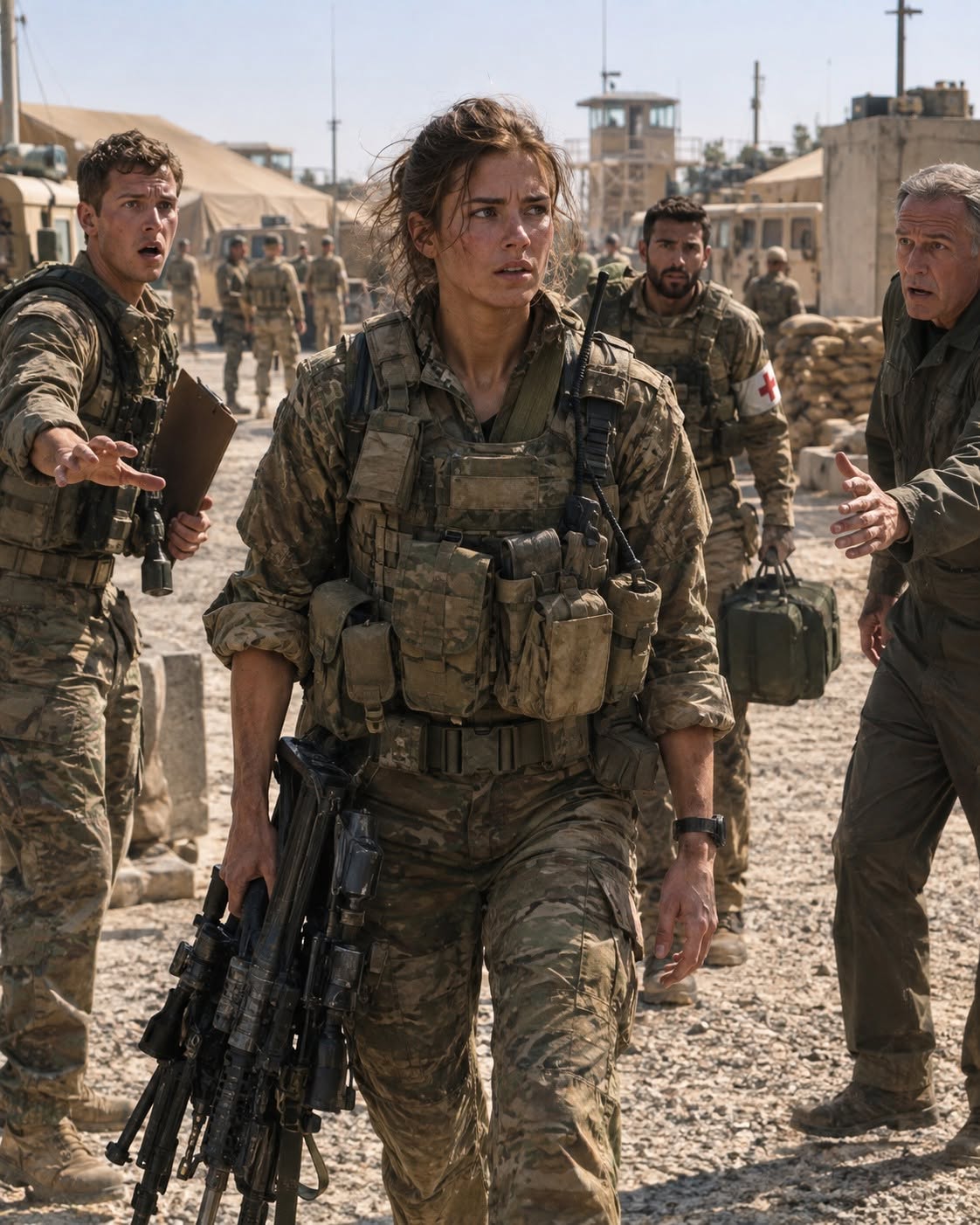
Twenty minutes later, the commander returned with Captain Daniel Reeves, the intelligence officer.
Reeves was a tall, narrow-faced man who had served at the outpost longer than most of us. He had been responsible for distributing our patrol routes and mission assignments.
I remembered him from the morning before our reconnaissance mission.
He had handed our squad leader a sealed folder and told him that the valley route was completely clear.
Now he stood at the foot of my cot, studying me.
“You’re certain about the voice?” he asked.
“I’ve already told the commander what I heard.”
“That’s not what I asked.”
I met his eyes.
“Yes. I’m certain.”
Reeves nodded as though he had received the answer he expected.
Then he looked at the commander.
“We need to isolate the radio immediately. There’s a possibility the transmission contained corrupted identification data.”
The commander didn’t move.
“Or there’s a possibility someone inside this base is feeding coordinates to the enemy.”
Reeves gave a faint smile.
“That is a serious accusation.”
“Then I suggest you help us establish the truth.”
For a second, something passed across Reeves’s face.
It was gone almost immediately.
He turned back toward me.
“Get some rest, soldier. The investigation will take time.”
When he left, I noticed something that bothered me.
His right hand was trembling.
Not from fear.
From anger.
By noon, the outpost had changed completely.
Sandbags were piled around the command building. Vehicles had been moved away from exposed positions. The eastern observation post was reinforced, and additional guards were stationed along the northern ridge.
The commander had ordered everyone to operate under the assumption that an attack was imminent.
I was still in the medical tent when Sergeant Miller came to see me.
He had been part of the patrol assigned to the western perimeter when I disappeared.
His face was pale.
“Good to see you’re alive,” he said.
“Good to see you too.”
He pulled up a chair.
“I heard what happened. Three days behind enemy lines, and you walked all the way back carrying their equipment. Most people wouldn’t have made it.”
“I wasn’t planning on dying out there.”
Miller laughed quietly.
Then his expression became serious.
“There’s something I thought you should know.”
He leaned closer.
“The commander has been reviewing the patrol assignments from the last two weeks. Three missions were ambushed. Yours was the third.”
I stared at him.
“Three?”
“All three teams received routes that were supposedly clear. All three were attacked within minutes of entering enemy territory.”
“What happened to the other teams?”
“Two lost men. One never returned.”
I felt the old memory of the valley settle heavily in my chest.
Our squad leader, Lieutenant Harris, had trusted the mission briefing completely. He had told us the enemy had abandoned the area.
We had walked straight into an ambush.
“Who prepared those routes?” I asked.
Miller hesitated.
“Captain Reeves.”
The room seemed to shrink around me.
“Does the commander know?”
“He does now.”
Miller stood.
“There’s one more thing. The commander wants to speak with you in the operations room. He thinks you might recognize something in the intercepted recording.”
I pushed the blanket aside.
“My ribs are going to complain.”
“Then let them complain.”
The operations room was crowded when I arrived.
Maps covered the walls. Radio operators sat at their stations, listening to fragments of enemy communications. The commander stood over a large table with several officers.
He pointed to an empty chair.
“Sit down.”
A recording was played through the room’s speakers.
Static filled the air, followed by a man’s voice.
“Eastern gate. First light. Confirm the returning asset.”
Then another voice answered.
“Asset has already crossed the perimeter.”
The recording ended.
I felt the blood drain from my face.
“That second voice,” I said.
The commander looked at me.
“You recognize it?”
I nodded.
“That’s the man who was giving instructions during the patrol ambush.”
An intelligence analyst adjusted the playback.
The voice came again.
This time, I noticed something beneath the words.
A faint metallic clicking sound.
Three clicks.
A pause.
Then two more.
I remembered hearing that sound during the night I captured the radio.
It had repeated every time the operator transmitted.
I looked at the commander.
“Can you play that again?”
He did.
Three clicks.
A pause.
Two clicks.
I leaned forward.
“That’s not interference.”
The radio technician shook his head.
“What do you mean?”
“It’s a signal. A deliberate one.”
The commander turned toward the technician.
“Can you identify its origin?”
The technician examined the recording.
“Possibly. But we need another transmission to compare.”
A young communications specialist suddenly raised his hand.
“Sir, we have one.”
Everyone turned.
He pointed toward the receiver on the far side of the room.
“An encrypted transmission just came in. Same frequency.”
The commander stepped toward him.
“Play it.”
The speaker crackled.
A familiar voice emerged.
“Package secured. Prepare the eastern gate.”
Then came the clicking.
Three.
Pause.
Two.
I recognized the pattern.
So did the commander.
He slowly turned toward the operations room entrance.
Captain Reeves was standing there.
For several seconds, nobody moved.
Reeves looked at the radio, then at the faces around the table.
“What is this?”
The commander stepped away from the map.
“Captain, I need you to explain why your identification code appeared in an intercepted enemy transmission.”
Reeves gave a short, disbelieving laugh.
“My identification code?”
“Your personal field transmitter uses that signal pattern.”
The captain glanced at the technician.
Then he looked at me.
“You’re making a mistake.”
I remembered the first time I had heard that clicking sound. It had come from the radio carried by the enemy patrol leader.
I had assumed it was a damaged switch.
Now I understood.
The device was repeating a signal associated with our own communications equipment.
Reeves had been communicating with the enemy through a channel that looked like ordinary interference.
He raised both hands.
“Commander, I can explain this.”
“Then explain.”
“The enemy must have captured one of our transmitters. They’re copying our codes.”
“Three patrols have been ambushed using information from your briefings,” Miller said from behind us.
Reeves turned sharply.
“Watch your tone, Sergeant.”
The commander placed a folder on the table.
“We recovered these documents from your office this morning.”
Reeves looked down.
Inside were copies of patrol schedules, supply movements, and defensive maps.
Some pages were marked with dates.
Others carried handwritten notes about the eastern gate.
For the first time, Reeves looked genuinely afraid.
“I can explain the documents,” he whispered.
“Then start talking,” the commander said.
Reeves swallowed.
“I wasn’t working for the enemy.”
Nobody answered.
He continued.
“I was communicating with a local intermediary. He promised to provide intelligence about enemy positions. In return, I gave him limited information about our patrol movements.”
“Limited?” the commander repeated.
“I never intended for anyone to be killed.”
My hands tightened around the edge of the table.
“Lieutenant Harris trusted you.”
Reeves looked at me.
“I know.”
“He trusted the route you gave us.”
“I know.”
“He died because we walked into an ambush.”
Reeves lowered his head.
For a moment, I wanted to cross the room and strike him.
Instead, I stayed where I was.
The commander opened another document.
“Your intermediary wasn’t providing intelligence. He was selling our information to the enemy. And judging by the attack preparations, he intended to eliminate this entire outpost.”
Reeves shook his head.
“I didn’t know.”
The commander looked at him with something colder than anger.
“You stopped asking questions when the money started arriving.”
Two military police officers approached.
Reeves did not resist when they took his arms.
As they escorted him away, he looked back at me.
“I never thought you’d survive the valley.”
I stared at him.
“Neither did I.”
The next transmission arrived forty minutes later.
The technician recognized the clicking pattern immediately.
This time, the voice was different.
“Eastern approach compromised. Confirm the ghost is inside.”
The commander listened without moving.
Then another voice answered.
“Confirmed. The asset has been recovered.”
The first operator spoke again.
“Proceed with the original plan.”
The commander turned toward the operations team.
“What original plan?”
The technician began tracing the transmission.
A location appeared on the electronic map.
The northern supply road.
The same road used by fuel trucks and medical vehicles.
The enemy wasn’t preparing to attack the eastern gate anymore.
They were changing their approach.
Someone had realized that our defenses were being reinforced and was trying to strike where we were weakest.
The commander immediately ordered the northern road closed.
But before the order could be completed, an observation post reported movement near the ridge.
Several vehicles had appeared beyond the tree line.
They were moving slowly, keeping their distance from the main road.
The commander grabbed the field telephone.
“Sound the alarm. All personnel to defensive positions.”
A siren began to howl across the outpost.
I stood beside the operations table, feeling every breath pull painfully against my injured ribs.
The commander looked at me.
“You’re staying inside.”
“Sir, I can still operate a radio.”
“You can barely stand.”
“I know the frequency they used. I can help identify their next transmission.”
He studied me for a moment.
Then he pointed toward the communications station.
“Sit down. And don’t make me regret this.”
The first explosion shook the outpost before the alarm had finished its second cycle.
Dust fell from the ceiling.
A soldier shouted that the northern observation post had lost contact.
The communications specialist tried to reach them.
Nothing.
Then the radio came alive.
“Enemy movement confirmed. Multiple vehicles. Requesting support.”
A burst of static followed.
The commander ordered the northern personnel to fall back to the inner defensive line.
The next few minutes were confusion.
Radios crackled. Officers shouted coordinates. Soldiers moved between reinforced positions as the enemy began probing the perimeter.
But the attack was not unfolding as expected.
The enemy seemed to know exactly where our old defensive positions had been.
They were avoiding the reinforced posts and moving toward the supply compound.
The commander stared at the map.
“They still have an outdated layout.”
I listened to the intercepted frequency.
A voice came through.
“Move to the eastern service entrance. The gate is clear.”
I looked up.
“Sir, they’re still expecting the eastern gate to open.”
The commander understood immediately.
“They think the old plan is still in place.”
He turned to the communications specialist.
“Can you transmit a false confirmation?”
The specialist hesitated.
“Not without using the compromised channel.”
“Then use it.”
I leaned toward the microphone.
“Let me speak.”
The commander looked at me.
“What are you planning?”
“They know the voice that reported the returning asset. If we answer with something familiar, they may believe the gate is still accessible.”
The commander considered it.
Then he nodded.
I pressed the transmit button.
“Eastern entrance ready. Package waiting.”
The words left my mouth before I could think about how strange they sounded.
Static.
Then a reply.
“Proceed. The asset is to be collected immediately.”
My stomach tightened.
They weren’t simply trying to attack the base.
They were coming for me.
The commander heard it too.
He looked at the radio technician.
“Keep them talking. Find out what they’re after.”
I transmitted again.
“Confirm collection point.”
The answer came quickly.
“Old fuel depot. Two minutes.”
The commander pointed at the map.
The old fuel depot stood outside the main defensive line, beside an abandoned maintenance building.
It had been closed for months.
And it was exactly where a small group could approach without being seen from the main gate.
“That’s their entry route,” he said.
The commander ordered the perimeter team to secure the area and move personnel away from the depot.
A few minutes later, the observation post reported movement near the abandoned building.
The enemy had taken the bait.
Their vehicles stopped short of the entrance.
Several armed figures dismounted.
They appeared confused.
Then the radio operator shouted.
“Sir! They’re transmitting again!”
I listened.
“Where is the asset? We were told he was waiting.”
I looked at the commander.
“They’re expecting someone to come out.”
“Who?”
I didn’t answer immediately.
Then I understood.
They believed I had been captured and turned.
The enemy had planned to use my supposed return as a way inside the outpost.
Reeves had told them the ghost was coming home.
They had never expected me to bring their radio back with me.
The commander ordered the outer team to hold its position.
The attackers hesitated, then began withdrawing toward the tree line.
But the outpost was not finished with them yet.
The northern patrol reported that one vehicle had become separated from the others.
The commander ordered it intercepted.
The engagement was brief.
When the dust settled, two enemy fighters had been captured, and a third had fled into the hills.
The immediate attack had been stopped.
But the commander still looked troubled.
“There’s someone coordinating this operation,” he said. “And I don’t think Reeves was the one making the decisions.”
That evening, I was finally allowed to return to the medical tent.
The medic examined my ribs and informed me that I had been walking around with a fracture and a serious muscle injury.
“You’re lucky you didn’t make it worse,” she said.
“I had other things to worry about.”
“That’s what everyone says right before they become my problem.”
I smiled despite the pain.
Outside, the base was quieter.
The soldiers had secured the perimeter, and the captured fighters were being questioned.
I thought the worst was over.
Then the commander entered carrying a small photograph.
He placed it on my bedside table.
“Do you recognize this man?”
I studied the picture.
It showed an older soldier in a worn uniform, standing beside a helicopter.
His expression was familiar.
I had seen him before.
Not in the valley.
Not during the ambush.
But in a photograph displayed in the operations building.
“That’s Major Elias Ward,” I said. “He was listed as missing three years ago.”
The commander nodded.
“His aircraft disappeared during a mission in the northern mountains. The investigation concluded that he had been killed.”
I looked at the photograph again.
“Why are you showing me this?”
“One of the captured fighters identified him as the man coordinating the attacks.”
I stared at the commander.
“Ward is alive?”
“Apparently.”
He sat down.
“According to the prisoners, Ward has been working with the enemy for more than a year. He knows our procedures, our communication systems, and our command structure.”
I thought about the intercepted transmissions.
The familiar codes.
The stolen schedules.
The precise knowledge of our defensive positions.
It all made sense.
Reeves had been selling information.
But Ward had been using it to build something far more dangerous.
The commander placed another photograph beside the first.
This one showed a younger man standing beside Ward.
My breath caught.
I recognized him immediately.
Lieutenant Harris.
My squad leader.
The man who had died in the valley.
“That’s impossible,” I whispered.
The commander shook his head.
“Look at the date.”
The photograph had been taken six months earlier.
Harris had been wearing civilian clothes.
Standing beside Ward.
Alive.
For several seconds, I couldn’t speak.
The commander let me absorb the image.
Then he said something that changed everything.
“We haven’t recovered Lieutenant Harris’s body.”
I looked up.
“What are you saying?”
“After the ambush, the recovery team found blood and equipment, but no remains. The official report classified him as killed because the patrol was destroyed and there were no survivors.”
I felt the room tilt.
“You think he survived?”
“I think we have reason to believe he did.”
The commander took a breath.
“And I think he may be the only person who knows where Ward is hiding.”
I didn’t sleep that night.
Every time I closed my eyes, I saw Harris standing in the valley.
His voice came back to me.
“Keep your head down. Wait for my signal.”
Then the gunfire.
The smoke.
The silence.
I had believed he was dead because I had heard his voice disappear beneath the shooting.
But now I remembered something else.
During the ambush, I had seen a figure dragged toward the enemy line.
I had assumed it was one of the enemy fighters.
I had been too injured to follow.
Could it have been Harris?
At sunrise, I went to the command building.
The commander was waiting.
“I want to go after him,” I said.
He shook his head.
“You’re not ready.”
“He knows what happened in that valley. If he’s alive, he may be able to tell us why Ward is doing this.”
“You’re still injured.”
“I know.”
“And we don’t know whether Harris is a prisoner, a collaborator, or something else.”
I placed the photograph on the table.
“Then let me help find out.”
The commander studied me for a long moment.
Finally, he pushed a folder across the table.
“An observation team found a possible location near the abandoned mining settlement north of the ridge. We’re sending a small unit to investigate.”
I opened the folder.
A map showed a remote collection of buildings surrounded by mountains.
“Who else is going?”
“Sergeant Miller, two reconnaissance specialists, and me.”
I looked at him.
“And me?”
He shook his head.
“Not this time.”
I felt anger rise in my chest.
“Sir—”
“Listen carefully. You have already done more than anyone could reasonably expect. Your job now is to recover.”
I wanted to argue.
But then he added something.
“If Harris is alive, we’ll bring him home. I promise.”
I looked down at the photograph.
For the first time, I realized how much I wanted to believe that promise.
The reconnaissance team left shortly after dawn.
I spent the morning in the medical tent, trying to ignore the silence.
Around midday, the radio specialist came to see me.
“Sir, we intercepted something.”
He handed me a set of headphones.
A voice came through.
Weak.
Distorted.
But familiar.
“…tell the survivor…”
I froze.
The message continued.
“…the valley was never supposed to be a massacre.”
Then static.
I took the headphones off.
“Play it again.”
The specialist did.
The voice repeated.
“Tell the survivor… the valley was never supposed to be a massacre.”
I stared at the radio.
That was Harris.
I knew it.
The message had been short, but it was unmistakably his voice.
The specialist looked at me.
“Sir, there’s more.”
He adjusted the receiver.
A second transmission arrived.
“Tell him I tried to stop it.”
I felt my throat tighten.
The commander had been right.
Harris was alive.
And he wanted me to know something.
The valley ambush had not gone according to plan.
The commander’s team reached the mining settlement before sunset.
They found the buildings abandoned, but inside one of the workshops, they discovered fresh food, medical supplies, and a military radio.
On the wall was a map with several routes marked in red.
One led directly toward our outpost.
Another led into the mountains.
A third ended at an old airstrip.
Then Miller found a photograph pinned beneath the map.
It showed Harris standing alone.
On the back, someone had written:
THE LAST WITNESS.
The commander immediately ordered the team to search the surrounding area.
They found a narrow trail leading toward an old communications station built into the mountainside.
The station had been abandoned years earlier.
But lights were visible through one of the windows.
The commander radioed the outpost.
“Possible contact. We have reason to believe Ward is here.”
The response came immediately.
“Proceed with caution. Do not engage unless necessary.”
The team moved closer.
Inside the station, they found a room filled with radio equipment.
And beside the main transmitter sat Lieutenant Harris.
He was thinner than I remembered.
His uniform was torn, and one side of his face was bruised.
But he was alive.
Miller lowered his weapon.
“Harris?”
The lieutenant looked up.
For a moment, he seemed unable to recognize the men standing in front of him.
Then he whispered:
“Where’s the survivor?”
The commander stepped forward.
“Safe. Back at the outpost.”
Harris closed his eyes.
A tear slipped down his cheek.
“I thought I had killed him.”
The commander kept his voice steady.
“Tell us what happened.”
Harris looked toward the transmitter.
“Ward planned the ambush. He wanted to eliminate the patrol and make it look like an ordinary battlefield loss. Reeves provided the route. But things went wrong.”
“How?”
“I refused to leave the others behind.”
He swallowed.
“Ward’s men were supposed to capture me and make me cooperate. I was the only officer who knew the full mission details. When I resisted, they took me to the valley and staged my death.”
“Why didn’t you contact us?”
“They were monitoring every channel. I couldn’t risk giving away the location of the others.”
The commander frowned.
“The others?”
Harris nodded.
“Two members of my patrol survived. They were taken to another location. I’ve been trying to find them.”
Miller looked at the map.
“Where?”
Harris pointed toward the airstrip.
“Ward is preparing to move them before the next attack.”
The commander’s expression hardened.
“Then we have to move.”
Harris stood slowly.
“I know the way.”
Back at the outpost, I heard the news over the radio.
Harris was alive.
The others might be alive too.
For the first time in days, I felt something close to relief.
Then the radio specialist received another message.
“Enemy movement near the airstrip. Multiple vehicles. Possible prisoner transfer.”
I grabbed my jacket.
The medic saw me.
“Don’t even think about it.”
“I have to go.”
“You have a fractured rib.”
“I’ve had worse.”
She stepped in front of the exit.
“You’re not invincible.”
I looked at her.
“No. But they might be running out of time.”
She stared at me for several seconds.
Then she moved aside.
“Take your medication. And come back alive.”
The commander agreed to let me join the recovery team, but only after I promised to remain behind the main group.
We traveled through the mountains in two vehicles.
The airstrip was an old concrete runway hidden between steep hills.
When we arrived, the area appeared deserted.
No engines.
No guards.
No movement.
Harris studied the buildings.
“Something’s wrong.”
The commander raised his hand.
Everyone stopped.
A distant engine started.
Then another.
Two vehicles emerged from behind a maintenance hangar.
One carried several armed men.
The other carried prisoners.
I recognized one of them immediately.
Corporal James.
He had been the youngest member of our patrol.
His face was bruised, but he was alive.
The other prisoner was our radio operator, Bennett.
He looked exhausted.
Harris stepped forward.
“Stay back,” the commander warned.
But Harris was already walking toward the airstrip.
A figure emerged from the first vehicle.
Older.
Gray-haired.
Calm.
Major Ward.
He looked at Harris and smiled.
“I wondered how long it would take you to come back.”
Harris stood motionless.
“You destroyed our patrol.”
Ward shrugged.
“Your patrol was a necessary inconvenience.”
“You killed my men.”
“I gave them a choice.”
“You gave them a grave.”
Ward’s smile disappeared.
For the first time, I saw something ugly behind his calm expression.
“You still don’t understand, Daniel. The command structure is rotten. I was trying to expose it.”
Harris shook his head.
“You were selling soldiers to an enemy.”
“I was creating leverage.”
The commander stepped forward.
“Your operation is over, Major.”
Ward laughed.
“You think so?”
He reached into his jacket and pulled out a small transmitter.
The airstrip lights flickered.
Then the radio specialist shouted:
“Sir! We’re receiving an emergency transmission from the outpost!”
The commander turned.
“What happened?”
The specialist listened, then went pale.
“Someone has activated the secondary beacon. The enemy knows our position.”
Ward smiled again.
“You see? I told you. I always have another move.”
I looked at the prisoners.
James was watching me.
His eyes widened when he recognized my face.
Then he shook his head.
A warning.
I followed his gaze toward the second vehicle.
There was a small equipment case on the passenger seat.
The same type of radio case I had carried back from the valley.
I understood what Ward had done.
He had placed another transmitter near the airstrip, using our own communications pattern to lure the outpost’s response team into the open.
The attack on the airstrip was a distraction.
The real target was our base.
I shouted to the commander.
“Sir! He’s using the beacon to redirect the attack!”
The commander turned sharply.
“What?”
“The outpost is the real target. He wants us here while his people move against the northern perimeter.”
Ward’s expression changed.
For the first time, he looked surprised.
I pointed toward the transmitter case.
“That’s the same equipment. He used it to make the enemy believe I was returning to the gate.”
Ward’s smile vanished.
“Quiet.”
The commander raised his hand.
“Secure the prisoners. Cut the transmission.”
The enemy fighters began moving.
The next few seconds were chaos.
A shot struck the concrete beside Harris.
Miller pulled him behind a vehicle.
The commander ordered the team to cover the prisoners while the radio specialist tried to disable the transmitter.
I moved toward James and Bennett.
My ribs screamed with every step.
James had managed to loosen one of his restraints.
When I reached him, he whispered:
“There’s a second radio in the vehicle. Ward’s been using it to control the northern group.”
I looked toward the equipment case.
Then I looked at the commander.
“Sir, we need that radio.”
The commander nodded to Miller.
“Get it.”
Miller moved with two soldiers.
Ward saw them.
He reached for his transmitter again.
But Harris was already standing.
“Elias!”
Ward turned.
Harris looked directly at him.
“You don’t get to decide who lives and who dies.”
Ward hesitated.
That moment was enough.
Miller reached the vehicle and secured the equipment case.
The specialist cut the transmitter.
The radio fell silent.
The enemy fighters lost their coordination.
Some tried to flee toward the hills. Others surrendered when they realized the operation had collapsed.
Ward remained standing beside the runway.
He looked at Harris.
Then at me.
“You should have stayed dead.”
I stared at him.
“I tried. You wouldn’t let me.”
The commander ordered his arrest.
This time, Ward did not smile.
The journey back to the outpost was quiet.
James and Bennett were taken directly to the medical tent.
Harris sat beside me in the transport vehicle.
Neither of us spoke for a long time.
Finally, he turned toward me.
“I owe you an apology.”
I looked at him.
“For what?”
“For leaving you behind.”
I shook my head.
“You didn’t leave me. You gave me the chance to survive.”
He stared down at his hands.
“I thought the others were dead.”
“So did I.”
He took a slow breath.
“I should have told you what I suspected about Reeves. I had doubts before the mission, but I didn’t have proof.”
I remembered the valley.
The sudden gunfire.
The men disappearing into the smoke.
The long hours spent hiding among the rocks.
“Why didn’t you say anything?”
“Because I thought I could handle it myself.”
I looked out at the dark mountains.
“That almost cost us everything.”
Harris nodded.
“I know.”
For a while, the only sound was the engine.
Then he said something I would remember long after the war was over.
“Courage isn’t always about standing your ground. Sometimes it’s about admitting you were wrong before someone else pays for it.”
The following weeks were difficult.
The investigation revealed that Reeves had been selling operational information for money. Ward had used that information to coordinate attacks against several outposts.
The two captured enemy fighters confirmed that Ward had promised them access to our communication network in exchange for support.
Several other officers were questioned.
Some were cleared.
Others were removed from duty.
The military launched a wider investigation, and the northern sector was reorganized.
The attack that had nearly destroyed our base became the beginning of a much larger operation to dismantle Ward’s network.
But the victory came with a cost.
The two missing members of another patrol were never found.
And Lieutenant Harris struggled with the knowledge that he had survived while others had not.
He rarely spoke about the valley.
Neither did I.
One afternoon, several weeks after the operation, I found him sitting outside the command building.
He was holding a small metal tag.
Lieutenant Harris’s identification tag.
He had recovered it from the abandoned communications station.
“Thought you might want this,” he said.
I took it carefully.
“Where did you find it?”
“In the room where Ward kept the mission records.”
I turned the tag over in my fingers.
There was a small scratch across the back.
I remembered seeing it before the ambush.
For a long time, neither of us spoke.
Then Harris looked toward the eastern gate.
“The guard who stopped you that morning. Do you remember him?”
“Of course.”
“He’s been telling everyone about the day a dead man walked out of the fog.”
I laughed softly.
“I suppose it’s a good story.”
“It is.”
He paused.
“But I think the important part is what happened after you got inside.”
I looked at him.
“What do you mean?”
“You could have hidden what you heard. You could have tried to save yourself and let the rest of us deal with the consequences. Instead, you trusted people enough to bring them the truth.”
I looked down at the identification tag.
“I didn’t know who I could trust.”
“Neither did I.”
The sun was beginning to set.
Beyond the eastern gate, the morning fog had long since disappeared.
I thought about the three days I had spent behind enemy lines.
About the men who never returned.
About the radio that had carried a warning no one else was supposed to hear.
And about the people who had made decisions that cost others their lives.
For a while, I had believed survival was the greatest victory I could achieve.
Now I understood that surviving meant very little if I used the second chance only for myself.
The commander later told me that my actions would be included in the official mission report. He recommended me for a commendation, though I never felt comfortable accepting praise for simply doing what needed to be done.
The young guard at the eastern gate was promoted months later.
Whenever he saw me, he joked that he still wasn’t convinced I was alive.
I always gave him the same answer.
“Check my pulse if you need proof.”
But there was one thing I never joked about.
The radio.
I kept the memory of that crackling transmission with me, because it reminded me how easily lies could travel through a system built on trust.
A uniform could be stolen.
A call sign could be copied.
A man’s reputation could be used to deceive an entire unit.
But the truth, once someone was brave enough to speak it, could change the course of events.
Years later, when new soldiers asked me what I had learned from that mission, I never told them about the ambush first.
I told them about the eastern gate.
About the young guard who saw a dead man walking toward him and chose to call for help rather than pull the trigger.
About the commander who listened before making a decision.
And about the soldier who returned carrying a warning that nobody else believed was possible.
Because the greatest lesson from those three days was not that a man could survive behind enemy lines.
It was that survival carried a responsibility.
We do not always get to choose what happens to us.
We cannot always prevent betrayal, loss, or fear.
But we can choose what we do with the truth when it reaches our hands.
And sometimes, the difference between a tragedy and a second chance is simply one person willing to bring that truth home.
THE END