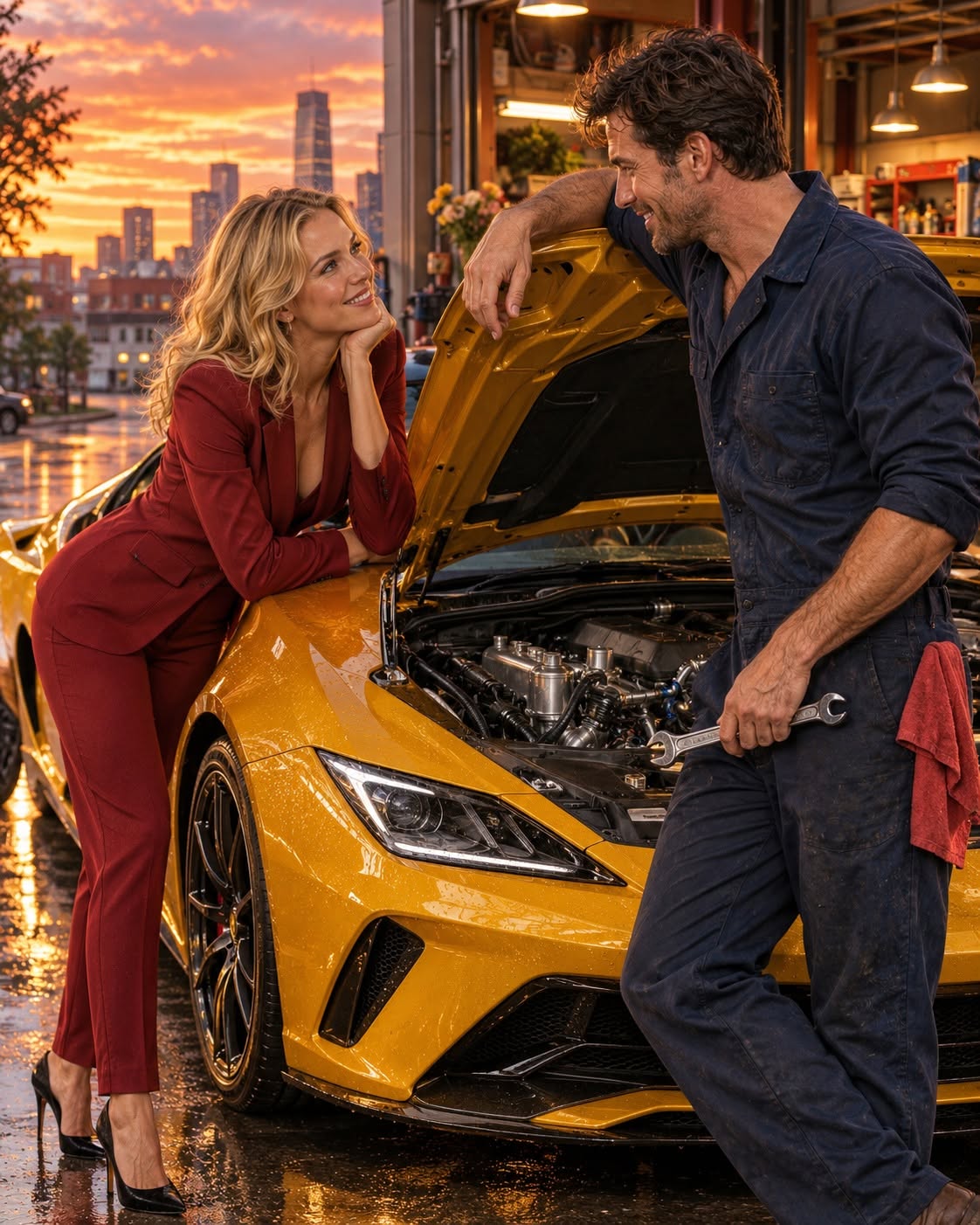
The woman standing beside the stranded electric car looked at my grease-stained hands like I was the problem.
THE TRUTH BEHIND THE PROTOTYPE
The Ending
The room fell silent when Una stepped up to the microphone.
Behind her, a massive screen displayed the company’s newest electric touring car. Rows of investors, journalists, engineers, and executives watched as she unfolded the documents in her hands.
I stood near the back of the demonstration hall, wearing the same old work jacket I’d worn when I first pulled over on that rainy coastal road. My hands were clean that morning, but I still felt as out of place as I had the first time Una looked at me.
My daughter, Mabel, was at home with our neighbor, Mrs. Collins. I’d promised her I’d be back before dinner.
I had no idea whether I’d be keeping that promise.
Una adjusted the microphone.
“For the past three years, this company has told the public that our new electric touring platform is among the safest vehicles ever developed. We’ve invited investors to see our technology, shown families our safety demonstrations, and assured regulators that our thermal management system has passed every test.”
She paused.
“Those assurances were false.”
A murmur moved through the room.
At the front table, Martin Hale, the company’s technical consultant, stopped smiling.
He had been the person who accused me of tampering with the prototype. He was also the person who had spent the previous week telling executives that my independent test results were unreliable.
“Una,” he said quietly, but his microphone picked up his voice. “I strongly recommend you stop.”
She didn’t look at him.
“On October 14, the regulator settings on prototype vehicle E-17 were changed. The new configuration reduced the sensitivity of the temperature monitoring system. It didn’t eliminate overheating. It made overheating harder to detect.”
The screen changed.
A graph appeared, showing temperature spikes that climbed dangerously high before the system registered a warning.
“These readings were recorded during independent testing,” she continued. “The official reports submitted to our safety department showed normal operating temperatures. They were not accurate.”
Martin stood.
“That data has not been independently verified.”
Una finally turned toward him.
“Actually, it has.”
She pressed a button.
The screen displayed three separate sets of test results. Mine. Those from an outside engineering laboratory. And a third set recorded by the company’s own battery monitoring system before the software configuration had been altered.
All three showed the same thing.
The cooling regulator was allowing dangerous temperature spikes.
For several seconds, nobody spoke.
Then a reporter raised her hand.
“Are you saying your company knowingly concealed a safety defect?”
Una took a breath.
“I’m saying that people inside this company knew the system was producing abnormal readings, and someone changed the settings to make those readings disappear from the official reports. I won’t pretend I know every person’s intention. But I know the public was given information that wasn’t true.”
Martin pushed his chair back.
“This is outrageous. You’re destroying years of work based on the measurements of an unqualified mechanic!”
I felt every eye turn toward me.
There it was again.
The same accusation. The same contempt.
I had expected it, but hearing it in front of hundreds of people still hurt.
I started toward the microphone.
Una lifted one hand, stopping me.
“No,” she said. “Let me finish.”
She opened another folder.
“This mechanic was hired to conduct independent testing. His original report identified a fault that our internal team had failed to disclose. Rather than investigate the fault, Mr. Hale recommended that we question his credibility.”
Martin’s face turned red.
“That’s a lie.”
“Then perhaps you can explain this.”
A new document appeared on the screen.
It was an internal email, dated six months earlier.
The sender was Martin Hale.
The recipient was the head of product development.
The subject line read: TEMPORARY REGULATOR ADJUSTMENT.
Una read aloud:
“Reducing the sensitivity threshold will prevent unnecessary warning interruptions during investor demonstrations. We can revisit the configuration after the launch window.”
A second message appeared underneath.
“Do not include the earlier thermal spikes in the public test summary. They are unlikely to occur under normal demonstration conditions.”
A journalist whispered something to the person beside her.
Martin looked around the room as if searching for someone who would rescue him.
Nobody moved.
Then he pointed at me.
“He’s the one who repaired the vehicle! How do we know he didn’t introduce the problem himself?”
I walked closer to the microphone.
“Because I documented the original condition before I touched anything,” I said. “Because the same abnormal readings appeared in the manufacturer’s archived data. And because an independent laboratory reproduced the fault without using any of my repair work.”
I looked directly at him.
“You can question my qualifications all you want. But you can’t change what the instruments recorded.”
The hall erupted.
Questions came from every direction.
Investors demanded explanations. Reporters shouted for dates and names. Several executives began speaking urgently into their phones.
Martin tried to leave through a side door, but two members of the company’s legal department approached him.
Una remained at the microphone.
“I am suspending the vehicle demonstration program effective immediately. We will notify regulators, arrange independent safety inspections, and provide full access to the relevant testing records.”
She paused.
“I also accept responsibility for failing to recognize these problems sooner. I signed off on reports that I should have questioned. My position in this company is not more important than the safety of the people who might one day drive these vehicles.”
I watched her step away from the microphone.
For the first time since I met her, she looked less like a powerful executive and more like a person who had finally decided to stop hiding behind her title.
But the hardest part of the story was still ahead.
Because telling the truth in a room full of cameras was one thing.
Living with the consequences was another.
THE PRICE OF TELLING THE TRUTH
By noon, the story had spread across the country.
The headlines were brutal.
ELECTRIC VEHICLE COMPANY HALTS LAUNCH AFTER SAFETY SCANDAL.
EXECUTIVE EXPOSES HIDDEN TEST RESULTS.
INDEPENDENT MECHANIC UNCOVERS PROTOTYPE DEFECT.
My phone wouldn’t stop ringing.
Some people called me a hero. Others accused me of chasing publicity. A few suggested I had deliberately sabotaged an expensive vehicle to make myself famous.
One online commentator even claimed that my garage had been hired by a competing manufacturer.
I had never met anyone from a competing manufacturer.
I had barely met anyone outside my neighborhood.
The attention became unbearable.
When I finally got home, Mabel was sitting at the kitchen table drawing pictures.
She looked up as I entered.
“Dad, are you famous?”
I dropped my keys beside the sink.
“No, sweetheart.”
“But Mrs. Collins said you’re on television.”
“Being on television doesn’t make someone famous.”
She considered that.
“Did you fix the car?”
“I found something wrong with it.”
“Did you tell the truth?”
I pulled out the chair opposite her.
“Yes.”
She smiled.
“Then that’s good.”
I looked at her drawing. It showed a little house with a crooked chimney, a yellow sun, and two people standing in front of it.
One was taller than the other.
Above them, in uneven handwriting, she’d written: MY DAD’S GARAGE.
I felt my throat tighten.
For months, I’d been worrying about overdue rent, broken equipment, and whether I could keep the business open long enough to give Mabel a stable childhood.
Somewhere along the way, I’d started believing that success meant never having to worry about money again.
But sitting there, looking at that drawing, I realized I’d been measuring the wrong thing.
“Dad?”
“Yeah?”
“Are they going to take your garage away?”
I reached across the table and held her small hand.
“I don’t know yet.”
Her smile faded.
“Can we still fix cars?”
I nodded.
“Every day.”
She seemed satisfied with that answer.
That night, I slept better than I had in weeks.
The next morning, however, reality returned.
My landlord, Mr. Peterson, was waiting outside the garage when I arrived.
He held a folded envelope.
“I’ve been getting calls about you,” he said.
I unlocked the side door.
“That’s unfortunate.”
He followed me inside.
“I saw the news. Big story.”
“Apparently.”
He glanced at the equipment, the old shelves, and the bucket sitting beneath the leak in the roof.
“Look, I don’t want to be the bad guy here. But you owe three months’ rent.”
“I know.”
“I can’t run this building on promises.”
I took a breath.
“I’ll have something for you by the end of the week.”
He shook his head.
“I’ve heard that before.”
He placed the envelope on my workbench.
It contained a formal notice giving me thirty days to settle the outstanding balance or vacate.
I watched him walk away.
The irony wasn’t lost on me.
I’d helped expose a company that had hidden a dangerous problem to protect its reputation. Yet I was still one missed payment away from losing the place where I’d spent twelve years building my own reputation.
For a moment, I wondered whether I should have accepted Una’s offer to cover my expenses.
Then my phone rang.
It was her.
“Can we talk?” she asked.
“About the car?”
“About everything.”
A DIFFERENT KIND OF OFFER
Una arrived that afternoon without a driver or an assistant.
She parked a modest company sedan outside my garage and stepped inside carrying two paper cups of coffee.
“I figured you wouldn’t want anything from the company cafeteria,” she said.
I accepted one.
“You’re learning.”
She smiled faintly.
Then she noticed the eviction notice on my workbench.
“How much do you owe?”
“That’s not your problem.”
“I didn’t say it was.”
“Good.”
She sat on an old wooden chair.
“The board has placed me on administrative leave.”
I leaned against the workbench.
“I’m sorry.”
“Are you?”
“Yes. You took a risk standing up there.”
She looked down at her coffee.
“I should have done it sooner.”
There was a long silence.
Then she said, “The company wants to settle this quietly. They’ll pay for your testing work, offer you a consulting contract, and issue a statement saying the investigation is ongoing. In exchange, they want you to stop speaking publicly.”
I frowned.
“Is that what you want?”
“No.”
“Then why are you asking?”
“Because I wanted you to hear the offer before I reject it.”
She placed another folder on the workbench.
Inside were copies of documents showing the company’s proposed settlement.
There was enough money to pay my debts, replace my equipment, and probably buy the garage outright.
For a few seconds, I imagined what that money could do.
A new roof.
A proper diagnostic machine.
A bedroom for Mabel that didn’t double as a storage room.
No more checking my bank balance before buying groceries.
It was tempting.
More tempting than I wanted to admit.
Then I saw a paragraph near the bottom.
The agreement required me to acknowledge that my original findings were preliminary and that no confirmed safety risk had been established.
I closed the folder.
“I can’t sign this.”
Una nodded.
“I know.”
“Do you?”
“I read the report. I saw the raw measurements. I know what the regulator was doing.”
I pushed the folder back toward her.
“Then we don’t need to pretend otherwise.”
She looked around my garage.
“You shouldn’t have to lose this place because you refused to lie.”
I gave a tired laugh.
“That’s a nice thought. But the landlord doesn’t accept moral principles as rent.”
Una looked at the eviction notice again.
“What if I told you there’s another way?”
I narrowed my eyes.
“Go on.”
“The company has an independent engineering division. The board is restructuring it after the scandal. I have proposed that the division be separated from product development and placed under an external oversight committee.”
“And?”
“I want you to run its independent vehicle-testing program.”
I almost laughed.
“You’re joking.”
“I’m not.”
“I’m a mechanic with a small garage.”
“You’re a mechanic who found a defect that our engineers overlooked, documented it properly, and refused to change his conclusions when someone threatened his livelihood.”
“That’s not the same as running an engineering department.”
“No,” she said. “It’s not.”
She leaned forward.
“That’s why I’m proposing a team. Qualified engineers, certified testing equipment, independent auditors, and a transparent reporting structure. You would lead the practical testing program. Your job would be to make sure the people who build these vehicles can’t control the people who test them.”
I stared at her.
“What happens if I find another problem?”
“You report it.”
“What happens if the board doesn’t like it?”
“Then the board answers to the oversight committee.”
“And what happens if you change your mind?”
She met my eyes.
“Then you walk away.”
I didn’t answer immediately.
For the first time, I wasn’t being asked to rescue a broken machine.
I was being asked to help build something that might prevent the next one from breaking.
But I had one condition.
“Mabel comes first.”
Una nodded.
“Of course.”
“No travel without notice. No late-night emergencies unless there’s an immediate safety issue. And I want everything in writing. No favors. No secret arrangements.”
She smiled.
“Those are reasonable conditions.”
“One more thing.”
“Yes?”
“I want the reports published, even when they make the company look bad.”
Una picked up her coffee.
“That’s the whole point.”
THE EVIDENCE NOBODY EXPECTED
Two weeks later, the investigation took an unexpected turn.
The independent laboratory had completed a deeper examination of the prototype’s control system.
The regulator settings hadn’t simply been lowered to reduce warning interruptions.
Someone had installed a secondary software routine that temporarily suppressed certain temperature readings during high-load operation.
It was more deliberate than anyone had initially suspected.
The software had been signed with a development certificate assigned to Martin Hale.
But when investigators traced the installation records, they discovered something else.
The software had been deployed using an access key belonging to the company’s chief operating officer, Daniel Voss.
Daniel had not been mentioned in the original emails.
He had been Martin’s supervisor.
He had also approved the budget for the prototype demonstration program.
The investigation team contacted him for an interview.
He refused.
Then, three days later, an anonymous envelope arrived at the independent laboratory.
Inside was a flash drive containing internal meeting recordings and a series of encrypted messages.
The laboratory forwarded everything to the regulators.
One recording changed the entire direction of the case.
It captured a meeting between Daniel, Martin, and two senior managers.
Daniel’s voice was unmistakable.
“We cannot delay the launch again. Investors have already been promised a demonstration. The thermal issue is intermittent. If the system doesn’t detect it, it doesn’t become a public issue.”
Martin responded, “But if the battery overheats during a test?”
Daniel laughed.
“Then make sure the test doesn’t run long enough.”
The room went quiet.
A manager asked whether the safety team should be informed.
Daniel replied, “The safety team answers to me.”
The recording ended.
This was no longer a dispute about engineering judgment.
It was evidence of a deliberate attempt to conceal a potential safety hazard.
Martin was dismissed.
Daniel resigned before the company could formally suspend him.
Regulators opened a broader inquiry into the company’s testing practices.
And the company announced a recall of every prototype using the affected regulator configuration.
But the anonymous flash drive created another problem.
Who had sent it?
The laboratory had no answer.
Una called me late one evening.
“Have you heard about the recording?”
“I have.”
“Someone inside the company finally came forward.”
“That’s good.”
“Not necessarily. Whoever sent it took a serious risk.”
“Maybe they got tired of watching people lie.”
She was quiet for a moment.
“There’s something else. The access logs show that the files were downloaded using a temporary account belonging to someone in the testing department.”
“Do they know who?”
“Not yet.”
I thought about the engineers I’d met during my first week at the facility. Most had seemed nervous, but one had stood out.
A young software engineer named Ethan Cole.
He had barely spoken during the meetings, but he’d asked me several questions about the temperature logs.
One afternoon, after I’d found the first suspicious readings, he’d quietly said, “Sometimes the numbers tell you what the people are afraid to say.”
I called Una.
“Have you spoken to Ethan?”
“Not yet. Why?”
“Because I think you should.”
The following morning, Ethan arrived at the independent laboratory.
He looked exhausted.
When Una asked whether he’d sent the files, he didn’t deny it.
“I didn’t know what else to do,” he said.
“Why didn’t you come forward earlier?” she asked.
He stared at the table.
“Because Martin told me my career would be over if I challenged the configuration. Daniel told my manager that the next round of layoffs would start in testing.”
He rubbed his hands together.
“I have a mortgage. My wife is expecting our first child. I kept telling myself the system was probably safe. I thought someone more senior would deal with it.”
Una’s expression softened.
“You’re not the only person who was afraid.”
Ethan looked up.
“Will I lose my job?”
“I can’t promise you that nothing will change,” she said. “But I can promise that your evidence will be protected, and retaliation will be investigated.”
I watched him breathe out slowly.
For the first time, I understood something important.
The problem hadn’t survived because one man was powerful.
It had survived because dozens of people had been made to feel powerless.
And that was something a new safety system alone couldn’t fix.
THE GARAGE THAT ALMOST DISAPPEARED
The next month was difficult.
The company continued its investigation. My new role remained uncertain. Lawyers reviewed contracts, regulators requested documents, and journalists kept asking whether I had become a corporate whistleblower.
Meanwhile, my garage was still losing money.
The roof continued leaking.
One of my lifts broke.
A supplier refused to extend my credit.
Then, on a Thursday morning, I found a handwritten note taped to my office door.
It was from Mr. Peterson.
He wanted to see me.
I walked to his office expecting another eviction warning.
Instead, he handed me a newspaper.
The headline read:
LOCAL MECHANIC’S INDEPENDENT TESTING HELPS EXPOSE VEHICLE SAFETY COVER-UP.
Beneath it was a photograph of me standing beside my van.
I grimaced.
“I hate that picture.”
Mr. Peterson laughed.
“Well, it got people talking.”
He opened a drawer and pulled out a new document.
“I’ve been thinking.”
I looked at him suspiciously.
“That sounds dangerous.”
He smiled.
“I own this building because my father left it to me. He ran a repair shop here for forty years. When I first started renting to you, I thought you’d stay a couple of years and move somewhere bigger.”
He tapped the paper.
“But you’ve been here twelve years. You know every crack in these walls. You helped my nephew when his car broke down and he couldn’t afford a proper repair. You’ve fixed my wife’s old truck more times than I can count.”
He slid the document toward me.
It was a revised lease.
The overdue rent had been converted into a manageable repayment plan. The monthly rent would be reduced for a year, and I would have the option to purchase the building if I could meet the agreed conditions.
I looked up.
“Why?”
“Because I watched you turn down a lot of money when you could have easily taken it and disappeared.”
He shrugged.
“People who care about doing things properly are becoming harder to find.”
I couldn’t speak for a moment.
Then I shook his hand.
“Thank you.”
“Don’t thank me yet. You’re still responsible for fixing that roof.”
We both laughed.
That evening, I told Mabel the news.
She jumped off the couch.
“Does that mean we can stay?”
“Yes.”
“Forever?”
I smiled.
“Not forever. But for a long time.”
She ran to her bedroom and returned with the drawing she’d made weeks earlier.
She placed it on the table.
“Now we need a bigger picture.”
“What for?”
“Because the garage is going to be bigger.”
I looked at her.
“How do you know?”
She shrugged.
“Because you always fix things.”
I hugged her tightly.
For the first time in a long while, the future didn’t look like something I needed to survive.
It looked like something I could build.
A NEW KIND OF WORKSHOP
Six months later, the company’s independent testing division officially opened.
It wasn’t glamorous.
The facility had plain walls, practical equipment, and a testing floor designed to reproduce real-world driving conditions.
There were no enormous promotional banners or glossy photographs of smiling families.
Instead, there was a large sign above the entrance:
SAFETY IS NOT A MARKETING PROMISE.
IT IS A RESPONSIBILITY.
I was appointed director of practical testing, with a contract that guaranteed independent reporting and protected my authority to halt a test whenever I identified a serious concern.
My first decision was to establish a rule.
Every test result, including failed tests, would be preserved in its original form.
No adjustments could be made without a recorded explanation and independent approval.
Every software change would have a traceable record.
And no executive could overrule a safety finding simply because a demonstration or launch date was approaching.
Some people called the rules excessive.
I called them necessary.
Ethan joined the new team as a senior software verification engineer.
He was still nervous about speaking in meetings, but he had started asking difficult questions.
That was a good sign.
Una returned to work after the board completed its review.
She had lost her position as chief executive.
At first, I thought she would fight to get it back.
Instead, she accepted a smaller role overseeing the company’s restructuring and compliance program.
When I asked why, she said something I never forgot.
“I used to think leadership meant protecting the company from bad news. Now I think it means making sure bad news reaches the people who can do something about it.”
The company eventually paid substantial penalties, replaced the affected systems, and agreed to independent monitoring.
Martin and Daniel faced separate legal proceedings. The findings against them were no longer based on rumors or accusations but on preserved technical records, internal messages, and testimony.
The full investigation took more than a year.
It was messy.
It was expensive.
And it damaged the company’s reputation.
But the vehicles were made safer, and the people responsible could no longer hide behind polished presentations.
As for me, I never became an executive.
I still wore work boots.
I still preferred a wrench to a conference room.
And I still drove my old van.
The difference was that my garage finally had a solid roof.
THE LAST TEST
One year after the demonstration scandal, the company invited a small group of journalists and regulators to observe the first public safety test of its redesigned electric touring vehicle.
I stood beside the prototype as the engineers prepared it.
Una was there, along with Ethan and the new safety team.
A reporter approached me.
“After everything that happened, do you trust this company now?”
I considered the question.
“I trust the process we’ve built,” I said. “Trusting a company blindly is what got us into trouble in the first place.”
The reporter nodded.
“And what about the vehicle?”
“We’ll know after the test.”
She smiled.
“You’re not giving me a very exciting answer.”
“I’m not here to give exciting answers. I’m here to give accurate ones.”
The test began.
The car accelerated along the enclosed track. Engineers monitored the battery temperature, cooling pressure, regulator response, and electrical load.
The numbers remained stable.
Then, halfway through the test, a warning appeared on the monitoring display.
The entire team went still.
A temperature sensor had recorded an unexpected increase.
The test supervisor immediately called for a controlled shutdown.
The vehicle slowed and stopped.
I walked toward the monitoring station.
“What’s the reading?”
Ethan examined the data.
“Temperature increase in the rear battery module. It’s within the emergency response threshold, but it’s higher than our expected range.”
“Any regulator failure?”
“Not according to the primary sensor.”
I looked at the secondary reading.
It was slightly different.
Not dangerously different, but enough to make me pause.
“Don’t reset anything,” I said. “Save the raw data. We’ll inspect the module before running another test.”
One of the visiting executives sighed.
“Really? We’re stopping the demonstration for a minor discrepancy?”
I turned toward him.
“Yes.”
“But the car is still operating normally.”
“Then it can wait until we understand the discrepancy.”
He shook his head.
“We’ve got investors watching.”
I looked through the glass toward the observers.
“I know.”
For a moment, I thought about the first rainy night. The stranded car. Una’s warning not to touch it. My leaking garage. The contract that had nearly cost me everything.
Then I looked at the engineers around me.
Nobody argued.
Nobody tried to hide the result.
They simply began the inspection.
Two hours later, the team discovered a cooling line that had been installed with an incorrect bend radius. Under certain conditions, it restricted coolant flow.
It wasn’t a catastrophic defect.
But if left undetected, repeated high-load operation could have accelerated component wear and created a more serious problem over time.
The manufacturer issued a correction before the vehicle entered production.
The journalists were surprised that we had stopped the demonstration over something relatively small.
I wasn’t.
The whole point of independent testing was to catch small problems before they became large ones.
When the reporters finally left, Una stood beside me on the track.
“Do you ever regret getting involved?” she asked.
I looked at the vehicle.
“Sometimes I regret how much trouble it caused.”
“That’s not the same thing.”
“No.”
She smiled.
“Would you pull over again if you saw that car on the side of the road?”
I laughed.
“Probably. Although I’d make sure the owner knew I was a mechanic before getting out.”
She laughed too.
Then she became serious.
“I never apologized properly for the way I treated you that first night.”
I looked at her.
“You did apologize.”
“Not enough.”
She glanced toward the testing floor.
“I thought your hands made you less qualified to help me. I thought the car’s value made my judgment more important than yours.”
She paused.
“I was wrong.”
I shrugged.
“Most people are wrong about something.”
“That’s generous.”
“Don’t get used to it.”
We stood there for a while, listening to the quiet hum of the facility.
Then my phone vibrated.
It was a message from Mabel.
A photograph appeared on the screen.
She was standing in front of our garage, holding a cardboard sign.
It read:
DAD, DON’T FORGET DINNER.
UNDERNEATH, she’d drawn a little electric car with a giant wrench beside it.
I laughed.
“Everything okay?” Una asked.
“Just a reminder that I have another boss.”
“She sounds demanding.”
“She is.”
I put my phone away.
“She’s also the reason I didn’t give up.”
WHAT REALLY MATTERED
A few months later, the company published its first independent safety report.
It included every major test, every failed result, every corrective action, and the names of the teams responsible for reviewing them.
The report wasn’t perfect.
It was long, technical, and occasionally uncomfortable.
But it was honest.
At the back was a photograph of the testing team.
I stood in the middle wearing my old work jacket.
Ethan was beside me.
Una stood at the end of the row.
Nobody was smiling particularly well.
We looked tired.
But we looked like people who had done something worth doing.
The report was distributed to regulators, investors, and the public.
For the first time, the company wasn’t asking people to trust its promises.
It was showing them the evidence.
That evening, I returned to my garage.
The new roof kept the rain outside.
The lights worked.
The equipment was organized.
And Mabel was sitting at the workbench doing her homework.
She looked up when I entered.
“You’re late.”
“I know.”
“Did you fix the car?”
I hung my jacket on its usual hook.
“We found another problem.”
She sighed dramatically.
“Cars are always breaking.”
“That’s why people need mechanics.”
She returned to her homework.
A few minutes later, she asked, “Dad, why did you help that lady when she was mean to you?”
I stopped sorting the tools.
It was a simple question.
But it deserved a careful answer.
“Because her car was in trouble.”
“But she didn’t believe you.”
“That’s true.”
“Then why help?”
I sat beside her.
“Because doing the right thing shouldn’t depend on whether someone likes you.”
She thought about that.
“Even if they say something mean?”
“Even then. But that doesn’t mean you have to let them treat you badly. You can help someone and still expect them to respect you.”
She nodded slowly.
Then she picked up her pencil.
“That’s a good rule.”
I smiled.
“Try to remember it.”
She looked at the drawing she’d been working on.
It was a picture of our garage, but this time she’d added something new.
A sign above the entrance.
I leaned closer.
“What does it say?”
She read it aloud, stumbling over a few of the longer words.
“GOOD WORK. HONEST PEOPLE. SECOND CHANCES.”
I stared at the words.
Then I looked at her.
“That’s better than anything I could have written.”
She grinned.
“I know.”
Outside, the evening rain began to fall.
It tapped against the new roof, soft and steady.
I thought about the woman on the coastal road, the silent prototype, the hidden readings, and the room full of people who had finally heard the truth.
I thought about the engineers who had been afraid to speak, the people who had risked their careers, and the families who would never know how close they might have come to driving an unsafe vehicle.
Most of all, I thought about the small decision that had started everything.
I had been tired.
I had been broke.
I had been on my way home.
And I could have kept driving.
But I had stopped.
Not because I expected a reward.
Not because I knew the woman would eventually trust me.
Not because I imagined I’d one day be standing in a laboratory helping to change an entire company’s safety culture.
I stopped because I heard something wrong, and I knew enough to understand that ignoring it would be easier than fixing it.
That was all.
And sometimes, that’s where the biggest changes begin.
Mabel reached over and took my hand.
“Dad?”
“Yeah?”
“When I grow up, I want to work in the garage.”
I smiled.
“You don’t have to become a mechanic.”
“I know.”
She looked toward the door, where my old van sat beneath the streetlight.
“But I want to learn how things work.”
I squeezed her hand.
“Then I’ll teach you.”
She returned to her homework, humming quietly.
I turned off the main lights and left the smaller lamp above her desk glowing.
The garage was no longer just a place where I repaired broken machines.
It had become a place where people could ask difficult questions, where mistakes could be admitted, and where the truth mattered more than appearances.
I had once believed that saving my garage meant saving my future.
Now I understood that the garage had never been the most important thing I owned.
It was the example I was leaving behind for my daughter.
A person could be overlooked because of the clothes they wore, the money they had, or the job printed on their business card.
But character wasn’t measured by any of those things.
It was measured by what someone chose to do when nobody was offering a reward.
And sometimes, the person everyone else underestimated was the only one willing to notice what was going wrong.
That night, as I locked the garage door, I glanced at the little sign Mabel had made.
GOOD WORK. HONEST PEOPLE. SECOND CHANCES.
I smiled.
For once, everything felt exactly where it belonged.
THE END