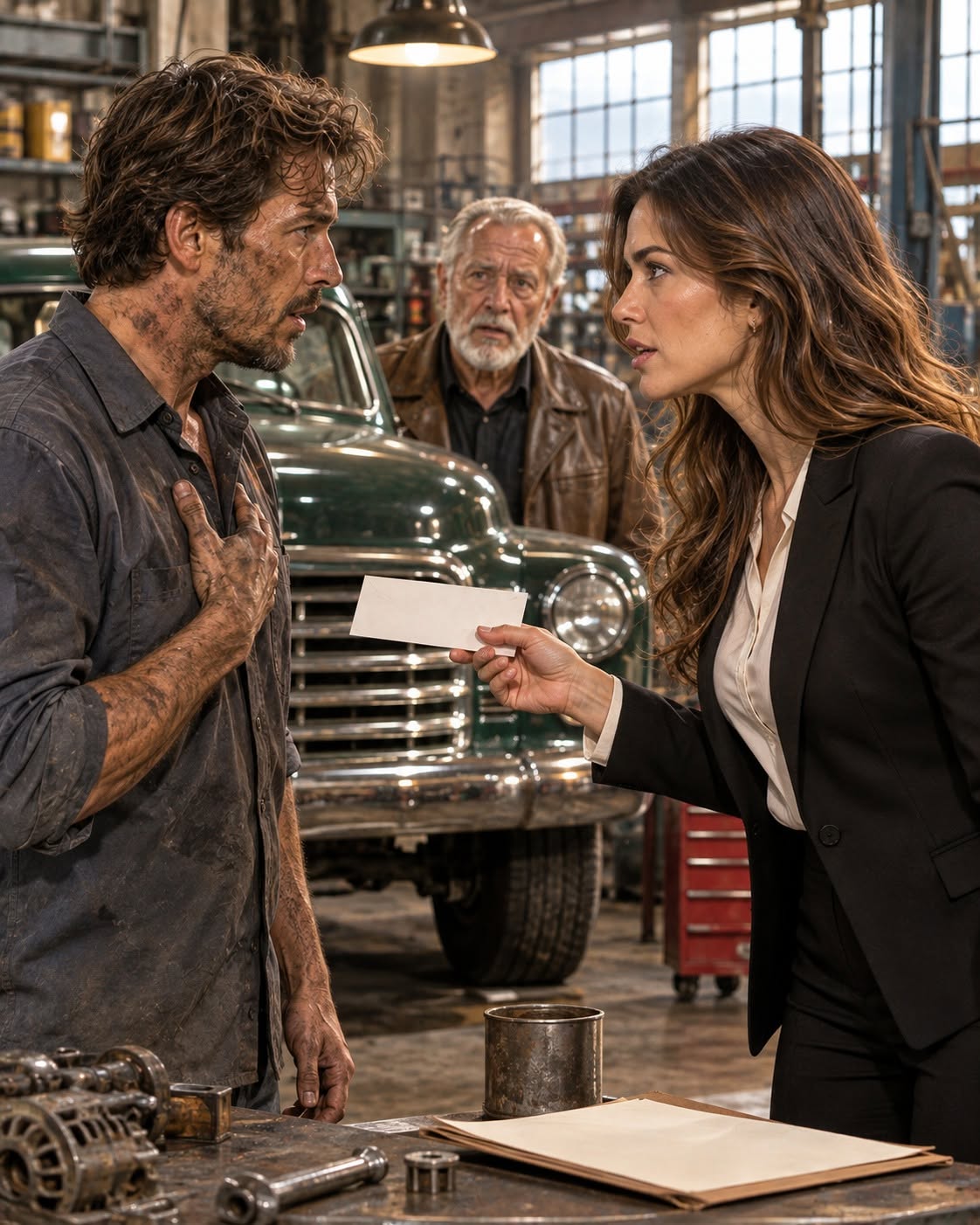
The woman in the expensive coat slammed a $25,000 check onto my workbench and told me to disappear from her father’s life.
Clare lowered her eyes to the check.
For several seconds, she stood there without saying anything. The confidence she’d walked in with seemed to have disappeared, replaced by something I couldn’t quite identify.
Then she folded the check in half and slipped it into her expensive handbag.
“I’ll tell my father what happened,” she said.
“You can tell him whatever you want. Just make sure you tell him the truth.”
She gave me a brief, uncomfortable nod before turning toward the door.
But just as she reached it, she stopped.
“One question,” she said without looking back. “If you knew who my father was, would you have stopped that day?”
I wiped my hands on an old rag.
“I guess we’ll never know. But I hope I would have stopped for anyone.”
She didn’t answer.
The bell above the garage door rang as she stepped outside.
I watched her black luxury car disappear down the street, then returned to the engine I’d been working on.
I had no idea that the following morning, everything I’d believed about Walter, his daughter, and my father’s garage would begin to change.
At 8:15 the next morning, I was opening the garage when I noticed a familiar dark green pickup parked across the street.
My stomach tightened.
Walter was standing beside it, wearing a thick brown coat and holding a paper bag.
He looked considerably warmer than he had on the highway, but his smile was just as genuine.
“Morning!” he called.
I walked toward him.
“Mr. Walter? What are you doing here?”
He laughed.
“First, call me Walter. Second, I brought breakfast. I figured the least I could do was make sure the man who rescued me didn’t starve.”
He held out the bag.
Inside were two breakfast sandwiches and a couple of coffees.
I smiled despite myself.
“You really didn’t have to do that.”
“I know. That’s why I wanted to.”
We stood near the garage entrance while he explained how he’d managed to find me.
Apparently, after getting home safely, he’d asked his driver to track down the mechanic who had helped him. He wanted to thank me properly.
He’d also heard something from Clare.
“She told me she visited you yesterday,” he said.
I looked at him.
“She did.”
“And she told me she offered you twenty-five thousand dollars.”
I sighed.
“She wanted me to stay away from you.”
Walter’s smile vanished.
“She did what?”
I didn’t want to turn the morning into an argument between a father and daughter, so I simply explained what had happened.
I told him about the check, the conditions, and why I’d refused it.
Walter listened without interrupting.
When I finished, he looked toward the garage.
“Do you know what bothers me most?” he asked.
I shook my head.
“I’ve spent forty years building a company. I’ve hired thousands of people, negotiated enormous contracts, and made decisions that affected entire communities. Yet somewhere along the way, my daughter started believing that everyone who approaches me must want something.”
He looked down at his coffee.
“Perhaps I’ve helped create that problem.”
I wasn’t sure what to say.
He glanced at the faded sign above my garage.
“How long has this place been here?”
“Thirty-eight years. My father opened it.”
“And you took it over?”
“After he passed away.”
Walter nodded slowly.
“Must have been difficult.”
“It still is.”
For a moment, I considered telling him about the foreclosure notice. But I didn’t want him to think I’d refused his daughter’s money only to ask him for something directly.
So I changed the subject.
We talked about his truck instead.
He told me he’d owned it for almost twenty years. It had belonged to his late wife, Margaret, and he’d refused to replace it even after his company could have bought him a fleet of new vehicles.
“She loved that old thing,” he said. “Sometimes keeping something matters more than its market value.”
I looked at my garage.
I understood exactly what he meant.
Before leaving, Walter reached into his coat pocket and handed me a small card.
“My personal number. If you ever want to talk, call me.”
I accepted it.
“Thank you.”
He started toward his pickup, then turned around.
“One more thing. Clare is going to apologize to you.”
I raised an eyebrow.
“Did she tell you that?”
“No. But I’m going to make sure she understands that money cannot repair every mistake.”
He drove away.
And for the first time in months, I found myself smiling before opening the garage.
Unfortunately, the good feeling didn’t last.
At around eleven, my accountant called.
I’d been expecting the call, but that didn’t make it any easier.
The bank had rejected my request for an extension. The overdue loan had reached its final stage, and the foreclosure process was moving forward.
I had seven days to make a substantial payment or risk losing the property.
I sat at my desk for several minutes after hanging up.
My father’s old photograph was hanging above the filing cabinet. He was standing in front of the garage on opening day, wearing the same grease-stained shirt he always wore when working.
He’d been so proud of that place.
I remembered him telling me something when I was a teenager.
“Son, a business isn’t just the building. It’s the people who trust you enough to come back.”
I had spent years trying to live up to those words.
Now I was running out of time.
That afternoon, something unexpected happened.
A woman walked into the garage carrying a large folder.
It was Clare.
She wasn’t wearing the same expensive coat. Instead, she had on a simple navy jacket, and her hair was tied back.
“Do you have a minute?” she asked.
I put down my wrench.
“That depends. Did you bring another check?”
She gave a small, embarrassed smile.
“No. I came to apologize.”
I leaned against the workbench.
She took a breath.
“I spoke to my father last night. He told me about your refusal.”
“Okay.”
“He also told me about my mother.”
That caught my attention.
Clare opened the folder and pulled out an old photograph.
It showed a younger Walter standing beside a woman in front of a small neighborhood grocery store.
“My mother grew up in a family that owned a little grocery shop,” she explained. “When my grandfather died, the family struggled to keep it open. My mother worked there every day until she was exhausted. Eventually, a wealthy investor offered to buy the building. He promised to help her, but his real intention was to take control of the property.”
She paused.
“My mother trusted him. She signed the papers without understanding everything. Within months, the shop was gone.”
I looked at the photograph.
“That’s terrible.”
“It was. My father spent years trying to help her rebuild her life. He eventually became successful, but my mother never completely recovered from what happened.”
Clare looked toward the garage.
“When she passed away, Dad became very protective of people who were close to him. And I became even worse. I convinced myself that anyone who approached him with kindness was probably looking for an opportunity.”
She lowered her eyes.
“Yesterday, I saw your financial situation. I knew you were desperate. Instead of asking why you’d helped him, I decided I already knew your motives.”
I didn’t say anything.
“I’m sorry,” she repeated. “You deserved better.”
I studied her face.
For the first time, I wasn’t looking at a wealthy woman who believed she could purchase anything. I was looking at someone who had spent years allowing fear to make decisions for her.
“Thank you for saying that,” I replied.
She nodded.
Then her eyes moved toward the old photograph of my father.
“Was this his garage?”
“Yes.”
“He must have been proud.”
“He was. I wish he could see it now.”
She noticed the stack of papers on my desk.
“Is that the foreclosure notice?”
I hesitated before answering.
“Yes.”
“How much do you owe?”
I shook my head.
“I don’t think that’s a conversation we need to have.”
She accepted my response.
“Fair enough.”
Then she surprised me.
“My father has a foundation that supports small family businesses. He started it after my mother died. It helps independent shops, family-owned stores, and local tradespeople who are struggling to survive.”
I looked at her carefully.
“Is this another offer with conditions?”
“No,” she said quickly. “And I don’t have the authority to promise you anything. But I think you should apply.”
I almost laughed.
“A foundation?”
“It’s not a charity that simply hands out money. They review applications, business records, and the plans owners have for keeping their companies alive.”
She placed a brochure on the workbench.
“You’d have to qualify like everyone else.”
I picked it up.
For some reason, that made all the difference.
There was no check being pushed toward me. No demand that I disappear. No attempt to purchase my gratitude.
Just an opportunity.
“Thank you,” I said.
Clare nodded.
“Good luck.”
She started to leave, but I called after her.
“Clare?”
She turned.
“Your father seems like a good man.”
Her expression softened.
“He is. He’s just getting older, and I think I’ve been so busy protecting him that I’ve forgotten to let him live.”
She left the brochure on my workbench and walked out.
That evening, I read every page.
The foundation offered low-interest emergency loans, equipment grants, and business mentoring. There were strict requirements, but I met most of them.
The biggest challenge was proving that the garage could become financially sustainable.
I had customers, but my equipment was old. I couldn’t afford to hire another mechanic, and the building needed electrical repairs.
If I could modernize the shop, I believed I could save it.
I spent the next two days preparing the application.
I included our financial records, customer reviews, repair history, and a detailed plan for improving the business.
I even attached a photograph of my father standing outside the garage.
In the personal statement, I wrote:
“This garage has never made me wealthy. But it has allowed me to earn an honest living, help my neighbors, and carry on something my father built with his own hands. I am not asking anyone to save a business that has no future. I am asking for the chance to prove that a small independent garage can still have one.”
I submitted the application on Friday.
Then I waited.
On Monday morning, the bank sent another letter.
The deadline had not changed.
Seven days.
I called several customers who owed me money. I sold an old motorcycle I had been keeping in storage. I even considered selling my father’s vintage tool chest, although the thought made my stomach turn.
Nothing was enough.
By Wednesday, I was beginning to accept that the garage might be gone.
Then, at 4:30 in the afternoon, a black sedan pulled into the parking lot.
A man in a gray suit stepped out.
He introduced himself as Daniel Brooks, the director of Walter’s family foundation.
“I believe you submitted an application for emergency business support,” he said.
“Yes.”
“We’d like to discuss it.”
I invited him inside.
He examined the workshop, asked about our equipment, and spent nearly two hours reviewing my records.
He wasn’t impressed by emotional stories. He wanted numbers.
How many vehicles did we service each month?
What was our average repair cost?
How much would new equipment increase productivity?
What would happen if business dropped during winter?
I answered everything as honestly as I could.
Finally, he closed his folder.
“Your situation is difficult,” he said.
“I know.”
“But your business has something many struggling companies don’t.”
“What’s that?”
“A loyal customer base. Your records show that nearly seventy percent of your customers return regularly. That’s unusual for a shop of this size.”
I nodded.
“My father always said that trust is worth more than advertising.”
Daniel smiled.
“He may have been right.”
Before leaving, he told me the committee would review my application the following morning.
I thanked him.
But he wasn’t finished.
“One more thing. Mr. Walter specifically requested that your application receive the same independent review as every other application. He doesn’t want you to receive special treatment because you helped him.”
That surprised me.
“Good,” I said. “That’s exactly how it should be.”
Daniel shook my hand.
“I’ll be in touch.”
The next day passed painfully slowly.
Every time a car stopped outside, I looked toward the door.
At 2:17 p.m., my phone rang.
It was Daniel.
“Your application has been approved.”
I stopped breathing for a moment.
“What?”
“The committee has approved a twenty-four-thousand-dollar emergency business loan, along with a twelve-thousand-dollar equipment modernization grant. The loan has a very low interest rate and a repayment schedule designed around your projected cash flow.”
I sat down.
“Are you serious?”
“Yes. There’s also a business mentor assigned to help you improve your operations. We believe the garage has a viable future.”
I covered my face with one hand.
For several seconds, I couldn’t speak.
The total support was enough to bring the overdue payments under control, stop the immediate foreclosure threat, and replace the equipment that had been holding the business back.
It wasn’t the twenty-five-thousand-dollar check Clare had offered.
It was something better.
It was a chance to keep what my father had built without surrendering my independence.
I thanked Daniel repeatedly.
After hanging up, I walked into the workshop and stood beneath my father’s photograph.
“We’re still here, Dad,” I whispered.
But the story wasn’t finished.
The following Saturday, Walter called and invited me to lunch.
I almost declined. I had too much work waiting.
But something in his voice made me accept.
We met at a small diner near the edge of town.
To my surprise, Clare was there too.
Walter stood when I approached.
“There he is! The most stubborn mechanic in the county.”
I laughed.
“Coming from a man who refuses to replace a twenty-year-old pickup, I’ll take that as a compliment.”
Clare smiled.
We ordered lunch, and for the first twenty minutes, we talked about ordinary things.
Walter told stories about his early business days. He’d started with two delivery trucks and a borrowed warehouse. His first major contract had nearly bankrupted him.
“I made mistakes,” he said. “Plenty of them. But I learned something important. You can recover from losing money. It’s much harder to recover from losing people’s trust.”
Clare looked at her father.
“You’ve told me that a thousand times.”
“And you still need to hear it.”
She rolled her eyes, and we all laughed.
Then Walter became serious.
“I heard your application was approved.”
“It was. I’m grateful.”
“You earned it.”
“I hope so.”
He leaned back.
“There’s something else I’ve been thinking about. Our foundation supports businesses, but we also want to help preserve skilled trades. Independent mechanics, electricians, carpenters, people whose knowledge is disappearing.”
I listened carefully.
“Would you consider helping us build a training program?”
I wasn’t sure what he meant.
“Training program?”
“Young people who don’t want to spend four years in college but want to learn a practical trade. We could help them get apprenticeships in small local businesses.”
I considered the idea.
My father had always believed that good mechanics were becoming harder to find. He’d often complained that young people were encouraged to chase office jobs while skilled trades were treated as second-class careers.
“I’d be interested,” I said. “But I’d want it to be practical. No fancy presentations. Let them get their hands dirty.”
Walter laughed.
“That’s exactly what I had in mind.”
Clare opened a notebook.
“We’ve actually been discussing something similar. We could start with three businesses in the area.”
For the next hour, we discussed possibilities.
The foundation could cover safety equipment, basic tools, and training stipends. Local businesses would provide practical instruction.
My garage would become one of the first participating locations.
When lunch ended, Walter shook my hand.
“I think this could become something important.”
I looked at Clare.
“Looks like we might finally be working together.”
She smiled.
“Provided you promise not to judge me by my expensive coat.”
“I’ll try.”
Over the next few months, the garage slowly changed.
We installed new diagnostic equipment, repaired the electrical system, and replaced the compressor that had been making that terrible noise for years.
I painted the walls, repaired the sign, and cleaned up the front office.
But the biggest change wasn’t in the building.
It was the people.
Three young apprentices joined our program.
The first was a nineteen-year-old named Ethan, who had dropped out of college because he couldn’t afford the tuition.
The second was a single mother named Rosa, who had always wanted to become a mechanic but had never found a shop willing to train her.
The third was a quiet seventeen-year-old named Marcus, who had grown up watching his grandfather repair cars.
They were different in almost every way.
But they all shared one thing: they wanted an opportunity.
I taught them what my father had taught me.
How to listen to an engine.
How to recognize a problem before replacing expensive parts.
How to explain a repair honestly to a customer.
And most importantly, how to treat people.
“Never make someone feel stupid because they don’t understand what’s wrong with their car,” I told them. “They trusted you enough to bring it here. Respect that.”
Ethan was especially talented.
He could identify unusual engine noises faster than anyone I’d ever trained.
Rosa was incredibly organized and quickly became the person everyone depended on when the shop got busy.
Marcus struggled at first, but he never gave up.
Watching them learn made me realize something I’d almost forgotten.
My father’s garage had never been just a place where people brought broken cars.
It was a place where people learned, worked, and built better lives.
Six months after Clare first walked into my garage, the foundation organized a small community event to celebrate the training program.
Walter attended, despite his insistence that public events were exhausting.
Clare arrived carrying a box of pastries.
She’d become a regular visitor by then, although she usually came to discuss foundation projects rather than personal matters.
As the event began, Walter asked me to say a few words.
I wasn’t comfortable speaking in front of a crowd, but I stepped forward.
I looked at the apprentices, the customers, and the people who had supported the garage.
“Six months ago, I thought I was going to lose this place,” I began.
“I was behind on payments, my equipment was failing, and I had no idea how to keep the business alive.”
I glanced at Walter.
“Then I helped a stranger on the side of a snowy highway. I didn’t know his name, and I certainly didn’t know he was wealthy.”
A few people laughed.
“When his daughter came here, she offered me twenty-five thousand dollars to disappear from his life. I refused because I didn’t want kindness to become a transaction.”
Clare lowered her head with a smile.
“But something unexpected happened. Instead of receiving a handout, I was given an opportunity to prove that this business still mattered. And that opportunity didn’t just save a building. It created jobs, trained young people, and gave our community something valuable.”
I paused.
“My father used to say that the real measure of a business wasn’t how much money it made. It was how many people could depend on it.”
I looked at the apprentices.
“Today, I think I finally understand what he meant.”
The crowd applauded.
Walter stood first.
He clapped longer than anyone else.
After the event, Clare approached me.
“I owe you another apology,” she said.
I raised an eyebrow.
“Another one?”
She laughed.
“I’ve been thinking about the day I came here with that check. I was so certain I was protecting my father that I didn’t realize I was treating you exactly the way I’d always feared people would treat him.”
I nodded.
“What changed?”
She looked around the garage.
“You did. You showed me that someone can help another person without expecting anything. And you made me realize that protecting someone doesn’t mean controlling every relationship they have.”
She hesitated.
“I’ve also started volunteering with the foundation’s small-business program. I want to understand the people we’re supposed to be helping, rather than just reviewing numbers from an office.”
“That’s a good place to start.”
She smiled.
Then she asked something unexpected.
“Would you like to have dinner with me sometime?”
I blinked.
“Are you asking me out?”
She laughed, slightly embarrassed.
“Yes. I suppose I am.”
I looked at her for a moment.
The woman standing in front of me was very different from the one who had entered my garage months earlier.
She wasn’t trying to buy anything.
She wasn’t demanding anything.
She was simply asking.
“I’d like that,” I said.
And that was how our friendship began.
It didn’t turn into a perfect romance overnight.
We had disagreements. Sometimes Clare struggled to understand why I preferred fixing something myself instead of paying someone else to do it. Sometimes I struggled to understand why she scheduled every minute of her day.
But we learned.
She taught me that accepting help wasn’t the same as surrendering independence.
I taught her that not every problem could be solved by making a phone call and signing a check.
A year after the snowstorm, Walter returned to the garage.
This time, his green Ford pickup was running perfectly.
He parked outside and walked in carrying a familiar paper bag.
“Breakfast?” I asked.
“Of course. Tradition.”
We sat at the old workbench, the same one where Clare had once placed that twenty-five-thousand-dollar check.
Walter looked around.
The walls had been repainted. The equipment was newer. The apprentices were busy working on two vehicles.
But I had kept my father’s old photograph in exactly the same place.
Walter followed my eyes.
“Your father would be proud.”
I smiled.
“I hope so.”
He reached into his coat and pulled out a small envelope.
“There’s something I want you to have.”
I opened it.
Inside was a photograph of Walter’s late wife, Margaret, standing beside her old grocery store.
On the back, he’d written a sentence:
“Some things are worth saving because of the people who built them.”
I looked up.
“Thank you.”
Walter nodded.
“She would have liked you.”
We sat quietly for a moment.
Then he glanced toward the apprentices.
“How many have you trained now?”
“Seven.”
“And how many are still working?”
“All seven.”
He smiled.
“That’s better than most of my investments.”
I laughed.
A few minutes later, Clare walked through the door.
She had a coffee in one hand and a folder in the other.
“Good morning, gentlemen.”
Walter looked at her.
“You’re late.”
“I’m three minutes early.”
“Exactly. Late for me.”
She shook her head and sat beside me.
We spent the morning discussing the next stage of the training program. The foundation wanted to expand into neighboring towns, and we’d been asked to help select new partner businesses.
I agreed, with one condition.
Every participating business had to commit to treating apprentices fairly and paying them for their work.
Walter approved immediately.
Clare wrote it into the program requirements.
It was a small decision, but it mattered.
That afternoon, after everyone had left, I stayed behind to close the garage.
I turned off the lights one by one, listening to the familiar sounds of the building settling for the night.
The compressor was quiet now.
The tools were organized.
The bills were paid.
For the first time in years, I wasn’t afraid of what the next month might bring.
I stood in front of my father’s photograph.
I thought about the snowstorm, the stranded truck, the check, and the woman who had once believed my kindness was something that needed to be purchased or controlled.
If I had accepted that money, perhaps I could have paid the bank immediately.
But I would have walked away with something I didn’t want: the feeling that I’d sold a piece of myself.
Refusing it hadn’t magically solved my problems.
It hadn’t paid the bills or repaired the equipment.
What it had done was preserve the one thing I needed most to keep moving forward: my belief in why I’d started this work in the first place.
And accepting help from Walter’s foundation hadn’t made me weak or dependent.
It had given me a fair opportunity, one I was willing to work for.
There was a difference.
The following morning, I arrived early.
A new sign had been installed above the entrance the previous evening.
It read:
MILLER AUTO REPAIR & APPRENTICE TRAINING CENTER
My father’s name was still there.
I stood beneath it for a long time.
Then I heard a car pull into the lot.
It was an old pickup with a smoking engine.
A young man stepped out, looking worried.
“Sorry to bother you,” he said. “I know you’re not open yet, but my truck just started making this awful noise. I don’t have much money until payday.”
I looked at the truck, then at the young man.
For a brief second, I remembered the elderly stranger standing beside his green Ford in the snow.
I smiled.
“Pop the hood. Let’s see what’s going on.”
He looked surprised.
“How much will that cost?”
“Let’s find out what’s wrong first.”
He nodded and opened the hood.
As I reached for my tools, I noticed Clare standing near the office window, watching with a smile.
She had come by early to discuss the foundation’s next project.
I glanced at her.
She gave me a small nod.
And I understood that she finally understood.
Kindness isn’t measured by the amount of money someone offers.
It’s measured by what they’re willing to do when there’s nothing to gain.
The young man looked at me nervously.
“Are you sure you have time?”
I picked up my wrench.
“Son, my father built this place because people needed someone they could trust. I don’t think he’d want me changing that now.”
The engine made a terrible rattling sound when I started it.
I laughed.
“Well, we’ve got ourselves a little problem.”
And just like that, another day began.
A year earlier, I had nearly lost everything trying to save my father’s garage.
Now that same garage was helping other people build their futures.
Walter had gained a friend. Clare had learned that protection without trust becomes control. And I had learned that accepting a helping hand didn’t mean giving up the dignity of standing on my own.
The twenty-five-thousand-dollar check had never been the real test.
The real test was whether we could look beyond money, fear, and assumptions long enough to recognize the humanity in one another.
Sometimes, the person you stop to help on the side of a frozen highway changes your life.
Sometimes, the person who first misunderstands you becomes someone you never expected to need.
And sometimes, saving what matters doesn’t require someone to buy it for you.
It simply requires someone to believe it’s worth saving.
My father used to say that every broken thing deserved an honest chance before anyone decided it was beyond repair.
I think he was talking about more than engines.
He was talking about people, too.