The United Airlines captain laughed when I told him I used to fly combat missions, saying women like me belonged
The first thing I learned about flying a commercial aircraft was that it did not care who I used to be.
The Boeing 737 shook beneath my hands, its warning alarms overlapping until the cockpit sounded like a room full of people screaming at once.
I had spent years flying military aircraft, but this was different.
The controls felt unfamiliar, the instruments demanded interpretations I had never needed to make in a fighter, and the lives behind me were attached to a machine built for a completely different kind of flying.
I could not afford to pretend otherwise.
“Matthew, I need a clear destination and the weather at Andrews,” I said into the headset.
His voice returned immediately.
“Runway conditions are being checked. Winds are shifting, and the tower is preparing an emergency arrival. Rescue crews are moving into position.”
“Tell them we have a depressurization event, incapacitated flight crew, and possible hydraulic problems.”
“Already relaying it. How are you holding up?”
I glanced at the instruments.
“Ask me when we’re on the ground.”
“That’s the Voodoo I remember.”
I almost smiled.
Then the aircraft lurched, and the smile disappeared.
A warning indicator showed that the aircraft’s hydraulic systems were no longer behaving normally.
The flaps would not respond as expected, and the automated landing functions could not be trusted.
I had no intention of letting a computer make promises it could not keep.
I needed information, time, and a cockpit reference for an aircraft whose systems I did not know well enough to improvise safely.
I called air traffic control again, requesting the airline’s operations support and a qualified Boeing 737 pilot to assist remotely.
The controller acknowledged the request and kept the radio channel open.
“United Four-Eighty-Two, emergency services are standing by. Can you confirm whether you can maintain control?”
“Affirmative for now. I need technical guidance and the most suitable available runway.”
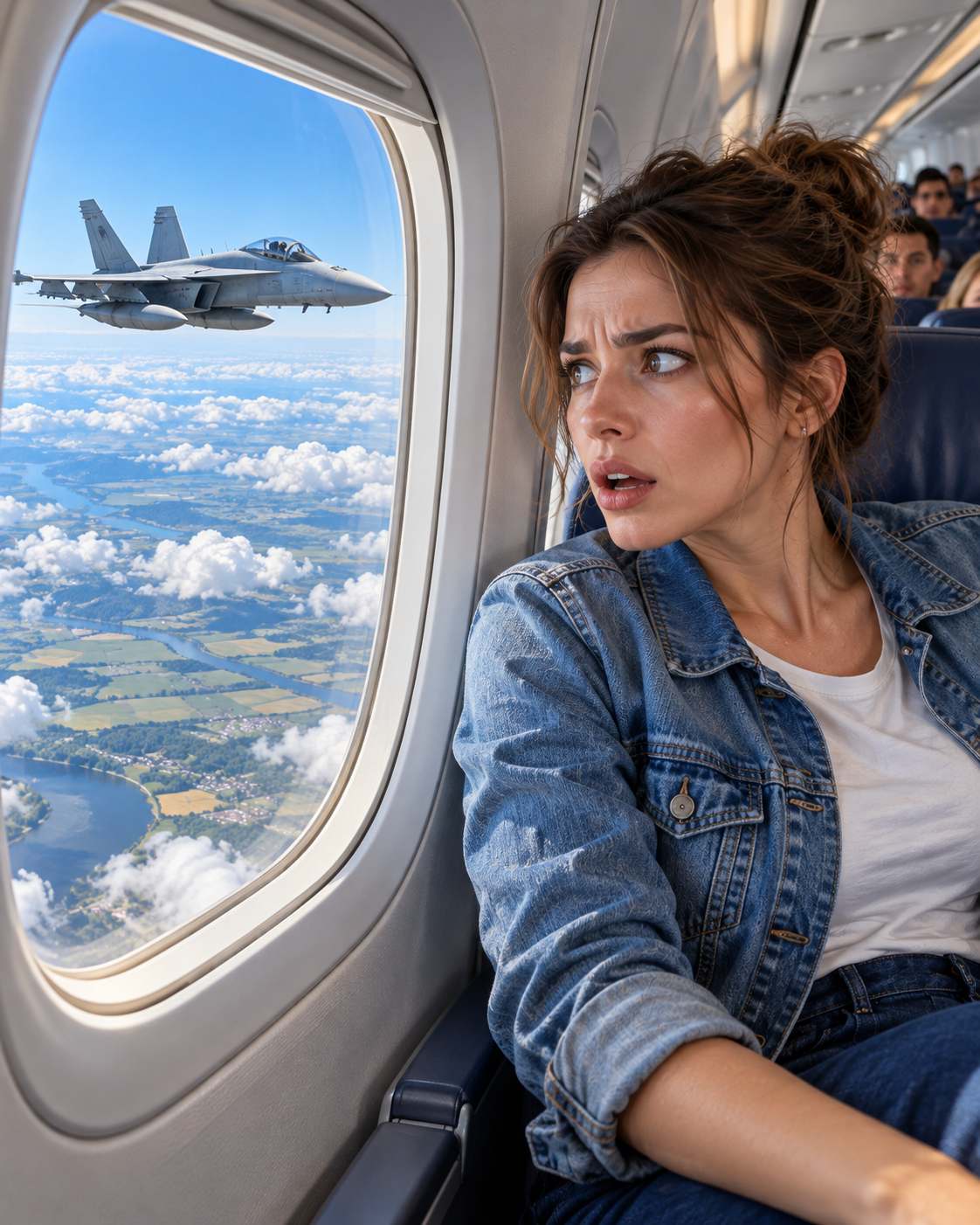
The answer came quickly.
“Understood. Continue to follow the emergency support instructions. We are coordinating with your airline and the military escort.”
Rachel stood near the cockpit doorway, wearing an oxygen mask and trying not to look at the dark cabin behind her.
“How many people are hurt?” I asked.
“Several are unconscious or confused. A few are breathing normally now that we’ve helped them with oxygen. Another attendant is staying with them.”
“Keep everyone secured. Don’t let anyone crowd the aisle, and tell the other attendant to report any passenger whose breathing or responsiveness worsens.”
She nodded and started to leave.
“Rachel.”
She turned.
“You’re doing well.”
Her expression crumpled for half a second before she forced it steady.
“I’ve never done anything like this.”
“Neither have I in this aircraft. We work with what we know, and we ask for help with what we don’t.”
She gave a small nod.
Then she went back to the passengers.
I listened to the radio as the ground team relayed updates, while Matthew remained beside us, guiding the aircraft toward the safest available route.
The sky ahead had become a black wall, and the lights of distant towns looked strangely peaceful beneath it.
I thought about the people sitting behind me.
A businessman who had complained about the delay before takeoff.
A mother who had been trying to settle her crying toddler.
An elderly couple who had held hands through the turbulence.
They had boarded a plane expecting to arrive at their destination.
None of them had agreed to become part of my past.
I had left military aviation because I could no longer tolerate the possibility of losing another person under my command.
Now the same fear had found me in a civilian cockpit.
I forced myself to breathe slowly.
Fear could be useful if I listened to what it was telling me.
Panic was different.
Panic demanded that I act before I understood.
I had survived too many bad days by refusing to confuse the two.
“Voodoo,” Matthew said, breaking into my thoughts. “The tower wants to know your intentions.”
“Tell them we need an emergency landing with full rescue coverage. The aircraft’s landing configuration is uncertain, and the approach must remain flexible.”
“Copy.”
A second voice joined the radio conversation, identifying himself as an airline operations specialist.
He began helping the controller relay aircraft-specific guidance, while a qualified pilot on the ground worked through the available emergency information with us.
For the first time since entering the cockpit, I felt the situation becoming a little less impossible.
Not safe.
Not easy.
But manageable, one decision at a time.
Then Rachel returned, her face pale.
“One of the passengers is awake,” she said. “He’s having trouble breathing, and another passenger says her husband isn’t responding.”
My chest tightened.
“Tell the attendant with them to follow the emergency medical guidance from the ground team. Make sure their oxygen masks are fitted correctly, and have medical responders meet us immediately when we land.”
She hesitated.
“Claire, some people are asking if we’re going to crash.”
I looked at her.
“Tell them we’re working to land safely. Don’t promise what we can’t guarantee.”
She nodded.
I could not offer the cabin certainty.
I could offer them honesty, direction, and every reasonable effort to bring them through the night.
That would have to be enough.
The aircraft shuddered again.
A new alert appeared, and Matthew’s voice sharpened.
“Voodoo, our ground contact says your approach window is narrowing. Weather is deteriorating near Andrews.”
I looked at the instruments, then out through the windshield.
Clouds were gathering over the horizon, and the lights below seemed to dissolve into darkness.
“What’s the alternative?”
The controller answered before Matthew could.
“We are evaluating nearby options, but Andrews remains the preferred destination based on emergency support availability. We will advise immediately if that changes.”
I acknowledged the message.
Every instinct in me wanted to take control of the entire situation, to force the uncertainty into a shape I could manage.
But a pilot’s responsibility was not to make the world obey.
It was to recognize the world as it was and make the safest possible decision within it.
I asked the ground team to confirm the status of the landing gear and the available emergency procedures.
Their reply made my stomach tighten.
The normal landing configuration could not be confirmed.
The ground crew was preparing for the possibility of a gear problem, and rescue vehicles would be positioned accordingly.
I looked at Rachel.
“We may have a rough landing.”
She gripped the doorway.
“How rough?”
“I don’t know yet.”
She swallowed, then squared her shoulders.
“Tell me what you need.”
I studied her for a moment.
“Stay with the passengers as long as it’s safe. Follow the cabin crew emergency procedures, keep people seated and secured, and be ready to move when the aircraft stops. Your job is to protect them, not to help me fly.”
She nodded, but before she turned away, she said something that I would remember for the rest of my life.
“My brother is on this flight.”
I stared at her.
“What?”
“He’s in the back, in 32F. He’s coming home from college.”
The fear I had seen in her face suddenly made sense.
She had not merely been fighting to keep strangers calm.
She had been trying to keep her brother alive while standing close enough to the cockpit to hear every alarm.
I wanted to tell her that he would be fine.
I wanted to offer her the same easy reassurance people had offered me after my worst missions.
Instead, I reached out and squeezed her hand.
“Then let’s do everything we can to get him home.”
She pressed her lips together and nodded.
When she left, I stared at the controls until the instruments stopped looking like a wall of problems and began looking like individual questions.
I had to answer them in the right order.
Matthew continued to provide an escort, relaying information from the military and coordinating with the controllers.
The airline’s technical team stayed connected, helping the ground personnel interpret the aircraft’s condition and communicate the available options.
I listened carefully and asked for clarification whenever something was outside my knowledge.
No one mocked me for asking.
No one called me weak for admitting that a commercial aircraft was not the same as a fighter.
The difference was almost painful.
In the military, I had once believed that strength meant being the person who never hesitated.
Experience had taught me that strength was often the willingness to say, I don’t know, before an assumption became a catastrophe.
The tower finally confirmed that emergency crews were positioned and that the runway remained available.
“United Four-Eighty-Two, we are ready for you. Winds remain challenging. Continue to follow the approach guidance and advise us of any change in aircraft condition.”
“Understood,” I replied.
My mouth was dry.
I checked the oxygen supply, confirmed communication with the ground team, and focused on keeping the aircraft stable while following the instructions available to me.
I did not attempt to guess my way through unfamiliar systems.
I did not let the fighter beside us become a distraction.
And I did not mistake the growing lights ahead for a promise that the danger was over.
We still had to reach the ground.
Then, through the windshield, I saw the runway lights.
They stretched across the darkness in a straight line, so ordinary and so beautiful that my eyes stung.
I had seen airfields from above in places where nobody waited with ambulances and fire engines.
I had landed with damage, exhaustion, and the knowledge that the next mission might be worse.
But I had never been more grateful to see a runway.
“Voodoo, Andrews confirms you’re cleared for the emergency approach,” Matthew said. “I’m staying with you until you’re down.”
I swallowed.
“Copy, Matthew. Thank you.”
He was silent for a moment.
“Don’t thank me yet.”
The aircraft bucked as another gust struck.
I steadied my breathing and listened to the ground team, taking each instruction carefully.
The cockpit seemed to narrow around me.
There was only the aircraft, the runway, and the responsibility I could not pass to anyone else.
Then Rachel’s voice came through the interphone.
“Claire, the passengers are braced. Everyone who can follow instructions is secured.”
I closed my eyes for one brief second.
“Thank you, Rachel.”
I could hear the fear in her breathing, but her voice stayed firm.
“My brother says to tell you he owes you a coffee.”
A strange, fragile laugh escaped me.
“Tell him he can buy it after we land.”
The runway grew larger.
The ground team continued to guide us, and I followed the available emergency procedures as carefully as I could.
The aircraft was heavy, damaged, and moving through air that refused to stay predictable.
I could not make the landing gentle simply by wanting it to be.
I could only remain attentive, respond to the aircraft, and trust the people helping us from the ground.
The wheels struck the runway with a brutal jolt.
A deafening vibration rolled through the fuselage.
The aircraft bounced, settled, and continued forward as I worked to keep it under control.
Somewhere behind me, people screamed.
Then came another jolt, followed by a long, grinding shudder.
I kept my attention on the aircraft until it had slowed enough for the ground team to guide us through the remaining emergency steps.
When we finally stopped, the silence felt impossible.
For a moment, I could hear nothing but my own breathing.
Then the cabin erupted.
People were crying, praying, calling for family members, and shouting with the raw disbelief of those who had expected never to see the ground again.
The rescue crews approached immediately.
Medical personnel began assessing the passengers and incapacitated pilots while the cabin crew followed the emergency evacuation instructions appropriate to the aircraft’s condition.
I remained in the cockpit until responders confirmed that I could leave safely.
My hands were trembling so badly that I could barely release my grip.
Rachel appeared in the doorway.
Her eyes were red, and her oxygen mask hung loose around her neck.
“Claire,” she whispered.
I looked at her.
She tried to speak, but the words broke apart.
“Everyone’s getting out.”
I nodded, and suddenly the cockpit blurred.
For six years, I had carried the memory of the Euphrates Valley as proof that my career had ended in failure.
I remembered the smoke, the radio chatter, Matthew’s aircraft going down, and the unbearable seconds when I thought I had arrived too late.
I had survived that day, but survival had not felt like victory.
It had felt like a debt I could never repay.
Now I was standing in another damaged aircraft, surrounded by people who had been given a chance to go home.
And I realized that my past had not returned to punish me.
It had returned because the skills I had tried to bury were still mine.
Outside, emergency personnel guided the passengers toward safety.
A medical responder approached me and asked whether I had sustained any injuries.
I shook my head, although I knew the shaking in my hands was not something I could simply ignore.
“Please check the cabin crew and passengers first,” I said. “The pilots were unresponsive, and several passengers lost consciousness.”
The responder assured me that the medical teams were handling those assessments.
Then I stepped out into the night.
The air felt cold and clean.
I looked up and saw Matthew’s F-22 turning away from the runway before disappearing into the darkness.
For one moment, I was back in the desert, watching another aircraft vanish into a sky I had once believed would always belong to me.
Then my radio crackled.
“Voodoo, this is Matthew. Confirm you are safely on the ground.”
I lifted the handset.
“Confirmed. We’re down.”
His answer came softly.
“Good to have you back, Claire.”
I could not find a response.
He had saved my life once by surviving long enough for me to reach him.
Tonight, he had helped me bring hundreds of people through a night that might otherwise have ended in tragedy.
Some debts, I was beginning to understand, were never meant to be repaid.
They were meant to be passed forward.
The following hours were a blur of medical examinations, statements, and questions from officials trying to reconstruct what had happened.
The pilots survived, although both required treatment and monitoring after the depressurization event.
Several passengers had experienced serious symptoms, but emergency personnel assessed everyone who needed care.
Rachel found her brother near the medical triage area.
He wrapped his arms around her so tightly that she began crying before she could say a word.
I watched from a distance, feeling as though I were witnessing something private and sacred.
Then he looked over her shoulder and saw me.
He approached slowly.
“You’re the pilot?”
“I helped,” I said.
He shook his head.
“My sister said you kept everyone calm.”
I glanced at Rachel, who was still holding his arm.
“She did more than I did to keep the cabin together.”
He looked at her with an expression that made me understand how much the night had changed him.
Then he turned back to me.
“Thank you for bringing her home.”
I had no answer that felt large enough.
So I nodded.
Later, when the airport had quieted and the immediate emergency had passed, Matthew arrived in civilian clothes.
He looked older than the young wingman I remembered, but his eyes had the same sharpness.
For a long time, we stood without speaking.
Then he said, “I never knew why you left.”
I looked toward the dark runway.
“I couldn’t keep doing it.”
“Because of me?”
I turned sharply.
“No. Not because of you.”
He looked unconvinced.
I took a breath.
“After the Euphrates mission, I couldn’t stop thinking about all the things I hadn’t controlled. I kept replaying every decision, every second, every possibility. Leaving felt like the only way to stop hearing the radios in my sleep.”
Matthew looked down.
“I thought you blamed yourself for what happened.”
“I did.”
He shook his head.
“You got me out. You stayed under fire when you could have left. You gave me the chance to live.”
“I know that now.”
“Do you?”
His question was gentle, but it struck somewhere deep.
I looked at my hands.
For years, I had told myself that leaving the cockpit was a decision made out of exhaustion and grief.
That was true, but it was not the whole truth.
I had also left because I feared that if I ever flew again, I might discover that the person I had been before the desert was gone forever.
Tonight had not erased the fear.
It had shown me that fear could ride beside me without being allowed to take the controls.
“I think I’m beginning to,” I said.
Matthew nodded.
“Good. Because I have a question.”
I gave him a tired smile.
“Of course you do.”
“The Air Force has a training program for experienced pilots returning to aviation in a different capacity. There’s also work helping civilian crews prepare for unusual emergencies. People who understand what happens when a plan stops matching reality.”
I looked at him.
“Are you offering me a job?”
“I’m asking whether you’re ready to stop treating your past like a locked room.”
I wanted to reject the idea immediately.
I had built a life outside the cockpit, and I was not sure I wanted to dismantle it.
But I also remembered the faces of the passengers, Rachel’s shaking hands, and the way the aircraft had seemed to become a living thing beneath my palms.
I remembered how frightened I had been.
And I remembered that I had asked for help instead of pretending I could do everything alone.
“I don’t know,” I admitted.
Matthew smiled faintly.
“That’s a better answer than pretending you do.”
A week later, I visited the hospital where several passengers had been treated.
Some had already gone home.
Others were still recovering, and a few wanted to speak with the people who had helped them during the flight.
I met an elderly woman who had been sitting near the front of the cabin.
She took both my hands in hers.
“My husband was unconscious,” she said. “I thought I was going to lose him.”
I squeezed her fingers.
“How is he?”
“He’s recovering. The doctors say he needs time.”
She looked at me with tears in her eyes.
“I kept thinking about all the things I hadn’t told him. All the ordinary things I thought we would have time for.”
I felt the words settle inside me.
There were no grand lessons in the room, no speeches that could make the fear disappear.
There was simply a woman who had nearly lost the person she loved, grateful for another chance to tell him what mattered.
I understood her more than she knew.
For years, I had treated my own life as something that had already ended in the desert.
I had stopped imagining the things I might still do because it felt safer to live within the boundaries of what I had lost.
But the people on Flight 482 had reminded me that a future was not a promise.
It was an opportunity.
And sometimes, the bravest thing a person could do was accept that opportunity without demanding certainty first.
When I left the hospital, I called Matthew.
“I’ll meet with the training team,” I told him.
“That’s all I’m asking.”
“No,” I said. “It’s not all.”
I paused, searching for the words.
“I want to help people prepare for the moment when the plan stops making sense. I want them to know how to ask for help, how to listen, and how to keep fear from turning into pride.”
Matthew was quiet for a moment.
“Then I think you’ve found the right work.”
In the months that followed, I began helping with emergency preparedness and human-factors training for aviation crews.
I did not return to the cockpit as though nothing had happened.
I took time to learn, to recover, and to understand the limits of what I could safely do.
My military experience gave me valuable instincts, but it did not make me an expert in every aircraft or every emergency.
That distinction became the foundation of the lessons I taught.
We practiced communication under pressure.
We discussed how authority could help a team move quickly, and how it could silence people who saw a problem developing.
We taught crews to recognize the difference between confidence and certainty, and to understand that asking for assistance was not a failure of leadership.
Whenever someone asked me what I had learned from Flight 482, I told them the truth.
I had not saved those passengers because I was fearless.
I had saved them because I was afraid, recognized the danger, and kept listening to the people who could help.
Rachel eventually returned to work.
She sent me a photograph of herself and her brother sitting in a coffee shop, both smiling as though they were determined to reclaim the ordinary moments the flight had almost stolen.
Her message was simple.
“He bought the coffee. He says you still owe him the story.”
I laughed for the first time that day.
I wrote back that I would tell him everything when we met.
But I left out one thing I had never fully explained to anyone.
When the aircraft finally stopped on the runway, I had not felt triumphant.
I had felt grief.
Grief for the woman I had been before the desert, for the years I had spent believing that survival was the same as healing, and for all the people who might have benefited from the skills I had hidden away because I was afraid to use them again.
The flight had not restored my old life.
It had given me a reason to build a different one.
And that, I learned, was sometimes the only kind of rescue that truly lasted.
One evening, nearly a year after the emergency, I returned to the airport and stood near the observation windows.
Aircraft moved along the taxiways beneath a sky streaked with orange and violet.
Families waited behind the glass.
Pilots walked toward their aircraft carrying bags and coffee cups.
Passengers boarded without thinking about how fragile an ordinary journey could be.
I watched a commercial jet lift into the evening light, and for the first time in years, I did not look away.
My phone vibrated.
It was a message from Matthew.
A new training assignment had come through, involving an aviation emergency that investigators still did not fully understand.
He had attached a preliminary report and asked whether I would review the communication timeline.
I read the message twice.
The old instinct returned, quiet but unmistakable.
Something in the report did not add up.
I looked at the departing aircraft, then at the words on my screen.
I no longer believed that courage meant returning to the person I had been before everything fell apart.
Courage meant accepting that I had changed, that I still had things to learn, and that the next person who needed help might depend on me being willing to look again.
I typed back, “Send me everything you have.”
Then I put the phone in my pocket and watched the aircraft disappear into the clouds.
For six years, I had believed the sky was the place where I had lost myself.
Now I understood that the sky had never owned me.
It had only shown me who I became when the easy answers disappeared.
I could not promise that every emergency would end safely.
I could not promise that I would never be afraid again.
But I could promise that I would keep learning, keep listening, and never mistake silence for safety.
Because somewhere above the clouds, another crew might be facing a warning they did not yet understand.
And somewhere in the cabin, another passenger might be watching, waiting for someone to notice.
This time, I would not turn away.
Not because I believed I could save everyone.
Because I finally understood that the possibility of failure was never a good enough reason to stop trying.
And when the next call came, I would answer it—not as the woman who had once escaped her past, but as the woman who had finally learned how to carry it without letting it decide her future.