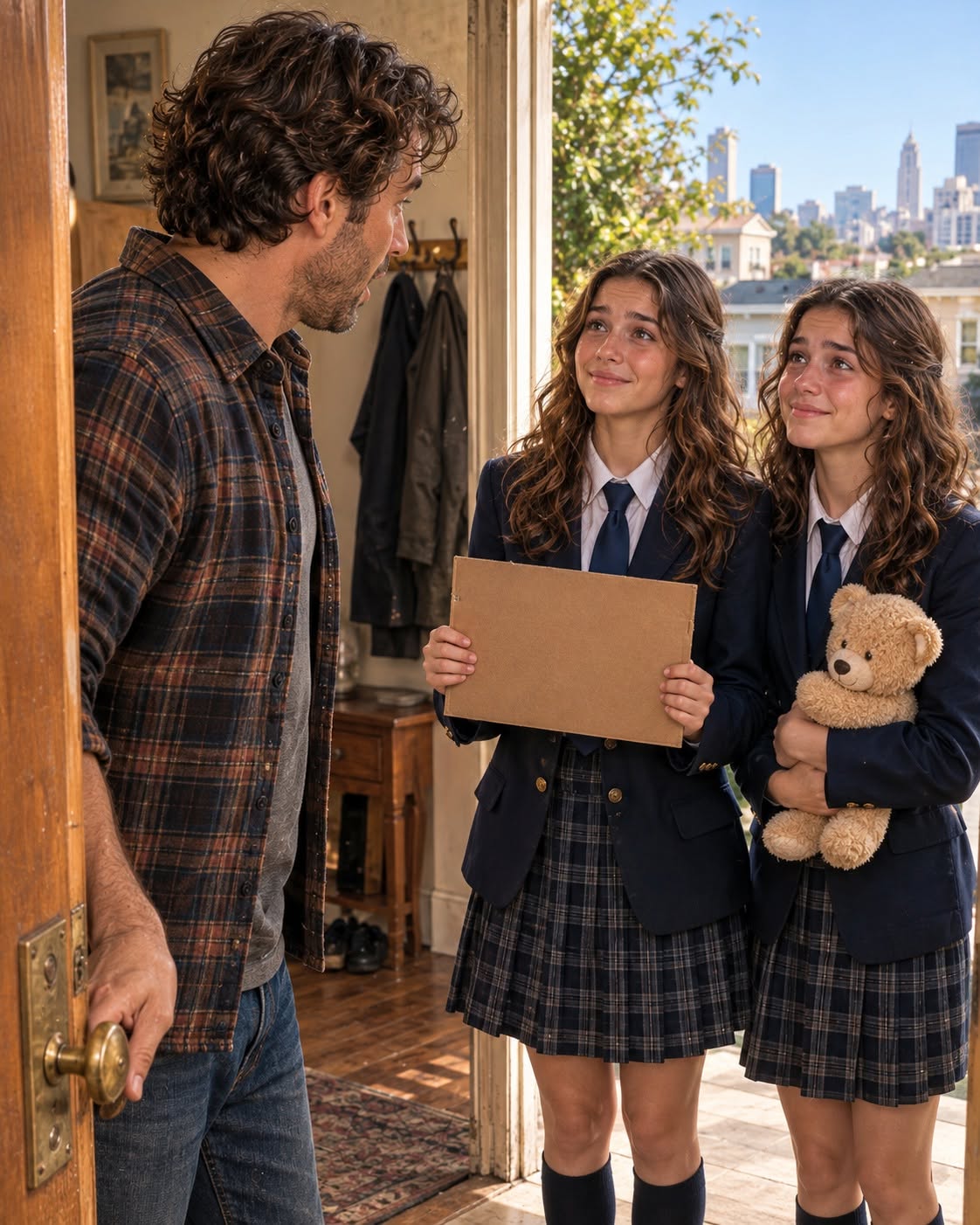
The two little girls standing outside my apartment at 10:30 p.m. were wearing matching designer dresses. Their next words nearly made me drop my pizza.
The phone rang three times before Claire answered.
I was lying on the couch, wrapped in two blankets, barely conscious. Noah sat beside me, holding a glass of water with both hands. Claire had been in my kitchen for twenty minutes, making soup while occasionally checking my temperature.
“Hello?”
She listened.
Then her face changed.
“What do you mean, you found it?”
A pause.
“Where were they?”
Another pause.
“Don’t touch anything. I’ll handle it.”
She ended the call and stood perfectly still.
I tried to lift my head.
“Everything okay?”
Claire looked at me, then at Noah.
“No. I think I’ve made a terrible mistake.”
Before I could ask what she meant, she sat down on the edge of the couch.
“The call was from Margaret. She’s been with my family for twelve years. She found something in the girls’ bedroom. A letter.”
“From Emma and Lily?”
Claire nodded.
“They wrote it three weeks ago. Apparently, they’ve been planning something.”
“What?”
Her eyes filled with tears.
“They want to run away.”
Noah stopped playing with the corner of my blanket.
“Why would they do that?”
Claire pressed her lips together.
“Because they think I don’t love them.”
For a moment, nobody spoke.
Then she reached into her handbag and pulled out a folded piece of paper.
“I haven’t read it yet. I was afraid.”
“Claire, they’re your children. You need to read it.”
She unfolded the letter with trembling fingers.
The handwriting was uneven, with some words written in different colors.
Dear Mommy,
We know you are busy. We know you have important things to do. We know you have meetings and phones and people who need you.
But we are only little for a little while.
We don’t want another dollhouse. We don’t want another vacation. We don’t want another person telling us to be quiet.
We want you to sit with us when we are scared.
We want you to know which stories we like.
We want you to come when we call.
If you are too busy to be our mommy, maybe we can find someone who has time to be our daddy and mommy.
Daniel said families eat dinner together. Maybe we can live with him.
We hope you won’t be angry.
Love, Emma and Lily.
Claire covered her mouth.
A tear slipped down her cheek and landed on the letter.
I looked at her for a long moment.
“Now you understand why they came to my apartment.”
She nodded.
“I thought they had everything.”
“They have everything money can buy.”
“And nothing money can’t.”
She looked at me.
“I don’t know how to fix this.”
“Then stop trying to fix it like a business problem.”
She let out a small, broken laugh.
“You’re very good at making me feel incompetent.”
“I’m a drafting teacher. It’s practically my job to point out where the structure is failing.”
For the first time that evening, she smiled.
Then Noah tugged gently at her sleeve.
“Miss Claire?”
She turned toward him.
“Yes, sweetheart?”
“Can you stay until Dad gets better?”
Something softened in her expression.
“Of course.”
He considered that for a moment.
“And can you make pancakes tomorrow?”
Claire laughed through her tears.
“I can try.”
“Mommy makes pancakes,” he explained. “But sometimes they’re burnt.”
Claire looked at me.
“I suppose I should practice.”
I wanted to laugh, but my throat hurt too much.
That night, Claire stayed.
She made up the spare mattress for Noah, sat beside my bed until he fell asleep, and checked my temperature every hour.
At some point after midnight, I woke up and found her sitting in the armchair, staring at the family photograph on my bookshelf.
It showed my late wife, Sarah, holding Noah as a baby.
“She looks happy,” Claire whispered.
“She was.”
“How long has it been?”
“Two years.”
“I’m sorry.”
“Thank you.”
She studied the photograph.
“Does it ever get easier?”
I thought about it.
“The pain changes. You learn to carry it differently. But you don’t stop missing them.”
She nodded slowly.
“My husband died when the girls were four.”
I turned toward her.
She had never told me that.
“Thomas was a good man,” she continued. “He loved Emma and Lily more than anything. He used to take them to the park every Sunday. He’d let them put flowers in his hair and pretend he was a princess.”
A faint smile appeared.
“After he died, I couldn’t stand being home. Every room reminded me of him. So I buried myself in work.”
“Did the girls know what happened?”
Claire looked down.
“I told them Daddy had gone somewhere he couldn’t come back from. I thought they were too young to understand death.”
“And then?”
“I kept telling them he was watching over them. But I never talked about him. I couldn’t.”
She rubbed her hands together.
“I thought if I gave them a perfect life, they wouldn’t feel the emptiness.”
I understood something then.
Claire wasn’t simply a woman who loved money more than her children.
She was a grieving mother who had confused providing with protecting.
She had been trying to outrun her own heartbreak while her daughters were growing up inside it.
“Tomorrow,” I said quietly, “you should tell them the truth.”
She nodded.
“I know.”
“And don’t make promises you can’t keep.”
She looked at me.
“What if I disappoint them again?”
“Then apologize and show up the next day.”
She sat silently for a while.
Then she whispered something that surprised me.
“I think I’m more afraid of being their mother than I’ve ever been of losing a company.”
I closed my eyes.
“That’s probably because this is the first thing in your life you can’t control.”
The next morning, I woke up to the smell of something burning.
For one terrifying second, I thought the apartment was on fire.
Then I heard Noah laughing.
I dragged myself out of bed and found Claire standing in my kitchen, staring at a blackened pancake.
Noah was sitting at the table, laughing so hard that milk nearly came out of his nose.
“What’s happening?”
Claire held up the spatula.
“Your son has informed me that this is not a pancake.”
“What is it?”
“Apparently, a piece of charcoal.”
Noah nodded seriously.
“But you tried, Miss Claire.”
I laughed.
It was the first time I had laughed properly in days.
By noon, my fever had started to break.
Claire insisted on taking Noah to school and bringing back medicine.
Before leaving, she placed a small note beside my water glass.
Thank you for reminding me that being present is more important than being perfect.
That afternoon, she went home.
And for the first time in years, she didn’t bring work with her.
I didn’t know what happened inside the Bancroft mansion that evening.
But I found out the next morning.
Claire called me at seven.
“Daniel, I need your help.”
“What’s wrong?”
“The girls are waiting for you.”
I sat up.
“Waiting for me where?”
“At the front door. They want you to come over.”
I hesitated.
“Claire, I don’t think that’s a good idea. I’m still recovering.”
“I know. I’m not asking you to be their father. I’m asking you to help me do something I’ve been too afraid to do.”
There was a silence.
“I want to tell them about Thomas.”
I looked toward Noah’s bedroom.
Then I took a deep breath.
“All right. I’ll come.”
When I arrived at the Bancroft estate, Emma and Lily were standing at the top of the staircase.
They ran down the moment they saw me.
“Daniel!”
Emma hugged my waist.
Lily wrapped both arms around my leg.
“You’re better!”
“Almost.”
“Did Mommy make you soup?”
“She did.”
“Was it good?”
I glanced at Claire.
“Much better than her pancakes.”
The girls giggled.
Claire gave me an exaggeratedly offended look.
“That is deeply unfair.”
Then her expression became serious.
“Girls, can we sit together for a little while?”
They exchanged nervous glances.
We went into the living room.
Claire had placed a small wooden box on the coffee table. It was old, with scratches along the edges and a brass lock.
“I want to tell you something about Daddy,” she began.
Emma’s smile disappeared.
“Is Daddy coming home?”
Claire closed her eyes for a second.
“No, sweetheart. He isn’t.”
Lily reached for her sister’s hand.
Claire took a breath.
“Your daddy died when you were little. He was very sick, and the doctors tried everything they could. But they couldn’t make him better.”
The room went quiet.
Emma stared at her.
“Why did you say he was away?”
Claire’s voice broke.
“Because I was sad. I missed him so much that I couldn’t talk about him without crying. I thought I was protecting you.”
“You said he would come back,” Lily whispered.
“I know.”
“You lied?”
Claire lowered herself onto her knees.
“Yes, sweetheart. I did. And I’m so sorry.”
Emma’s eyes filled with tears.
“Did Daddy not want us anymore?”
Claire immediately shook her head.
“Oh, no. Never. Never, ever.”
She opened the wooden box.
Inside were photographs, birthday cards, a tiny pair of baby shoes, and several envelopes.
“Your daddy loved you both more than anything in the world. He wrote these letters before he died. One for every birthday until you turned eighteen.”
Emma picked up an envelope.
Her name was written across the front in familiar handwriting.
“Can we read them?”
“Yes.”
Claire opened the first letter and began.
“To my beautiful Emma, on your seventh birthday…”
Her voice trembled as she read.
Thomas wrote about Emma’s stubbornness, her love of drawing, and the way she always wanted to be the leader of every game.
Then Claire read Lily’s letter.
He wrote about her kindness, her fascination with butterflies, and how she used to fall asleep holding his thumb.
The girls listened without moving.
When Claire finished, Emma climbed into her lap.
“Did Daddy know we were twins?”
Claire laughed through her tears.
“He knew before anybody else. He said he had won the lottery twice.”
Lily started crying.
Not the loud, frightened crying of a child who had been hurt.
It was the quiet crying of someone who had finally found the answer to a question she had carried for years.
Claire held both daughters tightly.
“I’m sorry I didn’t tell you sooner.”
Emma looked up.
“Can we talk about Daddy tomorrow, too?”
“Every day, if you want.”
“Even when you’re busy?”
Claire pressed her forehead against Emma’s.
“Especially then.”
I watched them for a moment.
Then I quietly stepped toward the door.
But Lily noticed.
“Daniel?”
I turned.
“Yes?”
“Are you leaving?”
“I thought you three needed some time together.”
She looked at her mother.
Claire gave a small nod.
“Daniel can stay, if he wants.”
So I stayed.
And something unexpected happened.
The girls didn’t ask me to become their father.
They didn’t ask me to replace Thomas.
Instead, Emma brought out a box of crayons and asked me to help her draw a picture of the family.
There were four people in it.
Claire.
Emma.
Lily.
And a small figure with a black suit and a huge smile.
“That’s Daddy,” she explained.
Then she drew another figure beside him.
“That’s you, Daniel.”
I smiled.
“Where’s Noah?”
She added a fifth person.
“There.”
Lily leaned over the drawing.
“And that’s us.”
She drew a giant sun above everyone.
Claire looked at the picture for a long time.
“That’s beautiful.”
Emma handed her a yellow crayon.
“You can color the sun, Mommy.”
And Claire did.
For the next month, our lives began to change in ways I never expected.
Claire stopped sending her daughters expensive gifts every time she felt guilty.
Instead, she started coming home early.
She learned to braid Lily’s hair, although the first attempts looked like tangled fishing nets.
She attended Emma’s school presentations and clapped so enthusiastically that other parents turned around.
She learned that Lily hated tomatoes but loved carrots, and that Emma needed ten minutes of quiet after school before she wanted to talk.
Most importantly, she started asking questions.
And she learned to listen to the answers.
The girls still visited our apartment occasionally.
Sometimes they brought cookies.
Sometimes they brought homework.
Sometimes they simply wanted to sit on the floor and watch Noah build complicated towers from wooden blocks.
Noah became their closest friend.
He was six, they were seven, and none of them cared about the difference.
They argued over board games, fought over the television remote, and occasionally accused one another of cheating.
It was ordinary childhood chaos.
And Claire seemed to treasure every minute of it.
One Saturday, she invited us to a small family picnic at the park.
She arrived wearing jeans and sneakers.
No assistants.
No driver.
No security team standing twenty feet away.
Just Claire, carrying a basket that was clearly too heavy.
“I brought sandwiches,” she announced.
Noah looked inside.
“Are they burned?”
Claire gasped.
“That happened one time!”
Emma laughed.
We spent the afternoon playing games.
At one point, Claire sat beside me on a bench while the children chased butterflies.
“I have something to tell you,” she said.
“That sounds serious.”
“It is.”
She stared at her hands.
“I’ve decided to change how my company operates.”
I waited.
“I’ve spent fifteen years building an organization that expects people to sacrifice everything for work. Their evenings, weekends, family time. I’ve been proud of that.”
She looked toward her daughters.
“Now I realize I was teaching thousands of people to make the same mistake I made.”
“What are you planning?”
“Flexible schedules. Paid parental leave. Better support for employees who are caring for children or sick relatives. And I’m stepping away from some of my responsibilities.”
I smiled.
“That sounds expensive.”
She laughed.
“Not nearly as expensive as losing your children.”
Then she grew quiet.
“Daniel, I want to thank you.”
“You don’t owe me anything.”
“I know. That’s why I want to.”
She reached into her bag and handed me an envelope.
I opened it.
Inside was a formal offer to establish a woodworking and design program at a community center near our neighborhood.
It included funding, equipment, and a salary for a full-time teaching position.
I looked up.
“Claire…”
“Before you refuse, hear me out. This isn’t charity. I’ve spoken with the center. They want the program, and they’ve agreed to hire someone qualified to run it.”
“I already have a job.”
“I know. You can keep teaching. This would be an opportunity to help more children learn practical skills.”
I studied the proposal.
It was something I had dreamed about for years.
My late wife had always encouraged me to open a small workshop where children could learn to build things with their hands.
But after she died, the dream had become another thing I couldn’t afford to pursue.
“Why are you doing this?”
Claire smiled.
“Because you taught me that children don’t need perfect parents. They need people who show up. I want more children to have someone who shows up for them.”
I accepted the offer.
But I made one condition.
“Every child gets to participate, regardless of whether their parents can pay.”
Claire nodded immediately.
“Agreed.”
For a while, it seemed like everything was finally falling into place.
Then came the night that nearly destroyed it all.
It happened three months later.
I was closing the workshop when my phone rang.
It was Claire.
Her voice was frantic.
“Daniel, please. I need you.”
“What’s happened?”
“It’s Emma. She’s missing.”
My stomach dropped.
“What do you mean, missing?”
“We were at a charity event. I had to speak with the board for ten minutes. When I came back, Lily was alone. She said Emma had gone to find me.”
“Have you called security?”
“Everyone is looking. We’ve checked the entire building.”
I grabbed my jacket.
“I’m coming.”
The event was being held at a hotel downtown.
When I arrived, the place was in chaos.
Security guards were checking exits.
Staff members were searching conference rooms.
Claire stood near the reception desk, pale and shaking.
Lily was sitting on a chair, clutching a small stuffed rabbit.
“Where did you last see her?” I asked.
“Near the ballroom,” Claire replied. “She said she wanted to show me something.”
Lily suddenly looked up.
“She was carrying Daddy’s letter.”
Claire froze.
“Which letter?”
“The one about the park.”
Thomas had written about taking the girls to the park and teaching them how to fly a kite.
He had promised that one day, they would both be able to hold the string without his help.
I knelt in front of Lily.
“Did Emma tell you where she was going?”
Lily nodded.
“She said she wanted to find the place Daddy liked.”
Claire covered her mouth.
The park.
Thomas’s favorite park was only a few blocks away.
We ran outside.
It was raining.
The streets were nearly empty, and the wind was pushing fallen leaves across the pavement.
We searched the playground first.
Nothing.
Then I noticed a small figure sitting beneath the old wooden shelter near the pond.
“Emma!”
She looked up.
Her face was wet with rain and tears.
Claire ran toward her.
“Emma!”
But Emma stepped backward.
“Don’t!”
Claire stopped.
Emma held the letter tightly against her chest.
“I just wanted to be where Daddy used to take us.”
Claire’s voice trembled.
“Sweetheart, you scared me.”
“You were busy again.”
“I know.”
“You said we were going to leave the party together, but you kept talking to those people.”
Claire knelt in the wet grass.
“You’re right.”
Emma stared at her.
“I thought you forgot about me.”
Claire began to cry.
“I didn’t forget. But I made you feel forgotten, and that’s just as painful.”
Emma looked down.
“I wanted Daddy.”
Claire reached out slowly.
“I want him too.”
For a moment, the only sound was the rain.
Then Claire said something I would never forget.
“I can’t bring Daddy back. I can’t give you the life we would have had if he were still here. But I can promise you something else.”
Emma looked up.
“I can promise to keep trying. I can promise to listen when you tell me I’m not paying attention. And I can promise that no meeting, no company, and no amount of money will ever be more important than your safety.”
Emma’s chin trembled.
“Even if the company loses money?”
Claire nodded.
“Even then.”
“Even if important people get angry?”
“Even then.”
Emma finally stepped forward.
Claire wrapped her arms around her daughter and held her close.
I looked away, giving them a moment.
But Emma suddenly called my name.
“Daniel?”
“Yes?”
“Can we go home?”
“Of course.”
We returned to the hotel together.
Lily ran into her sister’s arms.
The two girls held each other for a long time.
That night, Claire canceled the remainder of the event.
The next morning, she made another decision.
She announced that she would no longer accept work commitments that required her to miss important family events without a compelling reason.
Some investors criticized her.
A few board members threatened to reconsider their support.
One executive even suggested that her emotional decisions were becoming a liability.
Claire listened to them all.
Then she said something that made headlines.
“My children are not a distraction from my responsibilities. They are among the most important responsibilities I have.”
It was the first time I had seen her choose something without calculating what it would cost her.
And it changed everything.
A year passed.
The community workshop became one of the busiest programs in the neighborhood.
Children built birdhouses, toy cars, picture frames, and little wooden boats.
Some came from wealthy families.
Others came from homes where their parents were struggling to pay rent.
Nobody cared.
Everyone wore the same safety glasses.
Everyone got sawdust on their clothes.
And every child left with something they had made themselves.
Claire occasionally volunteered.
She wasn’t very good with tools.
She once managed to glue two pieces of wood together upside down and spent twenty minutes trying to separate them.
But she kept coming back.
The girls loved helping.
Emma became particularly interested in designing small houses.
Lily preferred making wooden animals.
Noah was obsessed with building a boat that could float without sinking.
He failed seven times.
On the eighth attempt, it worked.
He ran around the workshop shouting that he had invented something better than the Titanic.
We all laughed.
One afternoon, Claire arrived carrying a large cardboard box.
“I have something for everyone.”
Inside were four matching wooden nameplates.
One said DANIEL.
One said NOAH.
One said EMMA.
And the last said LILY.
“They’re for your workshop,” she explained.
The girls immediately wanted to hang theirs above the children’s workbench.
Noah insisted his should go in the middle.
A heated discussion followed.
Eventually, I settled the argument by placing all four in a row.
That evening, after everyone had left, Claire remained behind.
She stood beside the workbench, running her fingers over the wooden names.
“Do you ever think about that first night?” she asked.
“The night they showed up at my apartment?”
She nodded.
“Of course.”
“I was so angry with you.”
“I noticed.”
“I thought you were judging me.”
“I probably was.”
She laughed softly.
Then she turned toward me.
“Do you know what I remember most?”
“What?”
“The way you looked at the girls when I offered you that blank check.”
I shrugged.
“I didn’t think it was right.”
“You could have taken it. It was an enormous amount of money.”
“I know.”
“Why didn’t you?”
I looked around the workshop.
At the little wooden boats.
At the drawings taped to the walls.
At the tools arranged carefully along the shelves.
“Because those girls weren’t asking for a richer life. They were asking for someone to care whether they had a good day.”
Claire nodded.
“I spent years believing that love meant giving people everything.”
“And now?”
“Now I think it means giving them yourself.”
We stood quietly.
Then she asked a question I hadn’t expected.
“Daniel, would you consider having dinner with me sometime?”
I looked at her.
“At a restaurant?”
She smiled.
“No. Somewhere ordinary. Maybe your apartment. I’ll even attempt the pancakes again.”
I laughed.
“That sounds dangerous.”
“I’ll bring a fire extinguisher.”
I didn’t answer immediately.
Not because I didn’t want to.
But because I had learned something after losing Sarah.
Love was not something you rushed into because you were lonely.
It was something you allowed to grow when two people were ready.
“I’d like that,” I finally said.
Her smile was small but genuine.
“Good.”
Our first dinner was simple.
Spaghetti.
Garlic bread.
A salad Noah refused to eat.
Emma and Lily argued over who got to choose the movie.
Claire burned the garlic bread.
Nobody complained.
In fact, the girls declared it the best dinner they had ever had.
Months later, we began spending more time together.
Not because the girls needed someone to fill a space.
Not because Claire needed someone to rescue her.
And certainly not because I was looking for someone to replace Sarah.
We simply enjoyed being around one another.
One evening, Claire and I sat on the balcony while the children played inside.
She rested her head against my shoulder.
“Do you think we’re doing this right?” she asked.
I smiled.
“I think we’re doing it honestly.”
She took my hand.
“That’s better than perfect.”
“Much better.”
A year after that first night, we returned to the same apartment building where Emma and Lily had first knocked on my door.
The girls insisted on recreating the moment.
Emma stood on the left.
Lily stood on the right.
Both wore matching dresses, although this time they had chosen them themselves.
They knocked.
I opened the door.
“Are you our daddy?” Emma asked dramatically.
I pretended to think.
“That depends. Are you the two little girls who nearly made me drop my pizza?”
They burst into laughter.
Then Lily hugged me.
“We already know the answer.”
I looked past them.
Claire was standing in the hallway, holding a small paper bag.
Inside was a pizza.
A very ordinary pizza.
But it was the same kind I had been carrying that night.
“Happy anniversary,” she said.
“Anniversary of what?”
“The night everything changed.”
We gathered around the small kitchen table.
Five plates.
Five glasses.
Five people who had once been strangers in different ways.
Before eating, Emma stood up.
“I want to say something.”
Everyone looked at her.
“Last year, I thought having a family meant finding someone who could be our daddy.”
She glanced at Lily.
“But now I think a family is people who stay.”
Lily nodded.
“And people who say sorry when they make mistakes.”
Noah added, “And people who share pizza.”
We laughed.
Claire reached for my hand beneath the table.
I looked around at the children.
There was no perfect arrangement.
No magical solution that erased the past.
Thomas was still gone.
Sarah was still gone.
There were still difficult mornings, missed appointments, arguments, and days when everyone felt tired.
But there was also laughter.
There were bedtime stories.
There were school projects spread across the kitchen table.
There were people who noticed when someone was quiet.
And there were promises that were no longer written on expensive paper.
They were written in ordinary moments.
The following Sunday, we visited the park where Thomas had once taken his daughters.
Claire brought the old wooden box.
She placed a small photograph of Thomas beneath a tree, inside a weatherproof frame, where the girls could visit it whenever they wanted.
Emma held her mother’s hand.
Lily held mine.
Noah ran ahead, chasing a butterfly.
Claire looked at the photograph.
“I wish you could see them,” she whispered.
Then she turned toward the children.
“I think he’d be proud.”
Emma looked up.
“Do you think Daddy would like Daniel?”
I smiled.
Claire answered before I could.
“I think he would like the fact that Daniel never tried to take his place.”
Emma considered that.
“Good. Because nobody can be Daddy Thomas.”
She took my hand more tightly.
“But Daniel is Daniel.”
And somehow, that was enough.
That evening, as the sun disappeared behind the trees, Claire and I watched the children play.
She leaned toward me.
“Do you remember what you told me when I first came to your apartment with that check?”
“Unfortunately.”
“You told me to stop treating my daughters like another business expense.”
“I was a little harsh.”
“You were exactly as harsh as I needed.”
She paused.
“Thank you for not taking the money.”
I looked at her.
“Thank you for finally understanding what your daughters were asking for.”
She smiled.
Then she kissed my cheek.
I had spent two years believing that my family was finished when Sarah died.
Claire had spent years believing that money could protect her daughters from grief.
We were both wrong.
Life doesn’t always give us back the people we’ve lost.
It doesn’t erase mistakes or guarantee that tomorrow will be easier.
But sometimes, it gives us another chance to love.
Not by replacing what was lost.
Not by pretending the past never happened.
But by making room for new memories beside the old ones.
And that is what we did.
We didn’t become a perfect family.
We became a family that showed up.
A family that apologized.
A family that listened.
A family that understood that love wasn’t measured by the size of a house, the number of gifts beneath a Christmas tree, or the amount of money in a bank account.
It was measured in smaller things.
A warm meal after a difficult day.
A hand reaching for yours in a crowded room.
A parent who puts down the phone when a child says, “Look at me.”
And a promise kept, even when keeping it is inconvenient.
Years later, when someone asked Emma and Lily what they remembered about the night they went looking for a father, they always gave the same answer.
“We didn’t find someone to replace our daddy.”
They would smile.
“We found people who taught us that love doesn’t have to replace anything. It just has to make room.”
And every time I heard them say that, I thought about the pizza I had nearly dropped at 10:30 that night.
I thought about two little girls in matching dresses.
And I thought about how the biggest changes in our lives rarely arrive with a warning.
Sometimes, they simply knock on your door.
And all you have to do is open it.