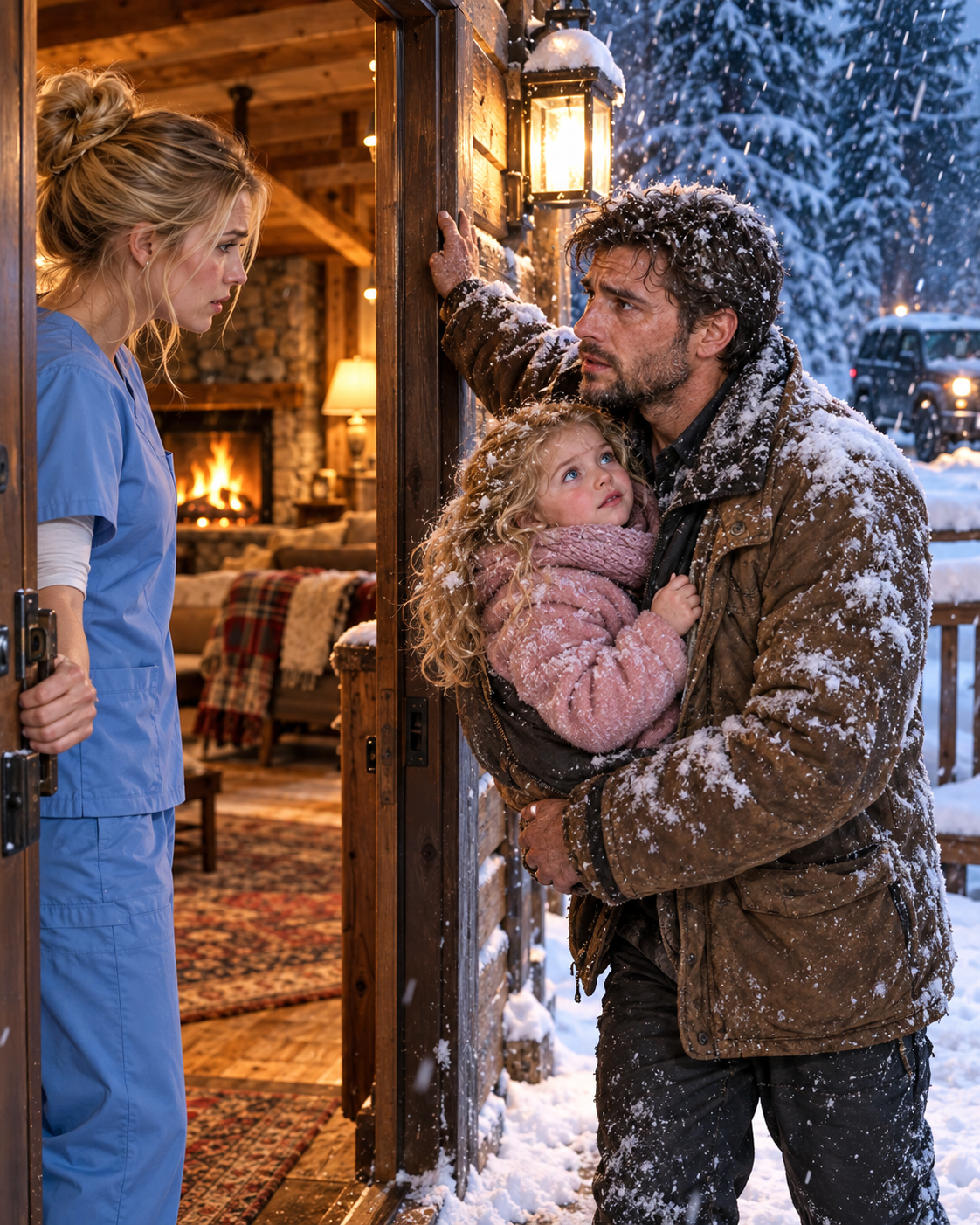
The sixteen Navy SEALs standing on my icy porch watched their commander collapse in disbelief when my three-year-old stranger called me an ANGEL
I stared at the envelope as if it were something alive.
Six years.
Six years of waking from dreams in which Luke stood at the end of my bed, smiling as though he had only stepped outside for a moment.
Six years of avoiding the sound of helicopters, of turning off the television whenever a rescue mission appeared on the news, of wondering whether the last thing he had seen was the ocean or the face of the man he had chosen to save.
And now his handwriting lay within arm’s reach.
“Where did you get that?” I asked.
Lucas swallowed painfully.
“Luke gave it to me before we lifted off that night. He made me promise that if anything happened, I’d find you and deliver it personally.”
My fingers curled around the edge of the mattress.
“Then why did I wait six years?”
“Because I didn’t know how to face you.”
His answer was quiet, but it landed harder than any excuse could have.
Lucas turned toward the window, where the winter sun cast pale rectangles across the hospital wall.
“After the crash, I spent months recovering. I had broken bones, a head injury, and nightmares that wouldn’t stop. Every time I closed my eyes, I saw that helicopter turning back toward us.”
He paused.
“I asked the Navy for your name. I wanted to find you, but I was told you were recovering from severe injuries and had been transferred. Later, I learned you had left the service. I tried through official channels, but I never got an address.”
“That doesn’t explain six years.”
“No,” he admitted. “It doesn’t.”
He looked at me again, and I saw no attempt to escape the truth.
“I was afraid you would look at me and see the man who should have died instead of Luke. And I was afraid you would be right.”
Anger stirred inside me, but it no longer had the clean, sharp shape it had possessed on my porch.
“Did you think hiding from me would make what happened easier?”
“No. I thought it would make it possible to keep living.”
He glanced toward the envelope.
“Then Lily was born, and everything changed. I realized she would grow up believing that being brave meant never being afraid. I wanted her to understand that a good man could be terrified and still do the right thing.”
His voice broke.
“Luke taught me that. I just couldn’t bring myself to tell you.”
I picked up the envelope.
The paper had softened at the folds, and a faint brown stain marked one corner. My name was written across the front in Luke’s familiar slanted handwriting.
My knees weakened.
“I need a minute.”
Lucas nodded, and I walked into the corridor.
I found an empty family room overlooking the parking lot and closed the door behind me. My hands shook so violently that I struggled to open the envelope without tearing it.
Inside was a folded letter and a small photograph of Luke standing beside a helicopter, his arm around a younger Lucas.
Luke was laughing at something outside the frame.
I pressed the photograph against my chest before unfolding the letter.
My beautiful girl,
If you’re reading this, then something has gone wrong, and I need you to know something before anyone else tells you what to feel.
You have always believed that loving someone means holding on tightly enough that nothing can take them away. I know because you grip my hand in your sleep when you have nightmares, and because you look at me as though I am the safest place in the world.
I wish I could promise you forever.
I can’t.
But I can promise that every day I have spent with you has been worth more than all the days I might have lived without knowing you.
I stopped reading.
The room blurred.
For a moment, I was back in our little apartment, sitting on the kitchen counter while Luke cooked terrible pancakes and insisted they were a secret Navy recipe.
I could hear him laughing when I threatened to throw them away.
I could smell the coffee he always made too strong.
I could feel his thumb brushing the back of my hand as he told me that someday we would have a house with a porch, a garden, and a dog that would probably destroy everything we owned.
Then I forced myself to continue.
If I have to go back for someone, please don’t think it means I love you less.
I love you with every part of me. But I have spent my life learning how to reach people who cannot reach me, and I cannot pretend not to hear them when they call.
The men on that beach are not strangers to me. They are someone’s husband, someone’s son, someone’s brother. Tonight, they are men who need help.
If I come home, I will tell you this story while we sit on our porch, and you will call me reckless, and I will kiss you until you forget what you were angry about.
If I don’t come home, I need you to do one thing for me.
Live.
Not because I would want you to forget me. Never that.
Live because the world is still full of people who need the kindness you give without even realizing it.
Marry me in your heart if you must, but don’t turn my absence into a prison.
You are not responsible for keeping my memory alive by being miserable.
You are responsible for being the extraordinary woman I fell in love with.
I will be thinking of you when the helicopter lifts.
And if I am lucky enough to come home, I will be thinking of you then, too.
All my love, until whatever comes next,
Luke.
I folded the letter slowly.
I didn’t scream.
I didn’t fall to the floor.
I simply sat there with the paper in my hands and cried the kind of tears that come when the pain you have carried for years finally changes shape.
Luke had known there was a chance he might not return.
He had not known he would die.
And he had never, not once, asked me to spend the rest of my life mourning him.
I had done that myself.
For six years, I had treated grief like a duty, as if smiling again would somehow dishonor the man who had loved me.
I had mistaken suffering for loyalty.
When I returned to Lucas’s room, he was watching the doorway.
“Was it what you expected?” he asked.
“No,” I whispered. “It was what I needed.”
I sat beside him and placed the letter on the bedside table.
“Why did you keep it all this time?”
He stared at his hands.
“Because every time I tried to deliver it, I imagined you asking why Luke had to die for me. I didn’t have an answer that would make you feel better.”
“There isn’t one.”
“I know.”
I studied his face, the bruises along his jaw, the exhaustion in his eyes, the fear he had carried longer than he had admitted.
“I still wish he had come home,” I said.
“So do I.”
“And I’m still angry that you waited.”
“You have every right to be.”
I expected defensiveness, perhaps a speech about duty or sacrifice.
Instead, he let the silence remain between us.
That was the first moment I believed I might eventually forgive him.
Not because he had saved Luke’s memory, and not because Luke had ordered me to live, but because Lucas had finally stopped trying to protect himself from my pain.
A soft knock interrupted us.
David Vance stood in the doorway, holding two paper cups of coffee.
“I brought enough for everyone,” he said. “Though I suspect neither of you will remember drinking it.”
I almost smiled.
David set the cups down and looked at the letter.
“Lucas told me he had it.”
“You knew?”
“I knew Luke had given him something. I didn’t know what it said.”
He pulled a chair closer to the bed.
“I was there that night. Not on the beach, but in the command center. I heard the radio traffic.”
My shoulders tightened.
David noticed.
“I won’t tell you that the mission went perfectly. It didn’t. We had weather reports that changed by the minute, a damaged radio relay, and men stranded farther down the coast than we expected. The decision to turn back was Luke’s, but he didn’t make it blindly. He knew the risks, and he believed he could get everyone out.”
“Could the mission have been handled differently?” I asked.
David didn’t look away.
“With what we knew at the time, perhaps. There were decisions that could have been made sooner. There were warnings we wish we’d understood differently. We reviewed everything afterward.”
He rubbed his forehead.
“But I won’t tell you there was one simple mistake that explains his death. Sometimes people do everything they can with the information they have, and the outcome is still terrible.”
It was the first honest answer anyone had given me about the crash.
Not a heroic speech.
Not a neat explanation.
Just the painful truth that no one could rewind the night and know which decision would have changed everything.
“What happened to the rest of the men?” I asked.
“Everyone who was on that beach survived,” David said. “Luke’s crew didn’t all make it. And the loss has stayed with every one of us.”
He looked at Lucas.
“Especially him.”
Lucas lowered his head.
“I was the one who called for help. I remember hearing Luke say, ‘Hang on, boys. We’re coming back.’ I remember believing that voice meant we were going to live.”
He swallowed.
“I’ve spent six years wondering whether I should have told him to keep going the first time. Whether I should have refused to let him turn back.”
“And what would you have done if you had?” I asked.
Lucas looked at me.
“I would have listened to men die over the radio.”
No one spoke for a long time.
Outside the window, snow slipped from a hospital roof in a soft avalanche.
Then Lily appeared at the doorway, holding a stuffed rabbit that someone from the nursing staff had found for her.
“Is Daddy going to be okay?”
Lucas’s expression changed instantly.
He opened his arms, and she climbed carefully onto the bed beside him.
“The doctors fixed the bad part,” he said. “I’m going to need some time, but I’m going to be okay.”
“Promise?”
He kissed her hair.
“I promise I’ll do everything I can.”
She considered that answer with the seriousness only a child could manage.
Then she turned to me.
“Are you still mad at Daddy?”
Lucas closed his eyes.
I looked at the little girl who had arrived at my door in the middle of a storm, unaware that her question would open a wound I had spent six years guarding.
“I’m still hurt,” I told her gently. “But grown-ups can be hurt and still choose to be kind.”
Lily nodded as if that made perfect sense.
“Then you can both have a hug.”
She reached for my hand and pulled it toward her father.
I hesitated.
Lucas did not move.
He let me decide.
So I rested my hand lightly on his shoulder.
It wasn’t forgiveness.
Not yet.
But it was a beginning.
Over the next week, I visited the hospital whenever my shifts allowed. Lucas recovered slowly, learning to sit up without dizziness and eventually to walk the corridor with a nurse beside him.
The doctors warned him that his recovery would take time, and he listened with the impatience of a man who had spent his life believing he could push through anything.
I recognized the look.
Luke had worn it whenever he tried to convince me that a sprained ankle was nothing.
“You two are exactly alike,” I told Lucas one afternoon when he tried to walk farther than his therapist had approved.
“That’s a terrible thing to say about a man recovering from surgery.”
“It was a terrible thing to say about Luke, too.”
For the first time, Lucas laughed.
The sound startled both of us.
It wasn’t that his grief had disappeared, or that mine had become easy to carry. It was simply that the room had made space for something besides sorrow.
A few days later, Lucas asked whether I would visit the cemetery with him before he and Lily returned home.
I almost refused.
The thought of standing beside Luke’s grave with the man he had died to save seemed unbearable.
But I remembered the letter.
Live.
So I agreed.
The morning was bright and bitterly cold when we drove to the little church cemetery beside my cabin. Lily carried a bouquet of white daisies, though it was far too early in the year for them to grow in the mountains.
“They’re from the grocery store,” she explained proudly. “Daddy said flowers don’t have to grow outside to be pretty.”
I smiled.
“Your daddy is right.”
We walked slowly along the frozen path until we reached Luke’s grave.
I had visited it hundreds of times, usually alone, always bringing the same winter flowers.
Lucas stood several feet away, his hands clasped before him.
“I’m sorry,” he said.
I looked at the headstone.
“For what?”
“For being alive when he isn’t.”
I turned toward him.
“That isn’t something you need to apologize for.”
His eyes filled, but he held himself still.
“I know it in my head. I don’t always know it in my heart.”
I understood that more than he could imagine.
For years, I had believed that if I could find the exact moment where everything went wrong, I might somehow make Luke’s death bearable.
But there was no moment that could restore him.
There was only the life he had lived, the love he had given, and the people who were still here because he had chosen to help them.
I stepped beside Lucas.
“Luke wouldn’t want you to spend your life paying for his death.”
“No,” he whispered. “He wouldn’t.”
“He would probably tell you to stop being dramatic and take your daughter for ice cream.”
Lucas laughed through his tears.
“That sounds exactly like him.”
Lily placed her daisies against the headstone.
“Thank you for helping Daddy,” she whispered to the stone. “I hope you have a nice heaven.”
Then she turned to me.
“Can we come back and visit him?”
I crouched beside her.
“Yes, sweetheart. Whenever you want.”
She threw her arms around my neck.
As I held her, I realized that Luke’s memory did not belong only to me anymore.
It lived in the men who had heard his voice over their radios.
It lived in a little girl who called him an angel without understanding what the word meant.
And it lived in the man who had survived because Luke had refused to leave him behind.
That afternoon, Lucas and Lily prepared to return to their home in Virginia.
David and several of the SEALs had come to help, filling the driveway with vehicles and carefully packed bags.
Before Lucas climbed into the passenger seat, he handed me the silver trident pin I had found on my porch.
“I want you to keep it,” he said.
“I thought this belonged to you.”
“It does. But I think Luke would have wanted you to have it.”
I studied the small metal emblem.
“I don’t want to become a shrine to what happened that night.”
“Then don’t,” Lucas replied. “Let it remind you that what happened afterward mattered, too.”
I closed my fingers around the pin.
“Will you tell Lily about Luke when she’s older?”
“Every story I know. And if you want, I’ll bring her back so you can tell her the ones I don’t.”
I looked at him for a long moment.
“Come back when you’re ready to visit. Not because you owe me anything.”
He nodded.
“Thank you.”
Then he added, almost too quietly to hear, “For saving my life.”
I glanced toward Luke’s grave, visible beyond the churchyard fence.
“Maybe we’re even.”
But as Lucas settled into the vehicle, I knew that wasn’t quite true.
Some things could never be balanced.
A life could not be repaid.
A lost future could not be rebuilt.
All we could do was decide what to make of the time we still had.
After the vehicles disappeared down the mountain road, I returned to my cabin and opened the windows for the first time in years.
Cold air swept through the rooms, carrying the smell of pine and distant snow.
I took Luke’s letter from the bedside table and placed it beside his photograph.
Then I went into the closet and pulled out the small wooden box where I had stored our wedding plans.
The venue reservation had expired years ago.
The flowers we’d chosen existed only in a faded catalog.
Our handwritten vows were still there, folded together beneath a ribbon.
I sat on the floor and read them aloud.
My voice trembled at first, but by the final line, I was smiling through my tears.
That evening, I cooked dinner for one and ate at the table instead of standing over the sink.
I turned on the radio.
When a helicopter passed somewhere high above the mountains, I felt the old terror rise inside my chest.
I let it come.
I let it pass.
For the first time, I didn’t mistake the pain for a warning that I was about to lose everything again.
Spring arrived slowly that year.
Snow melted from the ridge, revealing dark earth and the first green shoots along the road.
I returned to work full-time and began volunteering with a local emergency response team, teaching wilderness first aid to hikers and new volunteers.
I hadn’t planned to become that person again.
But every time I helped someone learn how to keep a stranger warm, how to recognize shock, or how to remain calm when fear threatened to take over, I felt a small piece of myself return.
I wasn’t becoming the woman I had been before the crash.
I was becoming someone new.
Someone who could remember Luke without feeling that memory demanded punishment.
In early May, a package arrived at my cabin.
Inside was a drawing made with crayons.
A little girl stood between a man in a navy uniform and a smiling figure with wings.
Across the top, in uneven letters, Lily had written, “MY DADDY AND MY ANGEL.”
Beneath it was a note from Lucas.
Lily asks about you every week. She says angels need visitors, too. If you’re willing, we’d love to see you this summer.
I placed the drawing beside Luke’s photograph.
For a long time, I stood there looking at the two pictures together.
One showed a man whose life had ended before our wedding.
The other showed a little girl who had been given a future because he had refused to turn away.
I used to believe that grief was a room with a locked door, and that loving Luke meant staying inside it forever.
Now I understood that grief was a doorway.
I could walk through it carrying him with me.
I could tell his stories, honor his courage, and still allow myself to laugh when Lily said something ridiculous.
I could miss him for the rest of my life without surrendering the rest of my life to missing him.
On the anniversary of the crash, I drove to the cemetery with fresh flowers and Luke’s letter tucked into my coat.
I knelt beside his grave and brushed a fallen leaf from the engraved letters of his name.
“I read your letter,” I whispered. “I’m trying.”
The wind moved through the trees, and somewhere in the distance, a helicopter crossed the pale morning sky.
This time, I watched until it disappeared.
Then I stood, placed the flowers against the stone, and walked back toward the road.
I did not leave Luke behind.
I carried him forward.
And when Lucas and Lily arrived that summer, bringing a picnic basket and a ridiculous amount of ice cream, I welcomed them onto my porch.
Lily ran straight to the mantel, where Luke’s photograph stood beside her drawing.
“See?” she announced to her father. “I told you my angel lives here.”
Lucas looked at me, uncertain whether to smile.
I smiled first.
“Your angel had terrible taste in pancakes,” I told Lily. “But he was very good at saving people.”
She giggled, and Lucas laughed with her.
For a moment, the three of us stood in the golden light, surrounded by the quiet life I had once believed was no longer meant for me.
I thought that was the end of the story.
I was wrong.
That evening, after Lucas and Lily had gone to bed in the guest room, I found an old voicemail on my phone from an unknown number.
It had been recorded two days before the crash and saved automatically from a message I had never listened to.
I pressed play.
Luke’s voice filled the room, warm and breathless, with the faint roar of a helicopter in the background.
“Hey, sweetheart. I know I promised I’d call when we landed, but the schedule changed. There’s something I need to tell you when I get home. It’s about the mission, and it’s something I should have explained before.”
A pause followed.
Then his voice softened.
“Don’t worry. Nothing’s wrong. I just need you to trust me on this one.”
The recording ended.
I stood motionless beside the mantel, my hand trembling around the phone.
Lucas had told me everything he knew about that night.
Or at least, I had believed he had.
I looked toward the guest room, where the faint sound of Lily laughing in her sleep drifted through the door.
Then I looked at Luke’s photograph.
For the first time in six years, the past had given me a new question instead of an old wound.
And as the mountain wind pressed softly against the windows, I realized that learning to live again did not mean every mystery had been solved.
Sometimes, healing began when you finally became strong enough to ask what you had been too broken to hear.
I saved the voicemail, turned off the light, and let the question remain unanswered until morning.
Because this time, I wasn’t afraid of what the truth might take from me.
I was ready to discover what it might finally set free.