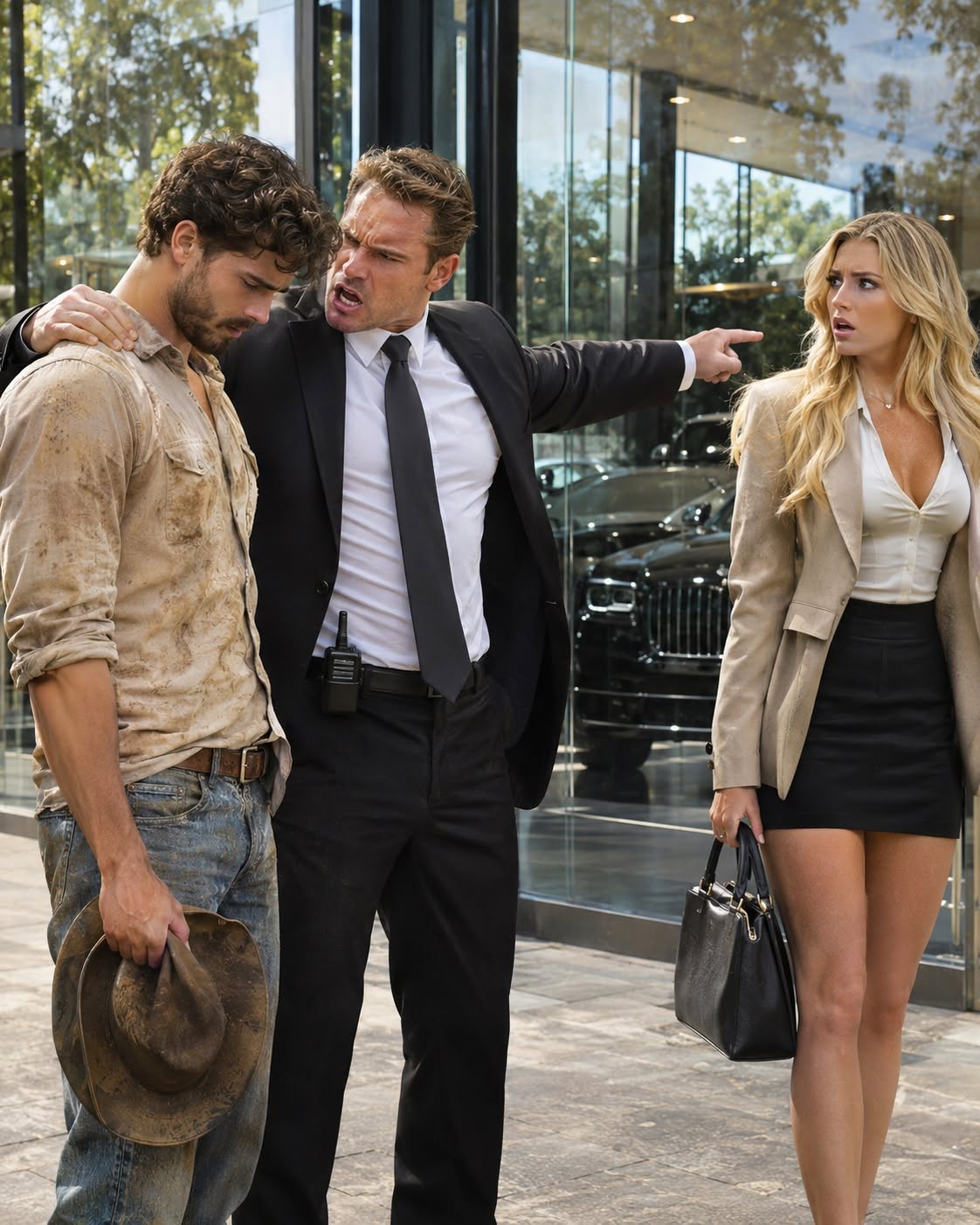
The showroom manager looked at my dusty boots, laughed, and told security to escort me out. I was standing there with my daughter’s future practically sitting in my hands
I crouched beside the piece of equipment she had pointed out, expecting to find an ordinary maintenance problem.
It was an old hydraulic lift used to move heavy feed containers and equipment around the ranch. The machine looked worn, but not beyond repair. Its metal frame had several scratches, the paint was peeling, and a faint trail of oil ran along the concrete beneath it.
“What’s wrong with it?” I asked.
The woman folded her arms.
“That’s what I’d like you to tell me.”
I didn’t rush to answer. I had learned something important over the years: the fastest way to make a dangerous mistake was to pretend you knew something before examining it.
I walked around the lift, checked the hydraulic lines, inspected the base, and examined the locking mechanism. Then I noticed something that made me stop.
One of the safety pins had been replaced with a bolt that wasn’t designed for that purpose. Worse, the metal around the mounting hole showed signs of stress.
I pointed it out.
“Whoever repaired this last time used the wrong hardware. The pin is supposed to lock the platform in place if the hydraulic pressure fails. This bolt could shear under a heavy load.”
The woman looked at me carefully.
“Are you sure?”
“Pretty sure. But I wouldn’t put anyone underneath it until we had a qualified technician inspect the entire assembly.”
She didn’t respond immediately.
Instead, she walked over to a small control panel and switched off the machine.
“Good,” she said quietly.
I looked at her.
“Good?”
She smiled faintly.
“Most people who come here tell me what they think I want to hear. You just told me something that could cost us money, delay our work, and make my maintenance supervisor unhappy.”
“Well, I’d rather disappoint somebody than see them get hurt.”
For the first time since arriving, she laughed.
“That’s exactly the answer I was hoping for.”
I thought that was the end of the test.
It wasn’t.
She led me into the maintenance office, where an older man sat behind a desk covered in invoices, repair logs, and equipment manuals.
“Daniel, this is the gentleman I told you about. He’s here to discuss the maintenance position.”
Daniel barely looked up.
“Another applicant?”
“Yes. And apparently, one who knows better than to trust a questionable repair.”
That got his attention.
He stood and walked toward me.
“I’m Daniel. I’ve managed this property’s maintenance operations for twenty-two years.”
I shook his hand.
“Nice to meet you.”
He looked at my boots, then at the list of previous jobs I had brought.
“Where did you get your experience?”
I explained that I had worked in apartment maintenance, repaired commercial refrigeration units, serviced irrigation systems, and spent several years doing general equipment repairs.
I also told him I had never been formally trained as a mechanic.
Daniel nodded slowly.
“So you’re a handyman?”
“Sometimes. But I don’t pretend to be an expert in everything. If something requires a licensed specialist, I call one.”
He glanced at the woman.
She was watching him.
Daniel pulled a chair out.
“All right. Let’s see what you know.”
For the next forty minutes, he asked questions about electrical safety, hydraulic systems, preventive maintenance, and equipment inspections.
Some questions were straightforward. Others were designed to catch me making assumptions.
I answered what I knew and admitted what I didn’t.
When he finally stopped, he leaned back.
“You’re not the most experienced applicant we’ve interviewed.”
I nodded.
“I understand.”
“But you might be the first one who understands that maintenance isn’t just about making something work. It’s about making sure it stays safe.”
The woman smiled.
Then Daniel said something that changed the atmosphere in the room.
“There’s another problem you should know about before we go any further.”
He opened a thick folder and placed it on the desk.
“Three weeks ago, one of our employees was injured when a storage platform failed. He survived, thankfully, but he’s still recovering. We’ve been reviewing the property’s maintenance records ever since.”
He showed me photographs of a damaged platform, along with inspection reports.
The more I studied them, the more concerned I became.
Several inspection dates had been copied from previous months. Some repairs had been marked completed without supporting documentation. A few pieces of equipment had no inspection records at all.
“Who signed these?” I asked.
Daniel looked uncomfortable.
“Most were approved by the previous maintenance coordinator.”
“Is he still here?”
The woman answered.
“No. He resigned shortly after the accident.”
I looked at the paperwork again.
There was something strange about the records. Several entries had been written in different handwriting, but they all carried the same approval initials.
I pointed this out.
“These records need to be checked against the actual work. Someone may have been signing off on inspections that weren’t completed.”
Daniel’s face tightened.
“That’s a serious accusation.”
“I’m not accusing anybody. I’m saying the paperwork doesn’t prove the work was done.”
The woman closed the folder.
“That’s enough for today. Thank you for being honest.”
I stood up, uncertain whether I had just talked myself out of a job.
As she walked me toward the parking area, she asked whether I was still interested in the position.
“Yes, ma’am. Very much.”
“Then I’d like to make you an offer.”
I stopped walking.
She explained that the ranch needed a maintenance technician who could handle daily repairs, organize inspection schedules, and coordinate outside specialists when necessary.
The salary was better than anything I had earned in years. There was health insurance, paid vacation, and a regular schedule.
But the part that mattered most was the flexibility.
I could arrange my hours around my daughter’s school schedule.
I felt something tighten in my throat.
“That would mean a lot to me.”
She held out her hand.
“Then let’s see if we can make this work.”
I shook it.
For the first time in a long while, I drove home feeling that my life might finally be moving in the right direction.
When I walked through the front door, my daughter was sitting at the kitchen table drawing pictures.
She was seven years old, with messy brown hair and the kind of smile that could make a difficult day disappear.
“Daddy!”
She ran over and wrapped her arms around my waist.
“Did you get the truck?”
I laughed softly.
“Not yet, sweetheart.”
Her smile faded a little.
“Did something happen?”
I knelt beside her.
“Something better might have happened.”
I told her about the ranch, the new job, and the possibility of having a regular paycheck.
She listened carefully.
Then she asked the question I hadn’t expected.
“Does that mean you’ll be home for dinner more?”
I swallowed.
“Yes. I think it does.”
She hugged me again.
“Then I hope they hire you.”
That night, I barely slept.
Not because I was worried about the job, but because I was afraid of losing it.
I had been disappointed before. Opportunities had come close enough to touch, only to disappear because of circumstances beyond my control.
But this time, I had something worth fighting for.
The next morning, the woman called.
Her name was Margaret Whitmore.
She told me the paperwork was ready and asked me to start the following Monday.
I accepted immediately.
My first two weeks at Whitmore Ranch were exhausting.
The property was much larger than I had imagined. There were several barns, a veterinary building, employee housing, equipment sheds, irrigation systems, and miles of fencing.
My responsibilities were not limited to fixing broken things.
I had to understand how the entire property operated.
Daniel showed me the maintenance schedule and introduced me to the staff.
Some employees welcomed me warmly. Others were less enthusiastic.
One man in particular seemed determined to make my life difficult.
His name was Travis Cole, and he had been at the ranch for eleven years.
He was responsible for operating heavy equipment and had apparently hoped to receive the maintenance coordinator position himself.
When Daniel introduced us, Travis barely shook my hand.
“So you’re the new guy?”
“That’s right.”
“Hope you know what you’re doing.”
“I’ll do my best.”
He gave a short laugh.
“That’s what everyone says.”
I didn’t take it personally.
I understood that people didn’t always welcome change, especially when they felt overlooked.
But I soon discovered that Travis’s attitude was only part of the problem.
During my first week, I found several machines with incomplete maintenance records. One tractor had a leaking brake line. A generator had been running with an overdue oil change. Two fire extinguishers had expired inspection tags.
I documented everything and brought the list to Daniel.
He looked troubled.
“How bad is it?”
“Not everything is an emergency, but some things need to be taken out of service until they’re properly inspected.”
He rubbed his forehead.
“I was afraid you’d say that.”
“Why?”
“Because Margaret is already dealing with the financial consequences of the accident. Repairs, legal expenses, insurance reviews. We can’t afford another major problem.”
I understood his concern.
But I also knew that ignoring a problem didn’t make it cheaper.
“We can prioritize the repairs,” I suggested. “But we shouldn’t put people at risk just to keep everything running.”
Daniel nodded.
“That’s why you’re here.”
Over the following days, I created a simple maintenance log that recorded each machine’s condition, the date of its last inspection, and the work still required.
I also labeled equipment that shouldn’t be operated until it had been checked by the appropriate professional.
Travis hated it.
One afternoon, I found him trying to use the tractor with the leaking brake line.
“Hey, Travis. That tractor is still out of service.”
He didn’t even turn around.
“I need it to move hay.”
“I understand, but the brakes aren’t safe.”
“I’ve been driving tractors since before you knew what a wrench was.”
“That may be true. But if the brakes fail on that slope, it could roll into the barn.”
He climbed down and walked toward me.
“Listen, new guy. This place has been operating just fine for years. We don’t need someone coming in and telling everybody how to do their jobs.”
“I’m not trying to tell you how to do yours.”
“Then stay out of my way.”
He walked off.
I watched him go, knowing that the situation was becoming more serious.
A few days later, Margaret called me into her office.
Daniel was already there.
She had a printed copy of my maintenance report on her desk.
“I’ve been reviewing your recommendations,” she said.
“Is there a problem?”
“Travis says you’re creating unnecessary delays and making the staff uncomfortable.”
I felt my stomach tighten.
“I don’t want to cause problems. But I can’t sign off on equipment I believe is unsafe.”
Margaret studied me.
“Would you change anything about the way you’re handling the situation?”
I considered the question.
“Maybe I could communicate the repair schedule better. People need to know when equipment will be available again. But I wouldn’t change the safety checks.”
She nodded.
“Good answer.”
Then she stood and walked to the window.
“Do you know why I started this ranch?”
I shook my head.
“My husband and I bought this property thirty years ago. We started with six horses and an old barn. He believed that a good business was built on taking care of the people who helped build it.”
Her voice softened.
“After he passed away, I tried to keep everything going. Somewhere along the way, I became too focused on numbers and deadlines. I trusted people to handle things because I didn’t have time to check.”
She turned toward me.
“That accident made me realize how much I had allowed to slip.”
I didn’t know what to say.
She continued.
“I don’t need someone who tells me everything is fine. I need someone who tells me the truth, even when I don’t like hearing it.”
I left her office feeling reassured.
But the real test was still ahead.
It happened on a Thursday afternoon.
A storm had been forecast for the weekend, and the ranch was preparing to move several horses into the larger indoor stable.
I was checking the drainage system near the equipment barn when I heard a loud metallic crash.
Then someone shouted.
“Get away from the platform!”
I ran toward the sound.
A large storage platform near the feed building had partially collapsed. Several heavy containers had fallen, and one employee was trapped behind a damaged support beam.
Travis was standing nearby, pale and visibly shaken.
Daniel arrived seconds later.
“Is anyone hurt?”
The employee trapped behind the beam was conscious, but he was holding his leg and struggling to move.
“Call emergency services!” I shouted.
Someone immediately grabbed a phone.
I approached the damaged structure but stopped when I noticed the remaining support beam was still under tension.
“Nobody touch anything!” I yelled.
I instructed everyone to keep clear while we waited for emergency responders. We needed to avoid shifting the load or creating another collapse.
Daniel crouched beside the injured employee, speaking calmly to keep him focused.
I looked at the structure.
The damage was disturbingly familiar.
The mounting hardware had been replaced with the same type of improper bolts I had found on the hydraulic lift.
Then I noticed something else.
The platform’s inspection tag showed that it had supposedly been checked just four days earlier.
I pulled out my phone and photographed it.
Travis stepped toward me.
“Don’t start taking pictures. We have an injured man.”
“I’m documenting the condition so the responders and investigators know what happened.”
He looked away.
When the ambulance arrived, the paramedics stabilized the employee and transported him to the hospital.
Fortunately, his injuries were not life-threatening.
But the incident changed everything.
Margaret arrived shortly afterward.
She looked at the collapsed platform, then at the inspection tag.
“Was this equipment approved for use?”
Daniel checked the records.
“According to the log, yes.”
I showed them the photographs of the mounting hardware.
“This wasn’t a sudden failure. The support had been compromised for some time.”
Margaret looked at me.
“Can you prove that?”
“I can show you the condition of the metal, the replacement bolts, and the inspection records. But a qualified structural inspector will need to determine the exact cause.”
She nodded.
“Get the equipment secured. Bring in an independent inspector. And nobody changes or removes anything until it’s documented.”
Then she turned to Daniel.
“Find every record connected to this platform.”
That evening, I stayed late to help organize the documentation.
I compared the photographs, work orders, inspection logs, and purchase receipts.
Something didn’t add up.
The records showed that the platform had received new safety hardware two months earlier.
But the purchase invoice listed a different type of bolt than the ones installed.
Even stranger, the invoice had been approved under the same initials that appeared on the questionable inspection reports.
I called Daniel over.
“Look at this.”
He examined the paperwork.
His face went pale.
“That’s impossible.”
“Why?”
“Because those initials belong to Travis.”
We both fell silent.
Daniel called Margaret.
Within twenty minutes, she was back in the office.
She examined the documents without saying a word.
Then she asked me to explain everything from the beginning.
I showed her the maintenance records, the photographs, and the discrepancies between the purchased hardware and what had actually been installed.
She listened carefully.
Finally, she asked, “Do you think Travis deliberately put people in danger?”
I hesitated.
“I don’t know. The evidence shows that the work wasn’t completed as documented. It doesn’t tell me why.”
Margaret nodded.
“That’s an important distinction.”
The next morning, an independent investigator arrived.
He inspected the collapsed platform, collected samples of the hardware, and reviewed the records.
By the end of the day, his preliminary findings confirmed that the support system had been improperly modified and that the inspection documentation did not match the physical condition of the equipment.
Travis was asked to attend a meeting with Margaret, Daniel, and the investigator.
I wasn’t part of the meeting, but I could hear raised voices through the office door.
At one point, Travis shouted, “I did what I had to do!”
A few minutes later, the door opened.
He walked out looking furious.
Margaret asked me to come inside.
On the table lay a handwritten statement.
Travis had admitted that he had ordered the cheaper hardware to save money and had never completed the full repair. He had signed the inspection records anyway.
He claimed he thought the platform would hold until the next scheduled maintenance period.
But the investigator had also discovered that Travis had been submitting invoices for materials that were never installed.
The missing money had been going into a personal account.
Margaret looked devastated.
“Eleven years,” she whispered. “I trusted him for eleven years.”
Daniel shook his head.
“I should have caught it.”
I looked at both of them.
“Trusting someone isn’t the mistake. The mistake is having no system to verify that important work was actually completed.”
Margaret looked up.
For a moment, nobody spoke.
Then she nodded.
“You’re right.”
Travis was suspended pending a full investigation, and the ranch began working with the authorities and its insurers. He was eventually dismissed, and the financial records were handed over for further review.
But the most important development happened a few days later.
The injured employee, whose name was Robert, returned from the hospital with his leg in a brace.
Margaret arranged a meeting with the staff.
She stood in front of everyone and apologized.
“I allowed problems to go unnoticed because I assumed everything was being handled. That was my responsibility. No employee should ever have to wonder whether the equipment they’re using is safe.”
She announced that the ranch would fund an independent safety review, replace compromised equipment, and establish regular inspections with documented approvals.
Then she surprised me.
“Starting today, I’d like to appoint someone to lead our maintenance and safety operations.”
She turned toward me.
“I’d like that person to be you.”
I felt everyone looking at me.
Daniel smiled.
Travis was gone, but there were still people who had worked alongside him for years. I knew the position would not be easy.
“Are you sure?” I asked.
Margaret smiled.
“I’ve never been more certain.”
I accepted.
The following months were some of the busiest of my life.
I worked with licensed technicians to repair and inspect the equipment. I organized the maintenance records, created preventive schedules, and made sure employees knew how to report problems without fear of being blamed.
I also introduced a simple rule.
Anyone could stop work if they noticed a safety concern.
Nobody would lose their job for speaking up.
At first, some employees thought it was unnecessary.
Then one afternoon, a young stable worker noticed a damaged electrical cable near a water trough.
He reported it immediately.
We isolated the area and brought in an electrician before anyone was injured.
Afterward, I thanked him in front of the team.
I wanted everyone to understand that noticing a problem was not an inconvenience.
It was part of doing the job well.
Meanwhile, my personal life began to change.
For the first time in years, I could pick my daughter up from school without checking my phone every five minutes to see whether another temporary job had become available.
We ate dinner together.
We went to the park on weekends.
I even started attending her school events.
One evening, she came home carrying a piece of paper.
“Daddy, look what I made!”
It was a drawing of a red truck parked beside a big green barn.
There were two people standing beside it.
One was tall and wearing a blue shirt.
The other was a little girl with brown hair.
Above them, she had written:
“MY DADDY’S NEW LIFE.”
I stared at the picture longer than I should have.
“Why did you draw a truck?” I asked.
She shrugged.
“Because you said you wanted one.”
I smiled.
“Maybe someday.”
She looked at me seriously.
“You work really hard. I think you deserve one.”
That night, I opened the folder where I kept my savings.
The money I had put aside for the truck was still there, but now I had something I hadn’t had before.
A steady income.
A health insurance plan.
And the confidence that I wouldn’t have to start over every few months.
I returned to the dealership a few weeks later.
The same showroom.
The same polished floors.
The same row of expensive vehicles.
But this time, I wasn’t there feeling embarrassed or hoping someone would give me a chance.
I had a budget, financing approval, and a clear idea of what I needed.
When I entered, the same manager recognized me.
His smile disappeared.
“Sir.”
I nodded politely.
“Good afternoon.”
He looked uncomfortable.
“Are you here about the truck?”
“Yes. I’d like to see the used pickup I asked about last time.”
He called over another salesperson, who greeted me warmly and showed me the vehicle.
It was a three-year-old pickup with a solid service history, reasonable mileage, and enough room for the tools I needed.
I inspected the tires, checked the maintenance records, and asked about the warranty.
Nobody rushed me.
Nobody questioned why I was wearing work boots.
The salesperson explained everything clearly.
When it came time to discuss the price, I negotiated a little, and we agreed on a number that fit my budget.
Then the manager approached.
He stood beside the desk for a moment before speaking.
“Sir, could I have a word?”
I looked at him.
“Of course.”
He lowered his voice.
“I owe you an apology for the way I treated you that day.”
I waited.
“I made assumptions about you based on your appearance. I was wrong.”
I could have reminded him of every humiliating word he had said.
I could have made him feel as small as he had made me feel.
But I remembered how my daughter had once asked whether being successful meant having more money than everyone else.
I had told her that success meant becoming someone you could be proud of.
So I simply said, “I hope you don’t treat the next person that way.”
He nodded.
“I won’t.”
I signed the paperwork and received the keys.
When I drove home, I stopped outside my daughter’s school just before dismissal.
She came running out when she saw the truck.
Her eyes widened.
“DADDY!”
I opened the passenger door.
She climbed inside, looking around as if she had entered a spaceship.
“Is this ours?”
I smiled.
“It is.”
She touched the dashboard.
“Can we take it to the ranch?”
“That’s where we’re going.”
She hugged me so tightly that I almost laughed.
Then she asked, “Did you get the truck because you got the new job?”
I thought about that for a moment.
“Partly. But mostly because I kept working, even when things were difficult.”
She nodded as though that made perfect sense.
We drove toward the ranch with the afternoon sun shining through the windshield.
When we arrived, several employees were outside repairing a fence.
Robert, the man who had been injured, waved from the barn. He had recovered enough to return to light duties and was helping organize the new safety procedures.
My daughter waved back.
Then Margaret came out of her office.
She saw the truck and smiled.
“So you finally found one.”
“I did. Thank you for everything.”
She shook her head.
“Don’t thank me for giving you a job. You earned it.”
I looked at the ranch, the people working around us, and the little girl sitting proudly in the passenger seat.
For months, I had believed that the truck was the thing that would change our lives.
But I was beginning to understand that the truck had only been a symbol.
What had really changed our lives was something much bigger.
Someone had finally looked past my clothes and given me the chance to show what I could do.
And once I had that chance, I had tried to make sure other people would receive the same respect.
Several weeks later, Margaret invited me to attend a small gathering at the ranch.
She explained that the property was starting a program for single parents who needed stable employment and practical training.
The program would offer paid apprenticeships in maintenance, equipment operation, and property management.
I was asked to help design the training schedule.
At first, I thought she was joking.
“Why me?”
She smiled.
“Because you know what it feels like to be judged before anyone bothers to ask what you’re capable of.”
I thought about the dealership.
The manager’s laughter.
The way everyone had looked at my dusty boots.
And the moment Margaret had stepped forward and asked why I was being treated that way.
“All right,” I said. “Let’s build something worthwhile.”
The first person to apply was a young father named Marcus.
He arrived wearing an old jacket and carrying a folder of work certificates.
He stood awkwardly in the office doorway.
“Sorry,” he said. “I wasn’t sure if I was dressed appropriately.”
I looked at his boots.
They were covered in dust.
I smiled.
“You’re dressed like someone who came here ready to work.”
His shoulders relaxed.
I invited him to sit down.
Then I asked him about his experience, his goals, and what kind of opportunities he was looking for.
As he spoke, I noticed the same nervousness I had felt during my first visit.
The fear of being dismissed.
The fear that someone would decide he wasn’t worth listening to.
I understood it completely.
When the interview ended, I walked him to the maintenance area and showed him the equipment.
“There’s something I want you to remember,” I told him.
“Never be afraid to admit what you don’t know. Never sign off on work you haven’t checked. And never let anyone convince you that your worth is determined by the clothes you’re wearing.”
He nodded.
I looked down at my own boots.
They were still dusty.
The difference was that I no longer felt the need to hide them.
A year earlier, I had walked into a dealership hoping to buy a used truck and left feeling like I didn’t belong.
Now I was standing on a ranch, helping build a workplace where people were judged by their character, their honesty, and the care they put into their work.
My daughter was nearby, drawing another picture at the office table.
This time, she drew the ranch, the truck, and several people standing together.
At the top, she wrote:
“EVERYONE DESERVES A CHANCE.”
I read the words and smiled.
Maybe that was the real lesson in everything that had happened.
A person’s appearance can tell you what kind of day they’ve had, what kind of work they do, or how much money they have.
But it cannot tell you how honest they are, how hard they work, how much responsibility they carry, or how much love they have for the people depending on them.
That showroom manager had seen dusty boots and decided he was looking at a man who didn’t belong.
Margaret had seen those same boots and recognized someone who knew the value of honest work.
Neither of them had seen my bank account first.
Neither had known my struggles.
But only one had taken the time to listen.
And that made all the difference.
I used to believe that giving someone an opportunity meant helping them get ahead.
Now I know it can mean something even greater.
Sometimes, an opportunity gives a person the chance to rebuild their life.
And sometimes, that person uses it to open the door for someone else.
The next time I looked at my daughter sitting proudly in the passenger seat of our truck, I realized something I wished I had understood much earlier.
We hadn’t become successful because someone finally decided we were worthy.
We had always been worthy.
Someone had simply given us the chance to prove it.
And I promised myself that as long as I had the power to make a decision, nobody who walked into my workplace wearing dusty boots would ever have to wonder whether they belonged.