The security director at Chicago’s Whitmore Meridian humiliated me in front of a lobby full of executives
I didn’t remember pulling the van to the curb, only the sudden silence inside it and the sound of my own breathing becoming too loud.
Emily was three hundred miles of ordinary life away from me, sitting in a college library with her headphones on, probably worrying about an exam or whether she could afford groceries until Friday.
She had no idea that a man from the worst chapter of my life had just turned her into leverage.
Arden leaned toward the phone, her face pale beneath the streetlights.
“Is that your daughter?”
I locked the screen.
“Yes.”
“Daniel, I’m sorry.”
“Don’t be sorry. Tell me what you know about Silas Vane.”
She hesitated, and that hesitation frightened me more than the photograph.
“I’ve never met him,” she said. “But Martin once told me someone outside the company was helping Preston move money through a private security contractor. He called that person the architect.”
“The architect?”
“He said the money was only part of it. Someone was collecting information about people who could be pressured into cooperating.”
I looked at the dark windows of the buildings around us.
“That sounds like Silas.”
For eleven years, I had told myself that the disaster in Prague was an isolated failure, a terrible combination of bad information and worse timing. Three people had died because a convoy I was helping coordinate had been sent through a route that should have been safe.
I had spent the next decade remembering every turn.
Every delay.
Every decision I might have changed.
Now I understood that my guilt had been useful to someone.
“Call your daughter,” Arden said. “Warn her.”
“Not yet.”
Her eyebrows drew together.
“Someone has already photographed her. If I call in a panic, she might react in a way that makes her easier to track. First, I need to know whether the photograph is live or old.”
I zoomed in on the image.
Emily was wearing the green scarf I’d bought her for Christmas. Behind her stood a campus event poster advertising a lecture scheduled for that afternoon.
I checked the time printed on the poster against the time in the corner of the photograph.
The picture was recent.
My hands tightened around the phone until my knuckles hurt.
“There’s a police station near her campus,” Arden said.
“Maybe. But I don’t know who Silas has reached, and I won’t send my daughter into a situation I don’t understand.”
“What do we do?”
I started the engine.
“First, we make sure he can’t predict our next move.”
I drove to a twenty-four-hour pharmacy, parked beneath its bright security lights, and called Emily using our usual video-chat routine. I had taught her never to panic at the first alarming message, never to follow instructions from a stranger, and always to verify a person’s identity before revealing where she was.
She answered on the third ring.
“Dad? Is everything okay? You look terrible.”
The familiar irritation in her voice nearly broke me.
“I’m working late. I need you to do me a favor.”
“Is this about tuition again? Because I told you I’m picking up another shift at the campus café.”
“No. This is about you getting home safely tonight. Can you go to the library’s main desk and ask them to help you contact campus security? Stay inside while they arrange an escort.”
Her smile faded.
“Why?”
“Because I love you, and I need you to trust me for ten minutes without making me explain everything over the phone.”
She studied my face.
“Dad, you’re scaring me.”
I wanted to tell her everything. I wanted to admit that the father who packed her lunches and worked double shifts had once helped plan operations for people who could make a life disappear with a single altered coordinate.
Instead, I swallowed the truth.
“I’m scared, too,” I said. “But I’m thinking clearly. Please do this for me.”
She nodded slowly.
“Okay. I’ll call you when I’m with security.”
When the call ended, I sat motionless for several seconds.
Arden said nothing. She understood that some fears could not be softened by reassuring words.
My phone rang again.
This time, the caller ID displayed a number I had memorized eleven years ago and hoped never to see again.
Silas.
I answered without speaking.
His voice came through warm and almost amused.
“Daniel Mercer. Still driving other people’s packages around Chicago?”
“You sent a photograph of my daughter.”
“I sent you a reminder that the world hasn’t forgotten you.”
“Leave her out of this.”
“Then stop interfering in business you don’t understand.”
I glanced at Arden, who was listening carefully.
“I understand enough to know Preston is working for you.”
Silas laughed softly.
“Preston works for whoever can give him the future he wants. That is the difference between a businessman and a sentimental fool.”
“What do you want?”
“The drive. The original drive, not the copy Martin made. Bring it to the old freight terminal on Canal Street at eleven tonight.”
“And if I don’t?”
There was a brief silence.
“Then your daughter will discover that being the child of a coward can be very expensive.”
The line went dead.
I lowered the phone.
Arden’s eyes shone with anger.
“He knows you won’t give him the evidence.”
“He knows I won’t risk Emily.”
“Then he’s already won.”
I turned toward her.
“No. He’s betting that protecting someone means doing exactly what he tells you.”
I had made that mistake once before.
In Prague, I had received a message claiming that a team on the ground was in danger. The message contained details only a trusted source should have known, and I had redirected a convoy to avoid an ambush.
The new route led them straight into one.
For eleven years, I had blamed my decision. I had never asked why the intelligence had been so convincing, or who had benefited from the convoy’s destruction.
Now those questions mattered more than my guilt.
“We need Martin Keen,” I said.
Arden opened the folder containing his handwritten ledger.
“According to this, Martin had been working from an apartment in Oak Park. He used it when he needed to handle sensitive audits outside the office.”
“Does anyone else know?”
“Preston probably does.”
“Then we’ll assume it’s watched.”
We left the van at a public garage and took a crowded commuter train, changing direction once before walking the final few blocks. I used reflections in storefront windows to watch the people behind us, but I refused to mistake every stranger for an enemy.
Paranoia was easy.
Discipline was harder.
Martin’s building was a modest brick apartment complex squeezed between a laundromat and a closed insurance office. The lobby smelled of wet coats and old carpet.
We climbed to the third floor.
His door stood slightly open.
Arden reached for the handle, but I stopped her.
“Stay behind me.”
The apartment had been searched. Drawers lay open, papers covered the floor, and a chair had been overturned near the kitchen. There was no sign of Martin.
Then I heard a faint metallic tap from somewhere behind the wall.
I followed the sound to a narrow pantry and found a small maintenance panel hanging loose. Behind it sat a battery-powered emergency recorder and an envelope with Arden’s name written across the front.
Inside was a note.
“If you are reading this, Preston knows I found the original accounts. Do not trust company security. Do not trust anyone who claims the Prague incident was an accident.”
Arden looked up sharply.
“Prague?”
I stared at the note.
Martin had known.
The recorder contained a short message in his tired, uneven voice.
“Arden, the offshore accounts are a diversion. The real operation is the acquisition of compromised identities and confidential route records. Whitmore Meridian’s logistics systems were used to identify secure movements for a private intelligence network. Carrington provided access. Vane provided the buyers. The money paid for silence.”
I felt the floor shift beneath me.
The company had not merely been used to steal money. Its logistics infrastructure had become a tool for gathering intelligence, the very kind of system I had once helped design.
The recorder clicked, then Martin continued.
“Daniel Mercer was framed in Prague. I found the original routing audit. His authorization code was duplicated after his credentials were revoked. The alteration came from an external terminal, but the report was rewritten to make it appear that Daniel approved the change.”
For eleven years, I had carried the deaths of three people as if they were a debt no one else could pay.
Now a dead man’s voice was telling me the debt had been deliberately placed in my hands.
Arden touched my arm.
“Daniel, you didn’t cause it.”
“I made the decision.”
“Based on information someone falsified.”
“I still made it.”
She looked at me with a sadness I hadn’t expected from someone who barely knew me.
“Then you know how much it hurts to be responsible for a decision that was never truly yours.”
Before I could answer, footsteps sounded in the hallway.
We slipped into the bedroom and closed the door without turning the lock. Through the narrow opening, I saw two men enter the apartment.
One was Preston Carrington.
The other was a broad-shouldered stranger wearing a dark wool coat.
“Search everything,” Preston ordered. “Vane wants the recorder and the ledger.”
The stranger moved toward the pantry.
I felt Arden tense beside me.
We had seconds, perhaps less.
I pointed toward the bedroom window, which opened onto a narrow exterior fire escape. Arden climbed through first, gripping the cold railing while I followed with the envelope and recorder.
A voice shouted behind us.
The window slammed open.
We descended the metal stairs as footsteps hammered above us, then crossed the alley and emerged onto the sidewalk among pedestrians leaving a nearby restaurant.
A black SUV rolled toward the curb.
I caught Arden’s wrist and pulled her into a corner grocery store just before the vehicle stopped.
We waited beside a rack of bottled water while the SUV passed.
Arden’s breathing was uneven.
“How do you live like this?” she whispered.
“I don’t. Not anymore. I just remember how.”
For the first time that night, she looked at me not as a mysterious delivery driver but as a father who had spent eleven years trying to build a safe world for his child.
“Then let’s finish this,” she said.
At 9:46 p.m., we reached an independent attorney’s office in a downtown building with no connection to Whitmore Meridian. The attorney, Rebecca Shaw, had represented the company’s minority shareholders in a previous dispute and had no ties to Carrington’s security department.
She listened to the recorder twice.
Then she made three calls: one to outside corporate counsel, one to a federal investigator she had worked with on a financial-fraud case, and one to a board member Arden knew had opposed Preston’s appointment.
“We need authentication,” Rebecca said. “The documents must be preserved, the originals must remain untouched, and we need a chain of custody that survives a courtroom.”
Arden placed the ledger on the table.
“The safe-deposit key opens a locker at Lakeshore Trust. Martin said the original records were there.”
Rebecca glanced at the clock.
“Then we retrieve them with witnesses, not alone.”
I wanted to object. Every instinct told me that movement created risk, and risk was the only thing Silas needed.
But hiding would leave Emily vulnerable while the people responsible remained free.
At 10:20 p.m., we entered Lakeshore Trust with Rebecca, an independent forensic accountant, and a uniformed security supervisor assigned by the bank’s compliance officer. The locker contained a sealed envelope, two encrypted drives, and a stack of printed transaction records.
The accountant examined the documents under the bank’s cameras.
“These accounts connect the security contractor to several shell companies,” he said. “And this ledger tracks payments to executives who approved access to restricted logistics data.”
Arden turned a page and stopped.
Her father, who had founded Whitmore Meridian, had signed one of the earliest contracts with the contractor.
For a moment, she looked as though she might collapse.
“My father told me the contract was for emergency infrastructure protection.”
“It may have started that way,” Rebecca said gently. “We need evidence before we decide what he knew.”
Arden closed her eyes.
She had spent her life trying to become a leader worthy of a man whose company was his greatest achievement. Now she was confronting the possibility that the same legacy she wanted to protect had been used to hurt people.
“I thought if I worked hard enough, I could keep his company honest,” she whispered.
I knew that feeling.
I had once believed that if I planned carefully enough, nobody would die.
Both beliefs had given us something noble to pursue.
Neither had made us invulnerable.
At 10:51 p.m., Rebecca received confirmation that federal investigators were prepared to meet us at a secure office and take custody of the evidence. The bank’s compliance officer sealed the original documents and recorded every transfer.
For the first time all night, I allowed myself to believe that the truth might survive.
Then Arden’s phone lit up.
A message from Preston read, “Your father would be ashamed of what you’ve done.”
A second message followed.
“Canal Street. Eleven. Come alone if you want Martin alive.”
Attached was a photograph of Martin Keen sitting in a chair, his face bruised but his eyes open.
Arden stared at the image.
“He’s alive.”
“Or they want us to believe he is,” I said.
Rebecca shook her head.
“You are not going to a meeting arranged by the people who have been following you.”
“We can’t abandon him,” Arden replied.
“No,” I said. “But we aren’t going to give them what they want, either.”
I asked Rebecca to share the photograph and message with the investigators. The metadata might help them determine when it had been taken, and the threats themselves could become evidence of coercion.
Then I called Silas.
“You wanted the drive,” I said. “I’ll bring a copy.”
“Eleven o’clock.”
“With one condition. Martin walks out first.”
Silas chuckled.
“You still think you can negotiate with me.”
“No. I think you need something from me, or you wouldn’t be calling.”
Silence.
Then his voice hardened.
“Bring the drive, Daniel. And don’t make me ask twice.”
He hung up.
I looked at Arden.
“The freight terminal isn’t the real objective. Silas wants to know whether I still have the ability to reconstruct the Prague route.”
“Why?”
“Because the original audit can identify who altered the route. But if Silas can make me look like I’m hiding evidence or manipulating the records, he can muddy the case before investigators understand what happened.”
Arden’s expression changed.
“He wants to turn your reputation into the weapon.”
“That’s what he did before.”
At 10:58 p.m., I entered the old freight terminal alone, carrying a decoy drive in my coat pocket and a small recorder Rebecca had provided. Federal investigators knew the location and were coordinating outside, but they had no guarantee Silas would follow the script.
The building smelled of rust, rainwater, and old diesel fuel. Broken windows rattled above the loading bays.
Silas stood near a row of abandoned cargo containers.
He looked older than I remembered, with silver at his temples and the same calm expression that had once made him dangerous. He wore an expensive coat and held himself like a man who had never needed to raise his voice to be obeyed.
“You’ve aged,” he said.
“So have you.”
“Eleven years, Daniel. Eleven years spent pretending you were a decent man because you couldn’t bear to face what you did.”
I kept my hands visible.
“Three people died because I trusted a false report.”
“Three people died because you changed their route.”
“Who altered the report?”
Silas smiled.
“Does it matter? They’re dead.”
“Not to the families.”
For the first time, something flickered in his expression.
“You always did confuse guilt with morality.”
He stepped closer.
“You were the best planner in the room. You saw patterns before anyone else. But you had one weakness: you needed to believe the people above you deserved your loyalty.”
“And you never believed anyone deserved yours.”
“That’s why I’m still standing.”
I took out the decoy drive.
“Where’s Martin?”
Silas glanced toward the far end of the terminal.
Preston emerged from the shadows, his face tight with anger. Between two hired men stood Martin Keen, moving stiffly but clearly alive.
Arden had been right to insist we save him.
I wanted to run toward Martin, but the room had been arranged to make every movement visible. Silas had chosen the open space, the containers, the distance between us. He was building a situation where my instincts would betray me if I rushed.
“Give me the drive,” he said.
I held it up.
“Tell me who changed the Prague route.”
Silas’s expression went cold.
“You still think the truth is going to make you feel better.”
“No. I think it might stop you doing this to someone else.”
He nodded toward Preston.
Preston took Martin by the shoulder and shoved him forward.
“Enough,” he snapped. “Give him the drive.”
I tossed it onto the concrete between us.
Silas gestured for Preston to retrieve it.
As Preston bent down, Martin suddenly shouted, “The original signature wasn’t Daniel’s!”
The words echoed through the terminal.
Silas moved toward him, but Martin stumbled sideways, pulling away from Preston’s grip.
“Your audit trail is in the second file,” Martin shouted. “The original terminal records everything!”
Silas’s calm vanished.
I had what I needed: confirmation that the original terminal records existed, and that Silas knew exactly what they contained.
Then the lights at the far end of the terminal flashed on.
Federal investigators entered from two access points, identifying themselves and ordering everyone to keep their hands visible.
Preston froze.
Silas reached inside his coat, but stopped when three officers aimed their weapons and ordered him to step away from the container.
For a moment, I thought he might try something reckless.
Instead, he slowly raised his hands.
His eyes remained fixed on me.
“You think this ends tonight?” he asked.
“No,” I said. “I think tonight is when you stop deciding how it ends.”
The officers separated the men, secured the scene, and took custody of the decoy drive. Martin was escorted to an ambulance for examination, while Rebecca and the investigators documented the threats, the recorder, and the chain of evidence we had preserved.
The operation did not become a neat confession or a miraculous victory. Silas said nothing more that night, Preston demanded an attorney, and the investigators warned us that the case would take months to untangle.
But the evidence was real.
And for the first time in eleven years, I was no longer the only person carrying the truth.
At 12:36 a.m., I finally called Emily.
She answered immediately.
“Dad? I’ve been calling you.”
“I’m sorry.”
“Campus security walked me to my dorm. They said someone reported a possible threat, but they wouldn’t tell me anything else.”
I closed my eyes.
“Are you safe?”
“Yes. But you need to tell me what’s happening.”
I looked through the terminal’s open doors at the flashing lights beyond the fence.
“I will,” I promised. “Not over the phone. When I get home, I’m going to tell you everything I should have told you years ago.”
She was quiet for a long moment.
“Are you coming home tonight?”
“Yes.”
“Then that’s enough for now.”
When the call ended, I sat on the curb outside the terminal, suddenly too tired to stand. Arden came over and sat beside me without speaking.
After a while, she said, “I spent my whole life thinking strength meant keeping everyone else from seeing you struggle.”
I watched the rain collect in the cracks of the pavement.
“I thought being a good father meant making sure my daughter never had to know what frightened me.”
“Did it work?”
I shook my head.
“No. It just meant I was frightened alone.”
Arden leaned back, looking toward the dark city.
“Maybe that’s what we both got wrong.”
Three weeks later, Whitmore Meridian announced an independent investigation, suspended the executives implicated in the records, and transferred its security operations to an outside firm. The company’s board could no longer bury the evidence inside its own reporting structure, and the federal case against Silas and Preston moved forward.
Martin survived and agreed to testify.
The full truth about Prague emerged slowly, through recovered communications, authentication records, and interviews with people who had spent years believing the official report. My authorization code had been duplicated after my credentials were revoked, and Silas had arranged for false intelligence to reach me through a source I trusted.
My decision had been real.
The information that shaped it had been a lie.
Those two facts would always exist together, and learning the truth did not erase the three people who had died. It did, however, allow their families to know that the disaster had not been the simple mistake the official report described.
I testified, answered every question, and accepted the parts of my responsibility that belonged to me.
For the first time, I stopped treating guilt as proof that I was a good man.
Guilt had kept me looking backward.
Responsibility finally gave me a reason to move forward.
When I told Emily everything, we sat at our kitchen table until dawn. I expected anger, disappointment, perhaps even fear of the father she had never known.
Instead, she reached across the table and took my hand.
“I wish you’d trusted me with the truth,” she said. “You didn’t have to make yourself a stranger just to keep me safe.”
I had no answer that could make eleven lost years disappear.
So I gave her the only honest one.
“I was afraid you’d lose the father you thought you had.”
She squeezed my hand.
“I didn’t need a perfect father, Dad. I needed you.”
Months later, I still drove deliveries, though I no longer pretended that my past did not exist. Arden offered me a position helping rebuild the company’s logistics security, but I declined the first time and asked for time to think.
I had spent too long confusing usefulness with identity.
Eventually, I agreed to consult on the reforms, provided the work included independent oversight and protections for the people whose information passed through the system. I wanted to build something that could not be quietly turned against the innocent.
On my first day back at Whitmore Meridian, Arden met me in the lobby where Preston had once tried to send me away.
“Good to have you here,” she said.
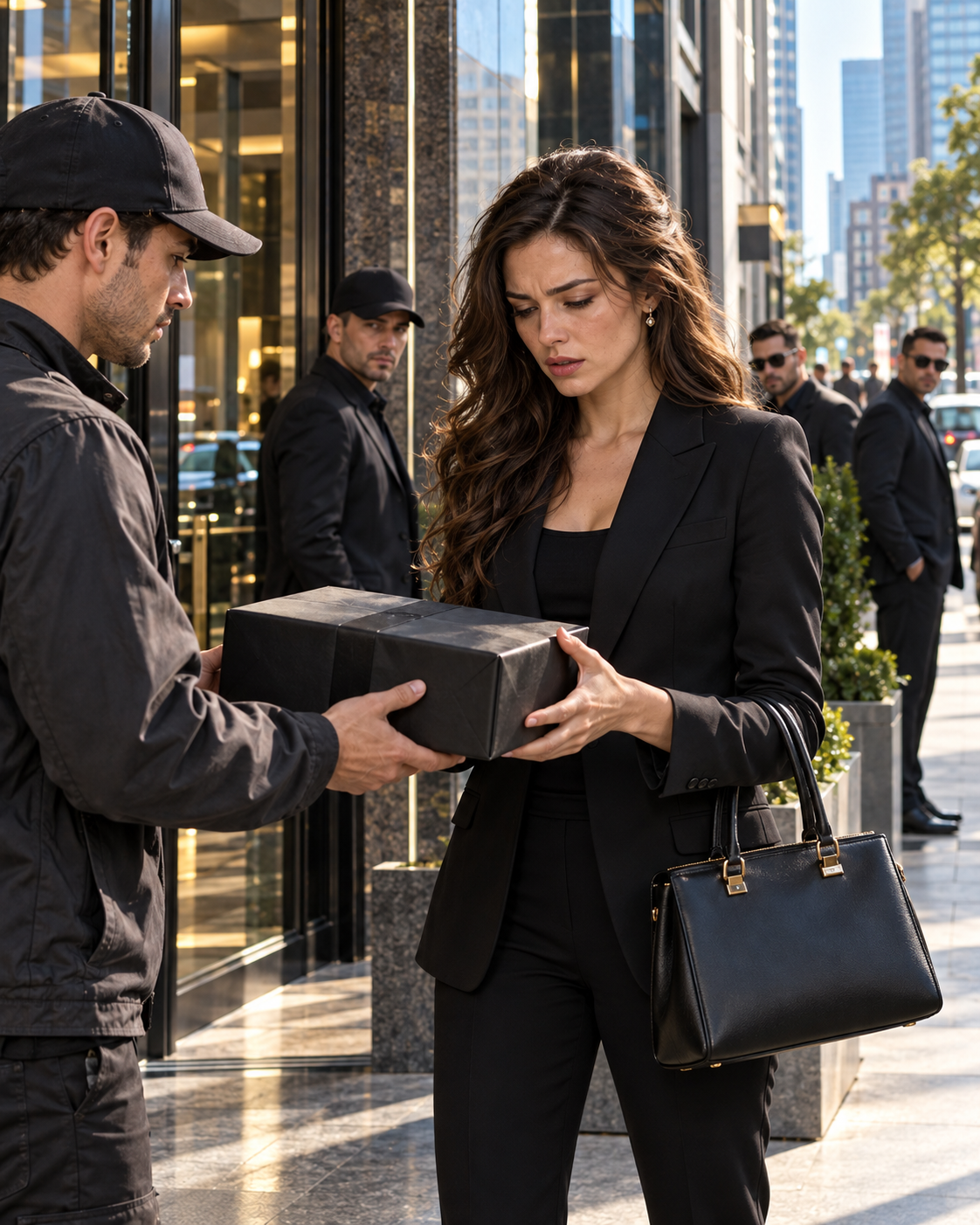
I looked at the security desk, the glass doors, and the spot where I had stood with the black box in my hands.
“I should have come back sooner.”
“No,” she replied. “You came back when you were ready to stop running.”
That evening, I picked Emily up from campus and took her to dinner at the little diner where we used to celebrate every time I managed to put another semester’s tuition aside. She told me about her classes, her friends, and a professor who insisted that the hardest part of any investigation was accepting evidence that challenged the story you wanted to believe.
I laughed at that.
For once, I didn’t tell her she was wrong.
When we reached home, an unfamiliar envelope waited in our mailbox. There was no return address, only my name written in block letters.
Inside was a photograph of the Prague convoy, taken moments before it entered the route that had been altered.
On the back, someone had written, “Silas was not the only person who knew.”
Beneath the photograph lay a small brass key.
I stood in the doorway, listening to Emily laugh at something on her phone, and felt the old instinct awaken—not as a command to disappear, but as a warning that the truth was larger than the case we had just survived.
I could have thrown the envelope away.
I could have returned to the life I had finally begun to reclaim.
Instead, I placed the photograph on the table and called Rebecca Shaw.
“There’s something else,” I told her.
Outside, Chicago moved through another ordinary night, full of people going home, making plans, and trusting that tomorrow would look like today.
I had once believed that protecting the people I loved meant keeping every shadow away from their door.
Now I understood that love was not the promise that darkness would never find us.
It was the decision to face the truth together when it did.
And as I turned the brass key over in my palm, I knew my old life was not finished asking questions.
This time, I would not face the answers alone.