The scratches on the wing looked fresh. The paint didn’t match. And when I leaned closer to the sealed panel beneath the fighter jet’s left wing
THE LAST WARNING: THE TRUTH THAT ALMOST COST ANOTHER PILOT HIS LIFE
The applause continued for several minutes, but I barely heard it.
My eyes remained fixed on the aircraft sitting silently on the runway. Only an hour earlier, that machine had been expected to soar over thousands of cheering spectators. Now it stood surrounded by security personnel, its left wing marked with yellow inspection tape.
One flight had been stopped.
But I couldn’t shake the question that had been forming in my mind.
How many other pilots were sitting in cockpits, trusting aircraft that might contain the same defective components?
I didn’t have to wait long for an answer.
Less than twenty minutes after the colonel addressed the crowd, my phone began vibrating repeatedly. The first call came from the base operations center. The second came from an officer in the maintenance command. The third was from a number I didn’t recognize.
I answered.
“Captain, this is Arthur Pendelton. We spoke earlier.”
His voice sounded different now. There was fear beneath his words.
“Arthur, what’s happening?”
“I need to tell you something. And I need you to understand that what you found today is only part of it.”
I stepped away from the crowd.
“What do you mean?”
There was a long pause.
“Those bolts weren’t supposed to be on that aircraft. But replacing them wasn’t an isolated mistake. Somebody was changing inspection records to make defective components appear acceptable.”
My stomach tightened.
“Do you have proof?”
“I have copies of the original production records. I also have photographs, shipping documents, and emails. But there’s something else you need to know.”
“What?”
“The aircraft involved in your friend’s crash wasn’t the only one.”
For a moment, I couldn’t speak.
Arthur continued.
“I believe at least eleven aircraft received components from that same defective batch. Some may have already been repaired. Others may still be flying.”
I looked back toward the runway.
Eleven aircraft.
Eleven crews.
Possibly eleven families who had no idea how close they might be to losing someone.
“Arthur, where are you right now?”
“At home. But I don’t think it’s safe for me to stay here.”
Before I could ask another question, the line went dead.
I called him back immediately.
No answer.
I tried again.
Nothing.
Then I received a message from an unknown number.
STOP DIGGING. YOU HAVE ALREADY CAUSED ENOUGH DAMAGE.
I read it twice.
The celebration had ended, but whatever we had uncovered was only beginning.
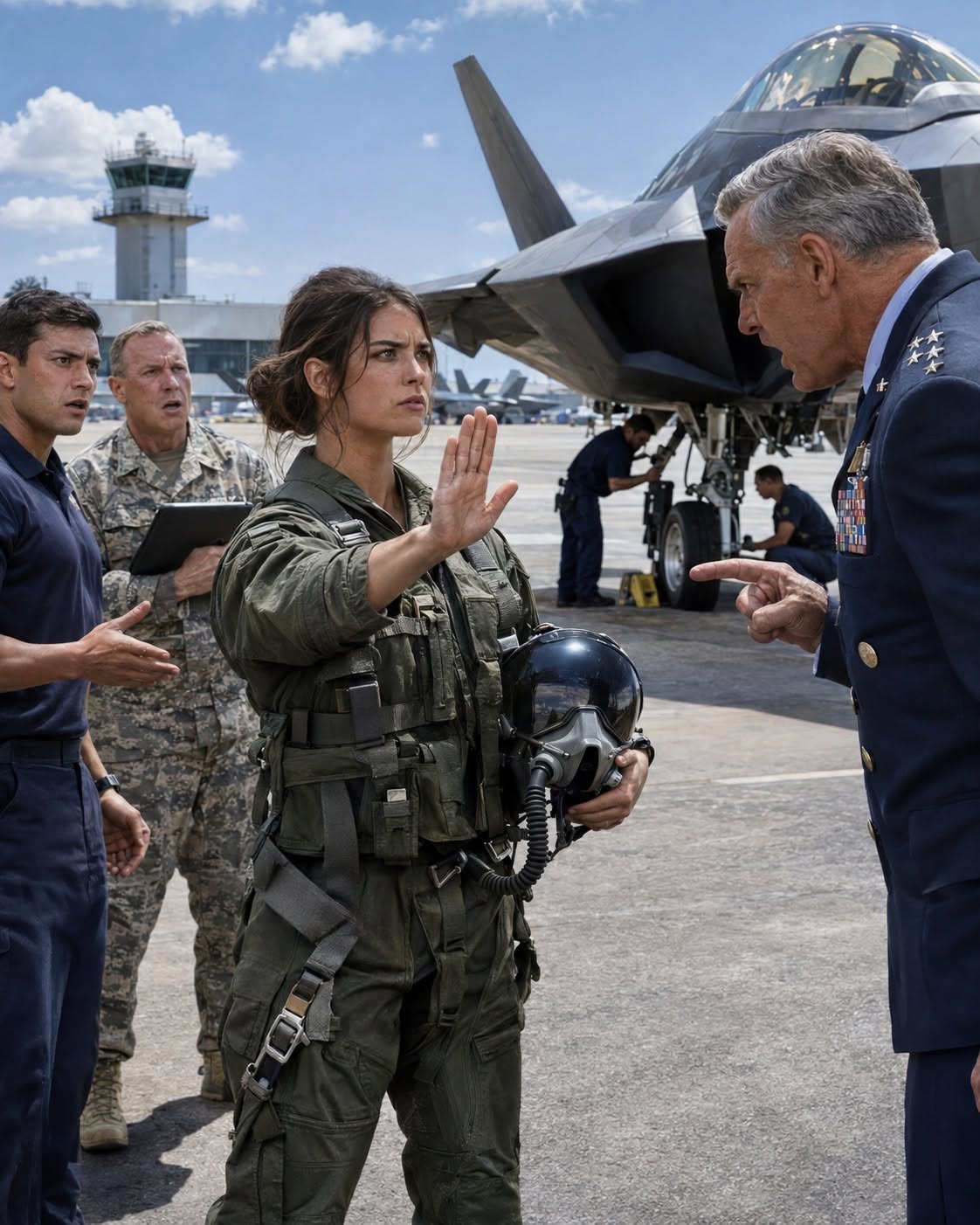
The colonel found me near the maintenance hangar.
“Captain, my office. Now.”
His expression had changed completely. The earlier anger was gone, replaced by something much more serious.
Inside his office, Colonel Harlan Vance closed the door and motioned for me to sit.
Master Sergeant Novak and Airman Lin had also been summoned. Both looked exhausted.
A folder lay open on the colonel’s desk.
“Headquarters has ordered an immediate technical review of the aircraft,” he said. “Until further notice, the entire squadron’s flight schedule is suspended.”
“That’s good, sir,” I replied.
“Don’t mistake this for a victory. We have a much bigger problem.”
He turned the folder toward us.
Inside were maintenance records from six different aircraft. Several entries contained identical inspection notes, identical approval codes, and identical timestamps.
Dale leaned closer.
“These inspections were supposedly completed at three different locations?”
“Correct,” the colonel said.
“That’s impossible,” Dale replied. “The teams listed here weren’t even assigned to those locations on those dates.”
Airman Lin studied the signatures.
“Sir, these aren’t handwritten signatures. They’re digital approvals.”
She pointed to a small code printed beside each entry.
“Someone used the same authorization credentials repeatedly.”
The colonel nodded.
“An internal investigation has already been opened. Until we know who is involved, everyone is to preserve all records and avoid discussing the matter outside authorized channels.”
I thought about Arthur’s warning.
“Sir, I spoke with the former factory assembler who left the note inside the wing.”
The colonel looked up.
“What did he tell you?”
I repeated the conversation, including the eleven aircraft and the documents he claimed to possess.
When I mentioned the threatening message, the colonel’s expression hardened.
“Show me.”
I handed him my phone.
He read it without speaking.
Then he picked up the office telephone and requested that security contact Arthur immediately.
But Arthur was already missing.
His apartment had been found unlocked. His car was still parked outside, and a cup of coffee sat untouched on his kitchen table.
There was no sign of a struggle.
However, investigators found something that changed everything.
Behind a loose panel in his study was a small storage device containing scanned manufacturing records, photographs, and correspondence dating back nearly four years.
The files revealed a disturbing pattern.
A supplier had delivered a batch of wing-attachment bolts that failed to meet the required strength specifications. Several factory employees had reported the discrepancy before the aircraft were completed.
Instead of stopping production, a senior quality-control manager had approved the shipment under an emergency classification.
The paperwork claimed the components had passed additional testing.
They hadn’t.
Some had been installed in aircraft anyway.
When the first reports of unusual wing vibrations appeared, the manufacturer classified them as isolated maintenance concerns. When the fatal crash involving my friend occurred, investigators were given incomplete production records.
The most disturbing discovery was an email written two days before his final flight.
It came from a factory engineer named Thomas Reed.
The subject line read: LEFT WING ATTACHMENT — URGENT SAFETY CONCERN.
The message contained a warning that the bolts could develop fatigue fractures under repeated high-load conditions.
At the bottom was a sentence that made my hands go cold.
“We are creating an accident that will eventually be blamed on the pilot.”
I read it again.
My friend had not been careless.
He had not ignored a warning.
He had been flying an aircraft whose manufacturer knew it might be structurally unsafe.
And someone had allowed him to climb into that cockpit.
I remembered his last conversation with me.
We had been sitting outside the squadron building, drinking coffee after a long training session. He had looked unusually serious.
“Have you ever noticed how people react when you question something they’re already determined to approve?” he had asked.
I laughed at the time.
Now I wished I had asked him more questions.
Three days passed.
The investigation expanded rapidly. Military safety inspectors arrived, followed by representatives from an independent engineering team. The affected aircraft were placed under a formal grounding order.
Meanwhile, the manufacturer released a public statement describing the discovery as a “limited documentation irregularity.”
I nearly threw my phone across the room when I read it.
A limited documentation irregularity.
There had been a cracked wing attachment, four incorrect bolts, and a former employee who had disappeared after trying to expose the truth.
They were still trying to make it sound like a paperwork problem.
Then came another development.
Major Derek Holloway requested to speak with me.
He arrived at the maintenance hangar late in the afternoon. He looked uncomfortable, as though he had been carrying something heavy for days.
“Captain, can we talk?”
“Of course.”
He glanced toward the grounded aircraft.
“I need to apologize.”
“For what?”
“For taking the flight after you refused.”
I shook my head.
“You were following orders. You didn’t know what we had found.”
“That’s not entirely true.”
I looked at him.
Derek took a slow breath.
“Two weeks ago, I noticed unusual vibration reports involving another aircraft from the same delivery group. I mentioned it to my flight commander. He told me the issue had already been reviewed and cleared.”
“Did you see the records?”
“No. I trusted the people responsible for maintenance.”
He looked down.
“Yesterday, when they reassigned your aircraft to me, I almost refused. But I thought you were being overly cautious. I thought the scratches were nothing.”
He paused.
“If you hadn’t stood your ground, I would have climbed into that cockpit.”
I didn’t know what to say.
Derek was one of the best pilots in our unit. He was disciplined, experienced, and respected by everyone.
He could have easily dismissed my concerns as a personal disagreement.
Instead, he had come to admit that he had nearly made the same mistake.
“There’s something else,” he said.
He reached into his jacket and pulled out a folded document.
It was a maintenance report from his aircraft, dated six weeks earlier.
The left wing attachment had been inspected following a vibration complaint. The report stated that all components had been found serviceable.
But someone had added a handwritten note in the margin.
CHECK BOLT LOT 7B. DO NOT CLEAR WITHOUT ENGINEERING REVIEW.
The note had been crossed out.
Below it was an approval signature.
Warren Vance.
The manufacturer’s representative who had handed me the paperwork on the day of the celebration.
I felt my jaw tighten.
“Have you shown this to the investigators?”
“Not yet. I wanted to show you first.”
“Why?”
“Because I think someone is trying to make this disappear.”
He was right.
That evening, the investigation team discovered that several electronic maintenance records had been accessed and altered after the aircraft grounding order.
Someone had attempted to replace original inspection entries with revised versions.
Fortunately, the system maintained an independent audit history.
The attempted changes had been recorded.
The investigation now had a name.
Warren Vance.
But when investigators attempted to locate him, they discovered that he had left the airfield shortly after the canceled demonstration.
His company vehicle had been found abandoned near a highway rest stop.
He was nowhere to be found.
For the first time, I began to wonder whether the problem was bigger than a manufacturer trying to avoid financial losses.
Someone had gone to extraordinary lengths to conceal a defect that could kill pilots.
Someone had threatened Arthur.
Someone had tried to alter records after the discovery.
And now a key witness had vanished.
The next morning, I received a call from my friend’s widow, Emily.
I hadn’t spoken to her since the celebration.
Her voice was quiet.
“Captain, I need to ask you something.”
“Anything.”
“Did my husband know?”
I closed my eyes.
I had been expecting this question.
“I believe he did, Emily. He reported concerns about the left wing before his final flight. We’ve found evidence that those concerns were legitimate.”
She was silent.
Then I heard her take a shaky breath.
“All these years, I wondered whether he had missed something. Whether he had made a mistake. People kept telling me that accidents happen, that sometimes there are no answers.”
“Emily, your husband was doing his job. He noticed a problem and tried to report it.”
“Then why didn’t anyone listen?”
I looked through the hangar window at the grounded aircraft.
“That’s the question we’re trying to answer.”
She began crying.
Not loudly.
Not dramatically.
Just the quiet, exhausted crying of someone who had spent three years waiting for a truth she was afraid might never come.
Before hanging up, she said something I would remember for the rest of my life.
“I don’t want another family to go through what we did.”
Neither did I.
The breakthrough came four days later.
A civilian investigator working with the military safety team discovered that the defective bolts had been supplied by a subcontractor operating under a different company name.
The subcontractor had changed ownership twice in three years. Its production facility had officially closed, but financial records showed that payments continued to flow through several consulting companies.
One of those companies was connected to a senior executive at the aircraft manufacturer.
The investigators also found that Thomas Reed, the engineer who had written the original warning, had not simply resigned.
He had been dismissed after refusing to approve the defective components.
Arthur had been dismissed shortly afterward.
Both men had attempted to contact government oversight offices, but their complaints had been classified as commercial disputes rather than immediate safety concerns.
It was a devastating failure of accountability.
But there was still one piece missing.
The original physical testing records.
Without them, the manufacturer could argue that the bolts discovered inside our aircraft had been replaced during later maintenance, and that the original production batch had passed all required inspections.
Then Airman Maya Lin found something.
She was reviewing the photographs taken when we opened the wing-root panel. One image showed a small identification stamp on the side of a bolt.
She enlarged it.
The stamp was almost invisible beneath a layer of corrosion.
It read 7B-041.
She compared it with the manufacturing database.
The component belonged to the exact defective production batch.
And its serial number appeared on a document connected to my friend’s aircraft.
The same batch.
The same supplier.
The same structural location.
There was no longer room for the manufacturer to claim that our discovery was an unrelated maintenance issue.
When Maya showed me the result, I felt a strange mixture of relief and anger.
We finally had evidence.
But we had needed a dead pilot, a missing whistleblower, and a near-disaster at a public celebration to obtain it.
That afternoon, the investigation team requested that I provide a formal statement.
I described every detail of the inspection, Warren’s hesitation, the pressure from my commanding officer, and the decision to refuse the flight.
They asked whether I had been certain the aircraft was unsafe.
I answered honestly.
“No. I didn’t know exactly what was wrong. I knew the evidence was unusual, and I knew I couldn’t explain it. But I also knew that putting someone in that cockpit without resolving those concerns would be irresponsible.”
One investigator leaned forward.
“So you refused a flight without definitive proof of a structural defect?”
“Yes.”
“Do you understand the consequences of that decision?”
“Absolutely.”
He studied me for several seconds.
“Then tell me why you did it.”
I thought about my friend.
I thought about Emily.
I thought about Arthur, who had lost his livelihood because he refused to remain silent.
And I thought about Major Holloway, who would have been sitting in that cockpit if I had allowed the schedule to take priority over the inspection.
“Because the absence of proof isn’t proof of safety,” I said. “And when the possible consequence is a pilot dying in the sky, I would rather explain a canceled flight than explain why I ignored a warning.”
Nobody spoke.
The investigation continued for another six weeks.
During that time, the military confirmed that fourteen aircraft had received components from the defective batch, not eleven as Arthur had initially suspected.
Seven were still in active service.
All fourteen were grounded for detailed inspection.
Engineers discovered fatigue cracks in three additional wing-attachment assemblies. Two had not yet shown obvious external signs of damage.
One aircraft had completed dozens of training flights without its crew realizing that a critical component was deteriorating.
The thought kept me awake at night.
Three aircraft.
Three potential tragedies.
And all of them had been flying because someone had decided that replacing a defective component was more expensive than hiding it.
Then, just as the investigation seemed to be moving toward a conclusion, a new piece of evidence arrived.
Arthur was alive.
He had contacted the independent investigators through a lawyer. He had been staying with a relative in another state after receiving several threatening messages.
He was frightened, but he was ready to testify.
The investigators arranged a secure meeting.
I was asked to attend because Arthur specifically requested to see the pilot who had discovered his warning.
When he entered the room, he looked older than he had sounded on the phone. His hair was gray, his shoulders slightly hunched, and his hands trembled as he placed a folder on the table.
“I didn’t know if anyone would believe me,” he said.
I stood and shook his hand.
“You helped save lives.”
He shook his head.
“I should have done more.”
“Arthur, you tried to report it.”
“Not enough. I should have gone public sooner. I should have found another way.”
He opened the folder.
Inside were original production sheets, photographs of failed test samples, and a series of handwritten notes from the factory floor.
One document stood out.
It was a signed instruction from the manufacturer’s quality director, ordering employees to continue production while a disputed batch was “administratively reconciled.”
Below it was another signature.
Warren Vance.
Arthur looked at me.
“He knew. He was there when we discovered the problem. He told us the aircraft would never leave the factory if we stopped production.”
“Did he threaten you?”
“Not directly. He said people with families should think carefully before making accusations that could destroy a company.”
Arthur lowered his eyes.
“I had two children in school. I was scared. But I couldn’t keep pretending those parts were safe.”
The investigators took the documents.
For the first time, Arthur seemed to relax.
Then he asked me a question.
“Did you find the note?”
I nodded.
“Yes.”
“That was the last thing I could do. I knew I might never get another chance to warn someone.”
I looked at the old man sitting across from me.
“You did more than you realize.”
A month later, the findings were made public.
The manufacturer announced the dismissal of several senior executives and admitted that internal quality-control procedures had been deliberately bypassed.
Federal authorities opened a criminal investigation into falsified safety records and the concealment of defective components.
Warren Vance was eventually located in another state. Investigators found evidence that he had attempted to destroy electronic correspondence and had contacted several former employees to coordinate their accounts of the incident.
He was arrested and charged alongside two senior company officials.
The investigation also reopened the case involving my friend’s death.
This time, the original maintenance concerns were included in the official review. Independent engineering specialists reconstructed the failure and compared the damaged components with the defective batch.
Their conclusion was painful but clear.
A structural failure caused by an improperly manufactured wing-attachment component had contributed to the crash.
The pilot had not been responsible.
My friend had not made the mistake.
He had been flying an aircraft that should never have been cleared for service.
When I received the final report, I sat alone in my office for nearly an hour.
I had imagined that learning the truth would bring peace.
It didn’t.
It brought anger, sadness, and a sense of relief so heavy that I could barely breathe.
I printed the report and drove to the cemetery where my friend was buried.
Emily was already there.
She was standing beside his headstone, holding a small bouquet of white flowers.
When she saw me, she smiled faintly.
“I received the report this morning,” she said.
I nodded.
“Then you know.”
She looked down at the inscription on the stone.
“For three years, I kept wondering whether he had known he was in danger. Whether he had been afraid. Whether he had done something wrong.”
She touched the edge of the headstone.
“Now I know he tried to protect the people around him. Even when nobody listened.”
I handed her a copy of the report.
She held it against her chest.
“Thank you for not letting them bury this.”
I wanted to tell her that I hadn’t done anything extraordinary.
I had simply refused to fly an aircraft that I couldn’t trust.
But looking at her face, I understood that sometimes the simplest decisions are the ones that require the greatest courage.
The following month, the squadron resumed limited operations after every affected aircraft had undergone inspection and the defective components had been replaced.
Our aircraft was eventually repaired and returned to service, but only after an independent team approved every part of the wing attachment.
The manufacturer also agreed to establish a compensation fund for the families affected by the defective components.
Arthur Pendelton was invited to participate in a new safety advisory program. He accepted, although he made one condition.
He wanted factory workers to have a direct, protected way to report safety concerns without risking their jobs.
His request was approved.
Maya Lin received recognition for identifying the serial number that connected the defective component to the original production batch. Dale Novak was commended for opening the panel despite the pressure to leave it untouched.
Major Holloway also received recognition for coming forward with his maintenance report.
As for Colonel Vance, he requested to meet with me shortly before the squadron returned to normal operations.
We sat in his office, the same room where he had once warned me that refusing the flight could damage my career.
He looked tired.
“Captain, I’ve been thinking about what happened that day.”
“So have I, sir.”
“I was wrong.”
He paused.
“I allowed the schedule, the officials, and the expectations surrounding that celebration to influence my judgment. I treated your concerns as an inconvenience instead of a safety warning.”
I didn’t respond immediately.
He continued.
“I can’t undo that. But I want you to know that I’ve recommended changes to our inspection procedures. No commander should be able to pressure a pilot into accepting an aircraft with unresolved safety concerns.”
“That would be a good start, sir.”
He looked at me.
“Do you think you’ll ever trust my judgment again?”
I considered the question.
“Trust isn’t something we restore with a speech, sir. It’s something we earn through the decisions we make afterward.”
He nodded slowly.
For the first time since the incident, I felt that he understood.
Several months later, I was invited to speak at a safety conference attended by pilots, mechanics, engineers, and military officials.
I had never considered myself a public speaker. I preferred the cockpit, where decisions were measured in seconds and actions mattered more than words.
But I accepted.
When I stepped onto the stage, I saw Arthur sitting near the front. Maya and Dale were beside him. Emily had also come.
I looked at the audience and began with a question.
“How many of you have ever noticed something wrong, but stayed quiet because you didn’t want to be the person who delayed the mission?”
Several people raised their hands.
I understood.
We all wanted to be dependable. We wanted our commanders to trust us, our colleagues to respect us, and our teams to succeed.
Nobody wanted to be remembered as the person who stopped everything.
But I told them what I had learned.
“An aircraft doesn’t care about our schedules. A structural component doesn’t become stronger because an important official is waiting for a demonstration. And gravity doesn’t make exceptions for people who are afraid of losing their jobs.”
A few people laughed quietly.
I continued.
“That day, I didn’t have a laboratory report proving the wing was defective. I didn’t have photographs of a fractured attachment. I didn’t know about the missing documents or the falsified inspections. I had scratches, mismatched paint, an unusual smell, and a representative who couldn’t give me a straight answer.”
I paused.
“Some people might say that wasn’t enough to refuse a flight. But I would ask them this: What would have been enough? A cracked bolt? A wing separating in the air? A family receiving a phone call?”
The room became silent.
I looked toward Arthur.
“One factory worker tried to raise an alarm and lost his job. One pilot tried to report a problem and lost his life. Another pilot refused to ignore the warning, and because of that decision, an entire chain of events was finally exposed.”
I took a breath.
“Safety isn’t created by the person who signs the inspection form. It’s created by every person who is willing to stop and ask whether that signature is deserved.”
When I finished, the audience stood.
But this time, the applause felt different.
It wasn’t for a dramatic rescue or a heroic moment.
It was for a principle that every person in that room understood.
Several months after the conference, I received an envelope from Arthur.
Inside was a photograph of the factory production line where he had worked for nearly twenty years.
On the back, he had written:
“Captain, I spent years believing that one man’s voice couldn’t change anything. Thank you for proving me wrong. I hope the next person who sees something dangerous won’t have to wait for a tragedy before someone listens.”
I placed the photograph beside my desk.
Not long afterward, I was assigned to lead a new flight-safety review team. The position came with additional responsibility, more paperwork, and far fewer hours in the cockpit.
Some of my colleagues joked that I had become the person who inspected everything twice.
I didn’t mind.
Whenever a young pilot asked why I was so particular about unusual marks, maintenance records, or small discrepancies, I told them the same story.
I told them about the scratches on the wing.
I told them about the smell of chemical solvent.
And I told them about the man who had hidden a warning where he hoped someone would eventually find it.
One afternoon, nearly a year after the celebration, I stood beside another fighter jet preparing for a routine training flight.
The maintenance crew had completed its inspection. The paperwork was in order. Every component had been checked.
But before climbing into the cockpit, I noticed a small scratch near the left wing root.
For a moment, the memories returned.
I called over the crew chief.
“Can you take another look at this area?”
He examined the mark, then nodded.
“Absolutely, Captain.”
It turned out to be a harmless surface abrasion. The inspection was completed, the aircraft was cleared, and the training mission proceeded without incident.
Nothing dramatic happened.
No applause.
No speeches.
No headlines.
Just a pilot who had asked a question and a mechanic who had taken the time to answer it.
And that, I realized, was exactly how things were supposed to work.
A year earlier, thousands of people had gathered to watch a fighter jet fly across the sky. They had expected an impressive demonstration of speed, power, and engineering.
Instead, they witnessed something far more important.
They saw what happens when someone refuses to let a dangerous mistake pass simply because everyone else wants the show to go on.
I still think about my friend whenever I walk past an aircraft.
I still wonder what might have happened if he had been given one more day, one more inspection, or one person willing to take his concerns seriously.
I cannot give him those things.
But I can make sure his warning was not forgotten.
And I can make sure Arthur’s courage was not wasted.
The greatest lesson from that day wasn’t that I had saved another pilot’s life by refusing to fly.
It was that no aircraft, no contract, no promotion, and no public celebration is worth more than the person sitting inside the cockpit.
People sometimes ask whether I would make the same decision again, knowing that it could have cost me my career.
My answer is always the same.
I would rather stand before a commander explaining why I refused to fly than stand before a grieving family explaining why I ignored what I saw.
Because courage isn’t always climbing into a cockpit and taking off when everyone is watching.
Sometimes courage is standing beside the aircraft, looking at something that doesn’t seem right, and having the strength to say two words that nobody wants to hear.
“Not today.”
And sometimes, those two words are the only thing standing between an ordinary day and a tragedy that can never be undone.