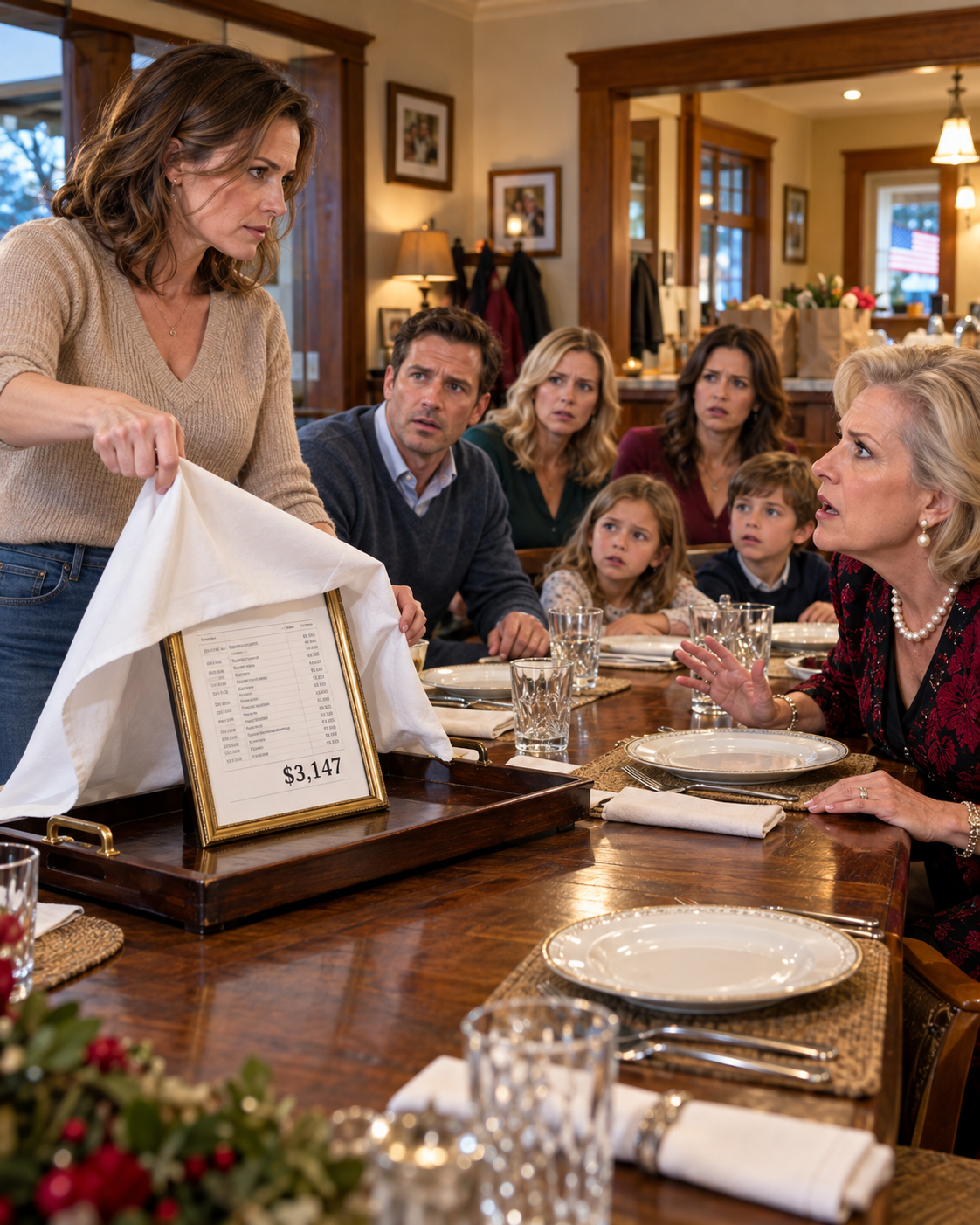
The room went SILENT when I lifted the napkin from the empty serving tray, and my mother-in-law stared
I stared at the photograph until the edges began to blur.
It showed Vivienne standing on our front porch four years earlier, before I had even finished unpacking the last moving box.
She was younger, though not by much, and she wasn’t smiling.
In her hand was a small brass key.
I knew every key to our house.
I knew the deadbolt key, the back-door key, the garage key, the mailbox key, and the tiny spare Julian kept on his key ring.
That brass key wasn’t any of them.
I turned the photograph over again.
“You don’t know.”
My first instinct was to call Julian.
My second was to hide the photograph.
The fact that my second instinct came first scared me.
For four years, I had told myself the problem was simple.
Vivienne was controlling.
Her daughters were entitled.
Julian was afraid of confrontation.
I was exhausted.
That explanation had been enough because it gave every painful thing a familiar name.
But now I was holding proof that something had happened before the pattern even began.
I slid the photograph into the drawer with the laminated $3,147 ledger.
Then I waited for Julian to come home.
When he finally walked through the door, he looked tired, loosened his tie, and kissed my forehead.
“How was your day?”
I held up the photograph.
His expression changed so quickly that I almost missed it.
He knew the picture.
That was the moment my stomach dropped.
“You’ve seen this.”
He didn’t answer.
“Julian.”
He sat down slowly.
“Where did you get that?”
“Under our door.”
He rubbed both hands over his face.
For several seconds, the only sound in the room was the refrigerator humming.
Then he whispered, “I thought it was gone.”
I sat across from him.
“What was supposed to be gone?”
He looked at the photograph again.
“The key.”
My chest tightened.
“What key?”
“The key to the basement.”
I almost laughed because it sounded absurd.
Our basement was unfinished storage.
Christmas decorations.
Old paint cans.
A broken treadmill.
Nothing worth hiding.
But Julian wasn’t laughing.
Four years earlier, before we moved into the house, he had given Vivienne a key because he was traveling for work and believed she might need to check on the property.
He told me he had changed the locks after we moved in.
At least, that’s what I thought.
“I changed the front and back locks,” he said.
“I didn’t change the basement lock.”
I stood up.
“You gave your mother access to our house and never told me?”
“I was going to.”
“When?”
He closed his eyes.
“I don’t know.”
That answer hurt more than an excuse would have.
We went downstairs together.
The basement smelled like dust and old wood.
Julian pulled aside several boxes until he reached a narrow door near the furnace.
He tried the handle.
Locked.
Then he reached into the back of an old toolbox.
There was another key.
My hands went cold.
He inserted it.
The lock clicked.
Inside was a small room I had never noticed.
It wasn’t large.
There was a folding chair, an old filing cabinet, and several cardboard boxes stacked against the wall.
“Why is there a room here?”
“I didn’t know it was here.”
“Then how did your mother?”
He didn’t answer.
We opened the first box.
Inside were old copies of property documents.
The second contained photographs.
The third contained letters.
And the fourth contained something that made Julian sit down.
It was a folder with my name on it.
Not our last name.
My maiden name.
My hands trembled as I opened it.
There were copies of employment records, an old apartment lease, photographs of my childhood neighborhood, and even a newspaper clipping from the town where I grew up.
“Why would your mother have this?”
Julian looked genuinely confused.
“I don’t know.”
But then I found the letter.
It was written by Vivienne.
The date was four years earlier.
The week before we moved in.
The first line made my heart stop.
“I need you to understand why I’m doing this.”
I read the rest in silence.
Vivienne had been terrified that Julian would abandon her after marrying me.
She believed marriage would mean losing the son she had raised alone.
She had convinced herself that if she remained indispensable, Julian would never fully separate from her.
The family gatherings had not started because she simply enjoyed visiting.
She had deliberately created obligations.
She had taught Clara and Megan that our house was the family gathering place.
She had told them Julian would cover anything they needed.
She had even written that if I became “difficult,” she had ways to make me feel isolated enough to leave.
My hands went numb.
There was one sentence underlined twice.
“She doesn’t understand yet that Julian still needs his mother more than he needs a wife.”
I looked at him.
He couldn’t meet my eyes.
“You knew she thought this way?”
“Not all of it.”
“But you knew enough.”
He nodded.
That was the hardest part.
Not the groceries.
Not the scratched floors.
Not the cruel comments.
Not even the $3,147.
It was discovering that Julian’s silence had not merely protected his mother.
It had protected a system he was too frightened to dismantle.
I walked upstairs without saying another word.
That night, I slept in the guest room.
The next morning, I called Maya.
She came over with coffee and listened without interrupting.
When I showed her the folder, she went completely still.
“This isn’t just about money anymore.”
“I know.”
“What are you going to do?”
I looked toward the window.
For the first time in four years, the house didn’t feel like a prison.
It felt like evidence.
“I want the truth.”
Maya nodded.
“Then start with the person who wrote the letter.”
Vivienne arrived that afternoon.
No warning.
No text.
She stood on the porch holding a casserole dish.
For one strange second, I almost laughed.
After everything, she had finally brought food.
She looked past me.
“Julian told me you found something downstairs.”
I didn’t move.
“You knew about the room.”
Her mouth tightened.
“I knew there was storage.”
“You knew about the file.”
Silence.
Then she sighed.
“I was protecting my son.”
“From me?”
“From losing him.”
Her honesty stunned me.
I expected denial.
Instead, she looked exhausted.
“I raised Julian alone,” she said.
“I made mistakes.”
“You didn’t make a mistake by being afraid.”
I held the folder against my chest.
“You made a choice.”
Her eyes filled with tears.
“I thought if I made myself necessary, I would never become unnecessary.”
For the first time, I saw something beneath the arrogance.
Fear.
It didn’t excuse what she had done.
But it explained why her grip had been so desperate.
Still, I wasn’t ready to forgive her.
“I understand why you’re afraid,” I said.
“But your fear doesn’t give you the right to make my home pay for it.”
She nodded slowly.
Then she said something I wasn’t prepared for.
“There’s something else.”
My heart sank.
“What?”
She looked toward the stairs.
“The money wasn’t the only thing I took.”
Julian appeared behind her.
“Mom, stop.”
She turned toward him.
“No.”
Her voice shook.
“Not anymore.”
She reached into her purse and pulled out an envelope.
Inside were copies of checks.
Old checks.
Thousands of dollars.
All written by Julian.
I looked at him.
He swallowed.
“After Dad died, Mom had debts.”
“How much?”
He didn’t answer.
Vivienne did.
“About twenty-eight thousand.”
My knees weakened.
For years, Julian had been secretly helping his mother financially.
That explained some things.
The expensive groceries.
The sudden emergencies.
The guilt.
The way Vivienne always seemed to believe Julian belonged to her.
But it didn’t explain everything.
“Why did you let me think our family gatherings were just about hospitality?”
Julian looked devastated.
“Because I was ashamed.”
I sat down.
He told me the truth.
When we first married, Vivienne had threatened to sell her house after falling behind on payments.
Julian panicked.
He secretly used money from our joint account to help her.
Then the gatherings began.
He convinced himself that if she stayed close, he could monitor her finances.
If he said no to her, she threatened to disappear.
If he didn’t answer her calls, she told him she was sick.
If he tried to set boundaries, she reminded him that he was the only reason she had survived.
He had become her emotional caretaker long before I entered his life.
And instead of ending that cycle, he had quietly brought it into our marriage.
I cried that night.
Not because I hated him.
Because I finally understood why he had looked so helpless all those years.
He wasn’t protecting a powerful mother.
He was protecting the frightened boy he had once been.
But understanding someone doesn’t mean surrendering your boundaries to them.
That became the first lesson of our therapy.
A week later, Julian sat across from Vivienne at our dining table.
No shouting.
No accusations.
Just boundaries.
He told her she could visit only when invited.
He would no longer provide money without transparency.
She would not insult me.
She would not rearrange our home.
She would not use guilt, emergencies, or family gatherings to control him.
Vivienne cried.
Julian cried.
I cried too.
But nobody backed down.
It was painful.
It was awkward.
It was necessary.
Months passed.
The house changed.
Not physically at first.
Emotionally.
The silence became peaceful instead of tense.
Our refrigerator no longer looked like it was preparing for an invasion.
The dining table became a place for two people to talk instead of eleven people to demand.
Then Megan came over one Saturday with a casserole.
She stood at the door holding it with both hands.
“I made this.”
I smiled.
“Thank you.”
She hesitated.
“Mom said family shouldn’t keep score.”
I waited.
Megan looked down.
“I think she was wrong.”
That sentence meant more to me than she probably realized.
We had a small potluck that evening.
No expensive menu.
No elaborate preparation.
Everyone brought something.
Leo helped set the table.
Chloe carried napkins.
Clara washed dishes.
And for the first time, nobody treated my home like a service station.
It felt like a home.
Even Vivienne came.
She stood quietly in the kitchen while I prepared dessert.
After a long silence, she said, “I owe you an apology.”
I turned around.
She didn’t make excuses.
She didn’t blame fear.
She didn’t mention being a mother.
She simply said, “I taught my children that love meant taking care of everything for them, and then I taught them to expect it from you.”
My eyes filled.
“I hope you teach them something different now.”
She nodded.
“I am trying.”
It wasn’t a perfect apology.
It wasn’t a magical ending.
But it was real.
And sometimes real is the only kind that matters.
A year after the night of the ledger, I opened my desk drawer and found the laminated $3,147 invoice.
I almost threw it away.
Instead, I kept it.
Not as a weapon.
Not as proof that I had won.
As a reminder.
Boundaries are not punishment.
Saying no is not cruelty.
And love does not require one person to disappear so everyone else can be comfortable.
Then I found the photograph again.
Vivienne holding the brass key.
I stared at it for a long time.
There was still one unanswered question.
Who had taken the photograph?
I asked Vivienne.
She said it wasn’t her.
I asked Julian.
He swore he had never seen it before.
Maya couldn’t identify the photographer.
Then, one evening, I received another envelope.
This time there was no photograph.
There was a handwritten note.
“You finally found the truth about the house.”
I read the sentence twice.
Then I noticed the handwriting.
It wasn’t Vivienne’s.
It wasn’t Julian’s.
It wasn’t Maya’s.
And beneath the message was a date from six months before we had ever bought the house.
I looked through the window at my quiet Craftsman home.
For the first time, I wasn’t afraid of what might be waiting inside.
I was afraid of what might have happened there before I arrived.
Because the truth had finally taught me something I would never forget.
Sometimes the people who hurt us are carrying wounds of their own.
But understanding their wounds does not require us to become the place where they bleed.
And sometimes reclaiming your home isn’t about locking the door on everyone else.
It’s about finally deciding who gets a key.
I folded the note, placed it beside the old ledger, and closed the drawer.
Then the doorbell rang.
Once.
Twice.
And when I looked through the window, I saw someone standing on my porch whom I had never expected to see again.
… The Story continues in the Comments!