The night my pregnant wife slid divorce papers across our Manhattan penthouse desk, I laughed, tossed her a $150,000 diamond bracelet
For several seconds, I couldn’t hear the rain against the windows or the distant hum of Manhattan traffic.
All I could see was the photograph of Clara holding a newborn child, her exhausted face softened by a smile I hadn’t seen in months.
The baby was wrapped in a pale yellow blanket, one tiny fist resting against Clara’s collarbone.
My daughter.
My Arya.
Except the photograph had been taken weeks before her due date, and the hospital bracelet around the baby’s wrist carried a date that made no sense.
I looked up at Justin.
“Where did you get this?”
He didn’t answer immediately.
Instead, he closed the office door, lowered the blinds, and placed another envelope beside the photograph.
“Before you decide what this means, you need to understand something,” he said. “Clara has spent the last six months preparing for a future in which you might never be allowed near your daughter.”
My first instinct was anger.
My second was fear.
“Is the baby mine?”
Justin’s expression changed, and for the first time since I’d known him, he looked less like a rival and more like a man carrying a burden he hadn’t wanted.
“Read the documents.”
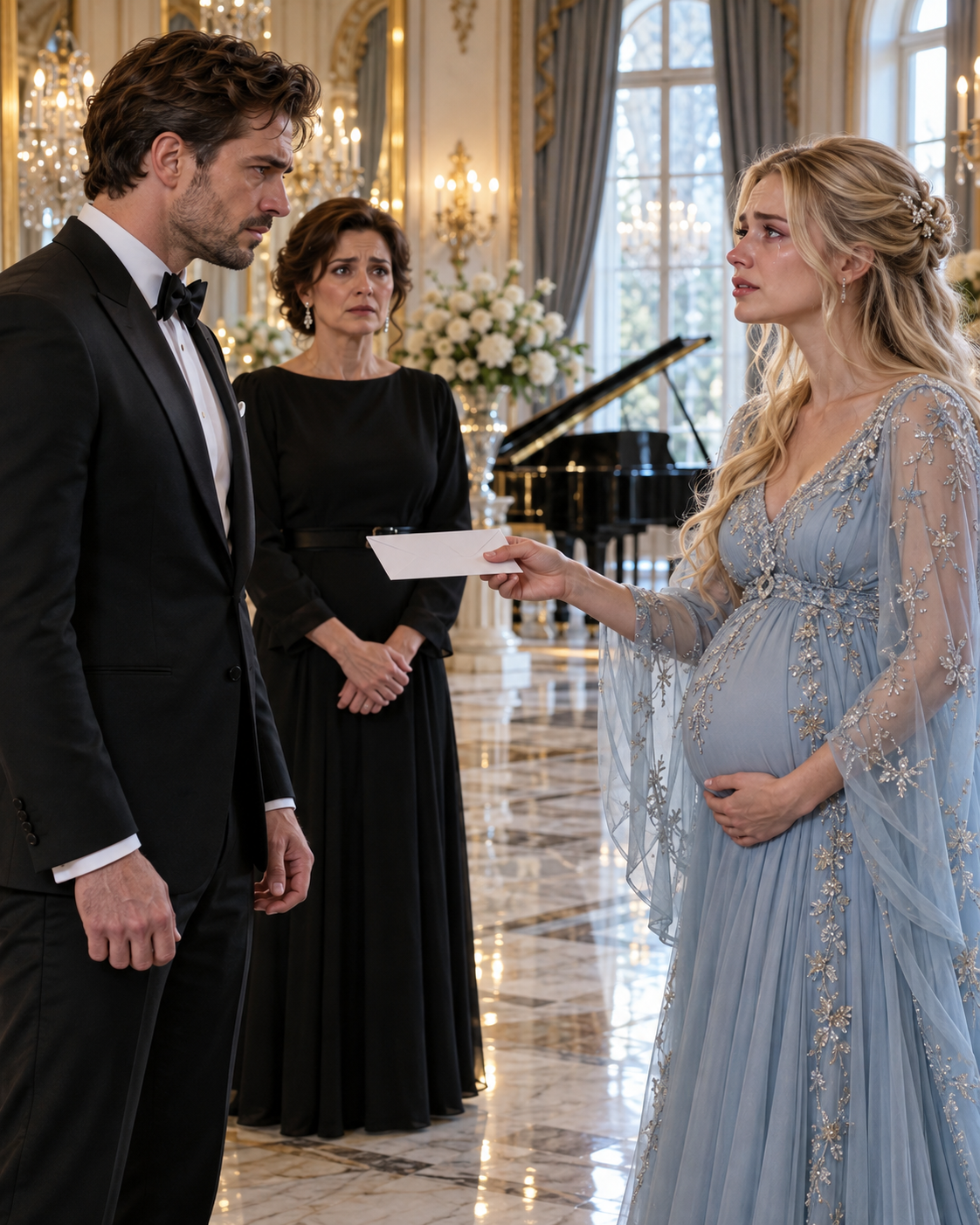
Inside the envelope was a hospital record, a letter from Clara’s obstetrician, and a copy of an emergency medical authorization.
The baby in the photograph was not Arya.
It was a little girl named Lily, the daughter of Clara’s younger sister, who had died following complications after childbirth.
Clara had been at the hospital to help care for her niece while her family made arrangements for the funeral.
I felt a wave of shame so sharp it almost made me sick.
I had seen a photograph and immediately imagined another betrayal, because suspicion had become the only language I understood.
“Why show me this?” I whispered.
“Because you need to stop confusing your fear with evidence,” Justin said. “Your wife has been doing the opposite for months.”
He opened the second folder.
It contained copies of the Helios Gen transactions, including records showing that the stolen patent rights had been transferred through three offshore companies before landing in an entity controlled by a holding company I had never seen.
I recognized the signature authorizing the first transfer.
Mine.
The signature authorizing the final transfer belonged to Justin.
“You stole it,” I said.
“We both did.”
“You told me the ownership structure was legitimate.”
“And you signed the papers because you wanted the profits without asking uncomfortable questions.”
I wanted to deny it, but I remembered the late-night meetings, the deliberately complicated reports, and the warning my former finance director had given me before I dismissed him for being disloyal.
I had not been tricked into every decision.
Some decisions had been made easier because I had wanted them to be wrong.
Justin leaned forward.
“Clara discovered the first irregularity while reviewing a charitable foundation’s investment records. She wasn’t looking for an affair or a way to take your company. She was trying to understand why money donated to a medical research program had disappeared into an account connected to Helios Gen.”
My stomach tightened.
“What does a charity have to do with our patent?”
“Helios Gen was developed through research partly funded by a foundation your company sponsored. The patent wasn’t entirely yours to move around, and the money you diverted affected people who had trusted your company to protect their work.”
For the first time, I understood why Clara’s divorce papers had felt less like an emotional reaction and more like the final page of a report.
She had found the crime before she found the affair.
The affair had simply shown her what kind of man I had become.
“Why didn’t she come to me?” I asked.
Justin gave a bitter laugh.
“Would you have listened?”
I couldn’t answer.
Six months earlier, Clara had asked me why our legal department was refusing to release a set of research documents.
I had accused her of interfering in matters she didn’t understand.
When she asked whether our investments were being audited independently, I had told her to enjoy her comfortable life and leave the difficult work to me.
I had watched hurt cross her face and mistaken her silence for surrender.
Now that silence had become a wall I couldn’t climb.
Justin pushed a final document toward me.
It was a notice of an emergency injunction seeking to freeze the disputed patent rights and preserve the company’s financial records.
The hearing was scheduled for the following morning.
“If you cooperate,” he said, “there may still be a way to limit the damage.”
“And if I don’t?”
“Then the government will get everything eventually, and they’ll have to decide how much of it you tried to hide.”
I stared at the papers.
For years, I had believed money could transform consequences into negotiations.
Now I was learning that a signature could outlive the man who had made it.
“Why are you helping Clara?”
Justin’s eyes hardened.
“Because I helped you steal something that never belonged to either of us, and because my brother is trying to make sure this case doesn’t become another example of wealthy men buying their way out.”
He stood, then paused beside the door.
“One more thing, Ethan. Clara doesn’t want to destroy you for the pleasure of watching you suffer.”
“Then what does she want?”
“For you to stop making her responsible for the man you’ve chosen to become.”
He left me alone with the photograph.
I called Clara.
The number had been disconnected.
I called Marcus, who informed me that all communication concerning the divorce had to go through counsel.
I called Arthur, who told me not to contact anyone involved in the investigation without his advice.
For the first time in my adult life, every door I reached for remained closed.
Then Seraphina arrived.
She swept into my office wearing the cream-colored coat I had bought her in Paris, her eyes bright with anger and fear.
“You’ve been ignoring me for two days,” she said. “Do you have any idea what people are saying about us?”
I placed the hospital photograph facedown.
“Not now.”
“Not now?” She stared at me. “You promised me a future, Ethan. You said Clara was practically a stranger, that your marriage was already over.”
“It is over.”
“Then tell the world.”
I looked at her and saw the same hunger that had once thrilled me because it resembled my own.
She didn’t want the life I had shared with Clara.
She wanted the life she believed she could take from me.
“I can’t give you what you want.”
Her expression collapsed into something painfully human.
“Was any of it real?”
I could have lied again.
I could have told her that I loved her, that the timing was unfortunate, that circumstances had conspired against us.
Instead, I admitted the truth.
“I wanted you to make me feel like I was still someone worth admiring.”
She looked away.
“And Clara?”
“I wanted her to keep loving me even when I gave her nothing to love.”
For a moment, neither of us spoke.
Then Seraphina removed the expensive watch I had given her and placed it on my desk.
“I thought being chosen by a powerful man meant I was special,” she said quietly. “I didn’t realize it meant I was willing to become someone I wouldn’t respect.”
She left without taking the watch.
I didn’t follow her.
The next morning, the courthouse was crowded with reporters, attorneys, and investors who had spent years treating my name as a guarantee of success.
I arrived with Arthur and a legal team that looked increasingly uncomfortable whenever the Helios Gen documents were mentioned.
Clara entered through a separate corridor.
She wore a simple navy dress, her hair pulled back, one hand resting protectively against her pregnant belly.
There was no triumph in her face.
That unsettled me more than anger would have.
I had prepared myself for accusations, tears, and demands.
I had not prepared myself for the quiet distance of someone who had already grieved the marriage while still living inside it.
When our eyes met, I almost called her name.
She looked away before I could speak.
The hearing began with Marcus presenting the financial records, followed by testimony concerning the transfers and the suspected misuse of company assets.
My attorneys challenged the documents, but the evidence was too extensive to dismiss.
The judge ordered the disputed assets preserved pending further proceedings and prohibited the destruction or alteration of relevant records.
It wasn’t a final judgment, but the order sent a clear message.
My money could no longer shield the evidence from scrutiny.
During a recess, I found Clara standing near a window overlooking the courthouse steps.
“Can we talk?” I asked.
“Your attorney can contact mine.”
“I’m not asking about the settlement.”
“Then what are you asking about?”
I searched for an answer that didn’t sound like another attempt to control her.
“I want to know whether you ever loved me.”
She looked at me for a long moment.
“Yes,” she said. “That was the problem.”
Her answer hurt more than any insult.
“I loved the man who used to sit on the kitchen floor with me when the power went out. I loved the man who remembered my mother’s birthday and stayed awake all night when she was sick. I loved the man who once told me he would rather lose every dollar than become someone who needed to lie to the people he loved.”
I swallowed.
“I remember.”
“I know you remember. You just decided those things mattered less than winning.”
I looked at her stomach.
“I’m going to be a father.”
“Yes.”
“Can you give me a chance to prove I can do that?”
Clara’s eyes filled, but she did not let the tears fall.
“You don’t earn the right to be a father by asking the mother of your child to trust you again. You earn it by being honest when honesty costs you something.”
Before I could answer, Marcus called her back into the courtroom.
She walked away, leaving me with the echo of a truth I had spent years avoiding.
The weeks that followed dismantled my life piece by piece.
Blackwood’s board suspended me from executive duties while an independent review examined the Helios Gen transactions.
Several major investors withdrew their support, and the company’s stock fell sharply as the investigation became public.
The gossip columnist I had hired released a statement distancing herself from the smear campaign, but that was only the beginning.
Seraphina’s affidavit became part of the legal record.
She provided messages showing that I had offered her money to keep quiet about the affair and had discussed portraying Clara as mentally unstable.
My attorneys urged me to deny the most damaging allegations.
Instead, I authorized the release of the original communications and admitted that the smear campaign had been my idea.
It was the first time I had chosen a truth that offered me no immediate advantage.
The confession did not make me innocent.
It simply removed one more lie from the pile.
Then came the settlement negotiations.
Clara’s legal team insisted on substantial financial protection for her and Arya, including a trust designed to secure our daughter’s future regardless of what happened to Blackwood Industries.
They also demanded accountability for the disputed patent transfers and a full accounting of the marital assets.
The final agreement took months.
I surrendered control of several investment accounts, relinquished a significant portion of my shares, and agreed to fund an independently administered trust for Arya.
The penthouse and Hamptons estate became part of the settlement, subject to the final financial adjustments.
The divorce itself was devastating, but the corporate investigation proved more complicated.
Clara would not trade her silence for money, and Marcus would not abandon the Helios Gen inquiry simply because the marriage was ending.
Justin cooperated with investigators and acknowledged his own role in the transactions.
His decision did not erase his responsibility, but it helped establish how the scheme had operated and who had authorized each transfer.
For the first time, the people who had built the deception began telling the same story without pretending someone else had written it.
One evening, Arthur called me into his office.
“The prosecutors are prepared to consider your cooperation,” he said. “That doesn’t guarantee immunity, and it doesn’t mean the financial consequences disappear.”
“What do they want?”
“The complete records, a truthful account of the transfers, and testimony about everyone involved.”
I looked out at the city.
For years, I had considered cooperation a weakness because it meant surrendering control of the narrative.
Now I understood that the narrative had never belonged entirely to me.
“Tell them I’ll testify,” I said.
The statement opened another painful chapter.
I spent weeks reviewing emails, transfer instructions, and contracts I had once signed without reading closely because the numbers looked favorable.
I gave investigators the names of intermediaries and identified the meetings where we had disguised the patent transfers as legitimate licensing arrangements.
Some of the details implicated people who had worked for me for years.
Others exposed my own decisions in ways no public-relations team could soften.
There were no triumphant moments.
There was only the slow, humiliating work of telling the truth.
Meanwhile, Clara prepared for Arya’s arrival.
I learned about her medical appointments through the arrangements made by our attorneys, and I sent messages that received no response.
I stopped asking her to forgive me.
Instead, I asked whether there was anything practical I could do to help.
For a long time, there was nothing.
Then one afternoon, Marcus relayed a message.
Clara wanted me to attend a meeting with a family counselor before the birth.
I arrived early and sat in a small room with soft lighting and a box of tissues on the table.
When Clara entered, she looked tired but composed.
The counselor asked us to discuss what we hoped our relationship as parents could become.
“I want Arya to know her father,” Clara said. “But I won’t let her grow up believing that love means tolerating dishonesty.”
“I don’t want that either,” I replied.
She studied my face.
“Wanting something is easy, Ethan. Doing it when you’re angry, embarrassed, or afraid is harder.”
“I know.”
“No,” she said gently. “You’re beginning to know.”
I didn’t argue.
We discussed boundaries, future visits, financial transparency, and how we would handle disagreements without using Arya as leverage.
There were awkward silences and moments when old resentments surfaced, but neither of us walked out.
When the session ended, Clara paused at the door.
“I don’t hate you,” she said.
For one reckless second, I mistook that for hope.
Then she added, “But not hating you doesn’t mean I can be married to you.”
“I understand.”
It was the first answer I had given her that wasn’t secretly a negotiation.
Three weeks later, Clara went into labor.
I was in the middle of a meeting with investigators when Marcus called.
“She wants you at the hospital,” he said. “If you can come without turning this into a spectacle.”
I was out the door before he finished speaking.
At the hospital, I found Clara exhausted, frightened, and holding my hand with a grip strong enough to hurt.
For once, there were no cameras, no lawyers, no contracts between us.
There was only the sound of a monitor and the knowledge that something larger than my ambition was about to enter the world.
When Arya was born, she cried so fiercely that the nurse laughed.
Clara began to cry too.
I stood beside the bed, unable to move, staring at the tiny face that had somehow made every expensive thing I owned feel weightless.
The nurse placed Arya in my arms.
She was smaller than I had imagined, with dark hair, wrinkled fingers, and a determined little mouth.
I had spent years trying to build a legacy that would outlive me.
Now I understood that a legacy could begin with something as simple as refusing to lie to a child.
“Hello, Arya,” I whispered. “I’m your father.”
Clara watched us from the bed.
There was love in her expression, but it was no longer the kind that asked me to become a better man.
It was the kind that hoped I would choose to become one myself.
The months after Arya’s birth were not a miraculous redemption.
The investigation continued, the divorce remained final, and the financial settlement forced me to rebuild my life on a scale I had once considered humiliating.
I lost my position at Blackwood Industries.
I sold properties, paid legal fees, and watched former friends discover that they had urgent business elsewhere.
The company survived under new leadership, while the Helios Gen dispute moved toward a resolution that included restitution and stricter oversight of its intellectual property.
My cooperation mattered, but it did not erase the damage I had caused.
I had to live with that.
I also had to learn how to be Arya’s father without treating fatherhood as another title to acquire.
I arrived when I said I would.
I kept my promises.
I answered difficult questions honestly, even when the honest answer made me look bad.
Clara and I became civil, then cautiously cooperative, but we never returned to the marriage we had lost.
One autumn afternoon, I took Arya to a small park near Clara’s new home.
She was beginning to walk, stumbling toward a cluster of fallen leaves while I followed close behind.
Clara sat on a bench, watching us.
For a moment, the three of us looked almost like a family again.
Then Arya fell onto the grass and burst into tears.
I scooped her up, brushing leaves from her coat, and promised that she was safe.
Clara smiled faintly.
“You don’t have to promise her that nothing bad will ever happen,” she said. “Just promise you’ll be there when it does.”
I looked at my daughter, then at the woman who had once trusted me with her entire heart.
“I can promise that.”
This time, I understood the difference between a promise and a performance.
Years later, I would still remember the night Clara pushed the blue folder across my desk.
I used to think that was the moment my empire collapsed.
I was wrong.
The collapse began much earlier, every time I chose convenience over honesty, applause over integrity, and possession over love.
The divorce papers only made the consequences impossible to ignore.
I never won Clara back, and eventually I stopped believing that forgiveness was something I could earn by suffering visibly enough.
She built a peaceful life for herself and Arya.
I built a smaller life of my own, one that required me to tell the truth even when no one was watching.
Some losses never become beautiful.
Some apologies arrive too late to restore what they broke.
But a person can still choose what to do after the damage is done.
On Arya’s first birthday, Clara invited me to join them for cake.
When my daughter placed a sticky hand against my cheek and laughed, I felt a kind of wealth no accountant could measure.
For once, I didn’t wonder how to protect it from the world.
I wondered how to deserve it.
And as Clara carried Arya toward the window, sunlight catching the tiny gold bracelet on her wrist, I finally understood the truth that had haunted me since that stormy night in Manhattan: the greatest thing I had lost wasn’t my money, my company, or even my marriage.
It was the man I might have been if I had learned to love without needing to own.
I could never return to the beginning.
But every morning, when Arya reached for my hand, I was given another chance to decide who would walk beside her.
And this time, I intended to be someone she could trust.