The night my father threw me out of our house at seventeen, he stood in the doorway while my stepsister Chloe watched from the staircase
Part 2
My studio apartment was not the kind of place people posted about on social media.
The walls were thin, the plumbing made strange noises at night, and the smell of detergent from the laundromat below sometimes seeped through the floorboards.
But I loved every inch of it.
I bought a secondhand table, a mattress, and a cheap set of kitchen utensils.
I taped my high school diploma to the wall above my desk because I wanted to see it every morning.
It reminded me that I had finished something important during a time when my life had seemed determined to fall apart.
I continued working at Mr. Harris’s electronics shop, eventually taking on more complicated repairs.
Customers began asking for me by name.
A woman brought in a laptop that another shop had declared beyond repair, and I managed to recover her photographs and documents.
An older man arrived with a radio that had belonged to his late wife, convinced it would never work again.
I spent two evenings tracing a damaged connection and replacing a failed component.
When the radio finally crackled to life, he stood silently at the counter, listening to a song he hadn’t heard in years.
Then he shook my hand.
“Thank you, son. You don’t know what this means to me.”
I did know.
I knew what it meant to have something precious restored after believing it was gone forever.
That was when I began thinking seriously about opening my own repair business.
I saved for tools, studied electronics in my spare time, and learned how to handle customer records, inventory, and the unglamorous paperwork that kept a small business running.
Jake helped me build a simple website.
Denise brought me sandwiches on the weekends when I worked late.
Mr. Harris taught me how to estimate repair costs honestly and how to tell a customer when replacing a device would be cheaper than fixing it.
None of them treated my circumstances as a reason to expect less from me.
They expected me to work hard, keep my promises, and learn from my mistakes.
That was the kind of accountability I had always needed.
By the time I turned nineteen, I was renting a small workshop with a storefront window and a sign bearing my name.
It wasn’t glamorous.
The first few months were painfully slow, and I sometimes sat behind the counter wondering whether I had made a terrible mistake by taking the risk.
But the business grew.
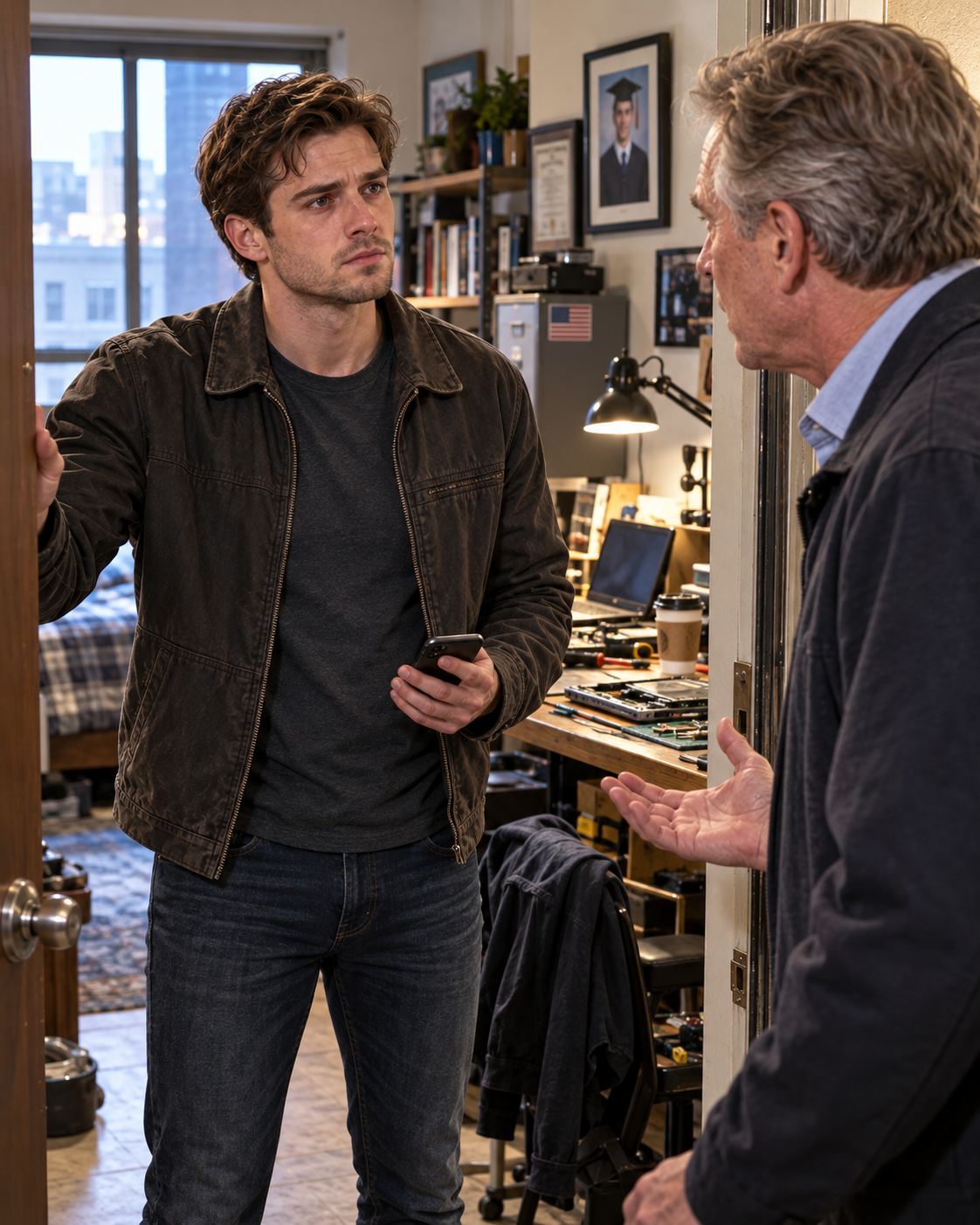
Word spread that I was honest, careful, and willing to explain repairs without making people feel stupid.
I became the person customers called when their computers failed before an important exam or their phones stopped working just before a family trip.
Some days were exhausting.
Some months, the bills came dangerously close to outpacing the money coming in.
Still, every problem belonged to a life I had chosen.
I no longer had to defend myself against accusations invented by someone who wanted me to fail.
I no longer had to guess which version of the truth would keep a parent from turning against me.
I could make a mistake, admit it, and fix it.
There was freedom in that.
I also stopped checking my phone for messages from home.
At first, it was deliberate.
I muted old family group chats, blocked the accounts that sent me hostile messages, and stopped asking mutual acquaintances whether my father had mentioned me.
Later, it became natural.
My life filled with customers, bills, repairs, friendships, and plans for the future.
The past did not disappear, but it stopped being the first thing I thought about when I woke up.
I rarely spoke about Chloe.
When people asked about my family, I told them we were not in contact and changed the subject.
I didn’t want to spend the rest of my life rehearsing arguments with people who were no longer in the room.
I wanted to build something that had nothing to do with them.
And slowly, I did.
By my mid-twenties, I had expanded the business into a larger shop, hired two employees, and developed a reputation for handling difficult repairs that other places refused to attempt.
I had a comfortable apartment, a reliable car, and enough savings to weather a bad month without panic.
I was not rich, and I did not need to be.
I had stability.
I had friends who showed up when they said they would.
I had a life in which kindness did not come with a hidden invoice.
For a long time, I believed the story with my father and Chloe had ended on that cold November night.
I thought I had already paid the full price of their betrayal.
Then, on a quiet Tuesday afternoon, my phone buzzed while I was replacing a damaged charging port.
The message came from a number I didn’t recognize.
The sender identified himself as Leo, Chloe’s long-term boyfriend.
I had never met him, but I recognized his name from occasional posts that mutual acquaintances had shared years earlier.
His message was brief.
“Hi, Ethan. I know you probably don’t want to hear from anyone connected to Chloe, but I need to tell you something. It’s about what happened when you were seventeen.”
I stared at the screen.
My hands remained frozen above the workbench.
For several minutes, I considered deleting the message without reading another word.
There was a time when I would have seized on any news from my family, desperate for proof that somebody had finally understood what had happened.
But that boy had grown up.
He had learned that curiosity could reopen doors better left closed.
Still, I read on.
“Chloe told me everything. Not just that she lied, but how she did it. She’s been having a difficult time lately, and a few nights ago, she finally admitted the whole thing. She said she framed you because she wanted your dad’s attention and thought you were the only person who could take it away from her.”
I read the message twice.
Then I set my phone down.
The workshop seemed unusually quiet.
I could hear the fluorescent lights buzzing above me and the distant traffic beyond the storefront window.
The truth I had spent years wishing for had arrived in the form of a text message from a stranger.
And I felt almost nothing at first.
No satisfaction.
No triumph.
Just a dull ache in a place I thought had healed.
Leo sent another message.
“She admitted moving your things, taking money and blaming you, and planting the vaping cartridge in your bag. She said she practiced crying because she knew your dad would believe her if she looked scared enough. She also admitted telling him you threatened her when you were actually trying to get her to stop.”
I closed my eyes.
The details were so precise that I could almost see those old scenes playing again.
The missing charger.
The money.
The accusations.
Chloe standing on the staircase with a tissue pressed to her face while my father pointed at the front door.
For years, I had wondered whether I had somehow contributed to what happened.
Had I been too defensive?
Too angry?
Too difficult to live with?
Had there been some part of the story I had failed to understand?
Leo’s messages answered those questions.
I had not imagined it.
I had not misunderstood it.
I had been deliberately framed.
“Why are you telling me this now?” I finally wrote.
His response took several minutes.
“Because she said she never expected you to actually leave. She thought your dad would punish you for a while, then bring you back. When he kicked you out, she panicked, but by then she’d already told too many lies. She said she kept doubling down because she was afraid the truth would come out.”
I stared at the words until they blurred.
Chloe had not merely wanted me punished.
She had wanted control over the story, and when the consequences became too large to manage, she had protected herself by letting them continue.
I had slept on a stranger’s couch.
I had spent nights worrying about food, rent, and whether I would be able to finish school.
I had learned how to survive without a parent because my sister had been afraid of losing attention.
And my father had accepted every lie because believing Chloe was easier than questioning his own judgment.
I typed a response, erased it, and tried again.
“Does my father know?”
Leo replied almost immediately.
“He knows now. Chloe told him herself.”
I put my phone down and returned to the repair in front of me.
I tightened a small screw, reconnected the battery, and tested the device.
The screen lit up.
The customer would be able to collect it that evening.
I wrote the receipt, placed the phone in its case, and handed it to my employee for the pickup shelf.
Then I walked into the back room and sat alone.
I had spent years imagining the moment someone would finally admit the truth.
In some versions, my father would call me immediately, his voice breaking as he confessed that he had been wrong.
In others, Chloe would face me, unable to meet my eyes, and admit that she had destroyed my childhood for reasons too small to justify the damage.
I had imagined apologies that would make the past feel less cruel.
But the actual truth did not arrive with a dramatic revelation or a feeling of victory.
It arrived on a phone screen while I was working.
And the boy who had once waited by a gas station for someone to rescue him was no longer there to receive it.
I had built a life without their permission.
I had survived without their acknowledgment.
The truth mattered, but it could not return the years I had spent wondering why my own father had stopped loving me.
That evening, I went home and cooked dinner.
I watched a movie, washed the dishes, and went to bed at my usual time.
I did not contact Chloe.
I did not ask Leo for recordings or screenshots.
I did not need to investigate every detail to prove that the pain had been real.
But the next morning, before I opened the shop, my phone rang.
The caller identification displayed a name I had not seen in years.
Dad.
I stood behind the counter, staring at the screen.
The phone rang until the call went to voicemail.
A minute later, it rang again.
I answered.
“Hello?”
For several seconds, all I heard was breathing.
Then my father’s voice emerged, older and rougher than I remembered.
“Ethan?”
I gripped the edge of the counter.
“Yes.”
“It’s Dad.”
“I know.”
Another silence followed.
I could picture him sitting at the kitchen table in the house where I had grown up, staring at a phone as though it were a difficult decision he could still postpone.
“I suppose you heard about Chloe,” he said.
“Leo contacted me.”
“Right.”
He cleared his throat.
“I don’t really know how to say this.”
I looked through the storefront window at the morning traffic.
For years, I had wanted to hear him struggle for words because he finally understood what he had done.
Now that the moment had arrived, I felt tired.
Not angry in the way I once had been.
Just tired.
“Then start with the truth,” I said.
He exhaled.
“Chloe admitted she lied about you. All of it. The money, the things she said you took, the vaping, the threats. She said she made it up.”
I closed my eyes.
“Yes.”
“I didn’t know.”
The words were so familiar that they almost sounded rehearsed.
I had heard them from him before, though never in exactly that form.
He had not known where I slept that first night.
He had not known whether I had enough money to eat.
He had not known whether I was frightened or ashamed or struggling to keep up with school.
But he had never asked.
And now he was telling me he had not known the truth because he had never bothered to look for it.
“You didn’t ask me,” I said.
My father went quiet.
“I know.”
“You didn’t check the receipts I showed you. You didn’t listen when I explained what happened. You didn’t even ask where I was going when you put my suitcase on the porch.”
His breathing became uneven.
“I thought I was protecting Chloe.”
“You were protecting the story she told you.”
He did not respond.
I looked down at my hands, remembering the cold porch railing beneath my fingers and the broken suitcase wheel lying in the driveway.
“I was seventeen, Dad.”
“I know.”
“No, I don’t think you do.”
My voice remained steady, but I could feel the old hurt rising beneath it.
“You were the person I was supposed to be able to trust. I was a kid, and you decided I was dangerous without giving me one honest chance to defend myself.”
He began to speak, then stopped.
For once, I did not rush to fill the silence.
I let him sit with the words.
Finally, he whispered, “I’m sorry, son.”
It was the apology I had once imagined so many times.
It should have meant more.
But an apology could arrive years after the person who needed it had learned how to live without it.
And I was no longer the boy standing outside in the cold, waiting for the door to open.
Part 3
My father asked whether we could meet.
He said he wanted to talk face-to-face, that he wanted to explain what had happened, and that he hoped we could find a way to become a family again.
“I miss you,” he added.
I looked at the workbench in front of me, at the tools I had purchased one at a time with money I had earned myself.
I thought about the first apartment, the late nights studying, the diploma on my wall, and the customers who had trusted me with things they could not afford to replace.
I thought about Jake, who had driven through the night because I had nowhere to sleep.
I thought about Denise, who had fed me without asking whether I deserved it.
And I thought about my father, who had possessed a house, a steady income, and every opportunity to protect his son, yet had chosen to close the door.
“What exactly do you want from me?” I asked.
He sounded wounded.
“I’m your father. I want my son back.”
The sentence nearly made me laugh.
Not because it was funny, but because he spoke as though I had wandered away and forgotten the way home.
“You didn’t lose me, Dad. You sent me away.”
“I know I made a terrible mistake.”
“Yes, you did.”
“I was trying to do what I thought was right.”
“You were trying to make a decision quickly. You didn’t care enough to find out whether it was right.”
He sighed.
“I can’t change what happened.”
“No, you can’t.”
“Then what am I supposed to do? Spend the rest of my life being punished for one mistake?”
There it was.
The question beneath the apology.
He wanted forgiveness, but he also wanted relief from the consequences of what he had done.
He wanted to be the kind of father who had made a mistake, not the kind of father who had abandoned his child.
He wanted the story to move forward before he had fully faced the part he had played in it.
I leaned against the counter and looked at the diploma framed above my desk in the small office behind the shop.
“I spent years trying to understand why you didn’t believe me,” I said. “I wondered whether I was a bad son, whether I had done something that made it easy for you to throw me away. I replayed that night so many times that I started remembering it differently, always looking for something I could have said to make you keep me.”
My father was crying now.
I could hear it in the pauses between his breaths.
“I never wanted you to suffer.”
“But you were willing to let me suffer because you thought I deserved it.”
“That’s not what I wanted.”
“It doesn’t matter what you wanted. You knew I was seventeen. You knew I had nowhere else to go. You chose to believe Chloe without checking a single thing I told you.”
He whispered my name.
For a moment, I felt the old instinct to comfort him.
It was automatic, a reflex left over from childhood, when I had learned that keeping my father calm was sometimes easier than asking him to understand me.
I recognized that instinct for what it was.
And I let it pass.
“I’m not calling to hurt you,” I said. “I’m telling you what happened because you asked for the truth.”
“I want to make things right.”
“You can’t make that night right.”
“Then let me try to make the future right.”
I closed my eyes.
It was the kind of sentence I might once have accepted because I had wanted so desperately to believe that love could repair anything.
But the future he was offering depended on something he had not yet understood.
Reconciliation was not a reward he could claim simply because he had finally discovered the truth.
It was not a door that automatically reopened when the person who had closed it became uncomfortable with the silence on the other side.
And I did not owe him access to my life simply because we shared a last name.
“I hope you learn from what happened,” I told him. “I hope you become someone who asks questions before condemning people, especially the people who trust you. But I can’t give you the relationship you’re asking for.”
His voice sharpened with desperation.
“You’re really going to throw away your own family?”
I felt a strange calm settle over me.
“No, Dad. I didn’t throw away my family. I was the one standing outside when you closed the door.”
He said nothing.
I continued, choosing every word carefully.
“You had years to look for me. You had years to ask whether I was safe, whether I had graduated, whether I needed help. You could have called, written, or found a way to tell me that you wanted to hear my side. You didn’t do any of those things.”
“I thought you hated me.”
“I was seventeen. You were the adult.”
The silence that followed was heavier than anything he had said.
For a moment, I wondered whether he would finally understand.
Then he whispered, “I suppose I deserve that.”
I shook my head, even though he couldn’t see me.
“This isn’t about what you deserve. I’m not trying to punish you. I’m choosing what I can live with.”
“Can’t we at least meet once?”
I thought about it.
Not because I wanted to punish him by refusing, but because I wanted to be certain that my answer came from the person I had become rather than the boy I had been.
I could imagine meeting him at a restaurant, watching him search my face for forgiveness, and hearing him explain that he had been manipulated by Chloe.
I could imagine him asking about my business, my apartment, and the years he had missed.
Perhaps he would cry.
Perhaps I would cry too.
Perhaps the meeting would be awkward, painful, or even unexpectedly kind.
But none of those possibilities changed the central truth.
I did not want to spend the next chapter of my life trying to repair a relationship I had not broken.
“Not now,” I said. “And I don’t want you to keep calling to change my mind.”
He inhaled sharply.
“Is that really it?”
I looked around the shop.
At the shelves of replacement components.
At the neatly arranged tools.
At the small framed photograph of Jake and me standing outside the storefront on opening day.
At the life I had built from the pieces of a childhood I had not been allowed to finish.
“That’s it,” I replied.
Then I said goodbye and ended the call.
My hand trembled for several seconds after the screen went dark.
I set the phone down and stood perfectly still.
I had expected the conversation to feel like winning an argument.
Instead, it felt like closing a book I had carried around for years, even after I had stopped reading it.
There was grief in that.
There was anger, too, and a sadness that no amount of success could erase.
But beneath all of it was relief.
I no longer needed my father to admit the truth before I was allowed to believe my own memories.
I no longer needed Chloe to confess before I was allowed to recognize the cruelty of what she had done.
Their admissions mattered because they confirmed what had happened, not because they gave me permission to heal.
Later that afternoon, Jake stopped by the shop to drop off lunch.
He took one look at my face and set the bag on the counter.
“What’s wrong?”
I told him about Leo’s message and my father’s call.
Jake listened without interrupting, his expression growing darker as I described the conversation.
When I finished, he asked, “How do you feel?”
I considered giving him the easy answer.
Instead, I told him the truth.
“Sad. Angry. Relieved. All at once.”
He nodded.
“That makes sense.”
“I thought I’d feel better when he finally admitted it.”
“Maybe you did. Maybe feeling better just doesn’t look the way you expected.”
I stared at the lunch bag.
“I don’t know if I made the right decision.”
Jake pulled out a chair.
“You don’t have to decide whether he’s a good person or a bad person. You just have to decide what kind of relationship is healthy for you.”
I looked at him.
“What if he really has changed?”
“Then he can live with the fact that you need distance. If he’s changed, he’ll respect that instead of demanding you prove you forgive him.”
I sat with those words for a long time.
It was possible my father regretted what he had done.
It was possible he had spent years thinking about me.
It was possible that hearing Chloe’s confession had forced him to confront a truth he had spent too long avoiding.
I could acknowledge all of that without pretending the past had become harmless.
I could hope he became a better man without volunteering to be hurt again.
And I could leave the possibility of a different future unanswered without promising him one.
That evening, after Jake left, I walked through the shop and turned off the lights one by one.
The glass storefront reflected my face back at me.
I looked older than the boy on the porch, steadier than the boy at the gas station, and far less afraid of being misunderstood.
I had built a life that did not depend on anyone’s approval.
I had learned to repair damaged circuits, diagnose complicated failures, and recognize when something was beyond repair without being ashamed of the answer.
Families were more complicated than electronics.
People could change.
Trust could sometimes be rebuilt.
But neither happened simply because someone wanted the damage to disappear.
Sometimes the most honest thing you could do was acknowledge what had broken, accept what could not be restored, and stop sacrificing your own peace to make another person comfortable.
In the months that followed, I heard small updates about my family through mutual acquaintances.
Chloe and Leo eventually separated.
I never learned every detail, and I stopped looking for them.
My father remained in the same house, surrounded by the same furniture and the same memories.
Occasionally, he sent a short message saying he hoped I was doing well.
I did not respond.
I was not trying to make him suffer.
I simply did not have anything to say that would move either of us forward.
Eventually, even the anger began to fade.
I stopped imagining conversations in which I finally made him understand what he had done.
I stopped rehearsing the perfect sentence that would force Chloe to see the damage she had caused.
I began to understand that closure was not always a moment when another person confessed, apologized, and gave you the ending you had deserved.
Sometimes closure was the quiet realization that you could remember what happened without needing to return to it.
On the anniversary of the day I opened my business, Jake and Denise came by after closing time.
We ordered pizza, sat around the small workbench, and laughed about the early days when I had repaired phones on a folding table in my apartment.
Denise raised her paper cup.
“To Ethan, who built something wonderful out of a very difficult beginning.”
I smiled, feeling my eyes sting.
Jake lifted his cup.
“And to never having to sleep on my couch again.”
We laughed, and for the first time in a long while, the memories of that first night did not hurt as sharply.
I could remember the cold, the broken suitcase wheel, and the shame of not knowing where I would sleep.
But I could also remember Jake arriving without hesitation.
I could remember Denise placing a warm bowl of chili in my hands.
I could remember the people who had shown me that family was not always the group of people who shared your blood.
Sometimes family was the person who opened a car door when you had nowhere else to go.
Sometimes it was the woman who made room on her couch and never once asked you to earn your right to be there.
And sometimes it was the friend who sat beside you in the dark until you were ready to believe that your life could still become something good.
After they left, I stayed in the shop for a few extra minutes.
I walked to the back office and looked at the framed diploma on the wall.
Beside it was a photograph of the storefront on the morning I first opened the doors.
I had been standing in front of the sign, trying not to look nervous, while Jake took the picture.
My father had not been there.
Chloe had not been there.
At the time, their absence had felt like proof that I was alone.
Now I understood that it was also proof of something else.
I had reached that moment without them.
I had made it through school, found a place to live, learned a trade, and built a business.
I had created a life in which the people who once rejected me no longer controlled the shape of my future.
That did not make what they had done acceptable.
It did not erase the boy who had stood outside a locked door, hoping his father would change his mind.
But it meant that the boy had survived.
I turned off the office light and locked the shop.
Outside, the evening air was cool, and the streetlights reflected on the pavement.
My phone buzzed in my pocket.
For a moment, I thought it might be my father again.
It was a customer asking whether I could look at a laptop the following morning.
I replied that I could, slipped the phone back into my pocket, and walked toward my car.
The simplicity of that moment made me smile.
There had been a time when every unknown message from home could change my entire day.
Now my life was full of ordinary things that belonged to me.
Work to finish.
Friends to see.
Bills to pay.
Plans to make.
A future that no longer required me to wait for someone else to decide whether I deserved it.
I still hoped my father would learn to live honestly with what he had done.
I hoped Chloe would someday understand that attention gained through cruelty was never the same as love.
But I no longer needed either of them to become different people before I could be at peace.
I had once believed that the worst thing my father could do was throw me out.
Years later, I realized there was something even more painful: the years I spent believing his decision meant something terrible about me.
It didn’t.
His decision told me what he was willing to believe, how he handled fear, and how quickly he had abandoned his responsibility when the truth required effort.
It did not determine my worth.
The night he closed that door, I thought my family had taken everything from me.
They had taken my home, my sense of safety, and the belief that love would always protect me from betrayal.
But they had not taken my ability to work, to care, to build, or to trust the people who earned my trust.
They had not taken the future I would create with my own hands.
And they had not taken the right to decide what happened next.
I could forgive one day, or I could choose not to.
I could reconsider the distance between us if life gave me a reason to do so, or I could leave that distance exactly where it was.
Neither decision would change the truth of what had happened when I was seventeen.
I had been a child who needed protection, and the person responsible for protecting me had chosen to believe a lie.
That was his failure, not mine.
So I kept the keys to my shop, the diploma on my wall, and the memory of the people who had helped me when I had nothing.
I stopped waiting for an apology to make me whole.
Because the deepest wound was never that my father had failed to recognize the truth.
It was that I had spent so many years believing I needed his recognition before I could trust myself.
I don’t believe that anymore.
And every morning when I unlock my shop, turn on the lights, and begin the work I built from nothing, I remember the boy who once stood outside a house with a broken suitcase and nowhere to go.
I wish I could tell him that the people inside that house would not always define his world.
I wish I could tell him that strangers would become family, that hard work would become freedom, and that one day the truth would arrive without needing to be chased.
Most of all, I would tell him this.
You were never the lie they told about you.
You were the person who kept going after they chose to believe it.
And sometimes, the most powerful ending is not when the people who hurt you finally beg for another chance.
It is when you realize you no longer need them to give you one.