The night I won a lifetime achievement award, I stood in a room full of powerful people and felt completely alone.
The document Daniel placed on the table was folded in half, its edges worn from being handled too many times.
I took it from him and began reading.
At first, the words seemed ordinary enough. Names, dates, court references, financial statements. Then I reached a paragraph near the bottom, and my fingers went cold.
It was a letter from Daniel’s former mother-in-law, Margaret Hayes.
She was Lily’s maternal grandmother.
According to the letter, Daniel’s ex-wife, Vanessa, had been telling the court that he was an unstable father who couldn’t provide a suitable home for their daughter. She had also claimed that Daniel was deliberately preventing Lily from seeing her maternal family.
But the most shocking part wasn’t the accusation.
It was a statement explaining that Vanessa had been receiving money from someone who wanted Daniel to lose custody.
I looked up.
“Who is paying her?”
Daniel lowered his eyes.
“My ex-wife’s new husband. His name is Richard Cole. He’s a property developer. He has a lot of money, and apparently, he has a lot of influence.”
“Why would he care whether you keep your daughter?”
Daniel rubbed his forehead.
“Because he wants Vanessa to move with him to another state. He doesn’t want Lily’s father involved in their new life. He thinks I’m an inconvenience.”
I looked at the letter again.
“Have you shown this to your lawyer?”
Daniel gave a bitter little laugh.
“I don’t have a lawyer anymore. I ran out of money three weeks ago.”
I stared at him.
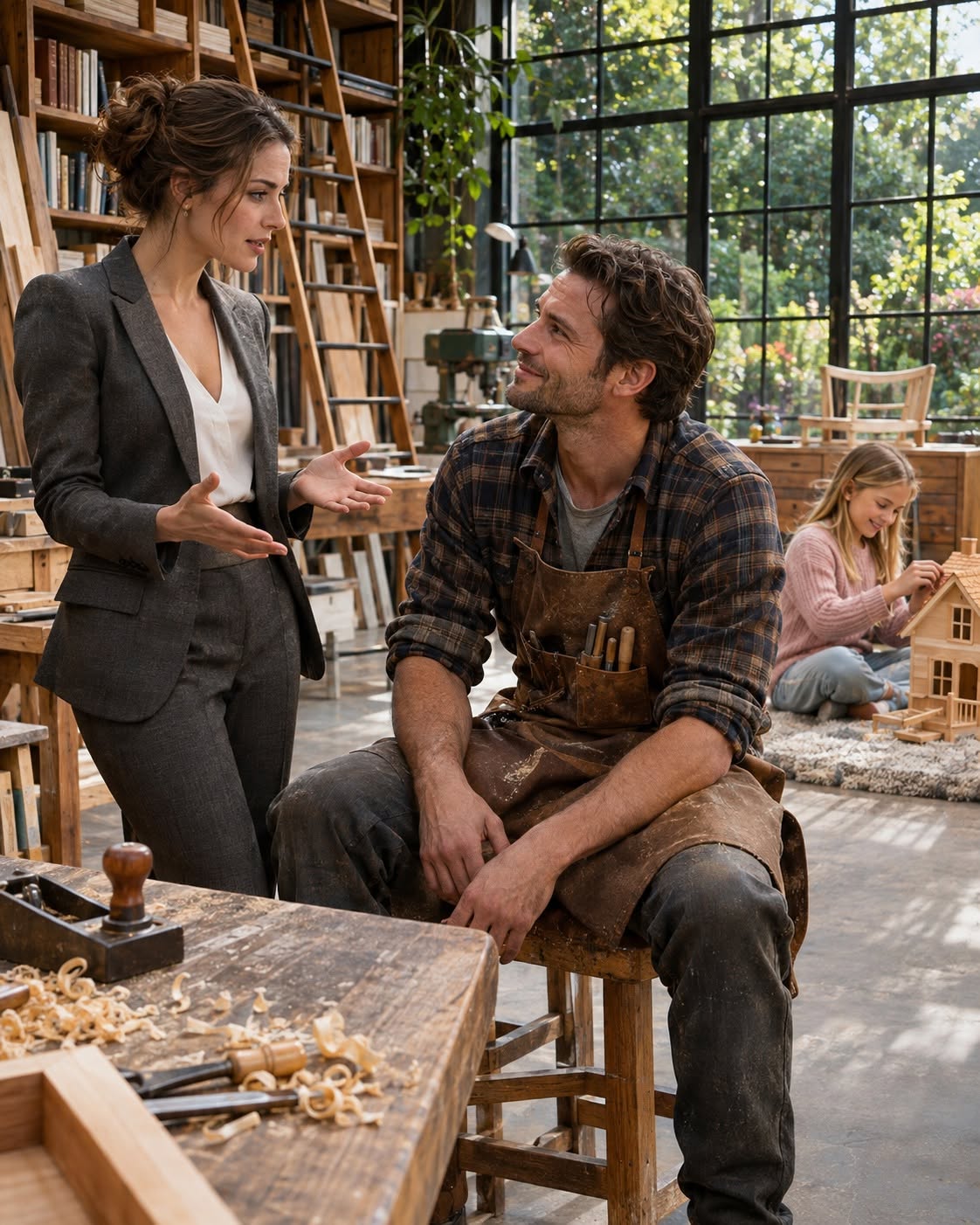
“And Vanessa knows that?”
“She knows everything. She knows I can’t afford to fight her. That’s why she’s pushing so hard.”
At that moment, Lily climbed onto the sofa beside us, holding the broken toy I’d been trying to repair.
“Miss Evelyn?”
I turned toward her.
“Yes, sweetheart?”
“Are you going to take Daddy away?”
The question hit me harder than anything I’d read in that letter.
Daniel immediately reached for her.
“No, princess. Nobody is taking me away from you.”
But Lily wasn’t looking at him.
She was looking at me.
Her little face was serious, and her eyes were filled with the kind of fear no six-year-old should have to carry.
I gently placed the document on the table.
“No, Lily. I’m not here to take your daddy anywhere. I’m here because I think your daddy deserves someone standing beside him.”
She studied me for a moment.
Then she held out her broken toy.
“Can you fix this?”
I smiled, although my throat had tightened.
“I think we can fix it together.”
That evening, I returned to my estate with something I hadn’t felt in years.
A purpose that had nothing to do with money, business, or proving myself to anyone.
But I was about to discover that helping Daniel would be far more complicated than writing a check.
And it would force me to confront something about my own past that I had spent decades trying to bury.
THE FIRST BLOW
The following morning, I called my attorney, Jonathan Reed.
He had represented my company for almost twenty years and was one of the sharpest legal minds I knew.
I explained Daniel’s situation and asked him to review the custody documents.
He listened carefully.
When I finished, he was silent for several seconds.
“Evelyn, I need to ask you something. Are you emotionally involved with this man?”
I frowned.
“What does that have to do with the legal situation?”
“Everything, potentially. If you finance his legal defense, the opposing side may attempt to portray you as someone trying to influence the custody arrangement.”
“I have no intention of influencing anything. I want Lily to have a fair chance at staying with her father.”
“Then we need to proceed carefully.”
I agreed.
Jonathan arranged an independent family-law attorney for Daniel, a woman named Catherine Brooks, who had an excellent reputation for handling complicated custody cases.
I insisted that Daniel meet her before making any decisions.
He was uncomfortable accepting my help.
“I can’t repay you,” he told me when I called.
“I’m not asking you to repay me.”
“People don’t usually do things like this without expecting something.”
I paused.
“Perhaps that’s because you’ve met too many people who confuse kindness with a business transaction.”
He didn’t respond.
Then he said quietly, “Thank you.”
Over the next two weeks, I visited Daniel and Lily several times.
I learned that Lily loved strawberry pancakes, hated thunderstorms, and had an extraordinary talent for remembering tiny details.
She also had a habit of asking questions that adults weren’t prepared to answer.
One afternoon, she asked me why I lived in such a big house if I didn’t have children.
I looked around my enormous kitchen.
“Because I spent a long time thinking that having a big house meant I had a successful life.”
“Is it successful?”
I laughed softly.
“That’s a surprisingly difficult question.”
She considered this.
“My daddy says a house is successful when people are happy inside it.”
I looked at Daniel.
He was repairing a loose cabinet hinge and pretending not to listen.
For some reason, I wanted to cry.
But happiness was not the only thing entering my life.
Trouble was coming.
And it arrived in the form of a newspaper headline.
WEALTHY SHIPPING EXECUTIVE FUNDS YOUNG CARPENTER’S CUSTODY BATTLE
The article appeared online on a Tuesday morning.
It suggested that I had developed an inappropriate relationship with an employee thirty-two years my junior and was using my financial influence to interfere in a family dispute.
The story included photographs of me leaving Daniel’s house.
Someone had even contacted the reporter with details about my award ceremony and the evening I had asked Daniel whether I was too old for him.
I felt sick.
I knew immediately that someone had been watching us.
By lunchtime, three members of my board had called.
By the afternoon, my company’s communications director was asking whether I intended to issue a statement.
Then Richard Cole called.
His voice was smooth, almost friendly.
“Ms. Bennett, I believe we should talk.”
“I don’t believe we have anything to discuss.”
“Perhaps. But I thought you’d like to know that your little friendship with Daniel is becoming a problem.”
“Get to the point, Mr. Cole.”
He chuckled.
“You’re a respected businesswoman. I would hate to see your reputation damaged over a man who clearly knows how to take advantage of wealthy women.”
My grip tightened around the phone.
“Be careful what you accuse people of.”
“I am simply offering friendly advice. Stay away from my family, and this story disappears.”
“Your family?”
“My wife and stepdaughter.”
I felt a chill run through me.
“Lily is Daniel’s daughter.”
“Legally, that’s still being decided.”
He paused.
“And I would strongly suggest you remember that.”
The call ended.
For several minutes, I sat completely still.
Then I called Jonathan.
This was no longer simply a custody dispute.
Someone was deliberately trying to intimidate us.
THE SECRET DANIEL NEVER TOLD ME
That evening, Daniel came to my estate.
He looked exhausted.
“I saw the article,” he said.
“I’m sorry.”
“Don’t apologize. You didn’t write it.”
He stood near the doorway, turning his work cap in his hands.
“I think I should stop working here.”
I looked at him.
“Why?”
“Because they’re using you to hurt me. I can’t let your business suffer because of my problems.”
“Daniel, you’re not a problem.”
“Maybe not to you. But I have a daughter. I can’t afford to be selfish.”
His words irritated me more than I expected.
“You think leaving will make Richard stop?”
“I don’t know. But at least he won’t have another reason to come after you.”
I walked closer.
“Listen to me. I have spent thirty years allowing other people to decide what I should fear. I’m not doing that anymore.”
He looked at me for a long moment.
Then he said something I hadn’t expected.
“Evelyn, there’s something else you should know.”
I waited.
“Vanessa didn’t always hate me. We were happy once. When Lily was born, she was the happiest woman in the world.”
He swallowed.
“Then her father died. She inherited some money, and Richard came into her life. He convinced her that she deserved a different kind of lifestyle. Expensive vacations, private schools, a bigger house. I couldn’t give her those things.”
“That doesn’t make you a bad husband.”
“I know. But I started working longer hours. I thought if I worked hard enough, she’d be happy again.”
He looked down at his hands.
“One night, I came home and found her packing. She said I was holding her back. She left Lily with me for three weeks while she went on vacation with Richard. Then she came back and told me she wanted full custody.”
I was silent.
“Why didn’t you tell me this earlier?”
“Because I didn’t want you to feel sorry for me.”
I reached for his hand, then stopped.
I wanted to comfort him, but I was beginning to understand that he needed something more important than comfort.
He needed to know he was still capable of standing on his own.
“Daniel, I don’t feel sorry for you. I respect you.”
His eyes met mine.
“And I don’t want you to give up your dignity just because someone has more money.”
For the first time that evening, he smiled.
But there was still one question I couldn’t ignore.
“Do you think Vanessa really wants Lily?”
He looked away.
“She’s her mother. I want to believe she does.”
I understood that answer.
Sometimes the hardest part of loving someone was accepting that they could be deeply imperfect.
THE COURTROOM
Three weeks later, the custody hearing began.
I sat in the back row, wearing a simple navy suit.
Daniel sat beside Catherine, his hands clasped tightly.
Across the room, Vanessa wore an expensive cream-colored dress. Richard sat behind her, whispering into her ear.
She looked beautiful, but there was something distant in her expression.
When she saw Daniel, she quickly looked away.
The first witness was a social worker who had inspected Daniel’s home.
She confirmed that the house was modest but safe, clean, and filled with everything a six-year-old needed.
Then Richard’s attorney presented photographs of Daniel’s small kitchen, his old furniture, and the bedroom Lily shared with her collection of stuffed animals.
They tried to make his home look inadequate.
Catherine stood.
“Is there any evidence that this child has been neglected?”
The social worker shook her head.
“No.”
“Has Daniel failed to provide food, clothing, medical care, or emotional support?”
“No. In fact, my reports consistently describe him as attentive and affectionate.”
The attorney sat down.
Then Vanessa took the stand.
She described Daniel as unreliable, emotionally distant, and financially incapable of raising Lily.
She claimed that he frequently left their daughter with strangers while working.
Daniel’s face tightened.
Catherine asked her whether she had ever left Lily alone with Daniel for several weeks.
Vanessa hesitated.
“Yes, but that was different.”
“How?”
“I had personal matters to attend to.”
“Did you provide financial support during those weeks?”
“I sent some money.”
Catherine presented bank records.
They showed no payments from Vanessa during that period.
Vanessa’s expression changed.
Then came the moment nobody expected.
Catherine presented a series of messages between Vanessa and Richard.
They had been obtained through the legal discovery process.
One message read:
“If we get the custody order, we can move without worrying about Daniel anymore.”
Another said:
“His house looks terrible. The judge will never let Lily stay there.”
But the most damaging message was dated two months earlier.
Richard had written:
“Once she’s with us, we can use the trust money for the school and the new house. Daniel won’t have any say.”
I watched Vanessa’s face turn pale.
Catherine continued.
“Mrs. Cole, were you aware that Lily has a trust fund established by her late maternal grandfather?”
Vanessa nodded.
“Yes.”
“And did you know that the fund can only be used for Lily’s benefit?”
“Of course.”
“Then why did you tell your husband that obtaining custody would allow him to use the money for a new house?”
Vanessa began to cry.
Richard leaned forward and whispered something.
The judge ordered him to remain silent.
For the first time, I saw fear in his eyes.
The hearing was adjourned until the following week.
Outside the courtroom, Daniel stood against a wall.
His hands were shaking.
“Did you see her?” he whispered.
I nodded.
“She looked like she didn’t even know what she was doing.”
I wanted to tell him that everything would be fine.
But I couldn’t.
The truth was that the next decision would change all of their lives.
THE WOMAN BEHIND THE LETTER
Two days before the next hearing, I received an unexpected visitor.
Margaret Hayes, Vanessa’s mother.
She was in her late seventies, thin, elegant, and carrying a small leather handbag.
“I believe you have been helping Daniel,” she said.
“I have.”
She nodded.
“Then I owe you an explanation.”
I invited her into my study.
She sat down and removed a folded photograph from her handbag.
It showed a young Vanessa holding a newborn Lily.
Beside her stood Daniel, smiling with a tired but unmistakably proud expression.
“Vanessa was once a very loving mother,” Margaret said.
“Daniel was a wonderful husband. They were young, but they had something real.”
“What happened?”
Margaret looked toward the window.
“After my husband died, Vanessa inherited a considerable amount of money. She was grieving, and Richard appeared at exactly the wrong moment. He made her feel important. He told her she deserved everything she had ever wanted.”
She took a shaky breath.
“I tried to warn her. But she stopped listening.”
“Why did you write the letter?”
“Because I found evidence that Richard was pressuring her to use Lily’s inheritance. I asked her to leave him. She refused.”
Margaret’s eyes filled with tears.
“Then she told me that if I continued interfering, I would never see my granddaughter again.”
I leaned forward.
“Why didn’t you tell the court sooner?”
“I was afraid.”
Her voice broke.
“I’m ashamed to admit that. I was afraid of losing Vanessa completely.”
I reached across the desk and held her hand.
“You’re here now.”
She nodded.
Then she opened her handbag again and placed a small envelope on the table.
“There’s something else. My husband kept copies of the original trust documents. Richard has been trying to get control of that money through a company he established.”
I stared at her.
“Does the court know?”
“Not yet.”
I immediately called Jonathan and Catherine.
Within hours, the documents were being examined.
And what they revealed was worse than we had imagined.
Richard had established a property company using a business address connected to his own office. He had been attempting to arrange a loan against assets belonging to the trust.
He had no legal authority to do so.
The documents also contained correspondence showing that Vanessa had signed papers without fully understanding their contents.
Suddenly, the custody case was no longer just about which parent could provide a better home.
It was about protecting a child’s inheritance from people who were supposed to protect her.
THE DAY EVERYTHING COLLAPSED
The final hearing took place on a rainy Thursday.
Daniel arrived early.
He wore a clean gray suit and a white shirt. His hands were still rough from years of woodworking, but he looked calmer than I had ever seen him.
Vanessa arrived twenty minutes later.
Richard was nowhere to be seen.
The judge reviewed the additional documents and listened to Margaret’s testimony.
Then something unexpected happened.
Vanessa stood before the court and asked permission to speak.
Her attorney looked startled.
The judge allowed it.
“I need to tell the truth,” Vanessa began.
Her voice trembled.
“Daniel was never a bad father. He was always a good father. I said those things because I was angry and because I thought I could give Lily a better life.”
She looked toward Daniel.
“I wanted the life Richard promised me. I wanted to stop feeling like I had settled for less.”
She wiped her eyes.
“But somewhere along the way, I stopped thinking about what Lily needed.”
Daniel stared at her.
Vanessa continued.
“Richard told me that if I got custody, he could help us start over. He said the trust would make everything easier. I didn’t understand how far he intended to go.”
Her voice broke.
“I know I hurt you. I know I hurt Lily.”
The courtroom was silent.
Then the judge asked whether she wished to withdraw her request for primary custody.
Vanessa nodded.
“Yes, Your Honor.”
The judge granted Daniel primary physical custody, with a structured visitation arrangement for Vanessa, subject to appropriate safeguards and further review.
The court also ordered the trust records preserved and referred the questionable financial transactions for further investigation.
It wasn’t a perfect ending.
There would be more legal proceedings, more difficult conversations, and a long road toward rebuilding trust.
But Daniel had been given the chance to raise his daughter without living under the constant threat of losing her.
When we stepped outside, the rain had stopped.
Daniel stood on the courthouse steps, staring at the sky.
He didn’t cheer.
He didn’t celebrate.
He simply closed his eyes and breathed.
Then he whispered, “I get to take her home.”
I felt tears running down my cheeks.
“Yes, Daniel. You do.”
He turned toward me.
And for the first time, he took my hand without hesitation.
THE CONFESSION
That evening, Daniel invited me to dinner.
Not at my estate.
Not at an expensive restaurant.
At his house.
He made roasted chicken, mashed potatoes, and vegetables. Lily had decorated the dining table with flowers she’d picked from the garden.
There were mismatched plates and a small candle in the middle.
It was the loveliest dinner I had attended in years.
After Lily went to bed, Daniel and I sat on the back porch.
The night air was cool.
He looked at me for a long time before speaking.
“Evelyn, I need to be honest with you.”
My heart began beating faster.
“All right.”
“When you first hired me, I thought you were intimidating. I figured you were one of those people who measured everyone by what they could do for her.”
I raised an eyebrow.
“That’s a charming confession.”
He smiled.
“I know. But then I watched you change.”
“I changed?”
“You started asking Lily about her drawings. You remembered how she liked her pancakes. You stopped walking past the people who worked for you without noticing them.”
He paused.
“And I realized that the woman everyone thought had everything was actually someone who had spent a long time being lonely.”
I looked down at my hands.
“That’s true.”
He moved a little closer.
“I care about you, Evelyn. More than I expected to.”
I swallowed.
“But I’m thirty-two. You’re forty-nine. We come from different worlds, and I have a daughter who needs stability. I can’t offer you a simple life.”
I looked at him.
“Daniel, I didn’t spend my life building a company so I could be frightened of a complicated life.”
He smiled, but his expression remained serious.
“I don’t want to become another responsibility you feel you have to carry.”
“Then don’t. Stand beside me. Not behind me. Not beneath me.”
He reached for my hand.
“That’s what I want.”
I felt something inside me soften.
Then I asked the question that had been haunting me since the night of the award ceremony.
“Are you sure you won’t wake up one morning and regret choosing a woman who is almost seventeen years older than you?”
Daniel smiled.
“Evelyn, I don’t love a number. I love the woman who sat on the floor repairing a little girl’s toy when she could have paid someone to do it.”
I laughed through my tears.
“That’s a rather specific reason.”
“It’s the one I remember.”
He leaned forward and kissed my forehead.
It was gentle, patient, and without any demand.
For once, I didn’t feel the need to control what happened next.
I simply let myself be happy.
A DIFFERENT KIND OF BEGINNING
Our relationship developed slowly.
I was careful not to confuse helping Daniel with loving him, and he was equally careful not to let gratitude become the foundation of what we shared.
He continued working as a carpenter.
I insisted that he receive fair payment for every job he completed at my estate, and he insisted on choosing which projects he accepted.
We agreed that his custody case would never become a reason for me to make decisions about Lily’s life.
Most importantly, we kept our finances separate.
Daniel wanted to know that if our relationship ever ended, he would still be able to provide for his daughter.
I respected him even more for that.
My board members were less enthusiastic.
One director suggested that my relationship with Daniel could damage the company’s image.
I listened without interrupting.
Then I said, “I spent decades building a reputation. I refuse to spend the rest of my life sacrificing happiness to protect it.”
He never raised the subject again.
A few months later, I made another decision.
I established a foundation that provided legal assistance and emergency support to parents facing unfair custody battles.
I named it The Open Door Foundation.
It was not named after me, my company, or my award.
It was named after a simple idea Daniel once shared with me.
A home should be a place where people feel safe enough to be themselves.
The foundation partnered with independent attorneys and family support organizations. Every case was reviewed on its own merits, and financial assistance was provided without regard to wealth, social status, or personal connections.
Daniel helped us develop a program that taught practical woodworking skills to single parents who needed stable employment.
He refused to have his name on the building.
He said the work mattered more than the recognition.
I understood.
One afternoon, about eight months after the custody hearing, Lily came running into my office carrying a piece of paper.
“Look!”
It was a drawing of three people standing in front of a large house.
One had long brown hair.
One had short dark hair.
The smallest person stood between them, holding both their hands.
Above the drawing, in colorful letters, she had written:
MY FAMILY.
I stared at it for a long time.
“That’s beautiful, Lily.”
She climbed into my lap.
“Can I call you Grandma Evelyn?”
I froze.
Not because I disliked the idea.
But because I understood how important those words were.
I looked at Daniel, who was standing in the doorway.
He gave me a small nod.
I turned back to Lily.
“You can call me whatever makes you happy, sweetheart.”
She wrapped her arms around my neck.
“Grandma Evelyn!”
And something inside me that had been empty for years finally felt full.
THE LAST SURPRISE
A year after the custody battle, I received a letter.
It was from Vanessa.
I almost put it aside.
But something made me open it.
She wrote that she had started therapy and was working to understand how she had allowed her ambition and resentment to damage her family.
She and Richard had separated after the financial investigation began.
She had also agreed to a more consistent visitation schedule with Lily.
The letter ended with a sentence I read several times.
“I used to think being a good mother meant giving my daughter everything I never had. Now I am beginning to understand that she may have needed something much simpler. Someone who would put her happiness before their pride.”
I folded the letter carefully.
I didn’t know whether Vanessa would become the mother Lily deserved.
But I hoped she would.
A child should never have to choose between loving two parents.
That evening, I showed Daniel the letter.
He read it quietly.
“Do you think she’s changed?” I asked.
He considered the question.
“I think she’s trying. That’s all I can ask for right now.”
He placed the letter on the table.
“People make mistakes. Some mistakes are terrible. But if someone is genuinely willing to take responsibility, perhaps they deserve the chance to become better.”
I smiled.
“You’re a more forgiving man than I am.”
He laughed.
“Don’t worry. I’m still learning.”
Then he reached into his pocket and placed a small wooden box in front of me.
It was beautifully made, with delicate carved details along the edges.
I opened it.
Inside was a simple silver ring.
Nothing extravagant.
No enormous diamond.
Just a smooth band with a tiny inscription on the inside.
STILL WORTH RESTORING.
I looked up at him.
“Daniel…”
He took my hands.
“I know we’re different. I know people will have opinions. And I know neither of us can promise that life will always be easy.”
He paused.
“But I want to build something with you. Not because you helped me. Not because you have money. Not because I need a better life.”
His eyes softened.
“Because when I’m with you, I feel like I can be completely myself. And I want Lily to grow up seeing that love isn’t about finding someone perfect. It’s about finding someone who is willing to keep showing up.”
I couldn’t speak.
For most of my adult life, I had believed that love was something you earned by being impressive enough.
I had collected awards, built companies, negotiated billion-dollar contracts, and learned how to walk into any room without showing fear.
Yet none of those achievements had taught me how to accept a simple, honest love.
Daniel wasn’t offering me a fantasy.
He was offering me a life.
And I wanted it.
“Yes,” I whispered.
He slipped the ring onto my finger.
From somewhere inside the house, Lily shouted, “DADDY! DID SHE SAY YES?”
Daniel laughed.
“She did!”
A moment later, Lily came racing into the room.
“Does this mean we’re going to be a family forever?”
I knelt down and hugged her.
“It means we’re going to keep choosing each other, every day.”
She seemed satisfied with that answer.
Then she looked at my ring.
“Can I have a ring too?”
Daniel and I burst out laughing.
“We’ll talk about that when you’re older,” he said.
She folded her arms.
“I think that’s unfair.”
And just like that, the most important moment of my life became an ordinary family evening filled with laughter.
THE HOUSE THAT FINALLY FELT LIKE HOME
Six months later, we held a small wedding in the garden behind my estate.
There were no celebrities, no business executives giving speeches, and no photographers waiting to capture an expensive celebration.
Only a handful of friends, Margaret, a few of Daniel’s colleagues, and the people who had become part of our lives.
Lily wore a pale blue dress and carried a basket of flowers.
She insisted on walking between us during the ceremony.
I wore a simple ivory gown.
Daniel wore a dark suit that he had chosen himself.
When the officiant asked whether we promised to love and respect each other, Daniel looked directly into my eyes.
“I do.”
My voice trembled.
“I do.”
Then Lily stepped forward and placed a small wooden ornament in our hands.
Daniel had carved it himself.
It was a little house with three tiny figures standing in the doorway.
On the bottom, he had engraved four words:
LOVE MAKES ROOM FOR EVERYONE.
I held it against my chest.
That night, after the guests had left, I stood alone in the garden for a few minutes.
The estate looked exactly as it had the night I received my lifetime achievement award.
The same stone paths.
The same enormous windows.
The same carefully maintained gardens.
But it no longer felt like a museum built to display my success.
Through the kitchen window, I could see Daniel washing dishes while Lily sat on the counter telling him an elaborate story about a dragon.
He was listening as if every word mattered.
I watched them for a moment.
Then Daniel noticed me standing outside and opened the door.
“Are you coming in?”
I smiled.
“Yes.”
He held out his hand.
I took it.
As I walked inside, I thought about the woman I had been that night at the award ceremony.
Forty-nine years old.
Surrounded by powerful people.
Wearing an expensive gown.
Terrified that time had passed her by and that the best parts of life were already behind her.
If I could speak to that woman now, I would tell her something I wish someone had told me much earlier.
You are not too old to begin again.
You are not too successful to need someone.
You are not weak because you want to be loved.
And you are never too far into your life to discover a different way of living.
I had spent decades restoring a company, protecting a fortune, and building a reputation.
But the greatest restoration of my life had happened in a much smaller place.
A modest house.
A broken toy.
A little girl who wanted someone to fix it.
And a carpenter who understood that something didn’t have to be flawless to be beautiful.
That night, I finally understood his words.
Sometimes the flaws are what make something worth restoring.
Not because broken things should always be put back together.
Not because every relationship deserves another chance.
But because our imperfections, our scars, and the difficult chapters of our lives do not erase our worth.
I had once believed that success meant reaching a place where nobody could hurt me.
Now I understood that a meaningful life meant finding people with whom I no longer needed to pretend.
And if there was one lesson I hoped Lily would remember as she grew older, it was this:
Never measure your worth by your age, your money, your appearance, or the approval of other people. The right people will see the person beneath all of those things.
Because sometimes, the most extraordinary chapter of your life doesn’t begin when you finally achieve everything you’ve ever wanted.
Sometimes it begins when you stop pretending you don’t need anything at all.