The night General William Hackett publicly called me a washed-up pilot at a classified briefing in Washington
The headlights beyond the perimeter fence multiplied until six black SUVs rolled toward the hangar, their tires crunching over the frozen pavement.
Sergeant Brody Jenkins raised his rifle, but I caught his arm before he could step into the open.
“Don’t shoot unless they give you a reason,” I said.
“Sir, they just tried to murder us in international airspace.”
“And they’ll call it an accident if we give them the chance.”
Inside the cargo hold, Dr. Benjamin Foster’s heartbeat had begun to strengthen, though his eyes remained closed. The medical module’s display flashed warnings about his body temperature and neurological activity, and I knew we had minutes, not hours, to get him somewhere safe.
Connor appeared at the rear entrance, carrying the encrypted laptop.
“There’s something you need to see.”
The screen showed a series of authorization records, each signed with Hackett’s digital credentials. The records documented the drone launch, the electronic interference over the Bering Sea, and an operation designated NIGHT GLASS.
But the last entry made my blood run cold.
It listed our aircraft’s tail number, our flight plan, and a final status: CREW AND CARGO TERMINATION CONFIRMED.
The order had been entered before we took off.
“They planned this from the beginning,” Connor whispered.
I thought of Hackett’s calm smile in Washington, the way he had dismissed my combat record in front of officers who once requested my advice. He hadn’t been humiliating me because he thought I was useless. He had been making sure nobody would question why a disgraced pilot had been assigned a routine transport mission.
My anger threatened to overwhelm me, but anger was exactly what men like Hackett counted on.
“Can you copy those records?” I asked.
Connor nodded. “Already started. There’s another file, but it’s encrypted behind a hardware key.”
“Keep working.”
A loudspeaker crackled outside.
“Captain, this is Colonel Marcus Vance, acting under direct Department of Defense authority. Secure the cargo and surrender all personnel for debriefing.”
I recognized Vance’s name from the briefing documents. He was Hackett’s security chief, a man whose reputation rested on making inconvenient people disappear behind walls of classification.
I stepped into the hangar entrance but stayed beneath the overhead lights.
“Colonel, I need medical support for Dr. Foster.”
“You are transporting a suspected national security threat. Step away from the container.”
“He’s a human being in a medical emergency.”
“That is not your decision to make.”
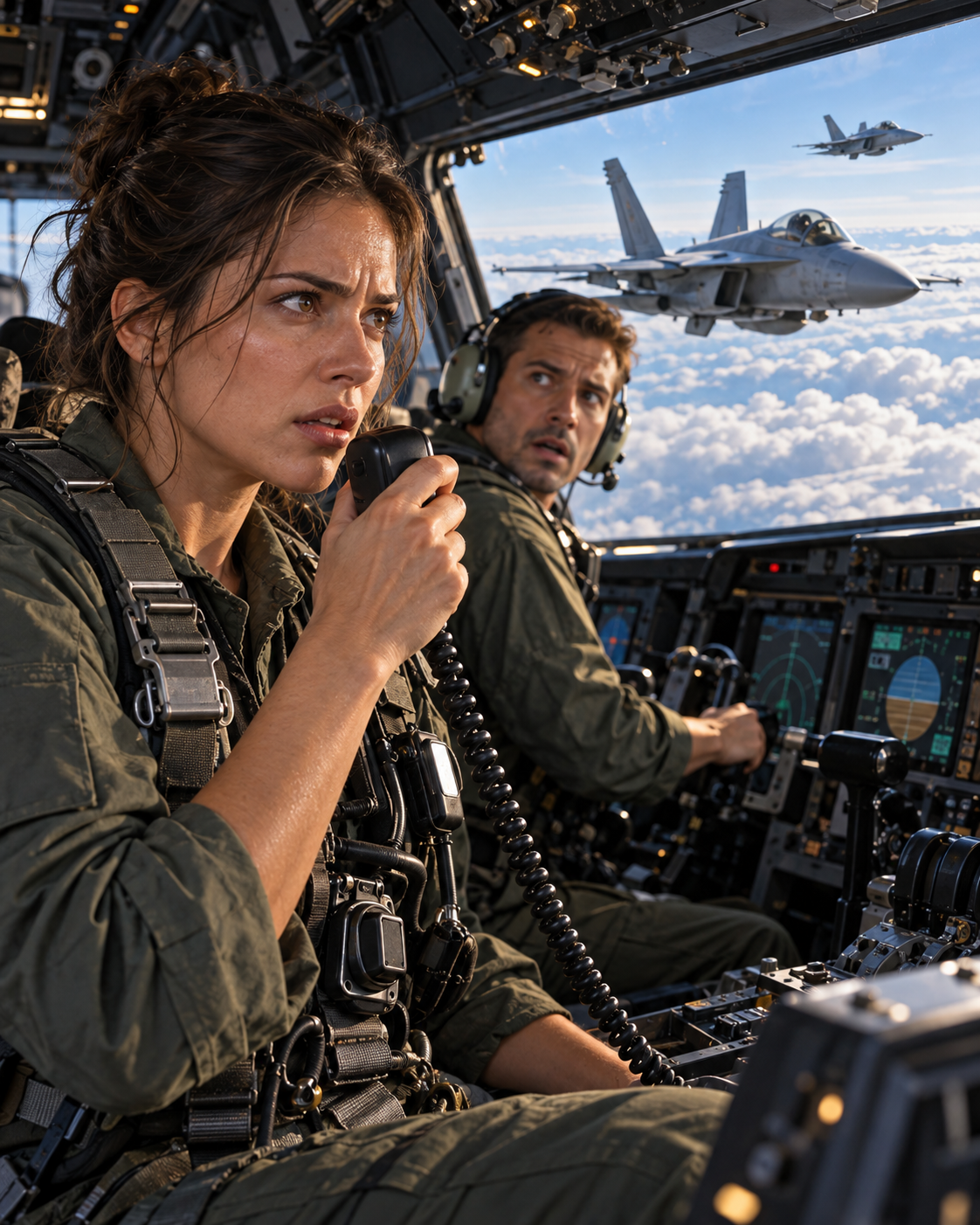
His voice carried the practiced certainty of someone accustomed to being obeyed.
Behind him, two armed men began moving toward the hangar’s side entrance.
Brody saw them first.
“Sir, we’ve got company.”
I looked at Vance and made a choice that would change the rest of my life.
“Colonel, I am placing this aircraft and its cargo under the protection of the base medical officer until a lawful medical evaluation can be completed.”
“You don’t have the authority.”
“Then put that in writing.”
For the first time, his expression changed.
It was small, barely a twitch around the eyes, but it told me everything. He could order people to disappear, yet he didn’t want to leave a document proving he’d ordered the disappearance of a man who was officially supposed to be in federal custody.
Vance lowered his chin toward his radio.
“Take them.”
The hangar lights went out.
Someone had cut the power.
Brody dragged me behind a stack of cargo pallets as gunfire cracked through the darkness. Connor shouted that the laptop had finished copying, then crawled toward us with the computer clutched against his chest.
I heard boots striking the concrete and the metallic click of a weapon being readied.
“Stay down,” I told Connor.
A beam of flashlight swept across the floor inches from his hand.
Then a voice rang out from the far side of the hangar.
“Federal agents! Drop your weapons!”
The gunfire stopped almost instantly.
Emergency lights flickered back on, revealing a group of armed federal investigators in dark winter uniforms. Their leader, a woman with short brown hair and a badge held high, moved between the two groups without hesitation.
“I’m Special Agent Rachel Morgan, Department of Justice. Colonel Vance, put your weapon on the ground.”
Vance stared at her in disbelief.
“Who authorized your presence?”
“The same people who authorized the independent investigation into NIGHT GLASS.”
His face lost its color.
Rachel turned toward me.
“Captain, is Dr. Foster alive?”
“He’s alive, but he needs medical attention.”
She signaled two medics forward. As they opened the module, Foster’s eyelids trembled, and a weak breath escaped his lips.
The sound was so ordinary that it nearly broke me.
After everything we had endured, after the drones and the ocean and the gunfire, one man breathing was the most extraordinary thing I had heard all night.
His eyes opened slowly.
“Where am I?” he rasped.
“You’re on Shemya Island,” I said. “You’re safe for the moment.”
He tried to lift his head, then grimaced.
“No,” he whispered. “You’re not.”
Rachel leaned closer.
“Dr. Foster, we need to know what happened.”
He looked at the laptop in Connor’s hands, and fear sharpened his expression.
“Did Hackett send you?”
“He did,” I answered. “And he tried to kill us.”
Foster closed his eyes.
“Then the breach is already underway.”
The medics transferred him to a secure treatment room while Rachel ordered Vance and his men disarmed. None of them resisted. Their confidence had depended on operating in the shadows, and the moment someone illuminated those shadows, they seemed suddenly ordinary.
I wanted to believe that meant we had won.
But Foster’s warning stayed with me.
Inside the medical facility, doctors worked to stabilize his temperature and reverse the effects of the stasis system. Rachel stationed agents outside his room, while Connor and I sat at a steel table beneath a flickering fluorescent light.
Neither of us spoke for several minutes.
Finally, Connor broke the silence.
“Sir, I keep thinking about those drones.”
“Which part?”
“The fact that somebody built them, tested them, and put them in the sky knowing they’d kill us.”
I looked at his young face, still marked by exhaustion.
“People can convince themselves that almost anything is necessary if they stop looking at the people who will pay the price.”
He stared at the table.
“My father served in the Air Force. He always said the uniform meant you were supposed to protect people.”
“Your father was right.”
“Then how does someone like Hackett get so far?”
I didn’t have an easy answer.
I’d spent years believing that courage meant confronting a threat head-on, trusting my training, and accepting that some missions demanded sacrifices. I’d never considered how easily those same beliefs could be manipulated by someone who knew exactly which orders a loyal officer would obey.
“Because loyalty can be exploited,” I finally said. “And because people who do terrible things rarely describe themselves as villains.”
The treatment-room door opened.
Rachel emerged holding a thin folder.
“Foster is stable enough to talk. He asked for you.”
I followed her inside.
Foster lay beneath a thermal blanket, an oxygen line beneath his nose and an IV taped to his arm. His face looked older than the photographs I’d seen, but his eyes were alert now, full of the kind of fear that came from knowing too much.
He motioned for us to come closer.
“General Hackett isn’t the architect,” he said. “He’s only the man willing to sign the orders.”
“Who is?” Rachel asked.
Foster hesitated.
“A group inside the defense establishment calls itself the Meridian Council. It’s not an official organization. It’s a network of senior officials, contractors, and intelligence intermediaries who believe they can control the balance of power by deciding which countries can see which threats.”
He explained that his team had developed a defensive software system designed to connect radar stations, airborne surveillance, and missile-defense platforms into a unified network. The system was intended to close the gaps that adversaries had repeatedly exploited.
But during a classified evaluation, Foster discovered that several gaps weren’t accidental.
They had been deliberately inserted.
Certain tracking systems would fail for precisely long enough to let selected aircraft cross protected airspace without being detected. The failures could be activated remotely, disguised as technical errors, and blamed on outdated equipment or enemy interference.
Someone was selling those windows of blindness to foreign buyers.
“Why would anyone risk an entire country’s security?” Connor asked.
“Because a vulnerability is worth more when you control both the threat and the cure,” Foster replied. “They could sell the weakness, profit from the panic, and then secure contracts to repair the damage.”
Rachel’s jaw tightened.
“And when you discovered it?”
“I copied the original audit records. The next morning, my security credentials were revoked. By noon, I was accused of espionage. Before I could reach an independent investigator, Hackett’s people took me into custody.”
He swallowed painfully.
“They told the public I had defected. Privately, they intended to move me to a black-site facility. The stasis module was supposed to preserve me until they could extract the encryption keys from my memory and destroy the evidence.”
I looked at the sealed laptop.
“Why not kill you immediately?”
“Because they needed my biometric authorization to open the original archive. They thought they could keep me alive just long enough to obtain it.”
Rachel opened the folder.
“Where is the original archive?”
Foster looked at her, then at me.
“Inside a defense test facility in Nevada. It’s isolated from the public network, and its records can’t be altered without leaving physical audit traces. The laptop contains the access sequence, but the archive requires my authorization in person.”
Rachel shook her head.
“You’re in no condition to travel.”
“Then Hackett has time to destroy it.”
“We can secure the facility,” she said.
“With whose authorization?” Foster asked. “The Meridian Council has people inside the agencies that would issue the order. If you alert the wrong office, they’ll know before your team reaches the gate.”
Silence settled over the room.
Then the laptop chimed.
Connor, who had remained near the door, looked down at the screen.
“There’s a new message.”
The sender was an account linked to General Hackett, but the text contained no threat.
It was a single line.
YOU HAVE SIX HOURS BEFORE THE ARCHIVE IS ERASED.
Beneath it was a location and an access credential.
Rachel read it twice.
“It’s bait.”
“Of course it is,” I said.
Foster stared at the screen with a look I couldn’t interpret.
“Not necessarily. Hackett wants the archive destroyed, but someone else may want it recovered. The Council isn’t united. Some of them are frightened of what happens if the others become too powerful.”
“You’re asking us to trust a message from the man who tried to kill us,” Rachel said.
“No,” Foster answered. “I’m asking you to understand that desperate people make mistakes.”
Rachel contacted her headquarters through a secure line, requesting a limited team whose members had no connection to the original investigation. She refused to share the Nevada coordinates until their identities were independently verified.
Meanwhile, Brody secured the hangar, and the surviving aircraft was examined for evidence of tampering. Investigators discovered that a maintenance access panel had been opened before departure, leaving traces of a device designed to transmit false status signals to the flight systems.
The mission had been sabotaged before we ever left the ground.
By dawn, the plan was settled.
Rachel would lead a small investigative team to Nevada. Foster would accompany us under medical supervision, because his authorization was essential to opening the archive. Connor would preserve the laptop’s evidence, and Brody volunteered to remain with the local investigators until the initial arrests were completed.
Before we left, Brody pulled me aside.
“Captain, I know I’m just a sergeant, but I need to ask you something.”
“Go ahead.”
“If we find out this goes all the way to the top, what happens then?”
I looked across the hangar at the titanium crate that had carried Foster through the sky like a coffin.
“Then we keep telling the truth until somebody can no longer afford to ignore it.”
He nodded, but I could see he wanted a more reassuring answer.
I did too.
The journey to Nevada was made aboard a government aircraft operated by a team Rachel had personally vetted. Foster slept under medical supervision for most of the flight, while I watched the horizon and tried not to imagine how many people had already been recruited to stop us.
Shortly before landing, Connor approached with the laptop.
“I found something buried in the mission files.”
He showed me a personnel record that listed my old F-15E squadron and a combat operation from six years earlier. During that mission, I had been ordered to strike a suspected weapons facility. Minutes before weapons release, a junior intelligence officer warned us that civilians might be inside.
I had aborted the attack.
The official report praised the decision after investigators confirmed the warning was accurate. But someone had quietly removed the intelligence officer’s name from the final record.
Her name was Rachel Morgan.
I looked toward the front of the aircraft, where she was reviewing documents.
“You were the one who warned us.”
She nodded when I showed her the file.
“I was a junior analyst. I had evidence that the target identification was wrong, but my supervisor ordered me to stay quiet. I sent the warning through an unofficial channel because I couldn’t live with what would happen if you fired.”
“Why didn’t you tell me?”
“Because I never knew which pilot received it. The transmission was anonymized to protect the source.”
For a moment, the noise of the engines seemed to fade.
Six years earlier, I had believed that aborting the strike was simply the right decision. I hadn’t known that another person had risked her career to give me the chance to make it.
“You saved those civilians,” I said.
“So did you.”
Her eyes met mine.
“And now we’re trying to save people we may never meet.”
The Nevada facility stood behind several layers of security fencing in a stretch of desert where the mountains looked black against the morning sky. The access credential opened the outer gate, but the guards inside claimed no one had received authorization for our visit.
Rachel presented her federal warrant.
The guards consulted their commander, then reluctantly allowed us into the main building.
Everything looked ordinary at first: server racks, monitoring stations, rows of status displays, and a secure laboratory behind a reinforced glass partition.
Then Foster saw the central console.
“That’s where they altered the audit records,” he whispered.
He approached the terminal with a technician’s careful movements, entering the access sequence from memory. The system requested his biometric authorization, and he pressed his palm against the scanner.
A warning appeared.
ARCHIVE INTEGRITY COMPROMISED.
Connor moved closer.
“Can you recover it?”
Foster’s fingers trembled as he navigated the menus.
“Some of it.”
A list of files appeared, including payment records, system modifications, and communication logs. Names filled the screen, followed by dates and transaction amounts routed through shell companies and defense contractors.
Then the console displayed a video recording.
General Hackett stood in a secure conference room beside a man whose face had been concealed by a shadow.
“We cannot permit the network to become fully operational,” Hackett said in the recording. “Once every sensor shares the same picture, the gaps disappear.”
The other man replied, “Then make sure the gaps remain useful. Our partners are paying for access, not promises.”
Hackett leaned forward.
“And the transport?”
“The drones will remove the witness and the evidence.”
The recording ended.
For several seconds, no one moved.
Rachel’s expression had hardened into something almost frightening.
“Copy everything. Preserve the original logs. No edits, no summaries.”
Connor began the transfer.
Then the building’s emergency lights turned red.
A mechanical voice announced that the facility had entered an automatic security lockdown.
Rachel’s radio crackled.
“Special Agent Morgan, this is headquarters. Stand down immediately. Your warrant has been suspended.”
She stared at the radio.
“Who issued that order?”
The reply came after a pause.
“Deputy Director Nathaniel Cross.”
Foster closed his eyes.
“He’s one of them.”
A loud impact shook the corridor outside.
Brody’s voice came over our secure channel from Shemya Island, where he’d been coordinating with the investigators.
“Captain, we’ve got a problem. The local evidence server was accessed remotely. Someone is trying to erase the copies.”
“Can you stop them?”
“We’re isolating the connection, but they’ve got administrative credentials.”
Rachel turned toward the terminal.
“They’re attacking both sites. They know we’re here.”
I watched the transfer bar crawl toward completion.
Seventy-two percent.
Eighty-one.
Ninety-four.
Then the screen froze.
A message appeared over the archive.
REMOTE PURGE INITIATED.
Foster’s face crumpled.
“No, no, no.”
Connor grabbed the console edge.
“There’s another connection. Someone is overriding the local controls.”
I recognized the pattern from the interference that had blinded our C-17. The same technique, the same deliberate silence, the same belief that whoever controlled the systems controlled reality.
“Disconnect the external network,” I said.
“The archive will lock if I do,” Foster warned.
“Then we open the local recovery partition.”
“That could destroy the only remaining copy.”
“And if we leave it connected, they’ll destroy it anyway.”
Foster looked at the files, then at the names of the people whose lives might depend on what they contained.
He nodded.
“Do it.”
Connor pulled the physical network isolation lever.
The display went black.
For one terrible second, I thought we had lost everything.
Then a small amber indicator began blinking beneath the console.
LOCAL RECOVERY AVAILABLE.
Foster entered a final sequence, and the archive reappeared, incomplete but intact. The recovered files were written to an isolated evidence device while Rachel’s team photographed the system and documented every step.
The door at the far end of the laboratory began to unlock.
Rachel raised her weapon.
“Nobody moves until I know who’s coming through that door.”
The door swung open.
A dozen federal agents entered, led by Deputy Director Nathaniel Cross himself.
He wore a dark suit, carried no visible weapon, and looked almost disappointed to find us alive.
“Agent Morgan, you have compromised a sensitive national security investigation,” he said. “Hand over the evidence.”
Rachel held her warrant at chest level.
“You’re under investigation for obstruction and conspiracy. Step away from the door.”
Cross laughed softly.
“You think a recording changes anything? Do you know how many classified programs depend on the system you’re about to destroy?”
“The program was designed to protect Americans,” Foster said. “You turned it into a marketplace for their vulnerability.”
Cross’s expression sharpened.
“You have no idea how fragile the balance of power really is. Sometimes a controlled weakness prevents a much larger war.”
“That’s what you tell yourself,” I said. “It makes the people you sacrifice easier to ignore.”
He looked at me with the same contempt Hackett had shown in Washington.
“You were a pilot. You followed orders. You have no understanding of the decisions made above your pay grade.”
“I understand what happens when people hide behind orders.”
For a moment, nobody spoke.
Then one of Cross’s agents lowered his weapon.
“Sir, I need to see the warrant.”
Cross turned on him.
“Stand down.”
The agent didn’t move.
Another agent stepped away from the doorway, followed by a third. Their faces revealed no triumph, only the exhausted uncertainty of people who had realized they might have been standing on the wrong side of the law.
Rachel seized the moment.
“Deputy Director Cross, put your hands where I can see them.”
He looked around the room and finally understood that his authority was no longer enough.
He surrendered without another word.
General Hackett was arrested later that day after investigators recovered the drone authorization records, the mission termination order, and financial communications linking him to the Meridian Council. The evidence reached multiple independent oversight offices before anyone could suppress it, and the surviving archive was duplicated under judicial supervision.
The investigation lasted eleven months.
Some officials resigned before charges were filed. Others denied everything until their own messages appeared on the public record. Several contractors lost their licenses, and a number of senior officials were indicted for conspiracy, bribery, and violations of national security law.
Not every name in the archive could be proven guilty, and not every missing file was recovered. The Meridian Council had spent years building layers of secrecy, and dismantling those layers took patience, evidence, and people willing to keep asking uncomfortable questions.
Dr. Foster testified before a closed congressional committee, then before a public hearing where he described how his work had been corrupted. He never called himself a hero.
“I built a system to help people see danger sooner,” he said. “My mistake was believing that everyone who asked for it wanted the same thing.”
When the hearing ended, he found me waiting in the corridor.
“I owe you my life,” he said.
“No,” I replied. “You owe the truth to the people who were put at risk. I was just the one flying the plane.”
He considered that, then nodded.
Connor recovered from the mission more slowly than he admitted. He returned to flight duty, but he stopped treating every order as an unquestionable command. He learned to ask why, to verify what could be verified, and to remember that a cockpit was full of human beings, not just instruments and procedures.
Rachel continued the investigation until the final indictments were filed. On the day Hackett entered his plea, she sent me a short message.
WE DIDN’T GET EVERY ANSWER. BUT WE GOT ENOUGH TO START.
I read it twice before putting my phone away.
A year after the flight over the Bering Sea, I stood beside a quiet runway at an Air Force base in Alaska, watching the winter light spread over the snow. The C-17 had been repaired, its damaged panels replaced and its systems thoroughly inspected. Someone had painted a small silver line beneath the cockpit windows, a maintenance mark that reminded me of the scar left by the near-crash.
I had been offered a return to fighter operations, but I hadn’t accepted immediately. For the first time in my career, I wanted to be certain that the next mission was one I could defend not only in the air, but also in the quiet moments afterward.
Connor joined me beside the aircraft.
“Do you ever wonder what would have happened if we’d followed the flight plan?”
“Every day.”
“Do you think we’d have made it?”
I watched a ground crew member check the cargo doors.
“No.”
He waited for more, but I couldn’t give him certainty I didn’t possess.
The people who had ordered our deaths had possessed impressive technology, powerful connections, and a convincing story about why their actions were necessary. What they hadn’t counted on was a pilot who refused to mistake silence for safety, a young co-pilot who kept asking questions, a sergeant who chose to stand his ground, and a scientist who refused to let his evidence die with him.
They hadn’t counted on ordinary people deciding that an order was not the same thing as the truth.
My phone vibrated.
The message came from an unknown number, with no sender identification and no traceable routing information.
I opened it.
The first line read: YOU FOUND NIGHT GLASS.
The second line made my chest tighten.
YOU MISSED THE FIRST PROJECT.
Attached was a photograph of a classified document bearing a date from twelve years earlier, long before Foster’s defense network had been designed.
At the bottom was a familiar signature.
General William Hackett’s.
But the name beside his was one I had seen only once, buried in the personnel records from my old squadron.
Rachel Morgan.
I stared at the screen, unable to breathe for several seconds.
Then another message arrived.
ASK HER WHAT HAPPENED IN NEVADA BEFORE SHE BECAME AN AGENT.
I looked across the runway toward the operations building, where Rachel was speaking with an investigator beneath the pale winter sky.
For the first time since the Bering Sea, I felt the old fear return—not the fear of dying, but the fear of discovering that the truth I’d fought for was only one piece of something much larger.
I locked my phone and slipped it into my pocket.
The aircraft behind me was ready to fly, and the sky ahead looked painfully clear.
I had learned that courage wasn’t simply charging into danger, and loyalty wasn’t blindly following the people who claimed to lead you. Sometimes courage meant asking the question everyone else was afraid to ask, and sometimes loyalty meant protecting people from the very institution you had sworn to serve.
But as I walked toward Rachel, I knew the hardest question still remained.
Had she been the person who saved those civilians six years ago—or had someone used that moment to place her exactly where they needed her to be?
I stopped a few steps away from her.
“Rachel,” I said quietly, “we need to talk about Nevada.”
Her face changed before I showed her the photograph.
And in that single, unguarded moment, I realized the next mission had already begun.