The morning Julian Vance had me escorted out of his Dallas racing headquarters, he called my $18,000 repair bill a LIE
Part 2
By noon the next day, Julian’s racing truck had been transported to the team’s private testing facility outside Dallas.
The garage there was larger than my entire workshop, with polished floors, climate-controlled equipment rooms, and technicians who worked beneath bright lights while wearing uniforms embroidered with the Vance Motorsport logo.
To Julian, it was the perfect place to prove that the expensive specialists he employed could solve any problem.
He expected the rebuilt engine to become another success story bearing his name.
Instead, he encountered a driver who refused to get behind the wheel.
Aaron Cross was Vance Motorsport’s star driver, a disciplined thirty-four-year-old who had spent years learning that confidence and safety were not the same thing.
He had won races in bad weather, recovered from mechanical failures at high speeds, and watched talented drivers lose their careers because someone else had ignored a warning.
When Julian presented the truck, Aaron asked to see the complete repair documentation.
The chief engineer, Marcus Reed, handed him the folder I had provided.
Aaron flipped through it slowly.
“Where are the final calibration records?”
Marcus frowned.
“I thought those were included.”
“They aren’t.”
He turned another page.
“Where is the complete post-rebuild validation report?”
Marcus glanced at Julian.
“We haven’t completed the independent checks yet.”
Aaron closed the folder.
“Then I’m not driving it.”
Julian gave a short, incredulous laugh.
“The engine runs perfectly.”
“That tells me it starts. It doesn’t tell me what happens under racing conditions.”
“We have a championship approaching. We don’t have time for unnecessary delays.”
Aaron’s expression hardened.
“Then you should have made time before bringing me an uncertified vehicle.”
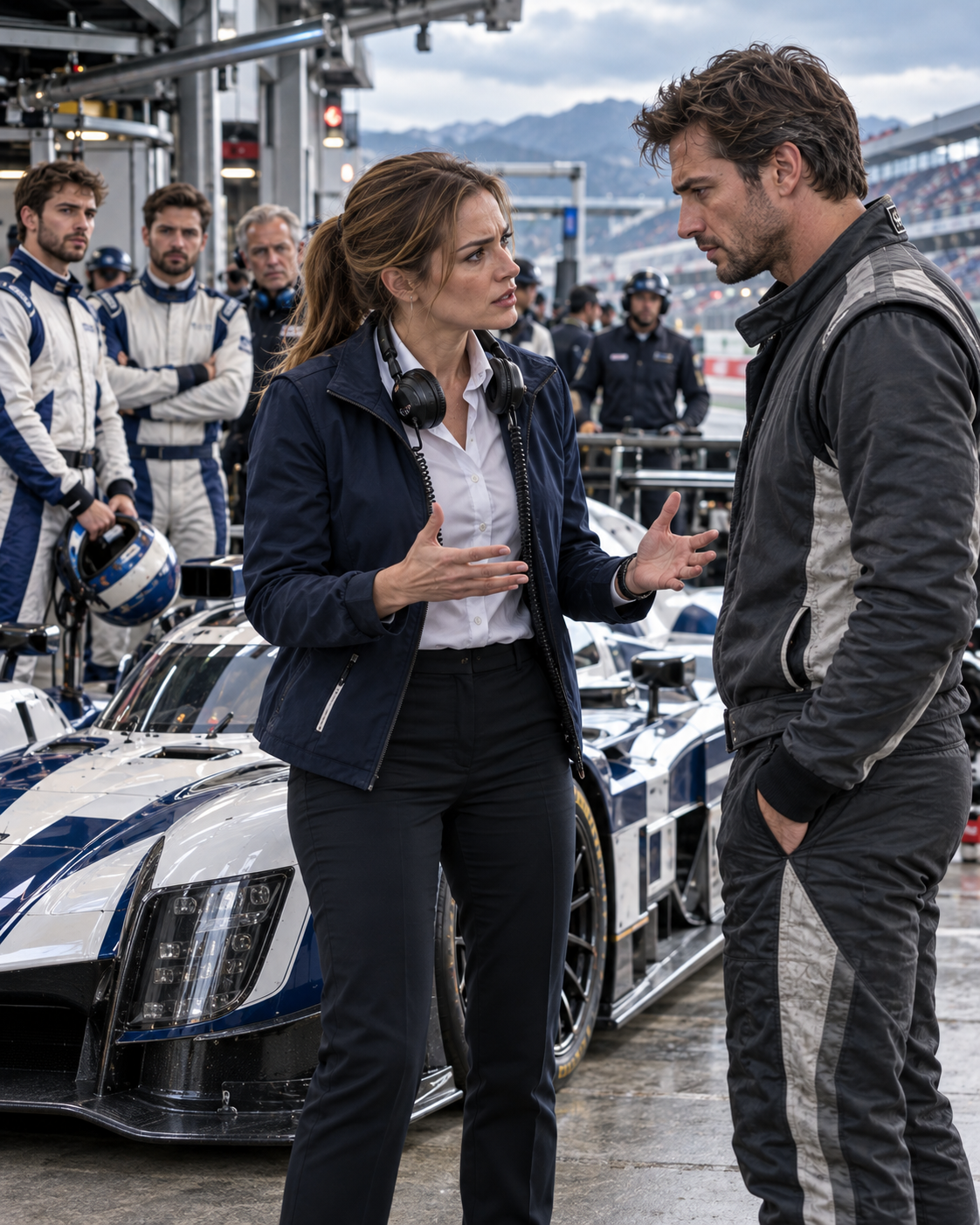
The room fell silent.
Julian stepped closer.
“You’re being paid to drive.”
“And I’m responsible for the consequences if this thing fails at two hundred miles an hour.”
Aaron set the folder on the workbench.
“Complete the checks. Show me the results. Then I’ll consider it.”
He walked out before Julian could answer.
For the first time, Julian faced a problem that couldn’t be intimidated into submission.
He called two experienced drivers who had previously expressed interest in joining the team.
Both reviewed the available technical information before agreeing to a test session.
Both withdrew when they learned that the rebuild lacked a complete independent safety clearance.
One of them told Julian directly that he would not risk his life to protect someone else’s schedule.
The other simply stopped answering his calls.
Meanwhile, Marcus and his engineers began examining the truck.
They verified the obvious mechanical work, checked the major assemblies, and ran preliminary diagnostic tests.
The engine started cleanly.
Its idle remained steady.
But under certain simulated operating conditions, one sensor reported readings that didn’t agree with the expected values.
The discrepancy was small enough to confuse the diagnostic process but important enough that no responsible engineer would ignore it.
Marcus repeated the test.
The readings changed.
He replaced the sensor with a verified unit.
The inconsistency returned.
He checked the wiring harness, examined the connectors, and compared the available calibration data against the team’s reference specifications.
Nothing gave him a definitive answer.
By the second afternoon, the team had lost another day.
By the third, Julian had begun pacing his office while the championship schedule loomed over every conversation.
He called the original specialists who had failed to repair the engine.
None could offer a useful solution.
One suggested another expensive component replacement.
Another proposed dismantling the entire assembly again.
Marcus rejected both ideas.
“We don’t know that the engine has another mechanical fault,” he told Julian. “We have an unresolved discrepancy in the sensor data. Replacing parts without identifying the cause could make things worse.”
“Then identify the cause.”
“We’re working on it.”
“Work faster.”
Marcus held his gaze.
“Speed isn’t the problem. Missing information is.”
That evening, Marcus reviewed the remaining records once more.
He found my photographs, the parts list, and the messages confirming the repair work, but several detailed calibration notes were not in the team’s copy of the folder.
The missing information was not proof of a defect.
It was a gap that prevented the engineers from understanding the exact sequence of adjustments I had made during the rebuild.
Marcus turned to Julian.
“We need Carter.”
Julian looked up sharply.
“Absolutely not.”
“We need his notes.”
“Then recreate them.”
“We can try, but it may take days, and we still need independent validation afterward.”
Julian’s jaw tightened.
He had spent his career treating every setback as a negotiation in which the other person eventually surrendered.
He had never imagined that a mechanic with an old truck and a small garage could become the one person he could not simply replace.
The next morning, the championship organizers confirmed that the team had to complete its scheduled technical preparations or risk losing valuable track time.
Sponsors began asking questions.
The team manager demanded an updated plan.
Aaron continued refusing to drive.
And Marcus, whose professional reputation depended on making responsible decisions, told Julian that he would not sign off on the truck until the unresolved discrepancy had been explained and the required checks completed.
Julian finally called me.
I was under the hood of an ordinary delivery van when my phone rang.
The number was unfamiliar, but the voice on the other end was not.
“Carter, this is Julian Vance.”
I kept working for another moment before answering.
“Good morning.”
“We have a problem with the truck.”
I tightened the fastener I was holding, then set down my tool.
“What kind of problem?”
“The sensor readings are inconsistent.”
“Have your engineers inspected the connections?”
“Of course they have.”
“Have they verified the calibration under the required conditions?”
A pause followed.
“We need you here.”
I looked at the invoice box sitting on a shelf near my office.
For a moment, I remembered the security guard’s hand on my elbow and Julian’s expression when he had told me to leave.
Then I remembered Chloe’s drawing.
MY DAD FIXES ANYTHING.
I had once believed that fixing an engine meant making it run.
Fifteen years in a garage had taught me that real expertise also meant knowing when not to turn a key.
“I’m willing to discuss the technical issue,” I said.
“Good. Get over here immediately.”
“Before we discuss the repair, I need to know when my outstanding invoice will be paid.”
Silence.
“Daniel, we have a championship on the line.”
“And I have a business to run.”
“You know how much this team is worth.”
“I know how much my work is worth.”
His voice grew sharper.
“You can’t hold a professional team hostage over a billing dispute.”
“I’m not holding anyone hostage. Your engineers are free to do their jobs, and your driver is free to make his own safety decisions. I’m simply not returning to work for a client who hasn’t paid me.”
I could hear him breathing through his nose.
“Name your terms.”
“The documented invoice must be settled in full. Any additional work must be agreed upon in writing, and qualified engineers must remain responsible for all mandatory inspections and safety clearance.”
“You expect me to pay before you even look at the truck?”
“I expect you to honor the bill for work I’ve already completed.”
He ended the call without another word.
I returned to the delivery van, but my hands felt unsteady.
Part of me wanted to walk away permanently.
Another part wanted to see the engine again, to understand the discrepancy, and to make sure no driver was placed at risk by an unresolved technical issue.
Those feelings were not contradictory.
I could refuse to be exploited without wishing harm on the people who depended on the machine I had repaired.
An hour later, my phone rang again.
This time, Julian’s legal counsel was on the line.
She introduced herself as Rebecca Shaw and asked whether I could send the invoice and supporting records directly to her office.
I agreed.
She reviewed the documentation, including the original scope of work, my itemized labor log, the parts receipts, and Julian’s written acknowledgments during the rebuild.
When she called back, her tone was measured.
“Our records support the amount you’re claiming. Mr. Vance has been advised to settle the outstanding invoice.”
I let out a breath I hadn’t realized I was holding.
“Thank you.”
“To be clear, the team still needs your technical assistance. Any return engagement will be handled separately, and the engineers will retain responsibility for safety certification.”
“That’s exactly how it should be.”
There was a brief pause.
“Mr. Carter, I understand that the earlier interaction was unpleasant. I can’t change what happened, but I can make sure the payment issue is handled properly.”
For the first time since Julian had escorted me out, I felt that someone inside his organization understood the difference between power and responsibility.
That afternoon, the full $18,000 arrived in my business account.
I stared at the confirmation for several seconds.
The money would cover Chloe’s school expenses, settle the bills I had delayed, and give my little garage enough breathing room to keep operating.
But the greatest relief came from knowing that I had not been forced to choose between protecting my livelihood and respecting myself.
I called Chloe after school.
“Guess what, sweetheart?”
She answered with her usual enthusiasm.
“What?”
“The school program is taken care of.”
There was a brief silence.
“Really?”
“Really.”
She squealed so loudly that I had to move the phone away from my ear.
“Does that mean pancakes on Saturday?”
I laughed.
“Chocolate chips and everything.”
That evening, I reviewed the technical records and prepared a copy of my calibration notes.
The following morning, I returned to the testing facility.
Julian was waiting near the entrance, wearing a suit that looked more expensive than the one he had worn at my garage.
He offered his hand.
I looked at it for a moment before shaking it.
“Thank you for coming,” he said.
“I came to help resolve a technical problem. Let’s keep the work focused on that.”
His hand dropped to his side.
“Of course.”
He led me into the main garage, where Marcus and several certified specialists stood beside the truck.
Aaron was there too, arms folded across his chest, watching me with an expression I couldn’t quite read.
Marcus approached first.
“I’m Marcus Reed, chief engineer. I’ve reviewed your records, and I’d like to understand your calibration sequence before we touch anything else.”
“That’s a good place to start,” I said.
He gestured toward the engine.
“We’ve repeated the diagnostics several times. We can reproduce the discrepancy, but we haven’t isolated its cause.”
I opened my folder and laid out my notes.
“Then let’s stop replacing parts and find out what the data is telling us.”
For the first time in days, the room became quiet for a useful reason.
Everyone was ready to listen.
And as I began explaining the final stages of the rebuild, I realized that the real test of my work was only beginning.
Part 3
Marcus and I spent the next hour comparing my original measurements against the team’s current diagnostic results.
The engine itself showed no obvious sign of the failure everyone had feared.
The rebuild had restored its mechanical integrity, and the major components were operating within the expected parameters during the initial checks.
The discrepancy appeared only when the system moved through a particular sequence of operating conditions.
I traced the readings through the data log, matching timestamps against the photographs and handwritten notes I had brought with me.
Then I stopped at one line.
“Run that test again,” I said.
Marcus adjusted the diagnostic equipment.
The values appeared on the screen.
I leaned closer.
“There.”
One sensor was reporting a value that did not match the system’s expected response, even though the sensor itself had already been replaced.
I followed the circuit diagram to the relevant connector.
“The problem may not be the sensor. It may be the connection or the calibration associated with it.”
Marcus studied the diagram.
“We checked the connector.”
“You checked whether it was connected. That’s not necessarily the same as confirming that the signal is being interpreted correctly under every required condition.”
He nodded slowly.
The certified electrical specialist joined us, and together we examined the connector, the relevant wiring, and the configuration used during the diagnostic sequence.
They discovered that the connection required a proper verification and calibration procedure before the system could be considered reliable under the test conditions.
The precise cause had not been a dramatic mechanical failure.
It was a small, easily overlooked issue that had become difficult to identify because everyone was searching for a more expensive explanation.
I stepped back while the specialists carried out their work.
They documented their findings, verified the connection, and repeated the relevant calibration process.
I offered observations when asked, but I did not attempt to replace their judgment with my own.
That distinction mattered to me.
I knew the engine because I had rebuilt it.
They possessed the qualifications, equipment, and authority required to independently evaluate whether it was safe to operate.
Neither responsibility canceled out the other.
By late afternoon, the discrepancy had been resolved, and the team began the formal validation process.
Every required check was performed according to the applicable procedures.
The engineers examined the results, repeated the relevant tests, and documented the system’s behavior before making any decision about track use.
Julian appeared several times, asking how soon the truck could be released.
Each time, Marcus gave him the same answer.
“When the checks are complete and the results support clearance.”
Eventually, Julian stopped asking.
I watched him from across the garage.
For the first time since I had met him, he seemed to understand that confidence could not substitute for evidence.
The following morning, the independent inspection was completed.
The responsible engineers reviewed the findings, confirmed that the required criteria had been met, and formally cleared the truck for the authorized test session.
Aaron arrived shortly afterward, wearing his racing suit and carrying his helmet.
He approached me before climbing into the cab.
“I heard you helped track down the discrepancy.”
“I helped the engineers narrow it down.”
He gave a small nod.
“Fair enough. That’s the kind of answer I like.”
He looked at the truck.
“I don’t care who gets credit. I care that the people who work on these machines take the risks seriously.”
“Then we’re in agreement.”
He smiled faintly.
“Looks like we are.”
When Aaron finally started the engine, its roar rolled across the testing facility.
This time, the sound didn’t make me feel proud of what I had done alone.
It made me feel relieved that a group of people had taken the time to verify the work before anyone put their life on the line.
The truck moved onto the track under controlled conditions.
I stood beside Marcus and watched it disappear around the first bend.
The minutes felt longer than they should have.
Then Aaron completed the opening lap.
He returned through the next section, maintaining the prescribed test procedure while the engineers monitored the data.
The second lap passed.
Then the third.
The readings remained within the required limits, and the team gathered more information with each pass.
When Aaron finally brought the truck back into the garage, he removed his helmet and grinned.
“Now that’s what I wanted to feel.”
Marcus reviewed the data before allowing himself a smile.
“The results are consistent with the required parameters. We’ll complete the remaining review before making the final determination about competition use.”
Julian exhaled.
For a moment, he looked as if he might embrace the nearest person.
Instead, he turned toward me.
“You saved our championship.”
I shook my head.
“The engineers completed the checks. Aaron made the decision to drive. The team did the work.”
Julian studied me, perhaps waiting for me to claim the credit he had once denied me.
I wasn’t interested in taking more than my share.
“I helped rebuild an engine,” I continued. “That doesn’t make me the only person responsible for what happens next.”
He looked away.
“I owe you an apology.”
The words sounded awkward in his mouth, like a tool he had never learned to use.
“You do,” I said.
He looked back at me.
“I shouldn’t have rejected your invoice. I shouldn’t have had security escort you out. And I shouldn’t have treated your experience as if it meant nothing simply because you worked in a small garage.”
I felt the old humiliation stir, but it no longer controlled me.
“You’re right.”
“I was under pressure, and I made a decision that could have cost your business money and damaged your reputation.”
“Pressure explains why you were impatient. It doesn’t excuse what you did.”
He lowered his eyes briefly.
“No. It doesn’t.”
I hadn’t expected the apology to erase anything.
An apology could not give me back the nights I had spent worrying about rent, or the moment I had stood outside his building wondering how I would explain the missing school payment to my daughter.
But a sincere acknowledgment could be the beginning of something better, provided it was followed by changed behavior.
Over the next several days, the team completed its remaining preparations.
The truck’s competition eligibility was confirmed through the appropriate process, and Aaron was cleared to participate.
On race day, I watched from the technical area with Marcus and the rest of the crew.
The championship circuit stretched beneath a pale morning sky, its grandstands filling with spectators who had come to watch powerful machines and fearless drivers fight for every fraction of a second.
Engines thundered around us.
Mechanics moved with focused urgency, checking equipment and communicating through headsets.
I had spent years working on vehicles that carried people to work, school, and family dinners.
Standing beside a championship team, I realized that the principles were not so different.
Every machine depended on people doing their jobs properly, especially when no one was watching.
Aaron took his place on the grid.
Before the start, he glanced toward the technical area and raised one hand.
I wasn’t sure whether the gesture was meant for me, but I raised mine in return.
The race began in a storm of noise and motion.
The truck launched cleanly, held its line through the opening section, and settled into a steady rhythm as Aaron began working his way through the field.
Lap after lap, the engine delivered the performance the team had expected.
The crew followed the data, watched the temperatures, and monitored every relevant system.
Nothing was left to assumption.
Near the final stretch, Aaron moved into a position that gave him a chance to challenge for the lead.
The grandstands rose in a wave of sound.
I gripped the railing so tightly that my fingers began to ache.
Then he crossed the finish line.
The team erupted.
People shouted, embraced, and slapped each other on the back.
Marcus laughed with relief, and even the most serious technicians allowed themselves to celebrate.
Aaron climbed out of the truck and raised both arms toward the crowd.
Julian stood in the middle of the celebration, smiling as cameras turned toward him.
For a moment, I wondered whether he would tell the story as if the victory had been his achievement alone.
Then the team gathered for a public interview.
A reporter asked Julian what had made the difference after the team’s difficult week of preparation.
Julian took the microphone.
“Our success came from the people who did the work,” he said. “Aaron trusted the process, Marcus and the engineering team insisted on proper validation, and Daniel Carter helped us resolve a problem that had stalled our progress.”
He paused, looking directly toward the technical area.
“I also owe Daniel a public apology. He completed a demanding rebuild, documented his work, and presented a legitimate invoice. I rejected it unfairly, and that was wrong. He deserved to be treated with professional respect from the beginning.”
The reporter asked whether the dispute had delayed the team.
“It did,” Julian admitted. “But the delay wasn’t caused by Daniel insisting on payment. It was caused by my decision not to honor an obligation.”
The words traveled farther than the apology he had given me privately.
I watched the cameras turn toward him and felt something unexpected.
Not triumph.
Relief.
For weeks, I had carried the fear that Julian’s version of events might become the only version anyone heard.
Now the truth had been spoken where the original humiliation had begun: in public, in front of people who had once watched me walk out of his headquarters.
After the event, Julian asked me to meet him in a quiet office overlooking the track.
He placed a folder on the desk.
Inside was an offer for a permanent lead mechanic position with Vance Motorsport.
The salary was competitive, the benefits were substantial, and the agreement included a flexible schedule that would allow me to remain present in Chloe’s life.
“I want you to consider joining us,” he said. “Not because I need someone to rescue us again, but because we need people who understand that the work matters more than the appearance of success.”
I read the offer carefully.
“I appreciate this.”
“I know I haven’t earned your trust yet.”
“No,” I said. “You haven’t.”
He nodded, accepting the answer without arguing.
“But I would like the chance to earn it.”
I looked through the office window at the truck sitting beneath the afternoon light.
A few weeks earlier, I had believed that the only way to protect my dignity was to walk away from Julian forever.
Now I understood that refusing mistreatment did not mean I had to reject every opportunity that followed it.
The important question was whether the new arrangement would respect the boundaries I had fought to establish.
“I have conditions,” I said.
“Name them.”
“All repair scopes must be documented. Additional labor must be approved clearly. Technicians must be able to raise safety concerns without being punished for it. And my schedule has to allow me to be a father.”
Julian listened without interrupting.
“Agreed.”
“I want that in writing.”
“It will be.”
I signed the offer after reviewing the final agreement with my own adviser.
I didn’t sign because Julian was wealthy, because his team had won, or because a racing championship could make my name sound impressive.
I signed because the position offered a chance to build something more stable for Chloe without requiring me to abandon the standards that had carried me through fifteen years of work.
A week later, the team hosted an open house for employees, families, and supporters.
Chloe arrived wearing her favorite blue dress, carrying the drawing she had made before Julian’s invoice dispute.
She had insisted on bringing it.
When she saw the racing truck, her eyes widened.
“That’s the one you fixed?”
“That’s the one.”
She studied the machine from front to back.
“Does it go really fast?”
“It does.”
“Did you make it win?”
I crouched beside her.
“I helped make sure the engine worked properly. A lot of people did their jobs, and the driver did his.”
She seemed to consider that answer.
“Then everybody helped.”
“Exactly.”
Marcus came over and greeted her, then showed her a few of the team’s engineering displays.
Aaron stopped by to thank her for supporting her father during the difficult week.
Chloe looked up at him with complete seriousness.
“Did the truck break?”
Aaron smiled.
“It had a problem we needed to understand before I drove it.”
“And now it’s okay?”
“Now we’ve tested it properly, and the engineers have cleared it for use.”
She nodded, apparently satisfied.
“Good. My dad says you shouldn’t pretend something is safe just because you really want it to be.”
Aaron glanced at me.
“Your dad is right.”
A little later, Julian approached us.
He greeted Chloe at eye level and thanked her for coming.
Then he looked at the drawing in her hands.
“Is that the truck your father worked on?”
She held it out proudly.
“It’s his truck picture.”
Julian studied the crooked stars and the words at the top.
MY DAD FIXES ANYTHING.
For a long moment, he said nothing.
Then he looked at me.
“I hope I can help make sure he doesn’t have to fix everything alone.”
I couldn’t tell whether he fully understood the meaning of his own words.
But I appreciated that he had finally stopped pretending he had never made a mistake.
As the open house continued, I watched Chloe laugh with the engineers and ask Aaron questions about the race.
She didn’t know about the invoice, the legal correspondence, or the days I had spent fearing that one man’s dishonesty might undo months of careful budgeting.
She only knew that her father had worked hard, that the truck had run safely after the proper checks, and that people had finally acknowledged what he had contributed.
For years, I had measured success by the bills I could pay, the repairs I could finish, and the promises I could keep.
Those things still mattered.
A father’s love did not erase rent, and pride did not put food on the table.
But standing there beside Chloe, I understood that stability meant more than earning enough to survive.
It meant building a life where your child could see you work hard without watching you surrender your dignity.
It meant knowing when to help, when to say no, and when to insist that a promise be honored.
And it meant teaching your child, through your actions, that kindness was not weakness and integrity was not something you traded away when the pressure became unbearable.
As the sun lowered over the Dallas track, Chloe slipped her hand into mine.
“Dad?”
“Yeah, sweetheart?”
“Are you happy now?”
I looked at the people moving around us, at the machine that had once brought me humiliation and had ultimately helped create a better future, and at the little girl who had believed in me before anyone else had reason to.
“I am,” I said. “But not because we won.”
She tilted her head.
“Why, then?”
I squeezed her hand.
“Because I learned that doing the right thing doesn’t always protect you from being treated badly. Sometimes, it means standing firm until the truth has a chance to speak for itself.”
Chloe thought about that for a moment, then smiled.
“Can we still have pancakes tomorrow?”
I laughed, the sound rising easily from somewhere deep inside me.
“Chocolate chips,” I promised. “As many as you want.”
And when we walked toward the parking lot, I carried no invoice folder, no unpaid bill, and no need to prove myself to the man who had once tried to make me feel small.
I had my daughter’s hand in mine, honest work waiting for me in the morning, and a future built on terms I could live with.
The greatest victory of my life had never been the engine roaring back to life, the championship trophy, or the public apology of a powerful man.
It was the quiet knowledge that I could stand in a room full of people who had underestimated me, tell the truth without raising my voice, and walk away with my values intact.
Because in the end, the most important thing I had ever repaired wasn’t a racing engine.
It was the belief that a decent man could still build a good life without becoming the kind of man who had once tried to break him.