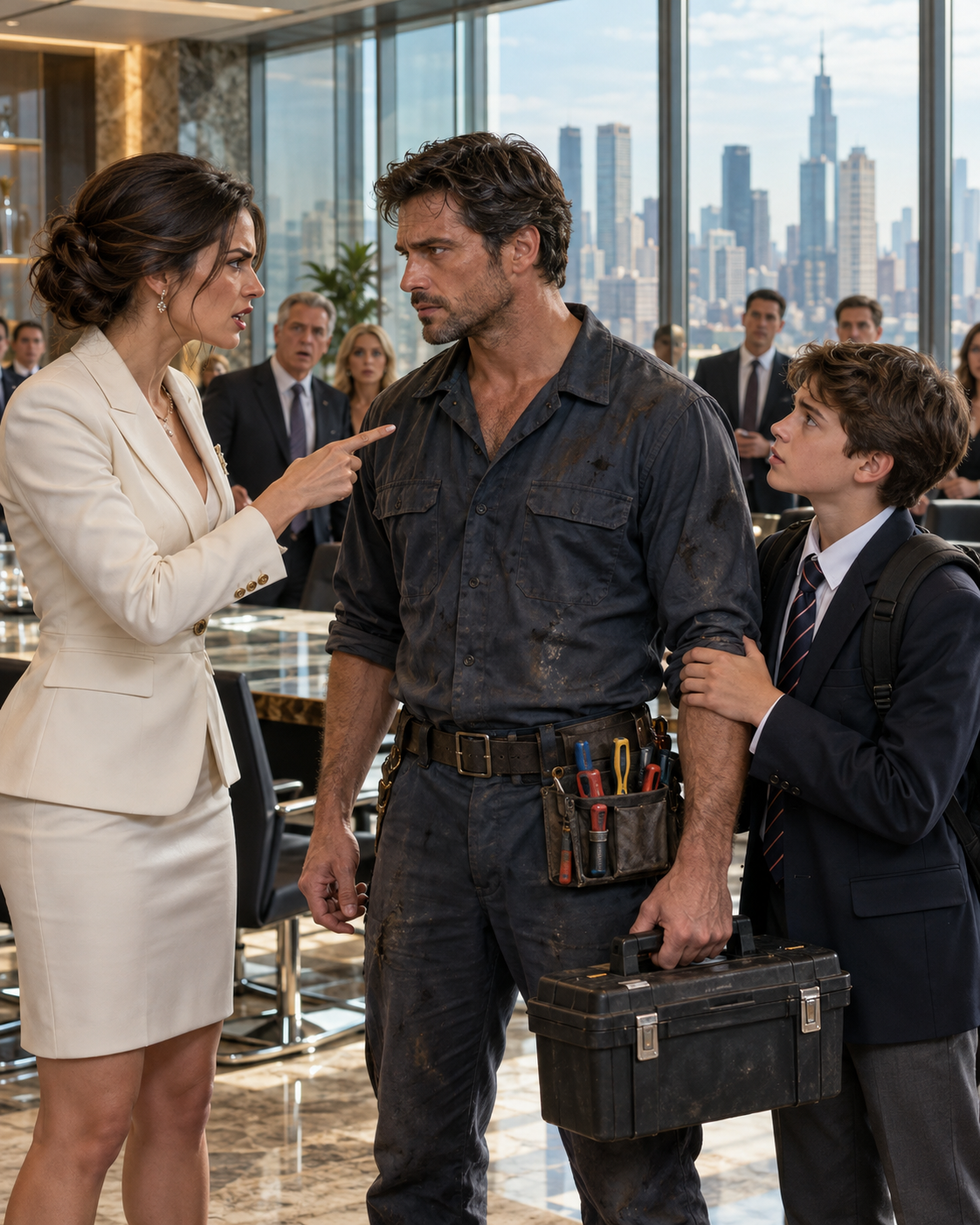
The morning Eleanor Vance humiliated me in front of thirty executives at Sterling Enterprises, she called my grease-stained uniform
Julian’s words seemed to drain the warmth from the ballroom.
For a moment, the music, the clinking glasses, and the polite laughter of Sterling Enterprises’ annual dinner faded into a distant hum.
Eleanor stood motionless beside the table, one hand resting against the stem of her glass.
“What letter?” I asked.
Julian swallowed.
“The one in her office. It has your name on it.”
My first thought was that someone had made a mistake.
I had spent years fixing other people’s problems, and I had learned that the most dangerous emergencies were often the ones that began with a perfectly ordinary sentence.
But the look on Eleanor’s face told me this was not an ordinary misunderstanding.
“Not here,” she said quietly.
Julian shook his head.
“You told me honesty mattered, even when it was uncomfortable.”
“I know what I told you.”
“Then why are you asking me to hide this?”
A nearby executive glanced in our direction, sensing tension without understanding its source.
Eleanor drew a breath.
“Because I was trying to protect someone.”
“Who?” I asked.
She looked at me, and for the first time, the powerful CEO seemed less like a woman accustomed to commanding entire buildings and more like a mother afraid of losing the trust of her child.
“You,” she said.
The answer made no sense.
I had met Eleanor less than a year earlier, and our relationship had grown through professional respect and the unexpected bond we shared through Julian.
There was nothing in my life that should have required her protection.
“Take me to the letter,” I said.
We left the ballroom through a side corridor, with Julian walking between us.
The elevator climbed toward the executive floor, and nobody spoke.
I watched the numbers change above the doors and thought about Maya waiting at home with the promise I had made to bring her a slice of chocolate cake from the dinner.
I had no idea that before the night ended, I would be forced to reconsider something I had believed about my own past.
Eleanor’s office overlooked downtown Columbus, where the city lights shone against the dark windows.
She unlocked a drawer beneath her desk and removed a cream-colored envelope.
My name was written across the front.
Not my work title.
Not “Facilities Manager.”
My full name, Daniel Mercer.
The handwriting was neat and unfamiliar.
“Who wrote it?” I asked.
“My former chief of staff found it in an old personnel file,” Eleanor said. “It was never delivered.”
“Why would a letter addressed to me be in your personnel files?”
She looked toward Julian.
“Because it was connected to a decision made at this company years ago.”
I opened the envelope carefully.
Inside lay a folded letter and a photocopy of a document bearing the logo of a small manufacturing company I recognized immediately.
Riverside Mechanical.
I had worked there when I was younger, before Maya was born, before my marriage fell apart, and before life became a series of jobs measured by whether they would pay enough to keep the lights on.
The letter was dated eleven years earlier.
I began reading.
Daniel, I know you were blamed for the shutdown that cost you your position, but I never believed you caused it. I saw the inspection records before they disappeared. You warned management that the cooling equipment was failing, and you asked them to stop operations until it could be repaired. They ignored you.
I stopped reading.
For several seconds, I could barely hear myself breathe.
Eleven years earlier, a refrigeration system at Riverside Mechanical had failed during a production shift.
I had reported unusual vibration in the motor, rising temperatures, and a faulty sensor that had been giving inconsistent readings.
My supervisor told me to finish the shift and leave the larger repair for the following week.
I refused to sign the inspection report stating that the equipment was safe.
Two days later, the system failed completely.
No one was killed, but the company lost a major shipment and suffered expensive damage.
Management blamed my maintenance work.
I was dismissed, and the incident followed me into job interviews like a stain nobody could see but everyone somehow knew was there.
I had never been able to prove what happened.
The inspection records vanished, my supervisor denied giving the instructions, and the company quietly settled its dispute with the customer.
I eventually found other work, but I carried the shame for years.
It was one reason I became so careful about documenting every repair and refusing to tell people what they wanted to hear simply because it made my life easier.
“Who wrote this?” I asked again.
“Eleanor’s former chief engineer,” Julian said. “His name is Thomas Reed. He left the company not long after the incident.”
Eleanor nodded.
“He sent the letter to our legal department when Sterling acquired part of Riverside’s industrial division. Someone placed it in the wrong file, and it was never forwarded.”
I looked at the copied document.
It was an internal inspection summary, stamped and signed.
My report had been filed two days before the failure.
The warning about the motor was there.
So was my recommendation to shut down the equipment until repairs could be completed.
At the bottom was a handwritten note from a manager ordering production to continue.
I felt something shift inside me, as if a door I had spent eleven years leaning against had suddenly opened.
“Why didn’t anyone tell me?”
Eleanor lowered her eyes.
“I discovered the letter several months ago, during an internal review of old liability records.”
“Several months ago?”
“Yes.”
I looked at her in disbelief.
“Before you offered me the job?”
“Before.”
The word struck harder than I expected.
I had believed our professional relationship was built on the work she had seen me do, the respect I had earned, and the changes we had made together at the vocational center.
Now I wondered whether she had offered me the position because she felt guilty about something that had happened long before we met.
“Did you hire me because of this letter?”
“No,” she said immediately. “I offered you the position because you were the most capable person for it. I had already seen how you handled emergencies, how you treated people, and how much our staff trusted you.”
“Then why keep it from me?”
She took a long breath.
“Because the document implicated people who were still connected to Sterling. Our acquisition agreement included unresolved claims from Riverside. I wanted legal counsel to establish what had happened before I brought it to you.”
“And you decided I didn’t need to know?”
“I thought I could resolve it without reopening something painful.”
I laughed once, without humor.
“You don’t get to decide which truths other people can survive.”
She flinched.
I regretted the sharpness of my voice almost immediately, but not the truth behind it.
Julian looked between us.
“Mom, you always say people need the chance to make their own decisions. Why didn’t you give him that chance?”
Eleanor sat down.
For several seconds, she looked at the letter as if it belonged to someone else.
“Because I was afraid,” she said.
It was the first answer that sounded entirely honest.
She explained that Thomas Reed had contacted the company again after discovering that the records had been preserved.
He had wanted to correct the official account, but he was seriously ill and worried that his statement would be dismissed as an attempt to settle an old grievance.
Eleanor had asked legal counsel to verify his evidence.
She had intended to speak with me when the review was complete.
But the review had become entangled in negotiations, old contracts, and disagreements between executives who feared that admitting the truth would expose the company to financial claims.
Then another document surfaced.
Julian reached into his jacket and pulled out a folded sheet of paper.
“I found this attached to the letter,” he said.
Eleanor’s expression changed.
“Where did you get that?”
“In the same file. I wasn’t looking for it. I was trying to find the old notes from the leadership program because you asked me to help organize the donation records.”
He unfolded it on the desk.
It was a short internal memorandum discussing the Riverside incident.
One sentence had been highlighted in yellow.
The original safety report must not be included in the acquisition materials until responsibility for the equipment failure has been established.
Below it was the signature of a former Sterling executive who had served on the acquisition team.
The document did not prove that Eleanor had ordered anything concealed, but it raised a serious question about who had known the truth and when.
I looked at her.
“Who signed this?”
“Martin Hale,” she said.
Hale was Sterling’s chief operating officer, a man I had met several times since becoming facilities manager.
He was courteous in the way some people are courteous to furniture: acknowledging your presence without considering that you might have thoughts of your own.
“He retired two years ago,” Eleanor continued. “He wasn’t involved in the decision to hire you.”
“Was he involved in the decision to keep this quiet?”
“I don’t know.”
For the first time, the situation seemed larger than an apology or an old employment dispute.
If the evidence had been deliberately withheld, other people might have been harmed by the same decisions.
A maintenance worker’s warning had been ignored, his reputation damaged, and a company had moved forward without fully addressing a safety failure.
I thought about the teenagers at the vocational center.
Many of them had already learned to expect that people with power could change the rules whenever the truth became inconvenient.
If I accepted silence because speaking up was uncomfortable, what lesson would I be teaching them?
“I want copies of everything,” I said.
Eleanor nodded.
“You’ll have them.”
“And I want an independent review, not one controlled by people who might be implicated.”
“Agreed.”
“I also want Thomas Reed’s statement preserved, and I want him told that I know about the letter.”
Eleanor reached for her phone.
“I’ll arrange it tonight.”
Julian looked relieved, but I could see something else in his face.
He was afraid his discovery might damage the relationship between his mother and me.
I turned toward him.
“You did the right thing by asking questions.”
He shook his head.
“I went through a file that wasn’t mine.”
“You should have told your mother what you found as soon as you realized it might be important. But you also shouldn’t have pretended you hadn’t seen something that could affect another person’s life.”
He looked down.
“So I did the wrong thing for the right reason?”
“Sometimes you make a mistake while trying to do the right thing. What matters is whether you take responsibility for both.”
He absorbed that quietly.
Then he nodded.
Eleanor watched him with an expression I had never seen on her face before.
It was pride without possession, affection without expectation.
“Thank you,” she whispered to him.
Julian looked surprised.
“For what?”
“For reminding me of something I should have understood long ago.”
That night, I returned home well after midnight.
Maya was asleep on the couch, wrapped in the blanket she had used since she was six, with an unfinished math worksheet on the coffee table.
I set the cake beside her schoolbag and covered her with the blanket properly.
For a long time, I sat in the dark.
I thought about the years I had spent wondering whether I had somehow failed at Riverside Mechanical.
I thought about the jobs I hadn’t received, the interviews that ended too quickly, and the way I had learned to speak carefully whenever someone asked about my employment history.
Most of all, I thought about the young man I had been when I lost that job.
He had believed that if he did honest work, documented the truth, and refused to compromise safety, the facts would eventually speak for themselves.
They hadn’t.
Not for eleven years.
The next morning, Eleanor called me before I left for work.
“I’ve contacted an independent investigator,” she said. “The review will include the original maintenance logs, acquisition records, and interviews with everyone who was involved.”
“Good.”
“I also want to make something clear. Your position at Sterling is not dependent on how this turns out.”
I appreciated that she said it, but I knew words alone would not settle everything.
“Then let the investigation finish,” I replied.
“And Daniel?”
“Yes?”
“I’m sorry I made you wait so long for the truth.”
I looked at Maya’s school photograph on the refrigerator.
“Don’t make anyone else wait that long.”
The investigation lasted six weeks.
During that time, I continued managing Sterling’s buildings, checking maintenance schedules, training junior technicians, and volunteering at the vocational center every other Saturday.
Life did not pause simply because the past had finally found a way to speak.
But the letter followed me everywhere.
When I examined an aging pump, I thought about the motor I had warned Riverside to replace.
When I signed an inspection report, I thought about the signature that had disappeared from the original records.
And whenever an employee hesitated to raise a concern, I remembered how expensive silence could become.
At the vocational center, Julian noticed the change in me.
One Saturday, he found me checking a row of donated power tools.
“You’ve been quieter lately,” he said.
“I’m thinking.”
“About the letter?”
I nodded.
He leaned against the workbench.
“I used to think adults were either good or bad. Like if someone did something wrong, it meant everything about them was wrong.”
“What do you think now?”
He considered the question.
“I think people can do good things and still make selfish decisions. And I think being sorry doesn’t mean much unless you do something different afterward.”
I smiled faintly.
“That’s a pretty good lesson.”
“I learned it from someone.”
“Then that someone sounds like a wise person.”
Julian laughed.
For a moment, he looked like the boy who had once refused to touch a screwdriver.
Then his expression grew serious.
“Do you think my mom can really change?”
I set down the wrench.
“I think change is something you do, not something you announce. Your mother has started doing it. Whether she keeps doing it is up to her.”
He nodded slowly.
“I don’t want her to become a different person just because she’s afraid of losing you.”
“Neither do I.”
“Then what do you want?”
I looked around the workshop.
A teenager was struggling to fit a socket onto a stubborn bolt while another student patiently held the workpiece steady.
“I want her to become the kind of person who does the right thing even when nobody is watching.”
Julian was silent for a while.
Then he picked up a wrench and joined the students.
The investigation’s findings arrived on a gray Thursday morning.
Eleanor asked me to meet her and the independent investigator in a conference room on the executive floor.
A thick folder lay on the table.
The investigator explained that the original maintenance logs confirmed my warnings, while archived emails showed that senior managers had been informed of the risk before the failure.
The records also revealed that the internal review after the incident had focused heavily on protecting the acquisition’s financial value rather than determining why the equipment had failed.
There was no evidence that Eleanor herself had directed anyone to falsify my report.
However, the company had inherited unresolved obligations, and its leadership had failed to ensure that the available evidence was properly reviewed and disclosed.
The investigator recommended correcting the historical record, reviewing relevant safety procedures, and establishing a formal process for employees to report concerns without fear of retaliation.
I listened without interrupting.
When the investigator finished, Eleanor folded her hands.
“We will implement every recommendation,” she said. “And I want the company to issue a written correction acknowledging that your safety warning was documented before the incident.”
I looked at her.
“Not just to me. The people who worked there deserve to know that their concerns weren’t imaginary.”
She nodded.
“Agreed.”
A week later, Sterling issued the correction.
The company also contacted former Riverside employees who might have been affected by the mishandling of the incident and established a review process for unresolved employment records.
I received a formal letter clearing my name.
It was only two pages long.
There were no dramatic speeches, no television cameras, and no crowd waiting to congratulate me.
I read it alone in my truck outside Maya’s school.
For several minutes, I couldn’t move.
I had imagined this moment for eleven years, but the truth did not return the opportunities I had lost or give back the confidence I had slowly rebuilt.
It could not restore the nights I had lain awake wondering whether I had been the problem.
Still, it gave something back.
It gave me the right to stop carrying a shame that had never belonged to me.
When I finally went inside, Maya was waiting near the entrance with her backpack.
“What’s wrong, Dad?”
I knelt and hugged her.
“Nothing’s wrong, sweetheart.”
She pulled back to look at my face.
“You’re crying.”
I laughed softly, wiping my eyes.
“Sometimes people cry when something good finally happens.”
She thought about that, then wrapped her arms around my neck again.
“Then I hope more good things happen.”
That evening, I framed the letter and placed it in a drawer rather than on the wall.
I didn’t need to display it as proof of my worth.
I had been worthy before anyone corrected the record.
The more important change happened inside Sterling.
Eleanor began holding monthly meetings with maintenance staff, listening to problems that had once been filtered through several layers of management.
She introduced a system allowing workers to document safety concerns directly and requiring written explanations whenever a recommendation was rejected.
Some executives complained that the new procedures slowed decisions.
Eleanor answered them with a question.
“How much time did we save the last time we ignored a warning?”
Nobody volunteered an answer.
She also invited several vocational center students to visit Sterling’s engineering department.
Julian was among them, wearing a clean work shirt and carrying the toolbox his mother had given him for his birthday.
He asked questions about electrical systems, equipment inspections, and apprenticeships.
The engineers who had once barely noticed him began treating him as a serious student.
His grades continued to improve, and he earned a place in a summer technical program.
When he received the acceptance letter, he brought it to the vocational center and showed it to me before telling anyone else.
“I got in,” he said, grinning.
I shook his hand.
“You earned it.”
He looked down at our hands, then back at me.
“Do you know what the best part is?”
“What?”
“I didn’t get in because of my mother.”
He folded the letter carefully.
“I got in because I worked for it.”
I felt a familiar tightness in my chest.
“Remember that feeling. There will be days when someone assumes you haven’t earned what you have. Let your work speak, but don’t let anyone convince you that you must accept disrespect to prove you’re humble.”
He nodded.
Then he surprised me by asking whether he could help teach the younger students on Saturdays.
I told him he would need to show up consistently, prepare his lessons, and learn how to be patient with people who struggled.
He agreed to every condition.
Over the next few months, Julian became one of the center’s most reliable volunteers.
He never pretended to know everything.
When a student made a mistake, he remembered how it felt to be the person everyone expected to fail.
And when someone succeeded, he celebrated as if the victory belonged to the entire room.
One afternoon, I watched him patiently explain a circuit to a fourteen-year-old boy who had nearly quit the program.
The boy finally understood, and his face lit up.
Julian smiled at him.
“See? You just needed another try.”
I turned away for a moment, pretending to inspect a shelf.
I had spent years wondering whether the work I did on Saturdays mattered enough to make a difference.
Now I understood that its value was not always measured by the person I helped directly.
Sometimes it lived on in the person they helped next.
Nearly a year after the letter surfaced, Eleanor invited me to lunch in the small cafeteria beside Sterling’s maintenance offices.
She arrived carrying two coffees and no assistant.
“I wanted to ask you something,” she said.
I waited.
“The board has approved a permanent apprenticeship partnership with the vocational center. Students will be able to train here, earn recognized certifications, and apply for paid positions when they’re ready.”
I smiled.
“That’s excellent news.”
“I’d like you to oversee the technical training portion, if you’re willing.”
I considered the proposal.
It would mean more responsibility, more paperwork, and less time to repair equipment myself.
But it would also mean that teenagers who had once been dismissed as troublemakers could see a path toward meaningful work.
“I’ll help build the program,” I said. “But I won’t promise every student a job. They’ll need to earn their certifications and meet the safety requirements.”
“Of course.”
“And the center must remain open to students who don’t end up working at Sterling.”
Eleanor smiled.
“That was already in the proposal.”
I studied her for a moment.
A year earlier, I might have assumed she had agreed because she wanted to make amends.
Now I could see the work behind her words.
She had learned to listen, and she had begun making decisions that would outlast her embarrassment over one morning in a hallway.
“Then let’s build something worth being proud of,” I said.
We shook hands across the table.
Later that week, I brought the news home to Maya.
She was doing homework at the kitchen table, her hair tied back, with a pencil tucked behind her ear.
“Does this mean you’ll be famous?” she asked.
I laughed.
“No.”
“Rich?”
“Probably not.”
She looked disappointed.
“Then why are you smiling like that?”
I sat beside her.
“Because more kids are going to get a chance to learn something useful. And because I won’t have to wonder whether we’re going to make rent every month.”
She leaned against my shoulder.
“That’s better than being famous.”
I kissed the top of her head.
“Much better.”
For the next several weeks, we worked on the apprenticeship program.
The vocational center received additional equipment, Sterling employees volunteered as mentors, and students began visiting the company to observe real maintenance operations.
We also created a simple rule that became the foundation of the program: no one would be mocked for asking a question, but no one would be excused from taking responsibility for a mistake.
It was a rule I wished someone had taught me when I was younger.
One Saturday, after the students had gone home, I found Eleanor standing beside the workbench, watching Julian put away a set of sockets.
“May I ask you something?” she said.
“Sure.”
“When you first met Julian, did you know who he was?”
“No.”
“Would you have treated him differently if you had?”
I thought carefully before answering.
“I hope not. But I can’t honestly promise that knowing his name wouldn’t have changed what I expected from him.”
She nodded.
“That’s more honest than most answers I hear.”
I set down the tool I was holding.
“Knowing someone’s background can help you understand them. The problem starts when you decide their background tells you everything you need to know.”
Eleanor looked around the room.
“I spent years believing that if I gave people opportunities, I had done my part. I didn’t understand how often I was making them prove they deserved basic respect first.”
She paused.
“I still catch myself doing it.”
“Then catch yourself and do better next time.”
She laughed quietly.
“You’re remarkably difficult to impress.”
“I work in maintenance. I’m impressed when a machine runs properly for six months.”
Her laughter grew, and for a moment, the woman who had once humiliated me in front of her staff seemed entirely at ease.
Then Julian approached us, holding a small envelope.
“I got something for you,” he said to me.
Inside was a photograph taken at the vocational center.
I was kneeling beside a workbench, explaining something to a student, while Julian stood nearby holding a wrench.
On the back, he had written a short message.
Thank you for treating me like someone I could become, not someone I had already been.
I read it twice.
When I looked up, Julian was watching me with a nervous smile.
“I thought you should have it.”
I slipped the photograph into my jacket pocket.
“Thank you.”
He glanced toward his mother.
“She helped me choose it.”
Eleanor smiled.
“I suggested the photograph. The words are his.”
I nodded, because I knew how much courage it took for a teenager to put gratitude into words without hiding behind a joke.
That evening, as I drove home, the photograph rested beside me on the passenger seat.
I thought about the many ways a life can change.
Sometimes it happens through a dramatic event, a sudden loss, or an unexpected opportunity.
Sometimes it begins with a person who refuses to laugh when everyone else does.
Sometimes it begins with a screwdriver placed gently into an uncertain hand.
And sometimes it begins when someone powerful finally realizes that the person they overlooked has been teaching them something all along.
I arrived home to find Maya waiting at the door.
She had made a cardboard sign that read, “WELCOME HOME, BEST DAD.”
The letters were uneven, and one corner had been repaired with too much tape.
I stood there looking at it until she began to laugh.
“You have to come inside,” she said. “The pizza’s getting cold.”
I lifted her into a hug.
For all the years I had spent trying to build a secure life for her, I realized that the most important thing I had given her was not a perfect home or a perfect father.
It was the chance to watch someone keep going without allowing hardship to make him cruel.
I hoped she would remember that when life eventually tested her.
I hoped Julian would remember it, too.
And I hoped Eleanor would continue remembering that leadership was not measured by how many people stood when you entered a room, but by how many people felt safe enough to speak when you were there.
Months later, at the opening of Sterling’s first permanent training workshop, the three of us stood together while the students explored their new equipment.
A young woman approached Eleanor and nervously explained that she had noticed a flaw in one of the workshop’s electrical connections.
The technicians checked it and confirmed that she was right.
Eleanor thanked her in front of everyone and ordered the connection repaired before the workshop opened.
No one mocked the student.
No one told her to stay in her lane.
Instead, Julian asked her to show him exactly what she had noticed so he could learn from it.
I watched the exchange from the doorway, feeling a quiet satisfaction that no promotion or salary could have given me.
Then Eleanor came over.
“Daniel,” she said, “there’s something else you should know.”
Her expression was serious enough that I turned toward her fully.
She held out a thin folder.
Inside was a letter from Thomas Reed, the former chief engineer whose testimony had helped clear my name.
He had written to thank me for insisting that the investigation continue, explaining that the review had prompted him to share other concerns he had kept silent about for years.
Those concerns were now being examined by an independent safety committee.
The letter ended with a sentence that made me sit down.
I used to think speaking up once had cost me everything, so I stopped speaking. Watching what you did reminded me that silence can protect a person’s comfort while leaving someone else to carry the consequences.
I folded the letter carefully.
For eleven years, I had believed my story was about a machine that failed and a man who lost his job.
Now I understood that it was also about all the people who had seen something wrong and decided it was safer not to speak.
Some had acted out of fear.
Some had acted out of ambition.
Some had simply convinced themselves that the truth could wait until a more convenient day.
But every delay had a cost, and someone always ended up paying it.
That night, Maya asked me whether I thought people could truly change.
I thought of Eleanor, who had learned to listen.
I thought of Julian, who had learned to believe in himself.
I thought of Thomas, who had finally found the courage to tell the truth.
And I thought of the younger version of myself, standing outside Riverside Mechanical with a box of tools and no idea how long it would take to rebuild a life.
“Yes,” I told her. “But not just because they feel bad about what they’ve done.”
She waited.
“They change when they start making different choices, especially when nobody is watching.”
Maya nodded and returned to her homework.
I stood by the kitchen window, looking out at the streetlights and thinking about the next Saturday at the vocational center.
There would be new students, broken machines, difficult questions, and someone who arrived believing they were already too far behind to succeed.
I would meet them at the workbench.
I would hand them a tool.
And I would give them the one thing I had learned could change a life long before money, status, or opportunity ever did.
I would give them a reason to believe they were worth teaching.
Because the truth that finally set me free was not simply that I had been right eleven years earlier.
It was that my worth had never depended on someone else admitting it.
And if there was one thing I wanted every student who passed through that workshop to understand, it was this: the world may judge you by the clothes you wear, the mistakes you make, or the name written on your records, but your character is revealed by what you do when you have the power to treat someone else the way you once needed to be treated.