The moment two Navy SEALs laughed at my callsign in front of their entire team, Lieutenant Mercer smirked
For several seconds, I could not answer Lieutenant Mercer.
The briefing room seemed to shrink around me, its bright overhead lights suddenly too harsh, the faces around the table too still.
I had spent two years convincing myself that the final transmission from Kestrel Ridge was nothing more than a dying man’s confusion, a fragment of noise buried beneath gunfire and static.
But Mercer had asked his question with the expression of someone who had carried the same memory for far too long.
“Who told you about that transmission?” I asked.
Mercer glanced at the five operators beside him before reaching inside his uniform pocket and withdrawing a small, weathered notebook.
“Staff Sergeant Daniel Cross,” he replied. “He was one of the six men you brought home.”
The name struck harder than I expected.
Daniel Cross had been the team’s communications specialist, a broad-shouldered operator with a habit of making jokes whenever the situation became frightening enough that nobody else could breathe.
I remembered his voice breaking through the static during those six hours, sometimes asking for coordinates, sometimes reporting casualties, and sometimes simply confirming that his men were still alive.
“What did Cross tell you?” I asked.
Mercer opened the notebook, but he did not read from it immediately.
“He said that when the last rescue aircraft arrived, he heard a voice on the emergency frequency that didn’t belong to anyone in his team.”
My throat tightened.
“What voice?”
“He said it was yours.”
I looked at the notebook.
Mercer continued carefully, as though he understood that the next words might reopen something neither of us knew how to close.
“He said you gave him a name, Commander. A name he had never heard before. Then the transmission ended, and when the recovery team reached you, nobody could explain why you had stayed at the outpost after your evacuation window closed.”
I lowered my eyes.
The name Daniel had heard was not a secret because I had wanted to protect myself.
It was a secret because someone else had asked me to bury it.
“Lieutenant,” I said quietly, “that operation is classified beyond the details Admiral Vance shared this morning.”
“I understand.”
“No, you don’t.” My voice came out sharper than I intended. “Not yet.”
The room fell silent again.
I looked at the six operators, at the men who had entered that morning prepared to measure my worth by the appearance of my uniform and the sound of my callsign.
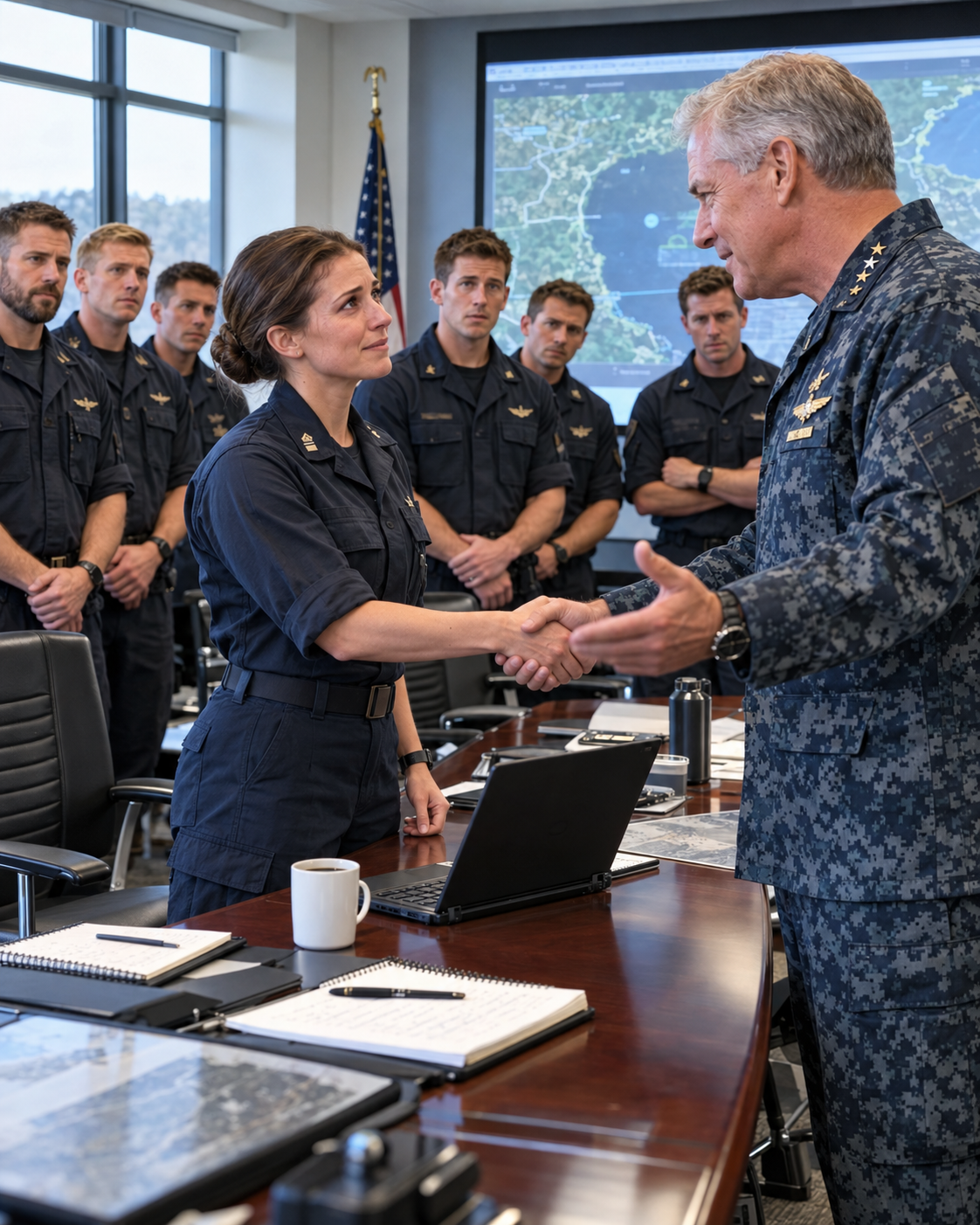
Now they were watching me as if the past had opened a door in the middle of the room.
“Your mission briefing is complete,” I said. “We will discuss Kestrel Ridge only through authorized channels.”
Mercer closed the notebook.
“Yes, ma’am.”
I left before anyone could ask another question.
In the corridor, I leaned against the cool concrete wall and closed my eyes.
For two years, I had told myself that surviving Kestrel Ridge meant the worst part was over.
I had been wrong.
The memory returned in fragments, never in order.
A red warning light flashing above a damaged communications console.
The metallic taste of blood in my mouth after an explosion threw me against a steel cabinet.
A headset pressed so tightly against my ear that the plastic had left a mark on my skin.
And six voices, each one growing weaker as the night stretched on.
I had been a lieutenant then, assigned to an intelligence support element operating from a temporary outpost near the fictional border region of a hostile coastal state.
Our mission had been simple on paper: monitor enemy movements, maintain communications with a reconnaissance team, and coordinate extraction if the situation deteriorated.
But the enemy had known our route.
They had known the team’s departure time, their surveillance pattern, and the precise stretch of terrain where the radio signal would be weakest.
By the time the first distress call reached us, the operation had already become a trap.
The six operators were pinned behind a collapsed stone wall in a dry ravine, surrounded by enemy fighters and cut off from their primary communications network.
Their lead vehicle had been destroyed.
Their extraction corridor was compromised.
And somewhere beyond the hills, someone was moving to ensure they would never reach the pickup point.
I remembered my commanding officer standing beside my console, shouting over the gunfire striking the outpost walls.
“Lieutenant, abandon the station and move to the secondary shelter!”
“I still have the team.”
“The structure is compromised!”
“If I leave, they lose the only link they have.”
He grabbed my shoulder and forced me to look at him.
“That is an order.”
I had obeyed him in almost every circumstance of my military career.
That night, I did not.
I switched to a damaged auxiliary set and built an improvised connection through a narrow emergency band, relaying fragments of the team’s transmissions to the extraction coordinator.
It was unreliable, vulnerable to interference, and dependent on equipment that should have been replaced months earlier.
But it worked.
For a while.
Then the outpost took another hit, and the lights went out.
I remember the darkness more clearly than the explosion.
I remember hearing one of the men cough through his microphone, followed by a quiet apology to his teammates for making so much noise.
I remember thinking that somewhere, six families were sleeping, believing their sons, husbands, or fathers would come home.
I remember deciding that I would not be the reason they did not.
The first evacuation order came shortly after midnight.
The second came less than an hour later.
Both times, I refused to leave until the rescue aircraft had a reliable link to the team.
I did not feel brave.
I felt terrified, exhausted, and painfully aware that every decision could be the last decision I ever made.
When the final aircraft reached the ravine, the emergency frequency erupted with overlapping voices.
“Visual on the extraction bird!”
“Moving now!”
“Cross is hit, but he’s conscious!”
Then the signal dissolved into static.
I slammed my hand against the console, fighting to bring the connection back.
“Recon element, this is Wraith. Sound off!”
Nothing.
“Six, I need confirmation. Sound off!”
A burst of interference cracked through the headset.
Then Daniel Cross spoke.
“Wraith, if you can hear me, there’s something you need to know.”
I had never heard him use that tone before.
“Save it for the aircraft, Cross. Get your men aboard.”
“No. Listen to me.”
Behind him, someone was shouting for a medic.
Cross sounded distant, as if he were speaking from the bottom of a well.
“They knew where we were going. They knew the route before we even crossed the ridge.”
“I know.”
“No, ma’am. You don’t understand.” He took a ragged breath. “Somebody gave them our route.”
Then the connection vanished.
The aircraft extracted all six men.
I was evacuated from the outpost minutes later, injured, half-deaf in one ear, and barely conscious.
By morning, the intelligence report described the ambush as the result of an operational security failure that investigators could not conclusively attribute to any individual.
Cross survived surgery.
The other five men recovered.
The official inquiry found insufficient evidence to determine how the enemy had obtained the team’s movements.
And the final transmission was classified as incomplete, its contents omitted from the report distributed to most personnel.
I had tried to believe the matter was closed.
But standing in the corridor outside the briefing room, I understood that Daniel Cross had never believed it was.
My phone vibrated.
A message appeared from Admiral Vance.
Report to my office. Immediately. Do not discuss Kestrel Ridge with anyone outside authorized channels.
I read it twice.
Then another message arrived, this time from an unfamiliar number.
You should have stayed quiet, Wraith. Some ghosts are safer buried.
For the first time that morning, the name felt less like a memory than a threat.
I photographed the message, secured my phone, and walked toward the admiral’s office.
Vance was waiting behind his desk when I entered.
The blinds were closed, and a thick folder lay beside a telephone secured to the wall.
He gestured toward the chair opposite him.
“Sit down, Commander.”
I remained standing.
“Someone just contacted me about Kestrel Ridge.”
His expression changed almost imperceptibly.
“What did they say?”
I showed him the message.
He read it without touching the phone, then leaned back and stared at the ceiling.
“I was hoping we had more time.”
“More time for what?”
“To determine whether the people responsible for that ambush are still operating inside our own system.”
The words settled between us.
“You knew Cross suspected a leak.”
“I knew there had been an allegation,” Vance replied. “I did not know whether he had evidence.”
“Did you investigate?”
“We did. The inquiry identified irregular access to the operation’s planning files, but the audit trail had been altered before investigators could preserve it.”
“Altered by whom?”
“We couldn’t prove that.”
I stared at him.
“Then why was the final transmission classified?”
“Because it contained information that could compromise an ongoing counterintelligence investigation.”
“An investigation that apparently hasn’t finished.”
“No,” he said. “It hasn’t.”
For a moment, the admiral looked older than I had ever seen him.
He opened the folder and turned it toward me.
Inside were printed access logs, redacted intelligence summaries, and a photograph of a man in civilian clothing leaving a secure facility.
I recognized him immediately.
Colonel Nathaniel Shaw had been the senior operations planner who approved our deployment to Kestrel Ridge.
He had reviewed the intelligence package, signed off on the team’s route, and insisted that the original extraction corridor remain unchanged despite my concerns about a gap in aerial surveillance.
Shaw had retired six months after the operation.
“What does he have to do with this?” I asked.
“We discovered that his credentials were used to access the reconnaissance team’s final movement plan shortly before the ambush.”
“Were his credentials stolen?”
“That was his explanation.”
“And you believed him?”
“I believed we lacked the evidence to accuse him.”
I looked again at the photograph.
“Where is he now?”
“Officially, he’s a private security consultant. Unofficially, we believe he has maintained contact with several individuals under investigation for leaking classified operational information.”
My jaw tightened.
“Then why are we briefing another SEAL team on a mission built around intelligence that may already be compromised?”
“Because the target network is connected to the same people who obtained the Kestrel Ridge route,” Vance said. “And because someone has been trying to redirect our attention away from it.”
Suddenly, the morning’s briefing made sense.
The suspicious gaps in surveillance.
The false routes.
The missing access records.
I had not merely been preparing a team for a dangerous operation.
I had been examining a pattern that someone had spent two years trying to hide.
“Why bring me into this now?” I asked.
“Because the intelligence you presented this morning exposed an inconsistency that matches the one we found before Kestrel Ridge.”
He tapped the folder.
“And because whoever sent that message knows you are looking at the same problem again.”
I thought about the six SEALs waiting in the briefing room.
I thought about Daniel Cross, still carrying the weight of a transmission nobody had wanted to hear.
“Does Mercer know?”
“Not yet. His team will be briefed on the threat before deployment, but we need to verify what Cross remembers before we expose him to unnecessary risk.”
“Then I’ll speak with Cross.”
Vance shook his head.
“You will not contact him outside an authorized setting.”
“Sir, he’s the only person who may know what was said before the signal disappeared.”
“And that makes him a target.”
The admiral’s voice was quiet, but the warning beneath it was unmistakable.
I finally sat down.
“What do you need from me?”
“Your original field notes, your recollection of the final transmission, and your assessment of whether the compromised intelligence could have come from inside the planning cell.”
I met his eyes.
“You want me to investigate the people who were supposed to protect that operation.”
“I want you to find the truth without giving the person responsible another opportunity to bury it.”
I left his office with a new authorization, a sealed case file, and a growing certainty that the past had never really ended.
When I returned to the briefing room, the SEALs were still there.
Mercer stood as I entered.
“Commander, Admiral Vance said the mission parameters may be changing.”
“They are.”
I connected my laptop again, but this time I did not display the target photographs.
Instead, I brought up a map showing the original Kestrel Ridge operation alongside the new intelligence network.
“The official explanation for the ambush was a compromised route,” I said. “We never established who compromised it. Recent evidence suggests that the source may still have access to classified operational planning.”
The room became still.
The operator who had mocked my callsign earlier leaned forward.
“Are you saying somebody inside the command structure gave them our route?”
“I’m saying we have evidence of unauthorized access, and we cannot assume the threat has been eliminated.”
Mercer studied the map.
“What does that mean for our mission?”
“It means we stop treating the intelligence package as unquestionable truth. We verify every critical assumption, preserve independent confirmation where possible, and report discrepancies immediately.”
One of the younger operators frowned.
“What if the discrepancies come from someone senior enough to overrule us?”
I looked at him.
“Then you document the discrepancy and escalate it through the proper channels. Rank determines responsibility, not immunity.”
Nobody spoke for a moment.
Then Mercer nodded.
“Understood.”
Something had changed in the room.
They were no longer looking at me as an intelligence officer who had earned an impressive reputation in a story from two years earlier.
They were looking at me as the person responsible for helping them recognize the same kind of danger before it swallowed them.
Over the next three days, we reviewed every available source connected to the planned operation.
The more we examined, the stranger the picture became.
An aerial surveillance window had been removed from the mission schedule without a documented reason.
A previously approved extraction route had been replaced by one passing through a narrow corridor with poor communications coverage.
Two intelligence summaries contained identical wording despite being attributed to separate sources.
And every unexplained change traced back to a small group of accounts with access to the planning system.
One belonged to Colonel Shaw.
Another belonged to a civilian contractor whose company had received several lucrative security agreements after Shaw’s retirement.
The third belonged to an analyst who had died in a vehicle accident eleven months earlier.
We could not establish that the three accounts had been controlled by the same person, but the overlap was too precise to ignore.
Mercer noticed something I had initially overlooked.
“Commander, look at the timestamps.”
He pointed to the access logs.
The suspicious changes had been made shortly before the relevant planning files were transmitted to an external intelligence-sharing system.
Not afterward.
Before.
Someone had prepared the documents for release while the operation was still being planned.
“Could it have been an automated synchronization error?” he asked.
“Possibly.”
“But you don’t believe that.”
“I believe we need to prove what happened before we decide what it means.”
That afternoon, Daniel Cross agreed to meet us at a secure facility.
He arrived wearing civilian clothes, with a slight limp and the guarded expression of a man who had spent years learning to live with questions that had no satisfying answers.
When he saw me, he stopped just inside the doorway.
For a moment, neither of us spoke.
Then he smiled faintly.
“Lieutenant Wraith.”
“Commander now.”
“Good,” he said. “Somebody finally promoted the woman who refused to let six idiots die.”
The words almost made me laugh.
Almost.
We sat across from each other in a small interview room while a counterintelligence officer recorded the session.
Cross described the ambush in detail, including the moment his team realized the enemy had positioned fighters along a route that should have been unknown to anyone outside the planning cell.
He remembered the failed communications network.
He remembered the extraction aircraft circling beyond the ridge.
And he remembered the final transmission.
“I was trying to tell you that our route had been sold,” he said. “Then I heard something on the frequency.”
“What did you hear?”
“A second voice. It came through after yours, faint but clear enough to understand.”
He rubbed his palms together.
“It said, ‘The witness is still alive.’”
My stomach tightened.
“Did you recognize the voice?”
“No. But I recognized what happened next.”
He looked at me.
“The channel went dead. Not gradually. It was like someone had cut the line.”
The counterintelligence officer leaned forward.
“Did you report this at the time?”
“I tried. My first statement included the words I heard, but the report I was later asked to sign didn’t.”
“Who asked you to sign it?”
Cross hesitated.
“A liaison officer from the investigation team. He said the transmission was probably enemy deception and that including it would complicate the inquiry.”
“Do you remember his name?”
“I remember his face.”
He reached into his bag and removed a folded sheet of paper.
“I found his name in the paperwork when I reviewed my medical records last year. I didn’t know whether it mattered until Mercer told me about the new operation.”
He slid the paper across the table.
The name belonged to a former counterintelligence liaison who had subsequently joined a private security firm.
That firm was now working for Colonel Shaw’s consulting company.
The room seemed to grow colder.
We had no proof of a conspiracy, but the evidence was beginning to form a pattern that could no longer be dismissed as coincidence.
When the interview ended, Cross caught my arm before I could leave.
“Commander, there’s something else.”
I turned back.
“The voice that came after yours used your name.”
I felt the blood drain from my face.
“What name?”
“Not Wraith. Your actual name.”
For a moment, I could not hear anything except the pounding of my heart.
Only a handful of people at the outpost had known my identity during that operation.
My name had been restricted in several transmission records because the emergency frequency was vulnerable to interception.
If someone had used it deliberately, they had known exactly who was holding the line.
“Why didn’t you tell the investigators that?” I asked.
“I did.”
His expression hardened.
“They told me I was concussed, exhausted, and misremembering the transmission.”
I had no answer for him.
For two years, I had wondered whether my decision to remain at the outpost had saved six men or simply delayed a catastrophe that was already in motion.
Now I understood that someone might have known I was there and wanted the entire team silenced before they could reveal what they had discovered.
The thought frightened me more than the memory of the gunfire ever had.
That evening, Admiral Vance convened a secure meeting with the counterintelligence team.
We presented the evidence, including Cross’s statement and the altered report.
Nobody made accusations beyond what we could support.
But by the end of the meeting, the investigation had been formally reopened, and the planned operation was placed under enhanced oversight.
Colonel Shaw was scheduled to attend a private review the following morning.
We intended to question him about the access logs, the route changes, and the relationship between his company and the contractor named in the investigation.
At 0615, I received a call from the secure duty officer.
“Commander, the review has been canceled.”
“Canceled by whom?”
“Colonel Shaw’s office. He has submitted documentation requesting medical leave.”
“Where is he?”
“We don’t have a confirmed location.”
I sat upright.
“Has his access been suspended?”
There was a pause.
“Not yet, ma’am.”
I ended the call and immediately contacted Vance.
By 0640, the admiral had ordered a formal security review of Shaw’s credentials and instructed the team to preserve every remaining access record.
By 0700, the security office had discovered that several files related to Kestrel Ridge had been accessed overnight.
One of them was my original incident report.
Another was a recording of the final emergency transmission.
The recording had been missing from the archive for nearly two years.
Now it was gone again.
Only this time, someone had tried to erase the access history as well.
I stared at the empty file entry on my screen, feeling the old helplessness creep back into my chest.
The same silence.
The same missing seconds.
The same sense that someone was standing just beyond the edge of everything we could prove.
Then Mercer called.
“Commander, we found something in the new mission package.”
“What?”
“One of the route changes was approved using your authorization code.”
I stopped breathing for a moment.
“That is impossible.”
“I know. You were with us when the change was supposedly submitted.”
I pulled up the audit log.
The authorization appeared valid.
The timestamp placed it during our first briefing, when my laptop had been connected to the projector and every operator in the room had been watching the intelligence presentation.
Someone had used my credentials to approve a change that could have sent Mercer’s team into the same kind of trap that had nearly killed six men two years earlier.
The realization was so cold and immediate that I felt it physically, like ice spreading through my veins.
This was no longer simply an investigation into an old ambush.
Someone was attempting to make me the source of the next failure.
If the operation went wrong, the record would show that I had approved the route.
My reputation would be destroyed.
My career would be finished.
And the people responsible might disappear behind the same uncertainty that had protected them after Kestrel Ridge.
I called Vance.
He listened without interrupting, then said, “Do not confront Shaw. Do not access the files again until the security team has secured your credentials.”
“Sir, Mercer and his men could still be exposed.”
“They will not deploy until the package is independently verified.”
“Then we need to move quickly.”
“We will.”
His voice softened.
“And Commander, listen carefully. What happened two years ago was not your fault.”
I stared at the access log.
“I know what the official report says.”
“That isn’t what I asked you to believe.”
For a moment, I could not answer.
Vance continued.
“You held a line because six people needed you. You made the best decision you could with the information you had. Whoever manipulated that operation is responsible for their actions, not you.”
I closed my eyes.
I had spent two years carrying a private burden that no commendation could lighten.
I had told myself that if I had been faster, smarter, or more suspicious, I might have prevented the ambush entirely.
But guilt was not evidence.
And responsibility did not mean accepting blame for someone else’s betrayal.
“Understood, Admiral,” I said.
We moved the mission into a controlled review while the security team examined the compromised authorization.
Mercer and his operators remained on standby.
For the first time since I had met them, they did not treat caution as weakness or questions as a challenge to their competence.
They asked for confirmation.
They checked assumptions.
They waited when something did not make sense.
The change was subtle, but it mattered.
Late that afternoon, a counterintelligence investigator entered the secure conference room carrying a recovered storage device.
“We found a copy of the missing transmission,” she said.
My hands went cold.
“Where?”
“An archived system associated with the former liaison’s contractor account. The file appears to have been copied before the original was removed.”
She placed the device on the table.
The recording was damaged, but enough remained to establish the sequence of events.
First came the frantic voices of the reconnaissance team.
Then my voice, distorted by interference, telling Cross to keep moving toward the extraction point.
Then the second transmission.
A man’s voice, calm and almost conversational, emerged through the static.
“The witness is still alive.”
A brief pause followed.
Then came my name.
Not a callsign.
Not a rank.
My actual name, spoken with the unmistakable familiarity of someone who knew exactly who I was.
The recording ended in a burst of noise.
Nobody in the room spoke.
The investigator explained that the audio alone could not identify the speaker conclusively, and the recording did not establish who had authorized the compromised route.
But it proved that the final transmission had contained information omitted from the official inquiry.
It also established that someone had deliberately removed the file from the archive.
For the first time in two years, the silence had a shape.
The investigation continued for weeks.
Shaw’s credentials were suspended, the former liaison was located for questioning, and several financial and communications records were referred for further examination.
No dramatic confession arrived.
No single piece of evidence explained every decision made before Kestrel Ridge.
Real investigations rarely unfold that neatly.
But the recovered recording, the altered reports, and the unauthorized access records created a chain of evidence that could finally be examined without relying on memory alone.
The planned operation eventually proceeded under revised intelligence and additional safeguards.
Mercer’s team completed its assignment without casualties.
When they returned, the lieutenant found me in the same briefing room where everything had begun.
He stood beside the table, his expression serious.
“I owe you another apology,” he said.
I looked up from my notes.
“For what?”
“For thinking that knowing your history meant I understood you.”
I set down my pen.
“You don’t need to understand everything I’ve been through, Lieutenant. You need to understand what the people beside you need when the situation becomes difficult.”
He nodded.
“I think I’m beginning to.”
One of the younger operators appeared in the doorway, holding a sealed envelope.
“Commander, this came through the secure channel for you.”
The envelope bore no return address.
Inside was a single sheet of paper containing one sentence.
You saved six men at Kestrel Ridge, but you still don’t know who gave the order.
Beneath it was a date.
A date from the morning before the ambush.
I read the message twice, then turned it over.
There was a second line written on the back.
Ask Admiral Vance what he knew before he sent you there.
For a long moment, I stood completely still.
I did not know whether the message was a threat, a manipulation, or an attempt by someone inside the investigation to force another secret into the open.
I knew only that it had arrived through a channel restricted to authorized personnel.
Someone still had access.
Someone still wanted me looking in a particular direction.
And someone had decided that the next part of the truth belonged to me.
I placed the note in the evidence folder and requested a formal authentication review.
Then I called Admiral Vance.
He answered on the second ring.
“Commander?”
I looked through the glass wall at the corridor outside, where Mercer and his team were preparing for their next assignment.
“Sir, I received a message about Kestrel Ridge.”
His silence lasted only a second, but it was long enough for me to notice.
“What does it say?”
I read him the final line.
When I finished, he did not deny anything.
He did not explain anything.
He simply said, “Come to my office. Alone.”
The call ended.
I stared at the phone, thinking about the six men who had survived because someone refused to abandon them, the people who had tried to bury their testimony, and the possibility that even the man who had praised my courage might know more than he had ever admitted.
Then I gathered the evidence folder and walked toward the admiral’s office.
I had learned at Kestrel Ridge that courage was not the absence of fear.
It was the decision to remain present when fear gave you every reason to turn away.
But as I reached the closed door, I understood something else.
Sometimes the hardest line to hold is not the one connecting you to people trapped under enemy fire.
Sometimes it is the line between loyalty and truth, especially when the person standing on the other side is someone you have trusted with your life.
I raised my hand and knocked.
From inside, Admiral Vance said, “Come in.”
And for the first time since the night I earned the name Wraith, I wondered whether the truth waiting behind that door would save me from the past—or reveal that the past had been protecting me from something far worse.