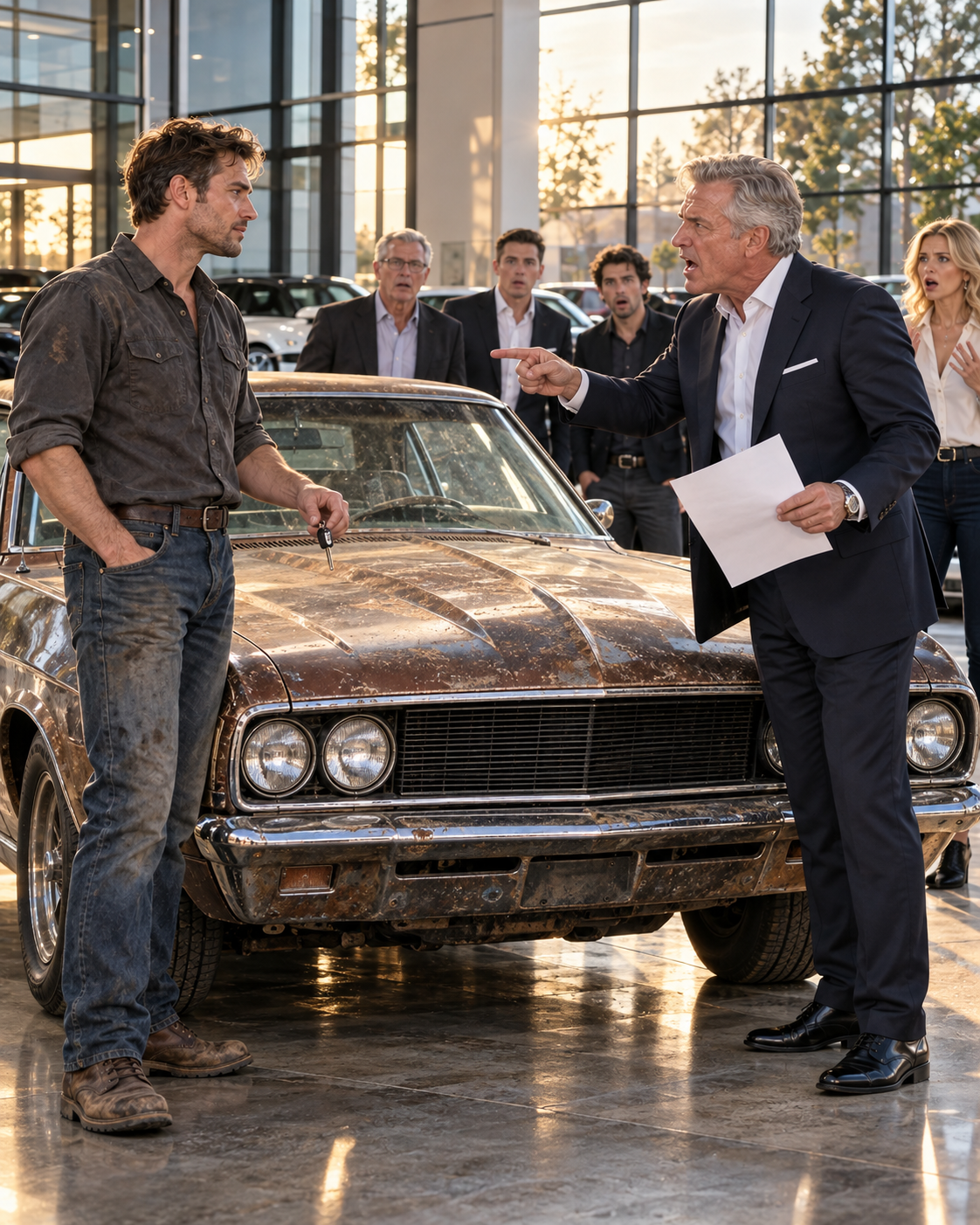
The moment Travis Witmore called my dust-covered 1969 Mustang Boss 429 a worthless heap in front of hundreds of collectors
The engine coughed again, and Tyler Knox took one involuntary step backward.
For a second, nobody moved.
I was still staring at Paige’s note when Warren shouted from the front of the car, “Don’t turn it off yet!”
I looked through the windshield. Warren had one hand braced against the fender, his other hand raised toward me.
“Keep the ignition on, but don’t crank it again. Let me check something.”
The engine had fallen silent, leaving behind the smell of hot metal and unburned fuel. Somewhere in the crowd, a camera shutter clicked.
Travis recovered first.
“Well, that was entertaining,” he announced. “A dying battery can make almost anything sound dramatic.”
Nobody laughed this time.
I climbed out and handed Warren the schematic. His eyes moved over Paige’s handwriting, then stopped at the warning I’d just discovered.
“If this happens again, don’t let them change the wire.”
“Who is ‘them’?” I asked.
Warren didn’t answer immediately.
Instead, he looked toward Tyler.
The appraiser had gone pale beneath his carefully maintained tan. He was staring at the schematic as though the paper had just spoken his name.
Travis noticed it, too.
“Tyler?” he asked. “You look like you’ve seen a ghost.”
Tyler swallowed.
“Where did you get that notebook?”
“My wife wrote it,” I said. “Six years ago, when we were restoring the car.”
“Was she the only one working on it?”
The question struck me as strange.
“Mostly. I helped when I could. Why?”
Tyler glanced toward the crowd, then at the cameras Clare Vaughn’s crew had positioned beside the Mustang.
“Can we talk somewhere private?”
Travis laughed sharply.
“Oh, absolutely not. We have a million-dollar wager, a public deadline, and an audience. If there’s a problem with the car, let’s hear it.”
Tyler looked at him.
For the first time that morning, he seemed less afraid of losing his reputation than of what might happen if he kept his mouth shut.
“That wire,” he said quietly. “I recognize the routing.”
Warren folded Paige’s schematic in half, protecting the handwritten note.
“From where?”
Tyler rubbed his palms against his trousers.
“From a restoration shop outside Phoenix. About five years ago.”
My mouth went dry.
“Which shop?”
He hesitated.
Then he said a name I hadn’t heard in years.
“Blackridge Performance.”
I felt the exhibition hall recede around me.
Blackridge was the shop where Paige and I had taken the Mustang shortly before she became too ill to continue working on it ourselves. We couldn’t afford a full restoration, so we had paid for an inspection and a few electrical repairs.
The owner, a man named Dennis Rourke, had promised to help us get the engine running.
He had returned the car three weeks later with a list of additional work we couldn’t afford.
Paige had been furious.
“They didn’t fix the problem,” she’d told me. “They just gave us a bigger bill.”
We had collected the Mustang and brought it home.
I remembered Dennis standing in his office doorway, watching us load the car onto a trailer.
I remembered him saying, “You people don’t know what you’ve got.”
At the time, I’d assumed he meant the car’s value.
Now Tyler was telling me he recognized the wiring.
“Did you work there?” I asked.
“No.”
“Then how do you know?”
Tyler looked at the crowd again.
“Because I inspected a Boss 429 with the same modification last year. The owner had bought it through a private collection. It had an electrical fault, an unusual fuel cutoff, and a wiring configuration that didn’t match the factory diagrams.”
Warren’s jaw tightened.
“Those modifications aren’t necessarily connected.”
“No,” Tyler agreed. “But the routing is distinctive. Whoever did it knew enough to make the changes look intentional.”
Travis stepped between us.
“This is getting ridiculous. We’re here to see whether a car starts, not listen to an appraiser tell ghost stories.”
I turned toward him.
“You made this public. You wanted everyone to see me fail. Now we’re trying to understand why somebody altered my wife’s restoration, and you want us to stop talking?”
His expression hardened.
“I want you to honor the wager.”
“Then give us until nine.”
I checked the clock above the exhibition entrance.
8:59.
Warren turned away from Tyler and leaned over the engine bay.
“One minute isn’t enough to solve this. We need to verify the ground, check the module compatibility, and confirm the fuel valve is actually in the position Paige marked.”
Travis pointed toward the event organizer.
“The rules say the engine has to run under its own power by nine.”
I looked at the organizer.
He examined the signed card, then the clock.
“That’s correct.”
Nolan came to stand beside me.
“Then let us try once more.”
Travis smiled without warmth.
“Go ahead.”
Warren moved quickly, checking the connections we’d worked on all night. He found the ground wire we’d rerouted, followed it back, and stopped at a small terminal hidden beneath a bracket.
“This isn’t factory,” he muttered.
He loosened the connection and inspected the wire.
Someone had added a narrow section of different-gauge cable, then covered the joint with old insulating tape. It wasn’t an obvious break. It was the sort of repair that might survive a casual inspection but fail under the wrong electrical load.
Warren looked at me.
“Whoever did this knew enough to make the fault intermittent.”
“Can you fix it?”
“I can correct the connection. I can’t promise the rest of the system is healthy.”
He replaced the damaged section with a properly sized wire, secured the ground, and checked the ignition module one final time.
Then he stepped back.
“Try it.”
I climbed into the Mustang.
Nolan stood beside the driver’s door, his hands clenched so tightly that his knuckles had turned white.
I turned the key.
The starter spun.
The engine caught for half a second, sputtered, and died.
A murmur rolled through the crowd.
Travis looked at his watch.
“Nine o’clock.”
He didn’t need to say anything else.
The organizer approached with the betting card in his hand.
“I’m sorry,” he said. “The deadline has passed.”
I stared at the steering wheel.
For six years, I had carried the promise to Paige like a stone in my chest. I had imagined this moment so many times that I had never considered what it would feel like if the engine refused to cooperate in front of hundreds of strangers.
Nolan opened the door.
“Dad, come out.”
“I need a second.”
“Please.”
I stepped onto the concrete.
He looked at me, and I saw his mother’s stubbornness in his face.
“We didn’t fail her because a car wouldn’t start.”
I wanted to believe him.
Before I could answer, Tyler approached the organizer.
“Hold on,” he said. “The engine did fire.”
Travis turned sharply.
“For less than a second.”
“The rules say the engine must run under its own power by nine. They don’t specify a minimum duration.”
The organizer checked the printed conditions.
Travis’s expression changed.
“You’re splitting hairs.”
“I’m reading the rules you signed,” Tyler replied.
He pointed toward the Mustang.
“The engine fired. It didn’t sustain operation, but it did run under its own power. If you want to challenge that, the organizers can review the wording.”
The crowd began talking again.
Travis looked at the card, then at me.
“This isn’t over.”
“No,” I said. “I don’t think it is.”
The organizer refused to declare either of us the winner until the wording could be reviewed. The wager remained disputed, and the crowd began drifting toward the next exhibition.
But I barely noticed.
I was watching Tyler.
He had saved us from an immediate ruling, but he still looked as though he was carrying something heavier than embarrassment.
When the crowd thinned, he approached me and held out a business card.
“Meet me at the coffee stand in fifteen minutes. Please come alone.”
Nolan stepped closer.
“Absolutely not.”
Tyler looked at him.
“Your son is right to be cautious. But what I have to tell your father concerns the car, and I don’t want to make an accusation in front of a camera.”
I studied his face.
“Then tell me now.”
He lowered his voice.
“Because if I’m right, the wiring isn’t the most important thing someone changed.”
He walked away before I could ask what he meant.
I watched him disappear into the crowd.
Then I looked at Paige’s notebook in Warren’s hands.
For the first time since arriving at the gala, I wasn’t thinking about the million-dollar bet.
I was thinking about the three weeks the Mustang had spent at Blackridge Performance—and the fact that Paige had never wanted to discuss what happened there.
Fifteen minutes later, Nolan and I met Tyler at the coffee stand.
I hadn’t intended to bring my son, but he refused to let me go alone. Warren stayed with the Mustang, photographing the wiring and recording the engine’s symptoms while Clare Vaughn’s camera crew packed away their equipment.
Tyler stood near a row of folding tables, holding a paper cup he hadn’t touched.
He looked at Nolan, then at me.
“I owe you an explanation,” he said.
“Start with Blackridge.”
He took a breath.
“Five years ago, Dennis Rourke sold a collection of restoration parts to a private buyer. Several items were advertised as original components removed from rare Ford muscle cars. One of those listings included an ignition assembly and a set of modified electrical components supposedly taken from a Boss 429.”
I frowned.
“How does that involve my car?”
“Because the buyer asked me to authenticate the parts. I was an independent appraiser at the time. I compared the numbers and documentation against the records I could access.”
“And?”
“Some of the components were genuine. Others had been altered. The paperwork was incomplete.”
Nolan crossed his arms.
“So you told the buyer?”
“I told him I couldn’t certify the assembly as original.”
“That doesn’t explain why you recognized the wire.”
Tyler lowered his eyes.
“After the sale fell apart, Dennis contacted me. He claimed another car had been used as a source for the parts. He showed me photographs of a Mustang in his shop.”
My stomach tightened.
“Was it mine?”
“I believe it was.”
I stared at him.
“Believe?”
“The pictures were taken from angles that concealed the license plate and most of the body. I couldn’t establish the car’s identity. I told Dennis that. He became angry and accused me of damaging his business.”
“Did he say he’d worked on the Boss 429?”
“Yes.”
“Did you know he’d worked on my car?”
“Not until I saw your schematic this morning.”
I stepped closer.
“Then why did you turn white when you read Paige’s note?”
Tyler set his coffee down.
“Because I remember something else about those photographs. There was a handwritten tag attached to a wiring harness. It carried two initials and a date.”
He looked directly at me.
“One of the initials was P.”
I felt a sudden chill.
“Paige?”
“I don’t know. I never saw her name.”
Nolan shook his head.
“You’re telling us a man may have taken parts from our car, and you didn’t report it?”
“I didn’t know whose car it was. I had no proof that anything had been stolen.”
“But you knew Dennis was selling altered parts.”
“I knew the documentation was unreliable. I declined to authenticate them. I couldn’t prove where the parts came from.”
His answer sounded rehearsed, though I couldn’t tell whether that was because he’d repeated it to himself for years or because he was still trying to protect his career.
I wanted to accuse him of cowardice.
Instead, I asked the question that mattered most.
“Did Paige know?”
Tyler shook his head.
“I can’t answer that.”
I turned away.
The thought of Paige discovering something wrong with the Mustang and keeping it to herself was almost unbearable. She had never been secretive about the car. She had shown me every receipt, every sketch, every component she replaced.
But she had also been ill. There had been days when she could barely finish a sentence without resting.
Maybe she had found something and decided it wasn’t worth worrying me about.
Maybe she had never known.
Or maybe the truth was much simpler, and I was searching for a mystery because I couldn’t bear another unanswered question about her.
Nolan touched my arm.
“Dad, we need the notebook.”
He was right.
We returned to the Mustang, where Warren had laid out Paige’s schematic beside a series of photographs.
He had marked three connections in pencil.
“The incompatible ignition module explains some of the symptoms,” he said. “The ground explains others. But this valve is separate.”
He pointed to the secondary fuel valve hidden behind the panel.
“It looks like someone installed it to interrupt fuel delivery. It could have a legitimate purpose in a modified setup, but I can’t tell you why it’s here without tracing the plumbing and checking the control.”
“Could it stop the engine from running?”
“Absolutely.”
“Could someone have installed it deliberately to keep the car from starting?”
“Possibly. But the fact that a component can cause a failure doesn’t prove that’s why it was installed.”
Warren’s caution irritated me because I wanted certainty.
It also made me trust him.
He turned another page in the notebook.
“Your wife was thorough. Look here.”
Paige had drawn the fuel system and labeled each line. Beside the secondary valve, she’d written a date and a question mark.
I recognized the date.
It was the week we collected the car from Blackridge.
Beneath it, she had added four words.
“Not in original layout.”
Nolan leaned over the page.
“She noticed it.”
“She noticed something about it,” Warren said. “That isn’t the same as knowing who installed it or why.”
I traced the line of Paige’s handwriting with my finger.
She had drawn a small box around the valve and written, “Ask Dennis.”
But she had never told me she’d planned to ask him.
I tried to remember the days after we collected the car.
Paige had spent an entire evening in the garage, checking the engine bay while I worked overtime to cover the restoration bill. When I came home, she had grease on her hands and a stack of invoices on the workbench.
“Everything okay?” I’d asked.
“Mostly.”
“What’s wrong?”
“Nothing I can’t figure out.”
I’d kissed her forehead and gone inside to make dinner.
I had taken her answer as reassurance because I was exhausted, frightened about her health, and desperate for one ordinary evening.
Now I wondered what she had been trying to figure out.
Clare Vaughn returned just before noon.
She approached without her camera operator and asked whether she could examine the notebook.
I hesitated.
“It’s personal.”
“I understand,” she said. “I don’t need to film it. I saw the note Tyler reacted to, and I heard some of the discussion. If someone altered your car improperly, you deserve to know.”
“You’re making a documentary about the gala?”
“About American muscle cars, their histories, and the people who keep them alive. I wasn’t planning to feature your Mustang until this morning.”
She glanced at the faded paint.
“Now I think its story might be more important than its auction value.”
I almost laughed.
“My car didn’t even make it to the deadline.”
“Your engine fired. That’s more than it did yesterday.”
Warren nodded in agreement.
Clare examined the relevant pages without touching the handwritten portions.
“Would you let me help you locate the old shop records?”
I asked why she cared.
“My first documentary was about a family-run restoration business that closed after the owner died. I learned how easily paperwork disappears when a shop changes hands. If Blackridge performed work on this car, there may be invoices, photographs, or inspection records somewhere.”
She paused.
“But I won’t publish anything about your wife without your permission. And I won’t call Dennis a thief because a few wires look suspicious.”
Her restraint reminded me of Warren’s.
I agreed.
Clare made a few calls while Nolan and I searched Paige’s notebook for references to Blackridge. We found an invoice number written on the back cover and a note indicating that Paige had requested a detailed parts list.
The paperwork we’d received from the shop contained no such list.
There was a payment receipt, a brief inspection report, and a warranty disclaimer.
Nothing else.
Clare eventually reached a former Blackridge employee named Miguel Santos, who now worked at a repair shop in Tempe.
He remembered the Mustang.
“Blue Boss?” he asked over the phone. “Yeah. I remember that one. Dennis was excited about it.”
“Why?” Clare asked.
“He said it had rare components and a valuable engine. He wanted the owner to authorize a complete rebuild.”
“Did the owner?”
“No. The husband came to pick it up. The wife was the one asking questions.”
My grip tightened around the phone.
“What questions?” I asked.
Miguel hesitated.
“About a fuel cutoff and a wiring change. She thought the shop had installed parts she hadn’t approved.”
“Did they?”
“I wasn’t in charge of the job. I was a junior mechanic. I saw Dennis arguing with her in the office.”
“What did he say?”
“I don’t remember every word. He said the modifications were necessary to protect the engine. She said she’d asked for a diagnosis, not a redesign.”
Nolan looked at me.
“Did she leave with the car?”
“Yes. She insisted on it. Dennis told her the engine wasn’t safe to run until the remaining work was completed.”
“Was he telling the truth?” I asked.
Miguel exhaled.
“I can’t say. But I remember her asking for the original parts back. Dennis told her he hadn’t removed anything.”
A long silence followed.
Then Miguel added something that made me sit down.
“She came back two days later with a notebook. She wanted to compare the wiring against a factory diagram. Dennis wouldn’t let her into the service bay.”
“Did she say why?”
“No. She just said she’d keep a record of everything.”
The call ended shortly afterward.
I stared at the floor.
Paige had returned to Blackridge without telling me.
She had tried to get answers on her own.
And I had never known.
Nolan sat beside me on the edge of the service platform.
“She was protecting you,” he said.
“Or she didn’t trust me to help.”
“Those aren’t the same thing, Dad.”
I looked at him.
He was seventeen, still growing into his shoulders, but he had begun speaking with the careful patience Paige used when she was trying not to frighten me.
“I was scared all the time when Mom was sick,” he continued. “You worked late, and I knew you were trying to keep everything together. Maybe she didn’t want to give you another problem.”
I rubbed my face with both hands.
“She shouldn’t have had to handle it alone.”
“No,” Nolan said. “But you can’t go back and change that.”
I wanted to tell him he didn’t understand what it was like to be the husband who had promised to finish something and then left it untouched for years.
But he did understand.
He had watched the garage remain closed.
He had watched me turn away from the one thing his mother had asked me to complete.
I reached for his hand.
“I’m sorry.”
He squeezed my fingers.
“Then let’s finish the car.”
By late afternoon, Warren had traced the fuel system and confirmed that the secondary valve interrupted the feed in a way inconsistent with Paige’s original diagram.
He removed the panel and photographed the valve, its connections, and the altered wiring. We preserved every component we could, labeling each one rather than throwing anything away.
The ignition module was replaced with a compatible unit, and the ground circuit was rebuilt correctly.
But Warren refused to turn the key until the fuel system had been checked thoroughly.
“If the valve was installed for a reason, we need to know what that reason was,” he said. “I’m not risking the engine just to prove a point to a man in an expensive suit.”
I didn’t argue.
For the first time, I understood that finishing Paige’s restoration didn’t mean getting the engine to fire at any cost.
It meant respecting the care she’d put into the work.
Clare and Tyler spent the afternoon contacting people who had been involved with Blackridge’s old inventory sales. Tyler had agreed to provide his inspection notes, including the report he’d written about the altered parts.
He looked uncomfortable handing them over.
“These records could damage my professional reputation,” he admitted.
“Why?”
“Because I accepted Dennis’s explanation that the modifications were legitimate, even though I couldn’t verify their origin. I should have documented more of what I saw.”
“Did you lie?”
“No. But I could have asked better questions.”
It was the first answer I’d heard from him that didn’t sound like an attempt to protect himself.
Clare scanned the documents and made copies for us.
One photograph showed a workbench at Blackridge. On it lay a wiring harness, a fuel valve, and a paper tag with a handwritten number.
Tyler enlarged the image.
The tag carried the same date Paige had written in her notebook.
Beneath it was a job number that matched the invoice on the back cover.
Warren studied the image.
“That establishes a connection between the parts and the job. It doesn’t establish whether they were installed on this particular car.”
“Could the shop records?” Nolan asked.
“Maybe.”
Clare called Miguel again and asked whether he knew where the old files had gone when Blackridge closed.
He remembered that Dennis had stored boxes at a commercial unit in Mesa before selling the remaining equipment.
The storage facility was still operating.
We drove there the following morning.
Travis’s wager had become a secondary concern, though the gala organizers had requested that we return for a formal review. The public dispute had spread through the collector community, and several people had offered to buy the Mustang despite its condition.
I turned them all down.
At the storage facility, Miguel met us beside a row of metal doors. He had agreed to come because he wanted to clarify what he’d seen all those years ago.
The unit’s current renter was a small business that had purchased Blackridge’s remaining records. After reviewing our documents, the owner allowed us to search the boxes connected to the Mustang’s job number.
We found invoices, parts catalogs, warranty forms, and stacks of faded photographs.
Most were ordinary shop records.
Then Nolan pulled a thin folder from the bottom of a box.
It was marked with the same invoice number we’d found in Paige’s notebook.
Inside was a work order dated five years earlier.
The first page listed the inspection Paige and I had paid for.
The second contained a handwritten note: “Customer declined complete rebuild. Retain modified components pending approval.”
Below it was a signature.
Dennis Rourke.
My throat tightened.
The next page listed the ignition module and fuel valve as parts removed from the vehicle.
But the inventory column marked them as returned to the owner.
They had never been returned.
Clipped behind the form was a second invoice, issued to an unnamed buyer several months later. It described an ignition assembly and a fuel-control component compatible with a Boss 429 restoration.
The serial references were incomplete, but the job number matched.
Tyler read the invoice twice.
“This is consistent with the parts I was asked to authenticate.”
“Can you prove they came from my car?” I asked.
“Not from this alone,” he said. “But it’s important evidence.”
At the bottom of the folder, we found a sealed envelope with Paige’s name written across the front.
I recognized her handwriting immediately.
The envelope had never been opened.
My fingers trembled as I lifted the flap.
Inside was a letter addressed to Dennis, along with a list of parts and a copy of the original wiring diagram.
The letter was dated three days after Paige’s final visit to Blackridge.
She had written that the shop had altered the car without her approval, failed to return the original components, and provided an inaccurate inventory.
She requested the return of the parts within ten business days.
If the matter wasn’t resolved, she would seek legal advice.
At the bottom, she’d added a sentence in her unmistakable handwriting.
“I have kept copies of everything, so please don’t mistake my patience for permission.”
I read it twice.
Paige had been preparing to confront the shop.
She hadn’t been waiting helplessly for someone else to solve the problem.
She had been gathering evidence.
But there was no proof the letter had ever been mailed. No tracking receipt, no response, and no indication that Dennis had seen it.
Clare photographed the documents and placed them back in their sleeves.
“These records raise serious questions,” she said. “But we should verify them before making public accusations.”
Tyler nodded.
“I can compare the invoice against my original appraisal notes. If the parts are the same, I can explain exactly what I saw and what I failed to verify.”
Miguel stood near the storage unit door.
“I should have told someone,” he said.
I looked at him.
“You were a junior mechanic. You didn’t control the shop.”
“I still knew she was asking for her parts back.”
He looked down at his shoes.
“I told myself it wasn’t my problem.”
I thought of the years Paige had spent trying to make the Mustang run.
Then I thought of all the times I’d been too tired to ask what she was working on.
“Most of us tell ourselves that at least once,” I said. “The important thing is what we do when we find out it really is our problem.”
We left with certified copies of the records and a plan to have the components independently examined.
For the first time, we had evidence that the wiring problem wasn’t merely the result of age or careless repairs.
But we still didn’t know why Dennis had kept the parts, whether he’d knowingly sold them, or whether the alterations had been intended to disable the car.
I wasn’t going to let suspicion become a verdict.
Not when Paige had spent so much time insisting that facts mattered.
Two days later, the gala organizers convened a formal review of the wager.
Travis arrived with his attorney.
He appeared relaxed, though the tension around his mouth suggested he had been following the growing discussion among collectors.
The organizer placed the signed betting card on the table.
“We need to resolve whether the vehicle met the stated condition before the deadline.”
Travis’s attorney argued that a brief ignition event did not constitute the engine running. Our representative, a local attorney who had agreed to review the wording, pointed out that the rules specified no minimum duration.
The organizer listened to both sides.
Then he asked Warren to describe what had happened.
Warren explained that the engine had started to fire after the ground connection was corrected but had failed to sustain operation because the fuel and ignition systems still required verification.
Travis leaned forward.
“So it didn’t run.”
“It fired and turned under its own power,” Warren said. “Whether that meets your wording is a matter for the organizers.”
Tyler submitted his signed statement confirming what he had witnessed.
Clare did not release her photographs or the Blackridge records. She had agreed to wait until the evidence could be authenticated.
After an hour, the organizer reached a decision.
The wager’s wording was ambiguous, but the engine’s failure to sustain operation meant the condition had not been met under the event’s interpretation.
Travis had won the formal bet.
I felt the loss settle over me, though it wasn’t as heavy as I’d expected.
A million dollars had never been mine to lose.
The car still needed work, and Paige’s promise remained unfinished.
Travis turned toward me.
“I’m willing to offer you something,” he said.
I looked at him warily.
“I’ll buy the Mustang for two hundred thousand dollars. More than fair for a nonrunning car with questionable restoration history.”
Nolan’s expression darkened.
“You just called it dead metal.”
“Two hundred thousand is a generous offer.”
I glanced at the betting card.
“You made a million-dollar wager because you thought I’d be embarrassed when the car failed.”
“I made a wager because I believed I was right.”
“And now you want to buy it.”
Travis folded his hands.
“I’m a collector. I know what a Boss 429 is worth.”
“So do I.”
“Then you know you can’t afford to restore it properly.”
The words landed where he’d intended them to.
He knew about my limited finances. He knew I had been widowed. He knew the car had been sitting for years.
For a moment, I imagined accepting his offer.
The money could pay off debts, help Nolan with college, and remove a burden I’d carried for too long.
But every time I pictured signing the papers, I saw Paige on the garage floor, holding her flashlight beneath the hood.
I remembered her saying, “Then we’ll take our time.”
“No,” I said.
Travis blinked.
“No?”
“I’m not selling it.”
He gave a thin smile.
“Sentiment is expensive.”
“So is regret.”
I stood, took Nolan’s shoulder, and walked out.
Behind us, Travis called after me.
“That car will never be worth what you think it is.”
I didn’t turn around.
For once, his opinion had nothing to do with what I needed to do next.
The independent examination took three weeks.
During that time, Warren helped us complete the restoration in stages. We documented every altered connection, verified the fuel lines, and checked the engine before attempting another start.
Tyler compared the archived photographs with the components we had removed.
The evidence established that the ignition assembly and fuel valve listed on Blackridge’s inventory matched the type of parts he’d been asked to authenticate. The serial references weren’t sufficient to prove that every component came from our car, but the dated work order, job number, and photographs made the connection difficult to dismiss.
The records also showed that Dennis had marked the components as returned when they had been retained for possible resale.
That was the clearest wrongdoing we could establish.
We still couldn’t prove why the car had been left with an incompatible ignition module and a misrouted ground. The hidden fuel valve could have been installed during an earlier modification, and no surviving document showed who had last altered its setting.
Tyler refused to claim more than the evidence supported.
So did Warren.
I was grateful for that, even when I wanted a simpler answer.
Clare interviewed the people involved and gave us the opportunity to review every passage concerning Paige before the documentary was completed. She explained that the film would focus on the restoration, the records, and the importance of preserving evidence when a classic car’s history was uncertain.
Dennis Rourke declined an interview.
His former business had closed, and the buyer of its remaining inventory confirmed that he had received the records but no explanation for the discrepancies.
We forwarded the documentation to an attorney, who advised us about the limits of any potential claim after so many years. Some options were uncertain, and there was no guarantee that we could recover the value of the missing parts.
I decided not to spend the rest of my life chasing a courtroom victory that might never come.
Instead, I concentrated on the car.
Nolan came to the garage after school most afternoons. He learned how to inspect a connection, read a wiring diagram, and check each system without assuming that the most obvious fault was the only one.
Sometimes he’d ask about Paige.
Not about the illness or the hospital, but about ordinary things.
“What music did Mom play when she worked on the engine?”
“Did she ever break anything?”
“How did you know she was the person you wanted to marry?”
I answered as honestly as I could.
I told him about the old rock station she insisted on listening to, the wrench she’d once dropped into a drain, and the way she’d laugh when I pretended I knew more about engines than I did.
I told him that I had loved her long before I understood how much courage it took to live the way she did.
One evening, while we were sorting parts, Nolan found a folded note tucked inside the back cover of the notebook.
It wasn’t a wiring diagram or an inventory.
It was a short message addressed to me.
“Don’t let the car become another thing you feel you have to finish perfectly before you’re allowed to be happy.”
I sat down on the workbench.
The note was dated only a few months before Paige died.
Nolan read it over my shoulder, then quietly placed it in my hand.
I had spent years treating the Mustang like a test I had to pass to prove that I had kept my promise.
I had imagined that if I could make it run, I might finally forgive myself for all the things I’d been unable to do when Paige was sick.
But Paige hadn’t asked me to restore the car perfectly.
She had asked me to finish it with her.
And when she could no longer work beside me, I had confused grief with obligation.
I pressed the note against my palm.
“I think I’ve been getting this wrong,” I said.
Nolan sat beside me.
“Maybe we both have.”
We stayed there for a while, listening to the evening traffic outside the garage.
Then he picked up a wrench.
“Come on, Dad. Warren said we need to check the fuel pressure again.”
I laughed for the first time in days.
“Your mother would be proud of how bossy you’ve become.”
He smiled.
“Learned from the best.”
The morning we attempted the final start, the garage was quiet except for the ticking of the cooling fans.
Warren had completed the last safety checks. The fuel system had been verified, the ignition module matched the setup, and every connection we had altered was documented.
The old secondary valve had been removed from the active fuel circuit after Warren determined it wasn’t needed for the configuration we were restoring. We preserved it in a labeled box with the photographs and inspection notes.
Nothing had been discarded merely because we didn’t understand it.
I sat behind the wheel.
Nolan stood beside the open driver’s door, while Warren watched the engine bay.
I placed Paige’s schematic on the dashboard.
For a moment, I thought about the gala, the crowd, Travis’s smile, and the million dollars I had never won.
Then I thought about the garage floor in Mesa, where Paige had sat with her flashlight and told me we’d take our time.
I turned the key.
The starter engaged.
The engine caught, stumbled once, and settled into a rough, powerful idle.
The sound filled the garage.
Warren raised both hands, listening carefully for anything that might indicate a problem. Nolan covered his mouth, then laughed as tears slipped down his cheeks.
I kept my hands on the steering wheel.
The Mustang vibrated beneath me, alive in a way it hadn’t been for years.
I didn’t shout.
I didn’t raise my arms or call anyone to witness the moment.
I simply sat there, listening to the engine Paige had loved, and let the sound reach the part of me that had remained silent since she died.
After a minute, Warren signaled me to shut it down so we could perform another inspection.
I turned the key.
The engine stopped.
The silence afterward felt different from the silence we’d known before.
This time, it wasn’t a failure.
It was the pause between one task and the next.
Nolan wiped his face with his sleeve.
“Mom would’ve loved that.”
“She would’ve told us the idle was too rough.”
He laughed.
“Then she’d have made us check it again.”
“Probably.”
We spent the next several weeks finishing the remaining work. The paint stayed imperfect. We repaired the damaged wiring, serviced the engine, and made sure the brakes, steering, cooling system, and fuel delivery were safe.
We didn’t attempt to turn the Mustang into a flawless show car.
We wanted it to be what Paige had imagined: a machine that could run, be driven, and carry its history without pretending none of the difficult parts had happened.
When Clare released her documentary, she included the story of the missing components and the records we had recovered. She was careful to distinguish the facts from our suspicions.
The film drew attention from collectors, mechanics, and people who had discovered similar discrepancies in old restoration work.
Tyler published a correction to his earlier appraisal practices and agreed to provide documentation to other owners whose cars had been serviced by Blackridge.
He didn’t ask to be praised for it.
He said he should have asked more questions the first time.
Miguel gave Clare a recorded interview explaining what he’d witnessed as a junior mechanic and why he’d stayed silent. He didn’t excuse himself, but he didn’t pretend he’d controlled decisions made by his employer.
Dennis never admitted wrongdoing publicly.
We never learned whether he had deliberately intended to keep the Mustang from running, and I stopped treating that unanswered question as the key to Paige’s story.
The records showed what they showed.
The rest remained uncertain.
Travis eventually contacted me through the gala organizers.
He offered to buy the Mustang again, this time for a higher price, and suggested that I might be interested in displaying it at one of his private collections.
I declined.
A week later, he sent a short letter acknowledging that his comments at the gala had been unnecessarily dismissive. It wasn’t an apology that changed our lives, and I didn’t pretend it was.
But I appreciated that he had finally addressed me as a person rather than an object lesson.
I kept the letter in a drawer.
The million-dollar wager faded from conversation, replaced by the documentary and the recovered records.
The Mustang itself became something quieter and more important.
It became a place where Nolan and I learned how to work together without trying to protect each other from every uncomfortable truth.
Sometimes we argued over a part.
Sometimes one of us made a mistake and the other had to point it out.
And sometimes, when the garage was empty and the afternoon light came through the open door, we sat beside the car and talked about Paige.
Not every conversation ended with tears.
Some ended with laughter.
That, too, felt like a way of bringing her back into our lives.
On the anniversary of Paige’s death, Nolan and I took the Mustang out for its first proper drive.
We checked the fluids, inspected the tires, and went through the safety checklist Warren had taught us to use.
The engine started on the first turn.
I eased the car out of the garage and onto the road.
The steering felt heavier than that of my modern truck, and the engine’s rumble traveled through the floorboards into my feet. Nolan sat beside me with the window down, grinning as the Arizona air swept through the cabin.
We drove toward Mesa, taking the long way past the neighborhood where Paige and I had lived when we first married.
At a red light, Nolan reached into the glove compartment and pulled out her notebook.
“You brought that?”
“Of course.”
He turned to the page with the original schematic.
Beside the drawing, Paige had written the date we first got the engine to turn over during our early restoration work.
Underneath it was a sentence we’d both read countless times without giving it much thought.
“Progress isn’t the same as perfection.”
Nolan handed the notebook back.
“I think she knew we’d need that reminder.”
I glanced at him.
“Your mother knew a lot of things before the rest of us caught up.”
The light turned green.
I pressed the accelerator gently, and the Mustang moved forward with a low, steady growl.
For six years, I had believed that finishing the car meant reaching a particular moment: the engine starting, the hood closing, the promise fulfilled.
But as the road opened ahead of us, I understood that the promise had never been about a deadline.
It had been about returning to something we loved without allowing grief to turn it into a monument to what we’d lost.
We had recovered the missing parts of the story, but not every answer. We had corrected the wiring, but we hadn’t erased the years when the garage stayed closed.
And we hadn’t needed to.
Paige’s handwriting still marked the pages. Her fingerprints were long gone from the metal, but her decisions remained in the careful lines she’d drawn, the questions she’d asked, and the patience she’d insisted we practice.
Nolan rested his arm on the window ledge.
“Where are we going?”
I thought about the storage unit in Mesa, the service bay in Scottsdale, the long nights in the garage, and the woman who had looked at a forgotten car and seen a future worth working toward.
“Wherever the road takes us,” I said.
He smiled and turned up the radio.
The Mustang rumbled beneath us, imperfect and stubborn and finally moving under its own power.
For the first time in years, I wasn’t driving toward the day Paige had left us.
I was driving with everything she had left behind.