The moment my three-year-old daughter marched into Room 9 and ordered a battle-scarred Navy SEAL to stop glaring at everyone
Part 2
The next morning, Caleb was polite.
That was somehow worse than his anger.
He answered every question, took his medication without argument, and allowed me to change his dressings, but he never looked directly at me.
Whenever our eyes nearly met, he turned toward the window.
I had cared for frightened patients before.
I understood pain, shock, and the strange ways trauma could make people cruel.
But this felt different.
It felt as though my presence reminded him of a debt he could never repay.
By the second night, I had almost convinced myself to stop wondering.
Then Chloe came back.
My sister had managed to take her for the day, but she dropped her off before my night shift began, apologizing because a family emergency had left her unable to keep Chloe overnight.
I promised to keep my daughter close.
I also promised myself I would not let her wander into Room 9 again.
That promise lasted until 11:15 p.m.
I was checking a patient’s medication when Chloe slipped past the nurses’ station with her toy stethoscope in one hand and a sheet of star stickers in the other.
I found her standing beside Caleb’s bed.
“You’re late,” she informed him.
Caleb glanced at the clock.
“For what?”
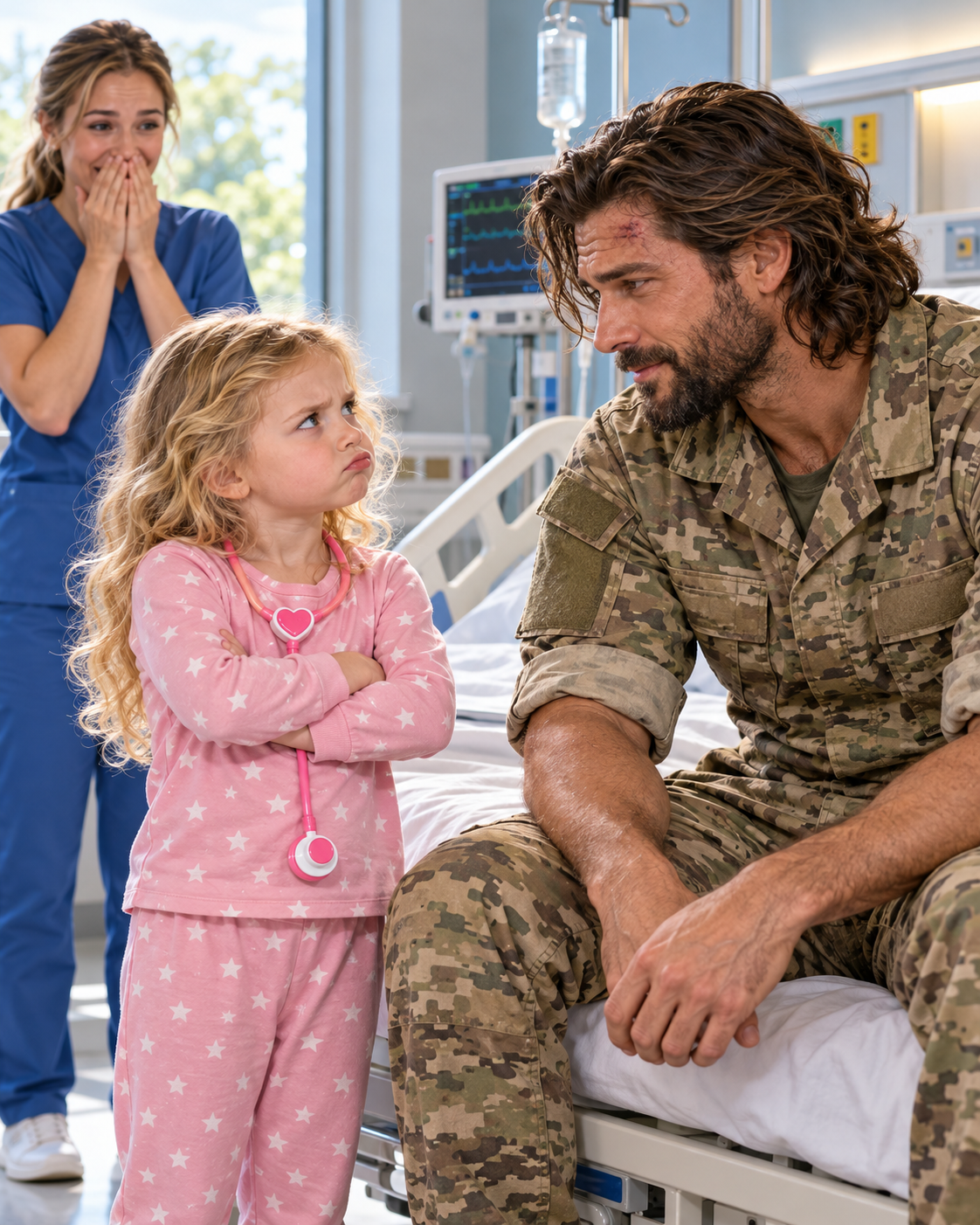
“Your exercises.”
He stared at her.
“My what?”
“Mommy says you have to move your arms so you get better.”
“I have a broken shoulder.”
“Then move the other one.”
A nurse behind me made a strangled sound.
Caleb looked at the ceiling as if asking for divine intervention.
“How many?”
“Ten.”
“Five.”
“Ten.”
“Seven.”
Chloe folded her arms.
“Do you want to get better or not?”
He closed his eyes.
“Ten, ma’am.”
The entire nurses’ station was watching by then.
Caleb completed ten slow arm exercises, grumbling under his breath while Chloe counted with the ruthless enthusiasm of a tiny drill instructor.
When he finished, she rewarded him with a sticker shaped like a smiling dinosaur.
“Good job.”
“Thank you, Doctor Chloe.”
She looked at the sticker on his gown, then considered him for a moment.
“Do you know how to salute?”
Caleb’s expression changed.
“Yes, I do.”
“Show me.”
He raised his good hand to his brow and performed a crisp Navy salute, even from his hospital bed.
Chloe attempted to imitate him, bringing her small fingers to the wrong side of her forehead.
He gently corrected her elbow.
“Keep your hand straight. That’s it.”
She tried again.
This time, her salute was nearly perfect.
“Very good,” he said.
“Did my daddy salute like that?”
Caleb’s hand froze in midair.
“Yes,” he answered after a moment. “He did.”
Chloe smiled.
“I knew it.”
She leaned against his bed, completely satisfied, while Caleb watched her with an expression I couldn’t bear to examine too closely.
That evening, I checked his chart while preparing his next medication.
The emergency contact section was blank.
No spouse.
No parent.
No sibling.
Nothing.
I knew many military patients had complicated family situations, and I had no right to pry into his private life.
Still, the empty space bothered me.
Perhaps it was because I understood what it meant to have your world reduced to a handful of names on a piece of paper.
Perhaps it was because Caleb seemed to have spent years looking after everyone except himself.
At 1:00 a.m., I found him awake, staring at the ceiling.
“Your emergency contact information is missing,” I said. “I need to update it before discharge planning.”
“I don’t have anyone to list.”
“Not a friend? A teammate?”
“No.”
I set the clipboard down.
“Everyone has someone.”
“Not everyone.”
His answer was so immediate, so final, that I felt something inside me harden.
“Then why did you react like that when you saw my husband’s dog tag?”
He turned toward me.
For the first time since that first night, he met my eyes.
I saw exhaustion there.
And shame.
“Because I knew Liam.”
“You knew him how?”
Caleb swallowed.
“Because he saved my life.”
The words landed between us with the weight of something dropped from a great height.
I sat down before my knees could give way.
Caleb drew a slow breath, wincing as his injuries pulled.
“Four years ago, we were operating overseas. The mission went wrong. We came under heavy fire, and the aircraft that was supposed to extract us couldn’t land where we were pinned down.”
He stared at his hands.
“I was hit. I couldn’t move properly, and the situation was getting worse by the minute. Liam came back for me when he could have stayed with the team and waited for another chance.”
I couldn’t speak.
“He got me onto his shoulder and dragged me toward the rescue helicopter. We were taking fire the entire way.”
His voice cracked.
“He was hit once, then again. I heard him grunt, but he kept moving. By the time we reached the aircraft, he’d taken three rounds.”
I pressed my hand against my mouth.
Caleb looked up, his eyes wet.
“He pushed me inside first. I remember grabbing his vest and telling him to get in. He looked at me and said, ‘You’re going home, Vance. That’s an order.'”
A tear slipped down his cheek.
“Then he collapsed.”
The room seemed to tilt around me.
For four years, I had lived with the official report, the careful words about courage, the condolences, and the unbearable silence that followed every time someone asked whether Liam had suffered.
I had never heard the last words he spoke to another person.
“Did he know?” I whispered.
Caleb frowned.
“Know what?”
“That he was dying.”
He lowered his head.
“I don’t know. But he was still trying to get me into that helicopter. Even after he could barely stand.”
I closed my eyes.
I had spent years imagining Liam’s final moments, sometimes picturing him afraid, sometimes picturing him thinking of Chloe, sometimes wondering whether he had known he would never walk through our front door again.
Now I knew that, in his final moments, he had been doing what he had always done.
He had been trying to save someone.
“Why didn’t anyone tell me you were there?” I asked.
“Because I wasn’t supposed to survive. And because I didn’t know how to face you.”
He wiped his eyes with the heel of his hand.
“I came back to the States, but I couldn’t get his last words out of my head. I kept thinking about you and the little girl he told us about. He talked about her constantly.”
My throat tightened.
“He did?”
“Every chance he got. He had a picture of her in his locker. He told us she had the loudest laugh in the world, and that you were the only person who could make him forget what he’d seen on a mission.”
Caleb smiled faintly, but it vanished almost immediately.
“Before we left, he made me promise something. He knew things were dangerous. He told me that if anything happened to him, I had to make sure you and Chloe weren’t left alone to face everything.”
I stared at him.
“The money orders.”
He nodded.
“That was me.”
For a moment, I couldn’t hear anything except the blood rushing in my ears.
“Every month?”
“Every month.”
“All this time?”
“All this time.”
I stood so abruptly that the chair scraped across the floor.
“You sent me money for four years without telling me who you were?”
“I was trying to keep my promise.”
“You could have written to me. You could have told me the truth.”
“I know.”
His voice was quiet.
“I couldn’t find a way to explain that I was alive because your husband wasn’t. Every time I thought about contacting you, I remembered him lying there and realized I was still breathing because he had made a choice.”
“You think I wanted you to suffer for surviving?”
“No.”
“Then why did you make me a stranger to you?”
He had no answer.
I looked away, blinking hard.
“I never spent any of it.”
Caleb lifted his head.
“What?”
“Every money order. I kept every single one in a shoebox under my bed. I couldn’t bring myself to spend money from someone who wouldn’t even tell me his name. It felt like pity.”
His expression changed.
“It wasn’t pity.”
“Then what was it?”
“It was Liam’s pay, passed on through me. It was a promise he trusted me to keep.”
He leaned forward despite the pain.
“Your husband earned every dollar of that money with his life, his courage, and the work he did. You didn’t owe me gratitude for sending it, and you certainly didn’t owe me forgiveness for not knowing how to tell you.”
I stared at him for a long time.
There was no excuse in his voice, no attempt to make himself the hero of the story.
Only a tired man who had survived something he had never learned how to survive emotionally.
“I don’t know what to do with that,” I admitted.
“You don’t have to do anything tonight.”
I looked at the dog tag around my neck, the twin of the one Chloe wore.
“Why did you ask for another nurse?”
His eyes filled again.
“Because when I saw Liam’s name, I remembered the sound of him falling. I remembered his blood on my hands. And then I looked at you and realized I’d been sending money to his wife for four years without ever having the courage to face her.”
He swallowed.
“I couldn’t stand there and pretend I was just another patient.”
I wanted to hate him for the years of silence.
I wanted to thank him for keeping his promise.
Mostly, I wanted to sit beside him and ask Liam a thousand questions through the only person who had heard his final words.
Instead, I picked up the clipboard.
“We’ll deal with the paperwork in the morning,” I said.
Caleb nodded.
At the door, I stopped.
“For what it’s worth, my husband would have hated you beating yourself up like this.”
A fragile smile appeared on his face.
“Yeah,” he whispered. “He probably would have.”
I left Room 9 feeling as if I had been handed a piece of my husband that I had never known existed.
For the first time in four years, the past felt less like a locked door and more like a room I might someday enter without falling apart.
I had no idea that, before sunrise, I would be forced to fight for the life of the man who had carried Liam’s final promise across four years of silence.
Part 3
At 2:50 a.m., the hospital was caught in that strange hour when the night seemed to hold its breath.
I sat in the breakroom with a cup of cold coffee, thinking about Caleb’s words.
Liam’s pay.
Not pity.
A promise.
I pictured the shoebox beneath my bed and all those untouched money orders, each one a small, anonymous reminder that someone somewhere remembered my husband.
For four years, I had mistaken the silence for distance.
Now I understood that silence could also be fear.
It did not make the silence painless, but it made it human.
I was still turning that thought over when I heard a crash from down the hall.
It was followed by a sound I will never forget.
A monitor alarm, shrill and relentless.
Then someone shouted, “Room 9!”
I was moving before my mind caught up.
When I reached the doorway, Caleb was on the floor beside his bed.
One hand was curled against his chest.
His lips had turned blue, and his eyes were half-open but unseeing.
For one terrifying second, I could not make myself believe what I was looking at.
“Caleb?”
I dropped beside him and checked for a response.
Nothing.
I searched for a pulse.
Nothing.
The room narrowed to his still body and the terrible silence beneath the alarm.
“Code Blue, Room 9!” I shouted. “I need the crash cart now!”
The hospital exploded into motion.
Nurses rushed through the doorway.
A respiratory therapist arrived with equipment.
The physician took position beside me as I began chest compressions.
One, two, three, four.
I counted because if I stopped counting, I might start thinking.
And if I started thinking, I would remember that this was the man my husband had died trying to save.
I would remember that Liam had dragged him through gunfire and pushed him toward a helicopter.
I would remember that Caleb had spent four years trying to honor a promise he didn’t know how to explain.
“Come on,” I whispered between compressions. “Stay with me.”
Someone took over briefly while the team worked to secure his airway and administer emergency treatment.
The physician suspected a massive pulmonary embolism, a sudden blockage that could kill within minutes.
I watched the team fight for him with a desperation that made every second feel like a lifetime.
I had learned CPR in a classroom.
I had practiced on a mannequin.
I had never imagined how different it would feel to press both hands against a real man’s chest while knowing that his death might tear open the life I had only just begun to understand.
The minutes dragged.
Five.
Ten.
Fifteen.
My arms burned.
My hands trembled.
I kept going.
“Come on, Caleb,” I pleaded. “You don’t get to leave like this.”
I thought of Chloe telling him to do ten exercises.
I thought of his laugh when she threatened to withhold stickers.
I thought of Liam’s final order.
You’re going home, Vance.
I pressed harder.
“Come on! You promised him!”
I didn’t know whether Caleb could hear me.
I didn’t know whether the words meant anything to the team around me.
But they meant everything to me.
Then the monitor changed.
A rhythm appeared.
The physician checked for a pulse.
“Hold compressions.”
I froze, my hands hovering over Caleb’s chest.
The room fell silent for one unbearable second.
Then the physician looked up.
“We have a pulse.”
Someone exhaled sharply.
A nurse began to cry.
I sat back on my heels, unable to move, staring at the man whose life had been balanced on the edge of a single heartbeat.
They transferred him to intensive care while I stood in the doorway, my scrubs damp with sweat and my hands shaking so badly that I had to grip the bedrail.
I had saved patients before.
I had never felt anything like this.
I went to the staff restroom and locked the door.
Then I slid down against the wall and cried.
I cried for Caleb.
I cried for Liam.
I cried for the young woman I had been when the military officer knocked on my door, and for the mother I had become while trying to make a world without her husband feel safe enough for a little girl.
Most of all, I cried because I had spent years believing that losing Liam meant losing every person connected to him, only to discover that one of those people had been carrying a piece of him all along.
At six in the morning, pale sunlight began spreading across the ICU windows.
I had washed my face, changed my scrubs, and returned to Caleb’s bedside.
The doctors had stabilized him, though they warned that the next hours would be critical.
His breathing was supported, and the monitors around him measured every fragile sign of recovery.
I sat beside him and took his hand.
It was warm.
That small warmth nearly broke me all over again.
“I’m not sure you can hear me,” I whispered, “but Chloe says you still owe her a dinosaur sticker.”
For a while, nothing happened.
Then his fingers moved.
I straightened.
His eyelids fluttered, opened slightly, and struggled to focus.
When he finally recognized me, his expression softened.
He squeezed my hand.
A faint smile touched his lips.
I had imagined what it would feel like to see Caleb awake again.
I had expected relief, perhaps even anger that he had frightened us all.
Instead, I felt something quieter.
It was the feeling of reaching the other side of a storm and realizing that the world was still there.
“Don’t try to talk,” I told him gently.
He moved his lips anyway.
I leaned closer.
“Did I make it?”
I swallowed the lump in my throat.
“Yes. You made it.”
His eyes filled with tears.
I squeezed his hand.
“You have to stop scaring the night shift.”
A weak breath escaped him, almost a laugh.
“Chloe,” he whispered.
“She’s sleeping.”
I nodded toward the nearby chair, where my daughter had curled up beneath a blanket after my sister brought her back to the hospital.
Her pink pajamas were rumpled.
One fuzzy slipper had fallen onto the floor.
In her small hand, she held Liam’s dog tag, clutching it even in sleep.
Caleb looked at her for a long time.
Then he turned back to me.
“I’m sorry,” he whispered.
I knew what he meant.
For the silence.
For the money orders without a name.
For the years he had carried my husband’s final request as though it were a punishment rather than a gift.
I brushed a tear from my cheek.
“I know.”
“I should have told you.”
“Yes,” I said. “You should have.”
His eyes closed briefly, and I saw the shame return.
“But you kept your promise,” I continued. “And you came back to us, even if it took four years.”
He looked at me again.
“I don’t know how to stop hearing him fall.”
I held his hand a little tighter.
“Maybe you don’t have to forget it. Maybe you just have to learn that surviving him wasn’t a betrayal.”
His face crumpled.
For the first time since I had met him, Caleb let himself cry without turning away.
I didn’t tell him everything would be fine.
I had learned the hard way that love did not guarantee safety, that courage did not always bring people home, and that some losses never became small enough to fit neatly into the past.
Instead, I stayed beside him.
Sometimes healing begins with a speech.
Sometimes it begins with a confession.
And sometimes it begins with one exhausted person refusing to let another person face the morning alone.
Chloe stirred in her chair and opened one sleepy eye.
“Is he better?”
Caleb managed a tiny nod.
She climbed down, padded to his bedside, and inspected him with the grave concentration of a doctor returning to a difficult case.
“Did you do your exercises?”
I laughed through my tears.
“Not yet,” Caleb whispered.
She sighed dramatically.
“You’re a very bad patient.”
“I know.”
She reached into her bag, found a dinosaur sticker, and carefully pressed it onto the edge of his blanket.
“This is for getting better.”
Caleb stared at the little sticker as though it were the highest honor he had ever received.
“Thank you, Doctor Chloe.”
She leaned forward and kissed his uninjured hand.
Then she placed her father’s dog tag beside it.
“Daddy says you have to be brave.”
Caleb shut his eyes.
A tear rolled down his cheek and disappeared into the pillow.
“Your daddy was the bravest man I ever knew,” he whispered.
Chloe considered that for a moment.
Then she nodded, satisfied.
“I know.”
She climbed back into her chair and fell asleep almost immediately, her small fingers still resting against the tag.
I watched her for a long time.
Liam was not coming back.
No amount of courage, money, or promises could change that truth.
But his love had not ended where his life did.
It had traveled through a battlefield, survived a frightened man’s silence, arrived in anonymous envelopes, and finally found its way into a hospital room where a little girl had ordered a wounded soldier to stop being mean.
And when Caleb’s heart stopped, the promise Liam had made him keep became something more than an obligation.
It became a reason to fight.
Later, when Caleb was strong enough to sit up, we would talk about the money orders, the years of grief, and the life he had built around a debt he could never repay.
I would tell him that the shoebox beneath my bed was still full, but that I no longer saw those envelopes as evidence of pity.
They were proof that Liam had been remembered.
And Caleb would learn that he did not have to spend the rest of his life earning the right to survive.
For now, the morning light grew warmer against the ICU windows.
My daughter slept beside us.
Caleb’s hand rested in mine.
And for the first time in four years, I felt no need to ask the universe why my husband had been taken from us.
I could not understand why Liam had died.
I could only understand what he had left behind.
A little girl who still believed her father could hear her.
A promise that had crossed years and oceans.
A man who was finally learning to forgive himself.
And a woman who was beginning to understand that moving forward did not mean leaving the dead behind.
I leaned down and whispered a quiet thank-you to the man whose final act of courage had brought us all to this room.
Then I looked at Caleb, who was watching Chloe sleep with tears shining in his eyes.
“You don’t have to carry him alone anymore,” I told him.
His fingers tightened around mine.
Outside, the hospital continued its ordinary morning, with carts rolling through corridors and nurses changing shifts as the world moved on.
Inside Room 9, three lives had been changed by a man who was no longer there to see it.
And as my daughter’s tiny hand curled around her father’s dog tag, I finally understood the truth Liam had left us.
Love does not always get to bring someone home.
Sometimes, it leaves a light burning for the people who survive.
And sometimes, the greatest tribute we can offer the ones we have lost is not to spend our lives standing beside their graves, but to keep living, keep loving, and keep reaching for one another in the dark.