The moment my mother stood inside a Pittsburgh diner and casually admitted she had spent my entire $80,000
Part 2
My mother finally found her voice, but it was the defensive, wounded voice she used whenever someone caught her doing something she couldn’t explain away.
“I was trying to help both my children,” she said. “Jordan needed a chance, and she has plenty of time to figure out school.”
Plenty of time.
I had spent years squeezing my future into the margins of everyone else’s emergencies, and now my own mother was telling me that I had more time to lose.
Grandpa looked at me.
“Did you know she was investing the money?”
I shook my head.
“Did you agree to it?”
“No.”
He nodded once, then turned back to my mother.
“Then you had no right to do it.”
She glanced toward the counter, where two customers had begun looking in our direction.
“Please lower your voice, Dad.”
“I’m not the one who needs to be embarrassed.”
His words were quiet, but there was nothing uncertain about them.
My mother folded her arms.
“You don’t understand how difficult things have been for Jordan. He’s been struggling to find his direction. This restaurant could finally give him stability.”
Grandpa’s expression hardened.
“And what about her direction? What about the future she has worked for?”
“She can apply next year.”
“With what money?”
My mother looked away.
That was when the truth became impossible to ignore.
She hadn’t simply risked an investment that might fail.
She had spent money that wasn’t hers to spend, money intended for a specific purpose, without asking the person whose life depended on it.
And she had done it because she believed I would absorb the consequences quietly, just as I had absorbed everything else.
I slid into the booth beside Grandpa because my knees no longer felt reliable.
“I was going to use that money for applications and tuition,” I said. “I was counting on it.”
My voice cracked on the last word.
I hated that it did.
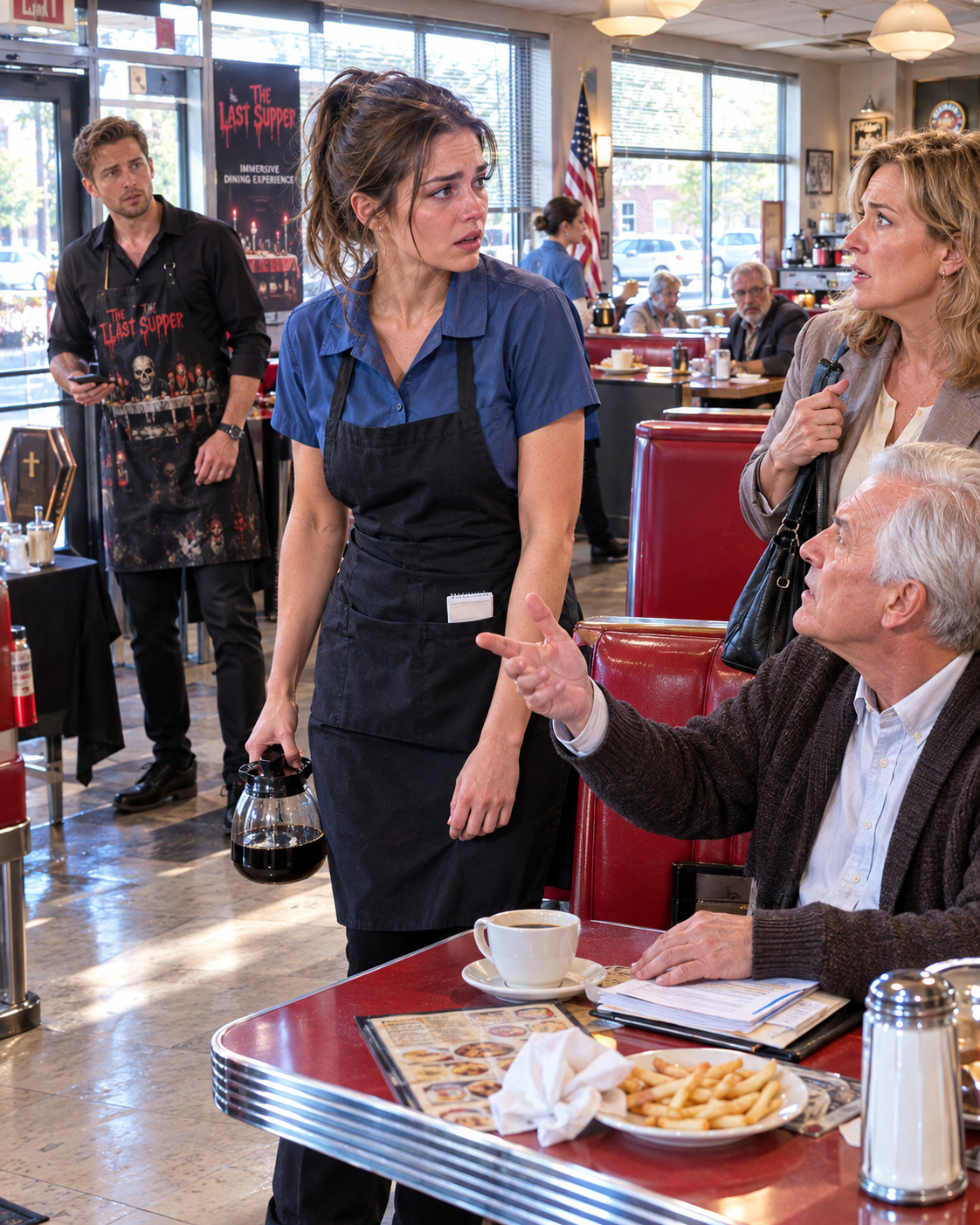
I hated that after years of working, saving, and swallowing disappointment, I still sounded like a child asking permission to be upset.
My grandfather reached across the table and covered my hand with his.
“I know, sweetheart.”
That simple sentence nearly broke me.
My mother gave an impatient shake of her head.
“You’re both acting as if I burned the money in the backyard. Jordan has a real business. Once the restaurant takes off, he’ll pay it back.”
“With what?” Grandpa asked. “The money it hasn’t earned yet?”
“You haven’t even seen the place.”
“I don’t need to see it to understand what you’ve done.”
She leaned back, crossing her arms more tightly.
“Jordan told me it would be successful. He had projections, a marketing plan, everything.”
“Did you read them?”
“Of course I did.”
“Did you have an independent accountant review them?”
Her silence lasted just long enough.
Grandpa exhaled through his nose.
“You handed eighty thousand dollars to a man whose previous businesses failed, without protecting the money or consulting the granddaughter it was intended to help.”
My mother flushed.
“That’s a cruel way to describe your own grandson.”
“It’s an accurate way to describe a decision.”
A server approached with a fresh pot of coffee, took one look at our faces, and quietly retreated toward the counter.
I wished I could disappear with her.
I was wearing a stained apron, my hair was coming loose from its clip, and my grandfather was discovering that his trust had been betrayed in the middle of the restaurant where I worked.
Somewhere behind me, a bell rang as the kitchen sent out another order.
Life continued around us, indifferent to the fact that mine had just cracked open.
Then Grandpa asked the question I hadn’t yet dared to ask.
“Where is Jordan?”
My mother stiffened.
“At the restaurant, probably.”
“Call him.”
“Dad, this isn’t the place.”
“You’re right,” Grandpa replied. “This is the place where your daughter works to pay for the education you just took away from her. So perhaps you should be grateful we’re having this conversation here instead of somewhere more private.”
She stared at him as if she had never heard him speak that way.
Then she pulled out her phone.
Jordan answered on the fourth ring, and even from across the table, I could hear his cheerful voice.
“Hey, Mom. What’s up?”
“Your grandfather is here,” she said. “We need you to come over.”
A pause.
“Why?”
“Just come, Jordan.”
He asked another question, but she ended the call before he could finish.
Twenty minutes later, he walked into the diner wearing a black shirt embroidered with the restaurant’s logo, a leather bracelet, and the confident expression of a man who believed the world was finally about to reward him.
He spotted us and grinned.
“Grandpa! You should come to The Last Supper sometime. We have a VIP table that looks like a burial chamber.”
Grandpa didn’t smile.
“Sit down.”
Jordan’s grin faded.
“What happened?”
Grandpa gestured toward the booth.
“Your mother tells me you’ve received eighty thousand dollars from the fund I established for your sister’s medical education.”
Jordan looked at Mom.
She stared at the table.
Then he looked at me.
For the first time since he arrived, he appeared uncertain.
“She told me it was a family investment,” he said.
“Did she tell you where the money came from?” I asked.
He rubbed the back of his neck.
“She said Grandpa wanted to help the business.”
“No,” I replied. “He wanted to help me become a doctor.”
Jordan sank into the booth.
The confidence drained from his face, leaving behind a man who suddenly looked every one of his thirty-one years.
“I didn’t know,” he muttered.
I wanted to believe him.
Part of me desperately wanted him to say that he had been misled, that he had never intended to take anything from me, that the whole thing could somehow be undone by a single honest conversation.
But Grandpa was already asking the questions that mattered.
“How much of the money remains?”
Jordan stared at his hands.
“Most of it went into the build-out.”
“How much remains?”
“I don’t know exactly.”
“Then find out.”
Jordan swallowed.
“We spent money on the sound system, the custom dining tables, the special effects, the contractors, the lighting, the licensing, and the opening campaign. We had to pay performers in advance, too.”
“And the coffins?” Grandpa asked.
Jordan looked up sharply.
“Those are part of the experience.”
“The bread boxes,” I said, my voice colder than I expected. “My medical school fund paid for the bread boxes.”
He flinched.
“They were custom-made.”
For a moment, I almost laughed.
Not because anything was funny, but because the absurdity was too large for my mind to hold.
I had spent months skipping meals and calculating the cheapest way to prepare for medical school, while my brother had apparently debated the artistic merits of coffin-shaped bread containers using money meant to change my life.
Grandpa leaned forward.
“Listen carefully, both of you. I did not save that money so one grandchild could turn the other one’s future into a gamble. I gave it for her education, and that was the purpose for which it was entrusted.”
Mom’s eyes filled with tears.
“Dad, please. We can work something out.”
“Yes,” he said. “You can.”
She reached toward him, but he withdrew his hand.
“I will speak to my attorney and my bank tomorrow. Whatever arrangements need to be made, I will fund her education directly from now on. The money will not pass through your hands again.”
Relief rose inside me so suddenly that it almost felt like pain.
Then he continued.
“And you and Jordan will explain, in writing, how you intend to repay the eighty thousand dollars you spent.”
Jordan stared at him.
“Grandpa, I can’t repay that right now. The restaurant has barely opened.”
“Then you will need to make a plan that reflects reality instead of fantasy.”
Mom shook her head.
“You can’t do this to us.”
Grandpa looked at her with exhausted sadness.
“I’m not doing this to you, Denise. I’m refusing to let you do it to her again.”
No one spoke.
I could hear the hum of the refrigerator behind the counter, the scrape of a chair across the floor, and the distant hiss of oil in the kitchen.
Then my mother stood so abruptly that her handbag struck the table.
“I hope you’re all happy,” she said. “I’ve spent my entire life trying to keep this family together, and now you’re treating me like a criminal.”
She walked out before anyone could answer.
Jordan remained seated, staring at the restaurant logo on his shirt.
After a while, he looked at me.
“I really didn’t know it was your money.”
I wanted to ask why he had accepted eighty thousand dollars without questioning where it came from.
I wanted to ask why he had never called me to discuss the investment, even though he knew I was working myself sick to save for school.
Instead, I asked the one question that had been haunting me.
“If you’d known, would you have refused it?”
Jordan opened his mouth.
Then he looked away.
That silence hurt more than anything my mother had said.
He finally stood, mumbled that he needed to get back to the restaurant, and left without ordering so much as a glass of water.
Grandpa stayed until my shift ended.
He sat in the booth while I refilled coffee cups, cleared plates, and carried heavy trays past customers who had no idea that a family disaster had unfolded only a few feet away.
When I finally untied my apron, he rose slowly and put on his old brown jacket.
“I’m sorry,” he said.
I shook my head.
“You didn’t do this.”
“I should have checked on the account sooner.”
“You were recovering from surgery.”
“And you were busy trying to carry everyone.”
He paused, studying my face.
“That needs to change.”
I didn’t know what to say, so I hugged him.
He held me tightly for a moment, then rested his cheek against my hair.
“You’re going to become a doctor,” he whispered. “Not because I say so, but because you have worked for it. We will deal with the money. You deal with your future.”
For the first time in months, I let myself believe that my dream might survive.
But as I drove home that night, I realized the money was only one part of the problem.
The bigger problem was that I had spent years confusing love with responsibility, and responsibility with the obligation to rescue people from every consequence of their own choices.
Grandpa could help protect my education.
He couldn’t make me stop handing my family the pieces of my life.
That part was up to me.
Part 3
The next morning, I sat in my car outside the medical clinic before my shift and opened my banking app.
The screen was painfully ordinary.
A checking balance, a savings balance, a list of transactions, and a recurring transfer scheduled to send money to my mother in three days.
Another transfer was scheduled for Jordan’s car insurance the following week.
I had set them up months earlier because I was tired of receiving panicked phone calls at the end of every month.
At the time, the transfers had felt like a solution.
Now they looked like chains I had fastened around my own wrists.
My thumb hovered above the screen.
I could already hear my mother’s voice in my head.
After everything I’ve done for you.
Your brother is struggling.
Family takes care of family.
I had heard those words so often that they no longer sounded like requests.
They sounded like laws.
I opened the first transfer and tapped Cancel.
A confirmation screen appeared.
I read it twice, expecting some sudden rush of guilt to stop me.
Then I confirmed.
The transfer disappeared.
I canceled Jordan’s insurance payment next.
Then I reviewed the other recurring payments and removed every one that existed only because someone in my family had learned I would cover the difference between their choices and their consequences.
When I finished, I sat in the driver’s seat with both hands resting on the steering wheel.
I didn’t feel triumphant.
I felt terrified.
For years, I had been the person who answered, the person who fixed things, the person who sent money before anyone had to ask twice.
I didn’t know who I was supposed to be if I stopped.
My phone rang before I could start the engine.
Mom.
I let it ring.
She called again.
Then came a text.
“Your grandfather is upset, and you’re making everything worse.”
I stared at the message until the words blurred.
A second text arrived.
“Jordan has employees depending on him. You can’t punish everyone because of a misunderstanding.”
A misunderstanding.
I had lost count of the number of times my family had used a softer word to make a painful truth easier to swallow.
A mistake.
A misunderstanding.
A rough patch.
A temporary setback.
But the money hadn’t wandered into the wrong account by accident.
Someone had made a choice, and I had been expected to pay for it.
I put the phone facedown and drove to work.
That afternoon, Grandpa called to tell me he had spoken to his attorney.
He had arranged for my education expenses to be paid directly to the relevant institutions, with the funds kept separate from anyone else’s accounts.
He was also documenting what had happened and seeking legal advice about the money my mother had transferred to Jordan’s business.
He didn’t promise that the entire eighty thousand dollars would be recovered.
He didn’t pretend that a restaurant could instantly return money spent on construction, payroll, and custom fixtures.
He simply promised that my future would no longer depend on my mother’s judgment.
It was the first financial promise anyone in my family had made to me without attaching an expectation that I would sacrifice something in return.
Over the following weeks, I learned how much peace could hurt before it began to feel like peace.
My mother stopped calling for several days, then began sending messages about small emergencies.
Her electric bill was higher than expected.
Her car needed new tires.
She wasn’t feeling well and wished someone would check on her.
I read every message.
I loved her.
That was the hardest part.
Boundaries would have been easier if I could have convinced myself that my family was entirely cruel, that every good memory had been a lie, that I had nothing to lose by stepping away.
But my mother had held me when I was sick.
She had packed lunches for me when I was little.
She had attended school performances and taken photographs at birthdays.
Jordan had once stayed awake all night with me when I was frightened before an important exam.
Those memories were real.
So was the betrayal.
For the first time, I understood that loving someone did not require me to pretend the worst thing they had done was harmless.
When my mother called again, I answered.
“I need you to help with the electric bill,” she said without greeting me.
I closed my eyes.
“I can’t pay it.”
A long silence followed.
“What do you mean, you can’t?”
“I mean I’m not paying it.”
Her voice sharpened.
“After everything I’ve done for you?”
“I love you, Mom. But I can’t keep paying for everyone’s expenses while trying to build my own life.”
“You have no idea how hard it is to be a parent.”
“Maybe I don’t,” I said. “But I know what it’s like to work two jobs and still be told my future can wait.”
She began crying.
The old instinct rose inside me immediately, urging me to apologize, offer money, and make the pain stop.
I let the silence remain.
For once, I did not rush to rescue her from the consequences of a conversation she had started.
Eventually, she hung up.
I cried afterward, sitting on the floor of my apartment with my back against the kitchen cabinets.
I cried for the little girl who had believed being useful was the same as being loved.
I cried for the years I had spent putting my own needs last because I was afraid that saying no would make me selfish.
And I cried for the version of my mother I wished would call back, apologize without excuses, and tell me she understood what she had taken.
That apology did not come.
Jordan’s restaurant survived its opening month, but survival was not the same as success.
The novelty attracted curious customers, and a few videos of diners screaming in the bathroom corridor spread across social media.
For a brief moment, Jordan seemed convinced that the business had finally become the breakthrough he had always predicted.
Then the practical problems began.
The custom sets were expensive to maintain.
The performers needed reliable pay.
The sound system broke down during a busy weekend, and a group of customers demanded refunds after an actor frightened a server carrying a tray of hot food.
Online reviews praised the atmosphere but complained about the prices, the cramped dining area, and the fact that the food itself was forgettable.
A horror-themed restaurant could make people scream.
It could not make them return if dinner wasn’t worth the money.
Jordan called me one evening.
I almost let it go to voicemail.
Instead, I answered because I wanted to know whether he had finally understood what happened.
“I’m having a hard time,” he said.
I waited.
“The bank is asking questions about the investment, and Grandpa wants a repayment plan. Mom says you won’t help with her bills anymore.”
“That’s true.”
He sighed.
“I don’t know what you want me to say.”
I looked at the medical textbooks spread across my desk.
“I wanted you to understand that the money wasn’t yours.”
“I know that now.”
“Did you know it when you accepted it?”
Another silence.
“I knew Grandpa was involved,” he admitted. “I didn’t ask enough questions.”
It wasn’t a full confession, but it was more honesty than I had heard from him in years.
He told me the restaurant had brought in less money than he expected and that he was considering selling some of the expensive props to reduce costs.
He said he had started taking extra shifts at a catering company to help cover expenses.
For once, I didn’t offer to send money.
I didn’t suggest a new business strategy or volunteer to manage his bills.
I simply listened.
Before we hung up, he said, “I am sorry about the money, and I’m sorry I never thought about what it meant to you.”
I wanted to tell him that an apology couldn’t restore the months I had spent exhausting myself or erase the fear I had felt when my future disappeared across a diner table.
But I also knew that if I wanted him to take responsibility, I had to allow him the dignity of doing so without making his first honest words meaningless.
“Then show me,” I said. “Don’t just tell me.”
He agreed.
Whether he would follow through remained his responsibility, not mine.
My mother took longer.
For a while, she treated Grandpa’s decision to fund my education directly as an insult.
She told relatives that he had turned against her, that I had encouraged him to humiliate her, and that I had abandoned the family when they needed me.
A few relatives called to ask why I couldn’t be more understanding.
I asked them whether they were willing to cover her bills or Jordan’s insurance.
Most suddenly remembered that they were busy.
That taught me something else about the word family.
Sometimes people used it to describe a bond.
Sometimes they used it to assign unpaid work to the person least likely to refuse.
I stopped explaining myself to everyone who had an opinion about my boundaries but no intention of sharing my burdens.
Meanwhile, my life began to change in small, almost invisible ways.
I bought groceries without calculating whether I could afford to send half the money to someone else.
I replaced a pair of worn-out work shoes instead of gluing the sole back on.
I took one evening off each week to study without checking my phone every few minutes.
I still worked hard, but my exhaustion began to serve a purpose I had chosen.
When my medical school interview invitation arrived, I read the email three times before I believed it.
Then I called Grandpa.
He answered on the second ring.
“I got an interview,” I said.
For a moment, there was silence.
Then he let out a laugh so joyful that I began crying before he finished speaking.
“I knew you’d get there.”
The interview was held in a quiet building with polished floors and large windows overlooking a courtyard.
I wore the best suit I owned, carried a folder containing my transcripts and recommendations, and arrived early enough to sit alone in the waiting room.
As I waited, I thought about the diner.
I remembered the smell of coffee, the cold grip of the table beneath my fingers, and my mother’s casual explanation about the coffins and the special effects.
For months, I had thought of that afternoon as the moment my family destroyed my dream.
But sitting in that waiting room, I realized it had also been the moment I finally saw the truth clearly enough to stop surrendering my life to it.
I was not simply a daughter, a sister, or the person everyone called when a bill came due.
I was a person with a future of my own.
I walked into the interview room and answered every question as honestly as I could.
I talked about the clinic patients who had taught me the importance of listening, the science courses that had challenged me, and the reasons I wanted to practice medicine.
I didn’t pretend that my life had been easy.
I explained that working two jobs had taught me discipline, and that watching people struggle to navigate healthcare had made me determined to become someone who could help them understand their options.
When I left the building, the afternoon air felt cool against my face.
I called Grandpa again.
“I think it went well,” I told him.
He replied, “Then go home and eat something that isn’t from a vending machine.”
I laughed so hard that a passing couple turned to look at me.
Several months later, my acceptance letter arrived.
I was standing in my apartment kitchen, still wearing my clinic scrubs, when I saw the email notification.
My hands shook as I opened it.
I read the first line, then covered my mouth and sank into a chair.
I had been accepted.
For a long time, I couldn’t do anything except cry.
Then I called Grandpa.
He answered with his usual greeting.
“What’s wrong?”
“Nothing,” I managed to say. “Nothing’s wrong. I got in.”
He was quiet for a second.
Then I heard him inhale sharply.
“Oh, sweetheart.”
His voice broke on the last word.
We stayed on the phone for nearly an hour, talking about tuition arrangements, orientation, and the courses I would take first.
He never once reminded me of the money.
He never made me feel that my acceptance belonged to him.
He had helped protect the opportunity, but I had earned my place.
The repayment issue remained complicated, and neither my mother nor Jordan could magically return eighty thousand dollars overnight.
My grandfather’s attorney continued addressing the matter through appropriate channels, and Jordan eventually began making payments under a formal plan as his circumstances allowed.
The restaurant had to scale back some of its elaborate features, sell equipment it could no longer afford, and focus more seriously on food and customer service.
It wasn’t the instant success Jordan had promised.
It was work, responsibility, and the slow realization that a business could not survive on confidence alone.
My mother and I began speaking occasionally, although our relationship was different.
I no longer answered every call immediately.
I no longer treated her distress as an automatic assignment.
When she asked for money, I said no if I could not afford to give it freely, and I stopped apologizing for having limits.
She didn’t always accept it gracefully.
Sometimes we ended conversations hurt and angry.
But for the first time, I wasn’t paying for the privilege of keeping the peace.
On the morning of my medical school orientation, Grandpa drove me to campus in his old sedan.
He insisted on arriving early, even though I had told him several times that we would have plenty of time.
He parked near the entrance, turned off the engine, and looked at the building through the windshield.
“Your grandmother would have loved to see this,” he said softly.
I swallowed the lump in my throat.
“She would have been proud of you, too.”
He nodded, then reached into the pocket of his old jacket and handed me a small envelope.
Inside was a photograph of the two of us at the kitchen table years earlier, surrounded by science books and plastic anatomical models.
On the back, he had written a sentence in his careful handwriting.
“Never confuse the people who need you with the people who help you grow.”
I traced the words with my thumb.
Then I looked at the man who had spent his life saving money, not because money was the most important thing in the world, but because he understood what it could make possible when used with love and purpose.
“Thank you,” I whispered.
He shook his head.
“You did the hard part.”
I stepped out of the car and walked toward the entrance.
For a moment, I turned back.
Grandpa was still watching me, his hands resting on the steering wheel, his face filled with the quiet pride of someone who had waited a long time to see a promise fulfilled.
I lifted the photograph.
He smiled.
Then I went inside.
I still work hard, and medical school has brought its own exhaustion, doubt, and sleepless nights.
There are days when the workload feels impossible, when I miss the simplicity of knowing exactly what I need to do and when I wonder how I will manage everything ahead of me.
But I no longer measure my worth by how much I can give away.
I no longer believe that love requires me to make myself smaller so someone else can avoid growing up.
I can care about my mother without financing every crisis.
I can love my brother without rescuing him from every consequence.
And I can honor my grandfather’s generosity by using the opportunity he protected rather than allowing guilt to take it from me again.
Sometimes I still think about that Thursday afternoon in the diner, about the casual way my mother said she had invested my future and the ridiculous image of my hard-earned education money becoming coffin-shaped bread boxes.
It would be easy to remember only the betrayal.
But when I think of that day now, I also remember my grandfather pushing away his untouched plate, looking directly at the people who had assumed I would stay silent, and deciding that someone needed to stand beside me.
He couldn’t give me back the years I had spent believing I was responsible for everyone else’s happiness.
He couldn’t undo the choices my family had made.
What he could do was remind me that my future mattered enough to defend.
And what I could do was finally believe him.
The first time I walked into a lecture hall as a medical student, I carried no envelope of emergency cash for my family, no list of bills I was expected to cover, and no secret promise to put my own dreams last.
I carried my textbooks, the photograph of Grandpa, and the knowledge that I had made it there through work, determination, and the courage to say no.
One day, I hope to stand beside a hospital bed and tell someone frightened that their life is worth fighting for.
I hope I can offer them the kind of reassurance that makes a person feel seen rather than indebted.
And whenever I begin to forget that my own life deserves the same care, I remember the words written on the back of that photograph.
Never confuse the people who need you with the people who help you grow.
Because the most painful lesson I learned was not that my family could take money meant for my future.
It was that I had spent years handing pieces of that future away, believing that refusing would make me a bad daughter or a bad sister.
It didn’t.
Sometimes the most loving thing you can do is stop making it possible for the people you love to keep hurting you.
Sometimes choosing your future means allowing someone else to face the consequences of their choices.
And sometimes, before you can spend your life learning how to save others, you have to learn that your own life is worth saving, too.