The moment my aging F/A-18E Super Hornet humiliated the Navy’s golden boy above Fallon, Nevada, Lieutenant Marcus Kingsley
I spent the entire night staring at the note on my kitchen table, listening to the wind scrape against my windows and wondering why a training exercise had suddenly become a threat against my grandfather’s memory.
Project Ghostwing.
The name meant nothing to me, but the date did.
It was the year Walt had stopped flying professionally, the year he had sold his crop duster and moved into a little farmhouse outside Kearney, Nebraska, where he spent the rest of his life repairing lawn mowers and pretending he had never wanted anything more.
I had been twelve when he quit.
When I asked him why, he told me he was tired of flying.
I had believed him because children believe the people who teach them how to live.
Now I wasn’t sure I had ever known the whole truth.
At 0615, my phone rang.
The caller ID was blocked.
“Lieutenant Vance,” a man’s voice said, “if you want to keep your career, forget the note.”
“Who is this?”
“Someone trying to save you from making your grandfather’s mistake.”
The call ended.
I immediately called Ray Okapor.
He answered on the fourth ring, sounding as if he hadn’t slept either.
“Tell me you know something about Project Ghostwing,” I said.
Silence stretched between us.
Then he exhaled.
“Meet me in the old maintenance hangar at 0700.”
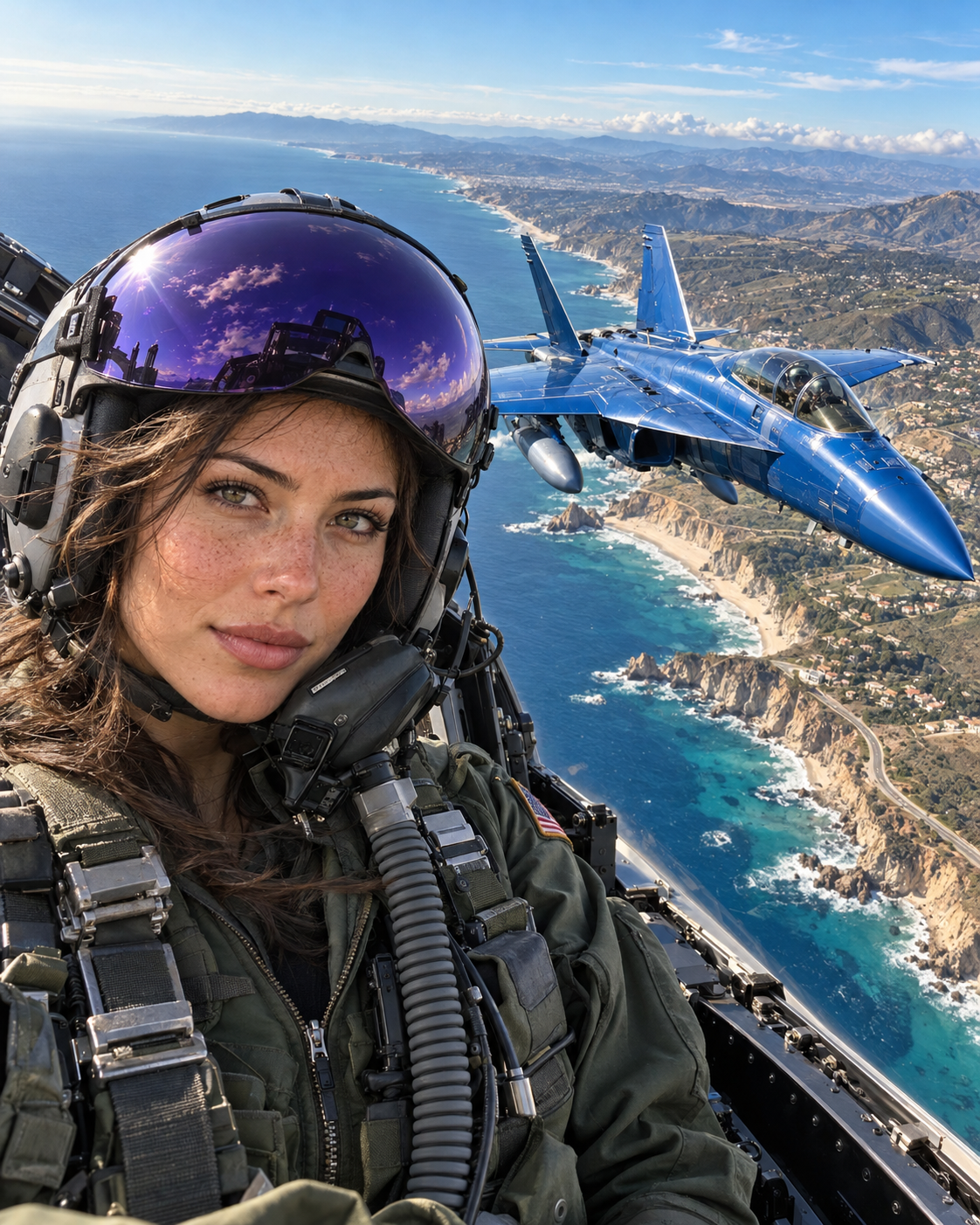
The hangar stood beyond the main flight line, its corrugated doors weathered by decades of desert storms.
When I arrived, Ray was waiting beside a retired training aircraft, holding a laptop and two cups of terrible vending-machine coffee.
He handed me one.
“I searched the internal records last night,” he said. “Ghostwing was a classified experimental flight-control program developed years ago to study how pilots react when automated systems encounter unpredictable aircraft behavior.”
“That sounds like a research project.”
“It was supposed to be.”
He opened his laptop and turned the screen toward me.
A grainy photograph showed a younger version of my grandfather standing beside a military test aircraft, wearing a flight suit with a name patch I had never seen.
WALTER VANCE.
My throat tightened.
“Grandpa flew military test aircraft?”
“According to the surviving records, he was a civilian test pilot contracted to evaluate emergency maneuvering systems.”
I stared at the photograph, trying to reconcile the man who had taught me to change spark plugs with the man standing beside that strange aircraft.
“What happened?”
“An accident. One pilot died during a test. The program was shut down, and most of the records were sealed.”
“Was my grandfather responsible?”
Ray shook his head.
“I don’t know. But the official report doesn’t agree with the surviving flight data.”
He showed me two graphs.
The first documented the aircraft’s control inputs before the crash.
The second showed a revised sequence that had been entered into the system several hours later.
Someone had changed the record.
The pilot’s name was Daniel Kingsley.
Marcus’s grandfather.
For a moment, the hangar seemed to tilt around me.
“You’re saying my grandfather was involved in a crash that killed his grandfather?”
“I’m saying both men were involved in the same classified program, and somebody altered the evidence afterward.”
“Why would Walt never tell me?”
“Maybe because he was ordered not to. Maybe because he was ashamed. Maybe because he was afraid that telling the truth would put someone else in danger.”
I looked at the photograph again.
Walt’s expression was different from the one I remembered.
He wasn’t smiling.
He looked like a man who had just watched the world become something he no longer recognized.
Before I could ask another question, footsteps echoed outside the hangar.
Commander Cruz entered, carrying a folder beneath one arm.
Her eyes moved from Ray to me, then to the laptop.
“I was hoping you would both be smart enough not to investigate this,” she said.
Ray closed the computer.
“Then you know about Ghostwing.”
“I know enough to understand why the program was buried.”
“Did you know Lieutenant Vance’s grandfather was involved?”
Cruz’s expression changed.
Only slightly.
But I saw it.
“Yes,” she said.
The word struck harder than an accusation.
“How long have you known?”
“Since before you arrived at Fallon.”
“And you let me fly that exercise?”
“I wanted to see whether the resemblance was real.”
I stepped toward her.
“The resemblance to what?”
Cruz opened the folder and removed an old photograph.
It showed two test pilots standing beside an experimental aircraft, one of them my grandfather and the other a younger Daniel Kingsley.
Between them stood a third man, his face partly obscured by the shadow of the hangar.
Cruz tapped the photograph.
“Ghostwing was designed to test whether pilots could retain control when automated flight systems encountered conditions outside their validated operating envelope. Your grandfather argued that human judgment had to remain central. Daniel Kingsley believed automation could make instinct unnecessary.”
“And the crash?”
“During a high-angle maneuver, the system failed to interpret the aircraft’s motion correctly. Daniel died. Walt survived.”
“Then why was the report changed?”
Cruz looked down at the photograph.
“Because the original data suggested the automation had contributed to the accident. The program had political support, a powerful contractor, and senior officers who had invested their careers in it. They needed a simpler explanation.”
“Which was?”
“Pilot error.”
The room fell silent.
My grandfather had spent twenty years living under the weight of a death he had not caused, while the institution that had hired him protected itself.
“Did he know the report had been altered?”
“He discovered it afterward. He challenged the findings and was warned that further disclosures would expose him to prosecution for violating his confidentiality agreement.”
“So he walked away.”
“Yes.”
I felt anger rise in my chest, but beneath it was something worse.
Grief for a man who had sat beside me at countless kitchen-table dinners, carrying a truth so heavy he could not bring himself to place it in my hands.
“Why are you telling me now?”
Cruz hesitated.
“Because the system that erased his contribution was never entirely retired.”
Ray slowly turned his laptop around again.
On the screen was a recent technical diagram of the F-35C’s targeting and flight-control architecture.
“Ghostwing’s original research was used to develop a predictive component in the modern training network,” he said. “Not the entire system, but a piece of the underlying logic.”
I stared at the diagram.
“You’re saying my exercise exposed the same weakness.”
“I’m saying your maneuver produced a discrepancy that shouldn’t exist if the system’s reported behavior is accurate.”
“And somebody deleted the evidence.”
Cruz nodded.
“Which is why you are not to discuss this outside this room.”
I laughed once, without humor.
“You grounded me for doing what you wanted to observe, then told me to stay quiet when the results became inconvenient.”
Her eyes hardened.
“I grounded you because you bypassed a safety system at an altitude where a mistake could have killed you. Your grandfather’s courage doesn’t make your decision safe.”
She was right, and that made the anger harder to hold.
The maneuver had worked.
That did not mean it had been wise.
Cruz placed the folder on a workbench.
“But neither does a safety violation explain away a corrupted record. I intend to find out who altered it.”
Before she could say more, the hangar door opened.
Marcus Kingsley stood in the sunlight.
He looked at the photograph in Cruz’s hand and went pale.
“My grandfather,” he whispered.
Nobody spoke.
He stepped inside and stared at the image as if the face he had admired his entire life had suddenly become a stranger.
“Why was I never told?”
Cruz answered quietly.
“Because someone believed the truth would damage his legacy.”
Marcus looked at me.
For the first time since I had met him, there was no arrogance in his eyes.
Only confusion, and the painful realization that his certainty had been inherited from people who might have lied to him.
“My family said Daniel died because a civilian pilot panicked,” he said. “They said Walt Vance abandoned him.”
“My grandfather never said anything about your family,” I replied.
“Maybe he was protecting us both.”
Marcus lowered his gaze.
Then he told us something none of us expected.
Three months earlier, his father had summoned him to a private meeting with representatives from the company responsible for maintaining his squadron’s advanced training systems.
They had shown him a demonstration of a new predictive targeting update.
The software was supposed to recognize a pilot’s likely maneuvers before the aircraft completed them, allowing the system to maintain a targeting solution through difficult engagements.
Marcus had been impressed.
He had signed an evaluation acknowledging that the system performed as advertised.
“Did they show you the underlying test data?” Ray asked.
“No. They showed me results.”
“Did you ever see it fail?”
Marcus hesitated.
“Once. During a simulator exercise, a pilot made an unexpected recovery and the targeting solution disappeared. The engineers said it was an input calibration problem.”
“Who was the pilot?”
He looked at me.
“I don’t remember his name. But I remember what the instructor said afterward.”
“What?”
Marcus swallowed.
“He said the system didn’t fail. The pilot had behaved incorrectly.”
Ray’s expression turned grim.
“That is exactly how Ghostwing began.”
For the first time, Marcus seemed to understand that his grandfather’s story wasn’t merely a family tragedy.
It was a warning that had survived long enough to find him.
By noon, Cruz had arranged a controlled review of the exercise telemetry.
My grounding remained in effect, but I was allowed to observe.
The original recordings were retrieved from a separate safety-monitoring system that did not rely on the same data feed used in the squadron’s main tactical display.
At first, the files appeared ordinary.
Then Ray compared the timestamps.
A critical section of the flight had been overwritten less than four minutes after the exercise ended.
The replacement data was too smooth.
It described a maneuver that matched neither my control inputs nor the aircraft’s physical response.
“Someone substituted a synthetic reconstruction,” Ray said.
Cruz leaned over his shoulder.
“Can you identify the source?”
“Not yet. But the correction came through an authorized maintenance channel.”
Every face in the room changed.
The person responsible had access.
They weren’t an outsider hacking a military network from some distant basement.
They were inside the institution.
Cruz ordered the system isolated and the access logs preserved.
Before the team could finish, an alert appeared on Ray’s screen.
The backup telemetry archive had been accessed remotely.
Then the connection disappeared.
“They’re deleting the originals,” he said.
Cruz immediately contacted base security.
But the damage had already begun.
One file remained intact, stored in a disconnected recorder that had captured the aircraft’s physical response independently of the tactical network.
Ray opened it.
A single sequence of numbers appeared on the screen, followed by an unfamiliar identifier.
GHOSTWING-02.
Below it was a note embedded in the archive’s metadata.
VALIDATION SUBJECT: D. VANCE.
My heart stopped.
“That’s me.”
Cruz read the line twice.
“No,” she said softly. “It can’t be.”
Ray searched the identifier.
The system returned a reference to an old research protocol that had been migrated into the modern training network.
My name had not been added after the exercise.
It had been entered into the protocol weeks earlier.
Someone had selected me before I ever climbed into the Hornet.
“They knew who I was,” I said.
“Or they knew who your grandfather was,” Ray replied.
Marcus stood motionless beside the wall.
“Then the dogfight wasn’t just a training exercise.”
Cruz didn’t answer.
She was staring at a second document attached to the archive.
It contained an authorization code and a signature.
The signature belonged to a senior program director who had attended our training briefings.
But the authorization date was almost a month old.
Someone had arranged the evaluation in advance, knowing that a pilot with my background might expose the weakness in the system.
They had wanted the maneuver.
They had also wanted the telemetry to disappear if it occurred.
The question was why.
Before we could answer it, base security arrived and ordered the room cleared.
Cruz handed over the evidence, insisting that the original recorder remain sealed and that every transfer be documented.
As we left, she pulled me aside.
“Listen carefully. You may have uncovered a genuine failure, but you still don’t know who designed the test or what they intended to prove. Don’t confuse suspicion with evidence.”
“What if they destroy the evidence?”
“Then we preserve what remains and make them explain the gaps.”
She paused.
“And Dakota, never attempt that maneuver again outside an authorized test environment. Your grandfather survived a dangerous system. That doesn’t mean you can afford to challenge one without a margin for recovery.”
I nodded.
For the first time, I understood that honoring Walt did not mean repeating his risks.
It meant learning from what those risks had cost him.
That evening, I returned to my truck and found another envelope tucked beneath the windshield wiper.
Inside was a photograph of my grandfather sitting alone in a small office, his face older than I remembered from any picture I had seen.
On the back, someone had written a sentence.
HE DIDN’T WALK AWAY BECAUSE HE WAS AFRAID.
Below it was an address in Reno.
I should have handed the note to security.
Instead, I called Cruz.
She listened without interrupting, then told me to wait while she arranged an escort.
An hour later, we arrived at a modest house on a quiet street.
An elderly woman opened the door before we knocked a second time.
She looked at the photograph in my hand and closed her eyes.
“I wondered when Walt’s family would come looking,” she said.
Her name was Evelyn Shaw.
She had been the lead data analyst on the original Ghostwing program.
She let us into a living room filled with books, old photographs, and boxes that looked as though they had not been opened in decades.
“I kept copies of the original test records,” she told us. “Not because I was brave, but because I knew what would happen if nobody did.”
She placed a sealed envelope on the table.
Inside were printed flight traces, handwritten notes, and a letter signed by my grandfather.
I recognized his handwriting immediately.
The letter described the final Ghostwing test in detail.
Daniel Kingsley had not been an inexperienced pilot, nor had he ignored the danger.
He had trusted the automated system because the test protocol assured him that the system would preserve control through the planned maneuver.
When the system began producing contradictory guidance, Walt had tried to warn him.
Daniel attempted to disengage the automation, but a delayed control response left him too low to recover.
Walt had taken every action available to him to help, but he could not save the aircraft.
The original data showed that the software had contributed to the accident.
The revised report blamed Daniel’s decision-making and suggested Walt had failed to intervene in time.
The truth was more complicated than either family’s version.
Daniel had trusted the system.
Walt had trusted the evidence of his own senses.
Neither man had been given the full information needed to make a safe decision.
“Why didn’t he release this?” I asked.
Evelyn’s eyes filled with tears.
“He tried. He appealed through every channel he could reach. But the program’s sponsors threatened to make him responsible for the accident if he continued. He was terrified that the truth would destroy Daniel’s family as well as his own.”
She looked at me.
“Walt wasn’t ashamed of the maneuver that saved him. He was ashamed that he had survived when Daniel hadn’t.”
I felt the words land somewhere deeper than anger.
For twenty years, I had thought my grandfather abandoned aviation because he had lost his nerve.
Now I understood that he had carried a dead man’s name alongside his own, unable to defend himself without risking another family’s grief.
Evelyn opened a second folder.
It contained correspondence from recent years, including warnings that the predictive targeting software had shown unexpected behavior during testing.
The warnings had been classified as minor anomalies.
Some had been removed from official summaries.
The signatures led to a contractor executive named Adrian Mercer, who had overseen the modern program’s development.
Mercer had not invented the original weakness.
He had inherited it, recognized its implications, and chosen to protect the program’s reputation rather than suspend the rollout.
Ghostwing had become more than a historical secret.
It had become a pattern.
A mistake was hidden, the hidden mistake became institutional knowledge, and each new generation was told that the system had already been proven safe.
Cruz read the final letter and folded it carefully.
“We have enough to begin a formal investigation,” she said.
“But not enough to prove who altered the Fallon recordings,” Ray replied.
Evelyn pointed to a small flash drive sealed inside the folder.
“Walt left instructions that this should only be opened if the same failure appeared again.”
Ray examined the drive without connecting it to any networked device.
Inside was a signed technical report and a recording of a meeting from the final months of the original program.
The voices were faint, but the meaning was unmistakable.
A senior official had acknowledged that the system’s predictive model could misinterpret unexpected pilot behavior.
Another voice had insisted that the problem be documented and corrected.
Then Adrian Mercer’s predecessor had responded that delaying the program would jeopardize funding and damage the careers of everyone involved.
The meeting ended without a resolution.
But the report attached to the recording showed that the weakness had never been fully eliminated.
The modern system had been built around assumptions that were too narrow.
My maneuver had not proved that instinct was superior to technology.
It had exposed the danger of treating a prediction as certainty.
When we left Evelyn’s house, the night air felt colder than before.
Marcus walked beside me in silence until we reached the cars.
“I spent my entire life trying to be the pilot my grandfather was,” he said.
“I thought that meant never doubting the technology, never showing uncertainty, never admitting that I didn’t know something.”
I looked at him.
“Maybe it means being willing to admit when you don’t.”
He nodded, but his eyes remained on the ground.
“If this comes out, my family will be dragged through it.”
“So will mine.”
“Do you hate my grandfather?”
I thought about the photograph, the altered report, and the man who had died trusting a system that was supposed to protect him.
“No,” I said. “I hate that somebody decided his death was easier to manage than the truth.”
Marcus breathed out slowly.
“Then I’ll testify.”
He did.
The following weeks were brutal.
The Navy opened a formal inquiry into the altered telemetry, the Ghostwing records, and the modern software’s validation process.
My flight privileges remained suspended while investigators reviewed my deliberate disengagement of the alpha limiter.
I admitted what I had done without excuses.
I also insisted that the corrupted records be treated as a separate matter, not as a convenient reason to dismiss the system failures.
Cruz testified about the prearranged evaluation.
Ray provided the independent telemetry.
Evelyn’s documents established the historical pattern.
Marcus submitted his own account of the earlier simulator anomaly and the briefing that had encouraged him to dismiss it.
For the first time, the people who had inherited the program’s assurances were being asked to defend them with evidence.
Adrian Mercer denied directing anyone to alter the recordings.
Investigators could not immediately establish who had initiated the deletion, and several officials insisted that the substituted data had been generated as part of routine processing.
But the original records, the access logs, and the historical correspondence made one thing impossible to ignore.
The program had concealed unresolved safety concerns.
The predictive targeting update was suspended pending independent review, and its developers were required to disclose the failures that had previously been classified as insignificant.
The inquiry also cleared my grandfather of the allegation that he had abandoned Daniel Kingsley.
His name was formally restored to the original test report as the pilot who had attempted to prevent the accident and survived it.
When I received a copy, I took it home and placed it beside the few photographs I had kept of Walt.
I cried harder than I expected.
Not because the report could return the years he had lost, but because I could finally imagine him setting down the burden he had carried.
My own disciplinary hearing came later.
The board found that I had knowingly violated a critical flight-safety procedure and had exposed myself and the aircraft to unacceptable risk.
I received a formal reprimand and additional training requirements.
My actions were not excused simply because the resulting data proved valuable.
I accepted the decision.
Cruz met me outside the hearing room.
“You were right about the weakness,” she said. “You were wrong to gamble your life on proving it.”
“I understand, ma’am.”
“Good. Because the next pilot who encounters a failure deserves a system that doesn’t require a miracle to survive it.”
For the first time since the dogfight, I saw something close to warmth in her expression.
Months later, I returned to the training range under strict restrictions.
My old Super Hornet waited on the flight line, its patched panels glowing beneath the morning sun.
Someone had written MAGPIE on a small strip of tape near the cockpit ladder.
I smiled despite myself.
Marcus was waiting beside the aircraft.
He had lost some of his swagger, but not his determination.
“Ready to fly?” he asked.
“Ready to learn,” I replied.
We were not there to recreate the dangerous maneuver.
The revised exercise focused on recognizing unreliable predictions, communicating anomalies, and preserving safe recovery margins when automation behaved unexpectedly.
The first time Marcus encountered a targeting discrepancy, he called it out immediately instead of trying to force the system to produce the expected answer.
I watched his aircraft return to formation, steady and controlled.
When we landed, he removed his helmet and looked across the flight line.
“My grandfather would have hated admitting the system was wrong,” he said.
“Maybe,” I answered. “But he deserved the chance to know.”
Marcus nodded.
“And so did yours.”
That afternoon, I visited Walt’s grave with a copy of the restored report.
The Nebraska wind moved through the grass, carrying the smell of wet earth from a field beyond the cemetery.
I laid the document against the headstone and rested my hand on the cool stone.
“I know why you stopped flying now, Grandpa,” I whispered. “But I wish you’d told me you were still fighting.”
For a long time, I stood there without moving.
Then my phone vibrated.
A message had arrived from Ray.
The independent review had uncovered another archived Ghostwing file, one that had never appeared in Evelyn’s collection or the official program history.
Its timestamp predated Daniel’s fatal test by eleven days.
The file contained a list of pilots selected for evaluation.
Walt’s name was first.
Daniel Kingsley’s was second.
The third name was unfamiliar.
The final line, however, made my blood turn cold.
AUTHORIZED OBSERVER: ELAINE CRUZ.
I read it twice, unable to understand how our hard-edged instructor could have been connected to a program that ended before her career had truly begun.
Then another message appeared.
Ray had found a recording attached to the file.
It was only twelve seconds long.
A woman’s voice spoke through static, young but unmistakable.
“If the system fails again, do not let them blame the pilot.”
The recording ended.
Beneath it was a final note, written in my grandfather’s unmistakable handwriting.
THEY WILL TRY AGAIN.
I looked toward the open fields beyond the cemetery, where the wind bent the grass in long, silver waves.
For years, I had believed the greatest lesson Walt taught me was how to fly an aircraft when the world turned against me.
Now I understood the harder lesson.
Skill could save a life, but skill alone could not repair a system that punished people for telling the truth.
Courage was not the willingness to ignore every warning.
It was the discipline to know which warnings to trust, the humility to admit when you were wrong, and the determination to make sure the next person did not inherit your silence.
I slipped the phone into my pocket and looked once more at my grandfather’s name.
The inquiry had restored his reputation, but it had not answered every question.
Somewhere in the Navy’s archives, another piece of Ghostwing remained hidden, and Commander Cruz had known more about the program than she had admitted.
I was going to find out why.
Not to prove I was a better pilot than Marcus Kingsley, and not to vindicate a maneuver that could easily have killed me.
I would find out because every pilot who climbed into a cockpit deserved to know what their machines could do, what they could not do, and who had decided which truths they were allowed to hear.
The next morning, I returned to Fallon.
My Super Hornet was waiting beneath the rising sun, old, imperfect, and honest about the scars it carried.
I climbed the ladder, settled into the seat, and rested my hands on the controls.
For the first time, the silence in the cockpit did not feel like loneliness.
It felt like responsibility.
Then the radio crackled.
“Magpie,” Cruz said, her voice quieter than I had ever heard it, “we need to talk about the third pilot.”
I looked out across the runway.
“Who was it, ma’am?”
A long pause followed.
Then she answered with six words that changed everything.
“Someone who is still flying today.”</WritingBlock