The moment Judge Evelyn Carter coldly called me a thief in a packed Chicago courtroom, I clutched my attorney’s trembling hand
For several seconds, nobody moved.
I could hear the faint buzz of the fluorescent lights above us and the rustle of paper as the prosecutor searched through his notes, desperately trying to understand why a six-year-old boy had just shaken an entire courtroom.
Judge Carter removed her glasses.
“Toby, I need you to understand something,” she said, her voice softer now. “You are not in trouble, and nobody is asking you to guess. I only want you to tell us what you remember.”
Toby looked at me.
I nodded, although my heart was beating so hard I could barely breathe.
“I was waiting for Mommy,” he began. “There was a chair near the big door, and I was drawing a dinosaur. Then I heard a lady talking.”
“Could you see the lady?” Daniel asked.
Toby pointed at Vanessa again.
“That lady.”
Vanessa immediately stood.
“This is ridiculous,” she snapped. “He’s a child. Children misunderstand things all the time.”
Her voice was sharp enough to make Toby flinch.
I rose instinctively, wanting to shield him, but the bailiff gently motioned for me to remain beside my attorney.
Judge Carter’s expression hardened.
“Mrs. Vance, sit down.”
Vanessa obeyed, but her eyes never left my son.
Daniel crouched slightly so he could speak to Toby without towering over him.
“Do you remember anything else she said?”
Toby pressed his lips together, thinking carefully.
“She said the bracelet would be gone, and the cameras wouldn’t show the important part. Then she said, ‘Don’t worry, he already promised me it would work.'”
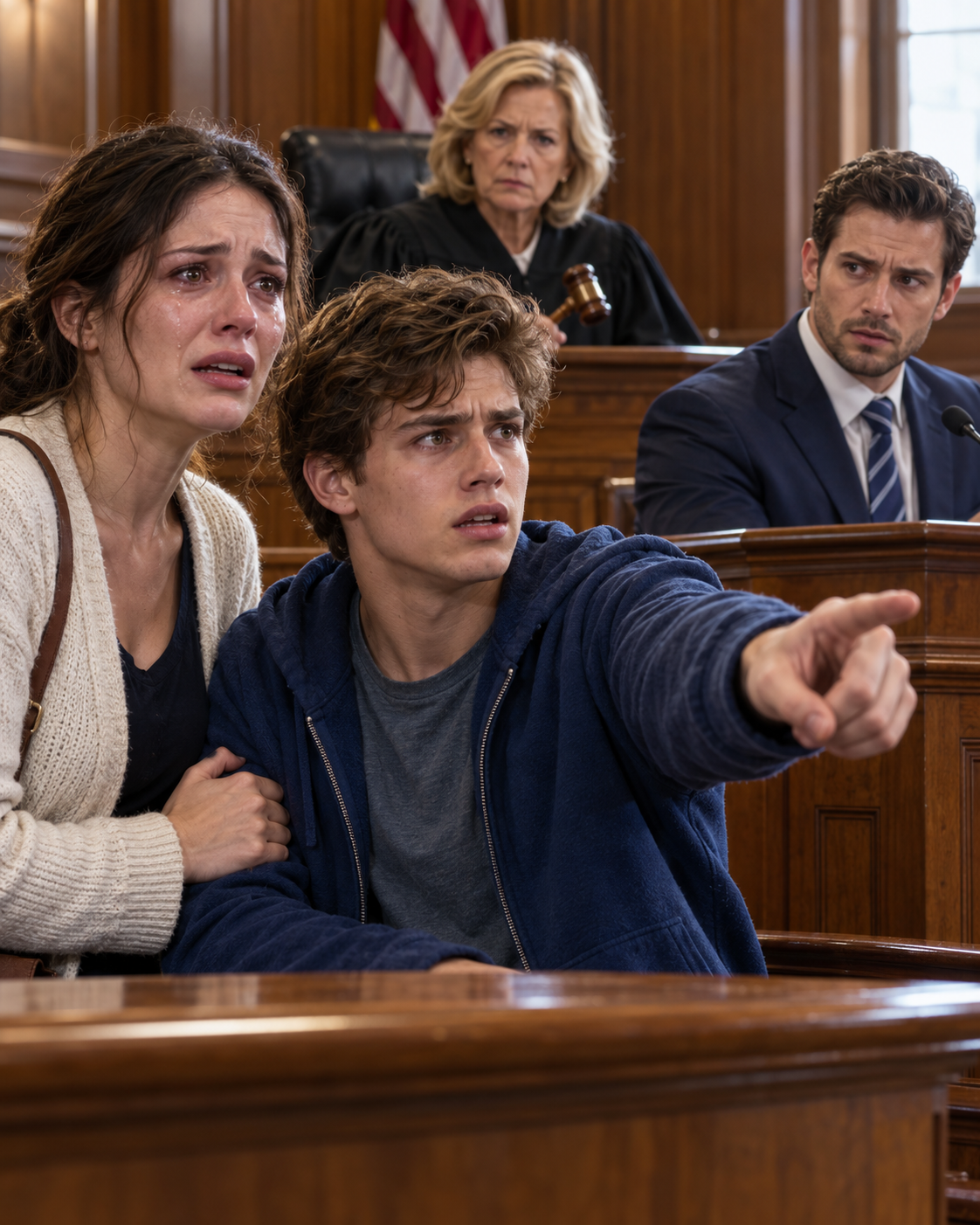
A murmur swept through the courtroom.
The prosecutor stood so quickly that his chair scraped against the floor.
“Your Honor, the witness’s statement is uncorroborated and may be the result of coaching.”
“Then you should welcome an investigation,” Judge Carter replied.
Her words landed like a hammer.
She ordered a recess, directed the attorneys to preserve all evidence related to the store’s security system, and instructed the prosecution to contact the investigators who had handled the original case.
My sentencing was postponed.
It was not freedom.
It was not even a promise that I would be believed.
But it was the first time in months that somebody had looked at the evidence and admitted that something might be wrong.
When the courtroom emptied, I dropped to my knees and pulled Toby into my arms.
“You were so brave,” I whispered into his hair.
He wrapped his arms around my neck.
“I didn’t want them to take you away, Mommy.”
Those words hurt more than any accusation.
My little boy had been carrying a fear too large for his six-year-old heart, and I had been so consumed by surviving my own nightmare that I hadn’t realized how closely he had been watching.
“I’m here,” I told him. “I’m right here.”
Yet even as I held him, I wondered what Vanessa had meant by those eleven missing seconds.
And why had she been so certain that nobody would ever discover the truth?
The answer began to emerge the following morning.
Daniel called me before sunrise.
“I’ve spoken with the investigators,” he said. “The store’s original security footage may still exist on an archived server.”
I sat upright in bed.
“May exist?”
“The system automatically creates backups, but the police were given an exported copy rather than the original files. If the backup wasn’t overwritten, we may be able to recover the missing segment.”
For the first time in weeks, I felt something dangerously close to hope.
Then Daniel added, “There’s another problem. The administrator account used to delete the footage belonged to Marcus Vance.”
I stared at the wall.
Marcus had been the store manager responsible for the security system.
He had testified that the cameras were functioning properly that day, except for a brief technical interruption.
His wife had testified that she watched me steal the bracelet.
Together, they had sounded like two ordinary people describing an ordinary crime.
Now their stories looked less like evidence and more like pieces of a trap.
The investigators obtained authorization to examine the store’s archived security records.
Marcus arrived at the station with an attorney, insisting that his account had been compromised.
Vanessa, meanwhile, gave a short statement through her lawyer, claiming that she had never spoken to Toby and that our family was attempting to escape the consequences of my conviction.
For a few hours, I feared the investigation would collapse into another contest between her polished confidence and my desperate insistence that I was innocent.
Then the digital forensic examiner found something.
The missing eleven seconds had not been lost because of a camera malfunction.
A deletion command had been issued manually through the administrator account.
The command had been executed shortly after the police requested the original recording.
More troubling still, the system log showed that the administrator account had been accessed from the manager’s office while Marcus was scheduled to be working.
It was not proof of a conspiracy by itself, but it was enough to make the investigators question everything he had told them.
Daniel called me again.
“They’re bringing Marcus back in for another interview.”
I gripped the phone.
“Will he tell them the truth?”
“I don’t know,” Daniel said. “But people who believe their lies are safe sometimes become careless when they discover someone has found the first crack.”
Marcus lasted less than two hours.
According to the investigators, he initially claimed that Vanessa had nothing to do with the missing footage.
Then they showed him the system logs.
They showed him the timestamp.
They showed him the administrator activity and asked why he had failed to mention it during his first interview.
His confidence began to crumble.
Finally, he asked to speak privately with his attorney.
When the interview resumed, he admitted that Vanessa had approached him several days before the alleged theft.
She had accumulated substantial debts, including unpaid loans and money owed to people who had begun threatening legal action.
She had convinced herself that a valuable bracelet could disappear without anyone noticing the difference between a genuine theft and a staged one.
According to Marcus, she had already identified me as a potential target.
I was a regular customer with no expensive clothes, no influential friends, and no family member who could afford an aggressive legal defense.
I was exactly the kind of person she believed the authorities would suspect.
“She said nobody would believe a single mother over a respectable woman,” Marcus eventually admitted.
When I heard those words, something inside me went very still.
It wasn’t merely that Vanessa had lied.
She had studied my life and decided my struggles made me disposable.
She had looked at the hours I worked, the inexpensive clothes I wore, and the fact that I raised my son alone, then mistaken those things for weakness.
Marcus told investigators that Vanessa had arranged for the bracelet to be removed from its display before I arrived.
She planned to make it appear that I had taken it, then use her testimony to establish that she had personally witnessed the crime.
Afterward, Marcus would delete the crucial portion of the surveillance recording and describe the gap as a technical failure.
In exchange, Vanessa had promised to help him financially once the matter was settled.
He had agreed because he was frightened of her debts, seduced by her promises, and convinced that nobody would look closely enough to catch them.
“What about the bracelet?” an investigator asked.
Marcus hesitated.
Then he admitted that Vanessa had hidden it inside a small compartment in her handbag before leaving the store.
She had intended to sell it later, after suspicion had settled on me.
The confession changed everything, but the investigators still needed the original footage.
A backup file was located on a secondary server that had not been connected to the store’s main system during the deletion.
The data was recovered and examined by a forensic specialist.
The recording showed me entering the store with Toby’s birthday drawing folded inside my purse.
It showed me approaching the necklace display and asking a sales associate about a small silver star pendant.
It showed Vanessa arriving several minutes later.
She glanced toward the security cameras, then spoke briefly with Marcus near the office door.
Afterward, she moved toward the bracelet display.
The footage showed her remove the bracelet herself.
She slipped it into her handbag, walked toward the far end of the counter, and waited until I approached the nearby display.
Then she deliberately positioned herself behind me.
When I bent down to retrieve a small gift box that had fallen from my shopping bag, Vanessa reached toward the counter and placed the empty bracelet case beside my purse.
From the right angle, it looked as though I had been handling it.
The next moment was the one that made the investigators stop the recording.
Vanessa turned toward the camera.
For a fraction of a second, she stared directly into the lens.
Then she smiled.
It was not a smile of surprise or confusion.
It was the calm, satisfied expression of someone who believed she had already won.
The original footage also captured Marcus entering the office and accessing the administrator system.
The missing eleven seconds contained the moment he disabled the relevant camera feed, but the surrounding recordings, system logs, and recovered backup made the sequence of events clear.
I had never touched the bracelet.
I had been framed from the moment I walked through the door.
When Daniel told me that the recovered footage supported my innocence, I sat at my kitchen table and cried so hard that I could barely hear him.
For months, I had replayed the day in my mind, wondering whether I had forgotten something, whether I had somehow made myself look guilty, whether there had been a moment when I could have prevented everything.
Now I finally had proof that my memory had not betrayed me.
I had told the truth from the beginning.
The world had simply refused to listen.
The case returned to Judge Carter’s courtroom four days later.
This time, the benches were crowded with reporters, court staff, and people who had followed the strange turn in the case.
Vanessa sat beside her attorney, her face pale beneath carefully applied makeup.
Marcus sat several seats away, looking older than he had during the original trial.
I stood beside Daniel, holding Toby’s hand.
My son wore the blue shirt he had chosen for the occasion because he said it made him look brave.
Judge Carter entered, and the room rose.
She reviewed the new evidence, the recovered surveillance footage, the system logs, and Marcus’s confession.
Then she turned to the prosecutor.
“Does the state maintain that there is sufficient evidence to sustain this conviction?”
The prosecutor stood.
“No, Your Honor. The newly recovered evidence fundamentally undermines the state’s case. We move to dismiss the charges.”
For one terrible second, I could not understand the words.
Dismiss the charges.
I had imagined those words so many times that they had become part of my private prayers, but hearing them spoken aloud felt unreal.
Judge Carter looked directly at me.
“Ms. Miller, the evidence now establishes that the accusation against you was false. The conviction cannot stand.”
My legs trembled.
Daniel steadied my arm as the judge formally vacated the conviction and dismissed the case.
I covered my mouth, and a sob escaped before I could stop it.
Toby rushed toward me, and I fell to my knees to catch him.
“We won, Mommy?” he whispered.
I held him so tightly that he laughed through his tears.
“We can go home,” I said. “We can go home together.”
Across the courtroom, Vanessa suddenly stood.
“This is a mistake,” she shouted. “He was supposed to fix it!”
Every head turned toward Marcus.
He closed his eyes.
Vanessa realized what she had said a moment too late.
Her attorney grabbed her arm and urged her to sit down, but the damage was done.
Investigators moved toward her as the judge ordered the courtroom to remain calm.
Marcus had already agreed to cooperate, and the recovered footage corroborated the confession that had begun the investigation.
Both were arrested on allegations connected to the scheme, including conspiracy and evidence tampering, while prosecutors pursued the appropriate charges relating to the false testimony and fabricated accusation.
Vanessa looked at me as officers escorted her toward the exit.
For the first time, she had nothing prepared to say.
No polished testimony.
No sympathetic expression.
No story in which she was the respectable person and I was the convenient villain.
I could have shouted at her.
I could have demanded that she look at my son and explain why she had nearly taken his mother away.
Instead, I held Toby’s hand and watched her leave.
I had spent too many nights allowing her lies to occupy my mind.
I wanted the future back more than I wanted another moment of her attention.
Before we left, Judge Carter asked us to remain.
She came down from the bench and stood a short distance from Toby.
“I want you to know something,” she told him. “You did a very brave thing by telling the truth.”
Toby looked at the floor.
“I was scared.”
“Being brave doesn’t mean you aren’t scared,” she replied. “Sometimes it means you speak even when you are.”
She paused, then looked at me.
“And sometimes the truth comes from the smallest voice in the room. The responsibility of the adults is to make sure they listen.”
I could not answer.
I simply nodded, tears slipping down my cheeks again.
Outside the courthouse, the afternoon sun fell across the steps, illuminating the same city that had seemed so cold when I first walked into the building as a defendant.
Toby tugged at my sleeve.
“Mommy, is my birthday ruined?”
I knelt in front of him.
“No, sweetheart. Not even close.”
“But we didn’t get your present.”
I stared at him, astonished that he was still thinking about the little silver necklace.
After everything that had happened, he was worried about a gift that cost less than a week’s groceries.
I kissed his forehead.
“You know what the best present is?”
He shook his head.
“Being able to take you home.”
He hugged me, and for a moment, the noise of the city faded.
Three months passed.
The legal proceedings continued, and the public attention eventually moved to other stories, but the consequences of that terrible day remained with us.
I returned to work, although my employer never quite looked at me the same way after the accusation became public.
Some neighbors apologized for believing the news reports.
Others avoided mentioning the case altogether.
I learned that innocence could be proven in a courtroom without instantly repairing every wound left behind.
Trust returned slowly.
Sleep returned in fragments.
And every time Toby disappeared from my sight in a crowded place, my heart tightened until I found him again.
Still, we rebuilt our ordinary life.
I saved what I could.
I made pancakes on Sunday mornings.
I listened to Toby explain the complicated rules of imaginary games involving dinosaurs, astronauts, and a stuffed rabbit who apparently controlled the entire universe.
For the first time in months, our future felt like something we were allowed to imagine.
Then, one Saturday afternoon, we walked past Bellamy & Co.
The store had changed owners after an internal review and a wave of public scrutiny.
The new owner, a kind-looking woman named Eleanor Brooks, had contacted Daniel several weeks earlier and asked whether I would be willing to visit.
I had almost refused.
The storefront still reminded me of the day my life had split into a before and an after.
But Toby wanted to see the star necklace in the window, so we stopped.
Eleanor came outside carrying a small velvet box.
“Ms. Miller,” she said, “I know this place caused you and your son a great deal of pain. I can’t undo what happened, but I wanted to offer you something.”
She opened the box.
Inside lay a delicate silver necklace with a tiny star pendant.
It was almost identical to the one I had originally intended to buy.
“For Toby,” she said. “No charge. I hope it can become a reminder of something better than what happened here.”
I stared at the necklace, unable to speak.
Toby looked up at me.
“Mommy, it’s my birthday star.”
I laughed through my tears.
Eleanor fastened the necklace around his neck, and Toby held the pendant between his fingers as though it were made of sunlight.
“Thank you,” I whispered.
She shook her head.
“You don’t owe this store anything. You were wronged here. I only hope we can begin making things right.”
As we walked away, Toby slipped his hand into mine.
“Mommy?”
“Yes, sweetheart?”
“Do you think bad people always get caught?”
I considered giving him the easy answer.
I wanted to tell him that the world always corrected its mistakes, that every lie eventually collapsed, and that kindness was always rewarded.
But he had already learned too much about how complicated the world could be.
“Not always,” I said carefully. “Sometimes people hide the truth for a long time. Sometimes they hurt others and never apologize. That’s why it’s important to tell the truth, even when it’s hard, and to stand beside people who are being treated unfairly.”
Toby thought about that.
“Like you?”
“Yes. Like me.”
He squeezed my hand.
“Then I’ll always stand beside you.”
Those seven words stayed with me long after we reached home.
That night, after Toby fell asleep, I placed his birthday drawing inside a small wooden box beside the recovered court documents.
The drawing showed two stick figures beneath a yellow sun.
One was taller, with long brown hair.
The other was small, with a blue shirt and an enormous smile.
Above them, Toby had written in uneven letters, “MY MOMMY IS GOOD.”
I traced the words with my fingertip.
For months, strangers had discussed my character as if they knew me.
They had measured my worth by my income, my clothes, and the accusations printed beside my name.
But my son had never needed a courtroom to tell him who I was.
He had watched me work when I was tired, share meals when we had little, and hold him through nights when I was afraid.
He had known the truth before the evidence proved it.
And when the adults around him nearly allowed a lie to destroy our family, he found the courage to speak.
I had spent years believing that protecting Toby meant shielding him from every frightening thing in the world.
Now I understood that I could not always keep the darkness away.
What I could do was teach him not to become part of it.
I could teach him that poverty was not shameful, that asking for help was not weakness, and that a person’s dignity did not disappear simply because someone powerful accused them of wrongdoing.
Most importantly, I could teach him that courage was not reserved for people wearing uniforms, standing behind microphones, or sitting on a judge’s bench.
Sometimes courage was a six-year-old boy with trembling hands, standing in a courtroom and telling the truth when everyone expected him to remain silent.
I turned off the kitchen light and walked to Toby’s bedroom.
He was sleeping peacefully, one hand curled beneath his cheek, the silver star resting against his chest.
I brushed his hair away from his forehead and whispered a promise I hoped I would always be strong enough to keep.
“No matter what happens, I’ll fight for you.”
Then I looked at his small hand resting on the blanket and remembered the promise he had made to me.
He would always stand beside me, too.
For the first time since the arrest, I allowed myself to believe that our story might no longer be defined by the worst thing someone had done to us.
It might instead be defined by what we chose to do afterward.
I thought the nightmare was finally behind us.
But the following morning, Daniel called with news that made my stomach tighten.
“There’s something you need to know,” he said. “The investigation uncovered another message on Marcus’s phone. It wasn’t sent by Vanessa.”
I gripped the edge of the kitchen counter.
“What did it say?”
Daniel was silent for a moment.
Then he read the message aloud.
“She was never supposed to be the only one blamed. If the footage comes back, make sure the original arrangement stays buried.”
I felt the room tilt around me.
“Who sent it?”
“We’re still verifying the sender’s identity,” Daniel replied. “But the timestamp is from the day before you entered that store.”
I looked toward Toby’s bedroom, where the little silver star hung beside his bed.
Vanessa had framed me.
Marcus had helped her.
But someone else had apparently known about the plan before it began.
And if that person had been watching the case from the shadows, then the truth that saved my son and me might only have uncovered the first layer of a much larger secret.