The moment I warned the wealthy owners of Hale Prestige Auctions that their $2.3 million Ferrari could suffer catastrophic engine failure
Part 2
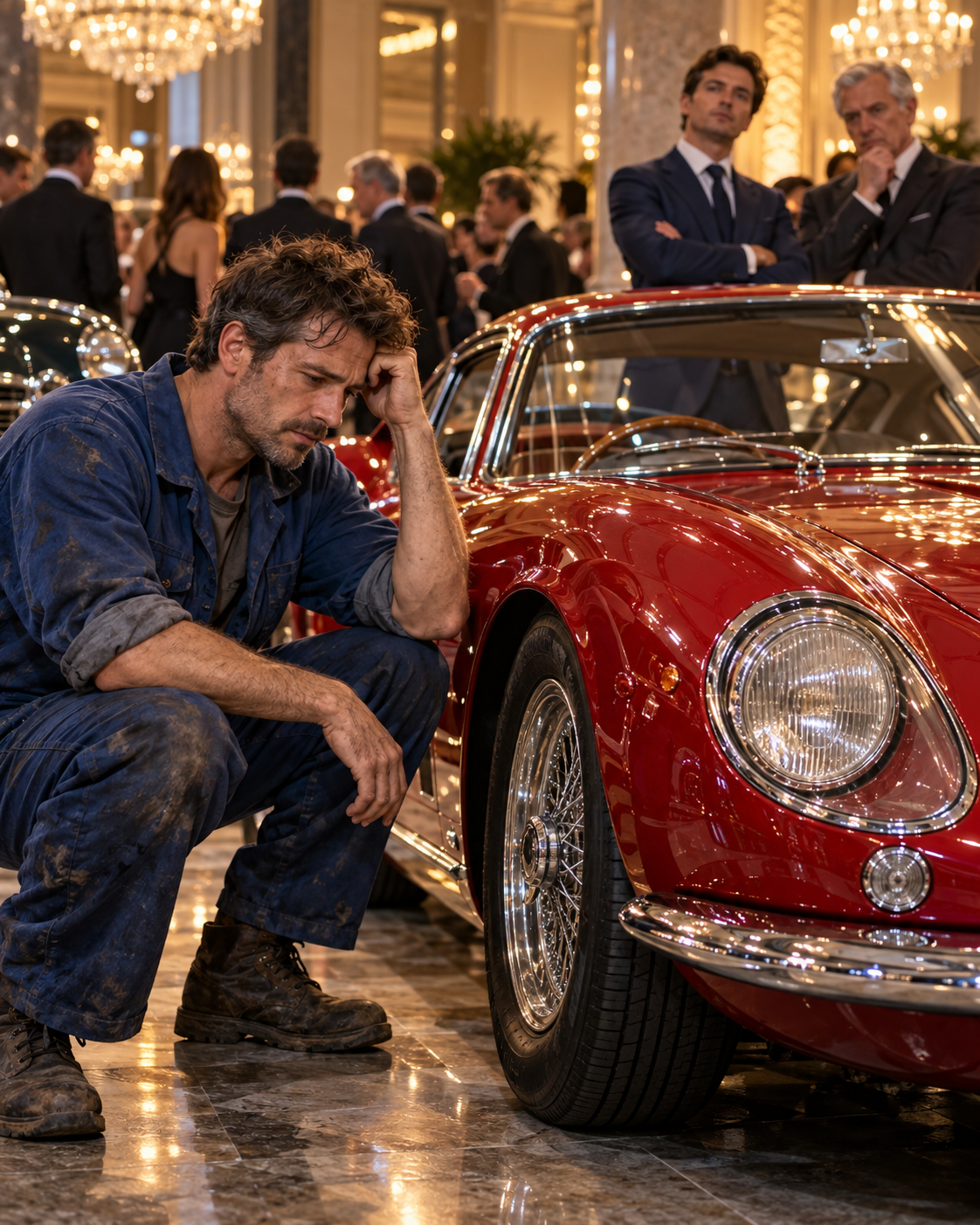
The drive back to my garage took twenty-three minutes, but I spent most of it thinking about the Ferrari.
I told myself I had done what I could.
I had identified a concern, explained why it mattered, and recommended verification.
I had not been hired to inspect Lot 1, and I had no authority to demand that anyone listen to me.
Still, there was a difference between accepting that I couldn’t control someone else’s decision and pretending I wasn’t worried about the consequences.
At a red light, my phone buzzed in the cup holder.
It was a message from Lily’s school reminding me that her next appointment with the pediatric pulmonologist was approaching.
I glanced at the date and felt my chest tighten.
The appointment would require a deposit before the clinic could confirm the additional testing her doctor had recommended.
I had enough money set aside for the visit, but barely enough for rent.
The Porsche had been my chance to create some breathing room.
I could not afford to spend the day worrying about a Ferrari that belonged to someone else.
So I went back to work.
A customer’s old pickup sat on the lift, its engine knocking whenever the temperature climbed. I spent the afternoon tracing the problem to a worn component and replacing it before the customer needed the truck for his night shift.
At six, I locked the garage and drove home.
Lily was sitting at the kitchen table with a workbook open in front of her, her hair pulled into a loose ponytail and a pencil tucked behind one ear.
“Daddy, I did the math problems without using my fingers.”
“That’s impressive.”
“Even the fractions.”
“Especially the fractions.”
She grinned, then noticed the expression on my face.
“Did something happen at work?”
I hung my jacket over the back of a chair.
“Nothing you need to worry about.”
She watched me for a moment.
“You say that when something happened.”
I sat beside her.
“You’re getting too good at reading me.”
“You taught me.”
There was no accusation in her voice, only a quiet certainty that made me feel both proud and ashamed.
I helped her finish the workbook, cooked dinner, and checked her medication schedule before tucking her into bed.
As I turned off her bedside lamp, she reached for my hand.
“Daddy?”
“Yeah, sweetheart?”
“Are we going to be okay?”
The question was so small that it almost broke me.
I sat on the edge of her bed and brushed a strand of hair away from her forehead.
“We’re going to keep working on it,” I told her. “One day at a time.”
She thought about that, then nodded.
“Okay. I can do one day.”
I kissed her forehead and stayed until her breathing settled into a steady rhythm.
Only then did I return to the kitchen and spread my bills across the table.
I had spent years repairing other people’s machines, but there was no simple procedure for repairing a life when the numbers no longer added up.
I worked through my accounts, calculated what I could postpone, and decided which jobs I would need to take over the weekend.
By midnight, I had a plan.
It wasn’t a good plan.
It was simply the best one available.
The following morning, I opened the garage before sunrise.
A thin layer of frost covered the windshield of my truck, and the air smelled of cold pavement and exhaust.
I was halfway through a brake inspection when my phone rang.
The caller ID showed an unfamiliar number.
“Daniel Carter?”
“Speaking.”
“This is Frank Delgado from Hale Prestige Auctions.”
I straightened slowly, wiping my hands on a rag.
“Good morning.”
“I wanted to follow up on your comments about the Ferrari yesterday.”
For a moment, I thought he might be calling to thank me for raising the concern.
Instead, he sounded tense.
“Mr. Hale has asked me to document the interaction. He believes your statements may have caused unnecessary concern among prospective buyers.”
I stared at the open hood in front of me.
“Did anyone inspect the engine?”
There was a pause.
“The car’s existing documentation has been reviewed.”
“That’s not what I asked.”
Frank exhaled.
“Daniel, I’m trying to handle this professionally.”
“So am I. Did anyone check the camshaft timing and lubrication system?”
Another pause followed, longer than the first.
“I can’t discuss internal procedures with you.”
“Then I hope someone who can discuss them has actually checked.”
His voice grew colder.
“You need to understand that making unsupported claims about a vehicle can have consequences.”
I felt something inside me settle.
“I never claimed to have completed a diagnosis. I reported a sound and recommended an inspection. That’s all.”
“Fine,” he said. “I’ll make a note of that.”
The call ended.
I lowered the phone and looked at the greasy rag in my hand.
For a few seconds, I considered calling the auction house again, asking to speak with Donovan, and repeating the warning until somebody listened.
Then I remembered the way Donovan had looked through me.
There was no new information I could provide over the phone.
Without access to the car, I could not establish the cause of the sound, and I would not pretend otherwise.
I had done my part.
I put the phone away and returned to the pickup.
The day moved forward in the usual fragments of work.
A customer arrived with a dead battery.
A delivery driver needed a belt replaced.
A young couple brought in a car that overheated whenever they used the air conditioning.
I listened, tested, diagnosed, and repaired.
By late afternoon, I had almost convinced myself that the Ferrari was no longer my concern.
Then a message appeared on my phone from a former colleague who occasionally attended collector-car events.
He had seen a promotional post from Hale Prestige Auctions announcing that Lot 1 had been sold to a private buyer.
The caption praised the Ferrari’s condition and described it as a remarkable example of Italian engineering.
I stared at the photograph.
The red bodywork gleamed beneath the lights.
The auction house’s name appeared beneath the image in elegant lettering.
There was no mention of my warning.
There was no mention of an additional inspection.
I couldn’t know whether anyone had checked the engine after I left.
I could only hope that they had.
That evening, I picked Lily up from an after-school program and stopped at the pharmacy to collect her prescription.
She talked all the way home about a science project involving planets, explaining that she wanted to build Saturn because its rings were more interesting than anything on Earth.
I listened carefully, asking questions and pretending not to notice how much the medication cost.
At home, she spread her colored paper across the kitchen table.
I sat beside her and helped cut out the rings.
“Daddy, why do you like fixing engines so much?”
I considered the question.
“Because when something is wrong, there’s usually a reason. You have to listen carefully, figure out what’s happening, and find a way to make it work again.”
She looked down at her cardboard planet.
“Can you fix everything if you listen carefully enough?”
I swallowed.
“No, sweetheart. Sometimes you can understand exactly what’s wrong and still not be able to fix it.”
She was quiet for a moment.
“That must be frustrating.”
“It is.”
She leaned against my arm.
“But you still try.”
I kissed the top of her head.
“Every time.”
I thought about those words long after she had gone to bed.
Because the next morning, I would discover just how costly it could be when people mistook a warning for an insult.
Part 3
At 10:17 on Saturday morning, my phone rang while I was balancing a tire in the garage.
The number belonged to a man I didn’t recognize.
“Is this Daniel Carter?”
“Yes.”
“This is Marcus Reed. I’m coordinating transport for Hale Prestige Auctions. Frank Delgado gave me your number.”
I set the tire down.
“All right.”
“We have a problem with the Ferrari.”
My hand went still.
“What happened?”
“We’re loading Lot 1 onto a transport vehicle. The car was driven toward the loading ramp, and the engine suddenly lost power. The driver says it made a brief mechanical noise, then stopped. Now it won’t turn over.”
I closed my eyes for a second.
“Don’t try to start it again.”
“We haven’t. The transport crew is waiting.”
“Good. Don’t force the engine, don’t attempt to move it under its own power, and have the vehicle secured where it is. If the engine has seized, repeated attempts could make the damage worse.”
There was a pause.
“Frank thought you might say that.”
“Has anyone confirmed that the engine is seized?”
“Not yet. The starter won’t turn it over, but we haven’t performed a complete diagnosis.”
“Then don’t call it confirmed until someone examines it. You need a qualified specialist to assess it in person.”
“We were hoping you’d come out.”
I looked toward the garage clock.
A customer was due to collect his truck in an hour, and Lily had an appointment that afternoon.
For a moment, I thought about refusing.
The men at Hale Prestige had made their position perfectly clear. They had dismissed my expertise when listening to me cost them nothing, and now they were calling because the problem had become impossible to ignore.
I had no desire to become the convenient mechanic they remembered only when something expensive broke.
Then I pictured the Ferrari on the loading ramp, its engine unable to turn, and the possibility that a simple inspection might have identified the danger before the car was put under load.
“I’ll come and look at the symptoms,” I said. “But I’m not promising a diagnosis until I can inspect it properly.”
I called my customer, explained the situation, and arranged for him to collect his truck later.
Then I grabbed my tools and drove to Hale Prestige Auctions.
When I arrived, the loading area had become unnaturally quiet.
The Ferrari sat halfway along the concrete ramp, its red paint still immaculate beneath the morning sun.
A transport operator stood near the driver’s door.
Frank Delgado was beside the front fender, speaking into his phone.
Troy Hale paced near the loading bay, his jaw clenched.
Donovan Hale stood a few feet away, staring at the car as though the machine had personally betrayed him.
The moment Frank saw me, he ended his call.
“Daniel. Thank you for coming.”
I nodded toward the Ferrari.
“Tell me exactly what happened.”
The transport operator stepped forward.
“We started it, let it idle, and moved it slowly toward the ramp. It sounded normal to me. Then, just as we began positioning it, the engine made a short fluttering noise and went silent.”
“Did you hear a bang?”
“No.”
“Grinding?”
“Not that I could hear.”
“Did the engine lose power gradually, or did it stop abruptly?”
“Pretty abruptly. It just died.”
I listened without interrupting.
The details mattered, but I refused to jump to conclusions simply because the symptoms resembled what I had suspected earlier.
“Did anyone try to restart it?”
“The driver turned the key once. Nothing happened. After that, we stopped.”
“Good.”
I approached the car and examined it without touching anything until I had permission.
The engine was silent.
The loading bay seemed to amplify that silence, making the absence of mechanical noise feel heavier than the crowd’s earlier laughter.
I checked what could be safely observed from the outside, then asked about the car’s recent service history, the circumstances of its last inspection, and whether anyone had documented the engine’s condition immediately before transport.
Frank answered what he could.
Some details were missing.
Others were recorded in the paperwork but had not been independently verified that morning.
I turned toward him.
“Has a qualified engine specialist examined it since it stopped?”
“No.”
“Then we need one before anyone attempts to turn it over again.”
Troy approached, visibly angry.
“You told us this would happen.”
“No,” I said. “I told you there was a sound that warranted inspection.”
“And now the engine is dead.”
“That appears to be the situation. We still need to establish why.”
Donovan’s expression was hard.
“Can you fix it?”
I looked at the car, then at the men standing around it.
“I can’t responsibly promise that without a proper diagnosis.”
Troy let out an incredulous breath.
“You came here claiming to know exactly what was wrong.”
“I told you what the sound suggested. I did not claim to know the full extent of the damage.”
I pointed toward the front of the engine compartment.
“If the camshaft timing was compromised, or if a related lubrication problem allowed internal components to run without adequate protection, continued operation could have caused severe damage. But until a specialist examines the engine, we cannot establish the precise failure.”
Donovan looked away from me and toward Frank.
“Was the car independently inspected before transport?”
Frank hesitated.
“The certification and restoration documents were reviewed.”
“That wasn’t my question.”
The same words I had used the previous morning now came from Donovan’s mouth.
Frank’s face tightened.
“I can’t confirm that every mechanical component was independently verified immediately before transport.”
Troy stopped pacing.
For the first time, he looked genuinely uncertain.
Donovan’s voice dropped.
“Are you telling me we sold a $2.3 million Ferrari without confirming its current mechanical condition?”
“I’m telling you what I can verify from the records available to me,” Frank replied. “I believed the documentation was sufficient.”
The transport operator shifted uncomfortably.
Nobody spoke for several seconds.
I could feel the weight of their attention moving toward me, but I didn’t mistake it for respect.
They weren’t looking at me because they had suddenly understood my worth.
They were looking at me because they needed someone who might help them understand what had gone wrong.
That distinction mattered.
“Let’s get an independent specialist here,” I said. “Someone experienced with this specific engine. Preserve the records, document the symptoms, and don’t attempt to start it again until the appropriate checks have been completed.”
Donovan nodded slowly.
“Frank, arrange it.”
Frank walked away to make the call.
Troy remained beside the car, staring at the engine compartment.
His earlier confidence had disappeared, leaving a man who had just realized that the cost of being wrong could not be negotiated away.
After a moment, he looked at me.
“You heard this yesterday?”
“Yes.”
“And you knew it could be serious?”
“I knew it needed investigation.”
He rubbed a hand over his mouth.
“Why didn’t you push harder?”
The question surprised me.
I looked at him carefully.
“I did push. I explained what I heard, why it concerned me, and what I recommended. You told me I was a man in garage clothes offering a roadside diagnosis.”
Troy’s eyes lowered.
“I was trying to protect the auction’s reputation.”
“No,” I said quietly. “You were protecting your confidence in it.”
He looked up.
I didn’t raise my voice.
“Those aren’t the same thing.”
Donovan had heard us.
He stood with his hands clasped in front of him, watching the Ferrari while the transport crew secured the ramp.
For a moment, I thought he might defend himself again.
Instead, he asked, “If we had listened yesterday, could this have been prevented?”
I took a breath.
“It’s possible that an inspection could have identified the underlying problem before the car was operated. I can’t tell you whether the damage was already present, whether it could have been repaired without major work, or whether the engine would have failed anyway. Anyone who tells you otherwise without examining it is guessing.”
The answer disappointed him.
He wanted certainty.
But certainty was not something I could honestly sell him.
“I understand,” he said at last.
The independent specialist arrived later that morning.
I stayed long enough to explain the sound I had heard and the symptoms reported by the transport operator, then stepped aside so the specialist could conduct his own assessment.
I did not touch the engine or pretend to know more than the evidence supported.
As the inspection continued, the mood around the loading bay grew heavier.
The specialist checked the engine’s ability to rotate, reviewed the available service documentation, and began the process of determining whether internal timing or lubrication problems had caused the failure.
His early findings were serious enough to rule out any attempt to restart the car.
A complete assessment would require further work.
No one offered a dramatic declaration, and no one could yet put a final number on the damage.
But the Ferrari would not be driving away that morning.
The car that had drawn admiring crowds the previous day now sat motionless beside the transport ramp, its beautiful bodywork concealing a problem that should never have been dismissed without investigation.
Troy watched the specialist work.
After a long silence, he turned toward me.
“I owe you an apology.”
I waited.
“I judged you by your clothes. I assumed you didn’t belong here, and when you raised a concern, I treated it like an insult instead of something worth checking.”
His voice sounded different now.
There was no audience to entertain and no buyer to impress.
“I was wrong.”
I nodded.
“Yes, you were.”
He seemed to expect me to soften the answer.
I didn’t.
An apology did not require me to pretend the insult had never happened.
But neither did I need to make him suffer to prove that I had been hurt.
Donovan approached us.
“Mr. Carter, I’d like to discuss compensation for your time and possibly arrange a formal consultation once we know the extent of the damage.”
I considered the offer.
My daughter’s next appointment was approaching, and the money would help.
Still, I wanted the arrangement to be clear.
“I can provide a written account of the observations I made and the advice I gave. If you need me to perform any additional work, we can agree on the scope and fee in writing.”
Donovan nodded.
“That’s fair.”
“And I want the report to state exactly what I observed, not more and not less. I won’t certify a cause I haven’t established.”
For the first time since I had met him, he looked at me without dismissing what I said.
“Understood.”
I stayed until the specialist had documented the initial findings and confirmed that the vehicle needed further examination before anyone could determine the full extent of the damage.
Then I packed my tools.
Troy stood beside the loading bay as I prepared to leave.
“Daniel?”
I turned.
“I know this doesn’t undo what happened yesterday, but I’m sorry.”
I looked at him for a moment.
“Then remember how you treated me before you knew I might be useful.”
He nodded, his eyes fixed on the concrete.
“I will.”
I drove back to my garage with the windows slightly open, letting the cold air clear my head.
I had not saved the Ferrari.
I had not proved that every problem could be prevented by listening.
And I had not suddenly become wealthy because a rich man had discovered he was wrong.
I was still a mechanic with bills to pay and a daughter who needed me.
But when I arrived home that evening, Lily was waiting at the kitchen table with her astronomy project finished.
She had made Saturn from cardboard, painted its surface in bands of gold and brown, and attached its rings with thin strips of wire.
“Daddy, look!”
I crouched beside her chair.
“That’s incredible.”
She smiled proudly, then noticed the tiredness in my face.
“Did you fix the car?”
I thought about the Ferrari, the silent engine, and the people who had learned too late that confidence could not replace careful work.
“Not exactly,” I said.
“Did you try?”
“Yes, sweetheart. I tried to help.”
She considered that, then reached for my hand.
“That’s what matters.”
For a moment, I couldn’t speak.
I had spent the entire day thinking about the cost of being ignored, but my daughter reminded me of something more important.
Doing the right thing was not a guarantee that things would turn out the way you wanted.
Sometimes it meant speaking up and being dismissed.
Sometimes it meant returning to help people who had humiliated you.
And sometimes it meant admitting that you could not repair everything, even when you understood what had gone wrong.
A few days later, the auction house contacted me with a formal request for a written statement about my observations.
I provided the facts, including the sound I had heard, the warning I had given, and the limits of what I could reasonably conclude without a full inspection.
I also submitted an invoice for my time at the loading bay.
They paid it without argument.
The Ferrari’s eventual repair costs and the final determination of what had caused the engine failure were matters for the specialists and the people responsible for the car.
I never claimed to know more than they could prove.
But I learned afterward that Hale Prestige changed its pre-transport procedures, requiring clearer documentation of mechanical checks before valuable vehicles were moved under their own power.
Frank sent me a brief note acknowledging that the concern should have been investigated more thoroughly.
Donovan never became my friend, and Troy never became a different person overnight.
Yet the next time I visited the auction house to inspect another vehicle, the staff asked about my findings before making assumptions about my experience.
That was a small change, but it was a real one.
As for me, I returned to the garage.
There were still broken cars waiting on the lifts, still customers counting every dollar, and still mornings when I had to look at the bank balance before deciding whether I could afford another cup of coffee.
Lily’s medical appointments continued, and some days were harder than others.
But we kept going.
One evening, several weeks after the Ferrari incident, she sat beside me while I reviewed the budget for the coming month.
She had a book open on her lap but was watching me instead.
“Daddy, are you worried again?”
I put the papers down.
“A little.”
She leaned against my shoulder.
“You always tell me that when something is wrong, you have to listen carefully before you can fix it.”
“I do.”
She looked at the bills spread across the table.
“Maybe people should listen carefully to people, too.”
I turned toward her.
She said it as simply as if she were explaining a fact from her science book.
I pulled her into my arms and held her close.
“You’re right, sweetheart.”
That night, after she fell asleep, I stood in the doorway of her room and listened to the gentle rhythm of her breathing.
I could not control every danger that might come into her life.
I could not promise that every warning would be heard or every problem would have a solution.
But I could keep showing up.
I could keep learning, keep working, and keep speaking when something mattered.
And I could remember that the value of a person was never determined by the price of their clothes, the size of their bank account, or the room in which they stood.
At Hale Prestige Auctions, a $2.3 million Ferrari had gone silent, and the people who believed they knew everything had been forced to confront what they had overlooked.
But the lesson I carried home was worth more than any car.
An engine doesn’t care who is listening, only whether the warning is understood in time.
People deserve better.
Because sometimes the person you dismiss is the only one trying to protect you from a mistake you cannot afford to make, and sometimes the quietest voice in the room is the one you will wish you had heard before everything went silent.