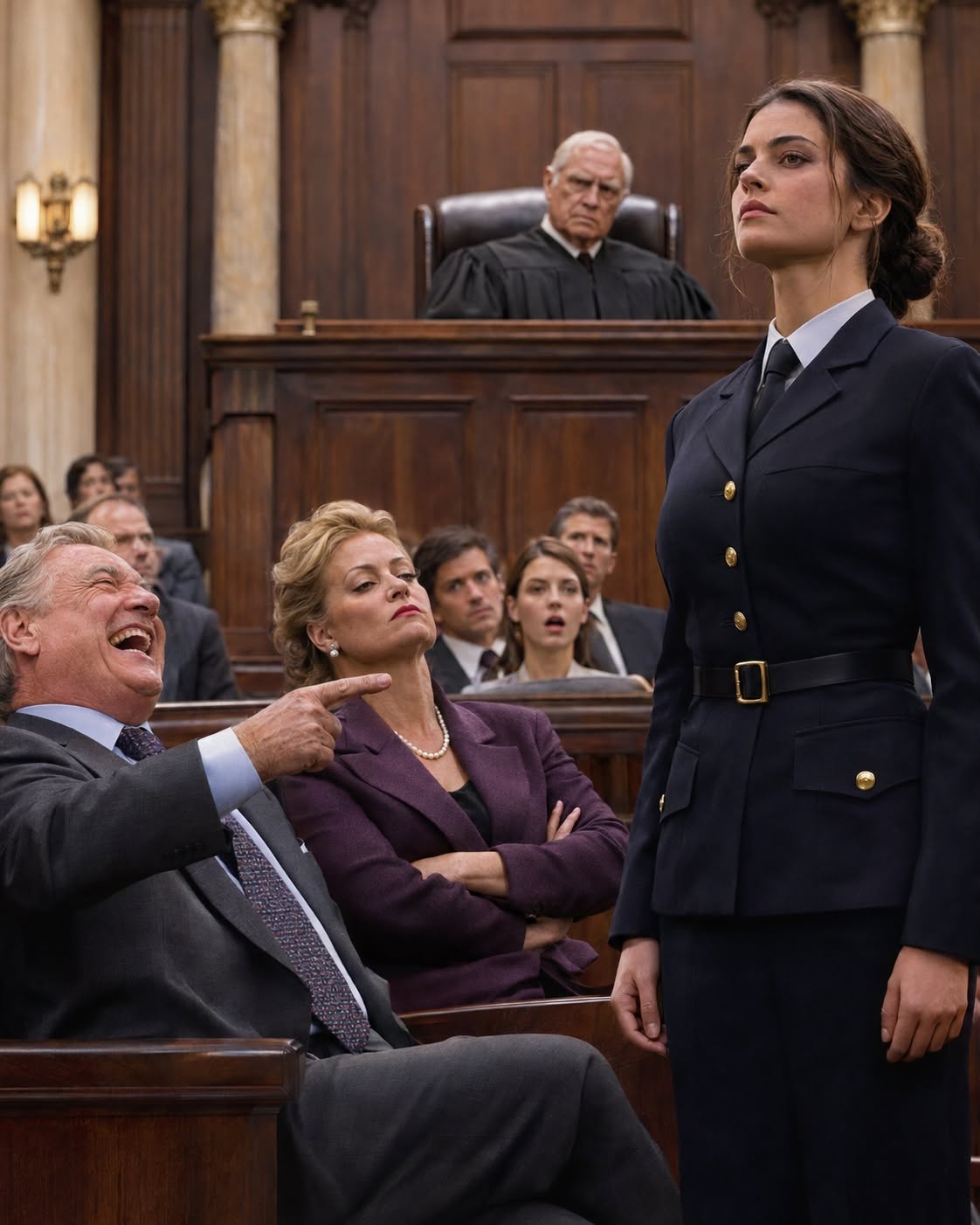
The moment I walked into the courtroom wearing my Navy SEAL dress blues, my father burst out laughing.
The courtroom doors closed behind us.
Judge Walter Callahan returned to his seat, adjusted his glasses, and looked down at the documents in front of him.
For several seconds, nobody spoke.
Then he turned toward my father’s attorney.
“Mr. Thorne, before we continue, I have a few questions concerning the financial disclosures submitted by your clients.”
My father shifted in his chair.
I noticed it immediately.
Raymond Holt had spent his entire life believing that confidence could solve almost any problem. He could intimidate employees, charm business partners, and silence family members with a single disappointed look.
But he couldn’t intimidate a judge.
“Your Honor,” Thorne began, “I’m not sure I understand the relevance of—”
“You will,” the judge interrupted.
He lifted a document.
“According to these records, Mr. Holt, you have been withdrawing funds from an account established for your granddaughter’s benefit. Is that correct?”
My stomach tightened.
I looked at Tessa.
She didn’t look surprised.
My father leaned toward his attorney and whispered something.
Judge Callahan waited.
“Mr. Holt?”
“Those were temporary transfers,” my father finally answered. “I was protecting the money. It was a family account.”
“Protecting it from whom?”
“Market instability.”
The judge glanced at another page.
“Then perhaps you can explain why approximately sixty-eight thousand dollars was transferred into an account belonging to your construction company.”
A murmur moved through the courtroom.
My mother stared straight ahead.
I felt my hands tighten beneath the table.
Sixty-eight thousand dollars.
Piper’s money.
Money Clara had saved for her daughter’s future.
My father cleared his throat.
“The business was experiencing a temporary cash-flow problem. I intended to replace every dollar.”
Tessa stood.
“Your Honor, we’d like to submit additional bank statements and a letter from the financial institution confirming that the withdrawals were unauthorized under the terms of the account.”
Thorne immediately objected.
Judge Callahan raised one hand.
“I’ll review the documents.”
He read silently for nearly a minute.
Then he looked at my father.
“Did your daughter authorize these transactions?”
“No.”
“Did she know about them?”
My father hesitated.
“I don’t believe so.”
“Then why did you make them?”
Raymond’s face reddened.
“Because I was trying to keep this family together!”
The judge slowly removed his glasses.
“Mr. Holt, taking money from a child’s account without authorization is not an act of keeping a family together.”
My father looked toward me.
For the first time that day, I saw something in his eyes that resembled fear.
But there was more.
Tessa stood again.
“Your Honor, there’s another matter we’d like the court to consider. We received a sealed letter from Clara Holt’s estate attorney this morning. It contains instructions Clara requested be preserved until the guardianship hearing.”
I turned toward her.
That wasn’t part of the evidence I’d seen before.
Tessa opened her folder and removed a small envelope.
My sister’s handwriting was on the front.
To be opened only if my parents challenge my choice.
I stopped breathing for a moment.
Clara had known.
Somehow, she had anticipated that our parents might fight her decision.
Judge Callahan accepted the envelope.
“Is this properly authenticated?”
“Yes, Your Honor. The estate attorney has provided an affidavit confirming the document’s origin and chain of custody.”
The judge opened it.
He read the first page.
Then the second.
His expression changed.
Not dramatically.
Just enough for me to realize that whatever Clara had written, it mattered.
“Mr. Holt,” he said quietly, “did you know your daughter had prepared this statement?”
My father didn’t answer.
“Mrs. Holt?”
My mother folded her hands.
“I don’t know what you’re referring to.”
Judge Callahan placed the letter on the bench.
“I’ll read a portion of it into the record.”
He paused.
Then he began.
“‘If my parents are fighting my brother for custody of Piper, I need the court to understand something. This isn’t about whether they love my daughter. I know they do. It’s about how they treat her when nobody is watching.'”
My throat tightened.
The judge continued.
“‘My father believes children should be obedient above everything else. My mother believes that keeping up appearances is more important than admitting when something is wrong. I grew up learning to hide my feelings because expressing them made our home uncomfortable.'”
My mother shook her head.
“That’s not true.”
The judge continued reading.
“‘My brother was the only person who ever told me I didn’t have to earn the right to be loved. When I became a mother, I promised myself Piper would never grow up believing that affection was something she had to work for.'”
I lowered my eyes.
I remembered Clara at seventeen, sitting on the hood of my old truck after another argument with our father.
She’d been crying.
I’d told her that one day we’d both have homes where nobody had to be afraid of making mistakes.
She had remembered.
“‘My brother has missed birthdays, holidays, and ordinary afternoons because he chose to serve his country. But he never missed being my brother. He called. He wrote. He remembered. He showed up whenever he could.’
“‘I trust him with my daughter because I have watched him keep promises when keeping them was difficult.'”
Judge Callahan lowered the letter.
The silence was almost unbearable.
Then he read the final paragraph.
“‘If my parents genuinely want to remain part of Piper’s life, I hope they will learn to love her without controlling her. But if they make her choose between pleasing them and feeling safe, I want the court to choose her safety. Please don’t confuse my wishes with a request to punish them. I simply want my little girl to have a childhood where she can breathe.'”
My eyes burned.
I stared at the empty seat beside me.
Clara should have been there.
She should have been complaining about the courtroom chairs and whispering that I looked ridiculous in my uniform.
Instead, her words were speaking for her.
Judge Callahan placed the letter down.
“Thank you, Mr. Thorne. I believe we’ve heard enough to understand the mother’s wishes.”
My father’s attorney stood.
“Your Honor, we respectfully request an opportunity to address these allegations.”
“You may address the financial allegations through the appropriate proceedings. But today, we’re determining the best interests of a child.”
He turned toward Dr. Finch.
“Doctor, does the mother’s letter change your recommendation?”
Dr. Finch stood.
“No, Your Honor. It reinforces it.”
She explained that her recommendation was based on independent interviews, home visits, school records, and Piper’s emotional responses.
She also confirmed that Piper had consistently expressed a desire to live with me.
“Did you find any indication that the child had been coached?” the judge asked.
“No.”
“Did she express affection for her grandparents?”
“Yes. She loves them. But she also expressed anxiety about disappointing them. Those feelings can coexist.”
My father leaned forward.
“She’s nine years old! She doesn’t understand what she’s saying!”
Dr. Finch turned toward him.
“With respect, Mr. Holt, being nine doesn’t mean a child’s feelings are imaginary.”
My father opened his mouth.
Then closed it.
The judge looked at me.
“Mr. Holt, please stand.”
I rose.
“You’ve indicated that you’ve submitted your retirement papers and secured civilian employment. Is that correct?”
“Yes, Your Honor.”
“Your military career has involved extended periods away from home. What makes you believe you can now provide the consistency this child requires?”
I took a breath.
“Because I’ve stopped treating home like a place I return to between assignments. I’m making it my permanent responsibility.”
The judge studied me.
“Explain.”
“I’ve spent years following orders, adapting to unfamiliar places, and accepting that plans can change without warning. But Piper doesn’t need someone who can survive uncertainty. She needs someone who can make her world predictable.”
I glanced at my niece.
“She needs breakfast at the same table, someone who knows her teacher’s name, someone who notices when she’s quiet. She needs someone who will be there when she gets sick, when she fails a test, and when she has a nightmare.”
My voice weakened.
“I can’t give her back her mother. I won’t pretend I can. But I can give her a home where she never has to wonder whether the person who loves her will answer the phone.”
The courtroom remained silent.
Then the judge asked, “And her grandparents?”
I looked at my parents.
“I want them in her life if they can be good for her. I don’t want to punish Piper by taking away people she loves. But I won’t sacrifice her emotional safety to protect their pride.”
My father shook his head.
I continued.
“Clara didn’t ask me to win a war against our parents. She asked me to raise her daughter.”
Judge Callahan nodded slowly.
“Thank you. You may sit.”
He called another brief recess before announcing his decision.
Those twenty minutes felt longer than some of my deployments.
Piper sat beside Tessa in the hallway, drawing on the back of an old court document.
I approached her.
“What are you drawing?”
“A house.”
I smiled.
“Looks nice.”
She held it up.
There were three people standing in front of it.
A tall man, a little girl, and a woman with long brown hair.
Clara.
I swallowed.
“Who’s that?”
“Mommy.”
“She’s beautiful.”
Piper nodded.
“Can we put her picture in my bedroom?”
“Of course.”
She looked down at the drawing.
“Will Grandma and Grandpa still come over?”
I crouched beside her.
“If that’s what you want, and if they can follow the rules that keep you safe.”
“What if they get mad?”
“Then they’ll have to work through being mad. That’s not your job.”
She thought about that.
Then she asked something I wasn’t prepared for.
“Uncle, if I make a mistake, will you still love me?”
I felt something break inside my chest.
I took both her hands.
“Sweetheart, you could make a thousand mistakes. You could break every glass in our kitchen. You could get the worst grades in your class. You could be angry with me for a whole week.”
I paused.
“Nothing you do will ever make you stop being loved.”
She leaned forward and hugged me.
And I realized that this was the real hearing.
Not the lawyers.
Not the documents.
Not the judge.
It was a little girl trying to discover whether love could finally feel safe.
When we returned to the courtroom, Judge Callahan had already taken his seat.
Everyone stood.
He waited for us to settle.
Then he began.
“After reviewing the mother’s written designation, the testimony, the guardian ad litem’s report, and the evidence concerning the proposed guardians’ financial and emotional circumstances, this court finds that granting guardianship to the maternal uncle is in the child’s best interests.”
Piper squeezed my hand.
I barely heard the next sentence.
“Temporary legal guardianship is hereby granted to Daniel Holt, with authority over the child’s residence, education, and ordinary medical care, subject to applicable law and further court orders.”
My knees almost gave way.
The judge continued.
“The grandparents will have an opportunity to maintain contact through a structured visitation arrangement, initially supervised by an approved family professional. Any expansion will depend on their ability to respect the child’s emotional boundaries.”
My mother stood abruptly.
“This is outrageous!”
The judge looked at her.
“Mrs. Holt, sit down.”
“You’re giving our granddaughter to a man who abandoned his family for the military!”
I felt Piper’s hand trembling.
I stepped slightly in front of her.
Judge Callahan’s voice became firm.
“Your granddaughter has not been awarded as a prize. She is a child. This court has considered her needs, her mother’s documented wishes, and the evidence presented. Your disappointment does not change that.”
My mother sat.
My father remained motionless.
Then the judge added something I would never forget.
“Mr. Holt, Mrs. Holt, you are not losing your granddaughter because someone else loves her more. You are being asked to demonstrate that your love does not require control.”
The gavel came down.
And just like that, everything changed.
Outside the courthouse, reporters were gathered near the entrance.
Someone had apparently heard about the Navy Cross citation and the unusual moment when the judge stood in recognition.
But I didn’t care about the attention.
I just wanted to get Piper home.
As we reached the parking lot, my father called after me.
“Daniel.”
I stopped.
Piper moved closer to my side.
Raymond approached slowly.
For once, he didn’t look like the most powerful person in the room.
He looked old.
“Can we talk?”
I glanced at Piper.
“Not right now.”
He looked disappointed.
“I just want to explain.”
“Then you’ll have to do it at the appropriate time, with the family counselor.”
His jaw tightened.
“You really think I’m some kind of monster?”
“No, Dad.”
I looked him in the eyes.
“I think you’ve spent so long believing you must control everything that you’ve forgotten how to listen.”
He looked away.
My mother joined him.
“We raised you better than this,” she said.
I almost laughed.
Instead, I answered quietly.
“You raised me to be strong. I’m trying to use that strength for something different.”
I opened the passenger door for Piper.
Before getting in, she looked toward her grandparents.
“Bye, Grandma. Bye, Grandpa.”
My mother looked surprised.
My father lifted one hand.
Neither of them approached.
We drove away.
For the first time in months, I didn’t have another mission waiting for me.
I had a little girl in the back seat asking whether we could stop for ice cream.
And that was enough.
The first few weeks were harder than I expected.
Piper had spent most of her childhood learning how to read adults.
She could tell when someone was irritated by the way they placed a glass on the table. She apologized when she dropped a pencil. She asked permission before taking a second cookie.
One evening, I found her standing beside the kitchen counter, holding a broken ceramic plate.
Her eyes were wide.
“I’m sorry,” she whispered.
I looked at the pieces on the floor.
Then at her.
“Are you hurt?”
She shook her head.
“Okay. Let’s get you some shoes so we can clean this up safely.”
She stared at me.
“You’re not mad?”
“Well, I’m not thrilled about losing a perfectly good plate.”
Her shoulders stiffened.
Then I smiled.
“But plates can be replaced. You can’t.”
She looked confused.
I handed her the dustpan.
“Come on. We’ll clean it together.”
That night, she slept through until morning.
It was the first time she’d done so since moving in.
I learned quickly that parenting wasn’t about issuing orders or creating perfect schedules.
It was about noticing the small things.
I learned that Piper hated scrambled eggs but loved pancakes.
That she needed a night-light shaped like a moon.
That she was terrified of thunderstorms but pretended she wasn’t.
I learned how to braid hair from an online video and how to distinguish between the three different kinds of glitter she insisted were absolutely necessary for school projects.
My military precision became useful in unexpected ways.
I made a morning checklist.
Breakfast. Backpack. Homework. Lunch.
But Piper added one more item.
“Hug before leaving.”
It became mandatory.
At school, she introduced me to her teacher as “my uncle, but he’s basically my dad now.”
I didn’t correct her.
I just smiled.
The grandparents’ first supervised visit took place three weeks later.
My mother arrived carrying an enormous gift bag.
Inside was an expensive dollhouse, a collection of dresses, and enough toys to fill a small store.
Piper looked at everything politely.
“Thank you, Grandma.”
Evelyn smiled.
“See? Grandma knows what little girls like.”
The counselor, Mrs. Bennett, gently reminded her that the purpose of the visit was to reconnect, not to overwhelm Piper with gifts.
My mother looked offended.
“I was only trying to make her happy.”
“Then perhaps ask her what would make her happy,” the counselor suggested.
Piper looked down at her shoes.
A few minutes later, my father asked about school.
She told him about a science project involving a model volcano.
“Volcanoes are messy,” he said. “You should have chosen something more practical.”
Piper’s smile disappeared.
I watched her carefully.
Then she surprised all of us.
“I like messy things sometimes, Grandpa.”
Raymond stared at her.
She continued.
“My teacher says making mistakes is how you learn.”
My father opened his mouth, but no criticism came out.
The visit ended quietly.
In the car, Piper asked whether Grandma and Grandpa were angry.
“I don’t know,” I answered honestly.
“Did I say something wrong?”
“No. You told them what you like. That’s allowed.”
She leaned back.
For a long time, she watched the passing trees.
Then she said, “I think Grandpa doesn’t know how to play.”
I laughed softly.
“Maybe he never learned.”
Two months after the hearing, something happened that nearly undid all our progress.
I received a call from Piper’s school just after lunch.
She had become sick during class.
When I arrived, she was sitting in the nurse’s office with her backpack on her lap.
Her face was pale.
“Hey, kiddo. What’s going on?”
She looked at me.
Then she started crying.
Not the quiet kind.
The kind that comes from somewhere deep and frightened.
I sat beside her.
“What happened?”
She handed me a folded piece of paper.
It was a note from my mother.
The school had received it that morning.
It said that Piper’s grandparents were planning to take her on a special weekend trip. It also told her not to mention it to me because I “would only make things difficult.”
At the bottom, my mother had written:
Grandma always keeps her promises. Don’t let anyone tell you otherwise.
I felt anger rise through me.
But Piper looked terrified.
“Grandma said she might not get to see me anymore if I tell you.”
I closed my eyes for a moment.
Then I turned toward her.
“Listen carefully. Adults should never ask children to keep secrets that make them scared.”
“But she said it was a surprise.”
“Surprises are things like birthday presents. Secrets that make you afraid are different.”
She wiped her face.
“Are you going to be mad at Grandma?”
I thought about the hearing.
About the letter.
About the judge’s warning.
“I’m going to talk to the counselor. That’s my responsibility. You don’t have to fix this.”
The visitation was temporarily suspended while the court reviewed the incident.
My mother accused me of poisoning Piper against her.
My father called three times.
I didn’t answer.
Instead, I contacted Tessa and followed the court’s instructions.
The counselor documented the incident and recommended additional boundaries.
But the most difficult part came two days later.
My father appeared at my front door.
Alone.
He was holding an old photograph.
I opened the door but didn’t invite him inside.
“Your mother doesn’t know I’m here,” he said.
“That may be for the best.”
He looked at me.
“I wanted to show you something.”
He handed me the photograph.
It showed Clara and me as children.
We were sitting on the hood of his first pickup truck, laughing.
Our father stood behind us with one arm around each of our shoulders.
For a moment, I couldn’t recognize the man holding the picture.
“Do you remember that day?” he asked.
“Yes.”
“You were both happy.”
“We were children.”
He swallowed.
“I wasn’t always the man you saw in court.”
I looked at him.
“No. But you were the man who made Clara afraid to speak up.”
His eyes lowered.
“I know.”
That answer surprised me.
He took a breath.
“When the business started struggling, I thought I could fix everything. I used Clara’s savings because I thought I could put it back before anyone noticed. Then she found out.”
My heart began pounding.
“What?”
“She confronted me. We argued. She told me she was moving away with Piper if I didn’t stop treating her like a child.”
He stared at the photograph.
“Your mother said she was being dramatic. I told her she was ungrateful.”
I felt sick.
“How long before the accident?”
“About two weeks.”
He looked up.
“She called me the night before it happened. She wanted to talk. I was angry, so I didn’t answer.”
The silence between us became unbearable.
“Did you ever call her back?”
He shook his head.
“No.”
I didn’t know what to say.
My father had spent months trying to convince the court that he was the stable choice.
Now he was telling me the truth.
“Why are you telling me this?”
“Because I saw the letter Clara wrote. And I finally understood that she wasn’t trying to punish us.”
He rubbed his face.
“She was trying to protect Piper from becoming another version of herself.”
For the first time, I saw my father cry.
Not loudly.
Not dramatically.
Just two tears falling onto the old photograph.
I wanted to comfort him.
Part of me still remembered the father who had carried me on his shoulders and taught me to ride a bicycle.
But Piper’s safety came first.
“Have you told the court about the money?”
“No.”
“Then you need to.”
He nodded.
“I will.”
“And you need to tell the truth about Clara.”
He looked at me.
“Even if it makes your mother angry?”
“Especially then.”
He stood there for another moment.
Then he said something I never expected.
“I don’t know how to be a grandfather without telling someone what to do.”
I answered honestly.
“Then start by learning to ask.”
He nodded.
And for the first time in years, he didn’t argue.
The financial investigation continued over the following months.
My father eventually admitted the unauthorized transfers and agreed to repay the money under a court-approved arrangement.
His construction company survived, but barely.
My mother, however, refused to acknowledge any wrongdoing.
She sent letters accusing me of destroying the family and using Clara’s death to gain control.
I didn’t respond.
I kept every letter.
I also kept Piper’s world as ordinary as possible.
We went to school.
We bought groceries.
We visited the library.
We planted tomatoes in the backyard.
Some nights, she asked questions about her mother.
I answered every one I could.
I never told her Clara had been perfect.
I told her she was funny, stubborn, brave, and occasionally terrible at cooking.
Piper loved those stories.
One afternoon, she found a box of Clara’s old postcards.
There were dozens.
She sat on the living room floor and read them one by one.
Some were from places I’d visited during deployments.
Others were from Clara’s travels with Piper when she was younger.
On the back of one postcard, Clara had written:
One day, I hope you understand that family isn’t measured by how often people sit at the same table. It’s measured by whether they make room for you when you need somewhere to belong.
Piper read it twice.
Then she looked at me.
“Mommy knew you would take care of me, didn’t she?”
I sat beside her.
“She believed I would try.”
“Did you promise her?”
I nodded.
“Yes.”
Piper rested her head against my shoulder.
“Then you kept it.”
I looked at the postcard.
For the first time, I understood that keeping a promise didn’t mean never making mistakes.
It meant continuing to show up.
Six months after the hearing, my father requested another meeting with the family counselor.
This time, he arrived without gifts.
He brought a small wooden box.
Inside was a collection of photographs.
Clara as a baby.
Clara at graduation.
Clara holding newborn Piper.
And one photograph I’d never seen before.
It showed my sister sitting in a hospital room, holding Piper against her chest.
She looked exhausted.
But she was smiling.
On the back, she’d written:
The day I learned that love is not ownership.
My father handed the box to Piper.
“I thought you might like these.”
She looked through them.
Then she pointed at the photograph of Clara holding her.
“Can I keep this one?”
“Of course,” he said.
She hesitated.
“Grandpa?”
“Yes?”
“Can you tell me what Mommy was like when she was little?”
My father looked stunned.
Then he sat down.
For the next twenty minutes, he told her stories.
Some were funny.
Some were embarrassing.
He told her how Clara used to sneak cookies before dinner and how she’d once put a frog in his work boots.
Piper laughed.
It was the first time I’d heard her laugh freely around him.
When the visit ended, she hugged him.
It was brief.
But it was genuine.
My father closed his eyes.
He didn’t ask for another hug.
He simply whispered, “Thank you.”
My mother took longer.
Much longer.
She didn’t attend counseling for several months.
When she finally agreed, she arrived looking uncomfortable and defensive.
She apologized to Piper for the secret note, but the words came with excuses.
“I only wanted to spend time with you. I didn’t think your uncle needed to know every little thing.”
The counselor gently asked her to try again without explaining her intentions.
My mother stared at Piper.
“I’m sorry I asked you to keep a secret.”
Piper nodded.
Then she said something that made my mother look away.
“I don’t like being scared that people will be mad at me.”
My mother began crying.
“I never wanted you to feel that way.”
Piper considered her answer.
“Okay.”
It wasn’t forgiveness.
Not yet.
But it was a beginning.
The court gradually allowed longer visits, provided the counselor’s recommendations were followed.
My mother learned not to criticize Piper’s clothes, grades, or interests.
She learned to let her choose which stories to tell.
And, perhaps hardest of all, she learned that being a grandmother didn’t give her the right to make every decision.
There were setbacks.
There were tense phone calls.
There were weekends when Piper didn’t want to visit.
I never forced her.
The counselor reminded us that trust couldn’t be ordered into existence.
It had to be earned.
A year after the hearing, I stood in the backyard watching Piper ride her bicycle.
She had fallen twice that afternoon.
Both times, she’d gotten back up.
On the third attempt, she made it all the way to the fence.
She turned around, grinning.
“Did you see that?”
“I did!”
“I didn’t even need help!”
“That’s because you’re getting good.”
She rode toward me and stopped.
Then she looked toward the driveway.
My parents were arriving for dinner.
Piper had invited them.
She’d also invited Dr. Finch, who had remained involved during the transition, and Tessa, who had become something of an honorary aunt.
I had grilled chicken, prepared too much food, and somehow managed to burn the first batch of vegetables.
It was an ordinary evening.
Exactly the kind Clara had wanted.
My father approached the backyard table carrying a small package.
“What’s that?” I asked.
“Something for Piper.”
He handed it to her.
Inside was a small wooden compass.
She turned it over in her hands.
“What’s it for?”
My father knelt beside her.
“So you can always find your way.”
Piper looked at him.
Then she asked, “What if I get lost?”
He thought about it.
“Then you ask someone you trust for help.”
She smiled.
“That’s good advice.”
My father looked toward me.
I nodded.
It was a small moment.
But sometimes small moments are how people begin changing.
After dinner, Piper disappeared into her bedroom.
She returned carrying a sheet of paper.
“I made something.”
It was another drawing of a house.
This time, there were five people in front of it.
Piper.
Me.
Grandma.
Grandpa.
And Clara, drawn above us in the sky, surrounded by yellow stars.
At the bottom, she’d written:
MY FAMILY.
My mother covered her mouth.
My father stared at the picture for a long time.
Then Piper handed it to me.
“Can we put this on the refrigerator?”
“Absolutely.”
She looked around the table.
“Because Mommy said family should make room for people.”
Nobody spoke.
Then my mother reached for Piper’s hand.
“Your mother was a very wise girl.”
Piper smiled.
“She was a grown-up.”
My father laughed.
A real laugh.
For once, nobody corrected her.
Two years after I first walked into that courtroom wearing my Navy dress blues, I returned to the courthouse for a final guardianship review.
I wore a simple suit this time.
No ribbons.
No medals.
No uniform.
Just a father standing beside his daughter.
The judge reviewed the reports, the visitation records, and the updated financial documentation.
He asked Dr. Finch whether she believed Piper was thriving.
“Yes, Your Honor,” she answered. “She’s doing well academically, has developed healthy friendships, and demonstrates a strong sense of security in her current home.”
Then he asked Piper whether she wanted to say anything.
She stood.
Her little hands were trembling.
“I like living with Uncle Daniel,” she said. “He makes pancakes on Saturdays, even though sometimes they’re weird shapes.”
A few people laughed.
She continued.
“He comes to my school plays. He knows when I have tests. And when I’m sad, he doesn’t tell me to stop crying.”
She looked toward my parents.
“I love Grandma and Grandpa too. But I like that I can tell them when I don’t want something.”
Judge Callahan smiled.
“That sounds like an important thing to have.”
“It is.”
The judge signed the final order confirming my permanent guardianship, subject to the continuing terms of the family contact arrangement.
Then he looked at me.
“Mr. Holt, it appears you’ve done what you promised this court you would do.”
I nodded.
“Thank you, Your Honor.”
As we left, I glanced at the courtroom where everything had begun.
I remembered my father’s laughter.
My mother’s accusations.
The silence after Clara’s letter was read.
And the moment the judge stood in recognition of my Navy Cross.
But the thing I remembered most clearly wasn’t the medal.
It was Piper asking whether I would still love her if she made a mistake.
That question had changed the way I understood my entire life.
That evening, Piper and I visited Clara’s grave.
We brought yellow flowers.
She placed them carefully beside the headstone.
Then she sat cross-legged on the grass.
“Hi, Mommy,” she whispered.
I stood a few feet away.
Piper told her about school, her bicycle, and the wooden compass Grandpa had given her.
She even mentioned the strange pancakes.
Then she grew quiet.
“Mommy, I think I’m okay now.”
My throat tightened.
She looked up at the sky.
“I still miss you. But I don’t feel lost all the time.”
She leaned forward and kissed her fingertips before touching the headstone.
I stood beside her.
After a moment, she reached for my hand.
“Can we go home?”
I looked down at her.
“Yes, sweetheart.”
We walked toward the car together.
Before getting in, she turned around one last time.
“Uncle Daniel?”
“Yeah?”
“Do you think Mommy knew we’d be happy?”
I thought about the voicemail.
The postcards.
The letter.
The trust she’d placed in me.
“I think she hoped we would be.”
Piper nodded.
“Then let’s keep trying.”
I smiled.
“That’s the plan.”
That night, after Piper fell asleep, I sat alone at the kitchen table.
Clara’s final letter lay beside my coffee.
I had read it so many times that I knew almost every word.
But there was one sentence I had never fully understood until now:
Please don’t confuse my wishes with a request to punish them. I simply want my little girl to have a childhood where she can breathe.
For a long time, I had thought protecting Piper meant fighting my parents.
Then I thought it meant forgiving them.
Eventually, I understood that neither was the whole truth.
Protecting a child means creating boundaries that don’t disappear just because someone is family.
It means allowing forgiveness without pretending harm never happened.
It means giving people opportunities to change while never making a child responsible for their mistakes.
My parents were still part of Piper’s life.
But they no longer controlled it.
And I was no longer the son who stayed silent to keep the peace.
I was the uncle who had become a father.
The brother who had kept his promise.
And a man who finally understood that the greatest act of courage wasn’t always running toward danger.
Sometimes it was staying.
Staying through the nightmares.
Staying through the difficult questions.
Staying when a little girl needed someone to sit beside her and tell her that she wasn’t too much trouble to love.
The Navy had taught me how to stand my ground.
Clara had taught me why it mattered.
And Piper taught me what it was all for.
The next morning, I found a sticky note on the refrigerator.
It was written in Piper’s handwriting.
There were three words:
YOU ALWAYS ANSWER.
I stood there for a long time, looking at it.
Then I took a magnet and placed it beside Clara’s photograph.
I didn’t need another medal.
I didn’t need another courtroom victory.
I had the one thing I’d spent years traveling the world to protect without fully understanding it.
A home.
And inside that home was a little girl who no longer wondered whether she was loved.
She knew.
Because sometimes the most important promise isn’t the one you make before a judge, before a battlefield, or before the people who doubt you.
It’s the quiet promise you keep every single day: I will be here.
And I always answered.