The moment I lifted our most advanced stealth fighter off the runway without authorization, every alarm at the base went off.
I didn’t answer the general immediately.
For the first time in my career, I wasn’t afraid of flying into enemy territory, testing an aircraft beyond its limits, or facing an opponent who wanted me dead.
I was afraid of trusting the wrong person.
The general stood beside the underground hangar, waiting for my decision. Behind him, technicians were already examining the prototype, searching for every trace of the hardware backdoor that had nearly compromised our missile defense system.
“Come back to the program,” he said. “We need someone who understands the aircraft, someone who knows what happened out there.”
I looked at the machine that had nearly turned me into a fugitive.
“With all due respect, sir, I spent my entire career trusting this institution. And the moment you needed me to disappear, you made sure everyone I knew believed I was a traitor.”
He lowered his eyes.
“I know.”
“Do you?”
He didn’t respond.
I walked past him toward the exit, but before I reached the door, a young intelligence officer hurried into the hangar.
“General, we have a problem.”
The general turned.
“What kind of problem?”
The officer held up a tablet. His face was pale.
“The engineering director wasn’t acting alone.”
The words seemed to freeze the entire room.
I turned around.
“What do you mean?”
The officer swallowed.
“We recovered his deleted communications. There are references to another individual, someone who provided the original authorization for the hardware modification.”
“Who?”
He hesitated before answering.
“Deputy Director Nathaniel Cross.”
For a moment, nobody moved.
Cross wasn’t just another administrator. He was the civilian executive overseeing the entire next-generation defense initiative. He had access to classified engineering records, weapons integration schedules, and the highest levels of military procurement.
More importantly, he had personally approved the prototype’s development.
And I knew him.
Three years earlier, Cross had stood beside me during my first successful test flight of the aircraft. He had shaken my hand, congratulated my team, and told the press that our work would change the future of national defense.
He had even attended the ceremony where I received my highest military decoration.
“That’s impossible,” I said.
The general looked at me.
“Nothing is impossible anymore.”
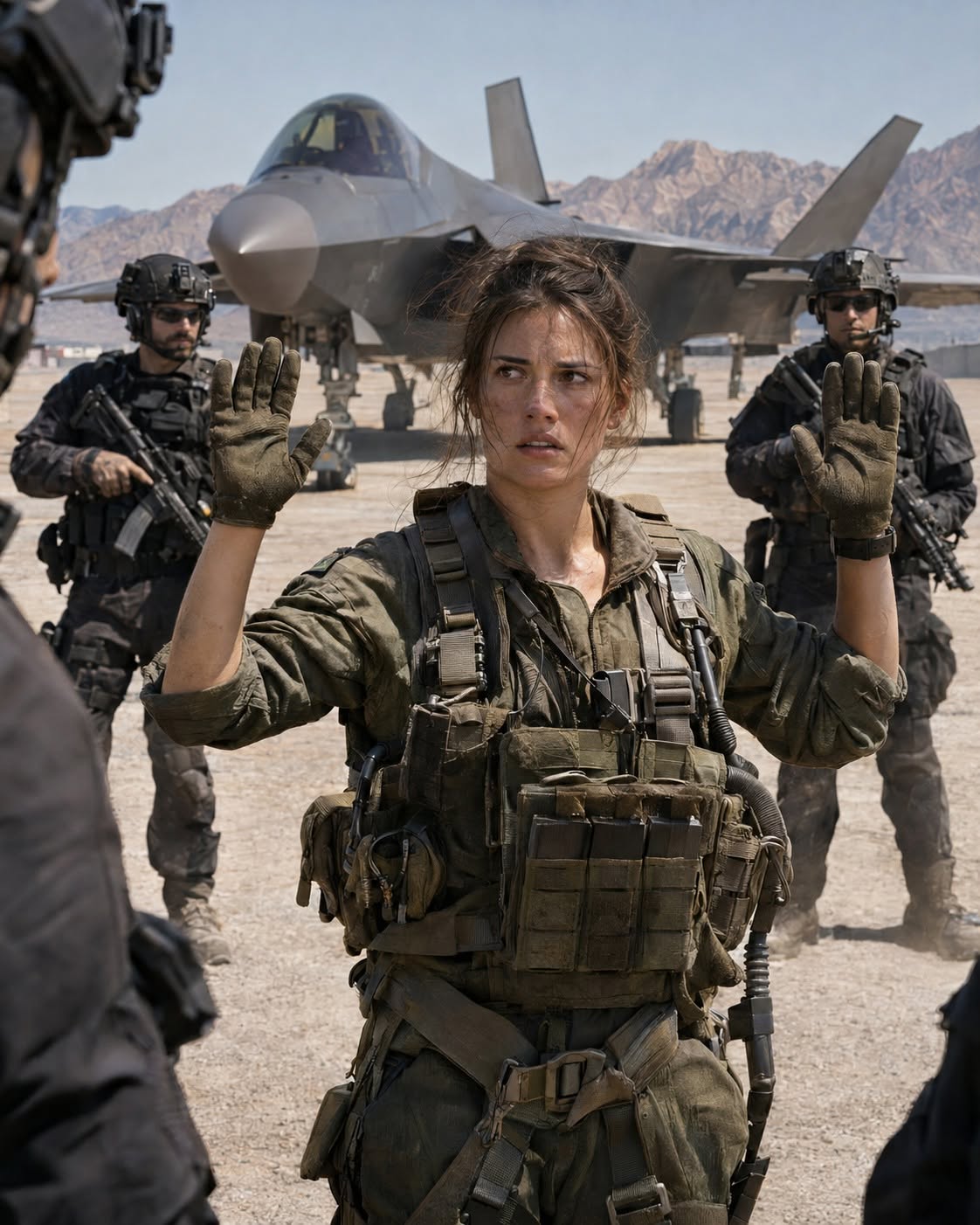
The intelligence officer brought up another file.
It contained a series of encrypted messages between the engineering director and an unidentified recipient. Most of the communications had been destroyed, but one sentence remained visible.
THE PILOT MUST NEVER REACH THE ORIGINAL FACILITY.
I read it twice.
Then I looked at the general.
“What original facility?”
He didn’t answer immediately.
Instead, he walked toward a metal cabinet at the far end of the hangar and entered a security code. A compartment opened, revealing a sealed folder marked with a classification level I had never seen before.
He removed it carefully.
“There’s something I should have told you before you took off this morning.”
I felt my stomach tighten.
“Go ahead.”
“The coordinates I gave you weren’t simply for an abandoned aircraft facility. They were for an experimental communications station that was decommissioned twelve years ago.”
He placed the folder on a table.
“Before it was shut down, that station was used to test an independent emergency command network. It was designed to keep our missile defense systems operational even if the primary command infrastructure was compromised.”
I understood.
The underground facility wasn’t just a hiding place.
It was connected to something much bigger.
“The backdoor wasn’t installed to disable the entire defense network,” I said slowly. “It was installed to take control of the emergency backup.”
The general nodded.
“Exactly. Whoever designed this operation wanted to make sure that if the primary system detected an intrusion, the backup would be compromised as well.”
I stared at the folder.
“Then why did Cross need the prototype?”
“Because its encrypted communications system was the only approved platform capable of accessing the old network.”
A cold realization settled over me.
The aircraft I had stolen wasn’t the weapon.
It was the key.
And the people behind the conspiracy had expected someone to use it.
“Did Cross know I was coming here?” I asked.
The general’s expression changed.
“We don’t know.”
I looked at the message again.
THE PILOT MUST NEVER REACH THE ORIGINAL FACILITY.
It wasn’t a warning about my unauthorized flight.
It was a warning that someone had anticipated the possibility of me discovering the truth.
“Sir,” I said, “I think we’re already behind.”
Before he could respond, every screen in the hangar went black.
A second later, the emergency lighting activated.
Then the old communications terminal at the center of the room began ringing.
Nobody had used that terminal in years.
The general approached it cautiously.
“Don’t touch anything,” I warned.
But the terminal continued ringing.
An intelligence technician moved toward a secondary console and checked the incoming signal.
His expression changed.
“General, the call is coming through the emergency network.”
“From where?”
The technician looked up.
“Your headquarters.”
The general picked up the secure handset.
“General Mercer.”
A familiar voice answered.
It was Nathaniel Cross.
“General, I understand you’ve had a difficult morning.”
Mercer said nothing.
Cross continued.
“I’ve been informed that one of our aircraft disappeared, that a decorated pilot is under investigation, and that a classified facility may have been compromised.”
He sounded calm.
Almost friendly.
Then he said something that made my blood run cold.
“I would strongly recommend you return the aircraft and hand over the pilot. There are things happening right now that neither of you understands.”
The general glanced at me.
“Is that a threat, Mr. Cross?”
A brief silence followed.
“No, General. It’s an opportunity to prevent a much larger disaster.”
Then Cross disconnected.
The technician immediately began tracing the call, but the signal vanished before he could identify its origin.
I stepped closer to the general.
“He knows we’re here.”
“Yes.”
“And he wants the aircraft.”
“Apparently.”
“Then we should destroy the prototype.”
The general looked at me sharply.
“That’s not an option.”
“Why not?”
“Because if we destroy it without understanding the backdoor, we may lose the only remaining evidence of how the emergency network was compromised.”
I understood his reasoning.
But something else bothered me.
Cross hadn’t asked about the engineering director.
He hadn’t asked whether the sabotage had been stopped.
He had asked for the aircraft.
That told me everything I needed to know.
He wasn’t worried about national security.
He was worried about losing control.
I walked over to the prototype and examined the cockpit.
There was a small maintenance panel beneath the right-side control console. During the aircraft’s development, I had personally helped test the interface behind it.
I remembered something unusual.
The system had occasionally generated a diagnostic warning that disappeared before the engineers could investigate it.
At the time, we had blamed a software calibration issue.
Now I wondered whether that warning had been the first indication of the hidden modification.
“General, I need the original maintenance logs.”
“Why?”
“Because I want to know who touched this aircraft before the backdoor was discovered.”
The general nodded to the technicians.
Within twenty minutes, they had recovered the records.
There were hundreds of entries.
Most were routine.
But one maintenance session stood out.
It had been performed at 2:17 in the morning, six weeks before the aircraft’s first classified flight.
The authorization belonged to Nathaniel Cross.
I leaned closer.
“That can’t be right. He isn’t an engineer.”
The technician examined the record.
“He didn’t perform the maintenance. He authorized a restricted inspection.”
“Who conducted it?”
The technician opened another file.
The name appeared.
Captain Daniel Reeves.
My former flight instructor.
My closest friend in the test program.
And the man who had taught me how to survive my first high-speed ejection.
I felt something inside me collapse.
“No.”
The general looked at me.
“You know him?”
I nodded slowly.
“He’s the reason I became a test pilot.”
I remembered the years we had spent together. The long nights in the hangar, the arguments over flight simulations, the celebrations after successful tests.
When my father died, Daniel had been the first person to visit me.
When I nearly lost an aircraft during a high-altitude test, he had stayed beside me until I recovered.
He had always been there.
And now his name was attached to the modification that could have destroyed our missile defense system.
“Where is he?” I asked.
The intelligence officer checked the personnel database.
“He’s currently assigned to the western flight-testing division.”
“When was he last seen?”
“Approximately three hours ago.”
“Where?”
The officer hesitated.
“At the main airbase.”
The same base where I had taken off.
The same base where military personnel had been ordered to intercept me.
And the same base where everyone believed I was a traitor.
I looked at the general.
“Call him.”
Mercer shook his head.
“Not yet.”
“Why?”
“Because if Reeves is involved, we don’t know how far this conspiracy reaches. We need to understand what he knows before we confront him.”
I felt anger rising.
“He’s my friend.”
“That makes him more dangerous, not less.”
I hated hearing those words.
But I knew the general was right.
For the next hour, our team examined the maintenance records and recovered fragments of the encrypted communications. The evidence suggested that Cross had arranged the original modification, while Reeves had provided technical access to the aircraft.
The engineering director had later expanded the vulnerability into the emergency defense network.
Three people.
Three separate roles.
And possibly a much larger organization behind them.
Then another message appeared.
This one wasn’t encrypted.
It was a simple text notification from the aircraft’s internal communications system.
UNAUTHORIZED COMMAND REQUEST DETECTED.
The technicians rushed toward the console.
“Someone is attempting to establish a remote connection.”
The general stepped forward.
“Can you block it?”
“We’re trying.”
The screen displayed a countdown.
Thirty seconds.
Twenty-five.
Twenty.
Then the aircraft’s navigation display activated by itself.
A warning appeared.
REMOTE FLIGHT CONTROL REQUEST PENDING.
I stared at the screen.
“They’re trying to take control of the aircraft.”
The general looked at the technicians.
“Disconnect it.”
“We can’t. The request is coming through the encrypted maintenance channel.”
The countdown continued.
Fifteen seconds.
Ten.
I recognized the architecture immediately.
The aircraft had a maintenance isolation system, but it had never been tested against a command originating from the emergency network.
I looked at the technician.
“Can you isolate the maintenance bus?”
“Not without shutting down the entire control system.”
“Then shut it down.”
He hesitated.
“That could damage the aircraft.”
“Better a damaged aircraft than an aircraft controlled by someone who wants to compromise our defense network.”
The general gave the order.
The technician activated the emergency isolation procedure.
The cockpit screens went dark.
For several seconds, the hangar was silent.
Then the countdown disappeared.
We had stopped the connection.
But we had also confirmed something terrifying.
Someone outside the facility could reach the aircraft.
Someone knew exactly where we were.
And someone was still trying to take control.
The general turned toward the intelligence officer.
“Secure every entrance. Nobody leaves this facility without authorization.”
Then he looked at me.
“Your friend is coming here.”
I frowned.
“What?”
“We sent him a message.”
“You contacted Reeves?”
“Not directly. We used an authenticated maintenance request associated with the aircraft. It indicated that his original inspection required clarification.”
I understood the plan.
If Reeves had been involved, he might believe the backdoor was still active and that he had an opportunity to cover his tracks.
But there was a risk.
If he was innocent, we were about to drag an innocent man into a nightmare.
“If he comes here,” I said, “I want to speak to him first.”
The general studied my face.
“Don’t let your personal history interfere with your judgment.”
“It won’t.”
I hoped I was telling the truth.
Two hours later, the outer security camera detected a vehicle approaching the underground entrance.
A black government SUV stopped outside.
One man stepped out.
Daniel Reeves.
He looked exactly as I remembered him, except for the exhaustion in his eyes.
He carried no visible weapon.
He entered the facility with two security officers.
When he saw me standing beside the aircraft, he stopped.
For several seconds, neither of us spoke.
Then he smiled faintly.
“Well, I’ll be damned.”
I couldn’t return the smile.
“Hello, Daniel.”
He looked at the aircraft.
“I heard you had a rough morning.”
“Something like that.”
He turned toward the general.
“Why am I here?”
Mercer placed a folder on the table.
“Your maintenance authorization was used to access a restricted aircraft modification six weeks before the prototype entered operational testing.”
Reeves looked down at the folder.
Then he looked at me.
“Is this what you think?”
“I don’t know what to think anymore.”
He slowly opened the file.
I watched his expression.
At first, he appeared confused.
Then his face changed.
Not into fear.
Into recognition.
He closed the folder.
“Where did you get this?”
“Does it matter?” the general asked.
Reeves took a deep breath.
“Yes. It matters very much.”
He looked directly at me.
“Because I never authorized that modification.”
The room fell silent.
“What?” I asked.
“That signature isn’t mine.”
The intelligence officer moved closer.
“We verified the digital authorization.”
Reeves shook his head.
“Then someone copied my credentials.”
The general’s expression hardened.
“Are you saying someone used your identity?”
“I’m saying someone had access to my personal authentication token.”
“Who?”
Reeves stared at the table.
Then he gave an answer none of us expected.
“Nathaniel Cross.”
I felt my pulse quicken.
“Why would Cross have your credentials?”
Reeves looked at me.
“Because I gave them to him.”
The general stepped forward.
“Explain.”
Reeves sat down.
His hands were trembling.
“Two months ago, Cross approached me. He said the program had discovered an instability in the aircraft’s encrypted communications architecture. He claimed the modification was a temporary diagnostic measure and that the authorization process would be completed afterward.”
“Did you approve it?” I asked.
“No. I refused.”
“Then why did he have your credentials?”
“Because he told me the inspection would be performed under my supervision. I gave him temporary access to review the diagnostic logs. I never imagined he would use it to install unauthorized hardware.”
I stared at him.
“You knew something was wrong, and you never reported it?”
Reeves lowered his head.
“I should have.”
His voice broke.
“He told me the modification was harmless. Then he showed me a classified document suggesting that the system could fail during a future synchronization test. He said the military was hiding a serious vulnerability and that he was trying to expose it before thousands of lives were put at risk.”
“Did you believe him?”
“For a while.”
The general leaned forward.
“Why?”
Reeves looked up.
“Because he showed me fabricated test results. He made it look as though senior command had knowingly ignored the problem.”
I felt sick.
Cross hadn’t simply recruited an engineer.
He had manipulated someone who trusted the institution enough to believe it was failing.
But that didn’t excuse Reeves.
“Why didn’t you come to me?” I asked.
He looked at me for a long moment.
“Because I knew you’d report it immediately. And I was afraid that if I accused Cross without evidence, he’d destroy my career and make sure nobody believed me.”
I wanted to be angry.
I was angry.
But beneath that anger was something worse.
Disappointment.
“Daniel, you taught me that a pilot’s first responsibility is to the people who depend on him. Not to his reputation. Not to his career. To the people on the ground.”
He nodded.
“I know.”
“You should have remembered that.”
He closed his eyes.
“You’re right.”
Before anyone could say anything else, the intelligence officer rushed into the room.
“General, we’ve identified a second communication channel.”
Mercer turned.
“From Cross?”
“No, sir. From the main command center.”
The officer displayed the incoming message.
It contained a single sentence.
THE SYNCHRONIZATION TEST HAS BEEN MOVED FORWARD.
I looked at the general.
“When?”
He checked the attached schedule.
“Forty-five minutes.”
My stomach dropped.
The missile defense synchronization test was supposed to happen the following week. Moving it forward meant the system would soon connect its primary and backup networks.
If the hidden vulnerability remained active, the sabotage could still succeed.
“Can we cancel it?” I asked.
Mercer shook his head.
“Not without confirmation from the national command authority. And Cross controls the authorization chain.”
“Then we need to expose him before the test begins.”
The general looked at the intelligence officer.
“Contact the command authority. Send them everything we’ve recovered.”
The officer started working.
A few seconds later, he stopped.
“General…”
“What?”
“The transmission has been rejected.”
“Why?”
“Because our credentials have been suspended.”
The general stared at him.
“That’s impossible.”
“Someone has revoked our access to the central command network.”
I looked at the monitor.
A new message appeared.
It was signed by Nathaniel Cross.
GENERAL MERCER AND ALL ASSOCIATED PERSONNEL ARE TO BE DETAINED PENDING INVESTIGATION FOR UNAUTHORIZED ACCESS TO CLASSIFIED SYSTEMS.
I almost laughed.
Cross was doing exactly what had been done to me.
He was turning the people trying to stop him into criminals.
The general slowly put down the folder.
“We’re cut off.”
“Not completely,” I said.
He turned toward me.
I pointed at the old communications terminal.
“The emergency station was designed to operate independently. If the primary command network is compromised, there must be a separate way to send an authenticated warning.”
Mercer nodded.
“There is.”
“Then use it.”
He shook his head.
“The system hasn’t been activated in twelve years. Its authorization protocol requires a physical verification from the original test aircraft.”
I looked at the prototype.
“That’s why Cross wanted it.”
“Yes.”
“Can we use it to send evidence?”
The technician hesitated.
“Possibly. But we would need to restore the aircraft’s emergency communications interface.”
I looked at the aircraft.
The same machine that had carried me into the desert.
The same machine that had nearly been remotely controlled.
And the same machine that might be our only chance.
“Then let’s do it.”
The general gave a single nod.
The technicians began working.
Reeves stepped toward me.
“I can help.”
I looked at him.
“Why should I trust you?”
He didn’t try to defend himself.
“You shouldn’t. Not yet.”
He paused.
“But I know the original communications architecture better than anyone here. If Cross modified it, I can help you identify what he changed.”
I studied him.
For years, I had considered him family.
Now I wasn’t sure whether I could ever look at him the same way again.
But the clock was running.
“Get to work,” I said.
For the next twenty minutes, we worked under the red emergency lights.
Reeves examined the aircraft’s original technical documentation while I checked the cockpit interface. The technicians restored the isolated communications system using a separate power source.
Finally, the old terminal came alive.
A message appeared.
EMERGENCY AUTHENTICATION REQUIRED.
The general approached.
“Proceed.”
I placed my hand against the pilot verification panel.
The system recognized my biometric credentials, but another warning appeared.
SECONDARY AUTHORIZATION REQUIRED.
Reeves stepped forward.
He looked at me.
“I understand.”
He placed his hand beside mine.
The system paused.
Then the screen displayed a green confirmation.
DUAL AUTHENTICATION ACCEPTED.
A secure channel opened.
But there was one final obstacle.
The system required a live verification sequence from the aircraft itself.
I climbed into the cockpit.
The technicians restored the essential flight-control interface, leaving the rest of the aircraft isolated.
I started the emergency transmission sequence.
A low electronic tone filled the hangar.
Then the terminal displayed a warning.
UNAUTHORIZED INTERFERENCE DETECTED.
Someone was attempting to block the transmission.
The technician shouted.
“We’re being jammed!”
The general grabbed the handset.
“Can you get through?”
“Not with the current connection.”
I looked at the system architecture.
The emergency transmitter had an independent backup antenna, but it had been disabled during decommissioning.
“Can you activate the backup?”
“Not from here.”
“Why?”
“Because the original antenna relay is located above the facility.”
I looked toward the elevator.
The relay room was on the surface.
And the entrance was exposed.
The general checked the security cameras.
“We have movement outside.”
A vehicle convoy was approaching the installation.
Military vehicles.
At least six.
I watched the footage.
The lead vehicle carried the insignia of our own military police.
The general’s face hardened.
“Cross has sent a detention team.”
“How long?”
“Three minutes, perhaps less.”
The technician looked at the terminal.
“We need at least five minutes to complete the transmission.”
I climbed out of the cockpit.
“Then I’ll activate the relay.”
Mercer grabbed my arm.
“No.”
“Sir, we’re out of time.”
“You’re not going outside alone.”
I looked at the approaching vehicles.
“Then come with me.”
He hesitated.
Finally, he nodded.
We took two security personnel and headed toward the surface access corridor.
Reeves remained behind with the technicians.
As we approached the elevator, I heard a loud impact from the outer entrance.
The detention team was forcing its way inside.
The general drew his sidearm.
“Move.”
We reached the surface relay room just as the first security alarm sounded.
The room was small, dusty, and filled with equipment that hadn’t been used in years.
I found the backup antenna control panel.
The system was dead.
I opened the maintenance compartment and examined the power connection.
A cable had been deliberately disconnected.
I reconnected it.
The panel flickered.
Then another warning appeared.
MANUAL RELAY ACTIVATION REQUIRED.
I reached for the control switch.
Before I could move it, the door opened.
A man stood in the doorway.
Daniel Reeves.
I froze.
“What are you doing here?”
He looked exhausted.
“Cross contacted me.”
My hand remained on the control panel.
“What?”
“He said the general had been compromised. He told me to stop the transmission before it was too late.”
I stepped away from the switch.
“Did you believe him?”
Reeves shook his head.
“No.”
“Then why are you here?”
He looked at the relay system.
“Because he told me something else.”
“What?”
“That the transmission won’t just expose him. It will expose everyone who helped build the original emergency network.”
I frowned.
“Everyone?”
“Cross says the original network was never completely independent. It was designed with an oversight channel that could be accessed by a small group of senior officials.”
The general stepped forward.
“That’s classified information.”
Reeves looked at him.
“Exactly. And if the evidence gets transmitted, it will reveal that the system has been vulnerable for years.”
I felt the pieces coming together.
Cross wasn’t simply trying to sabotage a defense system.
He was trying to control the story surrounding its failure.
If the breach became public, he could claim he had discovered a dangerous vulnerability and that senior command had concealed it.
He would present himself as the whistleblower.
The general and everyone involved in the program would become the villains.
And the actual sabotage would disappear beneath a mountain of political accusations.
“He’s trying to make the evidence look like an internal cover-up,” I said.
Reeves nodded.
“That’s why he wants the transmission stopped.”
The general looked at him.
“Did he tell you where he is?”
Reeves reached into his jacket and produced a small storage device.
“He sent me the location of his command terminal.”
I stared at it.
“Why would he give you that?”
“Because he thinks I’m still on his side.”
He placed the device on the table.
“There’s another thing you need to know. Cross isn’t planning to disappear after the synchronization test. He’s going to trigger a controlled failure, then use the emergency network to redirect the system’s automated response. He wants the incident to look like a catastrophic technical malfunction.”
The general’s face tightened.
“Can he do that?”
“Not if the original authentication process remains intact. But the backdoor gives him a way to interfere with the backup network.”
I looked at the clock.
Twenty minutes remained.
“Then we don’t have time to argue.”
I reached for the relay switch.
The general nodded.
“Do it.”
I activated the backup antenna.
A deep mechanical vibration passed through the room.
The terminal downstairs immediately displayed a connection confirmation.
EMERGENCY TRANSMISSION ACTIVE.
But the system requested one final input.
SUBMIT ORIGINAL AUTHENTICATION RECORD?
I selected yes.
The transmission began.
At that exact moment, the door behind us burst open.
Three armed military police officers entered.
“Step away from the controls!”
The general raised his hands.
“Stand down. This is a classified national security operation.”
The officer in charge held up a document.
“By order of Deputy Director Cross, you are all to surrender immediately.”
I looked at him.
“Have you read the evidence?”
“That’s not your concern.”
“It should be.”
He pointed his weapon toward the general.
“Last warning.”
Then the terminal sounded.
A new message appeared.
TRANSMISSION COMPLETE.
For a moment, nobody moved.
Then the officer’s radio crackled.
A voice came through.
“All units, stand down. Repeat, all units stand down.”
The officer looked confused.
The voice continued.
“Emergency command authority has confirmed the transmission. Deputy Director Cross is relieved of operational control pending immediate investigation. Secure his location.”
The general slowly lowered his hands.
I felt my knees weaken.
We had done it.
The evidence had reached someone who could act.
But the story wasn’t over.
The radio crackled again.
This time, the voice was different.
It was Nathaniel Cross.
“You’re making a terrible mistake.”
The officer stared at the handset.
Cross continued.
“You have no idea what you’re exposing. The system was compromised long before I arrived. I was trying to prevent a disaster that your own leadership refused to acknowledge.”
The general took the radio.
“Then you should have reported it, Nathaniel.”
A brief silence followed.
“You still don’t understand,” Cross replied.
“Then explain it.”
“Look at the original authorization records. The backdoor wasn’t created for the synchronization test. It was created years ago.”
The general looked at me.
I felt another wave of dread.
Cross wasn’t denying the sabotage.
He was suggesting something worse.
The radio crackled.
“Ask yourselves why the emergency network was built in the first place,” Cross said. “Ask who authorized the hidden oversight channel. And ask why your beloved pilot was selected to fly that aircraft.”
Then the transmission ended.
The general remained silent.
I looked at him.
“Was he telling the truth?”
He didn’t answer.
And that frightened me more than anything Cross had said.
We returned to the underground hangar.
The synchronization test had been suspended, the military police had withdrawn, and the national command authority had assumed control of the investigation.
Cross was arrested before sunset.
The engineering director was charged with conspiracy, unauthorized access, and attempted destruction of classified evidence.
Reeves was placed under investigation for his role in providing access to the aircraft.
But the original authorization records revealed something none of us had expected.
The emergency network had been developed twelve years earlier under a classified initiative called Project Sentinel.
Its purpose was to create a defense system that could continue operating even if the national command infrastructure was destroyed.
The program had been approved by a small group of senior officials.
One of them was General Mercer.
Another was a former defense secretary.
The third name was hidden behind a sealed authorization.
The investigation eventually identified that individual.
It was my father.
I read the document alone in a secure office.
For several minutes, I couldn’t move.
My father had died eight years earlier.
He had been a military communications engineer, a quiet man who spent most of his life working on systems nobody outside his department understood.
I remembered him teaching me how to repair an old radio when I was a child.
I remembered him telling me that technology was only as trustworthy as the people responsible for it.
But I had never known he was involved in Project Sentinel.
The general entered the office.
He saw the document in my hands.
“I’m sorry,” he said.
I looked up.
“Why didn’t you tell me?”
“Because your father requested that his involvement remain sealed. He believed the program would eventually be misused if its full architecture became widely known.”
“And Cross?”
“Cross discovered fragments of the original records. He realized the system had a hidden oversight channel and decided to use it for his own purposes.”
I stared at the authorization page.
“So my father helped build the system that Cross almost destroyed.”
“Your father helped build a safeguard. Cross turned it into a vulnerability.”
I shook my head.
“That’s a convenient distinction.”
The general didn’t argue.
I folded the document and placed it on the desk.
“Did my father know about the backdoor?”
“No. He died before the modification was installed.”
I looked at the photograph of my father on the wall.
For years, I had believed his work had been simple and honorable.
Now I understood that even good intentions could create systems whose dangers outlived the people who built them.
The investigation continued for months.
Cross was eventually convicted of conspiracy and espionage-related offenses. The engineering director received a lengthy sentence, and Reeves was formally reprimanded for his failure to report suspicious activity.
He lost his position in the flight-testing division.
I visited him once before he left the installation.
We sat in the same maintenance hangar where we had spent so many years working together.
He looked older.
“I know you probably hate me,” he said.
I watched a technician move an aircraft across the hangar.
“I don’t hate you.”
He looked surprised.
“But I don’t know if I can trust you again.”
He nodded.
“That’s fair.”
After a moment, he asked, “Do you think we can ever go back to the way things were?”
I shook my head.
“No. And maybe we shouldn’t.”
He stared at the floor.
I continued.
“Trust isn’t something you get back because you apologize. It’s something you rebuild by making different choices when nobody is watching.”
He didn’t respond.
But I could see that he understood.
Three months after the operation, General Mercer offered me the position he had mentioned before.
This time, the offer was different.
The new security program would be independent of the original development chain. Its purpose would be to review classified defense projects, investigate insider threats, and ensure that no single individual could secretly alter a system capable of putting millions of lives at risk.
I would have authority to question decisions made by senior officers.
Even the general’s.
I read the proposal carefully.
Then I asked him one question.
“Will I ever be ordered to disappear again?”
He gave a tired smile.
“I hope not.”
“That’s not an answer.”
“No,” he admitted. “It isn’t.”
I signed the appointment papers anyway.
Not because I suddenly trusted the institution.
Not because I believed every problem had been solved.
But because I had finally understood something important.
Leaving would not make the system safer.
Someone had to stay and challenge it.
On my first day in the new position, I walked into a conference room filled with engineers, military officers, and civilian investigators.
At the center of the table sat the original aircraft’s security architecture.
The prototype had been grounded permanently until every vulnerability could be independently verified.
A young engineer raised his hand.
“Sir, with all due respect, the original system was designed by some of the most experienced people in the country. Are we really suggesting that their work can’t be trusted?”
I looked around the room.
I remembered my father.
I remembered Reeves.
I remembered Cross.
And I remembered the morning I had taken off without authorization, while the people I trusted prepared to shoot me down.
“No system should be trusted simply because someone important says it is safe,” I answered.
The young engineer looked down at his notes.
I continued.
“Every safeguard must be tested. Every authorization must be accountable. And every person, regardless of rank, must be able to raise a concern without fearing that their career will be destroyed.”
The room became quiet.
Then an older technician spoke.
“What if questioning the system delays a critical mission?”
I looked directly at him.
“Then we make sure the system is strong enough to survive the questions.”
For the first time in months, I felt that I was exactly where I needed to be.
But there was one final thing I had to do.
I requested permission to visit the memorial wall at the installation.
My father’s name was engraved among hundreds of others who had served in classified programs.
I stood in front of it for a long time.
I thought about the aircraft, the hidden backdoor, and the people whose lives might have been endangered by decisions made in rooms they would never see.
Then I remembered something my father used to tell me.
He once said that the greatest danger in any machine wasn’t the part that could break.
It was the part everyone assumed could never fail.
At the time, I thought he was talking about aircraft engines.
Now I understood he had been talking about people.
I placed my hand against his name.
“I finished what you started, Dad,” I whispered.
But I knew that wasn’t entirely true.
The work would never really be finished.
There would always be someone looking for a shortcut, someone willing to trade responsibility for power, and someone convinced that the rules should not apply to them.
That was why the new program mattered.
Not because it could guarantee that betrayal would never happen again.
But because it could make betrayal harder to hide.
A year later, the prototype finally returned to the runway.
Not as the same secret machine it had been before, but as an aircraft rebuilt around an entirely different philosophy of security.
Every critical modification required independent approval.
Every access attempt was recorded outside the primary system.
And no single executive, general, engineer, or pilot could secretly override the safeguards.
I was invited to perform the first supervised test flight.
I stood beside the aircraft as the crew completed their final checks.
The general approached.
“Ready to fly?”
I looked at the cockpit.
For a moment, I remembered the day I had taken off without authorization.
The alarms.
The fighter jets.
The accusations.
The fear of being hunted by the people I had once trusted.
Then I looked toward the control tower.
This time, every person knew exactly where I was going.
Every authorization had been recorded.
And nobody had to pretend I was a traitor to let me do the right thing.
I climbed into the cockpit.
The engine started.
The runway stretched ahead.
For the first time in a long while, I wasn’t flying to escape someone.
I was flying because I had chosen to.
As the aircraft lifted into the morning sky, I looked down at the installation and thought about how close we had come to losing everything.
The mission had taught me that courage wasn’t always about disobeying an order or following one without question.
Sometimes, courage meant having the strength to ask why.
And sometimes, the greatest act of loyalty wasn’t protecting an institution from embarrassment.
It was protecting the people that institution existed to serve.
I had once believed that being a good soldier meant trusting the chain of command.
Now I understood that being a good soldier meant knowing when that chain needed to be challenged.
Because a country isn’t protected by its most advanced aircraft, its most powerful missiles, or its most classified technology.
It’s protected by people willing to do the right thing, even when doing so costs them everything.
And as I brought the aircraft safely back toward the runway, one final thought stayed with me.
The greatest threat to a nation’s security isn’t always the enemy outside its borders. Sometimes, it’s the person everyone trusts so completely that nobody thinks to question them.
That morning, I had taken off as a traitor.
I landed knowing who I was.
And for the first time in my career, that was enough.