The moment I landed back at Eielson Air Force Base, Colonel Richard Briggs called me a disgrace in front of my entire squadron
For several seconds, I forgot how to breathe.
My father stood outside my cockpit, alive, older than the man in my memories, with silver threaded through his dark hair and a scar running from his left temple to his jaw.
I had watched a military chaplain fold an American flag over an empty coffin.
I had spent twelve years believing the ocean had taken him.
Now he was standing beneath impossible blue lights aboard a ship that had caught my falling fighter as casually as a hand catching a dropped glass.
I raised my sidearm.
“Don’t come any closer.”
He stopped immediately.
“That’s fair.”
“You’re dead.”
“I know.”
“No.” My voice broke, and I hated him for hearing it. “You don’t get to say that like it’s some small misunderstanding.”
His expression tightened.
Behind him, two people in dark uniforms exchanged a glance, but neither intervened.
“I can explain,” he said.
“You have twelve years to make up for.”
“I know that, too.”
I wanted to throw the gun at him. I wanted to run into his arms. Most of all, I wanted him to be the father I remembered, the man who had taught me to ride a bicycle in our driveway and stayed awake through every thunderstorm because I was afraid of lightning.
Instead, I stared at the stranger wearing his face.
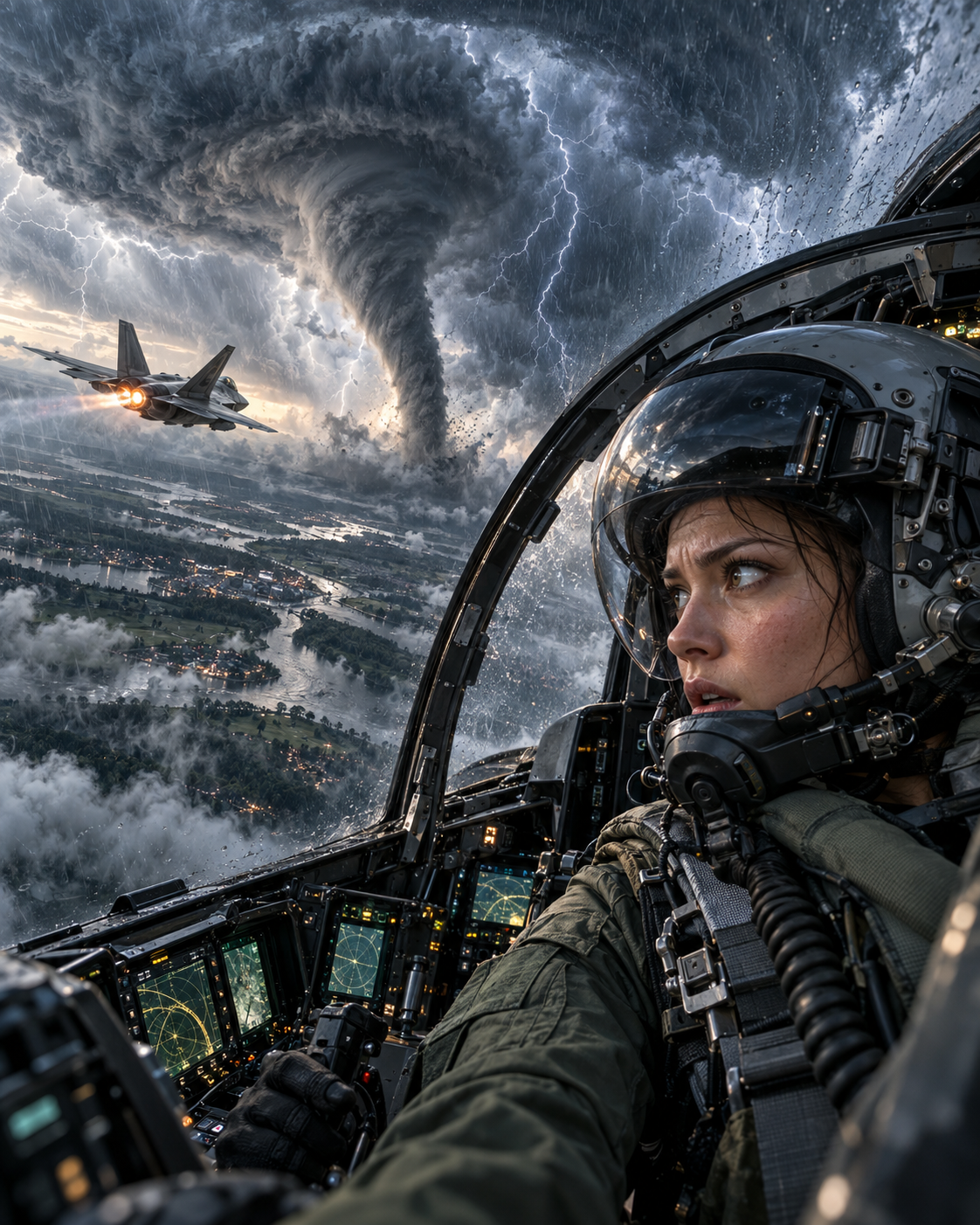
“Open the canopy.”
He turned toward a nearby technician and spoke a few quiet words.
The canopy released with a hiss, and cold, sterile air washed over me. I climbed out on trembling legs, keeping the pistol trained on him.
He didn’t reach for me.
That hurt more than I expected.
A woman in a charcoal uniform approached carrying a medical kit. She appeared to be in her forties, with close-cropped hair and a small scar crossing one eyebrow.
“Captain Vance, I’m Dr. Lena Cross. Your oxygen saturation is low, and you’ve likely suffered significant cold exposure. Let me examine you.”
“I’m fine.”
“You nearly died.”
“I’ve had a complicated evening.”
For the first time, my father almost smiled.
I pointed the gun at him again.
“Don’t.”
The smile vanished.
“Understood.”
Dr. Cross checked my pulse and wrapped a thermal blanket around my shoulders while my father waited several feet away, looking as though every second of my anger was something he had earned.
When she finished, he led me toward a glass-walled observation room.
Beyond it, the vessel’s interior stretched farther than its exterior dimensions should have allowed. Sleek machines hummed beneath the floor, and luminous patterns flowed across transparent displays. There were no visible engines, no conventional control towers, and no vibration from the storm outside.
On one screen, my F-35 appeared suspended in the hangar.
On another, the trimaran remained trapped between ice floes.
Its remaining crew were alive.
I stepped toward the display.
“Who are those people?”
“Watchtower personnel,” my father answered. “Three intelligence officers and two civilian scientists.”
“And the mercenaries?”
“Some were hired to recover the vessel’s cargo. Others were hired to ensure nobody survived long enough to explain what was aboard.”
“What cargo?”
He hesitated.
That hesitation brought the pistol up again.
“Don’t you dare start lying to me.”
He looked at the weapon, then at my face.
“A navigation core.”
“That’s it?”
“No.”
He touched the screen, bringing up a rotating image of a dark, crystalline object suspended inside a transparent containment chamber.
“That core can detect and manipulate variations in local gravitational fields. It was designed to stabilize a propulsion system capable of moving enormous mass without conventional thrust.”
I stared at him.
“You expect me to believe you built a flying ship that can catch an F-35 out of the sky?”
“We didn’t build the original technology.”
“Who did?”
“We don’t know.”
The answer was quiet, and for the first time, I heard genuine fear in his voice.
He enlarged the image.
The object was surrounded by concentric rings of strange markings, none resembling any engineering notation I had ever seen.
“Fourteen years ago, we recovered this device from beneath the Pacific seabed. It had no identifiable manufacturer, no recognizable alloy structure, and no power source that our instruments could explain. The first experiments nearly destroyed the research facility.”
“Then the government classified it.”
“Parts of the government did.”
“And Briggs?”
My father looked away.
“Briggs wanted control over it. He believed whoever controlled this technology could dictate the future of warfare.”
“And you refused.”
“I tried to stop the program.”
“Then why fake your death?”
“Because Briggs had already arranged for two members of our research team to disappear. When I discovered that the project had been transferred into an unauthorized military operation, I attempted to expose it. He intercepted my evidence, destroyed my credibility, and made sure the next mission would end with me missing.”
“You could have contacted me.”
“I couldn’t.”
“You didn’t even try.”
His silence was an answer.
I lowered the gun slightly, though my hands were still shaking.
He continued, “Briggs had access to your service records. He knew you were my daughter. If he believed you had information, he would have used you against me.”
“So you decided to protect me by making me grieve for twelve years?”
His eyes glistened.
“I told myself that distance was the only way to keep you safe. Eventually, I realized that was the excuse I used because I was too afraid to find another way.”
For a moment, neither of us spoke.
I wanted an apology large enough to cover twelve years of birthdays, promotions, lonely nights, and the day I had stood at his memorial in uniform while strangers told me how proud he would have been.
No apology could do that.
Before I could answer, a sharp tone rang through the observation room.
The screen showing the trimaran flashed red.
Dr. Cross hurried to the console.
“Incoming transmission. Military encryption.”
Briggs’s face appeared on the display.
He sat in an operations room at Eielson, wearing the same immaculate uniform I remembered from the briefing room. His expression was composed, but his eyes moved rapidly across the data streaming beside him.
“Unidentified vessel, this is Colonel Richard Briggs of the United States Air Force. You are harboring stolen military property and interfering with an authorized recovery operation. Release Captain Vance and stand by for boarding.”
My father stepped toward the microphone.
“Hello, Richard.”
Briggs went perfectly still.
Then he smiled.
It was the same cold smile he had worn when he called me reckless, the expression of a man who believed the world was a room he owned.
“Daniel,” he said. “I wondered how long you would stay buried.”
My father’s name sounded strange in Briggs’s mouth.
“You sent mercenaries after a civilian research crew,” Dad replied.
“I sent a recovery team to secure a dangerous asset.”
“You sent men with orders to kill witnesses.”
“Your daughter has already demonstrated how inconvenient disobedience can be.”
I moved beside my father.
“Colonel, I have recordings of the distress call, the attack, and your order to abandon the area.”
Briggs studied me.
“Captain, you have violated a direct command, endangered an aircraft, and interfered with an operation whose existence you are not authorized to know. You will surrender immediately, and I will ensure you receive a fair hearing.”
“Is that what you told my father?”
His smile disappeared.
For a moment, I saw the truth beneath his polished manner: not anger, but calculation.
He was deciding whether I was worth saving.
“Your father has manipulated you,” he said. “That vessel is not a rescue ship. It is an uncontrolled weapons platform. You have no idea what you have boarded.”
“Then why are you trying so hard to get it back?”
He leaned closer to the camera.
“Because I know what happens if it falls into the wrong hands.”
“Whose hands are those, Colonel?”
The transmission ended.
A second later, the entire vessel shuddered.
Red lights illuminated the ceiling.
Dr. Cross looked up from her console.
“We have a problem. Multiple contacts approaching from the northeast. High-speed aircraft, no transponder signals.”
My father moved to another display.
“How many?”
“Four. Possibly more behind the storm.”
“Briggs didn’t come here to negotiate,” he said. “He came to erase the evidence.”
I felt the old familiar weight settle over me, the instinct that came whenever the sky turned hostile and everyone around me began looking for someone to make the next decision.
“Can this vessel defend itself?”
“Yes,” my father answered.
“Can it defend the people on that trimaran?”
“Yes.”
“Then do it.”
He studied me.
“Valerie, you don’t understand what using this system could cost.”
“Neither did the people you left out there.”
Something changed in his expression.
Not agreement, exactly.
Recognition.
He turned to Dr. Cross.
“Prepare a recovery corridor. Bring the trimaran crew aboard.”
She hesitated.
“Activating the field at this distance could expose our position.”
“They’re already coming for us.”
Dr. Cross nodded and hurried away.
My father led me into a circular command chamber where the walls glowed with shifting maps of the ocean and atmosphere. At its center floated a three-dimensional image of the Bering Sea, complete with ice formations, wind currents, and the approaching aircraft.
No conventional screens or joysticks controlled the room.
Instead, the ship seemed to respond to subtle gestures made above a smooth black surface.
“What is this place?” I asked.
“The control chamber.”
“That doesn’t answer my question.”
“No,” he said. “It doesn’t.”
He placed his hand against a recessed panel.
The ship responded with a low, resonant hum.
“Ghost Rider isn’t simply an aircraft or a vessel. It’s a platform built around a system that changes how mass interacts with gravity. We can reduce our apparent weight, redirect momentum, and move through the atmosphere without producing the signatures conventional sensors expect.”
“How far can you go?”
“We don’t know the limit.”
“How fast?”
“We don’t know that, either.”
I stared at him.
“You’ve been operating this thing for twelve years and you still don’t know what it can do?”
“We know enough to be afraid of it.”
The incoming contacts appeared on the central display, their projected paths converging on our position.
My father pointed toward the eastern edge of the map.
“They’ll attempt to force us above the cloud layer, where their targeting systems can acquire a stable track. If that fails, they’ll attack the trimaran before we can recover its crew.”
“Then we don’t let them choose the battlefield.”
He turned to me.
“You’ve just flown through a Category 5 storm with almost no fuel. You need rest.”
“I’m a pilot, not a passenger.”
“You’re my daughter.”
“And those people are still out there.”
The words landed harder than I intended.
He looked down.
Then he nodded.
“All right, Captain. Tell me what you see.”
I studied the display.
The hostile aircraft were maintaining a broad formation, using the storm to conceal their approach. One pair was moving toward Ghost Rider, while the others angled toward the trimaran.
“They’re splitting their attention,” I said. “Two aircraft will keep you occupied while the others attack the survivors.”
“Agreed.”
“They expect you to protect yourself first.”
“And what do you propose?”
I pointed toward a narrow channel between two ice fields.
“Move Ghost Rider below their sensor horizon. Use the storm to break their targeting lock, then create a corridor for the trimaran crew. If they lose sight of us, they’ll have to choose between following you and maintaining their attack.”
My father studied the display for several seconds.
Then he gave a short nod.
“Let’s see if this old ship can still surprise someone.”
The command chamber darkened.
A deep vibration rolled through the floor, and the world on the display shifted as Ghost Rider descended into the storm. I felt no conventional acceleration, only a strange pressure behind my eyes, as if the ship had persuaded gravity to look the other way.
The first hostile aircraft swept over our former position.
Its targeting display locked onto empty ocean.
The pilot banked sharply, searching for a contact that no longer existed.
“Now,” I said.
Ghost Rider’s outer field expanded.
The wind above the trimaran changed direction, carving a temporary corridor through the blizzard. Ice fragments lifted from the surface, spun in a slow spiral, and drifted harmlessly away from the vessel.
A dark opening appeared in Ghost Rider’s side.
The trimaran’s damaged hull rose from the water.
For one impossible moment, it hung between the ice floes and the black ship, held by the same invisible force that had saved me.
Then it slid into the recovery bay.
Inside the command chamber, the incoming aircraft began to turn.
One of them had acquired a new target.
A warning flashed across the display.
“Missile launch detected,” Dr. Cross announced over the intercom.
My father’s jaw tightened.
“Defensive field to maximum.”
The missile approached through the snow, its seeker struggling to maintain a lock. Just before impact, its trajectory bent sideways, curving around Ghost Rider as though the air itself had become a river flowing around a stone.
It vanished into the storm.
The second missile followed.
It did not miss.
The explosion struck the outer field with a flash that turned the chamber white. The floor lurched beneath my boots, and every display went dark.
For a heartbeat, I heard nothing but my own breathing.
Then a voice crackled through the emergency speakers.
“Containment instability in the lower drive chamber.”
Dr. Cross appeared in the doorway, her face pale.
“We have a breach in the field regulator. If it collapses, the ship could lose its gravitational control.”
“How long?” my father asked.
“Ten minutes, maybe less.”
The room seemed to shrink around us.
The hostile aircraft were still outside.
The recovered crew were somewhere in the hangar.
And the vessel that had defied the laws of physics was beginning to fail.
My father turned to me.
“There’s a manual regulator in the lower chamber. It needs someone to stabilize the system while we restart the primary field.”
“Then let’s go.”
He shook his head.
“Only one person can enter at a time. The regulator is responding unpredictably, and the field could crush anyone who approaches it without the correct sequence.”
“Show me the sequence.”
“Valerie—”
“Don’t you dare tell me to stay behind.”
He looked at me for a long moment.
Then he reached into his uniform and removed a small metal disk, worn smooth around the edges.
I recognized it immediately.
It was my father’s old identification tag, the one the Air Force had returned to us after declaring him dead.
He placed it in my palm.
“I carried this every day,” he said. “Not because I thought I deserved to come home, but because I wanted to remember the person I had been before fear made every decision for me.”
My fingers closed around the tag.
“You don’t get to make up for twelve years by dying in front of me.”
“No,” he said softly. “But I can stop making the same mistake.”
He showed me the regulator sequence on a small display, explaining the pressure changes and the timing between each adjustment. I listened carefully, committing every detail to memory.
Then I headed toward the lower chamber.
The passageway narrowed as I descended.
The walls were covered in translucent conduits through which pale light flowed like blood beneath skin. The air grew warmer, and the low hum of the ship became a pounding vibration that seemed to come from inside my bones.
At the bottom, I found the regulator.
It was a circular assembly surrounding a dark central sphere, suspended above a platform without visible supports. Rings of light moved around it at different speeds, occasionally intersecting in brief, violent flashes.
A console stood beside the platform.
I entered the first sequence.
The regulator shuddered.
I entered the second.
A warning appeared.
FIELD VARIANCE EXCEEDS SAFE LIMITS.
I swallowed hard and moved to the final control.
For an instant, I remembered my father teaching me to fly a small trainer aircraft, his hand resting lightly on the back of my seat as I struggled to hold a steady heading.
“Don’t fight the sky,” he had told me. “Listen to what it’s doing.”
I had thought he was talking about weather.
Now I wondered if he had been talking about everything.
I adjusted the regulator by a fraction.
The light rings slowed.
The vibration softened.
Then a sharp metallic crack echoed through the chamber.
A pressure wave slammed me against the railing, and the console erupted in sparks.
I fell hard, pain shooting through my shoulder.
The regulator began to spin faster.
“Valerie, report!” my father shouted over the emergency channel.
I forced myself upright.
“Still here.”
“Get away from the console. The field is destabilizing.”
“If I stop, the whole system collapses.”
“You don’t know that.”
“I know enough.”
I entered the sequence again, this time reversing the second adjustment and holding the final control for three additional seconds.
The dark sphere pulsed.
The rings aligned.
A deep, resonant note filled the chamber, so low that I felt it in my teeth.
Then the lights steadied.
The vibration disappeared.
Across the wall, the warning changed from red to green.
PRIMARY FIELD RESTORED.
I leaned against the railing, shaking so hard I could barely stand.
“Regulator stable,” I whispered.
My father’s voice came through the speaker, rough with emotion.
“Copy that, Valerie.”
For a moment, neither of us spoke.
Then he said, “I’m proud of you.”
Those four words hurt more than the impact had.
I closed my eyes.
“I needed to hear that twelve years ago.”
“I know.”
“And I’m still angry.”
“You have every right to be.”
I wiped my face with the back of my hand.
“Let’s get everyone home.”
When I returned to the command chamber, Ghost Rider was stable again, and the hostile aircraft had lost their targeting locks. Two had withdrawn into the storm; the remaining pair circled at a distance, unwilling to approach a vessel they could no longer reliably detect.
The recovered trimaran crew were safe in the hangar.
Dr. Cross reported that all five survivors were alive, though two needed urgent medical attention.
For the first time that night, I allowed myself to breathe.
Then the main display flickered.
A new transmission appeared.
It carried the authentication signature of Colonel Briggs.
My father frowned.
“He’s broadcasting on a channel that should be isolated from every military network.”
The screen filled with text.
GHOST RIDER IS NOT TO BE DESTROYED.
RECOVER THE NAVIGATION CORE.
ELIMINATE ALL UNAUTHORIZED WITNESSES.
Below the orders was a second message, one that made my blood turn cold.
ASSET ZERO HAS BEEN ACTIVATED.
My father went pale.
“That can’t be right.”
“What is Asset Zero?”
He didn’t answer immediately.
Dr. Cross approached the console, her face drawn.
“Daniel, there’s another signal coming from beneath the ice.”
The map shifted.
Far below the seabed, a second pulse appeared.
Three beats.
A pause.
Two beats.
Then three again.
The same distress sequence that had brought me into the storm.
Only this time, it was coming from deep beneath the ocean.
My father gripped the edge of the console.
“Ghost Rider, identify the source.”
The system responded with a series of symbols none of us recognized.
Then the symbols rearranged themselves into a string of English words.
ORIGINAL CUSTODIAN AWAKENING.
I stared at the screen.
“The original custodian?”
My father looked at me, and I saw something I had never seen in him before.
Not fear of death.
Fear of being found.
“The technology wasn’t abandoned beneath the Pacific,” he said. “It was sealed away for a reason.”
The ship’s lights dimmed.
Far below us, something answered the signal.
The ocean floor rose on the display, revealing a vast structure buried beneath layers of rock and ice. Its shape was unmistakably similar to Ghost Rider, except it was larger by an order of magnitude, with long black projections extending from its hull like the ribs of some sleeping creature.
A final message appeared.
CUSTODIAN RECOGNITION REQUIRED.
Then another line.
BLOODLINE CONFIRMED.
I felt the identification tag in my palm.
My father’s eyes moved from the screen to me.
“Valerie,” he whispered, “I think the ship recognized you.”
Before I could answer, a new voice emerged from the speakers.
It was neither male nor female, neither human nor mechanical, yet it spoke with a clarity that made every hair on my arms rise.
“Captain Valerie Vance.”
I froze.
“Your return has been recorded.”
The display showed a door opening deep beneath the seabed.
Beyond it, thousands of lights began to awaken.
“Who are you?” I asked.
The voice paused, as if the question itself belonged to a language it had not heard in centuries.
“We are the reason your father survived.”
My father stepped backward.
“No,” he whispered. “We were told the custodians were gone.”
The voice continued.
“Your father was not selected to command Ghost Rider.”
The screen changed.
A photograph appeared, showing me as a little girl standing beside my father at an air show, wearing oversized ear protectors and laughing beneath the wings of a small aircraft.
I had never seen that photograph outside our family album.
Then the voice spoke again.
“He was selected to bring you home.”
The floor trembled.
Somewhere beneath the Bering Sea, the buried structure began to move.
I looked at my father, searching his face for an explanation, but he seemed as lost as I was.
For twelve years, I had believed that his disappearance was a tragedy caused by a powerful man’s greed.
Now I understood that Briggs had hidden something far older than a weapons program, something that had been waiting beneath the ocean for reasons none of us could comprehend.
My father reached for my hand.
This time, I let him take it.
“I don’t know what happens next,” he said.
Neither did I.
But as Ghost Rider turned toward the dark horizon and the lights beneath the sea grew brighter, I knew one thing with absolute certainty.
I had spent my life believing that courage meant following orders, that loyalty meant trusting the people above me, and that protecting someone sometimes required keeping the truth from them.
The storm had taught me otherwise.
Sometimes, the bravest thing a person can do is disobey a command that asks them to abandon someone who needs help.
Sometimes, forgiveness begins not when the pain disappears, but when someone finally stops pretending it never happened.
And sometimes, the truth you risk your life to uncover is only the first door in a much larger mystery.
The voice returned one final time.
“Captain Vance, the first custodial trial is complete.”
I tightened my grip on my father’s hand.
“What trial?”
The lights beneath the ocean flared like stars awakening in a buried sky.
“Your next choice will determine whether humanity is permitted to remain.”
And somewhere in the darkness beyond the ice, something enormous began rising toward us.