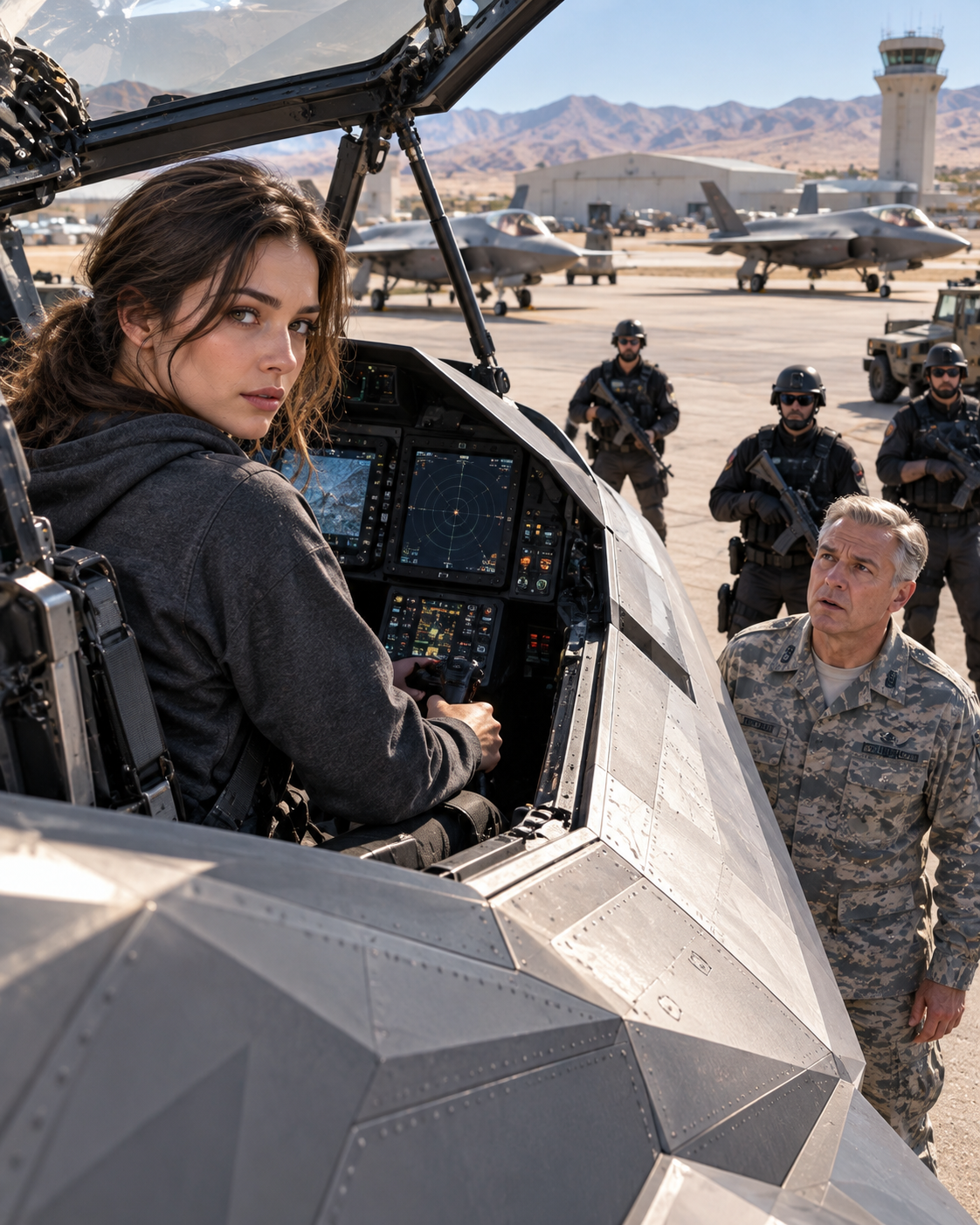
The moment I climbed into a multimillion-dollar F-22 Raptor at Nellis Air Force Base, Colonel Campbell called me a dangerous impostor
For one suspended second, I forgot how to breathe.
That voice had followed me through two years of nightmares, through the endless silence of the desert, and through every night I woke believing I could still hear a dying pilot calling for help.
I knew that voice.
Colonel Marcus Voss, the intelligence officer who had commanded Operation Desert Veil, was officially listed as retired.
He was also the man who had looked me in the eyes before my final mission and promised that every pilot in my formation would come home.
Three of them hadn’t.
Now he was speaking through a compromised emergency channel, as though my resurrection were an inconvenience he had anticipated.
“Identify yourself,” I said, tightening my grip on the controls.
“You know who I am, Nora.”
The Raptor continued accelerating toward the runway entrance.
I had seconds to decide whether to obey the warning in Voss’s voice or trust the instincts that had kept me alive when the desert wanted my bones.
“You have no idea what you’re interfering with,” he continued. “Move that aircraft, return to the holding area, and let the exercise proceed.”
I glanced at the instruments.
The Strike Eagle was old enough to feel honest, a machine whose vibrations traveled through the seat and into my spine. My borrowed aircraft had no idea who I was, and it didn’t care about my classified status.
It only cared what I asked it to do.
“Captain Reynolds, this is Major Nora Hayes,” I transmitted. “Your engine may fail under high load. Reject the takeoff now.”
“Major Hayes?” Ethan sounded bewildered. “You’re supposed to be dead.”
“I’m having a complicated morning.”
Despite everything, I almost smiled.
Then the warning lights on the Strike Eagle’s radar display flickered.
Someone was attempting to interfere with its systems, too.
Voss spoke again, his voice suddenly colder.
“Last chance, Wraith.”
I pushed the throttle forward.
The F-15 surged across the concrete, and I angled it toward the runway’s centerline, forcing Reynolds to choose between braking and colliding with me.
His Raptor was approaching at a speed that left no room for hesitation.
“Captain, abort now!”
“I can’t get a response from the tower!”
“Forget the tower. Take manual control and brake!”
“I’ve got a warning on my engine sensors!”
The words struck me harder than he could have known.
The attack had already begun.
I heard the Raptor’s tires scream against the runway as Reynolds fought to slow the aircraft. Its nose dipped, its landing gear shuddered, and the massive jet swerved toward the edge of the pavement.
I held my position until the last possible moment, then cut hard toward the adjacent taxiway.
The two aircraft missed each other by what felt like the width of a heartbeat.
A blast of hot air rocked the Strike Eagle.
Behind me, the Raptor slid to a halt, trailing a thin ribbon of smoke.
For several seconds, neither pilot spoke.
Then Reynolds’s voice came over the radio, raw with disbelief.
“I’m stopped. I’m alive.”
I closed my eyes.
The words should have brought relief, but all I could hear was another voice from another cockpit, two years earlier, disappearing beneath static.
“Wraith, I’ve lost my left engine!”
My wingman, Daniel Mercer, had said that moments before his aircraft vanished in the desert.
I had promised him I would bring him home.
I had broken that promise.
Not again.
I opened my eyes and looked toward the command building, where armed security teams were gathering around a row of black vehicles.
Campbell emerged from the building and ran toward the flight line, his face twisted with fury and fear.
He reached my aircraft just as I shut down the engine.
“Do you have any idea what you’ve done?” he demanded.
“Yes.”
“You commandeered a fighter, entered an active runway without clearance, and nearly caused a collision involving two of the most expensive aircraft on this base.”
“I also prevented a compromised aircraft from taking off.”
“You have no proof of that.”
I climbed down carefully, my knees threatening to betray me.
“Then ground every Raptor scheduled for the exercise and inspect the compressor assemblies before anyone starts another engine.”
Campbell stared at me.
“That’s an extraordinary accusation.”
“Then it should be easy to disprove.”
Before he could answer, Captain Reynolds appeared behind a line of security personnel, still wearing his flight helmet beneath one arm.
He looked younger than I had imagined, perhaps thirty, with sweat running down his face and an expression that belonged to someone who had just seen the future of his own funeral.
“My engine readings went crazy during taxi,” he said. “I thought the sensors were malfunctioning.”
“They weren’t,” I replied.
He swallowed.
“Why did you risk your life to stop me?”
I looked at him for a long moment.
“Because someone once risked everything to give me a chance to come home, and I didn’t get the chance to thank him.”
Before Reynolds could respond, Campbell’s secure phone rang.
He answered, listened, and handed it to me without speaking.
A woman on the other end identified herself as Director Evelyn Shaw of the Pentagon’s Special Access Review Office.
“Major Hayes, we have confirmed unauthorized interference with the base’s control network,” she said. “You were right to stop the aircraft.”
“Then you know who did it.”
“We have a preliminary lead, but we need you to secure the evidence before it disappears.”
I looked toward the hangars.
Maintenance crews were already approaching the grounded Raptor, while security personnel hurried to seal the surrounding area.
“Don’t let anyone touch that aircraft,” I said.
“Why?”
“Because whoever did this may have planted evidence that points to the wrong person.”
I turned toward Campbell.
“Clear the hangar, preserve the maintenance logs, and isolate the aircraft’s onboard data recorder. No one enters without a witness.”
Campbell hesitated.
Then, for the first time that morning, he followed my orders.
Within minutes, the Raptor was surrounded by investigators, its access panels sealed and its maintenance records copied under federal supervision.
I expected the first clue to be hidden in its software.
Instead, it came from a photograph.
A young maintenance technician named Lucas Bennett approached us carrying a tablet. He looked terrified, as if he had already imagined the consequences of speaking.
“Ma’am,” he said quietly, “I noticed something unusual during yesterday’s inspection.”
He displayed a close-up image of the compressor assembly.
One blade showed a hairline fracture near its root, almost invisible beneath the inspection lighting.
“That wasn’t in the last maintenance report,” I said.
“No, ma’am. And the replacement part was signed off by someone who wasn’t on the shift roster.”
“Who?”
Lucas hesitated.
“Chief Engineer Paul Danner.”
Campbell frowned.
“Danner has maintained aircraft here for sixteen years.”
“I know,” Lucas said. “That’s why I didn’t report it immediately.”
The admission hung between us.
Trust was the most dangerous thing in a place like this, because it could keep people loyal long after loyalty stopped being deserved.
“Where is Danner now?” I asked.
No one answered.
A security officer checked his radio, then shook his head.
“He left the maintenance hangar twenty minutes ago. His vehicle is gone.”
Director Shaw’s voice returned through the secure phone.
“Major, do not pursue him alone. Federal agents are moving to intercept.”
I looked at the image again.
The fracture was real, but it didn’t prove intent. A damaged component could result from manufacturing defects, excessive stress, or negligence.
The software anomaly was different.
Someone had created a condition in which the engine-control system could receive misleading sensor data during a high-load maneuver, potentially concealing a developing mechanical failure until the pilot had almost no time to react.
Together, the defects could turn an aircraft into a coffin.
“Pull the maintenance history for every Raptor assigned to today’s exercise,” I said. “Compare every component replacement against its procurement record.”
Campbell gave an order to the investigators.
The results came back less than an hour later.
Three aircraft had received parts from the same supplier.
All three had been assigned to the same combat simulation.
And all three had maintenance approvals linked to Danner’s credentials.
My stomach tightened.
“Ground the entire group,” I said.
Campbell didn’t argue this time.
But as the technicians secured the third aircraft, a junior investigator hurried into the hangar with a new report.
“Colonel, we found an encrypted access token embedded in the maintenance interface.”
“Can you identify its owner?” Campbell asked.
The investigator looked at me.
“It’s registered to a government account that was deactivated two years ago.”
I already knew what he was going to say.
“Operation Desert Veil,” I whispered.
The investigator nodded.
The room seemed to grow colder.
Someone had taken the technology involved in my final mission and brought it into a training exercise on American soil.
Someone had used credentials from a dead operation to conceal the sabotage.
And someone had known I would recognize the pattern.
I asked Director Shaw to meet me in a secure conference room.
She arrived with two federal agents and a sealed folder bearing the same black classification markings I remembered from the desert.
Inside were mission logs, procurement records, and photographs of the aircraft lost during Desert Veil.
At the bottom lay a document with my signature.
I had never seen it before.
It authorized the transfer of experimental flight-control software to a private defense contractor called Meridian Strategic Systems.
The approval date was three days before my supposed death.
“That signature is forged,” I said.
Shaw studied me carefully.
“Are you certain?”
“I was in the air when this document was supposedly signed.”
She turned to one of the agents.
“Find every copy and identify who submitted it.”
I continued reading.
The software had been designed to test whether advanced aircraft could maintain stability when conventional sensor data became unreliable. It was experimental, dangerous, and never approved for operational deployment.
Someone had altered the test parameters.
The system that was supposed to protect pilots from conflicting data could instead suppress warnings at precisely the moment they were needed most.
The document described the program as a limited research initiative.
The financial records told a different story.
Meridian had received millions of dollars through shell companies connected to a defense procurement network. Several payments had been authorized through accounts controlled by a senior intelligence office.
One name appeared repeatedly.
Marcus Voss.
I felt the old desert return around me.
Heat against my face.
Sand in my mouth.
Daniel Mercer shouting through the radio.
I remembered Voss’s calm voice ordering us to continue the mission despite the unexpected enemy formation.
I remembered the warning that had arrived too late.
I remembered the explosion that turned my wingman’s aircraft into a burning star.
“Why would he do this?” Campbell asked.
I stared at the paperwork.
“Because a failed experiment can be called an accident, but a successful one can be sold.”
Shaw closed the folder.
“We don’t have enough evidence to accuse Voss publicly. If he has access to classified systems, he’ll know we’re investigating.”
“Then stop giving him time.”
She leaned forward.
“You are not authorized to conduct an independent operation.”
“I wasn’t authorized to steal an F-15 either.”
For the first time, she almost smiled.
Then her expression hardened.
“Voss has been summoned to the base for an emergency review. He is expected to arrive within the hour.”
My pulse slowed.
Not from calm, but from the strange stillness that arrives when a long nightmare finally reveals its face.
“Good,” I said. “Then I’ll ask him what happened to my squadron.”
Voss arrived in a black government sedan accompanied by two aides.
He walked into the command building wearing a perfectly pressed uniform, his silver hair untouched by the wind. He looked exactly as I remembered him: composed, controlled, and certain that every room belonged to him.
Then he saw me.
For the first time since the desert, Marcus Voss looked afraid.
“Nora,” he said softly.
I stood across the conference table.
“General.”
His eyes flicked toward the folder in front of Shaw.
“I was told you had returned to active duty.”
“You were told I was dead.”
“That was the official report.”
“Was it your report?”
He didn’t answer.
Shaw placed the forged authorization in front of him.
“General Voss, we need an explanation for these transfers and the unauthorized access token discovered on an aircraft involved in today’s exercise.”
Voss glanced at the document, then back at me.
“This is a fabrication.”
“Then you won’t mind explaining why your credentials appear in the transaction history.”
“Credentials can be stolen.”
“Can they also order a flight formation into a known ambush?”
His jaw tightened.
The room fell silent.
I stepped closer.
“Daniel Mercer called for help. You ordered us to hold formation. You knew the enemy fighters were waiting for us, didn’t you?”
Voss looked at the agents surrounding him.
“You don’t understand the operational picture.”
“Then explain it.”
He lowered his voice.
“Desert Veil was designed to test a new defensive system under real combat conditions. The intelligence was incomplete, the threat was underestimated, and the mission failed.”
“Three pilots died.”
“War is not a clean business.”
“No,” I said. “But sending people into a trap and calling it research is a choice.”
His expression changed.
For one moment, I saw something beneath the arrogance—not remorse, but exhaustion.
“I never intended for your aircraft to go down.”
“But you intended to keep the program running.”
He said nothing.
Shaw signaled the agents.
“General Voss, please stand.”
Voss remained seated.
“You think arresting me will end this?” he asked. “Meridian has people in procurement, testing, and oversight. Some of them signed the very documents you’re holding. Others believe the program is too valuable to abandon.”
“Then we’ll find them,” I said.
He looked directly at me.
“You can’t bring your friends back.”
The words struck the place in my chest where Daniel’s final transmission still lived.
“No,” I replied. “But I can stop you from choosing who dies next.”
The agents took him into custody.
For a moment, I thought the nightmare was finally over.
Then the lights went out.
A sharp alarm sounded through the building, followed by the heavy clatter of emergency doors locking into place.
Campbell reached for his radio.
“Control, report.”
Only static answered.
Director Shaw turned toward the security monitors, which had gone black one by one.
A second later, a small backup display flickered to life.
A single line appeared across the screen.
WRAITH HAS BEEN IDENTIFIED. TERMINATE THE RECOVERY.
One of the agents drew his weapon.
Voss, standing between two guards, began to laugh.
It was not the laugh of a man who had lost.
It was the laugh of someone watching a plan unfold exactly as expected.
“You’re too late,” he said.
I seized the folder and pulled the maintenance records from its envelope.
“Too late for what?”
Voss looked at me with something almost like pity.
“The aircraft you stopped were never the final objective.”
My blood turned cold.
Shaw moved toward the backup terminal.
“Security, restore the network!”
No response.
I searched the records, scanning for anything that could explain his words. Then I found a reference to a second phase of the program, concealed beneath a routine systems-validation entry.
A remote test had been scheduled for that afternoon.
Its location was not Nellis.
It was a restricted flight-test facility in the Nevada desert, the same region where Desert Veil had ended.
And the test authorization carried a signature I recognized immediately.
Mine.
The document was dated two years earlier, three days before my aircraft disappeared.
Beneath the forged signature was a note in Daniel Mercer’s handwriting.
If Wraith survives, do not let her reach the truth alone.
I stared at the words until they blurred.
Daniel had known something was wrong.
Perhaps he had discovered the program before the ambush. Perhaps he had tried to warn me, and his final message had been more than a desperate call for help.
I turned toward Voss.
“What is at that facility?”
He stopped smiling.
For the first time, he looked genuinely uncertain.
“I don’t know what you’re talking about.”
I held up the document.
“Daniel’s handwriting says otherwise.”
His face changed.
That was all the confirmation I needed.
I handed the records to Shaw and ran for the door.
“Major!” Campbell shouted. “You cannot leave this base without authorization!”
I stopped long enough to look back at him.
“Colonel, two years ago I followed an order because I believed the people giving it knew more than I did. Three men died because of that mistake.”
My voice broke despite my best efforts.
“I won’t make it again.”
Campbell stared at me, then reached for his keys.
“Take my vehicle.”
Outside, the desert wind swept across the flight line, carrying the distant sound of aircraft engines and the metallic clang of maintenance crews securing the grounded fleet.
Captain Reynolds waited beside the hangar.
He had removed his helmet, and his expression had lost the arrogance I had sensed when I first heard his voice.
“I heard what happened,” he said. “If you need another pilot—”
“I need you to stay alive.”
He nodded slowly.
“Then make sure what happened to you doesn’t happen to someone else.”
I climbed into Campbell’s vehicle, clutching Daniel’s note against my chest.
For two years, I had believed survival was the only thing I had brought back from the desert.
Now I understood that survival had left me with a responsibility.
The people who sent me into that ambush had counted on silence, grief, and the certainty that a dead pilot could never contradict the official story.
They had forgotten one thing.
I was still here.
As we raced toward the highway, Shaw called through the secure phone.
“We’ve restored a limited network connection. The facility is active, and we have confirmed an unauthorized aircraft launch.”
“Who is flying?”
She paused.
“We’re still verifying the identity.”
I looked out at the empty Nevada horizon.
Then a transmission crackled through the vehicle’s speaker, weak and distorted by interference.
A man’s voice spoke three words that stopped my heart.
“Wraith, it’s Daniel.”
I gripped the phone so tightly my fingers hurt.
“That isn’t possible.”
The voice returned, older and exhausted, but unmistakably his.
“Nora, listen carefully. You were never supposed to survive Desert Veil.”
The connection began to break apart.
“Daniel, where are you?”
A burst of static swallowed his answer.
Then he spoke again, barely audible.
“Don’t trust the person driving you.”
I turned toward Colonel Campbell.
His hands tightened around the steering wheel.
Neither of us spoke.
Ahead, the highway stretched into the desert, leading toward the facility where my squadron had supposedly died.
And in the rearview mirror, far behind us, a pair of black vehicles had just turned onto the same road.