The moment Dr. Steven Vance shoved my gloved hand away from the X-ray order in St. Gabriel’s emergency room
The words on the envelope stayed in my mind long after Jonathan left the training room.
You were never declared dead.
I read them again beneath the fluorescent lights, feeling the same cold I had felt years earlier in Afghanistan.
For nearly a decade, I had believed my life had ended on that dusty road.
Apparently, someone had known otherwise.
I turned the envelope over.
There was no return address.
Only a faded military seal and a date from eleven years ago.
My fingers went numb.
I didn’t open it immediately.
Instead, I sat there listening to the hospital breathe around me.
Monitors beeped behind walls.
Carts rolled through corridors.
Someone laughed at the nurses’ station.
Life continued as though mine hadn’t just cracked open again.
Then Jonathan returned.
He stopped when he saw the envelope in my hand.
“You opened it?”
“No.”
His face changed.
“Good.”
I looked up.
“What does that mean?”
He closed the door behind him.
“It means I was hoping you’d never have to see it.”
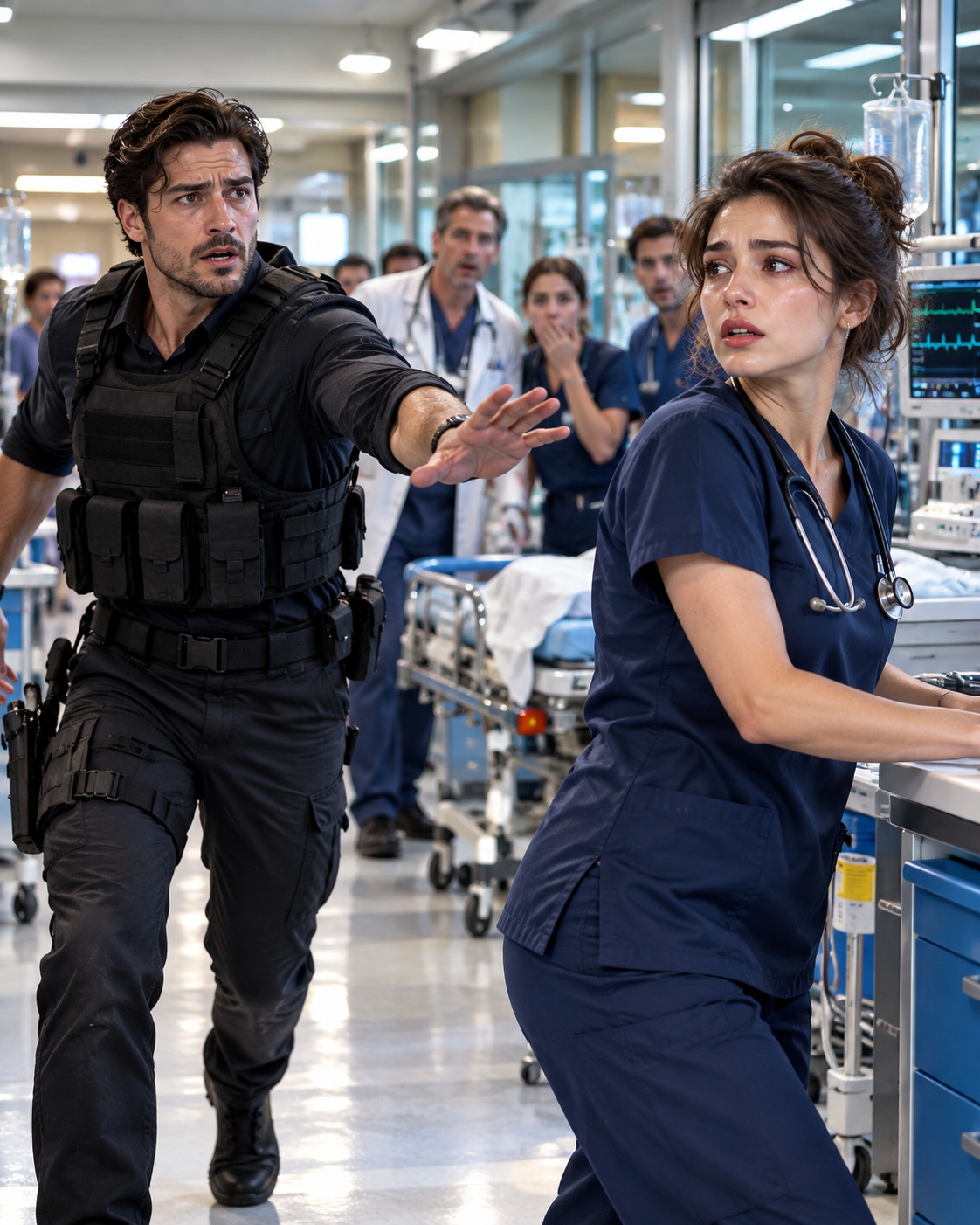
“That isn’t an answer.”
“No.”
He sat across from me.
“It isn’t.”
For a long moment, neither of us spoke.
Then he said, “After the evacuation, command told me you were dead.”
“I know.”
“They said there had been no recoverable remains.”
“I know.”
“They gave me your identification.”
I stared at him.
“My identification?”
He nodded.
“But there was something wrong with it.”
“What?”
“The photograph had been replaced.”
My chest tightened.
“What?”
Jonathan reached into his jacket and placed another photograph on the table.
It showed me in uniform beside an armored medical truck.
Except the woman in the photograph was not me.
Same uniform.
Same rank.
Different face.
I couldn’t breathe.
“Who did that?”
“I don’t know.”
“Then why bring this to me now?”
“Because after Leo’s case, I started asking questions.”
He looked ashamed.
“And I found someone who remembered you.”
The door opened before I could answer.
Dr. Helen Vance stood there.
She had been the physician who saved Leo, but now she looked frightened.
“Jonathan,” she said quietly, “you need to stop.”
He turned.
“Stop what?”
“Digging.”
The word landed heavily.
I stood.
“What aren’t you telling me?”
Helen looked at me for several seconds.
Then she closed the door.
“There was an investigation after the convoy attack.”
“I know.”
“No, Maya.”
Her voice softened.
“You know the story they gave you.”
She pulled out a folder.
“You don’t know what actually happened.”
My hands shook as I opened it.
The first page was an incident report.
The second was a medical evacuation log.
The third had several names blacked out.
One line remained visible.
PATIENT: UNKNOWN FEMALE CORPSMAN.
STATUS: ALIVE.
I stared at it.
“That’s me.”
Helen nodded.
“You were alive when they evacuated the others.”
“Then why did everyone think I was dead?”
She hesitated.
“Because someone changed the record.”
A sharp silence filled the room.
Jonathan whispered, “And that wasn’t the worst part.”
I looked at him.
“What was?”
“You were transferred somewhere else.”
“Where?”
“We don’t know.”
My stomach dropped.
Helen pointed to the final page.
“There was one handwritten note.”
I leaned closer.
It contained only a sentence.
KEEP PHOENIX OFF THE BOOKS.
I felt something inside me go still.
For years, I had blamed myself for disappearing.
I had believed my scars made me difficult to recognize.
I had convinced myself that nobody had searched because nobody cared.
Now I realized something much worse.
Someone had wanted me forgotten.
I spent the next three days digging through old records, but every path ended in missing pages, sealed files, or names that no longer existed.
Then, on the fourth night, someone left a package outside my apartment.
Inside was a small silver medical tag.
Mine.
I recognized the scratches immediately.
I had worn it around my neck during deployment.
There was also a handwritten note.
YOU SAVED THE CAPTAIN.
NOW SAVE YOURSELF.
I called Jonathan.
He arrived within ten minutes.
When he saw the tag, his face drained of color.
“I thought this was destroyed.”
“Who has access to these records?”
“Too many people.”
“Who would want me erased?”
He didn’t answer.
That frightened me more than anything.
The next morning, I went to work anyway.
Leo was back for a follow-up appointment.
The little boy recognized me instantly.
“Phoenix!”
I smiled.
“That’s right.”
He wrapped his arms around my waist.
His mother cried quietly behind him.
Jonathan watched from the doorway.
For a few minutes, everything felt normal.
Then Leo reached into his backpack.
“I brought you something.”
He handed me a new musical card.
My heart stopped.
I looked at Jonathan.
He looked at the card.
Nobody moved.
Leo pressed the button.
A cheerful melody played.
Then the music stopped abruptly.
A tiny voice recording came from inside.
“Phoenix, if you’re hearing this, they know you’re alive.”
The card fell from my hand.
Jonathan grabbed Leo.
Helen locked the door.
We listened again.
The message continued.
“The person who erased you is inside St. Gabriel.”
Nobody spoke.
I looked at the hospital badge hanging from my neck.
For the first time since I had returned to civilian life, I felt hunted.
We reported the message to hospital security, but the investigation found no obvious source.
The card had been purchased with cash.
The fingerprint analysis produced nothing useful.
The security cameras showed no one entering the pediatric clinic during the relevant time.
It should have been impossible.
But impossible had become a familiar word in my life.
That afternoon, I received an email from an unknown address.
There was only one attachment.
A photograph.
It showed me eleven years earlier, sitting unconscious inside an evacuation helicopter.
Beside me stood a man wearing a military medical officer’s uniform.
I recognized him.
My heart nearly stopped.
It was Dr. Steven Vance.
I stared at the photograph until the screen blurred.
Jonathan saw it.
“No.”
“What?”
He took a step backward.
“That can’t be.”
“You knew him then?”
“Steven wasn’t supposed to be there.”
The room went silent.
Then Jonathan told me something he had never said before.
His brother had been attached to the medical command overseeing our evacuation.
He had been one of the people responsible for recording casualties.
I felt sick.
“Then he knew I survived.”
Jonathan nodded slowly.
“And he may have known where you went.”
The pieces began falling into place.
Steven’s dismissal of Leo’s symptoms.
His irritation when I insisted on the X-ray.
His strange reaction when Jonathan recognized me.
Maybe he hadn’t been surprised.
Maybe he had been afraid.
I confronted him that evening.
He was alone in an empty consultation room.
When I walked in, he looked at me for several seconds.
Then he sighed.
“I wondered how long it would take.”
My blood ran cold.
“You knew.”
“Yes.”
“You knew I survived.”
“Yes.”
“Why?”
He sat down.
For the first time, the arrogance disappeared from his face.
What remained looked exhausted.
“I was twenty-nine,” he said. “I made a decision that destroyed more lives than you know.”
“Tell me.”
He looked at the floor.
“Your evacuation records were altered because someone wanted to hide a medical failure.”
“What failure?”
“A chain of unauthorized transfers.”
He swallowed.
“You were moved because you had information about a field hospital that wasn’t supposed to exist.”
My mouth went dry.
“What information?”
“You saw patients being moved under false names.”
I remembered fragments.
Rows of beds.
Unmarked uniforms.
A sealed corridor.
A doctor shouting at someone outside the operating room.
I had spent years believing those memories were nightmares.
They weren’t.
Steven continued.
“You wrote everything down.”
“Where are my notes?”
He looked at me.
“I don’t know.”
“Who does?”
Before he could answer, the lights flickered.
Then his expression changed.
He whispered one word.
“Run.”
The door behind me slammed open.
Someone in dark clothing rushed inside.
Steven shoved me aside.
A sharp crack filled the room.
He collapsed.
I dropped beside him.
“Steven!”
He pressed a trembling hand against his chest.
“Locker… seventeen.”
“What?”
“Old records room.”
His eyes closed.
“Phoenix… don’t trust anyone.”
The intruder was already gone.
Security flooded the hallway.
An ambulance arrived.
Steven survived.
But the old records room became my next destination.
Locker seventeen was buried behind boxes of outdated charts.
Inside was a rusted metal case.
My hands shook as I opened it.
There were my original medical notes.
Photographs.
Names.
Dates.
And one final document.
A transfer authorization signed by a senior officer.
The signature belonged to a man who was now a respected executive at St. Gabriel Regional Medical Center.
The same man who had approved Steven’s position years later.
The same man who had quietly recommended me for the pediatric training role.
I stared at his name.
Dr. Richard Hale.
He had been watching me from the day I arrived.
The revelation didn’t feel like victory.
It felt like grief.
I had spent years believing I had escaped my past.
I had only walked back into it.
The investigation that followed became national news within weeks.
Military authorities reopened the old case.
Hospital leadership suspended several administrators.
Steven cooperated with investigators and admitted that fear had kept him silent for years.
He apologized to me.
I didn’t forgive him immediately.
Some wounds deserve honesty before forgiveness.
Jonathan stayed beside me through every interview.
When reporters asked why I had returned to medicine after everything I had survived, I gave them the only answer I knew.
“Because children don’t get a second chance when adults miss the warning signs.”
That became the heart of the training program I built at St. Gabriel.
We taught nurses to trust subtle symptoms.
We taught physicians to listen when a frightened parent said, “Something isn’t right.”
We taught teams how to act when technology failed.
And most importantly, we taught them that hierarchy could never matter more than a patient’s life.
Months later, I stood in the pediatric emergency department watching a new group of nurses practice a simulated crisis.
One of them raised her hand.
“What if the doctor disagrees?”
I smiled.
“Then speak louder.”
The room laughed.
But I meant it.
Leo visited that afternoon carrying a drawing.
It showed a woman with a scarred shoulder standing beside a little boy.
Above them, in crooked blue letters, he had written:
PHOENIX SAVED ME.
I had to turn away for a moment.
Some wounds never disappear.
They simply stop controlling the story.
That evening, Jonathan found me outside the hospital beneath the first snowfall of the season.
“You finally look happy,” he said.
I watched the snow settle against the pavement.
“I finally stopped trying to disappear.”
He smiled.
Then he handed me another envelope.
I stared at it.
“Another secret?”
“Maybe.”
I opened it slowly.
Inside was a photograph I had never seen before.
It showed me standing beside a group of children at the field hospital in Afghanistan.
On the back, someone had written:
YOU WERE NEVER THE ONLY PHOENIX.
I looked at Jonathan.
“What does that mean?”
He shook his head.
“I don’t know.”
For once, I wasn’t afraid of the unknown.
I folded the photograph and slipped it into my pocket.
Then I walked back through the hospital doors, toward the children, the nurses, the noise, and the life I had once believed I had lost.
I had spent years thinking survival meant staying alive.
Now I understood that survival meant choosing what your life would mean after the worst thing had already happened.
And somewhere in an old photograph, another unanswered story was waiting for me.
Maybe one day I would find it.
Maybe I wouldn’t.
But I knew one thing for certain.
I was no longer hiding from the scars that proved I had survived.
I was finally using them to show someone else the way home.