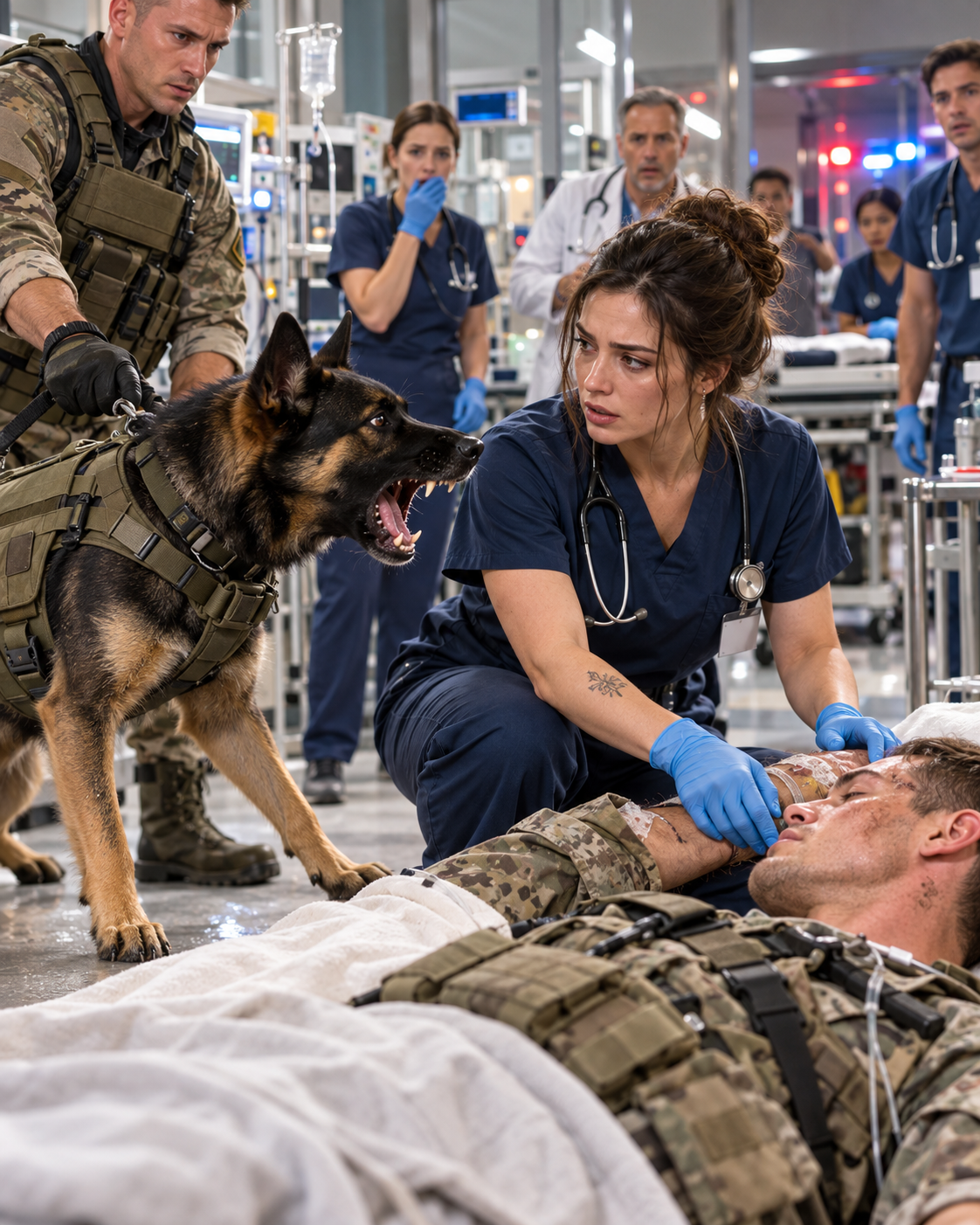
The moment Dr. Sterling ordered security to drag a combat K9 away from a dying Navy SEAL in Oakridge Medical Center’s Trauma Bay 1
I stared at the photograph until the faces began to blur.
Danny stood in the center, younger than I remembered him, with that crooked smile he always wore whenever someone told him to look serious for a picture.
The woman beside him had one hand resting on his shoulder, and the little girl in front of them held a stuffed rabbit against her chest.
On the back, beneath the message about the riverbank, was a name and a phone number.
Rachel Hayes.
Danny’s sister.
For eight years, I had avoided searching for his family because I couldn’t imagine looking into the eyes of someone who had lost a brother while I had come home alive.
Now someone had placed their photograph in my hands, and the past I had spent years burying was reaching for me again.
Rex lifted his head from the floor and nudged my wrist.
“I’m okay,” I whispered.
He didn’t believe me.
Neither did I.
That night, I sat at my kitchen table with the envelope, Danny’s photograph, and the phone I had picked up and put down so many times that my fingers had begun to ache.
I had rehearsed a hundred apologies over the years, but every version sounded selfish.
I was sorry.
I had tried.
I wished I could have done more.
None of those words could give Rachel her brother back.
Finally, I dialed the number.
It rang four times before a woman answered.
“Hello?”
My throat tightened. “Is this Rachel Hayes?”
“Yes. Who is this?”
“My name is Emily Carter. I served with Danny in Afghanistan.”
Silence.
I could hear a television playing faintly in the background, followed by the sound of someone moving a chair.
Then Rachel asked, “Are you the medic?”
I closed my eyes.
“Yes.”
Another silence followed, longer and heavier than the first.
“I wondered if you would ever call,” she said.
There was no anger in her voice, and somehow that hurt more.
“I received a photograph of Danny,” I explained. “Someone left it at my hospital. There’s a message on the back about something that happened at the riverbank. I don’t understand it.”
Rachel exhaled slowly.
“Then I think you need to come see me.”
I almost asked what she meant, but I could hear the hesitation in her breathing.
Whatever she knew, she wasn’t ready to explain it over the phone.
The next morning, I requested two days off and drove north with Rex in the passenger seat.
He rested his chin on the window ledge, watching the world slide past, occasionally glancing at me as if checking that I hadn’t disappeared.
For the first time in years, I wasn’t running away from a memory.
I was driving toward it.
Rachel lived in a modest house outside Annapolis, Maryland, with a small garden and wind chimes hanging from the porch.
When she opened the door, I recognized Danny immediately in the shape of her eyes.
She looked older than the woman in the photograph, but her smile had the same warmth.
“You came,” she said.
“I almost didn’t.”
She nodded, as though she understood more than I could explain.
Then her gaze fell on Rex.
“That’s the dog from Danny’s pictures.”
“His name is Rex. He was Marcus’s partner.”
Rachel knelt to greet him, and Rex sniffed her hand before allowing her to scratch beneath his chin.
“He always liked animals,” she said softly. “Danny used to bring home injured birds when we were kids. Our mother would complain, but she’d still let him keep them until they could fly.”
I swallowed.
“He talked about you.”
“Did he?”
“All the time.”
Rachel stepped aside.
“Come in.”
The living room was filled with ordinary things: framed photographs, books, a knitted blanket, a mug on the coffee table, and a child’s drawing pinned to the refrigerator.
That ordinary life struck me harder than any battlefield image.
Danny had been more than a name in a casualty report.
He had been someone’s brother, someone’s friend, and a man who had expected to come home and continue living.
Rachel brought me a small cardboard box.
“I’ve kept everything the Navy sent me,” she said. “His letters, his identification tags, the personal effects they returned. For a long time, I couldn’t open it.”
She sat opposite me and placed both hands on the lid.
“About a year ago, a Navy representative contacted me. They told me some deployment communications were being reviewed for archival release. They asked whether I wanted to receive a copy of Danny’s final transmission.”
My stomach tightened.
“Did you hear it?”
“Yes.”
“Then you know what he said.”
Rachel looked at me carefully.
“I know what the recording says. But there’s another reason I wanted you here.”
She opened the box.
Inside were folded letters, a small American flag, and a photograph of Danny in uniform.
Beneath them lay a sealed document bearing an official military stamp.
Rachel slid it across the table.
“This came with his personal effects, but it wasn’t explained to me until the records were reviewed.”
My hands shook as I opened it.
It was a copy of a mission report, with several paragraphs marked for clarification.
I read the first page, then the second.
The riverbank operation had been more complicated than the account I remembered.
Our unit had been ordered to evacuate a wounded intelligence officer whose location had been compromised. Marcus had sustained injuries during the withdrawal, and Danny and I had been separated from the main team by enemy fire.
The report described Danny’s final radio transmission as a deliberate authorization for the medical evacuation.
But it also contained a note about a second extraction route that had been discussed before the mission.
I looked up.
“What is this?”
Rachel folded her hands.
“Marcus told me you believed there was no way to go back for Danny.”
“There wasn’t. The route was blocked, and the radio was failing.”
“I know. That’s what you were told.”
Her words landed with the quiet force of a door closing.
“What do you mean?”
Rachel hesitated.
“Marcus has been trying to find out what happened ever since he learned the full details. He didn’t want to tell you anything until he had something more certain.”
My pulse quickened.
“Rachel, please. I can’t do another eight years of guessing.”
She reached into the box and removed a second envelope.
“This is a letter Danny wrote to me before that mission. It was delivered weeks later with the rest of his belongings.”
The paper was creased, the handwriting uneven but unmistakably his.
Rachel let me read it alone.
The letter began with a joke about military food, then moved to a description of the sea, a promise to visit his sister, and a request that she stop worrying whenever he missed a call.
Near the bottom, Danny had written, If anything happens to me, don’t let anyone turn it into a story about who should have done more. War gives people impossible choices, and surviving one doesn’t mean you owe the world your suffering.
I pressed the page against my chest.
Rachel waited until I looked up.
“He wrote that before the mission,” she said. “He understood the risks. He didn’t want us spending our lives trying to punish ourselves for something we couldn’t control.”
I stared at the letter, but my mind had returned to the report.
“Who knew about the other route?”
Rachel’s expression changed.
“That’s what Marcus has been trying to establish.”
Before I could ask more, my phone rang.
It was Marcus.
“Emily, where are you?”
“I’m with Rachel.”
A pause followed.
“Good. I was hoping you’d go.”
“Marcus, I found the mission report. It mentions another extraction route.”
His breathing changed.
“You’ve seen it.”
“Why didn’t you tell me?”
“I wanted proof before I brought you something that could tear open everything you’ve spent years trying to heal.”
“Then tell me now.”
Marcus was quiet for several seconds.
“The route was discussed before we deployed. It was supposed to be available if the main crossing became impassable. But the coordinates never reached our field team.”
I felt cold.
“Why not?”
“We don’t know yet. The original communications log is incomplete, and the officer responsible for coordinating the alternate route filed a report that contradicted what we experienced on the ground.”
I looked at Rachel.
She had gone very still.
“Who was the officer?”
Marcus gave me a name.
Commander Richard Bell.
I remembered him from the deployment, although only in fragments: a polished uniform, a clipped voice over the radio, and a man who seemed more concerned with paperwork than the people carrying stretchers.
“He said the route had been compromised,” Marcus continued. “We believed him because we had no reason not to.”
“Are you saying he lied?”
“I’m saying I don’t know. But the records don’t match, and someone worked hard to make sure the discrepancies stayed buried.”
My fingers tightened around the phone.
“Why would anyone do that?”
“I don’t have the answer. That’s why I need you to listen carefully. Don’t confront Bell, and don’t let anyone pressure you into making accusations without evidence.”
The call ended, leaving me with a terrible new realization.
The guilt I had carried for eight years might have been built on an incomplete account of what happened.
That did not mean someone had deliberately sent Danny to his death.
It did mean the truth deserved to be found.
Before I left Rachel’s house, she gave me a copy of Danny’s letter and the contact details of the Navy records officer who had provided the documents.
“Don’t do this because you think you owe my family something,” she said at the door. “Do it because the truth matters.”
I nodded, unable to speak.
On the drive home, Rex shifted in his seat and laid his head against my arm at a red light.
I scratched behind his ear.
“One step at a time,” I whispered.
For the first time, the words felt like something I could believe.
Two days later, I met Marcus at a rehabilitation center near the naval hospital where he was completing his recovery.
He was walking with a cane, moving carefully, but his eyes had regained their familiar sharpness.
Rex nearly pulled me off balance when he saw him.
Marcus laughed, then winced as the movement tugged at his healing abdomen.
“Easy, partner. I’m not ready to run with you yet.”
The reunion was brief, but watching them together reminded me how much of our old lives had survived inside the wreckage.
We sat in a quiet room overlooking the parking lot.
Marcus placed a folder on the table.
“I’ve spent eight years looking for you,” he said. “At first, I wanted to thank you for saving my life. Then I wanted to give you Danny’s recording. After that, I started asking questions about the mission.”
“Why didn’t you tell me you suspected something?”
“Because suspicion isn’t proof. And because I knew you were already hurting.”
I opened the folder.
Inside were copies of radio logs, after-action reports, and a timeline reconstructed from records that had only recently become available.
Marcus pointed to one page.
“The alternate route was approved before deployment. When the river crossing became dangerous, the field team should have received updated coordinates.”
“But we didn’t.”
“No. The transmission was marked as sent, but the receiving log has no record of it.”
“Could the equipment have failed?”
“It could have. That’s the problem. There are innocent explanations, and there are explanations that aren’t innocent. We need evidence before we decide which one is true.”
He leaned back, exhaustion visible in his face.
“I’ve replayed that night a thousand times. I remember you dragging me through the mud while Danny covered us. I remember him shouting that you should keep moving. I remember promising him we’d come back.”
His voice broke slightly.
“We never did.”
I looked down at my hands.
“Every time I saved someone after that, I wondered whether I deserved to.”
Marcus shook his head.
“That was never your debt to pay.”
“What if the mission could have gone differently?”
“Then the people responsible for the decisions should answer for them. Not you, Emily. You were a corpsman under fire, making a decision with the information you had. Danny knew that. That’s why he gave the order.”
For a long moment, neither of us spoke.
Then Marcus pushed the folder toward me.
“I want you to help me get the records reviewed. Not because we need someone to blame, but because the next medic deserves a mission where the truth isn’t hidden behind a stack of paperwork.”
I thought about Danny’s letter.
I thought about every patient who had looked at me with frightened eyes, trusting me to make decisions I could never guarantee would end well.
And I realized that healing didn’t require me to stop caring about what had happened.
It required me to stop confusing pain with responsibility.
“I’ll help,” I said.
Over the following weeks, we worked with a Navy review office to organize the documents and identify the missing communications.
I returned to Oakridge Medical Center during the day and reviewed the records in the evenings.
Rex became a fixture at my apartment, sleeping beside the front door until he was certain I had come home safely.
At work, my colleagues gradually learned why I had hidden my tattoo.
Some asked questions.
Others simply looked at the emblem, nodded, and returned to their shifts.
Dr. Sterling surprised me most.
One evening, he found me finishing a report in the nurses’ station.
“I owe you an apology,” he said.
I looked up.
“For what?”
“For the way I treated you when Vance came in. I saw a situation I couldn’t control, and I mistook your experience for insubordination.”
He glanced at my uncovered forearm.
“I was wrong.”
The apology wasn’t dramatic, and it didn’t erase the humiliation I had felt in the trauma bay.
But I accepted it because people could not learn if nobody allowed them to admit they had failed.
“Next time, listen when someone tells you a patient is dying,” I said.
He gave a tired smile.
“Fair enough.”
Then the records review took an unexpected turn.
A Navy investigator contacted Marcus and requested a formal interview about the riverbank operation.
The investigator had located an archived communications transcript that had not been included in the original review.
There was no indication yet of criminal misconduct, but the transcript appeared to contain a transmission from Commander Bell shortly before the evacuation.
Marcus called me immediately.
“They found something,” he said.
“What kind of something?”
“A message that may explain why the alternate route never reached us.”
My heart began to race.
“Does it prove he deliberately withheld the coordinates?”
“Not yet. It needs authentication, and the context matters. But it changes the timeline.”
For the first time, I felt something other than dread when the past returned.
I felt determination.
The interview took place in a plain conference room at a naval administrative building.
I sat beside Marcus while an investigator named Lieutenant Commander Elaine Foster laid the transcript on the table.
She explained that the document had been recovered from a backup communications archive and was being compared against the surviving radio logs.
“We are not here to reach a conclusion before the evidence supports one,” she said. “We are here to establish what was transmitted, what was received, and what decisions were made afterward.”
I appreciated her caution.
I had lived too long with a story built from fragments to accept another convenient answer.
Foster read the relevant passage aloud.
Commander Bell had reported that the alternate crossing was unavailable because of suspected enemy activity.
Several minutes later, another message appeared to indicate that the route might still be usable.
But the message’s destination field was incomplete, and investigators could not yet determine whether it had been sent to our unit or merely entered into the system.
Marcus leaned forward.
“That second message never reached us.”
“We understand that,” Foster replied. “What we don’t know is whether it was never transmitted, misrouted, or lost due to equipment failure.”
“And Bell’s report?” I asked.
“His statement appears inconsistent with the later message, but inconsistency alone doesn’t establish intent.”
I looked at the transcript, feeling the old battlefield return in flashes: the river, the gunfire, Danny’s hand gripping my sleeve, Marcus’s blood soaking through my uniform.
For years, I had believed the only question was whether I should have stayed.
Now I understood that another question had always existed.
Had the people responsible for coordinating our mission given us the information we needed to make a choice?
The investigation continued for months.
There were interviews, additional records requests, and long stretches when nothing seemed to move.
Some days I wondered whether pursuing the truth was reopening a wound that should have been left alone.
Then I would hear Danny’s voice in the recording, telling me to save Marcus and carry no guilt, and I would remember why we had begun.
The goal wasn’t to rewrite the past until it hurt less.
It was to make sure the facts were not buried simply because the truth was uncomfortable.
Eventually, investigators established that the alternate-route update had been entered into the communications system but had not been delivered to our field unit.
They also found that Bell’s initial report had described the route as compromised before the available intelligence fully supported that conclusion.
The evidence was serious, but it did not establish that Bell had deliberately withheld the update to cause harm.
He was interviewed, and his decisions were formally reviewed.
The Navy amended portions of the mission record to reflect the communication failure and the uncertainty surrounding the route’s status.
For the first time, the official account acknowledged that our team had operated without information that might have changed our options.
It did not promise that Danny would have survived if the message had arrived.
No honest investigation could promise that.
But it removed the lie I had told myself for eight years: that I alone had held the power to save him.
When Marcus called to tell me the review was complete, I sat on my apartment floor with Rex pressed against my side.
“They corrected the record,” he said. “Danny’s actions are recognized, and the communications failure is documented.”
I closed my eyes.
“Does it feel like enough?”
“No,” Marcus admitted. “But it’s the truth we can prove.”
That evening, I visited Rachel.
We sat in her garden as the sun sank behind the trees, and I told her what the investigation had found.
She listened without interrupting.
When I finished, she looked down at Danny’s photograph, which she had placed on the table between us.
“I used to imagine that if I knew every detail of his last day, the grief would finally make sense,” she said. “But it doesn’t work that way, does it?”
“No,” I answered. “It doesn’t.”
She touched the edge of the photograph.
“I still wish he’d come home.”
“So do I.”
We cried together, not as a grieving sister and a guilty medic, but as two people who had loved the same man in different ways.
Before I left, Rachel gave me a small envelope.
Inside was a copy of Danny’s letter, along with a note she had written herself.
It read, You were part of the life he loved, not the reason it ended.
I carried those words home and placed them beside the recording Marcus had given me.
The following spring, Marcus officially retired from active duty.
His doctors had cleared him for ordinary activity, but his injuries and the long recovery had made returning to operational service impossible.
He moved into a quiet house near the water, where Rex could run without hearing aircraft engines or the constant clatter of transport vehicles.
I visited them on weekends, bringing groceries, helping Marcus with the occasional chore, and letting Rex chase a ball along the shoreline.
One afternoon, Marcus watched me throw the ball for Rex.
“You know,” he said, “I spent years thinking I owed you my life.”
I glanced at him.
“You don’t owe me anything.”
“I know that now. But back then, I thought finding you would somehow settle the debt.”
He looked toward Rex, who was trotting back with the ball in his mouth.
“Turns out, we were both carrying things nobody asked us to carry.”
I sat beside him.
“What happens now?”
“We live. We remember. We try to make the next decision better than the last.”
It sounded simple when he said it.
Perhaps that was the point.
I returned to Oakridge with a different understanding of the tattoo on my arm.
It was not a symbol of a perfect soldier or a medic who had never failed.
It represented the people who had trusted me, the choices I had made under impossible circumstances, and the responsibility I still carried to care for those who needed me.
I stopped pulling my sleeves down whenever someone entered the room.
I stopped describing the tattoo as an old injury.
When a young nurse asked me about it, I told her the truth.
I told her about Harrow Medical, about Marcus, about Rex, and about Danny Hayes, who had given his last order to save another man’s life.
I told her that courage did not mean knowing the right answer every time.
Sometimes it meant making the best decision you could with the information you had, then finding the strength to live honestly with what followed.
Months later, on a quiet evening after a difficult shift, I found a message waiting on my phone from Rachel.
She had sent me a new photograph.
It showed Danny’s niece, now older, standing beside a framed picture of her uncle in uniform.
Beneath it, Rachel had written, I told her about the medic who helped bring her uncle’s story home.
I read the message twice before setting the phone down.
Rex rested his head on my knee, warm and steady.
For the first time, remembering Danny did not feel like standing beside a grave I had dug for myself.
It felt like carrying a light someone had trusted me to protect.
I thought that was where our story would end.
Then, late one night, Marcus called.
His voice was unusually serious.
“Emily, I received a letter from the review office. There’s one final document they want us to examine.”
I sat upright.
“What document?”
“A handwritten note recovered from the original mission file. It wasn’t included in the archive we reviewed.”
“Whose note?”
Marcus paused.
“Danny’s.”
The room seemed to grow colder.
“What’s in it?”
“I haven’t read the whole thing yet,” he said. “But there’s a line at the bottom with your name.”
My hand tightened around the phone.
For eight years, I had believed Danny’s final message was the last thing he had wanted me to hear.
Now another piece of his past had surfaced, carrying my name across the distance between the riverbank and the life I had rebuilt.
I looked down at Rex.
He was already standing beside the door, ears raised, as if he sensed that the night had changed.
“Marcus,” I whispered, “read me the line.”
He took a breath.
Then he said, “It says, ‘If Emily ever learns what really happened before the extraction, tell her she was never supposed to be the one who made that choice.'”
I couldn’t move.
Outside, rain began tapping against the windows, soft at first, then harder, like distant footsteps approaching from a place I had spent nearly a decade trying to leave behind.
And somewhere inside an old military file, a final piece of Danny Hayes’s story was waiting to be opened.