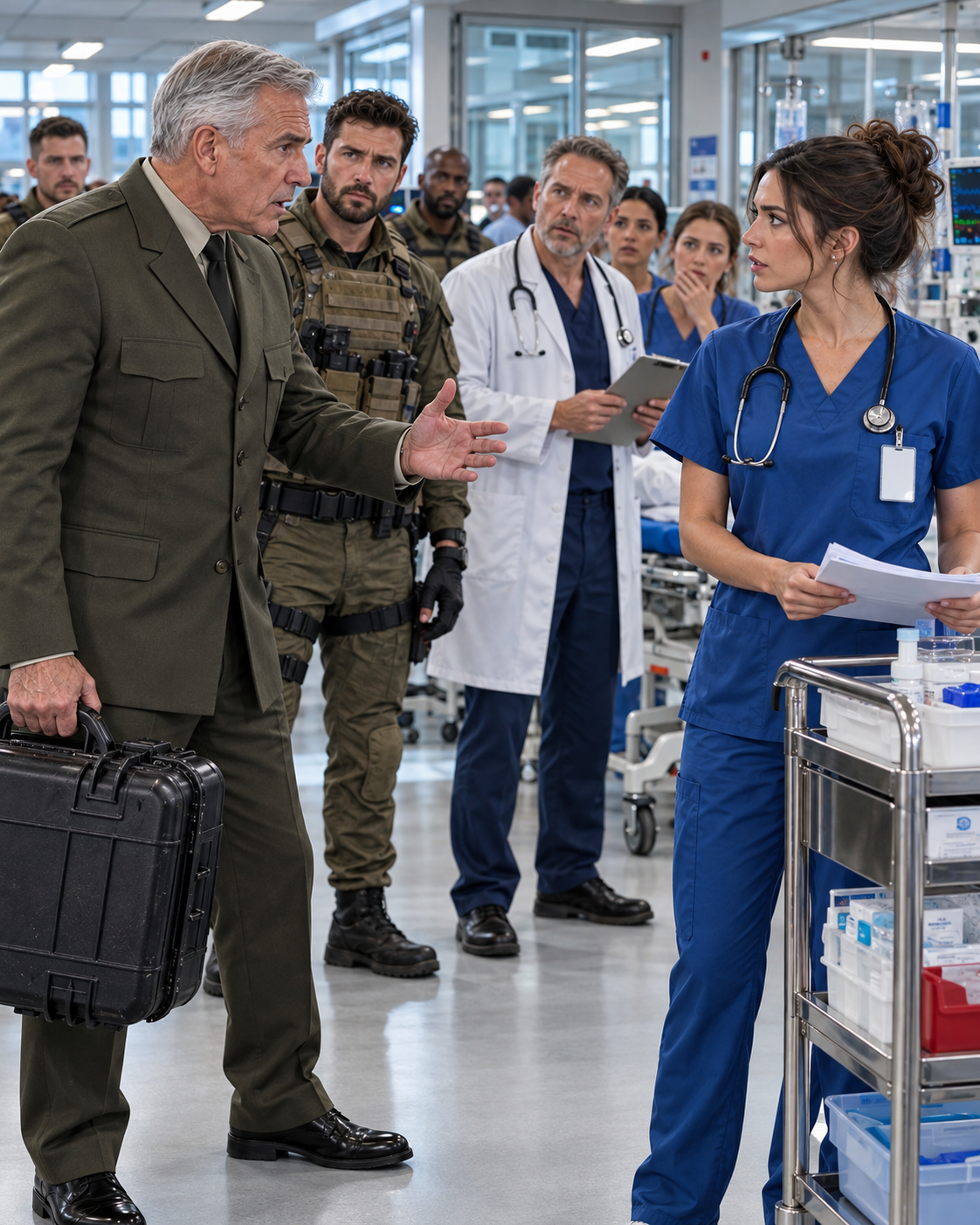
The moment Dr. Prescott called me a glorified supply nurse in front of a packed emergency room
The name Blackridge struck me harder than the general’s salute.
For ten years, I had trained myself not to react when people mentioned the dead, the missing, or the missions that never appeared in official reports. But Blackridge was different. Blackridge was the reason I had surrendered my uniform, packed a single suitcase, and promised myself that nobody would ever call me Valkyrie again.
“General, I need to know who wrote that message,” I said.
General Marcus Hale glanced at the soldier being wheeled toward surgery. “His name is Sergeant Daniel Mercer. He was found conscious at the crash site, but he refused to speak to anyone until the ambulance reached this hospital.”
“Did he say anything else?”
“He asked whether you were still alive.”
For a moment, I forgot how to breathe.
Daniel had been twenty years old when I first met him, a frightened communications specialist who apologized whenever he asked for help. I remembered teaching him how to wrap a wounded man’s leg, how to recognize shock, and how to keep his hands steady when everything around him was falling apart.
The last time I saw him, we were in the mountains outside Blackridge.
I had watched him climb into an evacuation helicopter with three other survivors.
Then an explosion swallowed the landing zone.
I had spent the next eleven days searching the wreckage before a commanding officer ordered me to stop.
The official report declared Daniel Mercer dead.
I had believed it because believing anything else hurt too much.
“He’s alive,” I whispered.
“Yes,” General Hale replied. “And someone went to extraordinary lengths to make sure he never reached this hospital.”
Behind us, Dr. Prescott cleared his throat.
“General, with respect, this is a civilian medical facility. We cannot simply allow armed personnel to dictate treatment.”
Hale turned toward him.
“My people aren’t here to dictate treatment, Doctor. They’re here because someone tried to kill them.”
Prescott straightened his coat. “And Nurse Vance has just performed an invasive procedure outside her normal responsibilities.”
I looked at him.
He wasn’t entirely wrong to be concerned about procedure, documentation, or the risks involved. But I could still see the fear beneath his indignation. He had watched a patient die in front of him and discovered that the person he had dismissed as incompetent possessed the calm he had lost.
“The procedure was performed because the patient was dying,” I said. “Document everything. Review every decision. But don’t turn a man’s survival into a contest over who outranks whom.”
Prescott’s lips parted, then closed.
General Hale studied me for a long moment.
“Captain, I need you in a secure room.”
I looked toward Trauma Two, where another soldier had just arrived with a chest wound.
“Then you’ll have to wait until my patients are stable.”
For the first time, the general almost smiled.
“That’s the answer I expected.”
The next four hours blurred into controlled chaos.
A young corporal arrived with fragments of metal embedded in his shoulder. A driver had a crushed pelvis and dangerously low blood pressure. Two soldiers suffered burns, and a third could barely breathe because his chest injury was preventing his lung from expanding properly.
I didn’t perform miracles.
I assessed, prioritized, communicated, and relied on the specialists around me. I knew when a patient needed surgery, when a transfusion could not wait, and when a quiet hand on someone’s shoulder mattered more than another shouted instruction.
I also knew the difference between courage and recklessness.
Every order had a reason.
Every second had a cost.
And every face reminded me of someone I had failed to bring home.
Prescott remained beside me, initially stiff and defensive, then increasingly attentive.
When I asked for blood products, he had them prepared. When I needed an anesthesiologist, he called directly. When a frightened junior nurse froze while preparing an emergency line, he guided her through the process without humiliating her.
It was the first time I had seen him treat his colleagues as people rather than obstacles.
At 8:47 p.m., the final critically injured operator was transferred to surgery.
I stepped into the staff washroom and turned on the faucet.
Blood swirled around the drain.
I scrubbed my fingers until the skin beneath my nails began to sting, but the water couldn’t wash away the memories rising behind my eyes.
Blackridge.
The ruined village.
The radio that had gone silent.
And Daniel’s voice, calling my name through the smoke.
“Clara?”
Prescott stood in the doorway.
I shut off the faucet.
“If you’ve come to tell me I violated hospital policy, I suggest you wait until tomorrow.”
“I came to apologize.”
I turned toward him, uncertain I had heard correctly.
He looked exhausted. Without his usual arrogance, he seemed older and strangely smaller.
“I saw what you did today,” he said. “And I realized something that I don’t like admitting.”
“What?”
“I’ve spent years believing that authority and competence were the same thing. If someone didn’t look the way I expected a doctor to look, or didn’t speak with the confidence I expected, I assumed they had nothing to teach me.”
He swallowed.
“When that soldier started dying, I knew the textbook answers. I knew the protocols. But I couldn’t make myself act. You did.”
I studied him carefully.
“Fear happens to everyone, Doctor. What matters is whether you let it make decisions for you.”
His eyes lowered.
“I treated you terribly.”
“Yes, you did.”
He nodded as if the blunt answer hurt more than any insult.
“I can’t undo that.”
“No. But you can stop doing it to the next person.”
For several seconds, neither of us spoke.
Then an officer appeared at the end of the corridor.
“Captain Vance, the general is ready.”
I followed him to a small conference room beside the hospital’s administrative wing.
General Hale stood over a table covered with photographs, printed reports, and a map of the interstate. Two military investigators waited beside him, their expressions severe.
He pointed to an empty chair.
“Sit down, Clara.”
I remained standing.
“Tell me what happened at Blackridge.”
Hale’s expression changed.
“I was hoping you’d say you remembered.”
“I remember every second.”
“Then you know why this convoy was transporting three members of your old unit under civilian identities.”
My gaze dropped to the photographs.
Daniel Mercer.
Lieutenant Evan Cole.
Sergeant Luis Bennett.
Three men I had believed dead or missing.
Three men who had once served under my command.
“Why were they together?”
“Because six weeks ago, Cole contacted military investigators with evidence that the Blackridge mission was deliberately compromised. Mercer was his primary witness. Bennett was carrying copies of the original operational logs.”
The room seemed to tilt.
“Compromised by whom?”
Hale slid a photograph across the table.
I recognized the man immediately.
Colonel Adrian Cross.
He had been my commanding officer at Blackridge, the man who promised that every member of our team would be extracted before the enemy closed in.
He was also the man who had ordered the evacuation helicopter to leave without me.
For years, I had told myself he had made an impossible decision under impossible circumstances.
I had needed that explanation to survive.
“Cross is under investigation,” Hale said. “He retired two years ago and now works as a defense contractor. We believe he arranged the convoy transfer after learning that Cole had recovered the original mission files.”
“Why would he risk killing his own men?”
“Because the files suggest he sold operational information to an intermediary. The information exposed our extraction route and left your team surrounded.”
I stared at the photograph.
Six soldiers had died at Blackridge.
I had carried the names of every one of them in my head, repeating them on sleepless nights as though remembering them could somehow keep them from disappearing.
“Why wasn’t this investigated?”
“It was investigated,” Hale said quietly. “But the evidence was incomplete, and the people who could have testified were officially dead.”
“Officially dead,” I repeated.
The words tasted like rust.
“Clara, there is something else.”
He opened a folder and removed a document bearing my signature.
I knew it before I read the first line.
It was the mission debrief I had signed after returning from Blackridge, injured and barely conscious. I remembered the medical tent, the morphine, and the intelligence officer who kept telling me that my team had died because the enemy had intercepted our communications.
But the report in front of me contained a paragraph I had never seen.
It stated that I had acknowledged receiving an unauthorized warning about the compromised extraction route and had failed to inform the team.
My name appeared beneath it.
My signature was real.
The words were not mine.
“I never said this.”
Hale’s voice was grim. “We know. The document was altered after you signed it.”
I gripped the edge of the table.
“Then someone used my signature to blame me for the mission.”
“Yes.”
The realization arrived slowly, then all at once.
I had spent ten years believing I was haunted by the men I couldn’t save.
Someone had made sure I would also believe their deaths were my fault.
The shame, the nightmares, the decision to abandon medicine in the military, the months I spent unable to enter a crowded room without searching for exits—all of it had been fed by a lie.
I lowered myself into the chair.
For the first time since the convoy arrived, I allowed myself to cry.
Not loudly.
Not dramatically.
Just enough for ten years of carefully controlled pain to escape.
General Hale waited without speaking.
When I finally looked up, I wiped my face with the heel of my hand.
“Where is Colonel Cross now?”
“At his residence outside Richmond. We have a warrant request underway, but we need the original files and testimony from the survivors.”
“Then we need Daniel awake.”
Hale nodded.
“He may be able to tell us who ordered the convoy attack.”
A sharp knock interrupted us.
One of the investigators checked his phone, and the color drained from his face.
“General, we’ve got a problem.”
He turned the screen toward Hale.
A message had been sent from an unknown number to a secure military contact.
STOP THE INVESTIGATION, OR VALKYRIE’S REMAINING WITNESSES WILL DIE.
Below it was a photograph of the hospital’s east entrance.
The image had been taken less than ten minutes earlier.
Someone was watching us.
Hale immediately ordered additional security around the patient wards. I returned to the emergency department, where Daniel remained in intensive care after surgery.
He was unconscious, his face pale beneath the hospital lights.
I stood beside his bed and looked at the young man I had once dragged through mud and smoke.
“You stubborn idiot,” I whispered. “You were supposed to be dead.”
His fingers moved.
I leaned closer.
“Daniel?”
His eyelids fluttered, and he struggled to focus on my face.
“Valkyrie?”
“I’m here.”
He tried to lift his head, but pain forced him back against the pillow.
“Cross,” he rasped.
“He’s being investigated. You’re safe for now.”
Daniel shook his head weakly.
“No. Not Cross.”
A chill crept down my spine.
“Then who?”
His eyes moved toward the closed door.
For one terrible second, I thought he had seen someone standing outside.
Then he gripped my wrist with surprising strength.
“The hospital.”
I stared at him.
“What do you mean?”
“Someone inside… sent him the files.”
His breathing became uneven, and the monitor accelerated.
“Daniel, listen to me. Don’t try to talk too fast.”
He forced the next words out.
“The person who changed your report… works here.”
The heart monitor began to shriek.
A nurse rushed into the room, followed by an intensive care physician. Daniel’s blood pressure was collapsing, and his oxygen level began to fall.
I stepped aside as the team moved in.
For several minutes, the room became a storm of commands and equipment. The physician identified a sudden complication and directed the necessary emergency treatment. I stayed near Daniel’s head, speaking to him whenever he seemed to surface.
“Stay with me,” I whispered. “You’ve made it this far. Don’t leave me now.”
Eventually, his vital signs began to stabilize.
The physician exhaled.
“We need to keep him sedated and monitor him closely.”
I nodded, but my attention had shifted to the glass panel beside the door.
A figure in dark scrubs had stood there moments earlier.
Now the corridor was empty.
I stepped outside.
The night nurse at the station looked up.
“Did you see someone leave this hallway?”
She frowned.
“Only Dr. Prescott. He said he was going to check a patient in the next wing.”
I felt the first real fear I had experienced that night.
Not because Prescott had behaved suspiciously before, but because Daniel’s warning had turned every familiar face into a question I could no longer ignore.
I found Prescott near the elevators, reading a patient chart.
“Did you enter Daniel Mercer’s room?”
He looked up sharply.
“Briefly. I wanted to review his condition.”
“Did you speak to him?”
“No. He was sedated.”
“Did you see anyone else in the corridor?”
His expression tightened.
“Clara, what is this?”
“Answer the question.”
He glanced toward the elevator doors.
“I saw a maintenance worker near the medication storage area. Why?”
Before I could respond, his phone rang.
He checked the screen and went completely still.
“Who is it?” I asked.
“Unknown number.”
He answered on speaker.
A distorted voice filled the corridor.
“Dr. Prescott, you’ve become involved in something you don’t understand. Go home, forget tonight, and nobody will get hurt.”
Prescott’s face drained of color.
The caller continued.
“Especially the nurse. She has already lost enough.”
The call ended.
For several seconds, neither of us moved.
Then Prescott looked at me, and I saw something new in his expression.
Not superiority.
Not embarrassment.
Fear for someone other than himself.
“We need to tell the general,” he said.
“We will. But first, I need you to tell me everything you know.”
He hesitated.
I could see the old instinct returning, the impulse to protect his reputation by withholding anything that might make him look foolish.
Then he opened his phone and showed me an email he had received three days earlier.
The sender’s address was disguised, but the message was clear.
It instructed him to review my employment history and report any unusual access to military records.
Attached was a scanned photograph of me wearing a combat medic’s uniform.
Someone had been investigating me long before the collision.
“I thought it was a background-check issue,” Prescott said. “I didn’t respond.”
“Did you forward it?”
“No.”
I studied his face.
For once, I believed him.
We took the email to General Hale, who immediately contacted the investigators. A preliminary review revealed that someone had used a hospital terminal to access restricted military casualty records shortly before the crash.
The terminal belonged to the administrative office.
Its access credentials belonged to Dr. Prescott.
He stared at the report in disbelief.
“I didn’t access those records.”
“Someone may have used your credentials,” Hale said. “We won’t know until the digital evidence is examined.”
Prescott looked at me.
“I swear I had nothing to do with this.”
I wanted to believe him, but Blackridge had taught me the danger of confusing trust with certainty.
“Then help us find out who did.”
For the next two hours, Prescott worked with the investigators to reconstruct the hospital’s access logs. His knowledge of the hospital’s systems helped them identify a maintenance account that had been used to enter restricted areas.
The account had been activated using a temporary badge assigned to a contractor.
The contractor’s name was Thomas Reed.
He had disappeared from the hospital’s maintenance roster six days earlier.
At 2:16 a.m., a security officer reported that a service vehicle was leaving the rear parking lot without authorization.
General Hale ordered the gates closed.
The vehicle accelerated toward the exit, struck a security barrier, and stopped.
Military police surrounded it.
Inside, they found no driver.
Only a discarded maintenance uniform, a burner phone, and a small envelope addressed to me.
My hands felt cold as I opened it.
Inside was a photograph of the Blackridge extraction site, taken before the mission began.
On the back, someone had written a single sentence.
YOU WERE NEVER SUPPOSED TO SURVIVE.
Beneath it was another name.
Not Adrian Cross.
Not Thomas Reed.
A name I recognized from the original mission roster.
Major Samuel Whitaker.
My second-in-command at Blackridge.
The man who had supposedly died while covering our retreat.
I stared at the photograph until the edges blurred.
Whitaker had been the one person I had trusted without hesitation. He had taught me to shoot, challenged my medical decisions, and once stayed awake for thirty-six hours to keep a wounded soldier alive because I had promised the man’s family we would bring him home.
I had watched the building where he was trapped collapse.
I had seen the fire.
I had signed the casualty report with shaking hands.
“General,” I whispered, “this doesn’t make sense.”
Hale looked over my shoulder.
“No,” he said. “It doesn’t.”
A new message arrived on the burner phone.
No one touched it until the investigators finished documenting the evidence.
The message contained a location outside the city and a time: 5:00 a.m.
Below it were seven words.
COME ALONE, VALKYRIE. I OWE YOU THE TRUTH.
Hale immediately rejected the idea.
“It’s a trap.”
“Probably.”
“Then you’re not going.”
I looked through the glass toward Daniel’s room.
He was alive because someone had finally brought the truth into the open. But if Whitaker was alive, he might be the only person who could explain why Blackridge had been betrayed and why the conspiracy had reached into this hospital.
“I won’t go alone,” I said. “But I need to hear what he has to say.”
The general studied me for a long moment before nodding to his investigators.
“We do this carefully. Nobody makes a move without my authorization.”
At 4:52 a.m., I stood inside an unmarked vehicle near an abandoned rail depot on the outskirts of Richmond.
The sky was beginning to lighten.
Rain tapped against the windows.
My hands were steady, but my heart felt as though it belonged to someone younger, someone who still believed that answers could undo pain.
A figure emerged from the shadows beside the tracks.
He walked with a slight limp.
His hair had gone gray at the temples, and a scar crossed his jaw.
But I recognized the way he carried his shoulders.
“Whitaker,” I whispered.
He stopped beneath a broken security light.
“Hello, Clara.”
I stepped out of the vehicle, with the general’s team positioned out of sight nearby.
“You let me believe you were dead.”
His face tightened.
“I know.”
“You let me spend ten years believing I had abandoned my people.”
“I know.”
“Then explain it.”
For a long moment, he looked at me as if he were searching for a version of the past that would hurt less to tell.
“Cross sold our extraction route,” he said. “He believed the enemy would capture the equipment, not the team. When the ambush began, he ordered the helicopter away because he knew the survivors could identify the breach.”
My throat tightened.
“And you?”
“I found the original communications logs. Cross had the evacuation order altered, and your debrief was changed to make it look as though you had ignored the warning.”
“Why didn’t you come forward?”
His eyes filled with something that looked almost like shame.
“Because I was afraid. Cross had people inside military intelligence, and he threatened my family. I disappeared before they could find me.”
“You could have contacted me.”
“I tried once. They intercepted the message.”
He reached into his coat and removed a small memory card.
“This contains the original transmissions, the financial records, and the names of the people who helped bury the evidence. Cross wasn’t working alone.”
I stared at the card.
“Who else?”
Whitaker’s gaze shifted toward the hospital in the distance.
“Someone who has spent years protecting the people responsible.”
Before I could ask another question, he looked past me and shouted, “Down!”
A sharp crack split the morning air.
Whitaker staggered.
I caught him as he fell, my hands instinctively pressing against the wound beneath his ribs.
For one terrible second, Blackridge returned in full: the screaming radios, the collapsing walls, the blood beneath my knees.
But this time, I was not the only one who knew how to fight for his life.
“Medical team, move!” I shouted into the concealed microphone.
Whitaker gripped my sleeve.
“Clara, don’t let them erase it again.”
“Save your strength.”
“I should have come back.”
His voice broke.
“I should have told you the truth.”
I pressed harder against the wound.
“Then stay alive long enough to tell it.”
The military team reached us within seconds and moved Whitaker into the vehicle. The shooter escaped into the rail yard, but the investigators recovered a second phone containing messages that connected the attack to Cross’s network.
Whitaker survived surgery.
The memory card survived too.
Over the following weeks, investigators uncovered a chain of corruption that reached far beyond one disgraced colonel. Several officers were suspended, financial records were seized, and the altered Blackridge report became central evidence in a formal inquiry.
Daniel recovered slowly.
When he could finally sit upright, I visited him with a cup of terrible hospital coffee.
He smiled weakly.
“Still bossing everyone around, Valkyrie?”
“Only the difficult patients.”
He laughed, then grew quiet.
“Did you find out what happened?”
“Enough to know that the truth is finally being heard.”
He looked toward the window.
“I used to think surviving was the same as winning.”
“So did I.”
“What do you think now?”
I considered the question.
“I think surviving gives us a chance to do something with the pain. It doesn’t erase what happened, but it means the people we lost don’t have to be remembered through lies.”
Daniel reached for my hand.
For the first time in ten years, remembering Blackridge did not feel like standing alone among the dead.
It felt like standing beside the living.
Dr. Prescott changed too, though not overnight.
He began listening before speaking, admitting uncertainty when he felt it, and treating nurses and junior staff as professionals whose judgment deserved consideration. When the hospital’s board questioned my actions during the collision, he testified honestly about what had happened and refused to let the discussion become an excuse to discredit me.
“I was wrong about Clara Vance,” he told them. “More importantly, I was wrong about what makes someone capable of saving a life.”
I remained at St. Jude.
Not because I had forgotten the battlefield, but because I had finally understood that I didn’t need to escape every memory to build a future.
I still woke sometimes from dreams of smoke and broken radio signals. Some nights, I still heard the voices of people I couldn’t save.
But now, when the memories came, I no longer treated them as proof that I had failed everyone.
I treated them as proof that I had loved people enough to carry their names.
Three months after the collision, General Hale visited the hospital with the findings of the investigation.
Cross had been arrested.
Whitaker’s testimony had confirmed the conspiracy, and the evidence had cleared my name of the false accusations surrounding Blackridge.
Hale placed a sealed envelope on my desk.
“There’s one final item,” he said. “We recovered it from an intelligence archive that Cross had been trying to destroy.”
Inside was a photograph of my old team.
Seven soldiers stood beside a transport helicopter, smiling beneath a cloudless sky.
I recognized every face.
But someone had written a date on the back that didn’t match the official mission records.
Beneath the date was a handwritten note.
ONE SURVIVOR WAS NEVER ACCOUNTED FOR.
I looked up at the general.
“Who wrote this?”
“We don’t know yet.”
I turned the photograph over again.
At the edge of the image, partly obscured by the helicopter’s open door, stood a figure I had never noticed before.
The face was blurred, but the insignia on the uniform was unmistakable.
It belonged to a unit that had officially been dissolved two years before Blackridge.
I felt the old fear rise, familiar but no longer powerful enough to silence me.
“General,” I said, “I think this goes deeper than Cross.”
Hale nodded slowly.
“Then we’ll find out how deep.”
That evening, I returned to the emergency department.
A young nurse was struggling to prepare a trauma cart while an impatient physician criticized her from across the room.
I watched her shoulders fold inward, saw the apology forming on her lips, and remembered the woman I had been before the world demanded that I become Valkyrie.
I walked over and stood beside her.
“Take a breath,” I said gently. “Tell me what you need, and we’ll work through it together.”
She looked at me, surprised.
“You’re not angry?”
“Being afraid doesn’t make you incapable. And making a mistake doesn’t mean you have nothing to offer.”
Her eyes brightened, and she turned back to the cart.
For the first time in years, the emergency room felt less like a battlefield and more like a place where people could learn to save one another.
I still wore my civilian uniform.
I still kept my old identification tag locked in a drawer.
But I no longer believed that becoming invisible was the same as finding peace.
Some wounds heal slowly.
Some truths arrive too late to save the people we lost.
And some secrets wait patiently until the people who buried them begin to believe they have won.
I had spent ten years trying to leave Blackridge behind.
Now I understood that the past had never truly been chasing me.
It had been waiting for me to stop running.
And when I looked once more at the photograph of my old team, I made myself a promise.
I would find the missing survivor.
I would uncover every lie.
And this time, no one would have to carry the truth alone.