The moment Dr. Arthur Pendleton shoved a syringe into my gloved hand beneath Alexandria Memorial Hospital
For several seconds, I couldn’t hear anything except the pounding of my own heart.
“What do you mean, someone selected me?”
Special Agent Jonathan Reed stepped around a pool of shattered glass and lowered his voice.
“I mean your assignment wasn’t a staffing decision, Miss Collins, and the physician who signed your ward orders wasn’t working alone.”
Behind him, federal agents moved through the ruined entrance, securing weapons, identifying the wounded, and calling for additional medical personnel.
The Ghost Ward no longer looked like a hospital unit.
It looked like a crime scene that had finally stopped pretending to be a place of healing.
I glanced at Wyatt, whose chest rose and fell beneath the oxygen mask, then at Carter, who was conscious but too weak to sit up without help.
“Whatever you think I know,” I told Reed, “I didn’t know any of this until today.”
“I believe you.”
He said it without hesitation, which somehow frightened me more than suspicion would have.
“Then tell me why I was brought here.”
Reed looked toward the security cameras mounted above the corridor.
“First, we get everyone alive out of this room.”
For the next twenty minutes, I forgot about conspiracies, forged orders, and the doctor lying dead near the doorway.
Wyatt needed continued monitoring, Carter required emergency treatment, and Mercer was struggling against the effects of the same poison that had nearly killed his men.
The arriving emergency team took over the resuscitation under federal supervision, while I gave a detailed account of the symptoms I’d observed and the treatment I had initiated.
Every time I closed my eyes, I saw Wyatt’s fingers tightening around my wrist.
Don’t let him put me to sleep.
When they finally moved the surviving SEALs toward the hospital’s main intensive care unit, Mercer caught my sleeve.
His hand was weak, but his gaze was clear.
“You saved Wyatt.”
“I treated him.”
“No,” he said. “You listened.”
He released my arm before the agents wheeled him through the doors.
I watched the bed disappear down the corridor, suddenly aware that my knees were shaking so violently I had to lean against the wall.
A nurse named Danielle, one of the few hospital staff members permitted into the Ghost Ward, handed me a blanket.
“You’re freezing.”
“I didn’t notice.”
“You don’t have to notice everything at once.”
Her kindness nearly broke me.
I wrapped the blanket around my shoulders and looked toward the broken doors.
Three weeks earlier, I had walked into this hospital carrying a new stethoscope and a lunch my father had packed for me.
I had believed the hardest part of nursing would be learning to live with grief when I couldn’t save a patient.
I hadn’t imagined that someone might deliberately put me in a room where saving a patient could get me killed.
Reed returned with a slim folder and two other investigators.
“Your assignment was submitted through the hospital’s emergency staffing system seventy-two hours before Hayes arrived,” he said. “The request was approved by Dr. Pendleton and authorized using the credentials of the director of nursing, Dana Voss.”
“Dana hired me.”
“That’s why we need to speak with her.”
“Do you think she knew?”
“I think the evidence will tell us more than suspicion ever will.”
He opened the folder and showed me the assignment form.
My name appeared at the top.
Below it were my employee number, training record, and a handwritten note that made my stomach turn.
NEW STAFF. LIMITED DEPARTMENTAL CONNECTIONS. SUITABLE FOR OBSERVATION DUTY.
I read the words again.
“Observation duty?”
“That’s what the request called it.”
“But I was told I was helping with a special case.”
Reed nodded.
“The official schedule said you were shadowing an attending physician in a restricted unit, which wasn’t unusual enough to trigger a review.”
He pointed to the next line.
“Someone deliberately made the assignment look ordinary.”
I couldn’t stop staring at my employee number.
My name had been turned into a tool before I’d even entered the ward.
“Why me?”
Reed hesitated, choosing his words with care.
“We’re still establishing that, but Pendleton had access to your training evaluation.”
“My evaluation said I was inexperienced.”
“It also said you were meticulous about documentation and uncomfortable challenging senior staff.”
I felt the room grow smaller.
During my final clinical rotation, an instructor had once told me I was too cautious to succeed in a busy hospital.
I’d taken that criticism seriously and spent weeks trying to become more decisive.
Now someone had read the same evaluation and seen an opportunity.
“They expected me to obey,” I whispered.
“Probably.”
“And if I had given Wyatt the morphine?”
Reed closed the folder.
“His death would likely have been recorded as an expected outcome of his supposed injuries, with your signature on the administration record.”
A wave of nausea rolled through me.
The syringe I had thrown away had not merely represented a mistake.
It had been the final step in a plan designed to make a murder look like compassionate care.
Reed let me sit in silence before adding another piece of information.
“The order was created before the mission team was officially admitted to this hospital, but we have evidence that Pendleton received advance notice of possible casualties.”
“From Blackbriar?”
“We believe someone associated with that company supplied the information.”
I pictured the mercenaries cutting through the reinforced doors and Pendleton trying to bargain with them.
They hadn’t come to rescue him.
They had come to eliminate witnesses.
“What exactly happened to Wyatt’s team?”
Reed pulled a chair closer.
“Three weeks ago, Commander Mercer and his team were assigned to a classified operation involving a remote logistics facility overseas.”
He explained that the team had been transporting sealed samples after discovering discrepancies in a supposedly routine water-quality inspection.
The operation had been authorized, but the evidence suggested that part of the site’s water supply had been contaminated by an unauthorized chemical agent.
The men had reported unusual symptoms among personnel who drank from the affected containers.
Their initial report was treated as a possible equipment failure, then quietly reclassified.
When they attempted to preserve samples for independent analysis, the chain of custody was broken.
Someone substituted documents, removed records, and told their command that the suspected contamination was caused by an accidental industrial exposure.
“Why would anyone poison the water?”
“We don’t know the full motive yet,” Reed said. “But the company responsible for supplying the filtration equipment was Blackbriar Strategic Solutions, and their contract included penalties for certain kinds of safety failures.”
“So they covered up a failure to protect their contract?”
“That is one possibility under investigation.”
He didn’t embellish the explanation or pretend the case was already solved.
That made me trust him more.
When the SEALs attempted to report the discrepancy through channels they believed were compromised, they were redirected to the Ghost Ward under the pretense of secure medical evaluation.
Their symptoms were documented as chemical burns, their charts were restricted, and their access to independent specialists was blocked.
Wyatt’s team had not entered Alexandria Memorial to die.
They had entered because someone promised them they would receive proper treatment.
Instead, the hospital had become another part of the operation designed to silence them.
I pressed the blanket against my chest.
“Who authorized a place like this?”
“That’s one of the questions we’re answering.”
“Does the hospital director know?”
“We’re going to ask.”
Reed stood and signaled to an agent waiting near the corridor.
Before he left, I caught his sleeve.
“I need you to understand something.”
He turned.
“I didn’t save Wyatt because I wanted to defy anyone.”
“I know.”
“I saved him because he was dying in front of me and the treatment didn’t make sense.”
Reed studied my face.
“Sometimes that’s the entire difference between a witness and a victim.”
Then he walked away.
For the next hour, federal agents interviewed the Ghost Ward staff while a separate team secured the hospital’s medication records and electronic access logs.
I was given a quiet room near intensive care, but I couldn’t bring myself to sit down.
Every sound reminded me of the cutting saw.
Every time the door opened, I expected to see Pendleton return with another order.
Eventually, a hospital administrator escorted Dana Voss into the room.
She had been the person who signed my employment documents, introduced me to the senior nursing staff, and told me that a good nurse never stopped advocating for her patients.
Now her face was pale, and she couldn’t meet my eyes.
“Avery, I didn’t know what they intended to do to you.”
I remained standing.
“Did you approve my assignment?”
“Yes.”
“Why?”
She rubbed her hands together.
“Pendleton told me the unit was short-staffed and needed a nurse who had completed the emergency care module.”
“You could have checked the details.”
“I should have.”
“Did you know it was called the Ghost Ward?”
Her eyes filled with tears.
“I knew there was a restricted unit, but I didn’t know what happened there.”
Reed entered with another agent and placed a printed email on the table.
“Ms. Voss, we’d like you to explain this message sent from your office account.”
Dana stared at the page.
The email instructed staffing to assign me to the restricted ward and remove my name from the ordinary rotation for the day.
It carried her authorization, but the routing details showed that it had been generated from Pendleton’s workstation.
“I didn’t write this,” she whispered.
Reed didn’t immediately respond.
Instead, he laid a second document beside the first.
It was an access audit showing that someone had used Dana’s credentials while she was attending a nursing leadership conference outside the hospital.
Dana pressed her fingers to her mouth.
“He told me my account would be used to approve routine transfers,” she said. “He said the hospital was preparing for a classified military arrival, and that everything had been cleared by federal authorities.”
“Did you verify that?”
“No.”
Her voice cracked.
“I thought refusing would jeopardize my position and the hospital’s military contract.”
I felt anger rise in me, but beneath it lay something more painful.
She had not planned the murder, as far as we could establish, but her fear had made someone else’s cruelty easier.
“People trusted you,” I said.
Dana lowered her head.
“I know.”
Reed explained that her cooperation would be documented, but investigators would determine her responsibility based on the evidence.
She agreed to surrender her access credentials and provide a complete account of every instruction Pendleton had given her.
When she left, I felt no satisfaction.
I had wanted one person to tell me there was a simple explanation, one mistake that could be corrected, one apology that would put the hospital back together.
Instead, I was discovering how many people had allowed small compromises to become a system of silence.
Later that afternoon, Wyatt regained enough strength to speak with me.
His voice was hoarse, and his face looked impossibly young without the hard expression he had worn when he first woke.
“Did everybody make it?”
“Carter is alive, and so is Commander Mercer.”
His eyes closed with relief.
“Bull?”
“He’s being checked for exposure, but he’s alive too.”
Wyatt let out a breath that almost became a laugh.
“Bull’s going to be furious he missed the worst of the action.”
“Maybe save the jokes until your physician says you’re ready.”
He studied me carefully.
“You’re the nurse who wouldn’t give me the injection.”
“I was supposed to give you the wrong treatment.”
“You were supposed to follow an order,” he corrected. “You chose to think.”
I looked toward the window, where the afternoon sun fell across the hospital roof.
“I was scared.”
“So was I.”
He said it quietly, without the bravado I had expected from a man whose profession required extraordinary courage.
“I heard Pendleton outside the room before you came in,” Wyatt continued. “He said there was no point transferring me because I wouldn’t survive the night.”
My throat tightened.
“I was beginning to believe him.”
“Why didn’t you tell someone sooner?”
His expression darkened.
“We did tell someone.”
He explained that the team had submitted reports after the first cases of exposure, but the information disappeared into a chain of restricted systems that returned no useful answers.
Their command had been told to stop speculating until the medical results were complete.
Then a witness who had seen the water samples was reassigned, and another was warned that discussing the incident could violate national security requirements.
“We weren’t trying to expose a military secret,” Wyatt said. “We were trying to stop someone from making people sick and calling it an accident.”
I thought about how often I’d seen frightened patients apologize for asking questions.
I had sometimes mistaken a quiet patient for a cooperative one.
Now I understood that silence could mean trust, but it could also mean fear.
“I’m glad you grabbed my arm,” I said.
“So am I.”
He drifted toward sleep, and I stepped into the corridor to let him rest.
Commander Mercer was waiting near the nurses’ station, his arm in a sling and his face marked by exhaustion.
“Agent Reed says you’re the reason my team has a chance to testify.”
“I didn’t do anything special.”
“That’s not true.”
He glanced toward Wyatt’s room.
“You could have protected your career by obeying the attending physician and telling yourself that a specialist knew more than you did.”
“I thought about it.”
“Of course you did. That’s what makes the choice matter.”
For a moment, his composure slipped.
“People trust us to bring them home, Nurse Collins, and sometimes that promise is the only thing keeping them moving.”
His voice grew quieter.
“I nearly lost three men because someone decided the truth was more expensive than their lives.”
I didn’t have an answer that could make that sentence hurt less.
So I stood beside him until a nurse arrived to take him back for further examination.
That evening, Reed asked me to review a limited set of records with the investigation team.
The hospital had maintained an internal archive for restricted admissions, separated from the ordinary electronic medical record system.
Pendleton’s credentials allowed him to create altered diagnostic summaries, but the archive retained earlier versions and timestamps.
We were not allowed to change anything or handle evidence without supervision.
Our task was simply to identify the records I remembered from the ward and confirm the sequence of events.
The first files showed that Wyatt’s symptoms had been documented as consistent with an unknown toxic exposure before his official diagnosis was changed.
Another file contained an order to discontinue further testing.
A third showed that the proposed morphine administration had been entered before I arrived.
The timestamps told a story no polished report could conceal.
Pendleton had already decided what the medical record would say before he knew whether Wyatt could be saved.
Then we found a message addressed to an account identified as BLACKBRIAR LIAISON.
It read, “The designated nurse is in place. Following expected termination, the chart will be reconciled with the injury classification.”
I read the sentence twice.
“Expected termination,” I whispered.
Reed’s expression hardened.
“That’s why we’re treating this as more than a medical misconduct investigation.”
The message did not prove who had written every instruction, but the recipient, timing, and related documents gave investigators a clear path to follow.
A second message referred to a contingency plan in the event that any patient recovered sufficiently to communicate.
The language was deliberately vague, but it matched the events in the ward.
Blackbriar had not merely expected Wyatt to die.
Someone had planned what to do if he survived.
“What about the mercenaries?” I asked.
“Their identities are still being established, but evidence from the scene connects their equipment and communications to Blackbriar’s security network.”
“And Pendleton?”
“He appears to have believed he could trade information for protection.”
I remembered the doctor standing with his hands raised as the armed men entered.
For a moment, I had almost pitied him.
Then he had offered to sacrifice everyone else to save himself.
I wondered how many small decisions it took for a person to become that frightened of the truth.
As the investigation continued, an additional detail emerged from the medical archive.
My employee number had been entered into the staffing request manually, and a note attached to the request stated that I had no previous connection to the patients.
At first, the investigators thought it meant Pendleton had simply wanted a nurse unlikely to recognize the SEALs.
But the access logs exposed a more deliberate effort.
The same workstation had opened my training evaluation the night before the assignment was created.
Someone had reviewed my medication competency, my clinical rotation history, and the report I’d filed during training after noticing a discrepancy in a patient’s chart.
That report had been minor, involving a medication record that didn’t match the bedside notes.
I had raised the concern because I thought someone had made an ordinary mistake.
My instructor had told me to be more careful about challenging experienced staff without understanding the entire situation.
I had learned from the incident, but I hadn’t realized anyone outside my training program would ever read the report.
“Why would Pendleton care about that?” I asked.
Reed considered the possibilities.
“Maybe he wanted someone whose habits he thought he understood. Maybe he thought a new nurse would be easier to control. We can’t establish his exact reasoning from the note alone.”
The uncertainty irritated me, but Reed refused to turn an inference into a fact.
“That is the difference between what we suspect and what we can prove,” he said. “The evidence is strong enough to show your assignment was engineered. It may never tell us every thought behind it.”
For the first time since the raid, I felt my breathing settle.
I had spent hours wanting the entire scheme to make sense, as though a perfect explanation could somehow make it less terrible.
But the central truth did not require a complete account of Pendleton’s mind.
He had tried to use a junior nurse to make a planned death look legitimate.
I had refused, and Wyatt was alive.
Over the next several days, the surviving SEALs remained under medical observation while federal investigators interviewed hospital staff and secured the restricted records.
Carter’s recovery was slower than Wyatt’s, and Mercer struggled with the knowledge that someone had targeted his team after they tried to report the contamination.
Bull spent much of his time sitting beside Carter’s bed, pretending he had come only to complain about the hospital food.
One afternoon, I found him helping Carter open a packet of crackers.
“You know,” Bull said, “for a guy who complains about hospital food, you’re doing a terrible job of escaping it.”
Carter gave him a tired smile.
“I’m saving my strength for when I have to listen to you tell this story for the next twenty years.”
Their laughter was quiet and fragile, but it filled the room in a way that the monitors couldn’t measure.
I stood at the door and let myself smile.
The sound reminded me that saving a life was not always a grand gesture.
Sometimes it meant buying someone enough time to complain about breakfast, tease a friend, or make plans for a future they had nearly lost.
A week after the attack, Reed told us that several Blackbriar employees had been detained for questioning, and investigators were tracing financial transfers associated with Pendleton’s consulting accounts.
The company’s executives denied directing any violence and claimed the contaminated water had resulted from an isolated failure by a subcontractor.
Those denials would be tested against the evidence in court.
The government also began reviewing the hospital’s restricted-unit procedures, including how patients had been admitted, who could alter their diagnoses, and why the records had been withheld from ordinary oversight.
Alexandria Memorial announced an independent audit and placed several administrators on leave.
Dana Voss cooperated with investigators, although her final responsibility would be determined through the appropriate process.
I was interviewed repeatedly, sometimes for hours, and every time I described the syringe in my hand, I felt the same cold pressure in my chest.
I worried that someone would decide I should have recognized the danger earlier.
I worried that I had missed a symptom or delayed a treatment.
I worried about what would have happened if Wyatt hadn’t managed to speak.
One morning, I finally admitted those fears to the hospital’s counseling specialist.
“What if I made the wrong decision for the wrong reason?” I asked.
She listened without interrupting.
“Did you act to protect yourself, or did you act because the patient needed help?”
“I acted because he was dying and the signs didn’t match the diagnosis.”
“Then let the investigation examine the treatment and let the evidence answer the questions it can answer. You don’t have to turn every uncertainty into a personal failure.”
I thought about that for a long time.
Nurses were taught to check their work, question discrepancies, and learn from mistakes.
But there was a difference between accepting responsibility and carrying blame that belonged to someone else.
I could review my decisions honestly without pretending I had caused the conspiracy.
I could acknowledge the fear without letting it decide what kind of nurse I would become.
When Wyatt was finally cleared to leave the hospital, he asked to see me before his discharge.
He stood slowly, still unsteady, and held out a small folded note.
“My team wanted you to have this.”
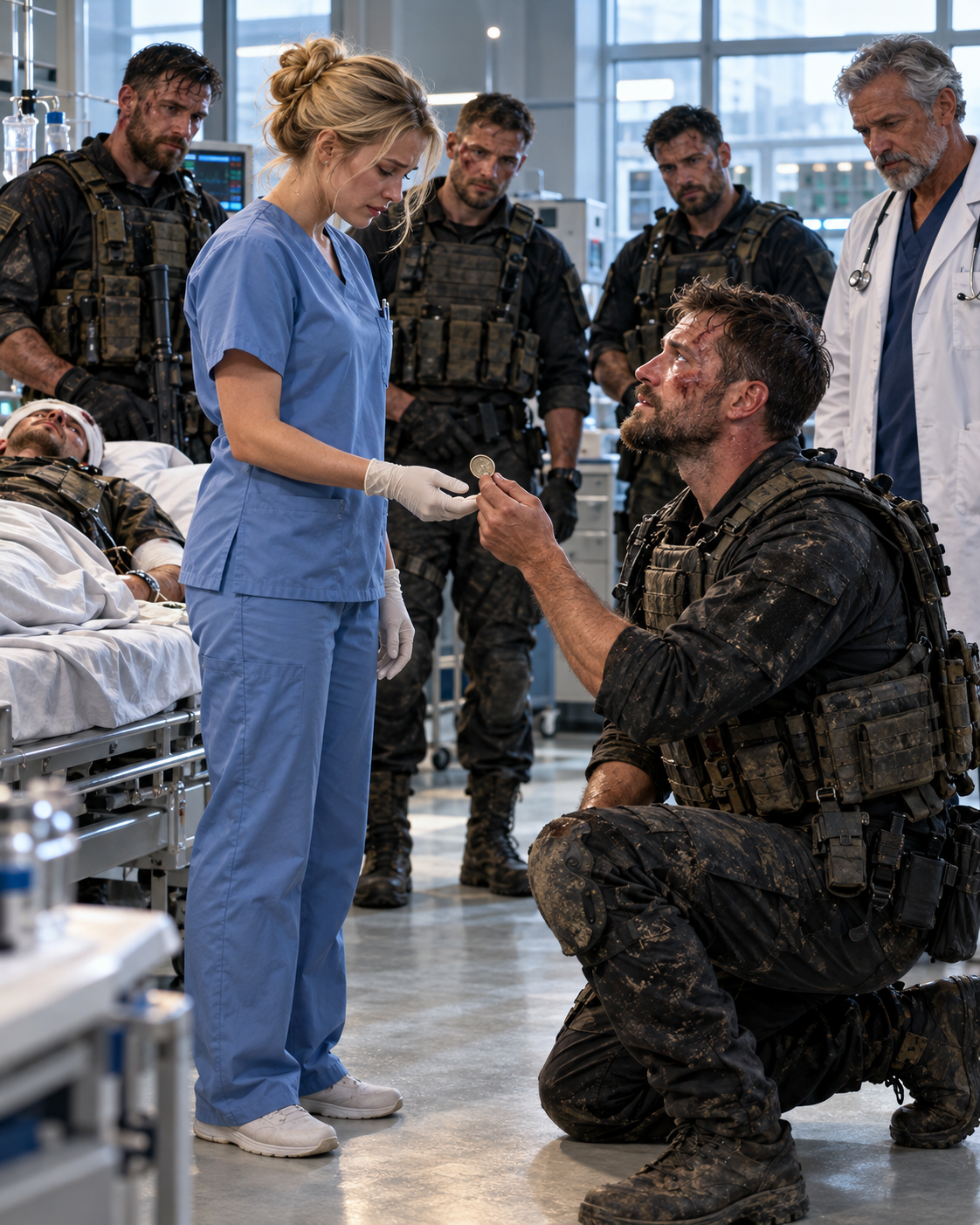
Inside was a photograph of the four SEALs before the operation, standing together beneath a gray sky with their equipment over their shoulders.
On the back, someone had written, “You reminded us that we are people before we are targets.”
I swallowed hard.
“I don’t know what to say.”
Wyatt smiled.
“You don’t have to say anything.”
Then he grew serious.
“Just remember something, Avery. The people who tell you not to ask questions aren’t always trying to protect you.”
He tucked the photograph into my hand.
“Sometimes they’re protecting what they’d lose if you found the answers.”
I kept that photograph in the top drawer of my desk.
The investigation lasted months, and the legal proceedings took longer than any of us hoped.
Evidence from the restricted archive, financial records, and witness testimony helped establish that patient records had been deliberately altered and that Blackbriar-linked personnel had attempted to obstruct the investigation.
The full chain of responsibility was more complicated than a single villain and a single confession.
Some people had acted knowingly, others had ignored warnings, and still others had trusted authority when they should have demanded verification.
Pendleton could never answer for his choices, but his death did not end the inquiry.
The people who had helped create the system were still alive, and the evidence could not be allowed to disappear with him.
When Alexandria Memorial reopened the restricted unit under new oversight, the name Ghost Ward was removed from the door.
A new team reviewed every patient admission, every medication order, and every request that restricted information from ordinary clinical review.
I returned to nursing after a period of leave.
My first shift back was on an ordinary medical floor, where an elderly patient complained that his soup was cold and a child cried because she couldn’t find her stuffed rabbit.
The ordinary sounds felt miraculous.
I checked medication lists, changed dressings, and listened to frightened families ask questions they had rehearsed in the elevator.
Nothing about the work looked heroic.
But each time a patient hesitated before telling me something important, I slowed down and listened.
I never wanted another person to feel that the only way to survive was to whisper a truth while gripping the arm of a stranger.
Months later, I met Reed outside the hospital after the latest round of hearings.
He told me the investigation had uncovered evidence that more than one patient in the restricted unit had received a misleading diagnosis, although not every case could be conclusively connected to the same scheme.
The review would continue, and the hospital would be required to preserve its records for independent examination.
“Do you think they’ll ever find everything?” I asked.
“Maybe not,” he said. “But they won’t find anything we stop looking for.”
I thought about the nurse I had been three weeks into my career, worried about making a mistake and desperate to prove I deserved the job.
I had believed professionalism meant learning when to speak and when to stay quiet.
Now I understood that it also meant recognizing the moment silence becomes part of the harm.
“I almost gave him the injection,” I admitted.
“But you didn’t.”
“I could have lost my license. I could have lost my job.”
Reed nodded.
“Doing the right thing doesn’t guarantee you won’t pay a price.”
He paused before adding, “It means you understand which price you can live with.”
That evening, I visited Wyatt and Carter at a small gathering the team had organized after their recovery.
Mercer stood by the window, quieter than the others, while Bull argued that he deserved credit for keeping the team alive despite having contributed mostly profanity and a great deal of stubbornness.
Carter laughed until he had to sit down.
Wyatt saw me enter and raised his glass of sparkling water.
“To Nurse Collins,” he said. “The only person in that building who listened when the rest of the room had already decided what was true.”
I shook my head, embarrassed by the attention.
“To the people who kept fighting long enough to tell someone.”
We raised our glasses.
For a moment, the terrible night belonged to the past, and the room was simply full of people who had been given another chance to live.
I returned to the hospital the following morning with the photograph in my pocket.
A patient in room twelve was refusing a treatment because he was certain the previous medication had made him worse.
The attending physician was busy, and the nurse beside me whispered that the patient was being difficult.
I pulled up a chair.
“Tell me what happened,” I said.
He looked surprised that I had asked.
Then he began to talk.
I listened carefully, checked the record, and called the attending to review the concern with us.
It turned out the patient had experienced a side effect that needed to be addressed, not dismissed.
The treatment plan was adjusted, and he finally relaxed against his pillow.
As I left the room, I thought about how close Wyatt had come to dying because his words were treated as an inconvenience.
I thought about Pendleton, whose authority had made people afraid to question him, and about Dana, whose fear had allowed the wrong person to use her name.
I thought about the agents who had arrived after the gunfire, the surviving SEALs, and the evidence that would continue to demand answers long after the hospital repaired its doors.
I was still young.
I would make mistakes, have difficult shifts, and face moments when I would not immediately know the right answer.
But I had learned that expertise did not make anyone infallible, and authority did not turn a falsehood into truth.
The responsibility to care for another human being required more than obedience.
It required attention, courage, humility, and the willingness to ask one more question when something didn’t make sense.
Years later, people would sometimes ask whether I had been afraid when I threw the morphine away.
I would tell them the truth.
I was terrified.
I was terrified of the doctor, the consequences, the armed men, and the possibility that my judgment could be wrong.
Courage had not appeared as a sudden absence of fear.
It had appeared as the decision to keep looking at the patient while the fear tried to make me look away.
And whenever I passed the corridor that led to the former Ghost Ward, I remembered Wyatt’s trembling fingers around my wrist and the words he had fought to get out.
“It’s in the water.”
He had been telling me more than how he was poisoned.
He had been telling me that the danger was already inside the system, hidden beneath familiar labels and protected by people who expected no one to question them.
I could not promise that every hidden truth would be uncovered or that every person responsible would face the consequences they deserved.
I could promise that I would not confuse a quiet room with a safe one, a signed order with a correct one, or a powerful person’s confidence with proof.
Because the night at Alexandria Memorial taught me something no textbook ever could: the most dangerous moment in medicine is not always when a patient stops breathing.
Sometimes, it is the moment everyone in the room decides there is nothing more to ask.
And sometimes, one frightened rookie nurse asking the wrong question is the only reason anyone gets to go home.