The moment Doug Ellery opened my locker at Mercy Valley Medical Center and discovered a locked black firearm case inside
Part 2
Howard Reyes pulled out the chair beside mine and sat down, placing his folder directly over the photograph of locker 47.
“I need everyone in this room to understand something before this conversation goes any further,” he said. “Ms. Vance has not committed a policy violation based on the information currently before you.”
Denise looked down at her notes.
“Director, we discovered a secured firearm case in an employee’s assigned locker. We have a duty to investigate.”
“Yes, you do.”
His answer came so quickly that she looked up.
“And Mr. Ellery followed the appropriate procedure by stopping the inspection and reporting the discovery. He did exactly what he was supposed to do.”
Doug’s expression changed, but Howard wasn’t finished.
“The problem is not the inspection. The problem is that the institution has two authorization systems operating without a clear point of coordination.”
Martin frowned.
“Two authorization systems?”
Howard opened the leather folder.
“Several months ago, Mercy Valley implemented a confidential security-placement directive to address specific high-risk situations within the hospital. The program operates under restricted administrative authority and is not distributed through ordinary departmental compliance channels.”
He paused, choosing his next words carefully.
“Under that directive, certain security arrangements are approved through a separate process. Those arrangements are documented and controlled, but access to the full authorization record is limited.”
Denise stared at him.
“You’re saying there’s an internal program that our department wasn’t informed about?”
“I’m saying the information available to each department was incomplete.”
“With respect, sir, our department is responsible for employee compliance. We cannot enforce policies properly if we don’t know what exceptions exist.”
Howard nodded.
“You’re correct.”
His willingness to agree seemed to unsettle her more than an argument would have.
He turned toward Martin.
“Your security team was also not given the complete authorization file. The directive was intentionally restricted because it concerns high-risk security placements, but the implementation failed to establish an adequate verification process for situations like this.”
I felt the tension in my shoulders begin to shift.
Not disappear.
Just change shape.
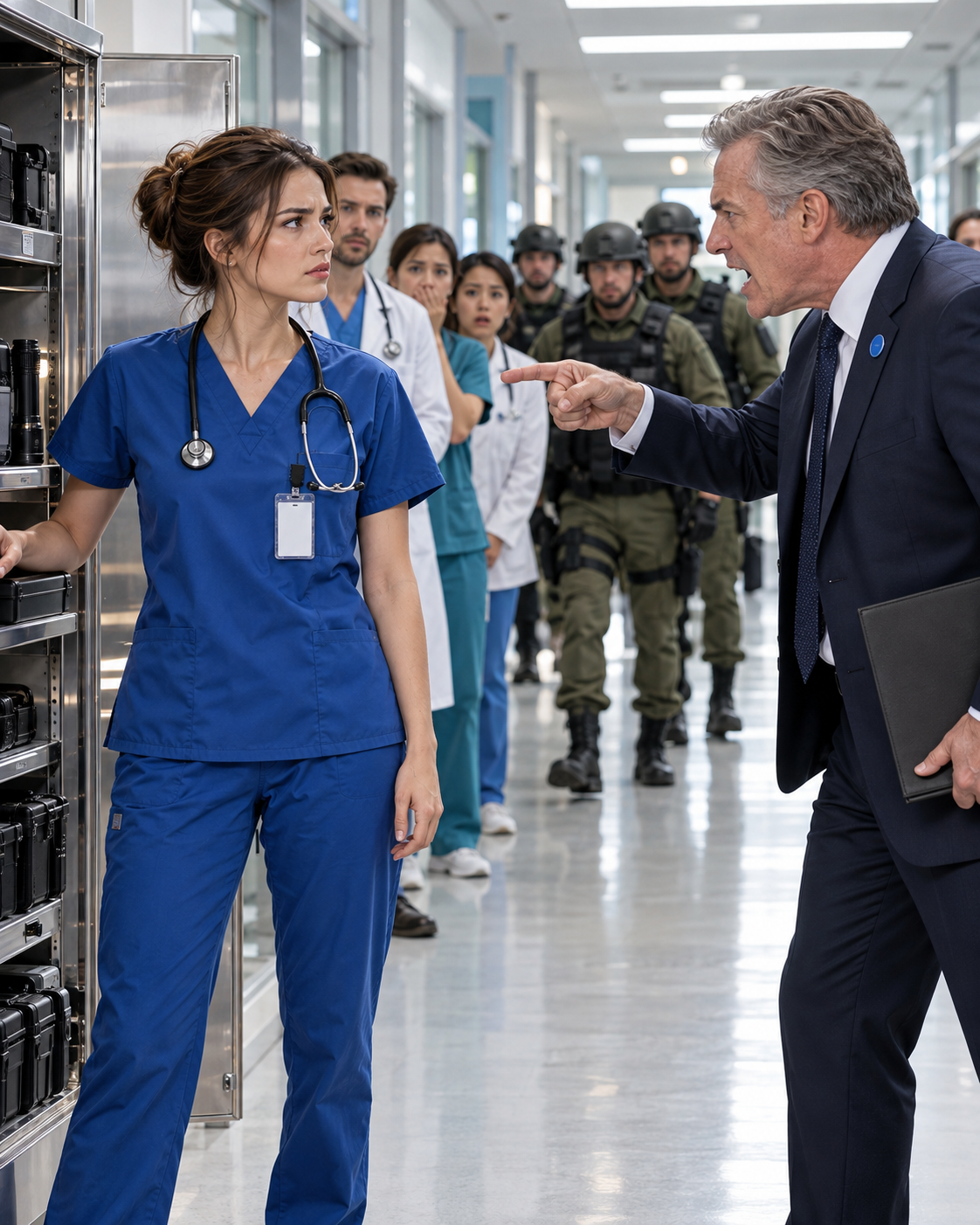
The weapon case had not appeared by accident, and I had not imagined the authority behind it.
But I could see the problem now.
The hospital had created a confidential process and then allowed ordinary procedures to operate as though that process did not exist.
One department had a rule.
Another had an exception.
And the person caught between them was sitting in a conference room being asked to defend herself.
Denise turned to Howard.
“Does this directive specifically cover locker 47?”
“Yes.”
“Does it authorize the item found there?”
“Yes.”
“Can you provide that authorization in writing?”
“That is why I brought the file.”
He opened the folder and removed several pages.
The top sheet bore the hospital’s official letterhead, an authorization number, a restricted classification marking, and Howard’s signature.
He passed it to Martin first.
Martin read it slowly.
Then he passed it to Denise.
Her face changed as she reached the final paragraph.
“This is an executive authorization,” she said quietly.
“It is.”
“And Ms. Vance’s name is included?”
“Yes.”
She looked at me.
For the first time since I had entered the room, her expression held something other than professional concern.
It held uncertainty about how badly the situation might have gone if Howard had not arrived.
Martin leaned back.
“Why wasn’t the security department given a verification code or a way to confirm the authorization?”
“That is one of the failures we need to correct,” Howard said. “The directive restricted distribution, but it should have included a secure confirmation procedure for authorized personnel who encountered something that appeared to violate ordinary policy.”
Doug finally spoke.
“Director, if I had ignored the case and it turned out to be unauthorized, I could have been held responsible for failing to report a potential security issue.”
Howard looked directly at him.
“Correct.”
“And if I had continued the inspection without reporting it, I could have compromised the security arrangement.”
“Also correct.”
Doug swallowed.
“Then what exactly should I have done differently?”
“Nothing at the point of discovery,” Howard replied. “You stopped, preserved the situation, and escalated it. That was the right response.”
The room became quiet again, but the silence no longer felt accusatory.
It felt like everyone was looking at the same problem for the first time.
Denise turned another page.
“We still need to document the incident. The compliance system has already generated a high-priority violation report.”
“Then we amend it,” Howard said. “The report should reflect the discovery, the appropriate suspension of the inspection, the verification of the executive authorization, and the procedural gap that allowed the conflict to occur.”
Martin nodded slowly.
“I can have security document the chain of custody for the photographs and confirm that the case was not opened.”
“Good.”
Howard then turned to me.
“Clara, I’m sorry you were brought into this without the context necessary to understand why.”
His apology was sincere, but it did not immediately erase the image of Denise’s folder or the possibility of losing my job.
“I appreciate that,” I said. “But I need to know something.”
“Go ahead.”
“Was I going to be suspended before you arrived?”
Nobody answered immediately.
That hesitation told me more than a prepared statement could have.
Denise folded her hands.
“We were preparing to place you on administrative leave pending investigation.”
“Even though no one had verified whether the case was authorized?”
“We had to consider the potential risk.”
“I understand considering the risk,” I said. “I don’t understand treating the existence of a case as proof that the person assigned to the locker has done something wrong.”
Denise looked at the table.
“You are right that the distinction should have been communicated more carefully.”
It wasn’t a perfect apology, but it was honest enough to matter.
Howard slid a second document toward me.
“This confirms the authorization and directs Human Resources to remove the proposed employment action from consideration. Your record will not carry a disciplinary finding related to this incident.”
I read every line.
There was no dramatic revelation hidden in the final paragraph, no elaborate explanation that would make the morning feel less absurd.
There was simply an official statement confirming what Howard had said and acknowledging the institutional failure.
I signed the acknowledgment of receipt.
Then I placed the pen on the table.
“Thank you.”
Howard nodded.
“We will also issue written instructions to the relevant departments so that authorized security placements can be verified without exposing restricted information unnecessarily.”
“That would help,” I said.
He closed the folder.
“I know this has been stressful, Clara. You may take the rest of the day off if you need it.”
I glanced at the clock.
It was almost noon.
“With respect, I’d rather return to the maternity ward.”
Everyone looked at me.
“Are you sure?” Denise asked.
“There’s a patient scheduled for a high-risk delivery this afternoon. She’s been anxious for weeks, and I’ve been helping her prepare. If she’s still waiting for me, I’d like to be there.”
Howard studied me for a moment.
Then he nodded.
“Of course.”
I stood, thanked everyone, and walked toward the door.
Doug rose halfway from his chair as though he wanted to say something, but the words didn’t come.
I gave him a small nod before leaving.
There was no reason to make him feel worse.
He had followed the rules available to him.
So had the people across the table.
And Howard had finally acknowledged that the system connecting those rules had failed.
The elevator doors closed, reflecting my tired face in their polished metal.
I looked older than I had that morning.
Not because the incident had changed who I was, but because I had seen how easily an ordinary working day could become a fight to protect a reputation built over years.
When the elevator reached the clinical floors, the doors opened to the familiar noise of the hospital.
A nurse hurried past with a stack of charts.
A physician called for an ultrasound machine.
Somewhere behind a closed door, a woman cried out through a contraction.
The sounds reached me like a hand reaching through deep water.
I straightened my shoulders and walked toward the maternity ward.
Whatever had happened in that conference room, there were still people who needed me.
And I knew exactly where I belonged.
Part 3
Emily Carter was already in labor when I reached her room.
She was thirty-two, expecting her first child, and frightened by the possibility of an emergency delivery after several weeks of closely monitored complications.
Her husband, Ben, stood beside the bed with his hands clasped so tightly that his knuckles had turned white.
When Emily saw me, her eyes filled with relief.
“Clara, I thought you weren’t coming.”
I pulled on a fresh pair of gloves and moved toward her bedside.
“I’m here.”
She searched my face.
“Is everything okay?”
For a moment, I considered telling her about the conference room, the photograph, and the strange silence that had followed Howard’s arrival.
Then I looked at the monitor beside her bed.
Her baby’s heartbeat was steady, and another contraction was beginning.
“Everything that matters right now is right here,” I told her. “Let’s take this one step at a time.”
She nodded, gripping my hand.
The hours that followed demanded everything I had.
I monitored her progress, coordinated with the obstetric team, and reminded Ben to breathe whenever his fear threatened to overtake his judgment.
When Emily became exhausted, I spoke softly beside her ear.
When the room grew tense, I kept my voice calm.
And when the baby finally arrived, a little girl with a furious cry and a shock of dark hair, Emily began to sob.
Ben covered his face with both hands.
“She’s here,” he whispered. “She’s actually here.”
I placed the baby against Emily’s chest and watched the fear leave her face one trembling breath at a time.
For a few minutes, there was no locker 47.
There was no compliance report.
There was no confidential directive or administrative failure.
There was only a mother meeting her daughter, a father crying with relief, and a tiny human being protesting the cold air of the world she had just entered.
I had been present for hundreds of moments like that.
They never became ordinary.
By late afternoon, Emily was stable, the baby was doing well, and the obstetric team had moved on to the next urgent task.
I was finishing my notes at the nurses’ station when I noticed Doug standing near the doorway.
He wasn’t wearing his usual expression of rigid authority.
He looked uncomfortable, almost uncertain whether he had the right to approach me.
I closed the chart.
“Doug.”
He stepped closer.
“Clara, do you have a minute?”
“Of course.”
He glanced toward the patient rooms, then back at me.
“I wanted to apologize.”
I waited.
“I know Director Reyes cleared the situation, but I still feel terrible about what happened this morning. I saw that case in your locker, and my mind went straight to the worst possible explanation.”
He rubbed his hands together.
“I’ve spent years working in security and compliance. I’ve seen people ignore small warning signs because they didn’t want to cause trouble, and sometimes the consequences were serious. When I found the case, I thought I had to act before someone got hurt.”
His voice lowered.
“But I didn’t know what I didn’t know.”
I looked at him carefully.
There was no attempt to blame someone else in his words.
He wasn’t asking me to pretend the morning had been pleasant.
He was simply acknowledging the weight of a decision made with incomplete information.
“I appreciate you coming to say that,” I told him.
“I should have been more careful.”
“You were careful,” I replied. “You stopped the inspection. You reported what you found. You didn’t open the case, and you didn’t try to handle something outside your authority on your own.”
He shook his head.
“It still put you in a terrible position.”
“Yes, it did.”
He looked up, perhaps expecting me to soften the answer.
I didn’t.
“Doug, I won’t pretend that being called into that room felt good. For a while, I genuinely thought I might lose my job over something I couldn’t explain without the director present.”
He nodded.
“But the fact that I was frightened doesn’t mean you acted maliciously,” I continued. “You were working with the information you had. The people responsible for coordinating the policies should have made sure the right information could be verified.”
He let out a slow breath.
“I keep thinking about how different it would have been if I’d ignored the case.”
“Exactly.”
I leaned back against the counter.
“Imagine if you had seen something that really was dangerous and decided not to report it because you were afraid of making a mistake. That could have been far worse.”
“But reporting it nearly got you suspended.”
“That is why the process needs to change.”
He was quiet for a moment.
Then he asked, “You’re really not angry with me?”
I thought about the conference room again.
I remembered the cold expression on his face, the photograph placed between us, and the way every question had felt like a door closing.
Then I remembered the way he had stopped the inspection instead of opening the case.
I remembered that he had filed a report rather than making an accusation in the hallway.
Most importantly, I remembered that when Howard explained the directive, Doug had not argued that his actions were beyond question.
He had asked what he should have done differently.
That mattered.
“I’m angry that a system designed to protect people left so much room for confusion,” I said. “I’m not angry with you for taking a potential security issue seriously.”
His shoulders relaxed slightly.
“I wish I’d known about the directive.”
“So do I.”
For the first time that day, we both smiled.
It wasn’t a triumphant smile, and nothing about the morning had become funny.
It was simply the expression of two people who had found a way to stand on the same side of a problem.
Doug glanced toward the corridor.
“I’ll be working with security and pharmacy to review the reporting process. Director Reyes wants a secure verification channel established so future discoveries can be checked without exposing restricted information.”
“That’s a good start.”
“I also asked that the updated procedure include a clear distinction between reporting a concern and establishing someone’s guilt.”
I looked at him with genuine surprise.
“That’s important.”
“I learned that lesson today,” he said.
Before leaving, he paused.
“For what it’s worth, I hope you know that I never wanted to damage your reputation.”
“I believe you.”
He nodded once, then walked away.
I watched him disappear around the corner before returning to my charting.
The hospital was growing quieter, although it would never truly become still.
A call bell rang.
A printer started.
Someone laughed softly behind the medication room door.
The world kept moving, as it always did.
Later that evening, Howard sent a written notice to the departments involved in the incident.
The notice confirmed that the authorized security placement had been documented under the confidential directive, that the discovery itself did not establish misconduct, and that the earlier compliance report would be amended to reflect the verified facts.
It also required a new procedure for resolving conflicts between restricted executive authorizations and ordinary departmental inspections.
No one could use the incident as grounds for a disciplinary finding against me.
The report would remain as a record of the discovery and the procedural review, but not as evidence of wrongdoing.
It was a small administrative distinction with a very human consequence.
My name would remain my own.
The next morning, I returned to work and found the maternity ward exactly as I had left it.
A fresh schedule was taped beside the nurses’ station.
A physician was asking about a patient’s blood pressure.
Someone had left a paper cup of coffee beside the computer I usually used.
Nothing looked different.
But I did.
For years, I had believed that professionalism meant remaining calm, following procedures, and doing my job so well that nobody would have reason to question me.
The incident with locker 47 had forced me to understand something more complicated.
Professionalism also meant knowing when a procedure had failed, when an accusation had outrun the evidence, and when a person who frightened or inconvenienced you might still be acting in good faith.
It meant accepting responsibility without pretending every mistake was malicious.
And it meant being willing to correct a broken system instead of simply finding someone to blame for it.
A week later, I passed Doug in the corridor outside the pharmacy.
He was carrying a folder and speaking with a security supervisor about the new verification procedure.
When he noticed me, he stopped.
“Morning, Clara.”
“Morning, Doug.”
He held up the folder.
“We’re making progress.”
“Good.”
He hesitated, then added, “I keep thinking about what you said. About the difference between reporting a concern and deciding someone is guilty.”
I smiled.
“It’s a distinction worth remembering.”
He nodded and continued down the corridor.
I went back to the maternity ward, where a new patient was waiting for an assessment.
She looked frightened when I entered the room.
I introduced myself, pulled up a chair, and began explaining what would happen next.
As I spoke, her breathing gradually slowed.
Her shoulders relaxed.
She reached for my hand.
And in that quiet moment, I understood why the morning of locker 47 had stayed with me.
It wasn’t because a black case had been discovered, or because a director had needed to intervene, or even because my career had briefly seemed to hang in the balance.
It was because I had watched a system confuse uncertainty with guilt, and I had seen how easily good people could become opponents when they were given different pieces of the truth.
The answer hadn’t been to ignore the rules.
It hadn’t been to attack Doug for following them, or to excuse the hospital for failing to coordinate them.
The answer had been to insist on the truth, protect the people involved, and make the system better than it had been before.
I still think about that day whenever I hear someone judged before the facts are clear.
I think about how Doug could have ignored what he found and hoped someone else would deal with it.
I think about how the compliance team could have doubled down rather than admitting the process was incomplete.
I think about how easily I could have mistaken their fear of responsibility for a personal attack.
And I think about Howard, who could have protected the institution’s image by blaming the people who had followed its visible rules, but instead accepted responsibility for the invisible ones.
None of us handled the situation perfectly.
That was precisely why it mattered.
The hospital did not become flawless overnight, and a signed directive could not guarantee that nobody would ever make another mistake.
But we left that morning with a clearer process, a corrected record, and a better understanding of what our responsibilities actually meant.
My locker remained number 47.
I continued caring for mothers and newborns.
Doug continued enforcing the rules, only now he had a clearer path for resolving the situations those rules had never anticipated.
And whenever I passed a frightened family in the corridor, I reminded myself that the most important part of my job was not simply to recognize danger.
It was to respond to it without allowing fear to make me forget the people standing in front of me.
Because sometimes the most damaging thing in a room is not the object everyone is afraid of.
Sometimes it is the assumption that someone must be guilty simply because nobody has explained the truth.
And sometimes, the strongest person in the room is not the one who never makes a mistake, but the one who can face an uncomfortable truth, accept responsibility, and leave the room determined to make things right.