The lieutenant laughed when I warned him that his fighter jet had a dangerous flight-control problem
“Will you take command of the emergency recovery?”
Lieutenant Colonel Julian Vance’s question hung in the air.
For a moment, I couldn’t speak.
I stared at the emergency flight authorization in his hand. It had been nearly eleven years since anyone had asked me to fly an aircraft. Eleven years since my wings had been taken away, my reputation destroyed, and my name erased from the records of the squadron I once loved.
“I’m a maintenance sergeant now, Colonel,” I finally said. “You know that.”
Julian stepped closer.
“I know exactly who you are. And so does the man currently trapped in that aircraft.”
He turned the monitor toward me.
The screen showed the fighter jet struggling through dark clouds. Its nose dipped unexpectedly, then jerked upward. The pilot was fighting the controls, but the aircraft wasn’t responding consistently.
A red warning flashed across the display.
FLIGHT CONTROL RESPONSE FAILURE.
My stomach tightened.
I’d seen that warning before.
Not in a maintenance report. Not in a training simulation.
I’d seen it eleven years ago, moments before my own aircraft collided with another fighter during a classified training exercise.
“Who’s the pilot?” I asked.
Julian hesitated.
“Lieutenant Ryan Cole.”
For several seconds, the room seemed to stop moving.
The same arrogant young officer who had laughed at my warnings was now thousands of feet above the ground, trapped inside the exact mechanical nightmare I’d spent eleven years trying to forget.
“Can he eject?” I asked.
“Possibly. But the aircraft is still carrying sensitive equipment, and he’s flying over a populated area. If he ejects at the wrong moment, he could lose control before reaching a safe altitude.”
“What’s his fuel status?”
“Critical. He has less than twenty minutes.”
I looked at the flight data.
Then I noticed something that made my blood run cold.
The control response wasn’t simply failing.
It was alternating between two conflicting commands.
One system was telling the aircraft to climb while another was forcing it downward.
It was the same software signature.
The same defect.
And someone had deliberately hidden it.
“Get me the original flight-control diagnostics,” I ordered.
Julian stared at me.
“You’re sure?”
“No. But I’m certain that if we follow the standard recovery procedure, we’re going to lose him.”
He immediately called the operations room.
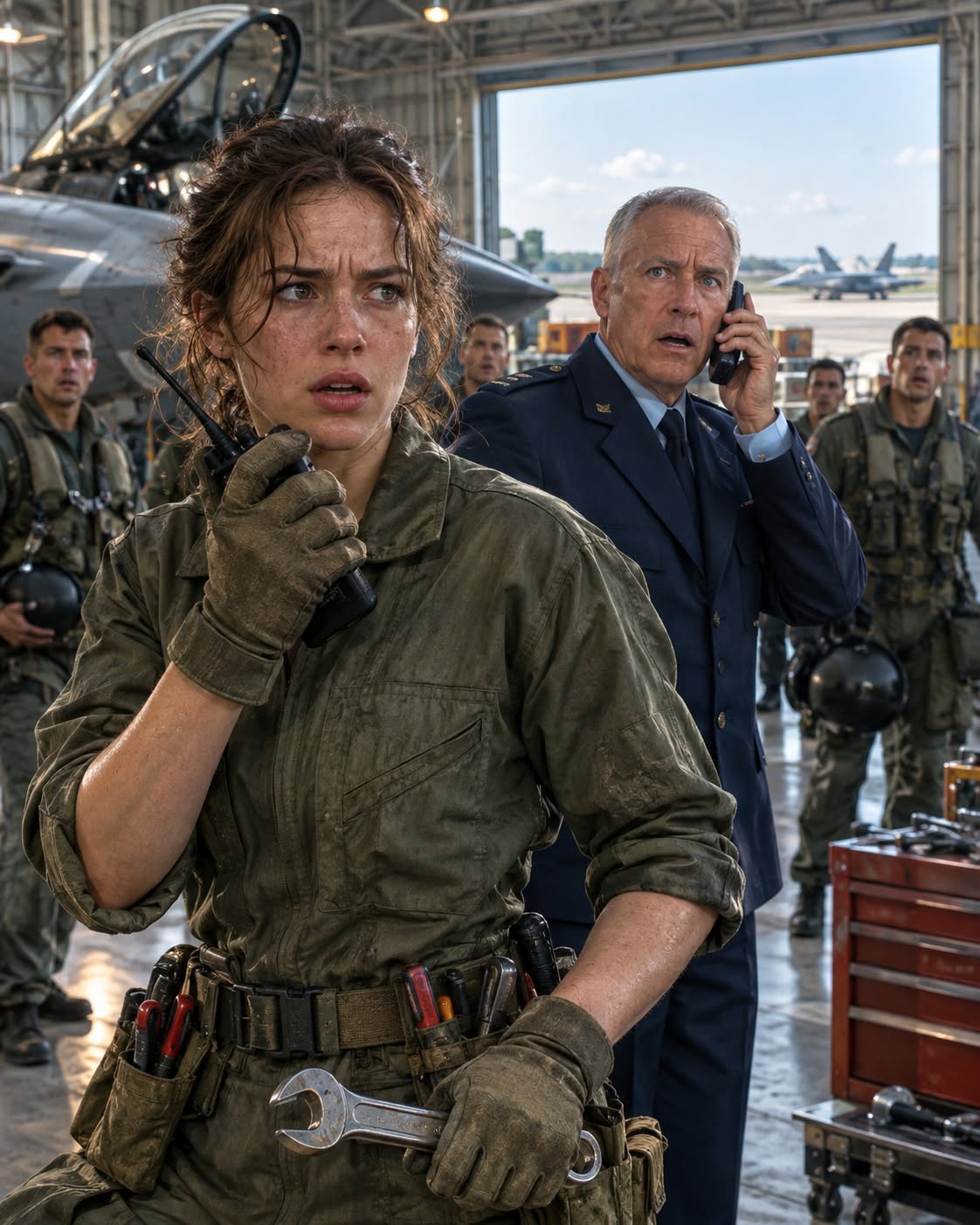
Within minutes, I was standing in front of a group of officers who looked at me as though I’d wandered into the wrong building.
Lieutenant General Marcus Hale, the senior operations commander, examined my identification.
“Sergeant, I understand you have maintenance concerns. But this is an active combat emergency. We don’t have time for speculation.”
I placed a printed diagnostic report on the table.
“This isn’t speculation, General. The flight-control software is receiving conflicting sensor data. The aircraft is attempting to correct a problem that doesn’t exist, then overcorrecting when the real flight conditions change.”
Hale barely glanced at the document.
“Are you suggesting you know more than the flight-control engineers?”
“No, sir. I’m suggesting the flight-control engineers are looking at the wrong version of the problem.”
I pointed to three lines of code in the report.
“Eleven years ago, this exact defect caused a midair collision during a training exercise. The investigation blamed pilot error. But the aircraft wasn’t responding to the pilot’s commands.”
A murmur spread across the room.
Hale’s expression changed.
“That’s a closed investigation.”
“Then someone should explain why the same defect is still killing people.”
He leaned back.
“Sergeant, you’re dangerously close to making accusations you cannot support.”
Before I could respond, Julian placed an old classified flight report on the table.
“I can support them.”
Hale looked at him sharply.
“Colonel Vance, I suggest you consider your position.”
“I have,” Julian replied. “For eleven years.”
He opened the report.
Inside were maintenance records, encrypted communications, and a series of software authorization logs.
One name appeared repeatedly.
Major Daniel Mercer.
I remembered him immediately.
He had been the lead flight-systems engineer assigned to our squadron before the accident. He had also testified against me during the inquiry.
“He approved the software update?” I asked.
Julian nodded.
“Not only that. He received warnings about the sensor synchronization problem six weeks before your accident.”
I felt something cold settle in my chest.
For eleven years, I’d believed the worst thing that happened to me was losing my wings.
Now I was beginning to understand that the accident hadn’t been an unfortunate mistake.
Someone had known.
Someone had chosen silence.
And the consequences were still unfolding.
A voice suddenly crackled through the communications speaker.
“Mayday, mayday. This is Falcon Two. Flight controls are becoming unresponsive. I can’t maintain altitude.”
It was Cole.
His voice was strained, but he was trying to remain calm.
“Falcon Two, this is Operations. Confirm your control status.”
“I’m losing pitch response. The aircraft keeps correcting itself. I have no reliable control.”
I moved toward the microphone.
“Lieutenant Cole, this is Sergeant Thompson.”
There was a pause.
“Sergeant? What are you doing on this channel?”
“Listening to you, Lieutenant. I need you to listen carefully.”
“I don’t have time for maintenance lectures!”
“You have less time than you think. Your aircraft is fighting your inputs. Stop trying to overpower every correction.”
His breathing became audible.
“Then what am I supposed to do?”
I looked at the diagnostic screen.
“First, tell me what your control system is reporting.”
“Left sensor is showing an unstable reading. Right sensor is normal. The backup system keeps switching between the two.”
My eyes moved across the data.
There it was.
The faulty synchronization sequence was activating whenever the two sensors disagreed beyond a programmed threshold.
“Julian,” I whispered, “pull up the backup control configuration.”
He immediately signaled the technical team.
I turned back to the microphone.
“Lieutenant, I need you to keep your voice calm. We’re going to work through this together. Don’t make any sudden corrections. Follow your aircraft’s approved emergency checklist, and keep communicating with us.”
“Understood.”
For the first time since I’d met him, Cole wasn’t arguing.
He was listening.
The technical team began examining the aircraft’s live data. One engineer shook his head.
“There’s no reliable way to isolate the faulty input remotely. The system is continuously switching.”
“Then we need to understand what caused the switching,” I replied.
I studied the old diagnostic report again.
A tiny reference number appeared in the lower corner.
It wasn’t part of the standard software documentation.
It was a maintenance override identifier.
I remembered seeing it before the accident.
“Wait.”
I grabbed the report from Julian.
“This isn’t just an old defect. Someone modified the synchronization parameters.”
The room fell silent.
“Can you prove that?” Hale demanded.
I pointed to the authorization record.
“The original configuration was changed after the system failed its first validation test. This adjustment made the aircraft appear stable during routine inspections, but it didn’t eliminate the underlying fault.”
Julian’s face darkened.
“Who authorized it?”
I turned the document around.
Major Daniel Mercer.
Hale stood abruptly.
“That’s enough. This operation is not a courtroom.”
“No, General,” I said quietly. “It’s a rescue mission. And if you keep ignoring the evidence, there may not be anyone left to put on trial.”
For the first time, nobody interrupted me.
Then the radio crackled again.
“Operations, I’m getting a second warning. My aircraft is becoming increasingly unstable.”
Cole sounded frightened now.
I closed my eyes briefly.
Eleven years earlier, I’d heard almost exactly the same words from my wingman.
His name was Captain Andrew Lewis.
He’d been my closest friend, my wingman, and the man who trusted me with his life.
During that disastrous training exercise, I’d watched his aircraft disappear into a wall of smoke.
I survived.
He didn’t.
The inquiry board said I had failed to maintain formation separation.
They said I’d made an unauthorized maneuver.
They said I was responsible.
I had spent years wondering whether I could have done something differently.
Now another pilot was facing the same nightmare.
I opened my eyes.
“Get me the flight-control engineer who designed the original system.”
Hale shook his head.
“He’s retired.”
“Then find him.”
Julian was already making the call.
Within minutes, he returned.
“There’s a problem.”
“What?”
“The engineer is dead. He passed away three years ago.”
I felt the hope inside me collapse.
“Did he leave any technical records?”
Julian hesitated.
“His daughter contacted the Air Force last month. She claimed he had kept a private archive documenting the original software defect.”
“Where is it?”
“Under investigation. The request was rejected.”
I looked at Hale.
“Who rejected it?”
He didn’t answer.
Julian did.
“General Hale.”
Every head in the room turned toward him.
Hale’s face became rigid.
“You are making a serious mistake, Colonel.”
“Perhaps,” Julian said. “But I made one eleven years ago when I allowed an incomplete investigation to stand. I won’t make it again.”
Before Hale could respond, another alarm sounded.
Cole’s aircraft had begun descending rapidly.
“Mayday! Mayday! I can’t stabilize!”
I rushed toward the main monitor.
The flight data was deteriorating.
There was no time left for another argument.
I turned to Julian.
“I need access to the original simulator data from my accident.”
He understood immediately.
“You think the two failures are connected?”
“I don’t think so. I know so.”
Hale stepped forward.
“Absolutely not. You are not authorized to access classified flight records.”
Julian placed the emergency authorization on the table.
“As deployment commander, I can authorize access for an immediate life-saving operation.”
Hale stared at him.
“You’re risking your career.”
Julian looked at me.
“Some things are worth more than a career.”
The authorization was signed.
The old simulator footage appeared on the screen.
I watched the aircraft from eleven years ago maneuver through the training zone. I recognized every movement, every correction, every moment of hesitation.
Then I saw it.
A fraction of a second before the collision, the flight-control system had issued a correction that neither pilot had requested.
The same correction was appearing in Cole’s live telemetry.
It wasn’t random.
The system was reacting to a corrupted sensor reference.
And the corruption was being triggered by a specific combination of flight conditions.
I remembered something from my years as a pilot.
Something no maintenance manual had ever explained properly.
The aircraft wasn’t necessarily losing its ability to fly.
It was losing its ability to distinguish between real movement and false sensor information.
That meant Cole’s greatest enemy wasn’t the aircraft’s instability.
It was the system’s attempt to correct an imaginary emergency.
I turned toward the technical team.
“Compare the live sensor readings against the independent navigation data. We need to identify which information is unreliable.”
The engineers worked quickly.
A few moments later, Caleb’s voice came through the speaker.
“Sergeant, I found something. The left-side reference data is inconsistent with the independent measurements.”
I looked at Julian.
“That’s it.”
He nodded.
“But how do we get him home?”
I took a breath.
“First, we stop pretending that the aircraft is healthy. Then we get him onto a recovery profile that accounts for the unreliable readings.”
I didn’t give Cole a complicated explanation. I directed the flight team to communicate through the approved emergency procedures, using independent measurements and the aircraft’s certified recovery guidance.
There was no magic switch.
No secret combination of buttons.
Only careful decisions, accurate information, and a pilot who had to trust people on the ground.
“Lieutenant Cole,” I said into the microphone, “I need you to trust the people helping you.”
His reply came after several seconds.
“Sergeant, I trust you.”
Those four words struck harder than I expected.
The lieutenant who had once laughed at me was now placing his life in my hands.
We continued monitoring the aircraft.
For several minutes, the situation appeared to improve.
Then the left sensor reading changed again.
The warning alarm returned.
“Control response deteriorating,” Caleb announced.
My heart sank.
The fault was becoming more severe.
Cole’s voice broke through the static.
“I’m losing stability. I don’t know how much longer I can hold this.”
I gripped the edge of the console.
“Stay with us, Lieutenant.”
“I should have listened to you.”
I swallowed.
“We can talk about that when you’re back on the ground.”
Then something unexpected happened.
The communications officer received an incoming transmission from an unknown military frequency.
A man’s voice spoke.
“Stop the recovery operation immediately.”
Julian turned toward the communications officer.
“Identify the caller.”
The officer checked the transmission.
“It’s coming from an encrypted command channel. The authorization code belongs to Major Daniel Mercer.”
My blood ran cold.
Mercer was supposed to be retired from active operations.
“Patch him through,” Julian ordered.
The man’s voice returned.
“This aircraft must not be recovered using the old configuration. Shut down the emergency operation.”
I stepped toward the microphone.
“Major Mercer?”
There was silence.
Then he spoke.
“Who is this?”
“Sergeant Thompson.”
Another pause.
I could almost hear him breathing.
“Thompson,” he finally said. “I thought you were finished.”
“I was. Until your old software started trying to kill another pilot.”
“You don’t understand what you’re dealing with.”
“Then explain it.”
Mercer hesitated.
“The original system was never approved for operational deployment. We were under pressure to deliver the aircraft on schedule. The synchronization problem was considered manageable.”
“Manageable?” I repeated.
“Your accident was unfortunate.”
I felt my hands tighten.
“Andrew Lewis died.”
Mercer said nothing.
“And you blamed me.”
“The inquiry board made its decision.”
“You gave them incomplete information.”
“I did what I was ordered to do.”
The words landed like a punch.
I looked at Julian.
He was recording everything.
“Who ordered you?” I asked.
Mercer ended the transmission.
A few seconds later, the communications officer announced that the incoming signal had disappeared.
But the damage was done.
We now had evidence that Mercer knew more than he had admitted.
And Cole was still in danger.
“Sergeant,” Caleb called out. “I’ve got another problem.”
I turned.
“What now?”
“The aircraft’s recovery data is showing a second inconsistency. The software configuration on this jet doesn’t match the approved maintenance version.”
My mind raced.
Someone had installed a modified update before deployment.
The same modification that had caused the original accident.
“Who signed off on the update?”
Caleb searched the records.
Then he went pale.
“Major Mercer.”
Julian slammed his hand against the table.
“He’s been involved all along.”
Hale finally spoke.
“Colonel, this is no longer a maintenance matter. We need to suspend the entire operation and secure every record.”
I turned toward him.
“General, we can investigate him after we bring Cole home.”
Hale looked away.
For a moment, I thought he would object again.
Instead, he nodded.
“Proceed.”
I returned to the monitor.
Cole’s aircraft was approaching the recovery zone.
The situation remained unstable, but the team had identified a way to guide him through the approved emergency recovery process using independent flight information.
I kept my voice steady.
“Lieutenant, you’re doing well. Keep communicating. We’re not giving up on you.”
“Copy that.”
The next few minutes felt longer than eleven years.
Every warning light mattered.
Every new reading could change the outcome.
Mateo had joined us by then, standing beside Caleb. Maya was watching from the back of the operations room, her hands clasped tightly together.
She had never seen me like this.
She had only known the quiet sergeant who cleaned aircraft, checked maintenance reports, and avoided arguments with officers.
Now she was watching a different part of my life emerge.
“Altitude stable,” Caleb announced.
I leaned closer.
“Confirm.”
“Confirmed. The independent readings are holding.”
“Recovery path?”
“Clear.”
Then Cole spoke.
“Operations, I can see the runway.”
A strange silence filled the room.
“Say again, Lieutenant?”
“I can see the runway.”
I closed my eyes for one second.
“Bring it home, Cole.”
The radio remained quiet.
We watched the aircraft approach.
Its landing gear deployed.
For a terrifying moment, the jet drifted slightly off its expected path.
Then it corrected.
The wheels touched the runway.
The aircraft bounced once, settled, and rolled forward.
Finally, it stopped.
Nobody moved.
Then the radio crackled.
“This is Falcon Two. I’m on the ground.”
I exhaled.
The entire room erupted.
Mateo grabbed my shoulder.
Caleb laughed with relief.
Maya covered her mouth as tears ran down her face.
Julian stood completely still, staring at the monitor.
I felt no urge to celebrate.
I simply looked at the aircraft.
Another pilot had come home.
That was enough.
A few minutes later, Cole walked into the operations building.
His flight suit was soaked with sweat. His face was pale, and his hands were still trembling.
He stopped in front of me.
For a moment, neither of us spoke.
Then he removed his helmet.
“Sergeant.”
“Lieutenant.”
He looked down at the floor.
“I owe you an apology.”
I waited.
“I was arrogant. I thought rank made me better than the people working beneath me. I ignored your warnings because I didn’t believe someone in maintenance could understand what I was dealing with.”
He swallowed.
“You saved my life.”
I shook my head.
“Your crew helped bring you home. So did the people monitoring your aircraft. You listened when it mattered.”
He looked at me.
“Why didn’t you ever tell us you were a pilot?”
“Because I didn’t need anyone to know.”
“But you used to fly fighters?”
I nodded.
“Once.”
He glanced at the old photograph hanging in the operations corridor.
It showed a group of fighter pilots standing beside their aircraft.
He moved closer.
Then he saw the name.
THOMPSON — CALL SIGN: GHOST.
His expression changed.
“Wait. You’re Ghost?”
I looked at the photograph.
For years, that name had belonged to someone I barely recognized.
During my flying career, I’d been known as Ghost because of my ability to disappear from an enemy’s radar during complex training exercises. My squadron had given me the nickname after a mission in which I’d guided an entire flight through a simulated hostile zone without losing a single aircraft.
Cole stared at me.
“My instructor used to tell stories about you.”
I almost smiled.
“Your instructor tells too many stories.”
“No, Sergeant. He said you were one of the best pilots he’d ever seen.”
I looked back at him.
“Then he should have told you that the best pilots aren’t the ones who never make mistakes. They’re the ones who know when to listen.”
Cole lowered his head.
“I’ll remember that.”
But the crisis wasn’t over.
Two hours after the landing, Julian summoned me to a secure conference room.
He had uncovered something disturbing.
The old flight records weren’t the only evidence against Mercer.
There were communications showing that several senior officials had known about the defective software for years.
One of them had been General Hale.
I stared at the documents.
“Hale knew?”
Julian nodded.
“He received the original engineering warnings. He also signed the authorization that allowed the modified software to remain in service.”
I felt sick.
“Why would he do that?”
“Money, promotions, political pressure. I don’t know the full story yet.”
“Then why did he allow us to rescue Cole?”
Julian looked at me.
“Because he realized that if Cole died, the entire operation would become impossible to hide.”
Before I could respond, the door opened.
General Hale entered with two security officers.
“Sergeant Thompson,” he said. “I need you to accompany us.”
Julian stood.
“On what grounds?”
“Unauthorized access to classified flight records. Interference with an operational command channel. And potentially compromising a military investigation.”
I looked at Julian.
He gave me a small nod.
Then I noticed the red recording light on the conference room camera.
Julian had anticipated this.
Every document had been copied into the official evidence system. The transmission from Mercer had also been preserved.
Hale had walked into a room where his own words could be used against him.
“You can take me wherever you want, General,” I said. “But you can’t take back what happened today.”
His face tightened.
“Do you think anyone will believe a disgraced former pilot over a decorated general?”
I looked him directly in the eyes.
“I don’t need them to believe me. I need them to examine the evidence.”
For the first time, Hale seemed uncertain.
The security officers approached.
But before they could reach me, another voice came from the doorway.
“That’s enough.”
It was the base commander.
Behind him stood two investigators from the Air Force Inspector General’s office.
One of them held a folder.
“General Hale, we have an authorization for your temporary suspension pending an investigation into the flight-control software program and the suppression of previous safety reports.”
Hale turned pale.
“This is a misunderstanding.”
“Then you’ll have an opportunity to explain it.”
The investigators escorted him from the room.
I watched him disappear down the corridor.
I didn’t feel victorious.
I felt tired.
Very tired.
Because somewhere in the middle of that investigation was the memory of Andrew Lewis.
The man who should have come home eleven years earlier.
Over the next several weeks, the investigation uncovered the truth.
Mercer had knowingly approved an untested software modification after the original engineering team warned that the sensor synchronization problem could become catastrophic under certain flight conditions.
General Hale had supported the decision because the program was already behind schedule and the aircraft contract involved millions of dollars.
When the training accident occurred, the inquiry board received altered maintenance records and incomplete software logs.
My unauthorized maneuver had become the perfect explanation.
The investigation also found that Julian had been pressured to remain silent. He had refused to falsify his own testimony, but he hadn’t been able to obtain enough evidence to overturn the verdict.
That failure had haunted him for eleven years.
This time, he refused to let it happen again.
Mercer was eventually arrested. Hale was removed from command and faced a separate investigation. Several other officials were questioned, and the defective software configuration was withdrawn pending a complete safety review.
My name was formally cleared.
The Air Force issued a statement acknowledging that the original investigation had relied on incomplete and misleading technical evidence.
I received a letter from the Secretary of the Air Force.
It included an apology.
It also offered me the opportunity to return to active flight status after a new evaluation.
I read the letter twice.
Then I placed it inside my locker.
I didn’t know what I wanted.
One afternoon, Maya found me sitting beside the hangar, looking at an old photograph.
It was a picture of Andrew and me standing beside our fighters.
We were young, smiling, and completely convinced that nothing could ever touch us.
“Sergeant?” she asked.
I folded the photograph.
“Yes?”
“Can I ask you something?”
“Of course.”
“Do you ever regret giving up flying?”
I looked toward the runway.
The afternoon sun reflected off the aircraft parked in the distance.
“Every day for a while,” I admitted. “Then I learned that losing something doesn’t mean your life is over.”
She sat beside me.
“Do you miss being called Ghost?”
I smiled faintly.
“Sometimes.”
“Then why don’t you go back?”
I thought about the question.
Because part of me still wanted to hear the engines roar.
Part of me still missed the feeling of climbing into a cockpit, looking across the horizon, and knowing that I was exactly where I belonged.
But another part of me remembered the sound of Andrew’s last transmission.
And the years I had spent believing I was responsible for his death.
“I spent too long thinking my worth depended on flying,” I said. “I thought that when they took my wings, they took away the best part of me.”
Maya listened quietly.
“But that day with Cole taught me something. I didn’t need to be in the cockpit to make a difference. I just needed to be willing to speak when something was wrong.”
She looked toward the aircraft.
“I hope I can be that kind of mechanic someday.”
I laughed.
“You can be better.”
A week later, Lieutenant Cole came to see me.
He carried two cups of coffee and a small envelope.
“I thought you might want this.”
Inside was a photograph of his aircraft after the emergency landing.
On the back, he had written:
To the man who taught me that rank doesn’t make someone right, and experience deserves to be heard. Thank you for bringing me home.
I looked up.
“That’s quite a speech for a lieutenant.”
He smiled.
“I’ve been practicing.”
We both laughed.
Then he became serious.
“Sergeant, I requested that my next assignment include working with the maintenance training program. I want pilots to understand what happens before they ever climb into a cockpit.”
I nodded.
“That’s a good idea.”
“And I want to apologize to your crew, too. I treated them terribly.”
“They’ll appreciate hearing that.”
He looked toward the hangar.
“Do you think you’ll ever fly again?”
I considered the question.
“Maybe.”
“Would you want to?”
I smiled.
“Ask me after I’ve had my coffee.”
Three months later, I received another offer.
This time, it wasn’t a letter asking me to return to a fighter squadron.
It was an invitation to lead a new flight-safety and maintenance integration program.
The goal was simple: ensure that pilots, mechanics, engineers, and commanders worked together instead of allowing rank to silence warnings.
Julian had recommended me.
He stood beside me when I signed the appointment.
“You know,” he said, “eleven years ago, I thought the worst thing that could happen to you was losing your wings.”
I looked at him.
“And now?”
“Now I think the worst thing would have been if you had allowed that injustice to turn you into someone who no longer cared.”
I stared through the hangar windows.
A young mechanic was explaining a maintenance concern to a group of pilots.
One of them was Lieutenant Cole.
He wasn’t interrupting.
He was listening.
I smiled.
“Looks like someone learned something.”
Julian laughed.
“Apparently, your lectures are more effective than mine.”
That evening, I returned to my locker and took out the old photograph.
For the first time in eleven years, I didn’t look at it with sadness.
Andrew was still gone.
Nothing could change that.
The years I had lost could never be returned.
But his death had not been meaningless.
His story had helped expose the truth, save another pilot, and change the way people on our base treated one another.
I carefully placed the photograph on my desk.
Beneath it, I placed my new appointment letter.
Then I noticed something tucked inside the envelope.
It was a small handwritten note from Julian.
You were never just a pilot, Thompson. You were always the person who refused to leave someone behind.
I read it twice.
Then I looked out at the runway.
An aircraft was preparing for takeoff.
Its engines roared, and its lights disappeared into the evening sky.
For a moment, I could almost feel the old flight suit against my shoulders.
I could almost hear Andrew laughing beside me.
But this time, I didn’t feel the need to chase the past.
I had finally understood something I’d spent eleven years learning.
A person’s value isn’t measured by the uniform they wear, the rank on their shoulder, or the title written beside their name.
Sometimes the person who saves a life isn’t sitting in the cockpit.
Sometimes they’re standing beneath the aircraft, covered in grease, holding a maintenance report that nobody wants to read.
And sometimes, the bravest thing a person can do isn’t taking off into the sky.
It’s standing on the ground, looking someone in the eye, and refusing to stay silent when a life is at stake.
Because the greatest pilots aren’t those who believe they can never fall.
They’re the ones who understand that everyone deserves a chance to make it home.
And as long as I could help make that happen, I knew I hadn’t lost my wings after all.