The funeral chapel doors slammed behind me as my father’s coffin arrived, and my brother looked at my plain
Part 2
The first thing I did was level the wings.
The second was breathe.
The third was accept that I was flying an aircraft I had never flown before, with smoke filling the cockpit and 285 strangers depending on me.
“Sarah, oxygen masks.”
She nodded.
I reached for the controls.
The 787 responded slowly, almost lazily, as if it could not understand why I was asking so much of it.
The altimeter unwound.
Twenty-two thousand.
Twenty-one.
Twenty thousand.
The nose was still dropping.
I eased the controls back.
The aircraft trembled.
The vertical speed decreased.
“Come on,” I whispered.
“Come on.”
Nineteen thousand feet.
The descent stopped.
For a few seconds, nobody spoke.
I could hear the ventilation system.
The alarms.
My own breathing.
Then Sarah looked at me.
“Who are you?”
I stared through the windshield.
“I used to fly.”
She shook her head.
“That’s not an answer.”
“No,” I said.
“It isn’t.”
I searched the cockpit for anything useful.
The radios were dead.
The electrical system was damaged.
Navigation displays flickered.
Smoke continued to crawl along the ceiling.
We had no reliable communications.
No one on the ground knew who was flying the airplane.
And no one outside that cockpit knew whether Flight 217 was under control.
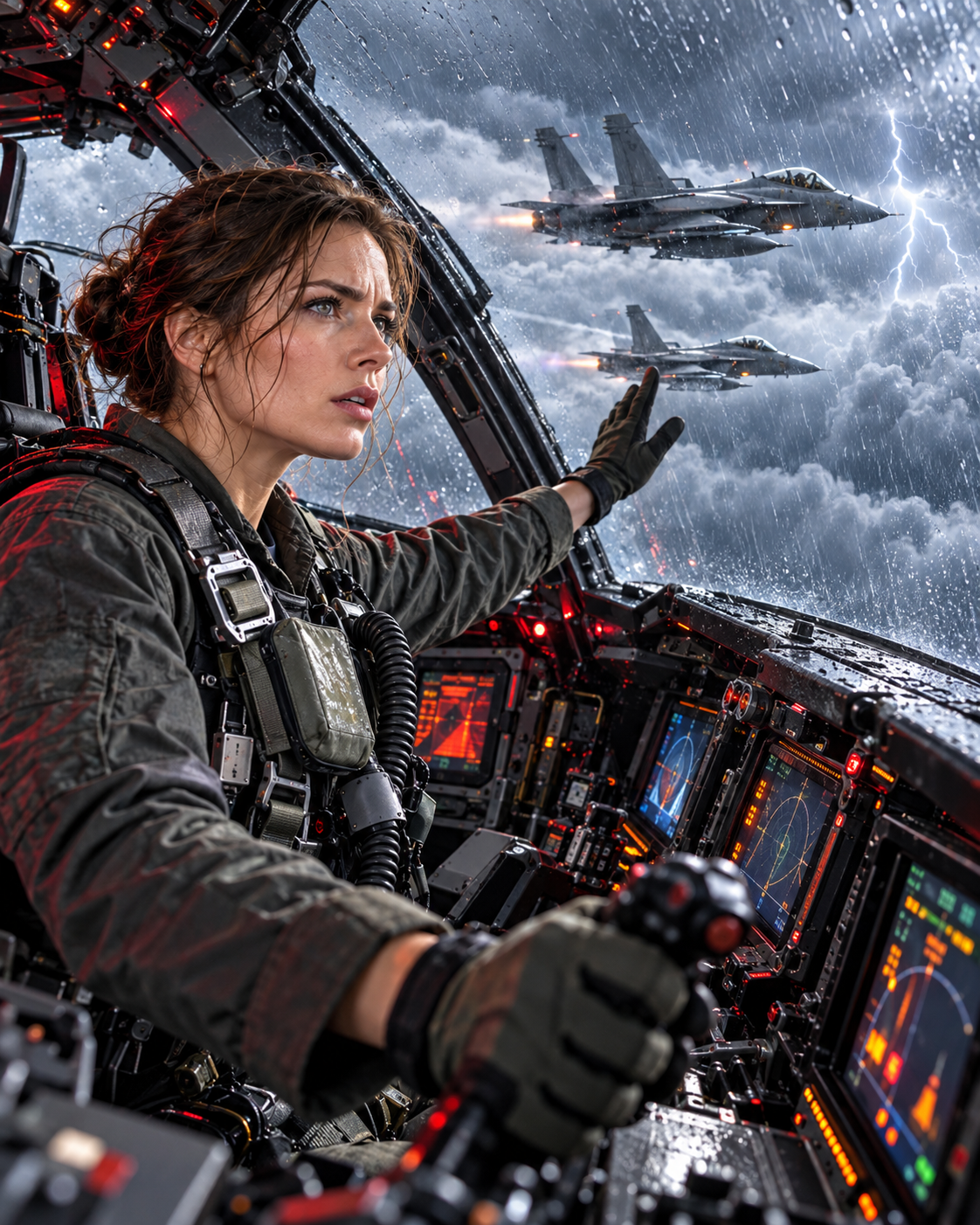
Then I saw two shapes appear through the haze ahead.
They were moving fast.
Too fast for civilian aircraft.
My stomach tightened.
Fighter jets.
Two F-22 Raptors came across our left wing in perfect formation.
I knew exactly what that meant.
Someone had decided we were a threat.
Sarah stared through the windshield.
“Are they escorting us?”
I shook my head.
“Not yet.”
The aircraft banked.
The Raptors moved with us.
Their missiles were visible beneath their wings.
Live weapons.
My heart sank.
General Marcus Vane had commanded countless air operations.
He knew what happened when an aircraft lost communications and began descending toward Anchorage with no response.
He could not assume we were innocent.
He had to protect the city.
The pilots were Captain Brian Miller and Lieutenant Tommy Ross.
Their call signs were Saber and Viper.
I knew both names.
Brian had once been a young pilot assigned to a storm mission over Alaska.
Tommy had been one of the best students I had ever watched fly.
Neither of them knew I was sitting in 12F when they came looking for the aircraft.
Brian transmitted on an emergency frequency.
“Flight 217, identify yourself.”
Nothing.
Again.
“Flight 217, respond.”
Nothing.
I watched him move across our windshield.
His aircraft rocked once.
A warning.
We had seconds.
Sarah looked at me.
“What do we do?”
I thought about the years I had spent teaching pilots how to survive impossible situations.
Never fight the aircraft.
Never fight fear.
Give the other person a reason to trust you.
I looked at the checklist cards beside the captain’s seat.
Then I found a black marker.
My hand was shaking.
Not from fear.
From the strange knowledge that my entire life had narrowed to one small rectangle of paper.
I wrote in large letters.
USAF.
CALL SIGN PHOENIX.
PILOTS DOWN.
286 ALIVE.
I pressed the card against the smoked cockpit window.
For several seconds, nothing happened.
Then the lead F-22 pulled closer.
Brian saw it.
I knew he did because his aircraft suddenly stopped maneuvering.
He stared at the message.
Then he looked at the airplane.
Then back at the message.
His voice came through the emergency frequency.
“Phoenix?”
My throat tightened.
I had not heard that name spoken over a military radio in years.
Brian transmitted again.
“Say again, Phoenix.”
I could not answer.
Our radio was dead.
So I held the card higher.
The fighter pulled alongside.
For one impossible second, Brian’s helmet turned toward me.
Then I saw his hand move.
He was saluting.
Sarah started crying.
I did not.
I could not afford to.
Brian transmitted to NORAD.
“Phoenix may be aboard.”
General Vane responded immediately.
“Cross-reference the manifest.”
There was a pause.
Then another voice came through.
“Clara Vance.”
The name seemed to hang in the sky.
General Vane went silent.
Brian’s voice returned.
“Confirm.”
“Lieutenant Colonel Clara Vance,” NORAD replied.
“Former Air Force test pilot.”
Brian exhaled.
“That’s Phoenix.”
I closed my eyes for half a second.
Years earlier, Brian had been trapped in a violent storm over the Brooks Range.
His aircraft had suffered cascading failures.
He had lost visibility.
He had lost orientation.
And I had talked him through the storm until his instruments came back.
Afterward, he told everyone I had saved his life.
I told him he had saved himself.
He never believed me.
Now he was flying beside me with a loaded missile under his wing.
And he had to convince the military not to shoot down the airplane I was flying.
“General,” Brian said, “I have visual confirmation of the aircraft and Phoenix’s signal.”
“Can you confirm pilots are down?”
“Negative on cockpit access, but message says yes.”
Another pause.
Then General Vane spoke.
“Kill order suspended.”
The words traveled through the fighter formation.
I watched both Raptors break outward.
Their missiles remained armed, but their noses turned away.
For the first time since the smoke appeared, I felt something inside my chest loosen.
Brian moved back beside our wing.
Tommy moved to the other side.
Two fighters.
One damaged airliner.
Three hundred lives balanced between them.
The Gulf of Alaska stretched beneath us.
And ahead, through the thinning smoke, Anchorage waited.
Part 3
The descent toward Anchorage was almost silent.
The passengers had stopped screaming.
Most of them had no idea what had happened.
They only knew the aircraft had leveled.
They only knew two fighters were beside us.
And they could see Sarah standing near the cockpit with tears on her face.
I kept my hands steady.
That was the one thing I could still give them.
Control.
Not certainty.
Not safety.
Control.
The runway appeared through the clouds.
I felt the old familiar pressure in my chest.
Every test pilot knows that the most dangerous moment is when you begin to believe you are safe.
I slowed the aircraft.
Lowered the nose.
Adjusted the controls.
The 787 responded.
Not perfectly.
But enough.
Brian’s voice came through the emergency frequency one final time.
“Phoenix, runway is yours.”
I smiled despite myself.
“Thank you, Saber.”
The words came out through a damaged system in the cockpit.
Brian heard them.
There was a long silence.
Then he answered.
“Welcome home, Colonel.”
The landing gear came down.
Three green lights.
The runway rushed toward us.
I pulled back gently.
The aircraft touched down hard.
The wheels screamed against the pavement.
The nose bounced once.
I corrected.
Then we were rolling.
Fire trucks surrounded us.
Emergency crews raced alongside the aircraft.
When we finally stopped, nobody moved.
For several seconds, there was only silence.
Then the cabin erupted.
People cried.
People hugged strangers.
A man near the front sank to his knees.
Sarah came into the cockpit and placed both hands over her mouth.
I looked at her.
“We made it.”
She nodded.
“No.”
She wiped her face.
“You made it.”
I looked back through the windshield.
Brian and Tommy had landed nearby.
Both Raptors stood at the edge of the runway, engines still running.
Then their canopies opened.
The two pilots climbed out.
They removed their helmets.
And as I stepped onto the tarmac, they walked toward me.
Brian stopped a few feet away.
For a moment, neither of us spoke.
Then he smiled.
“I knew it was you.”
“I hoped you would.”
He looked toward the aircraft.
“You flew a 787.”
“I flew what was in front of me.”
He laughed softly.
“Still Phoenix.”
Tommy stood beside him.
“I’ve heard stories about you since flight school.”
“Most of them are exaggerated.”
“Probably.”
He smiled.
“But not the important ones.”
Behind them, emergency crews worked around the aircraft.
The passengers were being escorted into the terminal.
News cameras had already begun arriving.
My name would be everywhere by nightfall.
But none of that mattered.
Because I suddenly remembered why I had been on Flight 217 in the first place.
My father.
The funeral.
The unfinished words.
The anger I had carried for decades.
I left the airport that evening and drove alone to the cemetery.
The sky over Anchorage was turning violet.
Snow rested lightly on the mountains.
My father’s grave was still fresh.
I stood there in the same navy sweater.
For a long time, I said nothing.
Then I placed my hands inside my pockets.
“I came home, Dad.”
The words sounded strange.
Almost childish.
“I know you didn’t understand what I did.”
The wind moved through the trees.
“I didn’t understand it either.”
I looked at his name carved into the stone.
“You thought I chose the sky over you.”
I swallowed.
“But the sky was never the choice.”
I looked toward the mountains.
“The choice was always whether I would become afraid of losing people.”
For years, I had believed courage meant climbing into dangerous aircraft.
I had been wrong.
Courage was coming home to a grave and admitting that you were still hurt.
Courage was forgiving someone who could no longer apologize.
Courage was accepting that sometimes the person who wounded you had been wounded long before you ever arrived.
I took the funeral card from my pocket.
On the back, I had written something during the flight.
Not a rank.
Not a call sign.
Just one sentence.
I placed it beneath the flowers.
Then I walked away.
The next morning, the story of Flight 217 was everywhere.
People called me a hero.
They called Brian and Tommy heroes.
They replayed the footage of the two F-22s escorting the 787 toward Anchorage.
They talked about the woman in seat 12F who had quietly taken control of an airliner when everyone else had lost consciousness.
But the part nobody understood was this.
I had never wanted to be remembered as Phoenix.
Phoenix was the woman who could fly a broken aircraft.
Clara was the woman who had spent years trying to repair a broken heart.
Those were not the same battle.
Weeks later, I received a package from my father’s house.
Inside was an old photograph.
I was six years old again, sitting on his shoulders beneath an Alaskan sky.
On the back, in his handwriting, were five words.
“She was born to fly.”
I sat at my kitchen table and cried harder than I had cried at his funeral.
Because suddenly I understood.
Maybe he had never hated the sky.
Maybe he had simply been terrified that one day it would take me from him.
And maybe, in his own broken way, he had loved me the only way he knew how.
I kept the photograph.
I keep it still.
Sometimes people ask me what really happened on Flight 217.
I tell them the truth.
An airplane broke.
Two pilots collapsed.
A stranger with a metal briefcase hid something from me.
Two fighter jets came within seconds of destroying us.
And a woman in seat 12F remembered who she was.
But if they ask me what saved those 286 people, I give them a different answer.
It was not the aircraft.
It was not the fighters.
It was not even the training.
It was the decision to stay calm long enough to give hope a chance.
Because sometimes the person sitting quietly beside you is carrying a lifetime you cannot see.
Sometimes the one you think is powerless is the only person left who knows what to do.
And sometimes, after spending your whole life trying to prove that you are strong, you finally discover that the bravest thing you can do is come home, forgive what cannot be changed, and keep flying anyway.