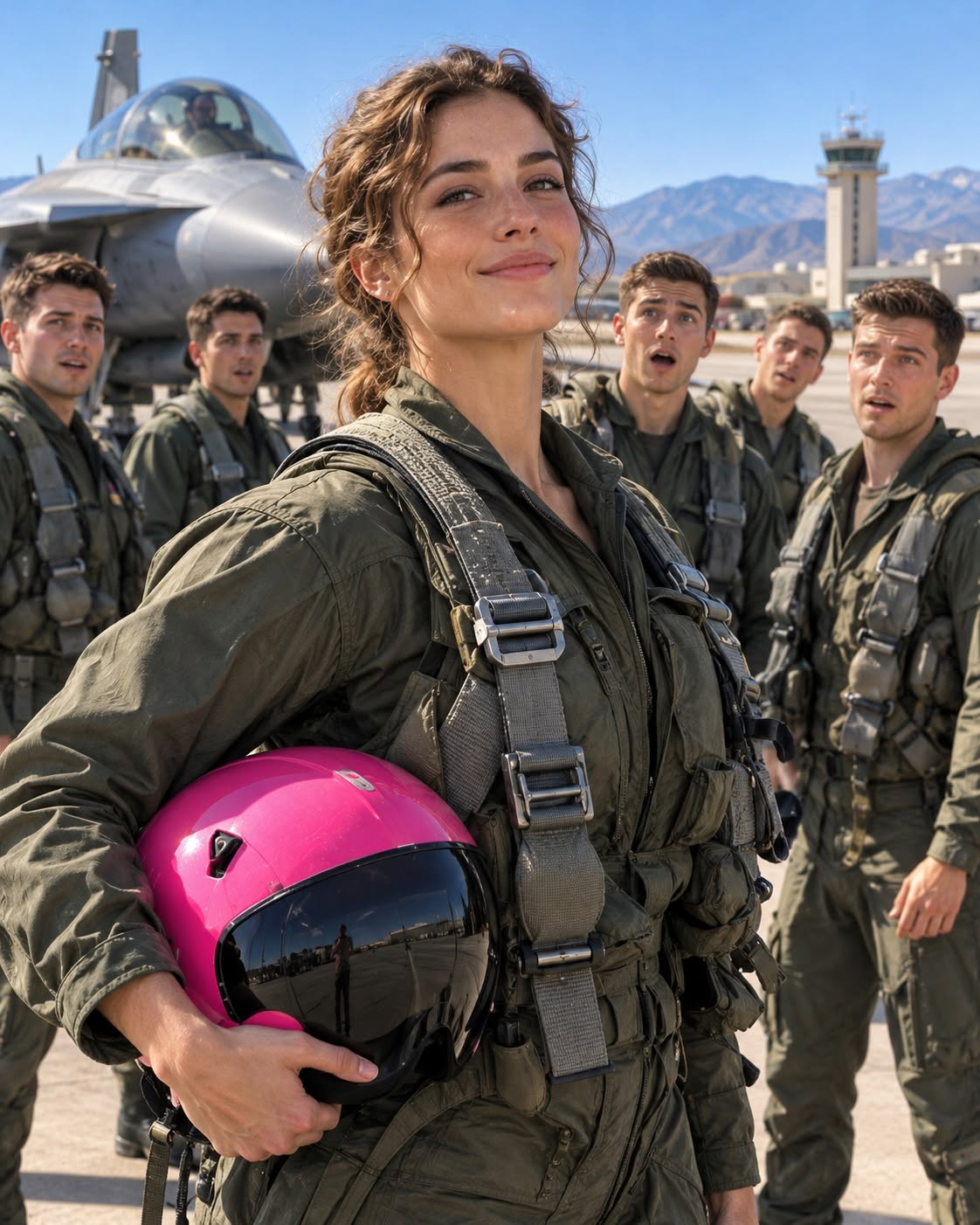
The first time the other pilots saw my pink helmet, they laughed so hard that one nearly spilled his coffee.
The room seemed to shrink around me.
I looked at the senior officer, then at the report lying open on the table. My fingers tightened slightly around the edge of my flight gloves.
“Yes, sir,” I finally answered. “My father taught me that maneuver.”
The senior officer leaned back.
“What was his name?”
I swallowed.
“Captain Daniel Hayes. He flew with the 17th Tactical Fighter Squadron before he was killed during a training mission eighteen years ago.”
For the first time since I had arrived at the base, nobody looked at my pink helmet.
They were looking at me.
The senior officer slowly closed the folder.
“Your father wasn’t just an ordinary fighter pilot, was he?”
“No, sir. But he never talked about himself that way.”
The commander shifted uncomfortably in his chair.
“With all due respect, sir, what does her father’s history have to do with today’s exercise? We are discussing a tactical violation.”
The senior officer turned toward him.
“That’s precisely why we’re discussing it.”
He opened the folder again and pulled out a photograph.
It showed an old fighter flying low between two enormous canyon walls. The photograph was grainy, its edges yellowed with age. On the back, someone had written a date and a short sentence.
The impossible passage. Daniel Hayes. Mission 17.
My stomach dropped.
I had seen that photograph before.
It had been sitting in my father’s workshop for as long as I could remember.
“Where did you get that?” I asked.
The senior officer studied my expression.
“From the military archives. Your father developed a maneuver that was considered too dangerous to use in standard operations. It involved using the terrain to create a temporary break in radar tracking, then approaching an opposing aircraft from an unexpected angle.”
He paused.
“During the final test, his aircraft encountered a mechanical failure. He managed to bring two other pilots safely out of the training area, but his own aircraft went down before he could return.”
I lowered my eyes.
For eighteen years, I had believed my father died because he had pushed an aging aircraft beyond its limits.
My mother had never told me anything different.
But the officer was not finished.
“There’s something else. The maneuver was never officially approved. Your father had requested permission to test it again, but his proposal was rejected. The technique was considered too unpredictable.”
The commander folded his arms.
“And that makes what she did today acceptable?”
The senior officer looked directly at him.
“It makes what she did today worth investigating.”
He turned back to me.
“Lieutenant, the recordings show that you didn’t simply hide in the canyon. You used a sequence of turns that matches your father’s original flight calculations. How did you know those calculations?”
I took a breath.
“Because I grew up watching him work on them.”
Then, for the first time, I told them something I had never shared with anyone at the base.
My father hadn’t taught me to become a fighter pilot.
He had taught me to understand the things most pilots never bothered to notice.
When I was ten, he would take me into his workshop and sit me beside an old wooden table covered with aircraft diagrams. He would point to a drawing and ask me what I saw.
I’d usually answer with something obvious.
A plane. A wing. An engine.
He would smile and shake his head.
“Look again, sweetheart. Don’t just look at what something is. Look at what it can become.”
He taught me how to recognize the difference between a healthy engine vibration and one that meant trouble. He showed me how wind moved around mountains and how small changes in air pressure could reveal what was happening beyond my line of sight.
Sometimes, he would draw complicated flight paths and ask me to find a safer way through them.
I never understood why he spent so much time doing that.
Not until the day he died.
After his funeral, my mother gave me his old flight notebook. I carried it through high school, flight training, and every rejection that came afterward.
The final pages contained the canyon maneuver.
Not a complete set of instructions.
Just enough to understand the idea.
I’d spent years studying the missing pieces.
And when I found the old fighter sitting abandoned in the hangar, I recognized the shape of the problem immediately.
It wasn’t a perfect aircraft.
But it was capable of something the modern fighters had forgotten how to do.
It could turn tightly at the speeds the exercise required, and its smaller profile made it difficult to track under certain terrain conditions.
I had never intended to imitate my father’s maneuver exactly.
I had intended to finish what he started.
The senior officer listened without interrupting.
When I finished, he looked at the commander.
“Colonel, I think we need to discuss something privately.”
The commander stood up.
“Of course, sir.”
Before leaving, he gave me a cold look.
“This isn’t over, Lieutenant.”
I didn’t respond.
I had heard that sentence too many times in my life.
When the door closed, the senior officer remained seated.
“Your father was one of the finest pilots I ever knew,” he said quietly.
I looked at him.
“You knew him?”
He nodded.
“His name was Robert Mitchell. I was a young flight officer when he saved my wingman during a storm exercise. He never mentioned it afterward. He just complained that the weather had ruined his weekend.”
For the first time that day, I smiled.
That sounded exactly like my father.
The officer stood and walked toward the window.
“There’s a reason I asked about that maneuver. We have been studying a problem for several months. Our modern aircraft are becoming increasingly dependent on advanced tracking systems. They’re extraordinary machines, but every system has weaknesses.”
He turned back.
“Your exercise exposed one of those weaknesses. The opposing squadron had become so confident in its technology that its pilots stopped paying attention to the environment around them.”
“Sir, I wasn’t trying to embarrass anyone.”
“I know.”
He paused.
“But you did something more important. You reminded us that technology should support a pilot’s judgment, not replace it.”
He closed the folder.
“I want you to remain with the squadron. Not as a punishment. As an opportunity.”
I wasn’t sure what he meant.
“Opportunity for what, sir?”
“To help us understand what your father was trying to accomplish.”
I left the room feeling as though I had stepped into another world.
Outside, the afternoon sun was beginning to disappear behind the hangars.
Ray was standing beside the old fighter, wiping grease from his hands.
He looked up when he saw me.
“Well?”
I shrugged.
“Apparently, my father was more famous than I thought.”
Ray stopped wiping his hands.
“Your father?”
I nodded.
Ray looked toward the aircraft.
Then he gave a long, thoughtful whistle.
“Well, that explains a few things.”
“What things?”
He reached into the pocket of his overalls and pulled out a small, folded piece of paper.
“I found this behind the instrument panel when we were replacing the old wiring. Didn’t think much of it at the time. The handwriting looked familiar, though.”
He handed it to me.
The paper was yellow and brittle.
I unfolded it carefully.
There were only three lines.
Never trust a machine to tell you the whole truth.
The sky always leaves clues.
And if you ever find yourself flying this aircraft, remember that the safest way home is not always the most obvious one.
My knees nearly gave way.
At the bottom was my father’s signature.
I stared at the paper for a long time.
Ray gently touched my shoulder.
“He left you something, kid.”
I shook my head.
“No. He left this for whoever found it.”
Ray smiled.
“Maybe. But somehow, I don’t think it was an accident that you ended up with that aircraft.”
I looked at the old fighter.
For the first time, it didn’t seem neglected.
It seemed like a promise.
The following morning, everything changed.
The story of the exercise had spread across the base. Pilots who had laughed at my helmet now avoided making eye contact. Others approached me with questions about the old fighter and how I had managed to outmaneuver five modern aircraft.
A few were genuinely curious.
Some were simply embarrassed.
One of them, Lieutenant Carter, approached me while I was checking my equipment.
“Hey, pink helmet.”
I turned.
He was the same pilot who had laughed the loudest on my first day.
“Yes?”
He scratched the back of his neck.
“About what I said when you arrived…”
I waited.
“That was out of line. I apologize.”
I studied him for a moment.
“Apology accepted.”
He looked relieved.
Then he glanced toward the old aircraft.
“So, is it true you actually beat all five of us?”
I smiled slightly.
“That’s what the report says.”
He laughed.
“Must be nice having a magic plane.”
I looked at him.
“It wasn’t magic. I just learned what it could do.”
He nodded slowly.
For the first time, I saw something other than arrogance in his expression.
Respect.
But respect would not last long if I couldn’t prove myself again.
Three days later, the senior officer called an emergency briefing.
The exercise had attracted attention from command headquarters. They wanted a second evaluation, this time under more difficult conditions.
There would be two teams.
The first would consist of four advanced fighters equipped with the latest tracking systems.
The second would consist of me and the old aircraft.
The mission was simple on paper.
Protect a simulated rescue aircraft traveling through a mountainous training corridor.
The opposing team had to locate and intercept it.
My job was to prevent that from happening.
The commander stood at the front of the room.
“I want to make one thing clear,” he said. “This is not a demonstration of historical aircraft. It is a test of modern operational readiness.”
His eyes briefly met mine.
“Nobody should assume yesterday’s results will be repeated.”
I nodded.
He continued.
“The opposing team will be led by Lieutenant Carter.”
Carter sat up straighter.
He glanced at me, then at the commander.
“Understood, sir.”
The commander looked at me.
“Lieutenant Hayes, you’ll be responsible for the escort aircraft.”
“Yes, sir.”
“One more thing. No improvisations outside the approved safety envelope. I don’t want another report full of surprises.”
“Understood.”
The briefing ended.
As I walked out, Ray caught up with me.
“Something bothering you?”
I looked toward the flight line.
“The aircraft.”
“What about it?”
“It’s been running beautifully, but something isn’t right. There’s a vibration in the left engine that wasn’t there yesterday.”
Ray frowned.
“I checked the mounts.”
“I know. But it changes when the aircraft banks.”
He studied me.
“How serious?”
“I don’t know yet.”
Ray immediately turned around.
“Then we’re finding out before you fly it.”
For the next four hours, we inspected everything.
We checked the engine mounts, control linkages, fuel lines, and the old hydraulic system. We found nothing obvious.
Finally, Ray removed a panel near the rear section of the engine compartment.
He went quiet.
“What is it?” I asked.
He pointed to a hairline crack in a structural support.
It was almost invisible.
Under certain loads, it could become dangerous.
My heart sank.
“Can we fix it?”
Ray examined the damage.
“Not properly in four hours. We can replace the damaged component, but I need a specialist and the correct part.”
I looked at the schedule.
The exercise was set to begin in the morning.
“Then we tell them the aircraft isn’t ready.”
Ray nodded.
“That’s what a responsible pilot does.”
I knew he was right.
Still, part of me felt the old pressure returning.
The pressure to prove that I deserved to be there.
To show that the pink helmet didn’t belong to someone who would back down.
But my father’s voice came back to me.
Respect the aircraft beneath you.
I closed the panel.
“We’re grounding her.”
Ray smiled.
“Good. I was hoping you’d say that.”
The next morning, the commander was furious.
“You are telling me you can’t fly?”
“Not safely, sir.”
“After everything that happened, you’re withdrawing from the exercise because of a minor mechanical concern?”
“It’s not minor.”
He looked at Ray.
“Is this your assessment, Sergeant?”
Ray stood straight.
“Yes, sir. The aircraft needs a replacement support.”
The commander shook his head.
“Then we’ll use another aircraft.”
I nodded.
“Understood.”
I expected him to be angry.
Instead, he gave a small, satisfied smile.
“Perhaps this is a good opportunity for you to learn when to recognize your limitations.”
I didn’t answer.
But something unexpected happened.
Lieutenant Carter stepped forward.
“Sir, I’d like to request a delay.”
The commander frowned.
“Why?”
“Because if Lieutenant Hayes can’t fly, we shouldn’t pretend this is the same exercise.”
The room went quiet.
Carter continued.
“She found a mechanical problem before it became a failure. That’s exactly what we want our pilots to do.”
I looked at him.
He avoided my eyes, but his voice remained steady.
Another pilot spoke up.
“I agree, sir.”
Then another.
The commander looked around the room as if he couldn’t believe what he was hearing.
Finally, the senior officer entered.
“I’ve already approved a forty-eight-hour delay,” he announced.
He turned toward Ray.
“Get the aircraft repaired properly. No shortcuts.”
Ray gave a firm nod.
“Yes, sir.”
The commander said nothing.
For the first time, I understood that the biggest victory wasn’t always the one recorded on a radar screen.
Sometimes it was having the courage to refuse a dangerous decision, even when everyone expected you to continue.
Forty-eight hours later, the aircraft was ready.
The damaged support had been replaced, the engine inspected, and every critical system checked twice.
Ray stood beside the ladder as I climbed into the cockpit.
“How does she feel?”
I adjusted my helmet.
“Like she’s been waiting for this.”
He laughed.
“Then bring her home in one piece.”
I gave him a thumbs-up.
The exercise began at 0900.
The simulated rescue aircraft lifted off first.
Four advanced fighters followed, spreading out across the training area.
I took off last.
For the first few minutes, everything went according to plan.
The rescue aircraft maintained its route.
Carter’s team searched the surrounding area.
Then the first unexpected message came through.
“Control, this is Falcon One. We’ve lost tracking on the rescue aircraft.”
The command center immediately responded.
“Confirm last known position.”
“Grid reference confirmed. Visibility is deteriorating.”
I looked at the horizon.
Dark clouds were gathering over the northern mountains.
A storm had moved into the region faster than forecast.
The exercise controller spoke over the radio.
“All aircraft, be advised. Weather conditions are approaching the exercise limits. Maintain separation and prepare for possible termination.”
Then came another call.
“Falcon Two to Control. We’re experiencing navigation interference.”
I glanced at my instruments.
Something was wrong.
The old fighter’s navigation system was behaving strangely, but I could still read the basic instruments.
I checked my position against the terrain.
The rescue aircraft was somewhere ahead of me.
Then I heard a voice that made my stomach tighten.
“Falcon Three to Control. I have a warning light. Requesting permission to return.”
A second later, another pilot reported the same problem.
The control room erupted into overlapping transmissions.
The storm had disrupted several electronic systems, and the aircraft were beginning to lose reliable navigation information.
This was no longer a simple exercise.
The senior officer’s voice came through, firm and unmistakable.
“All units, terminate the exercise. Return to base using approved recovery procedures.”
I acknowledged.
But then I heard something else.
A faint distress call.
It was coming from the rescue aircraft.
“Mayday, mayday. We have lost engine power. We are unable to maintain altitude.”
I immediately turned toward the signal.
“Control, this is Hayes. I have visual contact with the rescue aircraft’s last reported position. Request permission to assist.”
There was a brief silence.
Then the commander answered.
“Negative. Return to base. This is a training exercise.”
I looked toward the darkening mountains.
The rescue aircraft was not a simulation anymore.
It was a real aircraft in trouble.
“Sir, they have declared an emergency.”
“Lieutenant, that is an order. Return to base.”
My hands tightened around the controls.
I remembered my father’s workshop.
The diagrams.
The photographs.
The countless afternoons he had spent teaching me to look beyond the instruments.
I also remembered the most important lesson he had ever given me.
Never confuse obedience with responsibility.
I keyed the radio.
“Control, I am requesting emergency authority to assist the distressed aircraft. I have visual conditions and a safe approach corridor.”
The senior officer responded before the commander could.
“Hayes, this is Mitchell. You are cleared to assist, provided you remain within the emergency safety limits. Keep us informed.”
“Understood, sir.”
I pushed forward.
The canyon appeared beneath the clouds, dark and narrow.
I could see the rescue aircraft struggling against the wind.
Its wings were shaking.
One engine was trailing smoke.
I moved closer, maintaining a safe distance.
“Rescue aircraft, this is Hayes. Can you hear me?”
A strained voice answered.
“Hayes, we hear you. We’re losing altitude. We have two crew members aboard.”
“Understood. Keep your wings level as much as possible. I’m going to help guide you toward the wider valley.”
The aircraft was descending toward a rocky ridge.
I scanned the terrain.
The obvious route was blocked by the storm.
But farther west, there was a broad opening between two mountains.
It was the same area I had studied for weeks.
The same terrain that had helped me win the first exercise.
Now it might save two lives.
I relayed the route to the rescue crew.
“Turn gradually west. Do not attempt a steep correction. I’ll stay ahead of you.”
I guided them toward the opening.
The wind pushed against both aircraft.
My old fighter trembled.
For a moment, the engine vibration returned.
My eyes flicked toward the instruments.
The repair had held.
But the storm was becoming stronger.
“Hayes, we’re descending too quickly!” the rescue pilot shouted.
I looked at the terrain.
There was no time for a perfect solution.
Only a safe enough one.
I radioed the control room.
“Control, the rescue aircraft is approaching the western valley. I need ground emergency services positioned at the north access point.”
The senior officer responded immediately.
“Understood. Emergency teams are being dispatched.”
Then another voice broke through.
“Hayes, this is Carter. We have you on visual. What’s happening?”
I glanced to my right.
One of the advanced fighters had returned to the area.
Carter was following at a distance.
“You’re supposed to be heading back to base,” I said.
“Weather cleared enough for visual recovery. I saw your signal. What do you need?”
I hesitated for only a second.
“Can you maintain visual contact with the rescue aircraft and relay its position? My instruments are unreliable.”
“Copy that.”
Another fighter joined him.
Then another.
The pilots who had once laughed at my pink helmet were now working together to keep two strangers alive.
Carter’s voice came through again.
“Hayes, I have the rescue aircraft. They’re drifting toward the eastern side.”
“Copy. Keep them centered in the valley.”
The rescue pilot struggled to correct his course.
I moved ahead and called out the terrain.
“You’re clear on the left. Keep the turn gentle. You’ve got room.”
For several terrifying seconds, nobody spoke.
Then Carter shouted.
“Hayes! They’re clearing the ridge!”
I looked back.
The rescue aircraft had passed the mountain.
Its altitude was low, but its wings were level.
The valley opened beneath it.
“You’re clear,” I said. “The landing area is ahead.”
The rescue pilot answered with a shaky voice.
“Copy. We’re going in.”
I watched as the aircraft descended.
Its wheels struck the ground hard.
It bounced once.
Then it settled.
A cloud of dust rose behind it.
For one horrible moment, I thought it might overturn.
But it stopped.
I let out a breath I hadn’t realized I was holding.
“Rescue aircraft is down safely,” Carter announced.
The radio erupted.
“Both crew members are alive.”
“Emergency vehicles are approaching.”
“Visual confirmation received.”
I closed my eyes for half a second.
Then I looked at the old fighter’s instruments.
She was still flying.
I turned toward home.
The journey back was quiet.
No jokes.
No arguments.
Only the sound of the engine and the occasional confirmation from the control room.
When I landed, Ray was already waiting.
He ran toward the aircraft before the propeller had fully stopped.
I climbed down, removed my gloves, and looked at him.
“She’s okay.”
Ray laughed, but his eyes were wet.
“I wasn’t asking about the airplane.”
I looked toward the emergency vehicles in the distance.
“They made it.”
He pulled me into a quick, rough hug.
“Your father would’ve been proud.”
I couldn’t answer.
Because for the first time in eighteen years, I felt as though I had finally understood what my father had been trying to teach me.
It wasn’t about flying better than everyone else.
It wasn’t about proving that an old aircraft could defeat a modern one.
It was about knowing what mattered when everything else fell apart.
That afternoon, the senior officer called another meeting.
This time, the entire squadron was present.
The commander stood at the front, unusually quiet.
The senior officer placed two documents on the table.
The first was the official report from the tactical exercise.
The second was the emergency rescue report.
“Today, we witnessed something important,” he began.
“Technology failed in ways we did not anticipate. Weather conditions changed faster than our systems could compensate. Several experienced pilots found themselves in situations they had never trained for.”
He looked at me.
“And one pilot recognized that the most important information wasn’t coming from a computer.”
He turned toward the commander.
“Colonel, would you like to say something?”
The commander stood.
For several seconds, he said nothing.
Then he looked directly at me.
“Lieutenant Hayes, I owe you an apology.”
The room became silent.
“I judged you before I understood your abilities. I judged your aircraft before I understood its capabilities. And I allowed personal assumptions to influence how I assigned your responsibilities.”
He paused.
“That was a failure of leadership.”
I didn’t know what to say.
He continued.
“Your performance today has demonstrated qualities every pilot should possess. Preparation, discipline, sound judgment, and the courage to speak up when something is wrong.”
He extended his hand.
“Well done, Lieutenant.”
I shook it.
“Thank you, sir.”
Then Carter stood.
“I’d also like to say something.”
The senior officer nodded.
Carter looked around the room.
“When Hayes first arrived, I laughed at her helmet. I thought she didn’t belong here. I was wrong.”
He turned toward me.
“Today, she trusted us when she didn’t have to. She let us help her, and she helped us get two people home.”
He took a breath.
“I’d rather fly with someone like that than someone who thinks being the best means never needing anyone else.”
A few pilots nodded.
The senior officer smiled.
Then he reached into his folder and removed a small photograph.
It was the same photograph from the previous meeting.
My father’s aircraft flying between the canyon walls.
“I’ve been thinking about something,” he said. “Your father spent years trying to make people understand that a pilot’s greatest advantage isn’t the equipment in the cockpit. It’s the ability to understand the situation around them.”
He placed the photograph in front of me.
“I believe it’s time his work received the recognition it deserves.”
I stared at the image.
“What do you mean, sir?”
He smiled.
“We are establishing a new training program focused on situational awareness, mechanical understanding, and decision-making under pressure. I’d like you to help develop it.”
I was speechless.
“And Ray,” he added, looking toward the mechanic standing near the door, “will be our technical adviser.”
Ray blinked.
“Me, sir?”
“You know that aircraft better than anyone. I’d say you’re qualified.”
For once, Ray didn’t have a clever response.
He simply smiled.
The following weeks were different from anything I had experienced before.
I was no longer assigned to the neglected corner of the hangar.
Instead, pilots from different squadrons came to study the old fighter. They wanted to understand how it had performed so well during the exercise and why its pilot had been able to recognize problems that advanced systems had missed.
But I insisted on one condition.
Nobody would treat the aircraft as a miracle.
It was old.
It had limitations.
It required careful maintenance and a pilot who understood its weaknesses.
That was exactly the point.
During one training session, a young pilot approached me.
He was new to the base and looked nervous.
His eyes moved from my face to the pink helmet resting on the table.
“Ma’am, can I ask you something?”
“Of course.”
“Why do you still wear that?”
I looked at the helmet.
Its paint was scratched in several places. The visor had been replaced twice. One side carried a small white symbol I had painted myself.
I smiled.
“Because it reminds me of someone.”
“Your father?”
I nodded.
“He used to tell me that the world would always try to decide who I was before I had the chance to show them. He said I should never spend my life changing myself just to make other people comfortable.”
The young pilot considered that.
“Is that why it’s pink?”
“Partly.”
I picked it up and turned it in my hands.
“When I first started flying, everyone expected me to wear something that made me look more like the pilots they were used to seeing. I wanted something that reminded me I didn’t have to become someone else to belong here.”
He smiled.
“That’s pretty cool.”
I laughed.
“Just remember, the helmet doesn’t make you a good pilot.”
“I know.”
“Good. Because if you ever forget to check your aircraft, I’ll personally make sure you spend a week with Ray.”
The young pilot laughed.
Ray, who had been listening from the other side of the hangar, pointed a wrench at us.
“Make it two weeks!”
For the first time, the hangar was filled with laughter that didn’t come at anyone’s expense.
Months later, the old fighter was moved to a special display area beside the training building.
Its exterior was restored, but I insisted that the maintenance marks and small imperfections remain visible.
I didn’t want it to look like a brand-new aircraft.
I wanted people to see what it really was.
An old machine that had survived because people had cared enough to understand it.
Beside the aircraft, a small plaque was installed.
It read:
THE HAYES LEGACY
In honor of Captain Daniel Hayes, whose courage and curiosity helped shape a generation of pilots.
And in recognition of every aviator who understands that true skill begins with humility.
On the day of the unveiling, my mother came to the base.
She stood in front of the plaque for a long time.
Then she looked at me.
“Your father would’ve loved this.”
I slipped my hand into hers.
“I wish he could’ve seen it.”
She smiled sadly.
“He did, sweetheart. Maybe not in the way we wanted. But everything he taught you is still here.”
I looked toward the hangar.
Ray was arguing with a young mechanic about a replacement part. Carter was helping another pilot prepare for a flight. The commander was standing with the senior officer, discussing the new training program.
The squadron had changed.
Not because of one spectacular flight.
Not because of a pink helmet.
But because a group of people had learned that being professional meant more than looking impressive or owning the newest equipment.
It meant listening.
It meant learning.
It meant admitting when you were wrong.
And sometimes, it meant trusting the person everyone else had underestimated.
Before my mother left, she reached into her handbag and handed me a small envelope.
“I found this in your father’s old desk. I think it’s time you had it.”
My name was written across the front.
The handwriting was unmistakable.
I opened it carefully.
Inside was a single sheet of paper.
It was dated three months before his final flight.
My little girl,
If you ever read this, I hope you have found something worth working hard for. I hope you’ve learned that being brave doesn’t mean being fearless, and being strong doesn’t mean refusing help.
People will sometimes laugh at the things they don’t understand. Let them. You don’t owe the world an explanation for every choice you make.
But never let pride become the reason you take a risk you don’t need to take. A good pilot knows how to fly. A great pilot knows when to turn back, when to ask for help, and when another life matters more than a personal victory.
And if you ever find yourself sitting in a cockpit wondering whether you belong there, remember this: The sky doesn’t care what color your helmet is. It only asks whether you know what you’re doing and whether you respect the lives depending on you.
I’m proud of you already.
Love, Dad.
I read it once.
Then again.
By the third time, my vision had blurred.
My mother wrapped her arms around me, and I finally allowed myself to cry.
Not because I was sad.
But because I no longer felt that I needed to prove something to a man who had been gone for eighteen years.
I had spent so much of my life trying to become the pilot my father would have admired.
Now I understood that he had never asked me to become him.
He had simply wanted me to become myself.
A few minutes later, the base announcement system crackled.
“Lieutenant Hayes, report to the flight line. Your next assignment is ready.”
I wiped my eyes, folded the letter, and placed it safely inside my jacket.
My mother smiled.
“Go on.”
I picked up my pink helmet.
As I walked toward the hangar, I passed the same group of pilots who had laughed at me on my first day.
Carter raised his coffee cup.
“Looking good, Hayes.”
I grinned.
“Careful. You might spill that.”
Everyone laughed.
This time, I laughed with them.
The old fighter was waiting.
So was the sky.
And as I climbed into the cockpit, I thought about the lesson that had taken me eighteen years to understand.
People may judge you by the things they can see.
They may measure your worth by your appearance, your background, your equipment, or the position they think you deserve.
But none of those things tells the whole story.
The loudest person in the room isn’t always the strongest.
The newest machine isn’t always the wisest choice.
And the person everyone underestimates may be the one who saves the day.
I lowered my visor.
The pink helmet caught the morning sunlight.
Then I started the engine.
Because I had finally learned something my father had tried to teach me all along:
You don’t prove you belong by looking like everyone else. You prove it by showing up prepared, doing the right thing when it matters, and having the courage to remain yourself even when the whole world is laughing.