The first time I warned the head maintenance officer that one of our fighter jets wasn’t safe to fly, he laughed in front of the entire crew.
I spent the next several minutes staring at the paperwork on Major Collins’s desk.
There were two documents sitting side by side. One was a written promise to correct my missing wages and formally recognize my technical contributions. The other was an internal transfer request that would move me to a different maintenance unit once the emergency had passed.
Collins had already signed both.
He wanted me to accept his apology, help restore the team’s reputation, and quietly move on.
For a moment, I considered it.
I was exhausted. My hands were still sore from working beneath the fighter jet, and I hadn’t slept since the attack began. Part of me wanted nothing more than to collect my overdue wages and return to doing the work I loved.
But then I remembered something.
Three weeks earlier, I had submitted a report about a second aircraft with a similar structural concern. Collins had dismissed that one, too.
I looked up.
“Major, before I sign anything, I need to know what happened to the other aircraft.”
His expression changed.
“What other aircraft?”
“Falcon Seven. I submitted a fatigue inspection report on it last month.”
He leaned back.
“That aircraft passed its inspection.”
“According to the computerized report. I’m asking whether anyone physically examined the affected section.”
Collins rubbed his forehead.
“We’re dealing with a military emergency. This isn’t the time to reopen old maintenance disputes.”
“That’s exactly why it is the time.”
He stared at me.
I slid a copy of the report across his desk.
“Falcon Seven was scheduled for a routine inspection before the attack. I found a developing stress fracture near its hydraulic routing bracket. The measurements were included in this report. I recommended grounding it until a senior inspector could examine it.”
Collins glanced at the signature at the bottom.
His own.
For several seconds, neither of us spoke.
Then he picked up the telephone.
“Get me the maintenance control officer. Immediately.”
I watched him make the call.
Something told me the night wasn’t over.
Twenty minutes later, we were standing inside the secondary maintenance hangar.
Falcon Seven sat beneath the overhead lights, surrounded by equipment and emergency supply crates. It was one of the aircraft originally assigned to support the extraction mission.
Its pilot, Captain Daniel Reeves, was already waiting.
He was a quiet man in his late thirties who had flown combat missions for years. I had seen him around the base, but we had never spoken beyond the usual professional greetings.
When Collins explained that we needed another inspection, Reeves frowned.
“Is there a problem with my aircraft?”
I answered before Collins could.
“There may be. I found a structural concern during its previous inspection. I need to verify whether it has progressed.”
Reeves looked at Collins.
“Was this reported?”
Collins hesitated.
“Yes.”
“And?”
“It was considered acceptable at the time.”
Captain Reeves looked back at me.
“Do you believe it’s safe?”
I chose my words carefully.
“I believe the available evidence warrants an immediate technical inspection before anyone authorizes another flight.”
That was enough.
Reeves removed his flight helmet and placed it on a nearby workbench.
“Then nobody takes it up until you finish.”
Collins didn’t object.
We began the inspection under the supervision of the senior maintenance inspector. This time, there were no shortcuts, no jokes, and no one telling me that I was being overly cautious.
I located the area described in my original report.
The crack had grown.
Not dramatically. Not enough to make the aircraft visibly damaged. But it was now extending toward a mounting point that carried significant mechanical stress.
I felt a cold knot form in my stomach.
The earlier warning had been correct.
I photographed the defect, measured its dimensions, and immediately notified the inspection authority. The aircraft was placed on a temporary hold pending a full engineering assessment.
Captain Reeves stood beside me as I completed the documentation.
“How long have you been trying to get someone to look at this?”
“Since last month.”
He looked toward Collins.
“Then someone needs to explain why this was ignored.”
Collins said nothing.
For the first time, I realized that the problem was bigger than one man’s attitude toward a female mechanic.
His decisions had created a system in which people were afraid to challenge him.
And that system had almost put two pilots in danger.
The following morning, a message arrived from the base commander’s office.
I was ordered to attend an emergency maintenance review.
I expected to find Collins waiting with a prepared explanation. Instead, I walked into a conference room filled with senior officers, the base safety director, the chief engineer, and a representative from the military personnel department.
At the head of the table sat Colonel Margaret Hayes.
She was a serious-looking woman in her early fifties, with silver beginning to show in her dark hair.
I had seen her during formal inspections, but never spoken to her directly.
“Sergeant,” she said, pointing to the empty chair, “please sit down.”
I took my place.
Colonel Hayes opened a folder.
“Last night’s incident has raised several questions. We understand that you identified a potentially dangerous defect before the aircraft experienced a hydraulic failure.”
“Yes, ma’am.”
“We also understand that your report was submitted and subsequently approved by Major Collins.”
“Yes, ma’am.”
She turned toward him.
“Major, is that correct?”
Collins adjusted his uniform.
“The aircraft was inspected according to the procedures available at the time. The circumstances changed during the attack, and the electronic interference complicated the situation.”
Colonel Hayes didn’t look impressed.
“That’s not what I asked.”
He lowered his eyes.
“Yes, ma’am.”
She turned back to me.
“I want you to explain exactly what you found. Start with your first report and take us through the sequence of events.”
So I did.
I explained the initial inspection, the measurements, the photographs, the repeated requests for review, and the missing wages.
I also explained that I had never received a formal response to several of my safety reports.
When I finished, the room was silent.
The personnel representative opened another folder.
“We have a separate payroll discrepancy here. Three pay periods show unauthorized withholding adjustments.”
I looked at him.
“Three?”
He nodded.
“Your records indicate that you should have received the full amount.”
I had suspected something was wrong, but I hadn’t known the problem extended across three pay periods.
“Who authorized the adjustments?” Colonel Hayes asked.
The representative checked his documents.
“Major Collins approved the administrative exceptions.”
Every head in the room turned toward him.
Collins shifted in his chair.
“There were budget complications. I intended to resolve the matter.”
“You had three opportunities to resolve it,” Colonel Hayes replied. “Why didn’t you?”
He didn’t answer.
Then the chief engineer spoke.
“There’s another concern. We reviewed the previous maintenance logs from both aircraft. Several inspection notes appear to have been altered after their initial submission.”
My stomach tightened.
“What do you mean?” I asked.
He placed two documents on the table.
“The original notes identify structural concerns. The final digital entries classify them as routine observations that required no further action.”
I leaned forward.
The wording was familiar.
It was almost identical to the language Collins had used when dismissing my reports.
“Those aren’t my final entries,” I said.
The chief engineer nodded.
“We know. Your signed inspection copies contain the original observations.”
Colonel Hayes closed the folder.
“Then this is no longer simply a disagreement about maintenance judgment. We’re opening a formal investigation into the alteration of safety records and the unauthorized withholding of wages.”
Collins looked up sharply.
“Colonel, with respect, I have served this base for eighteen years.”
“And that service does not place you above its safety regulations.”
Nobody moved.
Then she addressed me again.
“Sergeant, I want you to understand something. You are not being investigated for reporting a safety concern. You are being asked to assist because you documented it properly.”
I nodded.
For the first time in months, I felt as though someone was actually listening.
I thought that meeting would be the hardest part.
I was wrong.
Two days later, the investigation uncovered something far more disturbing.
The maintenance department had been operating under enormous pressure to meet readiness targets. Aircraft that remained grounded for extended inspections affected performance evaluations. Delays required explanations. Repeated safety holds made the department appear inefficient.
Instead of addressing those problems, Collins had developed a habit of encouraging technicians to classify certain defects as minor observations.
Some employees had complied.
Others had quietly disagreed but never put their objections in writing.
My reports were different.
They contained measurements, photographs, inspection times, technical references, and the names of the personnel who had witnessed the findings.
That made them difficult to dismiss.
Investigators also discovered that Collins had personally instructed an administrative clerk to delay processing my payroll corrections after I challenged one of his maintenance decisions.
The clerk eventually admitted that she had been uncomfortable with the order but feared losing her position.
When she was interviewed, she provided copies of the original payroll instructions.
I felt angry when I heard that.
Not because I wanted revenge.
Because I had spent weeks wondering whether I had made a mistake, whether I had misunderstood the paperwork, whether I had somehow failed to follow the correct process.
Meanwhile, someone had deliberately made it harder for me to receive money I had already earned.
The worst discovery came from the maintenance logs.
Several other technicians had reported similar concerns involving different aircraft.
Their reports had been downgraded, delayed, or closed without proper engineering review.
Some defects were harmless.
Others were not.
The problem wasn’t that every aircraft had been unsafe.
The problem was that nobody could confidently tell which ones were safe because the reporting process had become unreliable.
A military maintenance system depended on honesty.
Without it, even the most advanced aircraft became a gamble.
A week after the investigation began, I received an unexpected visitor.
Captain Reeves walked into the hangar carrying two cups of coffee.
“Thought you might need this.”
I accepted one.
“Thank you, Captain.”
He leaned against the workbench.
“I heard they’re reviewing the entire maintenance department.”
“They are.”
He took a sip.
“Good.”
For a moment, we watched a team of mechanics working on a grounded aircraft.
Then he asked, “Can I tell you something?”
“Of course.”
“Before the attack, I requested a different aircraft for the extraction mission. Mine had been giving me inconsistent hydraulic readings. The issue was marked as resolved, but I never felt comfortable with it.”
I turned toward him.
“Did you report that?”
“Twice.”
My stomach tightened.
“What happened?”
“My first report disappeared from the system. The second came back with a note saying the issue had been corrected.”
“Was it?”
“No.”
He looked down at his coffee.
“I thought maybe I was being overly cautious. You know how it is. Pilots don’t want to be the person who delays a mission without a good reason.”
I understood.
He had trusted the system to tell him the aircraft was safe.
I had trusted the inspection process to protect the people who flew it.
Both of us had discovered that trust could become dangerous when people were more concerned about appearances than facts.
“Captain,” I said, “you were right to report it.”
He gave me a tired smile.
“So were you.”
Then he placed something on the workbench.
It was a small handwritten note.
Several pilots and maintenance technicians had signed it.
It thanked me for refusing to approve an aircraft simply because someone higher in rank wanted it ready.
I read it twice.
I had spent so long trying to prove that I belonged in that hangar that I hadn’t realized how many people had been quietly hoping someone would finally speak up.
But the investigation brought another challenge.
One afternoon, Colonel Hayes summoned me to her office.
There was a new document on her desk.
It was a recommendation for a temporary assignment at the regional aviation maintenance center.
The position involved technical inspection, safety oversight, and training.
It was a promotion in responsibility, though not yet in rank.
I stared at it.
“Ma’am, is this a transfer?”
“It’s an opportunity.”
I looked at the description.
The work was important, but it meant leaving the flight line where I had spent years building my experience.
“Why me?”
“Because you identified problems others missed. More importantly, you documented them in a way that allowed independent investigators to verify your findings.”
She paused.
“Your work has also exposed weaknesses in our maintenance reporting process. We need someone who understands what happens when those weaknesses reach the hangar floor.”
I considered the offer.
Then I asked the question that had been bothering me.
“Would I be leaving because of what happened with Major Collins?”
“No,” she said firmly. “You would be moving because your skills could improve an entire maintenance organization.”
I appreciated her answer.
But I wasn’t ready to accept.
“May I have some time to think about it?”
“Take two days.”
I left her office carrying the document.
That evening, I stayed late in the hangar.
I walked past the aircraft I had worked on during the emergency. Its damaged hydraulic assembly had been removed and placed in an evidence container for the investigation.
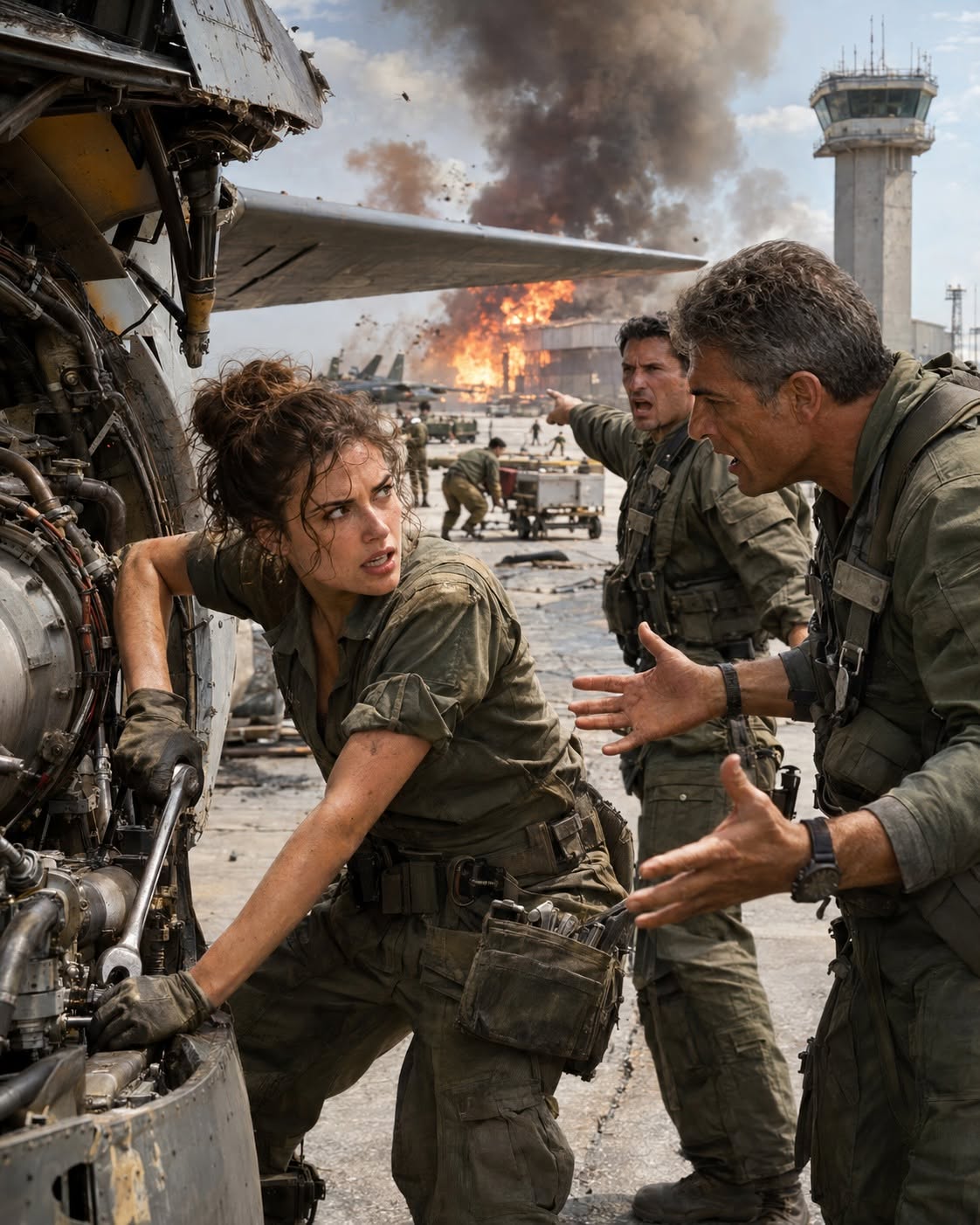
I remembered lying beneath it while alarms echoed overhead.
I remembered Collins asking me to save the aircraft.
And I remembered the moment I realized that the crack had developed exactly where I had predicted.
I had wanted respect.
But I was beginning to understand that respect wasn’t the only thing I could fight for.
I could help create a place where the next mechanic wouldn’t have to beg someone to take a safety report seriously.
That thought changed my decision.
The next morning, I accepted the assignment.
However, I made one request.
I wanted the new safety review process to include a protected reporting channel for technicians, an independent review mechanism for disputed aircraft inspections, and mandatory documentation of every decision to override a safety recommendation.
Colonel Hayes listened carefully.
“That’s ambitious.”
“It’s necessary, ma’am.”
She studied me for a moment.
“Put it in writing. I’ll make sure the engineering team reviews it.”
I smiled.
I had learned that lesson the hard way.
If something mattered, it needed to be documented.
Three weeks later, Major Collins was relieved of his maintenance command while the investigation continued. He was eventually found responsible for improper payroll actions, altering maintenance documentation, and violating established safety procedures.
His disciplinary process was handled through the appropriate military channels.
I never attended the hearing.
I didn’t need to watch him lose his position to feel that something had changed.
My overdue wages were restored in full, including the adjustments that had been withheld without authorization. The personnel department also corrected my employment records.
More importantly, the base commander issued a formal order requiring independent review of disputed safety findings.
The new policy didn’t make every maintenance decision easy.
It made it harder for one person to silence everyone else.
My first assignment at the regional maintenance center began on a cold Monday morning.
The facility was much larger than the desert base. It had specialized inspection equipment, engineering laboratories, and dozens of technicians working across different aircraft systems.
I was nervous.
Not because I doubted my technical abilities, but because I knew that changing a culture was harder than repairing a machine.
During my first week, I attended a maintenance briefing.
A young female technician stood near the back of the room holding a folder.
She looked uncertain.
When the senior engineer asked whether anyone had concerns about the proposed inspection schedule, she slowly raised her hand.
“Sir, I think the current schedule overlooks a recurring stress point in the auxiliary hydraulic assembly.”
The engineer glanced at her folder.
“That’s already been evaluated.”
She lowered her hand slightly.
“I have additional measurements.”
A few people shifted in their seats.
I recognized the expression on her face.
It was the same one I had worn months earlier.
The expression of someone deciding whether speaking up was worth the humiliation that might follow.
I stood.
“Let’s see the measurements.”
The young technician looked at me.
“Ma’am?”
“Bring them forward. We’ll review them together.”
She approached the table and opened her folder.
Her observations were detailed, carefully documented, and supported by photographs.
I asked several questions.
She answered each one clearly.
The senior engineer leaned forward.
“That’s actually a valid concern.”
The technician’s shoulders relaxed.
I smiled.
“Good catch. Let’s get the inspection team involved before this moves any further.”
After the meeting, she approached me near the doorway.
“Thank you for listening.”
I knew exactly what she meant.
“Don’t thank me for doing my job,” I said. “Your report deserved to be reviewed.”
She smiled.
Then she asked, “Can I come to you if I find something else?”
“Absolutely. But I want you to remember something.”
I waited until she looked directly at me.
“You don’t need my permission to speak up. You need the evidence, the courage to present it, and a process that takes it seriously.”
She nodded.
And I realized that this was the real reason I had accepted the assignment.
Six months later, I returned to the desert base for a safety audit.
The hangar looked almost the same.
The same concrete floor. The same overhead lights. The same smell of aviation fuel and metal.
But the atmosphere had changed.
Technicians were now required to review safety findings together, and disagreements were recorded instead of quietly erased.
The maintenance supervisors had also introduced a system that allowed inspectors to request independent technical reviews without seeking approval from the officer whose decision they were challenging.
I walked past the aircraft where everything had begun.
A young mechanic was working beneath the landing gear.
He looked up when he saw me.
“Sergeant, could you take a look at something?”
I crouched beside him.
“What have you found?”
He showed me a small area where a protective bracket appeared to be wearing unevenly.
I examined it carefully.
It wasn’t a critical defect, but it deserved attention.
“Good observation,” I told him. “Let’s document it and have engineering review the wear pattern.”
He nodded and began recording the measurements.
Then I noticed someone standing near the hangar entrance.
Major Collins.
He was no longer in command. His disciplinary case had been completed, and he had been reassigned to duties that did not involve aircraft maintenance authority.
He looked older than I remembered.
For a moment, neither of us moved.
Then he approached.
“Sergeant.”
“Major.”
He glanced toward the young mechanic.
“I heard you’ve been doing well at the regional center.”
“I have.”
He nodded.
“I wanted to tell you something.”
I waited.
“I was wrong about you.”
I didn’t answer immediately.
He continued.
“I thought I was protecting the standards of this department. I believed that questioning my decisions weakened my authority. I couldn’t see that I was doing the opposite.”
His voice was quiet.
“I should have listened when you first reported that crack. I should never have interfered with your wages.”
I looked at him.
“Why didn’t you?”
He took a breath.
“Because I was afraid of being wrong.”
That answer surprised me.
For months, I had imagined that his behavior came entirely from arrogance. Perhaps some of it did. But now I understood that fear had played a role, too.
He had built his authority around the idea that he always knew best. Admitting uncertainty would have threatened the image he had created.
So instead of listening, he had silenced the people who might expose his mistakes.
I spoke carefully.
“Being wrong isn’t the worst thing that can happen in maintenance, Major. Refusing to correct it is.”
He looked down.
“I know that now.”
I didn’t offer him instant forgiveness.
Some things cannot be repaired with a single apology.
But I didn’t feel the need to punish him with silence, either.
“Then I hope you remember it,” I said.
He nodded and walked away.
I watched him disappear through the hangar doors.
For the first time, I felt no anger.
Only relief that his decisions no longer controlled my future.
That evening, before leaving the base, I stopped beside the maintenance office.
A new sign had been installed outside the entrance.
It read:
EVERY SAFETY CONCERN DESERVES A DOCUMENTED REVIEW. RANK DOES NOT REPLACE EVIDENCE.
I stood there longer than I expected.
I thought about the first time Collins had laughed at me in front of the crew.
I remembered the missing wages, the ignored reports, and the nights I had spent checking measurements because I knew that somebody might one day need proof.
I also remembered the emergency.
The alarms.
The corrupted displays.
The damaged hydraulic line.
And the moment a man who had spent weeks dismissing me finally said, “Please.”
People sometimes believe that earning respect means eventually proving everyone wrong.
I used to believe that, too.
But I had learned something more important.
I didn’t need a crisis to prove my competence. I didn’t need a superior officer’s apology to validate my qualifications. And I certainly didn’t need to become cruel just because someone had treated me unfairly.
What mattered was what I did with the opportunity I had been given.
I could have spent the rest of my career trying to make Collins regret what he had done.
Instead, I chose to make it harder for anyone else to repeat it.
A few months later, I received an envelope from the regional command office.
Inside was my official appointment as senior technical safety inspector.
There was also a handwritten note from Colonel Hayes.
It contained only one sentence:
The best people to protect a standard are often the ones who were once punished for defending it.
I folded the note and placed it inside my desk.
Then I returned to the hangar.
A group of young technicians was waiting for their afternoon briefing. Some were experienced. Others were just beginning their careers.
Among them was the young mechanic who had shown me the worn bracket during my last visit.
He had been assigned to the regional center for advanced training.
I looked around the room.
“Before we start,” I said, “I want to make one thing clear. In this building, nobody is expected to know everything. But everyone is expected to speak when something doesn’t look right.”
A technician raised his hand.
“What if a supervisor disagrees?”
“Then we review the evidence. We check the specifications. We ask another qualified person. And if the concern remains unresolved, we escalate it through the proper safety channels.”
I paused.
“An aircraft doesn’t care about someone’s rank. It responds to physics, pressure, temperature, and the condition of its components. Our responsibility is to respect those facts, even when they are inconvenient.”
Nobody laughed.
Nobody looked away.
They opened their notebooks and began taking notes.
I smiled.
For years, I had thought my greatest achievement would be keeping aircraft in the air.
Now I understood that my greatest contribution might be making sure the right people had the courage and authority to say when an aircraft should stay on the ground.
Because the truth is simple.
A mechanic’s job isn’t to please a commanding officer.
A pilot’s job isn’t to gamble with an aircraft.
And leadership isn’t about making sure nobody questions you.
It’s about creating an environment where the truth can reach you before it’s too late.
I had once been the woman standing alone in a hangar, holding a safety report while an entire crew laughed.
Now I was the person making sure nobody else had to stand alone.
And if there was one lesson I wanted every young technician to remember, it was this:
Never confuse someone’s authority with their ability to be right.
Your voice may be uncomfortable. Your evidence may challenge someone powerful. Your warning may delay a mission, damage a reputation, or expose a mistake.
Speak professionally. Document carefully. Follow the proper procedures.
And never let intimidation convince you that silence is safer than telling the truth.
Because sometimes the smallest crack in a piece of metal is a warning of something much bigger.
And sometimes the person everyone refuses to listen to is the very person who sees it first.
That night, I didn’t just help save an aircraft.
I helped change the way an entire team understood responsibility.
And that was worth more to me than any apology, promotion, or paycheck could ever be.