The first thing I noticed was the silence. On a presidential aircraft, silence like that meant something had gone terribly wrong.
The Name That Was Never Supposed to Be Found
The name was Elias Voss.
For three seconds, nobody moved.
I stared at the handwriting on my father’s report, hoping my eyes had somehow mistaken the letters. But there it was, written in the same dark blue ink as the warning beneath it.
Elias Voss.
The man who had signed my father’s disappearance order.
The man who had attended my father’s funeral without ever explaining why there had been no body.
And the man who, according to every official record I had ever seen, had died eleven years ago.
“That’s impossible,” I whispered.
Mara looked at me. “You know him?”
“I know what he did to my family.”
The president slowly lowered himself into the nearest seat. For the first time since I had entered the cabin, he looked less like the leader of a country and more like an exhausted old man carrying a secret that had become too heavy.
“Elias Voss was my national security adviser,” he said. “He was also the head of the operation that investigated your father’s research.”
“Investigated?” I laughed bitterly. “You mean buried it.”
The president didn’t answer immediately.
“Your father discovered that a communications system designed to protect presidential aircraft could be manipulated from inside the security network. He believed someone was developing a way to make an aircraft invisible to civilian and military tracking systems without interrupting its flight.”
“I know. I read his report.”
“No,” the president replied. “You read the version they allowed to survive.”
He opened the folder and removed several pages I hadn’t seen before.
The final sheet contained a photograph.
My father stood beside a younger Elias Voss in front of a military aircraft. Both men were smiling. My father looked younger than I remembered him, with dark hair, a clean uniform, and the expression of a man who still believed that doing the right thing was enough.
On the back of the photograph, someone had written:
Project Nightglass — Initial Research Team.
My stomach tightened.
“My father worked with him?”
“At first, yes,” the president said. “Your father believed Voss wanted to improve national security. He didn’t discover the truth until it was too late.”
A sudden metallic vibration traveled through the cabin.
Cole looked toward the cockpit.
“We’re running out of time.”
The aircraft’s warning system emitted a short electronic tone. The display showed a countdown that none of us understood completely, but Mara recognized the significance immediately.
“Seven minutes,” she said.
“Seven minutes until what?” I demanded.
“Until the backup system transmits its activation signal.”
The president looked at her. “Can you stop it?”
“I can try.”
“That’s not an answer.”
“It’s the only honest one I have.”
Cole moved toward the cockpit. “Then let’s stop talking.”
I followed him.
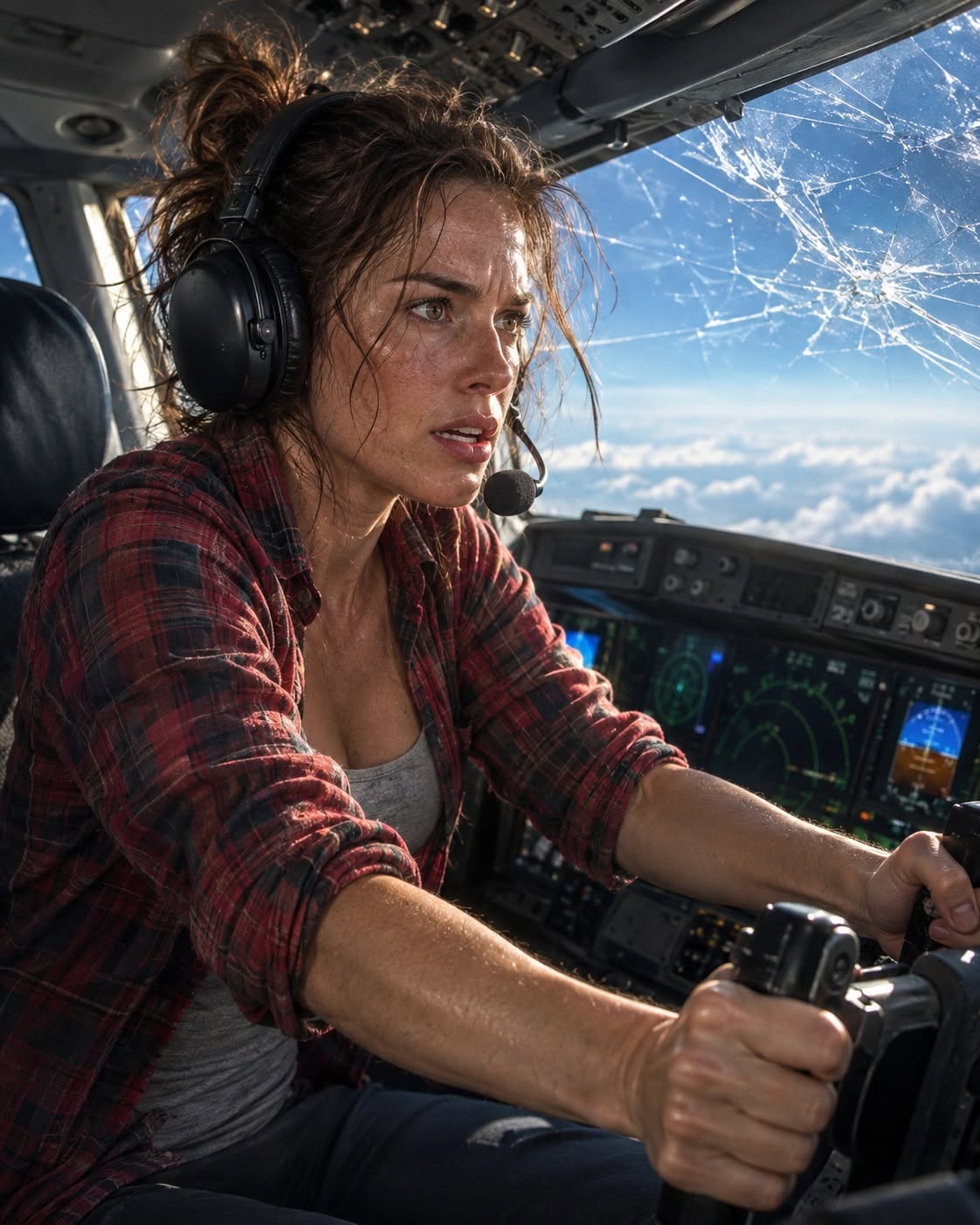
The aircraft seemed to shudder as we entered the flight deck. The two pilots remained unconscious, their breathing shallow but steady. Cole checked their condition while Mara examined the communications console.
I studied the warning indicator.
It was identical to the one my father had drawn in the margins of his original report.
Suddenly, I remembered something.
Not a technical detail. Not a secret code.
A sentence.
My father had said it to me when I was sixteen, after I had asked why he sometimes stayed awake until sunrise.
“Never trust a system that claims it cannot fail,” he had told me. “Trust the person willing to admit where it might.”
At the time, I thought he was talking about his job.
Now I understood.
“Mara,” I said. “The backup system. Is it connected to the main transmitter?”
She glanced at me. “Why?”
“Because my father wrote that the original design had a separate emergency circuit. If the primary system was disabled, the backup was supposed to remain independent.”
“That’s correct.”
“But the report says the backup unit can be stopped by interrupting the same authorization sequence.”
Mara frowned.
“That’s what Voss’s team claimed.”
“My father didn’t believe them.”
I pointed to the handwritten warning.
“Look at the last paragraph. He says the emergency circuit wasn’t truly independent. It was connected to a second authorization channel. Someone could use that connection to activate the system even if the main transmitter was shut down.”
Mara leaned closer.
Her face changed.
“That means the backup isn’t waiting for the main unit.”
“Exactly.”
“It’s already receiving instructions.”
Cole looked up from the pilot’s seat.
“Can you stop it?”
Mara swallowed.
“Only if we identify who is sending the authorization.”
The president stepped into the cockpit.
“Then identify them.”
Mara turned toward him.
“Mr. President, I need to tell you something.”
“Now?”
“I was involved in the operation that placed this equipment aboard the aircraft.”
The silence returned.
Cole slowly stood.
“You said you changed sides.”
“I did.”
“After helping put a device on the president’s plane?”
“I was told it was a protective communications upgrade. I discovered the real purpose after the aircraft had already been prepared.”
Cole moved closer.
“And you expect us to believe that?”
“No,” Mara said. “I expect you to understand that I have the same reason you do to stop it.”
She pulled a small photograph from her jacket.
It showed a woman and a young boy standing outside a modest house.
“My family,” she said. “Voss’s people threatened them when I questioned the operation. They told me that if I cooperated, nobody would get hurt.”
She looked at the photograph.
“I believed them. That’s the part I’ll have to live with.”
I looked at her and saw something I recognized.
The particular exhaustion of someone who had spent too long trying to convince herself that silence was the same thing as survival.
“Then help us finish this,” I said.
Mara nodded.
She examined the communications panel again, searching through the aircraft’s existing diagnostic information.
A new message appeared.
INCOMING AUTHORIZATION — SOURCE VERIFIED.
Beneath it was a name.
ELIAS VOSS.
My hands went cold.
“He’s alive,” I whispered.
The president stared at the screen.
“Then he never died.”
“No,” Mara replied. “He just stopped existing on paper.”
Cole shook his head.
“Where is he?”
Before anyone could answer, the cabin speakers crackled.
A man’s voice emerged.
“Mr. President. I see you’ve discovered my little arrangement.”
I recognized the voice from an old recording my mother had once played for me. It was calm, smooth, and almost fatherly.
The president closed his eyes.
“Elias.”
“James. It’s been a long time.”
“You put innocent people on this aircraft.”
“I put a temporary communications system on an aircraft that was already scheduled for a routine mission. Nobody was supposed to get hurt.”
“You drugged my crew.”
“They’re alive. I assure you, I took precautions.”
The president stepped toward the microphone.
“Your precautions could have killed every person aboard.”
“Then perhaps you should have thought about that before reopening the investigation.”
I felt my heart pounding.
“You knew my father,” I said.
The voice paused.
“Ah. His daughter.”
“Did you kill him?”
A faint sigh came through the speakers.
“Your father was a brilliant man. Unfortunately, brilliance can become a dangerous thing when combined with a conscience.”
“Answer me.”
“He discovered something that should have remained buried. I offered him a way to protect his family. He refused.”
“Where is he?”
Silence.
Then Voss laughed softly.
“That’s the question you’ve been asking for years, isn’t it?”
I gripped the edge of the console.
“Where is my father?”
“Alive, last I heard.”
The words seemed to knock the air out of my lungs.
The president turned toward me.
I couldn’t move.
“You’re lying,” I whispered.
“Am I? Ask your president why he authorized the transfer of a classified prisoner eleven years ago.”
I looked at the president.
His expression told me everything.
“You knew,” I said.
He lowered his head.
“I knew your father had been taken into protective custody. I believed he was being held somewhere secure. I was told he had died during a transfer.”
“You believed?”
“I was given a death certificate. I was shown photographs. I was told there had been an accident.”
“And you never checked?”
His eyes filled with something I hadn’t expected to see.
Shame.
“I should have.”
The speakers crackled again.
“How touching,” Voss said. “A reunion built on old mistakes. Unfortunately, we don’t have time for it.”
The countdown had reached four minutes.
Mara looked at the display.
“He’s preparing to transmit.”
“Can you stop him?” Cole asked.
“I need access to the authorization channel.”
“Where?”
“Inside the secondary communications compartment.”
Cole pointed toward the rear of the aircraft.
“Then I’ll go.”
Mara grabbed his arm.
“There’s a problem. The compartment is sealed electronically. I can’t open it from here.”
The president looked at me.
“Your father designed the original system. Is there anything in his report that could help?”
I looked down at the pages.
Most of the technical information was too complicated to understand at a glance. But one handwritten note stood out.
Never use the emergency channel as a key. It was designed to be a witness, not a door.
I read it twice.
Then I noticed a small symbol beside the sentence.
A circle divided by a single line.
I had seen it before.
On an old wooden box in my mother’s attic.
A box my mother had told me never to open.
“Wait,” I said.
I remembered the night before my father disappeared. I had been eleven years old. He had sat beside my bed and placed a tiny brass object in my hand.
“If anyone ever tells you that I abandoned you,” he had whispered, “remember that I didn’t leave because I stopped loving you.”
I had kept that object for years.
A small brass key with the same symbol engraved on its surface.
I had never known what it opened.
“It’s not a digital authorization,” I said.
Mara looked at me.
“What?”
“The emergency channel. My father designed it to preserve evidence. The physical compartment must contain something that can’t be remotely overwritten.”
Cole stared at me.
“Do you have the key?”
I reached into the small inner pocket of my jacket.
The brass key was still there.
I had carried it for fourteen years without knowing why.
Mara looked at it as though she had just seen a ghost.
“That could be it.”
Cole took the key.
“I’m going.”
The president caught his shoulder.
“Bring him back.”
Cole gave a short nod.
Then he disappeared into the narrow passage.
The countdown showed three minutes and twenty seconds.
Mara stayed beside the console, watching the incoming signal.
I stood behind her, holding the report so tightly that its edges bent.
“Tell me something,” I said.
She didn’t look up.
“Anything.”
“Why did you really change sides?”
She was quiet for a moment.
“Because I found a recording of your father.”
My heart stopped.
“What?”
“Voss kept it in an archive. I wasn’t supposed to see it. Your father had recorded a statement before his disappearance. He said the Nightglass project had been designed to create an invisible corridor for aircraft carrying classified material. But the system had been expanded. It was no longer just about concealing flights.”
“What was it about?”
“Control. Whoever controlled the system could manipulate the information that governments relied on to know where aircraft were, what they were carrying, and who was responsible for their movements.”
I stared at her.
“So this was never about one plane.”
“No. Your aircraft was a demonstration.”
A chill passed through me.
“Who was the intended audience?”
Mara turned toward the president.
“Several foreign governments. Private military contractors. People who were willing to pay billions for the ability to move anything through the sky without being seen.”
The president’s jaw tightened.
“And Voss planned to sell it.”
“He already has.”
A sharp alarm interrupted us.
The countdown had reached two minutes.
Mara’s fingers moved over the console.
“He’s accelerating the transmission.”
A voice came through the speakers again.
“Miss, you should stop trying to save a system that has already been sold.”
I stepped toward the microphone.
“You keep talking about my father as if he were the problem.”
“Your father was the problem.”
“No. He was the only person who understood what you were becoming.”
Voss chuckled.
“That’s a sentimental interpretation.”
“Then why are you afraid of his report?”
For the first time, the voice lost its calm.
“Because you don’t understand what you’re holding.”
“I understand enough.”
“Your father chose his principles over his family. He could have come home. He could have signed the agreement. Instead, he decided that a piece of paper was more important than seeing his daughter grow up.”
My eyes burned.
For fourteen years, I had wondered whether my father had chosen to leave us.
Whether he had become so consumed by his work that he had forgotten the people waiting for him at home.
Voss knew exactly where to place the knife.
But this time, I refused to let him use my grief.
“My father made his choice,” I said. “You made yours.”
The speakers went silent.
Then the voice returned, colder than before.
“Then I suppose you’ll have to live with the consequences.”
The aircraft lurched.
Mara grabbed the console.
“What happened?”
“He’s interfering with the navigation system.”
The president held onto the nearest seat.
“Can we still land?”
“Not safely if the interference continues.”
A minute and forty seconds.
Then Cole’s voice came through the internal intercom.
“I’m at the compartment.”
“Did you find it?” Mara asked.
“Yes. The key fits. But there’s something else.”
“What?”
“A second panel. It looks like the evidence recorder is connected to the authorization system.”
Mara looked at the display.
“Don’t disconnect anything yet.”
“Why?”
“Because if you interrupt the wrong circuit, it could trigger the transmission.”
Cole swore under his breath.
“Then tell me what to do.”
Mara studied the screen.
“Your father built the emergency channel to record every authorization attempt. If we can preserve that recording, we can identify everyone who participated.”
“How?”
“We need to stop the transmission without destroying the evidence.”
I looked at my father’s note again.
Never use the emergency channel as a key. It was designed to be a witness, not a door.
A witness.
Not a door.
I suddenly understood what he had meant.
“Mara,” I said. “What if we stop trying to control the system?”
She turned.
“What?”
“What if we let the evidence recorder do what it was designed to do?”
“The recorder?”
“It was built to preserve every command. Every authorization. Every person who accessed the system. My father didn’t create a way to unlock the compartment. He created a way to expose whoever used it.”
Mara stared at the report.
Then she looked at the display.
“You’re right.”
She pressed the internal communication button.
“Cole, do you see a separate recording indicator?”
“Yes.”
“Is it active?”
“Yes, but the signal is being blocked.”
“Then don’t touch the main system. We need to preserve the recording.”
The president stepped closer.
“What happens after that?”
Mara looked at him.
“We broadcast the evidence through the aircraft’s independent emergency channel.”
“Can Voss stop it?”
“Not without revealing that he’s trying to suppress a presidential distress transmission.”
The president understood immediately.
“Then do it.”
Mara shook her head.
“We need authorization from the aircraft commander.”
“The captain is unconscious.”
The president looked at me.
“Can you help?”
I understood what he was asking.
I wasn’t a pilot. I wasn’t a senior official. I wasn’t supposed to be making decisions on an aircraft carrying the president.
But I had spent my life learning the one thing my father had wanted me to understand.
A system could be powerful.
A person could be afraid.
And doing the right thing rarely came with a guarantee.
I took the report and placed it in front of the president.
“Then authorize it yourself.”
He looked at the document for a moment.
Then he reached for the emergency communication control.
“This is the President of the United States. I am declaring an emergency aboard this aircraft. All available authorities are instructed to preserve the communications record and respond to this distress transmission.”
Mara activated the emergency recorder.
A confirmation tone sounded.
For a moment, nothing happened.
Then the display changed.
RECORDING PRESERVED.
The countdown stopped.
The cabin speakers went silent.
I exhaled for what felt like the first time in several minutes.
“Did we do it?” I asked.
Mara stared at the screen.
“I think so.”
Then another message appeared.
SECONDARY SIGNAL DETECTED.
Her face went white.
“No.”
The president stepped closer.
“What now?”
Mara shook her head.
“There’s another transmitter.”
The speakers crackled.
Voss returned.
“Very clever. Your father would have been proud.”
Cole’s voice came through the intercom.
“There’s another unit in this compartment. Smaller than the first.”
“Can you identify it?” Mara asked.
“I can see a label.”
“What does it say?”
Cole hesitated.
“Nightglass — Manual Override.”
Mara closed her eyes.
“He planned for this.”
“Can you stop it?” I asked.
“Not from here.”
The president looked at the display.
“Then what do we do?”
Mara answered quietly.
“We need to land before the signal completes.”
A warning sounded.
The aircraft’s remaining fuel estimate flashed.
The president turned to me.
“How long?”
“Less than twenty minutes,” Mara replied. “But with the navigation interference, I can’t guarantee a safe approach.”
I looked at the unconscious captain.
Then at the first officer.
“We need them awake.”
Cole returned to the cockpit, his face pale from the exertion.
He carried a small evidence module in one hand.
“The recording is safe,” he said. “But I couldn’t disable the second transmitter.”
He placed the module on the console.
“Whatever happens, this needs to reach investigators.”
The president took it.
“It will.”
A new message appeared on the display.
REMOTE CONNECTION ESTABLISHED.
Mara looked at me.
“He’s not in another country. He’s close enough to maintain a direct connection.”
“Where?”
“Somewhere within range of the aircraft’s communications relay.”
The president’s expression hardened.
“Can we identify the source?”
Mara studied the screen.
A location appeared.
Not a city.
Not a building.
An aircraft.
A private jet flying several miles behind us.
Voss was aboard.
For the first time, I felt something other than fear.
I felt anger so clear it almost made me calm.
“He came to watch,” I said.
The president nodded.
“Then let’s make sure he sees us land.”
He turned to Cole.
“Can you reach the air traffic authorities through an independent channel?”
“Possibly.”
“Do it.”
Cole moved to the communications panel.
Mara worked beside him.
Within moments, a weak transmission came through.
An air traffic controller answered.
“Unidentified aircraft, state your emergency.”
The president took the microphone.
“This is the presidential aircraft. We have a communications compromise, incapacitated flight crew, and a potential security threat. We require immediate assistance.”
There was a pause.
Then the controller’s voice returned, suddenly alert.
“Presidential aircraft, your signal is confirmed. Emergency services are being notified.”
For the first time, I felt the possibility of survival.
But Voss wasn’t finished.
The display flashed.
A new message appeared.
MANUAL OVERRIDE INITIATED.
The aircraft began to descend.
Mara grabbed the console.
“He’s forcing the system to send a false navigation command.”
Cole moved toward the cockpit.
“Can we take manual control?”
“Only if the captain is awake.”
I hurried to the pilot’s seat.
“Captain?”
No response.
I shook his shoulder.
“Captain, can you hear me?”
His eyelids moved.
Then, slowly, he opened his eyes.
“Where…?”
“You’re aboard the presidential aircraft. You’ve been unconscious. We need you.”
He tried to sit up but struggled.
Cole supported him.
“Take your time.”
The captain looked at the instruments.
Then his expression changed.
“What’s happened to my navigation?”
“Someone has compromised the communications system,” Mara replied.
The captain swallowed.
“Then we need to disconnect from it.”
Mara shook her head.
“We can’t do that without losing our emergency channel.”
The captain looked at me.
“Who are you?”
“My name is—”
He stared at my face.
Then he looked at the photograph lying on the console.
The photograph of my father and Voss.
His eyes widened.
“You’re his daughter.”
I nodded.
The captain looked away.
“I knew your father.”
My throat tightened.
“Did you know what happened to him?”
He closed his eyes briefly.
“I was part of the security detail during his transfer.”
My heart began to pound.
“You saw him?”
“Yes.”
“Was he alive?”
The captain looked directly at me.
“Yes.”
I felt my knees weaken.
“Where was he taken?”
“I don’t know. But I remember the last thing he said.”
“What?”
The captain’s voice trembled.
“He asked me to tell you that he had never stopped trying to come home.”
I covered my mouth.
Fourteen years of unanswered questions seemed to collapse into one unbearable moment.
Then the captain gripped the controls.
“Enough. Let’s get this aircraft on the ground.”
He took command of the flight deck.
Cole assisted him while Mara continued monitoring the compromised communications system.
The president remained behind us, holding the evidence module.
I watched the navigation display.
The false signal continued to appear and disappear.
But the captain refused to trust it.
He relied on independent flight instruments and the air traffic controller’s instructions.
Minutes passed.
The aircraft descended through a layer of clouds.
Then the runway appeared.
A long strip of lights stretched across the dark landscape.
“We have visual contact,” the captain said.
“Runway confirmed,” Cole replied.
Mara watched the communications display.
“He’s still transmitting.”
The captain tightened his grip on the controls.
“Then let him.”
The aircraft touched down hard.
The landing gear struck the runway with a violent thud.
Everyone lurched forward.
A brief scraping sound came from beneath us.
Then the aircraft slowed.
Stopped.
For one second, nobody spoke.
Then the cabin erupted with the sound of people shouting, crying, and calling for help.
Emergency vehicles surrounded the aircraft.
Medical personnel rushed aboard.
The president was escorted away.
The unconscious crew members were taken to waiting ambulances.
Cole was treated for a cut above his eyebrow.
Mara surrendered her weapon and identification to federal investigators.
I remained in the cockpit.
I couldn’t bring myself to leave the photograph.
A uniformed officer approached.
“Ma’am, we need you to come with us.”
“Where is the president?”
“He’s safe.”
“Did he tell you about my father?”
The officer hesitated.
“Yes.”
“Then I want answers.”
He nodded.
“He’s waiting for you.”
The president was sitting in a secure room at the airport.
He looked older than he had aboard the aircraft.
A physician had checked him, and a glass of water sat untouched on the table.
When I entered, he stood.
“I owe you the truth,” he said.
I didn’t sit down.
“Then tell me everything.”
He opened a folder.
Inside were documents dated fourteen years earlier.
My father’s original investigation.
His detention record.
A classified transfer order.
And a letter addressed to me.
I recognized the handwriting immediately.
My father’s.
My hands began to tremble.
“Where did you get this?”
“It was recovered from the archive where Voss kept the Nightglass records.”
I opened it.
The first line nearly broke me.
My dearest daughter,
If you are reading this, it means I have failed to come home when I promised I would.
I pressed the paper against my chest.
The president quietly moved away, giving me space.
I continued reading.
I need you to understand something. I did not leave because I stopped loving you. I left because there were people who believed the truth was more dangerous than the lies they had built around it.
I was given a choice. Sign a false report and return to my family, or refuse and disappear into a system that would erase my name.
I chose not to sign.
I know that choice hurt you. I know your mother will have to explain things she cannot understand herself. I am sorry for every birthday, every ordinary morning, and every moment when you needed me and I was not there.
But I want you to remember this: never allow anyone to convince you that doing the right thing is pointless simply because it is difficult.
Sometimes the truth takes longer than we expect to reach the people who need it.
And sometimes the people who love us must trust that we will find our way back.
I love you. Always.
There was no signature.
Just the small symbol I had seen on the brass key.
I couldn’t stop crying.
The president waited until I had finished.
“Your father was transferred to a private detention facility after refusing Voss’s demands. The official records were falsified. I discovered the truth too late.”
“Is he alive now?”
The president took a breath.
“We have reason to believe he is.”
“Where?”
“We’re working to locate him.”
I looked at him.
“With respect, Mr. President, I’ve heard that answer for fourteen years.”
He lowered his eyes.
“You’re right.”
For the first time, he didn’t offer a promise.
He offered something better.
A commitment.
“I will personally authorize an independent investigation. No one connected to Voss’s operation will control it. Every record will be examined, and every person responsible will be held accountable.”
I folded the letter carefully.
“Don’t do it for me.”
He looked up.
“Do it because there are probably other families waiting for answers.”
He nodded.
“That’s exactly what we will do.”
The investigation began before sunrise.
By the end of the first day, the evidence module had revealed something far larger than anyone expected.
Nightglass had never been the work of one man.
It was a network involving private contractors, former intelligence officials, government employees, and wealthy investors.
The operation had been quietly funded through shell companies for nearly a decade.
Several people had helped Voss maintain his false identity.
Others had signed orders that sent innocent personnel into dangerous situations.
The recording recovered aboard the aircraft exposed dozens of names.
One of them belonged to a senior official who had publicly attended my father’s memorial service.
Another belonged to a man who had personally assured my mother that her husband had died.
Within forty-eight hours, arrests began.
Voss’s private jet was intercepted after landing at a regional airport.
He was taken into custody without resistance.
When investigators asked whether he had anything to say, he reportedly smiled and requested legal representation.
But before he was escorted away, he asked one question.
“Did the girl find her father’s letter?”
An investigator said yes.
Voss shook his head.
“Then I suppose I finally lost.”
Three weeks later, I received a telephone call.
The voice on the other end belonged to an investigator assigned to the independent inquiry.
“We found a facility connected to the original transfer records.”
My heart stopped.
“Where?”
“An isolated medical center in northern Virginia. It was operating under a different name.”
“Is my father there?”
“We have identified someone matching his records. We need you to come in.”
I don’t remember the drive.
I don’t remember walking through the security entrance.
I remember only the hallway.
White walls.
Fluorescent lights.
The smell of disinfectant.
And a door at the end.
The investigator stopped beside it.
“He’s been told you’re coming.”
My mouth had gone dry.
“Is he conscious?”
“Yes.”
I placed my hand against the door.
For fourteen years, I had imagined this moment in a thousand different ways.
Sometimes he would be angry.
Sometimes he would be unable to recognize me.
Sometimes he would simply be gone.
I had prepared myself for every possibility except hope.
The door opened.
A man sat beside the window.
His hair was almost completely gray.
His shoulders were thinner than I remembered.
But when he turned toward me, I recognized his eyes immediately.
The same eyes that had watched me learn to ride a bicycle.
The same eyes that had smiled at me when I brought home my first school report.
He stared at me.
Then he whispered my name.
I couldn’t speak.
I crossed the room and fell into his arms.
For several moments, neither of us said anything.
He held me as if he were afraid I might disappear.
“I’m sorry,” he whispered.
I shook my head against his shoulder.
“Don’t.”
“I tried to come home.”
“I know.”
“They told me you had grown up. They showed me photographs. Your graduation. Your first job. I kept every one they allowed me to have.”
I pulled back.
“Why didn’t you escape?”
He looked toward the window.
“Because they threatened your mother. They threatened you. Every time I considered running, they reminded me what could happen to the people I loved.”
His voice broke.
“I thought keeping you safe meant staying away.”
I took his hand.
“You should have known that we would rather have the truth than a perfect lie.”
He closed his eyes.
“I know that now.”
We sat together for a long time.
He told me about the years he had spent trying to preserve evidence. About the people who had helped him secretly. About the medical facility that had kept him isolated under a false identity.
He had survived because several ordinary employees had refused to participate in his disappearance.
A nurse had secretly preserved his medical records.
An administrator had copied an old transfer order.
A technician had kept a damaged storage drive instead of destroying it.
None of them had been famous.
None of them had possessed extraordinary power.
They had simply refused to cooperate with a lie.
Before I left that evening, my father reached for my hand.
“Did you find the report?”
“Yes.”
“And the warning?”
“Yes.”
He smiled faintly.
“Then you understand why I wrote it.”
“I understand why you refused to sign.”
He nodded.
“Sometimes people ask what courage looks like. They imagine soldiers, heroes, people standing in front of danger without fear.”
He looked at me.
“But most of the time, courage is much quieter. It’s a person deciding that they will not tell a lie just because the truth might cost them something.”
I held his hand tighter.
“I spent fourteen years thinking you had forgotten us.”
“I never forgot a single day.”
That night, I called my mother.
I didn’t tell her immediately.
I simply asked her to sit down.
Then I said the words I had imagined saying since childhood.
“Mom, I found Dad.”
There was a long silence.
Then I heard her crying.
Not the quiet kind of crying she had done at birthdays and holidays.
This was something deeper.
The sound of a person finally putting down a weight she had carried for fourteen years.
My father was released from medical custody after the investigation established the circumstances of his detention.
The government issued a formal apology.
Several officials resigned.
Others faced criminal charges.
The Nightglass program was dismantled, and the evidence was transferred to independent oversight authorities.
The president eventually gave a public statement acknowledging that his administration had failed to protect a man who had tried to protect the country.
He didn’t call my father a hero.
My father wouldn’t have liked that.
He called him a citizen who had been wronged, and promised that the truth would not be buried again.
As for Mara, she testified for months.
She admitted her role in the operation, provided evidence against Voss, and accepted responsibility for the decisions she had made.
She also helped investigators protect the families of other witnesses.
Cole recovered from his injuries and returned to civilian life.
Before leaving, he visited my father.
The two men shook hands.
“Your daughter saved more than one aircraft that day,” Cole said.
My father smiled.
“She always was stubborn.”
I rolled my eyes.
For the first time in years, the sound of my father’s laughter filled a room.
Several months later, I returned to the aviation security office where I had once worked.
I was offered a position helping review the systems that protected government aircraft.
I accepted, but with one condition.
Every critical security system would be subject to independent review, and every employee would have a protected way to report problems without fear of retaliation.
Some people said it would slow things down.
Others said it would create unnecessary paperwork.
I remembered the silent aircraft.
The unconscious crew.
The false navigation display.
And the man who had tried to turn an entire country into a customer for his private empire.
I told them something my father had once told me.
“Safety isn’t the absence of problems. It’s the willingness to find them before someone gets hurt.”
One year after the flight, my father and I visited the small memorial garden where his name had once appeared on a plaque.
The plaque had been corrected.
His name was no longer listed among the dead.
He stood beside me, holding my mother’s hand.
For a while, we watched the aircraft moving across the distant sky.
“Do you ever think about that night?” he asked.
“Every day.”
“Do you regret what happened?”
I considered the question.
I regretted the years we had lost.
I regretted the birthdays, the ordinary mornings, the conversations that could never be recovered.
But I didn’t regret discovering the truth.
“No,” I said. “I regret that it took so long.”
He nodded.
Then he reached into his coat and handed me something.
It was the old brass key.
“I think you’ve earned the right to keep this.”
I turned it over in my palm.
For years, I had believed it was a key to a secret compartment, a hidden message, or some forgotten part of my father’s work.
Now I understood that it had been something else.
A reminder.
A promise.
A small piece of trust that had survived fourteen years of silence.
I slipped it into my pocket.
Above us, another aircraft crossed the evening sky.
Its lights blinked steadily against the fading sun.
This time, I didn’t wonder whether someone was hiding it.
I simply watched it fly.
And I thought about the people aboard it.
The pilots who trusted their instruments.
The crew who trusted one another.
The passengers who believed that somewhere, someone was making sure they would reach home safely.
I finally understood what my father had been trying to protect all along.
It wasn’t a machine.
It wasn’t a government.
It wasn’t even a secret.
It was the simple right of ordinary people to live without being manipulated by those who believed power made them untouchable.
That night, I went home with my parents.
For the first time in fourteen years, there was a place set at the dinner table for everyone.
My father raised his glass.
“To coming home,” he said.
My mother smiled through her tears.
I raised mine, too.
“To the truth,” I replied.
And for once, the silence that followed wasn’t frightening.
It was peaceful.
Because some secrets are kept to protect the powerful.
Some truths take years to find their way into the light.
But no matter how carefully someone buries the truth, there will always be people willing to dig.
And sometimes, the bravest thing a person can do is refuse to look away.
THE END