The first sign that something was terribly wrong was the sudden, violent drop of the aircraft’s nose.
The emergency landing should have been the end of it.
At least, that’s what I believed when I stepped away from the aircraft that afternoon.
The passengers were alive. The pilots had been rushed to the hospital. The fighter jets had returned to their base, and emergency crews had secured the aircraft.
For the first time in what felt like an eternity, I could breathe without listening for another alarm.
But as I stood on the runway, watching paramedics carry one of the unconscious pilots toward an ambulance, something caught my attention.
A man in a dark gray suit was standing beside the airport security vehicles.
He wasn’t a paramedic.
He wasn’t an airport employee.
And he certainly wasn’t part of the airline’s emergency response team.
He was watching me.
When our eyes met, he immediately turned away and spoke quietly into his phone.
I might have dismissed it if not for what happened next.
A uniformed airport officer approached me and said, “Mr. Hayes, someone from federal aviation security would like to speak with you.”
I was exhausted, my hands were still shaking, and my ears were ringing from the cockpit alarms.
“Can it wait?”
“I’m afraid it can’t.”
I followed him toward a waiting black SUV.
Inside, the man in the gray suit introduced himself as Special Agent Robert Collins.
He placed a folder on the seat between us.
“Mr. Hayes, first, I want to thank you for what you did today.”
“Then why does this feel like an interrogation?”
He didn’t smile.
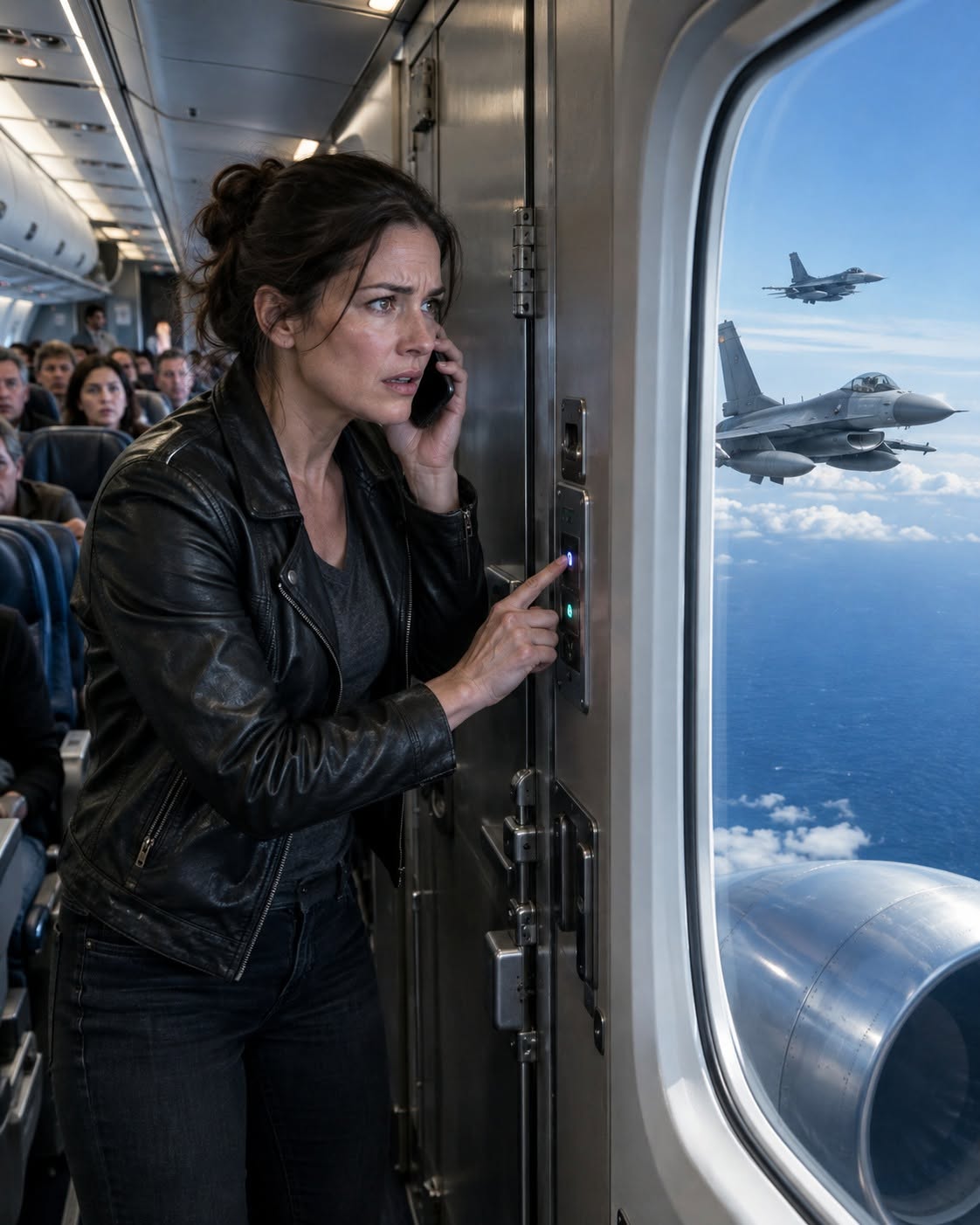
“Because there are some things about your flight that don’t make sense.”
I looked at the folder.
“What things?”
He opened it and showed me a photograph of the aircraft’s cockpit.
It had been taken during the emergency response.
The instrument panel was damaged, several warning lights were still illuminated, and a thick layer of smoke had covered the upper portion of the windshield.
But that wasn’t what caught my attention.
There was a small rectangular device attached beneath the captain’s instrument console.
I’d seen hundreds of cockpit configurations during my military career.
That device didn’t belong there.
“What is that?” I asked.
Collins leaned forward.
“That’s exactly what we’re trying to find out.”
He explained that the aircraft’s initial technical reports suggested the emergency hadn’t been caused by a simple mechanical malfunction.
Several independent systems had experienced unusual failures within seconds of one another.
The flight control computer had received conflicting signals.
The environmental control system had circulated contaminated air into the cockpit.
And the aircraft’s automatic flight management system had continued issuing commands even after the pilots became unconscious.
“Are you saying someone did this deliberately?”
“I’m saying we haven’t ruled it out.”
I stared at the photograph again.
The small device looked almost insignificant.
But something about its position bothered me.
It wasn’t connected to the visible wiring.
It appeared to have been installed behind the protective panel, where ordinary maintenance inspections might never notice it.
“Who had access to the aircraft before departure?”
Collins closed the folder.
“That’s what we’re investigating.”
I leaned back.
“Then you should start with whoever installed that thing.”
He looked at me for several seconds.
“Mr. Hayes, there’s something else. The captain regained consciousness approximately twenty minutes ago. Before the medical team sedated him again, he asked for you.”
That surprised me.
I’d barely spoken to the captain during the emergency.
“Why?”
Collins hesitated.
“Because he said he knew what happened.”
A cold feeling settled in my stomach.
“Then take me to him.”
The hospital was less than fifteen minutes away.
When we arrived, the captain was in intensive care, connected to several monitoring machines.
His name was Thomas Bennett.
He was in his early fifties, with silver hair and the exhausted face of someone who had spent too many years working under pressure.
His eyes opened when he saw me.
“You’re Daniel Hayes?”
“Yes.”
He struggled to speak.
“Thank you.”
I pulled a chair beside his bed.
“Don’t thank me yet. I need to know what happened in that cockpit.”
He looked toward Agent Collins, who had followed us into the room.
“Is he staying?”
Collins nodded.
“Anything you tell us will be documented.”
The captain swallowed.
“Before we lost consciousness, I heard a strange tone. Three short beeps. Then the ventilation system started making a noise I’d never heard before.”
He paused to catch his breath.
“I checked the environmental readings. Everything looked normal, but my head started hurting. The first officer said he couldn’t feel his hands.”
“What happened after that?”
“I tried switching the ventilation to emergency mode. The controls didn’t respond.”
My attention sharpened.
“Did you notice anything unusual on the flight management display?”
His eyes moved toward me.
“Yes.”
“What?”
“A command appeared that I didn’t recognize. It instructed the aircraft to maintain a descending profile. I tried overriding it manually, but the system rejected my input.”
I felt my jaw tighten.
That explained why the aircraft had continued descending even after the automatic systems should have responded to the changing conditions.
But it raised another question.
“Did you authorize that command?”
“Absolutely not.”
He closed his eyes.
Then he whispered something that changed the entire investigation.
“Someone was already inside our systems before we took off.”
Agent Collins immediately stepped closer.
“Who?”
The captain shook his head.
“I don’t know. But there was a maintenance alert on the aircraft the night before. The technician said it was a software synchronization issue.”
“Which technician?”
The captain opened his eyes.
“His name was Evan Miller.”
Collins wrote the name down.
I recognized the expression on his face.
He had just found his first lead.
But the captain wasn’t finished.
“There was something else,” he said.
“What?”
He looked directly at me.
“Daniel, before I passed out, I saw a message on the secondary display.”
“What message?”
His voice dropped to almost nothing.
“AUTHORIZED OVERRIDE: PROJECT NIGHTFALL.”
Nobody spoke.
The name meant nothing to me.
But Agent Collins looked as if someone had just confirmed his worst suspicion.
He quickly closed his notebook.
“That’s enough for now. Mr. Hayes, we need to talk outside.”
I stood.
Before I reached the door, the captain grabbed my wrist.
“Don’t let them take that aircraft apart before they recover the flight recorder.”
I turned back.
“Why?”
His eyes were filled with fear.
“Because the recorder isn’t the only thing that contains the truth.”
Then he whispered:
“They were testing something.”
I left the room with a thousand questions.
And for the first time since the emergency landing, I wondered whether saving that aircraft had exposed something much more dangerous than a mechanical failure.
THE NAME NOBODY WANTED TO HEAR
Agent Collins drove me to a federal building near the airport.
On the way, I asked him what Project Nightfall was.
He didn’t answer immediately.
Finally, he said, “It was an experimental aviation security program.”
“What kind of program?”
“An autonomous aircraft recovery system. It was designed to take control of an aircraft during certain catastrophic emergencies.”
I frowned.
“An automatic system that can override the pilots?”
“Under specific circumstances, yes.”
“That sounds like a terrible idea.”
“It’s supposed to prevent aircraft from being used as weapons or becoming uncontrollable during a major emergency.”
I stared out the window.
“And who controls it?”
“That’s classified.”
I turned toward him.
“People nearly died today. I think I’ve earned a little more than that.”
Collins sighed.
“The system was developed through a private defense contractor working with several government agencies. It was never supposed to be activated on a commercial passenger flight without specific authorization.”
“Yet it was.”
“That’s what we’re trying to establish.”
I thought about the mysterious device beneath the cockpit console.
“Could that system have caused the aircraft to descend?”
“Potentially.”
“Could someone have deliberately activated it?”
He didn’t answer.
That was answer enough.
When we reached the building, he led me into a conference room.
Three people were waiting.
One was a woman in her forties with short black hair and a military-style posture.
The second was a young technical specialist carrying a laptop.
The third was someone I hadn’t expected to see again.
Marcus Reed.
My old friend stood up immediately.
“Daniel.”
We shook hands.
For a moment, neither of us spoke.
Then he pulled me into a firm embrace.
“You’re supposed to be retired,” he said.
I managed a tired smile.
“Apparently, nobody told the airplane.”
He laughed, but the expression disappeared quickly.
The woman introduced herself as Colonel Sarah Mitchell.
She was overseeing the military investigation.
The technical specialist was identified as Noah Bennett, an aviation systems engineer.
Sarah began explaining what they had discovered.
The aircraft’s flight management system had received an external command through a maintenance communication interface.
That command had triggered an emergency control sequence.
The system had interpreted the aircraft’s situation as a potential hostile takeover and attempted to execute an automated containment maneuver.
Except the aircraft wasn’t under attack.
Its pilots were simply incapacitated.
And the system had no reliable way of understanding the difference.
“Who authorized the command?” I asked.
Noah looked at his laptop.
“That’s the problem. The authorization appears legitimate.”
“Meaning?”
“Someone used a valid security credential.”
Sarah folded her arms.
“Someone with access to the highest level of the program.”
Marcus looked at me.
“Do you understand what that means?”
I nodded slowly.
“This wasn’t an ordinary cyberattack.”
“No,” he said. “It might be an inside job.”
I stared at the screen.
A timeline appeared showing the aircraft’s system activity.
There were dozens of technical entries, but one stood out.
The first unauthorized command had been transmitted seven minutes before the aircraft began descending.
The source was identified as a secure network connected to a defense research facility.
I leaned closer.
“Can you identify the operator?”
Noah shook his head.
“The account belongs to a senior systems administrator. But the account has been inactive for nearly three months.”
“Who owns it?”
Noah hesitated.
Then he displayed a name.
Evan Miller.
The same name the captain had mentioned.
I felt a chill run down my spine.
“Is that the technician?”
“Yes,” Noah said.
“But there’s a problem. Evan Miller died six months ago.”
Nobody moved.
I looked at the screen again.
The command had been transmitted using credentials belonging to a dead man.
That meant someone had either stolen his identity or deliberately created a trail designed to lead investigators toward him.
Sarah closed the laptop.
“We need to find out who actually sent that command.”
I looked at Marcus.
“Can your squadron help?”
He nodded.
“Already requested. But there’s something you should know.”
“What?”
“The military received a second signal from the aircraft after your emergency landing.”
“What kind of signal?”
Marcus glanced at Sarah.
“An encrypted transmission.”
I felt my stomach tighten.
“From the cockpit?”
“Yes.”
“What did it say?”
Sarah answered.
“STAGE TWO COMPLETE.”
For several seconds, I couldn’t speak.
The aircraft hadn’t simply been an experiment.
Someone had been waiting to see what happened after it landed.
And they had just received confirmation that the first stage was over.
THE SECOND AIRCRAFT
I wanted to go home.
I wanted to take a shower, sleep for twelve hours, and forget the sound of those alarms.
But I knew I couldn’t.
Not after seeing that message.
Sarah explained that the aircraft had been moved to a secured hangar. Investigators were examining every component, while federal authorities were tracing the encrypted transmission.
Then Noah discovered something.
The signal hadn’t originated from the aircraft’s communication system.
It had been transmitted by a separate device hidden inside the cabin’s lower equipment compartment.
The same compartment I had crawled through to reach the cockpit.
I remembered the freezing air, the smoke, and the jammed access hatch.
“Did I damage the device when I opened the hatch?”
Noah shook his head.
“No. It was mounted behind the equipment rack.”
“Can you identify it?”
He rotated his laptop.
A photograph appeared.
The device was small, black, and almost identical to the one beneath the cockpit console.
“This is a remote activation relay,” he explained. “It can communicate with compatible systems on other aircraft.”
I stared at him.
“Other aircraft?”
“Yes. The system was designed to support a fleet-wide emergency response network.”
Sarah walked toward the screen.
“We’ve identified two additional aircraft that received similar unauthorized signals.”
One was a cargo aircraft.
The other was a passenger jet scheduled to depart from Denver the following morning.
My blood ran cold.
“Have you grounded them?”
“We’re working on it.”
“Working on it?” I repeated. “You have evidence that someone can remotely interfere with commercial aircraft, and you’re still allowing planes to fly?”
Sarah’s expression hardened.
“We’re coordinating with aviation authorities. We cannot ground every aircraft connected to a particular software platform without understanding the full scope.”
I stood up.
“Then understand it quickly.”
Marcus put a hand on my shoulder.
“Daniel, sit down.”
I looked at him.
He lowered his voice.
“You’re right to be angry. But we need to be careful. Whoever did this may be monitoring our response.”
I slowly sat back down.
Noah continued examining the data.
Then he noticed something strange.
The second aircraft had not received a descending command.
It had received something different.
A flight path modification.
The system was instructing it to divert toward a remote airfield.
“Why would someone do that?” I asked.
Noah enlarged the route.
The aircraft was scheduled to carry a group of government officials attending an international security conference.
Sarah’s face changed.
“That’s not a coincidence.”
The room suddenly felt smaller.
This was no longer about an experimental system behaving unpredictably.
Someone was targeting specific flights.
But why?
Before anyone could answer, Collins entered the room holding a phone.
“We have a problem.”
He placed it on the table.
A live news broadcast was playing.
The headline read:
RETIRED COMBAT PILOT UNDER INVESTIGATION AFTER COCKPIT BREACH DURING FLIGHT EMERGENCY.
I stared at the screen.
The report described me as an unauthorized passenger who had forced his way into a secured cockpit.
It claimed investigators were examining whether my actions had contributed to the aircraft’s damage.
Then the reporter played a short video.
It showed me arguing with the federal air marshal near the cockpit door.
The footage ended just before the aircraft’s descent became visible.
There was no footage of the unconscious pilots.
No footage of the smoke.
No mention of the emergency descent.
The story made me look like a dangerous passenger who had taken control of an aircraft.
I looked at Collins.
“Who released this?”
“We’re investigating.”
I shook my head.
“No. Someone wants to discredit me before I can explain what happened.”
Marcus looked furious.
“They’re trying to make Daniel the story.”
Sarah nodded.
“And if the public believes he caused the emergency, it will become much harder to investigate the real cause.”
I looked at the news screen.
A reporter was standing outside the airport.
Behind her, the aircraft was barely visible.
Then I noticed something in the background.
A man in a dark gray suit.
The same man who had watched me on the runway.
Agent Collins followed my gaze.
He froze the footage.
“That’s impossible.”
“What?”
He enlarged the image.
The man was wearing a security identification badge.
Noah leaned closer.
Then he whispered:
“That’s Dr. Victor Shaw.”
Sarah’s expression turned cold.
“He’s the director of the Nightfall development program.”
The man who had thanked me for saving the aircraft was now being identified as the person who controlled the system.
And he had been standing less than twenty feet away from me.
THE MAN BEHIND NIGHTFALL
Victor Shaw was a brilliant engineer.
He had spent nearly twenty years developing advanced aviation security systems and had received multiple awards for his work.
He had also testified before congressional committees about the dangers of unauthorized aircraft access.
According to his official biography, he had devoted his career to protecting passengers.
But his financial records told a different story.
Investigators discovered that a private company associated with him had received millions of dollars in payments from an offshore defense contractor.
The payments had begun shortly after Nightfall was approved for expanded testing.
There was another discovery.
Several internal safety reports had been altered.
Engineers had repeatedly warned that the system could misinterpret environmental failures as hostile interference.
Their recommendations had been ignored.
One report had even described a simulated emergency in which an aircraft entered an unrecoverable descent after the system rejected manual pilot commands.
The report had been marked as resolved.
But the problem had never been fixed.
I read the documents in silence.
Finally, I looked at Sarah.
“Shaw knew this could happen.”
She nodded.
“We believe he knew the risks.”
“Then why did he allow it?”
Marcus answered quietly.
“Money. Influence. Maybe something bigger.”
Collins entered another room to coordinate a search warrant.
Meanwhile, Noah discovered an encrypted file hidden inside the relay’s memory.
It contained a list of aircraft registration numbers.
There were seventeen.
I counted them twice.
Seventeen commercial aircraft had been connected to the Nightfall network.
Some were scheduled to fly within the next twenty-four hours.
“How many have already been compromised?” I asked.
Noah shook his head.
“We don’t know.”
Sarah immediately ordered the list transmitted to aviation authorities.
Within minutes, emergency restrictions began appearing across several airports.
Flights were delayed.
Aircraft were grounded.
Maintenance teams were dispatched.
But one aircraft was already airborne.
Flight 882.
A passenger jet carrying 186 people from Chicago to Washington.
Its flight management system had just received an unauthorized update.
The aircraft was climbing normally.
For now.
Marcus checked his phone.
“Air traffic control has contacted the pilots. They’re reporting intermittent instrument failures.”
I stood.
“How far from Washington?”
“About forty minutes.”
“Can they divert?”
“Not if the system keeps interfering.”
Sarah looked at Noah.
“Can we disable the network remotely?”
He shook his head.
“The system has multiple isolated security layers. If we shut down the wrong one, we could lose communication with the aircraft entirely.”
I looked at the route displayed on the screen.
The plane was approaching a heavily populated corridor.
My mind returned to the first aircraft.
The unconscious pilots.
The helpless passengers.
The fighter jets waiting for authorization.
I knew exactly how this could end.
“Marcus,” I said.
He looked at me.
“Get your squadron airborne.”
Sarah immediately objected.
“We cannot send fighters without authorization.”
Marcus remained calm.
“Then get authorization.”
He reached for his phone.
I turned toward Noah.
“Find me a way to communicate with the aircraft without using the compromised network.”
Noah began typing.
For the next several minutes, the room became a storm of activity.
Calls were made.
Commands were issued.
Technical teams were brought online.
And then, just as the first fighter jet was cleared for takeoff, another alert appeared.
Flight 882 had begun descending.
THE SECOND CHANCE
I watched the aircraft’s altitude decrease on the screen.
The descent was slower than the first emergency, but that made it no less dangerous.
The pilots were still conscious.
They had managed to disconnect some of the automated systems, but their controls were responding unpredictably.
A radio transmission came through.
“This is Flight 882. We have conflicting flight control indications. Our aircraft is not responding consistently to manual inputs.”
Marcus picked up the microphone.
“Flight 882, this is military escort. We are approaching your position. Can you hear me?”
The captain responded.
“Affirmative. We have 186 souls on board. We need assistance.”
I moved closer.
“Let me speak to them.”
Sarah looked at me.
“Daniel, you’re not flying this aircraft.”
“I know.”
She hesitated, then handed me the microphone.
I pressed the transmit button.
“Flight 882, this is Daniel Hayes. I was aboard the aircraft that experienced a similar emergency earlier today. I need you to listen carefully.”
There was a pause.
Then the captain responded.
“Go ahead, Daniel.”
I explained what we had discovered about the Nightfall system.
I told him that the automatic controls might be receiving false commands.
I instructed him to avoid relying solely on the displayed flight path and to coordinate every action with his first officer.
Most importantly, I told him not to attempt a sudden maneuver based on a single warning.
The aircraft needed time.
The captain listened carefully.
Then he said something I hadn’t expected.
“Mr. Hayes, we’re already losing hydraulic pressure.”
I looked at Noah.
He checked the technical data.
His expression changed.
“That’s bad.”
“How bad?”
“The system is commanding repeated control adjustments. It’s putting enormous stress on the aircraft’s backup systems.”
I gripped the edge of the table.
“Can they disconnect the relay?”
Noah shook his head.
“Not from the cockpit. The relay is physically isolated.”
I looked at the aircraft’s diagram.
There was a service access compartment beneath the forward equipment area.
Almost identical to the one I had entered on my own flight.
“Could a crew member reach it?”
Noah hesitated.
“Technically, yes. But it would require someone to access the equipment bay and manually isolate the relay.”
I grabbed the microphone.
“Captain, do you have an available crew member who can reach the lower service compartment?”
He answered.
“I have a senior flight attendant. She’s trained in emergency equipment procedures.”
“Ask her to listen carefully. She must not attempt anything until your aircraft is stable enough for her to move safely.”
I heard the captain relay the instruction.
Then another voice came through.
A woman’s voice.
“This is Sarah, senior cabin crew. I’m listening.”
I explained the situation as simply as I could.
She asked a question.
“Will this save everyone?”
I looked at the descending altitude.
I thought about the first aircraft.
I thought about the hundreds of passengers who had trusted us without knowing what was happening.
“I can’t promise you that,” I said. “But it’s our best chance.”
There was a moment of silence.
Then she answered.
“Tell me what to do.”
While Sarah prepared to move toward the service compartment, the military fighters reached Flight 882.
Marcus came through the radio.
“Daniel, we have visual contact. The aircraft is unstable.”
I looked at the screen.
The passenger jet was beginning to drift away from its assigned route.
Its descent was becoming steeper.
And then we received another transmission.
It wasn’t from the aircraft.
It was from an encrypted external channel.
A calm male voice spoke.
“Terminate the recovery attempt.”
Everyone in the room went silent.
Agent Collins immediately recognized the voice.
“Victor Shaw.”
The transmission continued.
“You have no authority to interfere with this operation. The aircraft must complete its programmed route.”
Sarah grabbed the microphone.
“Victor, this is Colonel Mitchell. Your system is putting civilian lives at risk. Stand down immediately.”
Shaw laughed softly.
“You still don’t understand what you’re dealing with.”
Collins stepped forward.
“Dr. Shaw, you’re under federal investigation. Your access has been suspended.”
“Investigation?” Shaw replied. “You think this is about a malfunction?”
He paused.
Then he said something that made the entire room go cold.
“Nightfall was never designed to recover aircraft.”
I felt my blood run cold.
“What was it designed to do?” I asked.
Shaw answered.
“To demonstrate that no commercial aircraft can operate outside the reach of centralized control.”
The room fell silent.
He continued.
“Governments spend billions protecting their airspace. Yet a single civilian aircraft can still become a catastrophic weapon. Nightfall solves that problem.”
“By taking control away from the pilots?” I asked.
“By ensuring that no one can make unauthorized decisions.”
I stared at the aircraft’s declining altitude.
“You’re going to kill 186 people to prove a point.”
Shaw’s voice became colder.
“Sometimes the cost of progress is misunderstood.”
Before he could say anything else, Collins signaled to the technical team.
They traced the transmission.
The signal was coming from inside the airport.
Shaw wasn’t operating from a remote facility.
He was still nearby.
Collins immediately dispatched officers.
But we had another problem.
Flight 882 was approaching the point where the pilots would no longer have enough altitude to recover from the descent.
And Sarah, the flight attendant, had just reached the service compartment.
THE LAST VOICE ON THE RADIO
The next three minutes felt longer than my entire military career.
I stayed on the radio with Flight 882.
Sarah reported that she had found the equipment panel.
She could see the relay.
But it was secured behind a protective casing.
“There’s a red emergency isolation switch,” Noah explained. “If she can reach it, the system should disconnect from the aircraft’s flight management interface.”
“Should?”
“That’s all I can give you.”
I relayed the information.
Sarah found the switch.
But before she could reach it, the aircraft shook violently.
I heard a loud crash over the microphone.
Then nothing.
“Sarah? Can you hear me?”
Static.
“Sarah, respond.”
No answer.
The captain came through.
“She’s down. The aircraft just dropped several hundred feet.”
I closed my eyes for a second.
Then I opened them.
“Captain, is she breathing?”
“Yes. She’s conscious, but injured.”
“Can she reach the switch?”
A pause.
“I don’t know.”
I looked at the screen.
The aircraft was approaching the edge of the emergency recovery envelope.
The fighters were holding position nearby.
Marcus came through.
“Daniel, command is asking for a status update.”
“Tell them the aircraft is still recoverable.”
“How sure are you?”
I stared at the numbers.
“Not sure enough.”
He understood.
Then he said quietly:
“I need you to know something. I have authorization to engage if the aircraft becomes an imminent threat.”
“I know.”
“I don’t want to do it.”
“Neither do I.”
For a moment, we were two old friends again.
Two pilots who had spent their lives preparing for situations neither of us had ever wanted to face.
Then I heard a faint voice through the radio.
“Mr. Hayes?”
It was Sarah.
She was breathing heavily.
“I’m here.”
“Can you reach the switch?”
“I can.”
“Then wait for the captain to stabilize the aircraft. Don’t risk moving until he gives you the word.”
She coughed.
“Understood.”
The captain came back.
“We’re attempting a controlled recovery.”
I watched the altitude.
The descent slowed slightly.
Then increased again.
The aircraft was fighting the commands coming from the Nightfall system.
I knew that feeling.
It was like trying to steer a vehicle while someone else was grabbing the wheel.
I pressed the microphone.
“Captain, don’t fight every movement. Make small corrections. Give the aircraft time to respond.”
He acknowledged.
A few seconds later, the descent stabilized again.
“Sarah,” I said. “Now.”
I heard movement.
Then a metallic click.
Nothing happened.
“Did you activate it?”
“I did.”
Noah looked at his screen.
“Nothing. The relay is still transmitting.”
I felt my heart sink.
“Sarah, is there another switch?”
She answered through heavy breathing.
“There’s a second connection. It has a small locking cover.”
Noah suddenly stood.
“That’s the backup circuit.”
“What does it do?”
“It keeps the system active if the primary connection is interrupted.”
I leaned toward the microphone.
“Sarah, can you see a second isolation switch?”
“Yes.”
“Can you reach it?”
“Not without removing the cover.”
“Then remove it.”
There was another crash.
The aircraft shuddered.
Sarah cried out.
I heard the captain shouting something in the background.
Then her voice returned.
“I’ve opened it.”
Noah was staring at the screen.
“Wait.”
For one second, nothing changed.
Then the signal disappeared.
The Nightfall relay went offline.
The aircraft’s flight control system began responding to the pilots again.
The captain shouted over the radio.
“We have manual control!”
I exhaled.
The room erupted.
Marcus laughed.
Sarah covered her face.
Noah leaned back in his chair, looking as though he hadn’t slept in days.
I remained still.
Because I knew we weren’t finished.
The aircraft was still descending.
The pilots had regained control, but they had very little altitude remaining.
“Flight 882, this is Daniel. Confirm your control response.”
The captain answered.
“Confirmed. We’re correcting the descent.”
I watched the numbers.
The altitude stopped falling.
Then began increasing.
Only slightly.
But it was enough.
Marcus’s voice came through.
“Daniel, we have them.”
I closed my eyes.
For the first time that day, I allowed myself to believe we might actually win.
THE ARREST
While Flight 882 continued toward a safe diversion airport, federal officers located Victor Shaw inside a private operations suite at the airport.
He wasn’t trying to escape.
He was sitting at a desk, calmly watching the aircraft’s telemetry.
When Collins entered, Shaw looked up.
“You’re making a mistake.”
Collins placed a set of documents on the desk.
“You’re under arrest for your role in the unauthorized interference with civilian aircraft.”
Shaw smiled.
“You can’t prove anything.”
Collins pointed toward the monitor.
“Your transmission was recorded.”
For the first time, Shaw’s confidence disappeared.
But what happened next surprised everyone.
He asked to speak with me.
I refused at first.
I had no desire to listen to a man who had treated hundreds of innocent passengers like test subjects.
But Collins insisted that Shaw had information about the remaining aircraft on the compromised network.
So I agreed.
We met in a secure interview room.
Shaw sat across from me with his hands restrained.
He looked older than he had at the airport.
“Mr. Hayes,” he said. “You’re a difficult man to kill.”
I stared at him.
“You nearly killed 186 people today.”
“That wasn’t the objective.”
“What was the objective?”
He leaned forward.
“To prove that the system works.”
I shook my head.
“Your system failed.”
“No. It responded exactly as programmed.”
“Then your programming is defective.”
His smile returned.
“You’re thinking like a pilot. That’s your problem.”
I leaned forward.
“And you’re thinking like a man who has never had to look a passenger in the eyes after making a decision.”
For a moment, he said nothing.
Then he opened a folder.
Inside were photographs of the seventeen aircraft.
Each one had been assigned a different test scenario.
Some involved simulated engine failures.
Others involved navigation disruptions.
But several had been scheduled to experience actual control interference.
“Why?” I asked.
“Because the government wanted evidence that the system could function under real conditions.”
“Without informing the pilots?”
He looked away.
“Full disclosure would have compromised the test.”
I felt anger rising inside me.
“You call that a test? Those people were never told they were in danger.”
He didn’t answer.
I continued.
“Every passenger who stepped onto those planes believed they were being carried safely to their destination. They trusted the pilots. They trusted the airline. They trusted the people responsible for keeping them alive.”
Shaw stared at the table.
Then he said something unexpected.
“The first aircraft wasn’t supposed to recover.”
I went still.
“What?”
“The descent was part of a planned demonstration. The system was designed to prevent unauthorized recovery once an emergency protocol was initiated.”
I felt my blood run cold.
“You deliberately programmed it to reject the pilots.”
He nodded.
“The purpose was to demonstrate that centralized control was necessary.”
“And if I hadn’t been aboard?”
Shaw looked directly at me.
“The aircraft would have entered restricted airspace. The military would have destroyed it.”
I couldn’t speak.
The fighter jets.
The authorization to fire.
The entire situation had been manipulated.
The system had created an emergency, then made the aircraft appear to be a threat that only the system could control.
“Why was I able to interfere?” I asked.
Shaw studied me.
“Because you knew something the system couldn’t predict.”
“What?”
“You were willing to ignore the rules.”
I stood.
“No. I was willing to recognize when the rules were no longer protecting people.”
I turned toward the door.
Behind me, Shaw spoke one last time.
“Daniel, you think you saved those people.”
I stopped.
“You only delayed what comes next.”
I looked back.
“What does that mean?”
He smiled faintly.
“Nightfall isn’t controlled by me anymore.”
Before I could ask another question, Collins entered the room.
“That’s enough.”
He led me out.
But Shaw’s final words followed me down the corridor.
Nightfall wasn’t controlled by him anymore.
THE FINAL DISCOVERY
At 2:17 the following morning, I received a call from Marcus.
He sounded different.
Not frightened.
Not angry.
Just deeply concerned.
“Daniel, you need to come back.”
“What happened?”
“We found something.”
I returned to the federal operations center.
Noah was standing in front of a large screen.
On it was a map showing the seventeen aircraft connected to Nightfall.
Most had been grounded.
Two had been inspected and cleared.
One had been confirmed compromised.
But there was something else.
A new signal had appeared.
It wasn’t coming from any of the aircraft.
It was coming from a satellite communication relay.
Noah explained that the original Nightfall network had been designed with an independent backup command system.
Even if every aircraft relay was disconnected, the backup system could continue transmitting authorization signals.
“Where is it located?” I asked.
Noah pointed toward the screen.
“An orbital communications platform.”
I frowned.
“Can someone still control the aircraft from there?”
“Not directly. But the system can still issue security commands to compatible aircraft that haven’t been isolated.”
Sarah stepped forward.
“We’ve identified a new transmission.”
The screen changed.
A single line of text appeared.
NIGHTFALL: FINAL PROTOCOL INITIATED.
I felt a familiar coldness settle over me.
“How many aircraft?”
Noah checked the data.
“One.”
“Which one?”
He hesitated.
Then he turned the screen toward me.
The aircraft registration number belonged to a passenger jet preparing for departure from Washington.
Flight 604.
The same flight carrying the federal investigators who had been scheduled to testify about the Nightfall program.
Including Agent Collins.
I looked at him.
“You’re on that flight?”
He nodded.
“We were supposed to return to headquarters this morning.”
I shook my head.
“Then you’re not getting on it.”
Collins immediately picked up his phone.
Within minutes, the departure was suspended.
But the system had already begun transmitting.
Noah found an emergency protocol that could isolate the remaining aircraft from the Nightfall network.
There was one problem.
The command required authorization from the original program administrator.
And that administrator was dead.
Evan Miller.
The technician whose credentials had been used to compromise the first aircraft.
Except now we knew his credentials had been stolen.
Noah searched the archived system files.
Then he stopped.
“Wait.”
He enlarged a document.
There was a second administrator.
Someone who had access to the original system architecture.
Someone who had signed off on the backup control protocol.
I read the name.
My heart seemed to stop.
Thomas Bennett.
The captain of my flight.
The man lying in the hospital.
I stared at the screen.
“Why would he have access?”
Sarah answered.
“Before becoming an airline captain, Bennett worked as a flight systems consultant. He was part of the original Nightfall safety review team.”
Everything suddenly made sense.
He had recognized the system because he had helped evaluate it.
He had known what the mysterious command meant.
And he had specifically asked me to recover the flight recorder.
I remembered his words.
The recorder isn’t the only thing that contains the truth.
I looked at Marcus.
“We need to get to the hospital.”
THE CAPTAIN’S SECRET
Thomas Bennett was awake when we arrived.
This time, he wasn’t surrounded by emergency personnel.
He was sitting upright, staring at a television with the sound turned off.
When he saw me, he slowly reached for the remote.
“Did they find it?” he asked.
I pulled a chair closer.
“Find what?”
He looked toward Collins.
“The original safety archive.”
Collins stepped forward.
“We found your name in the authorization records.”
Thomas closed his eyes.
“I was hoping we wouldn’t.”
I leaned forward.
“Captain, what did you know about Nightfall?”
He remained silent for several seconds.
Then he began telling us a story that went back nearly a decade.
He had been hired as an independent aviation consultant when Nightfall was first developed.
His responsibility had been to evaluate whether an autonomous system could safely assume control during an aircraft emergency.
At first, the project had been promising.
It was designed to prevent hijackings and recover aircraft when pilots were incapacitated.
But during testing, Thomas noticed a dangerous flaw.
The system could misinterpret a malfunction as an act of hostile interference.
Worse, it could override a pilot’s attempts to recover the aircraft.
He had submitted a report recommending that the system never be connected to commercial aircraft without additional safeguards.
The report was rejected.
He resigned from the project.
But he kept a copy of the original safety archive.
“Why didn’t you report it?” Collins asked.
Thomas looked at him.
“I did. Three times.”
He explained that his reports had been buried under layers of classified procedures.
His warnings had been dismissed as theoretical concerns.
Then Evan Miller, the technician who had worked on the system, contacted him.
Evan had discovered that someone was using his credentials to access the network.
He believed Nightfall was being prepared for unauthorized real-world testing.
Before he could reveal everything, he was found dead.
Officially, his death had been ruled accidental.
Thomas had never believed that explanation.
He had kept the archive hidden, waiting for an opportunity to expose what had happened.
“Why didn’t you tell us during the flight?” I asked.
He looked at me with tired eyes.
“Because I didn’t know who I could trust. I had spent years trying to expose this program. Every time I got close, someone made the evidence disappear.”
He reached toward a bedside drawer.
Inside was a small encrypted storage device.
“I kept the original safety archive here.”
Collins took it carefully.
“Does this contain the names of everyone involved?”
“Yes.”
Thomas looked at me.
“And it contains the one thing Shaw didn’t want anyone to discover.”
“What?”
“The original Nightfall system was never supposed to have a remote command function.”
The room went silent.
Thomas continued.
“That capability was added after I left the project. Someone modified the system to allow a centralized operator to override the aircraft.”
I stared at the device.
“Can we identify who authorized the modification?”
Thomas nodded.
“Everything is in there.”
For the first time, I saw something other than fear in his expression.
Relief.
He had finally been able to tell the truth.
But before Collins could leave, Thomas grabbed his arm.
“There’s one more thing.”
“What?”
“The system has a final failsafe. If the backup command network detects that the original administrator’s credentials have been exposed, it automatically locks every connected aircraft into emergency security mode.”
Noah looked up.
“That would disable the manual recovery interface.”
Thomas nodded.
“And once the final protocol begins, it cannot be reversed remotely.”
I felt my stomach tighten.
“How long?”
Thomas looked at the clock.
“Approximately thirty minutes.”
THE CHOICE
For the next hour, the operations center became a race against time.
The storage device confirmed everything Thomas had said.
Nightfall had been modified without proper authorization.
Several senior executives and government contractors had participated in concealing the changes.
Victor Shaw was only one part of a much larger operation.
But there was one name that appeared repeatedly in the records.
Adrian Cross.
He was the chairman of the private defense company that had developed the modified system.
He had also been the person who approved the final failsafe.
Investigators traced him to a private aviation facility outside Washington.
By then, the system had begun issuing emergency commands to every remaining aircraft connected to the network.
Most were on the ground.
One was preparing for departure.
Flight 604.
The aircraft carrying Collins’ investigative team.
If the system locked it into emergency mode, the pilots could lose the ability to control it after takeoff.
We had to stop it before it left the runway.
Sarah coordinated with airport security.
Marcus contacted his command.
Noah worked on a method of disabling the network without triggering the final failsafe.
I stood beside him, watching the countdown.
Twenty minutes.
Then fifteen.
Then ten.
“We need the original administrator’s authorization,” Noah said.
I looked at Thomas, who was connected to the operations center through a secure hospital link.
“Can you access the system?”
He shook his head.
“My credentials were revoked years ago.”
“Can you restore them?”
He hesitated.
“There is one way.”
“What?”
“The original system recognizes a physical emergency authorization key. It was kept at the development facility.”
Sarah looked up.
“Where?”
Thomas gave us the address.
It was the same facility where Adrian Cross was believed to be hiding.
Marcus immediately requested a transport aircraft.
I grabbed my jacket.
Sarah looked at me.
“Daniel, you’re not going.”
I stared at her.
“Then who is?”
“We have federal tactical teams moving toward the facility.”
“Those teams don’t know the system.”
“Neither do you, not at that level.”
I understood her concern.
But I also understood something else.
The system wasn’t simply a computer problem.
It was an aviation emergency created by people who believed technology could replace judgment.
And I had seen what happened when nobody challenged it.
“I’m not going there to fight anyone,” I said. “I’m going because I know what we’re trying to stop.”
Marcus stood beside me.
“He’s right.”
Sarah looked at us for a long moment.
Then she nodded.
“Fine. But you follow the tactical team’s instructions.”
We arrived at the facility with six minutes remaining.
The building was surrounded by security fencing.
Its windows were dark.
A federal team entered through the main access point while Marcus and I followed the technical personnel through a side entrance.
Inside, the facility was eerily quiet.
Rows of computer terminals stood beneath fluorescent lights.
A large display showed the Nightfall network.
And at the center of the room stood Adrian Cross.
He was an older man with silver hair and a perfectly tailored suit.
He didn’t look surprised to see us.
“Mr. Hayes,” he said.
“You’re becoming quite inconvenient.”
I ignored him.
“Where’s the authorization key?”
Cross smiled.
“You think a little metal key can stop what we’ve built?”
I looked toward the display.
The countdown had reached four minutes.
“Turn it off.”
He shook his head.
“You don’t understand. The system is protecting millions of people.”
“From what?”
“From human error. From terrorists. From pilots making the wrong decision.”
I stepped closer.
“Today, the pilots weren’t the problem.”
Cross looked at me.
“Your intervention proved exactly why we need Nightfall. You were an unpredictable variable.”
I almost laughed.
“You built a system that couldn’t recognize a medical emergency. Then you called the people who tried to save lives unpredictable.”
His expression hardened.
“History will judge us differently.”
“No,” I said. “History will remember the people who died because you refused to admit you were wrong.”
For a moment, neither of us moved.
Then Marcus spoke.
“Daniel. The key.”
Cross glanced toward a locked cabinet.
The tactical officers moved immediately.
But Cross reached toward a nearby console.
A warning appeared on the display.
FINAL PROTOCOL ACTIVATION.
I lunged forward.
Marcus grabbed Cross’s arm while an officer secured him.
The countdown continued.
Three minutes.
Noah rushed to the terminal.
“The system is locked!”
“Use the key!” I shouted.
The officer opened the cabinet.
Inside was a small metallic device with a red identification strip.
Noah inserted it into the emergency authorization port.
The screen changed.
ACCESS DENIED.
He tried again.
Nothing.
“What’s wrong?” I asked.
He looked at the key.
“The system requires a live biometric confirmation from the original administrator.”
We all turned toward the hospital link.
Thomas.
But he was hundreds of miles away.
And the system was counting down.
THE CALL THAT CHANGED EVERYTHING
Thomas was brought onto the secure video connection.
Noah explained what he needed.
For several seconds, Thomas said nothing.
Then he spoke.
“I can’t provide the biometric confirmation.”
Noah frowned.
“Why not?”
“Because the original system required a physical authorization at the facility. The biometric reader only works within the building.”
I looked at the countdown.
Two minutes.
“Is there another way?”
Thomas hesitated.
Then he said:
“Yes. But someone has to manually restore the original safety protocol.”
Noah turned toward him.
“How?”
Thomas explained that the system contained an older recovery mode.
It had been designed to allow a qualified administrator to disable the remote command network and restore the aircraft’s independent control systems.
But the procedure required two simultaneous confirmations.
One from the original authorization terminal.
The other from the aircraft’s onboard emergency relay.
I stared at the screen.
“Flight 604.”
Thomas nodded.
“If the aircraft is still connected, the pilots may be able to transmit the second confirmation.”
Noah quickly established communication with the flight.
The captain answered immediately.
“We’re experiencing multiple system alerts. What’s happening?”
I took the microphone.
“Captain, this is Daniel Hayes. We need you to help us disable an unauthorized control network.”
The captain responded.
“Tell me what to do.”
Noah guided him through the procedure.
The first confirmation was entered at the facility.
The second needed to come from the aircraft.
But Flight 604 had already begun receiving the final emergency command.
Its instruments were flashing.
The pilots were struggling to keep the aircraft stationary.
“How much time?” Marcus asked.
Noah looked at the display.
“Forty seconds.”
I pressed the microphone.
“Captain, listen to me. You’re going to see a prompt asking whether you want to authorize independent flight control.”
“Understood.”
“Do not confirm until your first officer verifies the aircraft’s current control status.”
“Understood.”
Thirty seconds.
The system generated the authorization prompt.
The captain read it aloud.
Noah entered the first confirmation.
Then the aircraft transmitted the second.
For a moment, the entire system froze.
The countdown disappeared.
The display went black.
Everyone stared at it.
Then a single message appeared.
NIGHTFALL NETWORK DISABLED.
I exhaled so hard that my knees nearly gave way.
Marcus laughed.
Noah leaned against the console.
Sarah, listening through the communications channel, closed her eyes.
And somewhere above us, 186 passengers aboard Flight 604 were still alive.
The system had finally been stopped.
But the most important victory wasn’t the destruction of Nightfall.
It was that the pilots had regained the ability to make their own decisions.
WHAT CAME AFTER
The investigation lasted eleven months.
Victor Shaw, Adrian Cross, and several senior executives were arrested.
The original safety archive exposed years of concealed testing, falsified reports, and deliberate interference with civilian aviation systems.
The government suspended the entire Nightfall program.
An independent review was conducted across every airline and aircraft manufacturer that had used components connected to the system.
New safeguards were introduced.
Remote control functions were restricted.
Emergency override procedures were rewritten.
And every pilot received additional training on recognizing unauthorized system behavior.
The federal air marshal from my original flight was also investigated.
His name was Robert Ellis.
He had followed the security procedures he had been trained to enforce.
But during the investigation, he admitted that he had ignored several warning signs because he was focused entirely on keeping an unauthorized passenger away from the cockpit.
When we finally met again, he looked uncomfortable.
“I owe you an apology,” he said.
I shook my head.
“You were doing your job.”
“I was so focused on the door that I stopped listening to what was happening on the other side of it.”
I looked at him.
“Then remember that next time. Procedures are important, but they exist to protect people. They should never become more important than the people they’re meant to protect.”
He nodded slowly.
We shook hands.
There was no anger between us.
Only the understanding that both of us had been placed in a situation neither had expected.
Thomas Bennett recovered fully.
He eventually testified before Congress and became one of the strongest voices advocating for independent aviation safety oversight.
The first officer recovered too, although it took several months of rehabilitation.
Sarah, the senior flight attendant from Flight 882, received a national award for her courage.
She later told reporters that she hadn’t felt brave at the time.
She had simply heard hundreds of people crying in the cabin and realized someone had to do something.
Marcus returned to his squadron.
But our friendship changed.
We spoke more often.
Not about flying.
About family.
About the years we had spent away from home.
About the things we had postponed because we believed there would always be another day.
One evening, several months after the investigation ended, Marcus called me.
He had found an old photograph from our military days.
It showed us standing beside two fighter jets, younger, smiling, and completely unaware of how much life still had in store for us.
He sent it to me with a short message.
“Still glad I recognized your call sign.”
I stared at the photograph for a long time.
Then I replied:
“Still glad you answered.”
THE LAST PASSENGER
Almost a year after the emergency, I received a letter.
There was no return address.
Inside was a handwritten note and a small photograph.
The photograph showed a little boy standing beside his mother.
I recognized him immediately.
He had been sitting three rows behind me on the first flight.
During the emergency landing, he had been holding his mother’s hand so tightly that his fingers had turned white.
The note read:
“Mr. Hayes,
You probably don’t remember me. My name is Ethan. I was the little boy on your flight.
My mother told me what happened that day. She said you were one of the reasons we got home safely.
I’m older than I was when you met me, but I still remember the noise, the shaking, and how scared everyone was.
I used to think heroes were people who never got frightened.
Now I know they’re people who are frightened too, but still try to help.
My mother says I want to become a pilot.
I hope I can be as brave as you someday.
Thank you for bringing us home.
Ethan.”
I read the letter twice.
Then I placed it beside the photograph Marcus had sent me.
For years, I had measured my life in missions completed, aircraft landed, and people brought home.
I had believed that retirement meant leaving all of that behind.
But that little boy reminded me of something I had forgotten.
The most important part of being a pilot had never been controlling an aircraft.
It had been understanding that every life aboard that aircraft mattered.
A few weeks later, I visited the aviation museum where several of my old military photographs were displayed.
A group of young students was touring the facility.
Their instructor asked if I would speak to them about my career.
I agreed.
One student raised his hand.
“Sir, what was the most important thing you learned as a fighter pilot?”
I thought about the emergency descent.
The smoke-filled cockpit.
The fighter jets waiting for authorization.
The marshal standing between me and the door.
The engineers who had warned about Nightfall.
And the passengers who had trusted complete strangers with their lives.
Then I answered.
“Learn your procedures. Master your equipment. Listen to the people who know more than you. But never forget why those procedures exist in the first place.”
The student nodded.
I continued.
“Technology can make us faster. Rules can make us safer. Experience can make us wiser. But none of those things are valuable if we stop using our judgment and our humanity.”
After the presentation, I walked outside.
A commercial aircraft was climbing into the afternoon sky.
Its wings caught the sunlight as it disappeared into the clouds.
I watched until I could no longer see it.
Then my phone rang.
It was Thomas.
“Daniel, I heard Ethan wants to become a pilot.”
I smiled.
“Word travels fast.”
“He also wants to meet you again.”
“Tell him I’d be happy to.”
There was a short pause.
Then Thomas asked:
“Do you ever think about that day?”
“Every day.”
“Do you regret getting involved?”
I looked toward the sky.
“No.”
“Even knowing what it cost you?”
I thought about the investigation, the accusations, the sleepless nights, and the months of uncertainty.
Then I thought about the passengers.
The children.
The parents.
The flight attendants.
The two pilots who had survived.
The people who had gone home to their families because someone had refused to accept that there was nothing left to do.
“No,” I said again. “I’d make the same decision.”
Thomas was quiet.
Then he asked the question that had followed me since the emergency.
“Do you think the marshal was wrong?”
I considered it carefully.
“I think he was wrong to stop listening. But I don’t think he was wrong to care about security. Both things can be true.”
I explained that the real failure had started long before either of us entered that cockpit.
It had started when people with power decided that protecting their authority was more important than protecting passengers.
When engineers were ignored.
When warnings were buried.
When a machine was trusted more than the people responsible for operating it.
And when following instructions became an excuse for refusing to think.
Thomas sighed.
“I suppose that’s the lesson.”
“Maybe.”
I ended the call and stood quietly for another moment.
The wind moved across the airfield.
Somewhere in the distance, another aircraft prepared for departure.
I no longer flew combat missions.
I no longer sat in cockpits waiting for orders.
And I had no intention of returning to the life I once knew.
But I had learned something during that terrible flight that I wished I had understood much earlier.
Being brave doesn’t mean believing you’re always right.
It means recognizing when something is wrong, having the courage to speak up, and accepting responsibility for the choices you make.
Sometimes the person standing between danger and hundreds of lives isn’t the most powerful person in the room.
Sometimes it’s simply the person willing to listen, think, and act when everyone else is afraid to move.
I still remember the moment the fighter jets appeared beside our aircraft.
I remember their wings flashing in the sunlight.
I remember Marcus’s voice asking whether I had control.
And I remember the answer I gave him.
“Tell them to hold their fire.”
That sentence saved more than one aircraft that day.
It reminded me that a decision made in seconds can change hundreds of lives.
And it reminded me that the greatest responsibility any person can carry isn’t the authority to control others.
It’s the responsibility to protect them.
THE END.