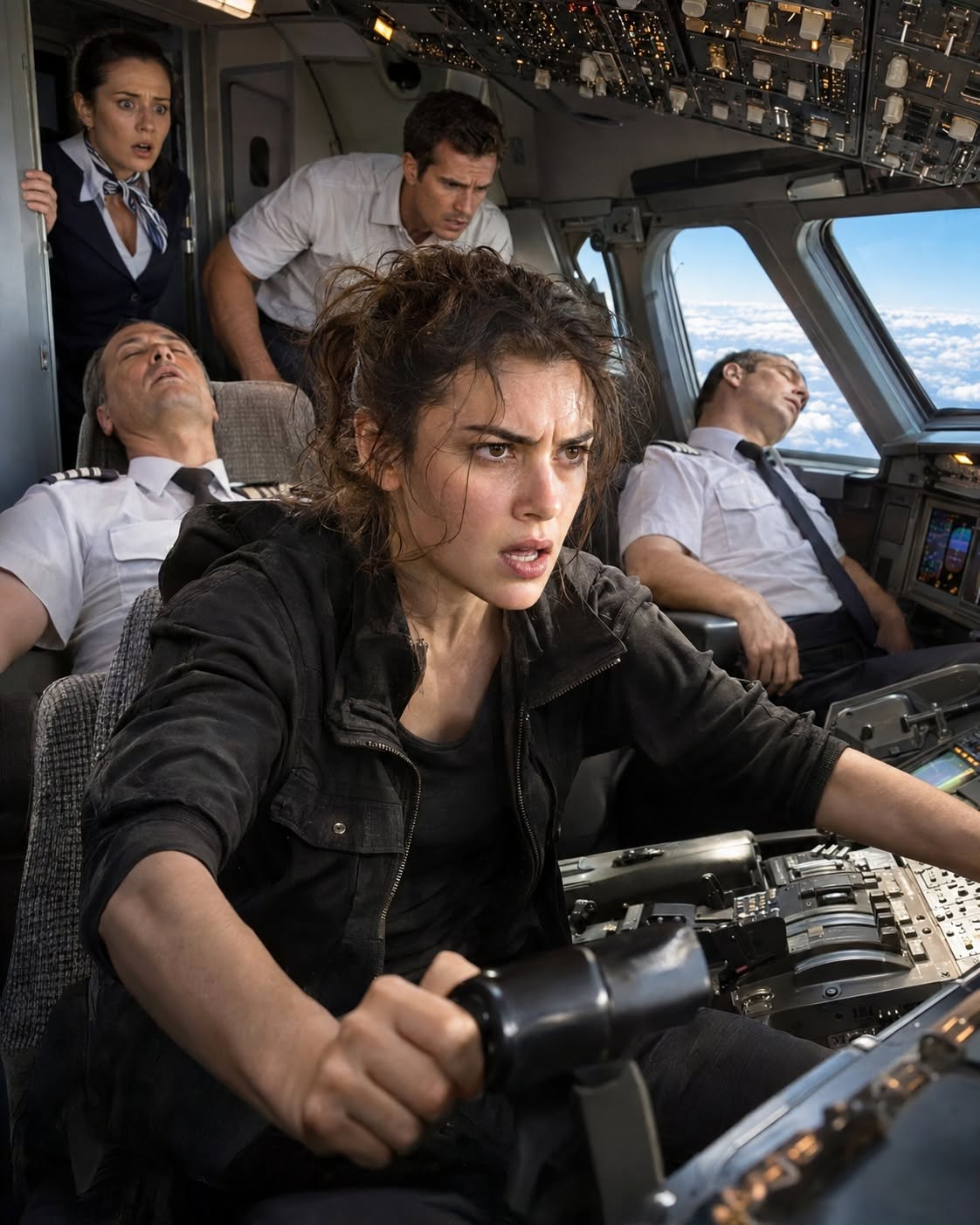
The first officer collapsed before he could finish his sentence. Seconds later, the captain slumped over the controls
PILOT’S LAST CALL — THE FINAL SECRET
The question followed me long after I left Ramstein.
I had spent years believing that the hardest part of any operation was surviving the moment when everything went wrong. But I was beginning to understand that surviving was sometimes only the beginning. The real danger often came afterward, when people started asking questions that powerful individuals desperately wanted to keep unanswered.
Three days after the emergency landing, I received a phone call from an unknown number.
I almost ignored it.
Then I heard a familiar voice.
“Don’t say anything. Just listen.”
It was Marcus Torres.
His voice was different from the one I remembered in the cockpit. There was no urgency, no confidence, and none of the calm authority he had displayed while hundreds of passengers were depending on us.
He sounded frightened.
“Where are you?” I asked.
“Somewhere I can talk. But not for long.”
“What happened?”
There was a brief silence.
“They’ve closed the investigation.”
I frowned.
“What do you mean, closed?”
“I mean the official report says the chemical exposure was an isolated technical failure. The attempted diversion never happened. The compromised landing gear was attributed to mechanical damage during the emergency.”
I couldn’t believe what I was hearing.
“We both know that’s not what happened.”
“I know,” Marcus replied. “And so do several people who were on that aircraft.”
“Then why would they write that report?”
His answer was almost a whisper.
“Because someone wants this buried.”
Before I could ask another question, he gave me an address and told me to come alone.
Then the line went dead.
I stared at my phone for several seconds.
I had spent the previous three days trying to convince myself that the nightmare was over. The passengers were safe. The aircraft had been secured. The conspirators had been arrested.
But Marcus’s call changed everything.
Someone hadn’t simply tried to hijack our aircraft.
Someone had been protecting the operation from the beginning.
And apparently, that person was still in a position to influence what happened next.
I drove to the address that evening.
It was an old industrial building outside the city, surrounded by empty warehouses and an overgrown parking lot. Marcus was waiting inside a small office on the second floor.
He looked exhausted.
On the desk in front of him were several photographs, a laptop, and a thick folder containing copies of documents.
“You shouldn’t have come here,” he said.
“Then you shouldn’t have called me.”
For the first time that evening, he almost smiled.
Then he opened the folder.
Inside were photographs of the aircraft’s maintenance records, flight communications, and several pages of classified correspondence.
I recognized the aircraft immediately.
But one document caught my attention.
It was a revised flight authorization signed almost forty-eight hours before our departure.
The signature belonged to a senior diplomatic official named Adrian Voss.
I remembered the name from the investigation. Voss had been identified as the diplomat who helped arrange the unauthorized diversion toward the remote airstrip.
According to the official report, he had acted alone.
Marcus shook his head when I said this.
“That’s what they want everyone to believe. But Voss wasn’t the person running the operation.”
“Who was?”
Marcus placed another photograph on the desk.
It showed a man standing beside the aircraft several hours before departure.
I knew his face.
Not personally, but I had seen him during the flight.
He had been sitting in business class, quietly reading a newspaper while the rest of us were settling into our seats.
“That’s Daniel Mercer,” Marcus said. “A security consultant with access to several military aviation contracts.”
I studied the photograph.
“What was he doing on our flight?”
“That’s what I’ve been trying to find out.”
Marcus explained that Mercer had disappeared shortly after the aircraft landed. His name had not appeared on the original passenger manifest. Someone had arranged for him to travel under a different identity.
But there was something even more disturbing.
The chemical agent had not been intended to incapacitate the pilots permanently.
It had been designed to leave them unconscious for a specific period.
Long enough for the aircraft to reach the remote airstrip.
Long enough for a second team to board.
And long enough for everyone aboard to disappear before authorities could respond.
“Why would anyone go to those lengths?” I asked.
Marcus slid another document toward me.
The answer was written across the top.
PROJECT NIGHTFALL.
Beneath the heading was a list of names, flight numbers, and financial transactions.
The operation had been designed to steal something much more valuable than an aircraft.
A passenger on our flight had been carrying a small encrypted storage device containing evidence of an international weapons procurement network.
His name was Elias Warren.
He had been traveling under diplomatic protection.
And he was dead.
I felt the room become strangely quiet.
“Dead?”
Marcus nodded.
“His body was found in a hotel room near the airport two days after our landing.”
I looked at the document again.
Elias Warren had been sitting only a few rows ahead of me.
I remembered him.
A middle-aged man with gray hair who had spent most of the flight looking out the window. He had barely spoken to anyone.
I had even noticed him helping an elderly passenger with her luggage.
Now Marcus was telling me that he had been carrying evidence capable of exposing an international conspiracy.
“Did they recover the device?”
“No.”
“Then someone still wants it.”
Marcus looked directly at me.
“That’s exactly what worries me.”
For the next hour, we examined everything he had collected. The documents suggested that several individuals inside different government agencies had been involved in arranging the operation.
Some had approved travel authorizations.
Others had manipulated security procedures.
One had even attempted to erase the aircraft’s maintenance history.
But the most troubling discovery was a passenger list containing the names of everyone who had been aboard.
Beside my name was a handwritten note.
SUBJECT IDENTIFIED. MONITOR CLOSELY.
I leaned back.
“Why am I on this list?”
Marcus didn’t answer immediately.
Instead, he opened his laptop and played a recording.
It was a conversation between two unidentified men, apparently recorded shortly before our flight departed.
One voice asked whether the civilian military passenger had been accounted for.
The other replied that he was not considered a primary concern.
Then came a sentence that made my stomach tighten.
“If he interferes, eliminate him before the aircraft reaches Germany.”
I listened twice.
They had known about me before the flight.
They had known about my military background.
And they had anticipated that I might become involved.
The operation hadn’t gone exactly according to plan, but I was beginning to suspect that the people behind it had prepared for far more possibilities than we had imagined.
Marcus closed the laptop.
“We need to find Warren’s device.”
“How?”
He pointed to another document.
“Before he died, Warren sent a message to someone. We traced the recipient to a woman named Claire Bennett. She was a financial investigator working in London.”
“Does she know what happened?”
“She knows enough to be in danger.”
I looked at the clock.
It was nearly midnight.
I had a choice.
I could walk away, report everything through official channels, and hope someone trustworthy would take responsibility.
Or I could help Marcus find out why a dead passenger, a compromised aircraft, and a rogue diplomat were connected.
I already knew which option I was going to choose.
The following morning, we traveled to London.
Claire Bennett was waiting for us in a small café near the river. She was in her early forties, with tired eyes and a nervous habit of checking the entrance every few minutes.
When Marcus introduced us, she barely acknowledged my presence.
Instead, she placed a small envelope on the table.
“Before I tell you anything, I need to know whether you can keep a secret.”
Marcus looked at me.
I nodded.
Claire opened the envelope.
Inside was a photograph of Elias Warren standing beside a younger man.
The younger man was Daniel Mercer.
But there was something else in the photograph.
Behind them stood a senior intelligence official whose face I recognized immediately.
General Thomas Caldwell.
A man who had once commanded a unit I had served alongside.
I felt an uncomfortable chill.
Caldwell had been considered a decorated officer, respected for his discipline and unquestionable loyalty.
If he was involved, this conspiracy was much larger than we had imagined.
Claire explained that Warren had discovered a network of companies secretly purchasing military equipment through shell organizations. The equipment was being redirected to private armed groups operating in unstable regions.
Several government officials had received money in exchange for approving the transactions.
The encrypted device contained financial records, internal communications, and evidence linking the entire network to its sponsors.
“Why didn’t Warren give the evidence to the authorities?” I asked.
“Because some of the authorities were involved,” Claire replied.
She then revealed something that changed our understanding of the flight.
Warren had not originally intended to travel to Germany.
His destination had been London.
The flight plan had been altered after he boarded, using authorization from Voss.
The remote airstrip was only one part of the operation.
The real objective was to recover the storage device before Warren could deliver it to Claire.
“Where is it now?” Marcus asked.
Claire hesitated.
Then she looked at me.
“Warren gave it to someone on the aircraft.”
I frowned.
“Who?”
“An elderly woman traveling with her granddaughter.”
For a moment, neither Marcus nor I spoke.
I remembered them.
The little girl had been sitting near the rear of the cabin, drawing pictures on a folded piece of paper. Her grandmother had asked a flight attendant for a blanket shortly after takeoff.
I remembered seeing the woman helping the child fasten her seat belt.
“You’re telling me they were carrying the evidence?”
Claire nodded.
“Warren knew he was being watched. He arranged for the device to be passed to someone who wouldn’t attract attention.”
“Where are they now?”
“Safe, I hope.”
That was when Claire received a message.
She read it once.
Then her expression changed.
“They’ve found them.”
Before we could ask who she meant, her phone rang.
The call came from an unknown number.
Claire answered.
A man’s voice spoke for less than ten seconds.
She turned pale.
Then she slowly placed the phone on the table.
“They have my sister.”
Marcus immediately stood.
“Who?”
“Daniel Mercer.”
I felt the situation closing around us.
Mercer wasn’t simply searching for the storage device. He was using the people closest to Claire to force her cooperation.
And if he had located the grandmother and child, there was no telling what he intended to do next.
We left the café through separate exits.
Marcus contacted a trusted colleague who could help us locate the family without alerting the compromised officials. Claire stayed with us, refusing to leave her sister’s safety to anyone else.
By late afternoon, we had a location.
A small country house outside Oxford.
The grandmother and her granddaughter were being held there.
We couldn’t simply storm the building. There were too many unknowns, and the presence of a child made every decision more dangerous.
Marcus insisted that we wait for additional support.
I agreed.
But then Claire received another message.
It contained a photograph of her sister sitting inside a room with her hands tied.
Underneath it was a simple sentence.
BRING THE DEVICE. NO AUTHORITIES.
We had less than two hours.
I looked at Marcus.
He was already making arrangements.
“We’re not going to give them what they want,” he said.
“No,” I replied. “But we’re going to make sure they don’t hurt anyone while we’re trying to stop them.”
What followed was the longest evening of my life.
Our small group coordinated with a trusted local security team. We established communication with the people inside the house and tried to identify how many individuals were guarding the captives.
Then something unexpected happened.
The little girl managed to send a message from a hidden phone.
It was only four words.
GRANDMA SAYS LOOK INSIDE.
Claire read it aloud.
I looked at the photograph of the grandmother again.
She was holding a small paperback book.
A children’s story.
I remembered the image from the aircraft.
The woman had carried that same book during the flight.
“Does she always have it?” I asked.
Claire shook her head.
“No. That book belonged to Warren.”
The realization came slowly.
The storage device had never been in the grandmother’s luggage.
It had been hidden inside the book.
And if Mercer had searched her belongings, he might still have missed it.
We needed to get the book out without revealing that we knew where the evidence was.
Marcus contacted the local team.
A short time later, the situation changed dramatically.
An ambulance arrived outside the property.
The captors had been told that one of the occupants was experiencing a serious medical emergency.
While their attention shifted, the security team managed to reach the house.
There was shouting.
A brief struggle.
Then silence.
Within minutes, the grandmother, her granddaughter, and Claire’s sister were outside.
Everyone was alive.
But Daniel Mercer was gone.
He had escaped through a rear entrance before the building was secured.
The little girl ran toward Claire and wrapped her arms around her.
The grandmother approached me.
She was holding the paperback book.
“You saved us,” she said.
I shook my head.
“You did most of that yourself.”
She smiled sadly.
Then she handed me the book.
Inside its back cover was a small compartment.
The encrypted storage device was still there.
For the first time since the aircraft landed at Ramstein, we finally had something the conspirators couldn’t easily explain away.
But we were still missing one piece.
General Caldwell.
And he was the person with the greatest ability to make the evidence disappear.
The following day, we arranged a secure meeting with an independent oversight investigator.
We provided copies of the documents, the recording, and the storage device. Claire supplied the financial records, while Marcus gave a detailed account of the aircraft incident.
For the first time, our story was being heard by people who had not been involved in the original operation.
The investigator listened without interrupting.
When we finished, he closed the folder.
Then he asked a question none of us expected.
“Why did you wait three days before bringing this forward?”
Marcus explained the threats, the compromised investigation, and our attempt to protect the witnesses.
The investigator nodded.
Then he looked at me.
“Did you know that General Caldwell personally authorized your aircraft’s emergency diversion?”
I felt my jaw tighten.
“No.”
He opened another file.
“Because he did.”
The document showed that Caldwell had approved the flight’s revised destination under the justification of a classified security transfer.
But the signature was not the most disturbing part.
At the bottom was a second authorization.
It had been issued after the aircraft landed at Ramstein.
It ordered the immediate transfer of all recovered evidence to a private security contractor.
That contractor was controlled by Daniel Mercer.
Caldwell had been trying to retrieve the device even after the operation failed.
The investigator stood.
“I think it’s time we speak with the general.”
We expected resistance.
Instead, Caldwell agreed to meet us.
The meeting took place in a secure government building two days later.
He entered wearing a dark suit, carrying a leather folder, and looking exactly as I remembered him.
For several seconds, he studied my face.
Then he smiled.
“I heard you had an eventful flight.”
I didn’t return the smile.
“You knew what was going to happen.”
He sat down.
“I knew there was an operation involving that aircraft.”
“People were going to die.”
“That was never the intention.”
“Then why were the pilots poisoned?”
Caldwell folded his hands.
“Because certain people needed to be removed from the equation.”
I felt anger rising, but I kept my voice steady.
“You exposed hundreds of passengers to a chemical agent. You arranged an unauthorized diversion. You allowed an innocent man to be murdered.”
His expression hardened.
“You’re looking at this emotionally.”
“No,” I replied. “I’m looking at the people who were on that aircraft.”
For the first time, Caldwell seemed genuinely irritated.
He explained that the weapons network had been created years earlier to move military equipment into regions where conventional diplomatic channels had failed.
According to him, the operation had saved lives.
But over time, the network had become profitable.
Officials began taking payments. Contractors started selling equipment to unauthorized buyers. People who questioned the arrangement disappeared.
Elias Warren had uncovered the truth.
Caldwell claimed he had wanted to retrieve the device and negotiate a controlled disclosure.
I asked him whether that was why Warren was dead.
He didn’t answer.
Then he looked directly at me.
“You were never supposed to become involved.”
I leaned forward.
“That’s what everyone keeps telling me.”
He sighed.
“You don’t understand what you’re dealing with. There are people above me who will not allow this investigation to continue.”
“Then they should have thought about that before putting innocent passengers in danger.”
The meeting ended abruptly.
Caldwell was escorted from the room.
But he wasn’t arrested.
Not yet.
The evidence had to be verified, the financial trail established, and every allegation investigated properly.
We had finally exposed the conspiracy, but its leaders still had influence.
That night, Marcus received a message from an unknown number.
It contained a photograph.
Our aircraft.
Taken at Ramstein.
On the back of the photograph was a handwritten sentence.
YOU SHOULD HAVE LEFT THE PAST ALONE.
Marcus showed it to me.
I studied the image carefully.
Then I noticed something strange.
The photograph had been taken from inside the airport security perimeter.
Whoever had sent it had access to restricted areas.
The conspiracy was still alive.
And someone knew exactly where we were.
We were moved to a secure location before sunrise.
The following morning, the oversight investigator contacted us with unexpected news.
Daniel Mercer had been arrested at a private airport while attempting to leave the country.
His luggage contained several false passports, large amounts of cash, and documents linking him to the operation.
More importantly, he had agreed to cooperate.
Not because he had suddenly developed a conscience.
But because General Caldwell had ordered him to take responsibility for everything.
Mercer understood that he was being prepared as the fall guy.
He had decided that if he was going down, he wasn’t going down alone.
His testimony revealed the final piece of the conspiracy.
The aircraft incident had been only one operation in a much larger scheme. Several other flights had been considered as potential targets because their passengers included individuals carrying sensitive information.
The remote airstrip was a temporary holding location, not a permanent destination.
The plan was to remove selected passengers, recover their documents, and create an official explanation that would make the incident appear to be an ordinary aviation emergency.
But the plan had failed because someone had refused to remain in his seat.
Me.
I didn’t feel proud when I heard that.
I felt sick.
The investigation continued for months.
Several officials were suspended. Financial accounts were frozen. Military contractors lost their security clearances. General Caldwell was eventually charged with conspiracy, corruption, and multiple offenses related to the attempted operation.
Adrian Voss was extradited after investigators uncovered evidence that he had coordinated the diplomatic arrangements.
Daniel Mercer received a lengthy prison sentence after his cooperation helped prosecutors establish the full chain of responsibility.
And Elias Warren’s death was finally recognized as murder.
His family received the evidence he had risked everything to preserve.
The encrypted device contained more than financial records.
It also held personal messages he had written to his daughter.
In one of them, he explained why he had decided to expose the network.
He wrote that he had spent most of his career believing that protecting his country meant protecting the people who represented it.
Eventually, he realized that those two things were not always the same.
His final sentence stayed with me.
“Integrity isn’t proven when doing the right thing is easy. It’s proven when doing the wrong thing would make your life much simpler.”
I read those words several times.
They reminded me of the decision I had made aboard the aircraft.
I hadn’t known whether I would succeed.
I hadn’t known whether I had the authority to act.
I hadn’t even known whether the people around me would trust me.
But I had known that doing nothing would leave hundreds of lives in danger.
Months later, I received an invitation to attend a small ceremony honoring the passengers and crew who had survived the incident.
I almost declined.
I wasn’t interested in speeches or medals.
But one name on the invitation changed my mind.
The grandmother and her granddaughter would be there.
So would Claire, her sister, and Marcus.
When I arrived, the little girl ran toward me.
She was carrying a folded piece of paper.
“I made something for you,” she said.
It was a drawing of an airplane.
The wings were slightly uneven, the windows were crooked, and the landing gear looked far too large.
But beneath the aircraft, she had written a sentence in bright blue letters.
THANK YOU FOR BRINGING EVERYONE HOME.
I couldn’t speak for a moment.
Then I knelt beside her.
“That’s a very good drawing.”
She smiled.
“My grandma says you’re a hero.”
I looked toward the grandmother, who was watching us from a few steps away.
“Your grandma is very kind,” I said. “But there were a lot of people who helped that day.”
The girl thought about it.
Then she asked something I wasn’t prepared for.
“Why did you help us if you didn’t know us?”
I considered giving her the simple answer.
Because it was my duty.
Because I had been trained to act.
Because someone had to.
But none of those explanations felt complete.
So I told her the truth.
“Because you shouldn’t have to know someone to care whether they live.”
She looked at me for a moment, then nodded as if she understood.
That evening, Marcus and I stood outside the building while the ceremony continued behind us.
For the first time in months, neither of us was looking over our shoulders.
“Do you ever think about that flight?” he asked.
“Every day.”
“Would you do it again?”
I looked toward the runway in the distance.
The question was more complicated than it sounded.
I remembered the collapsed pilots, the frightened passengers, the uncertainty in the cockpit, and the moment the landing gear finally locked into place.
I remembered how close we had come to losing everything.
“Yes,” I finally answered. “But I’d hope I never have to.”
Marcus nodded.
Then he said something I would remember for the rest of my life.
“Most people think courage means knowing you can win. I think it means understanding what could happen if you don’t even try.”
We stood there quietly.
A few minutes later, an aircraft passed overhead.
Its lights disappeared into the evening sky.
For a long time, I watched it go.
I thought about the passengers who had boarded our flight expecting nothing more than an ordinary journey. People with families waiting at home. People with unfinished conversations, birthdays to celebrate, and ordinary plans for the following morning.
None of them had volunteered to become part of an international conspiracy.
None of them had asked to depend on the decisions of a stranger.
Yet for a few terrifying hours, their lives had rested on choices that could not be taken back.
I had once believed that being prepared meant having the right answers.
That flight taught me something different.
Sometimes, there are no right answers waiting for you. There is only an imperfect choice, a limited amount of time, and the responsibility to think about the people who will live with the consequences.
I never received a public explanation of everything that happened behind the scenes. Some details remained classified. Some questions were never answered. And I eventually learned that justice, even when it arrives, rarely feels as complete as people imagine.
But I knew three things.
The passengers had survived.
The truth about Elias Warren had come out.
And the people responsible could no longer hide behind the authority they had abused.
As for me, I returned to my ordinary life.
I traveled occasionally, spent more time with my family, and tried to appreciate the quiet moments I had once taken for granted.
Sometimes, when I boarded an aircraft, I would look toward the cockpit and think about that day.
I would remember how quickly an ordinary flight had become a fight for survival.
And I would remember the people who had stepped forward when the situation demanded it.
Not because they were fearless.
Not because they knew exactly what to do.
But because they understood that fear was not an excuse to abandon others.
One afternoon, nearly a year after the incident, I received a final letter from Claire Bennett.
She wrote that the investigation had officially concluded. The remaining financial assets connected to Project Nightfall had been recovered, and several victims of the weapons network were finally receiving assistance.
At the bottom of the letter, she included a photograph.
It showed Elias Warren’s daughter standing beside a memorial dedicated to her father.
She was holding the same paperback book that had carried the encrypted device.
On its cover, someone had written a dedication:
FOR THE PEOPLE WHO CHOOSE TO DO WHAT IS RIGHT, EVEN WHEN NO ONE IS WATCHING.
I placed the photograph on my desk.
Then I returned to work.
I didn’t need another reminder that I had done something extraordinary.
I needed to remember that ordinary people were often the ones who paid the price when powerful individuals made terrible decisions.
And perhaps that was the greatest lesson of the entire experience.
Being capable of taking action does not mean you should seek danger, ignore the rules, or believe you are always right. It means understanding when silence becomes complicity, when authority must be questioned, and when the safety of others matters more than personal comfort.
Courage is not about becoming the person who controls every situation.
It is about refusing to turn away when someone needs help.
Even now, whenever I hear the words “Ladies and gentlemen, welcome aboard,” I think about the hundreds of people who were sitting behind me that day.
They never knew how close they came to losing everything.
And perhaps they never needed to know every detail.
They simply needed to make it home.
That was the promise we had fought to keep.
And it was the only recognition I ever truly wanted.
THE END.