The famous surgeon ripped off his blood-soaked gloves, abandoned a dying patient on the operating table
The hospital investigation began behind closed doors, but secrets have a way of leaking through the smallest cracks.
By the end of the first week, everyone at Ashgrove Memorial knew something had happened in Operating Room Four, even if nobody agreed on what to call it.
Some staff members whispered that Dr. Julian Voss had suffered a panic attack.
Others claimed that Nurse Claire Bennett had exceeded her authority and risked the patient’s life.
A few simply avoided me, afraid that standing too close to the truth might put their own careers in danger.
I returned to my regular shifts because routine was the only thing keeping my thoughts from spiraling.
I checked medication charts, monitored patients, changed dressings, and answered call lights.
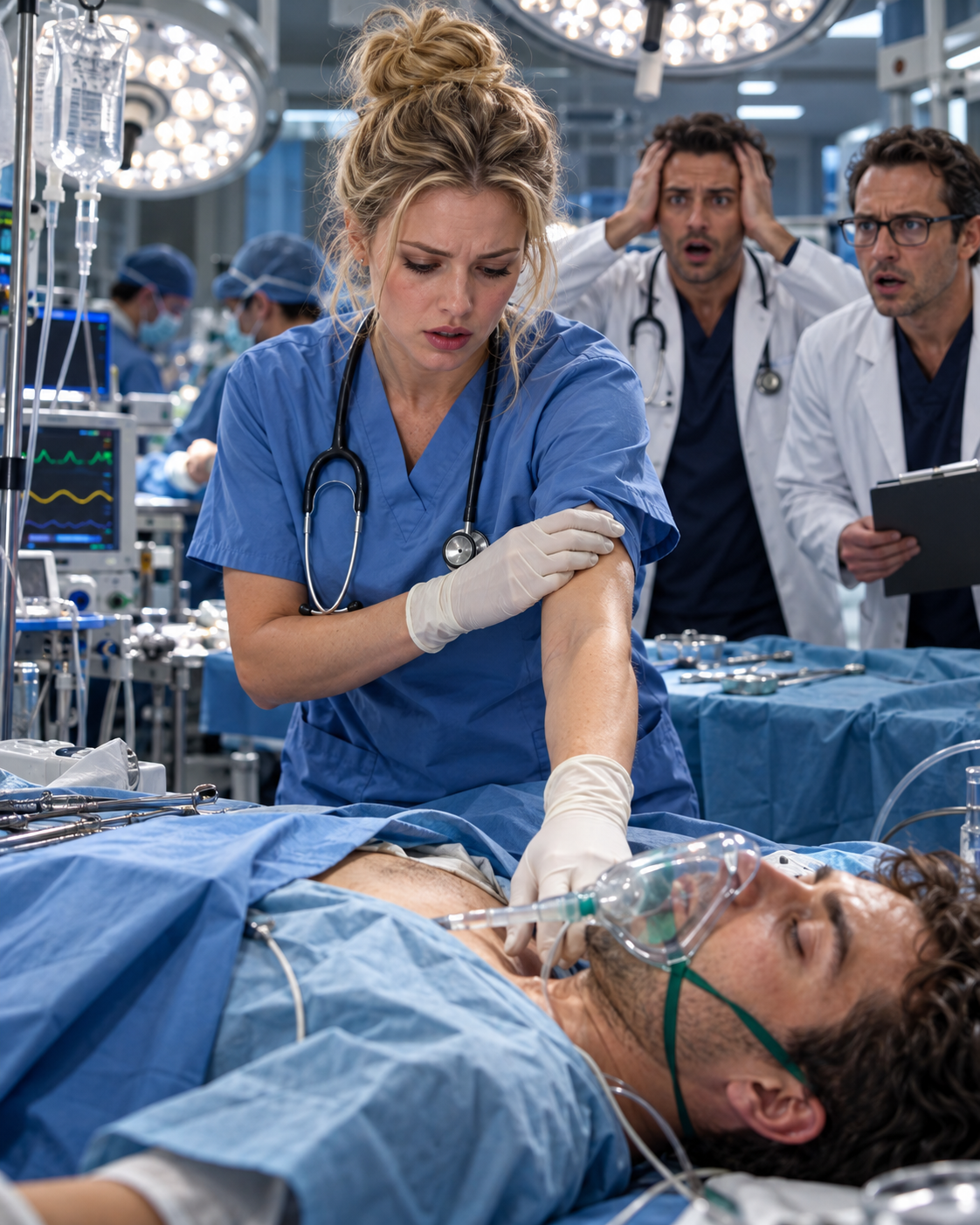
But every time I entered the operating suite, I remembered the moment Voss had abandoned Daniel.
I remembered the empty doorway.
I remembered the monitor screaming.
And I remembered how familiar that terrible silence had felt.
On the ocean, there had been no time to wonder whether someone with a more impressive title would take responsibility.
You assessed the danger, trusted your training, and did everything within your ability to bring people home.
At Ashgrove, I was discovering that the hardest part of an emergency sometimes came after the bleeding stopped.
It was the battle over who would be allowed to tell the truth.
Dr. Okafor summoned me to her office on Monday morning.
A stack of printed reports covered her desk, and a cup of untouched coffee sat beside her computer.
“Sit down, Claire.”
I obeyed.
“I have reviewed the operating room footage, the access logs, the anesthesia records, and the written accounts from everyone present.”
She paused before continuing.
“Your actions were consistent with emergency nursing responsibilities and the immediate need to support hemorrhage control while definitive surgical assistance was obtained.”
Relief loosened something in my chest, but only slightly.
“What about Dr. Voss?”
“He claims he left to summon additional help.”
“That isn’t what happened.”
“I know. The access logs show that he left the suite without making the emergency call he later described. The call was placed by the circulating nurse after he had departed.”
I stared at her.
“Can he still deny it?”
“He can deny anything he wishes. The records will speak for themselves.”
She opened another folder.
“There’s something else. Before joining Ashgrove, you received specialized training in casualty evacuation, trauma assessment, and emergency stabilization. Your personnel file indicates that your rescue career ended after a serious accident.”
My shoulders stiffened.
“I don’t want special treatment.”
“This isn’t special treatment. It’s a review of whether the hospital has failed to recognize a valuable skill set.”
I looked at the window behind her desk.
For eleven months, I had deliberately avoided attention because I believed being invisible was safer than being disappointed again.
Now attention was finding me whether I wanted it or not.
“All I want is to do my job,” I said.
“Then let’s make sure nobody can punish you for doing it properly.”
The first formal hearing took place two days later.
The conference room was packed with hospital executives, legal representatives, department heads, and several members of the board.
Dr. Voss arrived in a charcoal suit, looking composed enough to deliver a keynote address.
Robert Callaway sat beside him with a thick binder.
I sat across the table with Priya and Dr. Okafor.
The chair of the board, Margaret Ellis, opened the meeting by explaining that the purpose was to establish what had happened and determine whether patient safety procedures had been violated.
Then Voss spoke.
He described the vascular injury as an unpredictable complication and said he had stepped away to coordinate urgent assistance.
He called the event “a moment of confusion during an exceptionally difficult procedure.”
He never mentioned stripping off his gloves.
He never mentioned the residents who had followed him out.
And he never mentioned the fact that Daniel had been left without the operating surgeon while his blood pressure collapsed.
When he finished, Callaway suggested that the hospital consider a confidential resolution to avoid damaging its reputation.
Priya leaned toward her microphone.
“With respect, I need to correct the record.”
Callaway turned sharply.
“Your written statement has been received.”
“My written statement says the surgeon abandoned the operating room. The summary you circulated says he stepped away briefly to coordinate assistance. Those are not the same thing.”
A murmur moved through the room.
Priya’s voice trembled, but she did not stop.
“I was afraid to contradict him because he is a famous surgeon and I am a nurse whose contract comes up for review next month. I’m still afraid. But Daniel nearly died, and changing the wording won’t make what happened less serious.”
For a moment, nobody spoke.
I looked at Priya and felt a fierce admiration that had nothing to do with technical skill.
She had chosen to stand where fear wanted her to sit.
Dr. Okafor displayed the access logs and time-stamped recordings.
The footage showed Voss stepping away from the surgical field, removing his gloves, and exiting the room.
The residents followed seconds later.
The emergency call was placed by another member of staff after the surgeon had left.
When the recording ended, Voss’s jaw tightened.
“That footage lacks context,” he said.
Dr. Okafor folded her hands.
“Then provide the context, Doctor. Why did you leave your patient without arranging a qualified surgical handover?”
Voss glanced at Callaway.
Callaway said nothing.
For the first time since I had met him, the celebrated surgeon appeared unable to control the room.
The board suspended him from operating pending the outcome of the investigation.
Callaway was removed from direct oversight of the case after his attempts to minimize the incident were brought under review.
Neither decision felt like a victory.
They felt like the beginning of a process that should have been routine from the start.
Outside the conference room, a reporter from a local medical news outlet approached us.
“Is it true a nurse took over after Dr. Voss fled?”
Dr. Okafor stepped between the reporter and our group.
“The hospital will release verified findings when the review is complete. We will not speculate about individual actions before that process concludes.”
She guided us away before anyone could turn Daniel’s suffering into a spectacle.
That evening, I found a message from an unknown number on my phone.
It contained a single sentence.
“You should have stayed invisible.”
My pulse quickened.
I read it again, then showed it to Priya.
“Do you think it’s Voss?”
“I don’t know,” she said. “But you need to report it.”
I wanted to dismiss it as an angry message from someone who disliked the investigation.
Instead, I forwarded it to hospital security and Dr. Okafor.
The next morning, security confirmed that the message could not be reliably traced from the information available.
They offered to escort me to my car after late shifts, and I accepted.
It was a small concession, but I was learning that courage did not require pretending fear was absent.
Sometimes courage meant admitting that something frightened you and asking for help anyway.
Meanwhile, Daniel continued to recover.
His wife, Emily, visited him every afternoon, bringing photographs of their six-year-old daughter, Sophie.
When I checked his vitals, he would ask whether I had eaten, whether I was sleeping, and whether the hospital had stopped treating me like a problem.
I laughed at that last question.
“There’s a difference between being investigated and being treated like a problem.”
“Not always,” he replied.
One afternoon, Emily caught me outside his room.
“Claire, I want you to know something.”
She held a paper cup of tea between her hands.
“Daniel doesn’t remember everything from that night, but he remembers hearing people argue and thinking he was going to die alone.”
I felt the familiar tightness in my throat.
“He said he could hear someone giving calm instructions. He didn’t know your name, but he said your voice made him believe he still had a chance.”
I looked through the glass at Daniel, who was trying to sit upright while a physical therapist encouraged him.
“I only did what needed to be done.”
Emily smiled sadly.
“That’s what people always say after doing something extraordinary.”
Her words followed me for the rest of the day.
I had spent years thinking my career ended when the Coast Guard medically discharged me.
But perhaps the uniform had never been the thing that made me useful.
Perhaps it had simply been the place where I first learned what I could do when fear was loud and time was short.
Two weeks later, the hospital board released its preliminary findings.
Dr. Voss had violated emergency response expectations by leaving the operating room without ensuring an appropriate handover.
His account of the incident was inconsistent with the documented timeline, and his failure to provide a clear explanation had undermined confidence in his judgment.
He was removed from his leadership role in the trauma surgery program.
His planned promotional tour, which had included medical conferences and television appearances, was canceled.
He requested a transfer to another facility while the hospital completed its disciplinary process.
Callaway also faced a separate review of his handling of the incident and the accuracy of the internal summary he had circulated.
The hospital did not declare me a hero.
It did something more useful.
It revised its emergency escalation policy, clarified the responsibilities of staff during sudden surgical crises, and established a protected reporting process so nurses and technicians could raise safety concerns without fearing retaliation.
Dr. Okafor asked me to help with the training program.
At first, I refused.
“I haven’t led a hospital training exercise before,” I told her.
“You have led people through dangerous situations before,” she replied. “The setting is different, but the value of clear communication is the same.”
I thought about the helicopter hanging above the ocean, the injured passengers waiting on a pitching deck, and the people who had trusted me to keep my head when everything around us seemed to be falling apart.
Then I remembered the eleven months I had spent hiding in plain sight.
“All right,” I said. “But the drills need to involve everyone, not just the physicians.”
Dr. Okafor smiled.
“That was exactly what I hoped you’d say.”
The first simulation took place in a training room converted to resemble a critical care bay.
Nurses, residents, surgeons, technicians, and anesthesiology staff gathered around a mannequin connected to monitors.
I explained that the exercise would test communication, escalation, and team coordination rather than individual heroics.
“Nobody is expected to know everything,” I told them. “But everyone is expected to speak up when they see danger, and everyone is expected to listen.”
The scenario began with a simulated patient deteriorating after surgery.
A resident hesitated when the blood pressure alarm sounded.
A nurse recognized the change and called for assistance.
The senior physician initially dismissed the warning.
I stopped the exercise.
“Let’s rewind,” I said.
The physician frowned.
“Why?”
“Because the patient doesn’t get safer just because the person raising the concern has a lower title.”
Nobody laughed.
We ran the scenario again.
This time, the nurse’s warning was acknowledged immediately, the emergency response was activated, and the team coordinated its actions without waiting for someone to give permission to care.
Afterward, Priya approached me.
“You know what I thought the first time you walked into the operating room?”
“What?”
“I thought you were going to get blamed for something you couldn’t possibly control.”
I smiled faintly.
“I thought that too.”
“Then why did you step forward?”
I considered the question.
“Because Daniel didn’t have time to wait for me to stop being afraid.”
Priya nodded.
“That’s the difference, isn’t it? Being brave doesn’t mean you don’t feel fear. It means the fear doesn’t get to make the decision.”
I carried those words with me.
As spring arrived, Daniel was discharged from the hospital.
He walked slowly, still recovering from the trauma and the long weeks of rehabilitation, but he was alive.
On the morning he left, he asked whether I could spare a few minutes before my shift ended.
I found him sitting in the lobby beside Emily and Sophie.
Sophie held a handmade card covered in crooked hearts and bright blue stars.
“We made this for you,” Daniel said.
I opened it.
Inside was a drawing of a woman wearing blue scrubs beside a hospital bed.
A red heart floated above the bed, and beneath the picture Sophie had written, with help from her mother, THANK YOU FOR HELPING MY DADDY COME HOME.
I had received certificates, commendations, and official letters during my Coast Guard career.
None of them had ever felt as heavy as that little card.
“Your dad did the hard work of recovering,” I told Sophie.
She shook her head.
“Daddy says you helped him.”
I crouched to her height.
“Your daddy is a very determined man.”
She considered that, then gave me a serious nod.
“He’s also bad at hide-and-seek.”
Daniel laughed, and the sound filled the lobby with a warmth that made the difficult weeks feel worthwhile.
After they left, I stood near the entrance and watched their car disappear into the traffic.
For a long time, I had thought survival meant getting through the worst moment and then learning to live with what remained.
Now I understood that survival could also mean allowing yourself to be seen again.
The hospital’s final review was completed several months later.
Dr. Voss’s transfer request was approved after he stepped down from his leadership position, and the hospital reported the findings to the appropriate professional bodies.
The review did not erase his medical accomplishments, nor did it need to.
It established that expertise did not excuse abandoning responsibility when a patient needed help.
Callaway was reassigned while his conduct underwent further administrative review.
Priya received a formal commendation for her accurate reporting and her role in maintaining emergency care.
I was offered a permanent position coordinating trauma-response education across the hospital.
I accepted, but I kept my regular nursing shifts.
I did not want to become a person who only spoke about emergencies from behind a desk.
I wanted to keep meeting patients, listening to frightened families, and remembering why the work mattered.
On my first day leading the new program, I stood before a room filled with staff members who had once barely noticed me.
Some looked curious.
Others looked skeptical.
A few seemed uncomfortable at the thought of taking instructions from a nurse who had spent eleven months avoiding attention.
I placed a photograph on the table.
It showed a Coast Guard rescue helicopter suspended above a dark stretch of ocean, its searchlight cutting through the rain.
“This was taken during one of my last rescue missions,” I said. “I kept it because I thought it represented the person I used to be.”
I paused.
“For years, I believed my career ended when I could no longer climb into that helicopter. I thought the accident had taken away the only thing that made me valuable.”
I looked around the room.
“But when a patient was bleeding in front of me, none of that mattered. My old uniform didn’t matter. My medical discharge didn’t matter. What mattered was what I had learned, what I could safely do, and whether I was willing to act within my role while calling for the people who could do more.”
The room grew quiet.
“Titles matter because they define responsibilities, not because they make one person more human than another. The moment we stop listening to the person who sees a problem is the moment our system begins to fail.”
I saw Priya nod from the back of the room.
Then Dr. Okafor stepped forward and announced that the hospital would make the simulation program a permanent part of its emergency training.
For the first time in a long while, I felt no need to shrink into the background.
I was not the woman who had lost her old life.
I was the woman who had survived it and found another way to serve.
Months passed, and the training program grew.
Staff members began reporting near misses earlier.
Junior nurses spoke more confidently during briefings.
Surgeons practiced listening without interrupting, and senior physicians learned to recognize when their authority was making others afraid to speak.
The changes were small, often invisible to patients, but they mattered.
A hospital became safer not through one dramatic act of heroism, but through hundreds of ordinary decisions to tell the truth, ask for help, and take responsibility.
One evening, after a particularly exhausting shift, I found Dr. Okafor waiting outside the training room.
She held a sealed envelope.
“This arrived for you,” she said.
The return address belonged to a Coast Guard office I had not heard from since my medical discharge.
My stomach tightened.
For years, I had avoided correspondence connected to my old career because I feared every official letter would reopen the life I had lost.
I opened the envelope carefully.
Inside was a formal invitation to speak at a rescue-service safety conference about emergency leadership, trauma coordination, and the transition from military rescue work into civilian healthcare.
At the bottom was a handwritten note from a former teammate, Marcus Reed.
“I heard you found your way back to the work, Claire. Some of us never doubted you would.”
I read the sentence several times.
I had spent years believing that the person I used to be had disappeared somewhere beneath the waves.
But Marcus remembered me.
And now, for the first time, I wondered whether returning to that world might not be a retreat into the past, but a way to help others avoid the mistakes that had cost me so much.
The next morning, I called him.
His voice sounded older, but the familiar warmth was still there.
“I was beginning to think you’d never answer,” he said.
“I wasn’t sure I was ready.”
“Nobody ever is, Claire. That’s why you train before the alarm goes off.”
I laughed softly.
We spoke about the conference, the people we had lost touch with, and the accident that had changed the direction of my life.
Before we ended the call, Marcus said something that stayed with me.
“The ocean doesn’t get to decide who you are for the rest of your life.”
I looked out at the city beyond the hospital windows.
For so long, I had defined myself by what I could no longer do.
I could no longer climb into a rescue helicopter.
I could no longer endure the physical demands of my old position.
I could no longer return to the exact life I had before the accident.
But I could still teach.
I could still care for patients.
I could still stand beside someone who was afraid and help them find the next safe step.
That evening, I accepted the invitation.
Then I returned to the ward, where a young nurse was struggling to explain to a senior physician that her patient had become suddenly confused.
The physician glanced at the chart and began to dismiss her concern.
I stopped beside them.
“Let’s hear her out,” I said.
The nurse looked at me, surprised, then described the change she had noticed.
The team reassessed the patient and discovered a developing complication that required urgent treatment.
The patient received care before the situation deteriorated.
No alarms filled the hallway.
Nobody ran.
There was no dramatic rescue and no audience to applaud.
There was simply a nurse who spoke, a physician who listened, and a patient who received help in time.
As I walked away, I realized that this was the kind of courage I wanted to spend the rest of my life protecting.
Not the kind that needed a spotlight.
Not the kind that depended on a title.
The kind that appeared quietly when someone recognized danger and refused to look away.
I still kept the photograph of the rescue helicopter in my locker.
But beside it, I placed Sophie’s handmade card, its crooked blue stars fading slightly at the edges.
One reminded me of the life I had lost.
The other reminded me of the lives that could still be changed.
And whenever someone asked whether I missed the ocean, I told them the truth.
“Every day.”
Then I would return to work, because I had finally learned that losing one way to save people did not mean losing the ability to save them.
Sometimes the person who stays is not the person with the highest title or the loudest voice.
Sometimes it is the person everyone has overlooked, the person carrying old scars beneath an ordinary uniform, the person who has already learned what happens when fear makes people abandon one another.
And sometimes, when the alarms begin to sound, that person steps forward—not because she believes she can do everything, but because she knows she must not leave the work of helping others to someone else.
I had once believed my greatest rescue was the one that ended my career.
Now I understood that it was the one that taught me my life still had a purpose.
Yet the night before my first conference, another envelope arrived at my apartment, with no return address and no explanation.
Inside was a photograph of the helicopter involved in my accident, taken from an angle I had never seen before.
On the back, someone had written a single sentence.
“Claire, the winch failure was not what you were told.”
I stood motionless beneath the kitchen light, the photograph trembling in my hands.
For years, I had believed the accident was a tragic mechanical failure, a terrible piece of luck that had ended one life and forced me to build another.
Now, as I stared at the unfamiliar photograph, I wondered whether the past I had finally made peace with had been hiding a truth of its own.
And for the first time since the operating room at Ashgrove, I felt the old alarms begin to sound inside me.