The entire trauma bay watched Dr. Warren Teague sneer at me and order me away from a dying Navy SEAL
Part 2
The moment we entered Trauma One, the hospital’s familiar sounds seemed to fall away beneath the monitor alarms and the rush of hurried footsteps.
Eli Hart was barely responsive, his skin gray beneath the harsh surgical lights, and every shallow breath looked like an argument his body was losing.
I pulled on gloves and moved to the patient’s left side while the respiratory therapist adjusted the oxygen delivery.
“Confirm his airway is protected and keep reassessing his ventilation,” I said. “I want blood moving, surgical support coming, and continuous monitoring while we address the chest emergency.”
A resident began listing the patient’s vital signs.
I listened, checked the examination findings, and recognized the pattern with the terrible clarity that comes from having seen it before.
A suspected tension pneumothorax can turn a treatable injury into cardiac arrest when pressure inside the chest prevents the lungs from expanding and interferes with blood returning to the heart.
The diagnosis could not wait for a perfect picture.
The patient needed immediate intervention by a qualified clinician, and I had performed that intervention under far worse conditions than this.
I confirmed the emergency indication with the team, identified the appropriate equipment, and directed the trained staff to prepare for immediate chest decompression under the hospital’s emergency protocol.
Dr. Teague stood at the foot of the bed, visibly struggling to regain control.
“Keller, I am the attending physician.”
“Then help me keep him alive.”
The words came out before I could soften them.
His face changed, but he finally moved toward the resuscitati
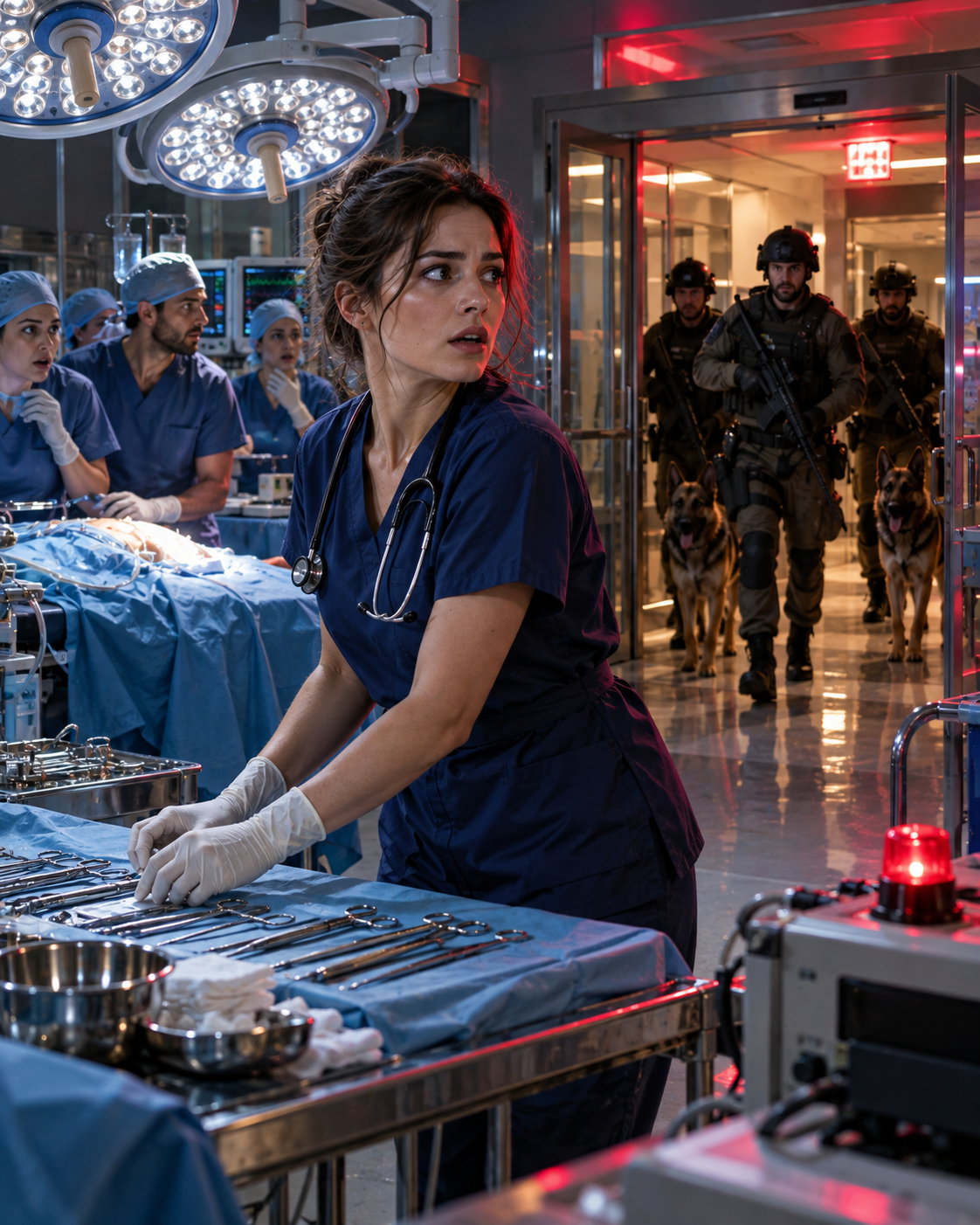 on equipment.
I carried out the emergency decompression with controlled precision, then assisted with chest-tube placement as the trauma team took over the coordinated resuscitation.
There was no flourish.
No dramatic pause.
Only the practical sequence of actions that had to happen in the right order, with the patient’s changing condition guiding every decision.
The moment the trapped pressure was relieved, the team reassessed his breathing and circulation.
His oxygenation began to improve, and the monitor showed signs that his circulation was responding to treatment.
“Keep the blood going,” I said. “Do not assume the chest injury is the only source of shock. We need surgical evaluation for the internal bleeding and fragment injuries.”
A resident repeated the orders, this time without hesitation.
Dr. Teague finally began contributing meaningfully, directing the next stages of stabilization and coordinating with the surgical service.
I did not resent him for helping.
Eli did not need us to settle our differences.
He needed every competent person in that room to do their job.
When the surgical team arrived, I gave a concise handoff covering the mechanism of injury, deterioration during transport, the suspected tension pneumothorax, the emergency intervention, and his response to treatment.
The lead surgeon nodded once.
“We have him from here.”
As the team moved Eli toward the operating suite, his hand shifted against the stretcher rail.
His fingers brushed the edge of my glove.
I did not know whether he was conscious enough to recognize anyone, but I leaned closer anyway.
“Stay with us, Hart. Your team brought you home.”
The SEALs followed the stretcher until the operating suite doors closed.
Only then did I notice that my hands were trembling.
I stepped into the corridor and removed my gloves carefully, one finger at a time.
For several seconds, I stared at the faint red mark where the glove had pressed against my wrist.
I had spent years teaching myself that an emergency ended when the patient reached the next stage of care.
But my body had not forgotten the old reflexes.
My heart was still racing.
My mouth tasted metallic.
Somewhere behind me, Master Chief Holloway said my name.
“Keller.”
I turned.
He stood a few feet away, shoulders squared, rainwater still darkening the fabric around his collar.
Up close, I could see the lines time had carved around his eyes.
He looked older than the man I remembered, but his gaze was unchanged.
“Is he going to make it?” he asked.
“The surgical team is working on him. He’s responding to stabilization, but the next few hours matter.”
Holloway nodded slowly.
Then his eyes dropped to the chain at my neck.
The dog tags had slipped above the collar of my undershirt when I leaned over the stretcher.
He saw the scratched metal.
He saw Daniel’s name.
And then he saw mine.
For a moment, he looked as though the floor had disappeared beneath him.
“Where did you get those?”
I touched the tags instinctively.
“They’re mine.”
“I know they’re yours.”
His voice broke on the last word.
He stepped closer, studying my face with a mixture of disbelief and something that looked painfully like relief.
“We were told you never made it to the extraction point.”
“I did.”
“Your unit reported the vehicle was destroyed. We searched the area, but the mission had already moved, and the communications were gone. Daniel—”
He stopped.
Neither of us needed him to finish the sentence.
I had carried Daniel’s tags ever since the military returned his personal effects to me.
Holloway lowered his head briefly, as if he were trying to contain years of questions inside one breath.
“We thought you were dead.”
“I know.”
“Why didn’t you tell anyone you were back?”
I looked through the operating suite window, where staff moved beneath the bright lights.
“Because I wasn’t the same person who left.”
He studied me for a long moment.
Then he did something I had not seen him do since the deployment.
He stood at attention.
“HM1 Keller,” he said quietly. “It is an honor to see you standing here.”
My throat tightened.
“Master Chief, you don’t have to do that.”
“Yes, I do.”
The corridor had become strangely still.
A nurse who had once laughed at Dr. Teague’s jokes stood beside the supply cart, watching us.
Two residents had emerged from the trauma bay.
Dr. Teague was at the doorway, his face pale and his mouth slightly open.
Holloway did not look at any of them.
He kept his eyes on me.
“You saved our people more times than I can count,” he said. “You kept working when everyone else was running out of options. Daniel trusted you with his life.”
I looked down at the dog tags.
“I couldn’t save him.”
Holloway’s expression softened.
“You got him out. You stayed with him. You did everything a human being could do.”
The words struck a place inside me that had remained raw for years.
I had heard versions of them before, from chaplains, commanders, therapists, and people who loved me enough to try.
None had ever made the guilt disappear.
But hearing them from the man who had stood beside Daniel’s stretcher gave them a different weight.
Before I could respond, a sharp voice cut across the corridor.
“What exactly is going on here?”
Commander Gordon Pruitt, the hospital administrator, strode toward us with two security officers behind him.
He was immaculate despite the storm, his uniform pressed and his expression already arranged into official displeasure.
“I received reports that a civilian nurse assumed command of a military trauma case, issued clinical orders beyond her assigned role, and performed an intervention without my authorization.”
I straightened.
“Commander, the patient was deteriorating from a suspected tension pneumothorax. The intervention was performed under the emergency circumstances and clinical authority available in the trauma bay. The full record is documented.”
Pruitt held up one hand.
“I will determine what happened after I hear from the attending physician.”
He turned toward Dr. Teague.
“Doctor?”
For a moment, Teague looked at me.
I could almost see the old choice forming in his mind: preserve his pride, or tell the truth.
“She recognized the emergency,” he said at last. “The patient was critically unstable, and the team acted to stabilize him.”
Pruitt’s jaw tightened.
“That’s not an answer to my question.”
“It is the relevant clinical answer,” Teague replied, more firmly this time.
Pruitt looked toward Holloway.
“And who are you to intervene in this hospital’s internal review?”
Holloway stepped forward.
“Master Chief Ray Holloway, United States Navy. I brought Petty Officer Hart here, and I witnessed the response.”
“That does not give you authority over hospital personnel.”
“No, Commander. It gives me the responsibility to tell you what I witnessed.”
Holloway glanced at the dog tags resting against my chest.
Then he looked directly at Pruitt.
“You are standing in front of HM1 Keller, an independent duty corpsman who served alongside special operations personnel in combat and saved lives when medical support was hours away. She is the reason several men under my command came home.”
Pruitt’s expression changed.
The name had reached him.
Not because he knew me personally, but because my old record was not the kind that disappeared simply because I stopped discussing it.
He looked at me again, and for the first time that night, he seemed unsure what he was seeing.
Holloway continued.
“If you have questions about the clinical decisions made tonight, review the chart and speak with the treating team. But do not mistake a quiet voice for an absence of competence.”
No one spoke.
The words settled over the corridor with a force that no raised voice could have achieved.
I wanted to feel vindicated.
Instead, I felt tired.
My past had finally entered the room, and it had brought Daniel’s memory with it.
I could not tell whether that was a gift or another wound.
Then the operating suite doors opened, and a surgeon stepped into the corridor.
We all turned.
“Petty Officer Hart is alive,” she said. “We found significant internal injuries, and he’s going to need close monitoring and further treatment, but we controlled the immediate crisis.”
Holloway closed his eyes.
One of the SEALs behind him pressed a fist against his mouth.
I leaned against the wall and let out a breath I felt as though I had been holding for years.
Eli Hart was alive.
For that moment, nothing else mattered.
Part 3
The hours after Hart entered surgery passed slowly.
I completed my documentation, answered the trauma team’s questions, and made sure the details of the emergency were recorded accurately.
I did not embellish my role or hide the limits of what I had done.
The patient had arrived critically ill.
The team had recognized a life-threatening chest emergency, intervened, and continued resuscitation until the surgical service could take over.
That was the truth.
It was enough.
By sunrise, the storm had moved offshore, leaving the hospital windows streaked with rain and the parking lot shining beneath a pale gray sky.
I was preparing to leave when Commander Pruitt asked me to meet him in his office.
I considered declining.
Instead, I went because the same professionalism that had guided me through the trauma bay required me to face the questions that followed.
Pruitt sat behind his desk with my personnel file open in front of him.
Dr. Teague stood beside the window.
For once, he was not looking at his phone.
“Your service record is extensive,” Pruitt began. “Your current personnel file contains only a fraction of it.”
“I requested that my previous service be kept separate from my civilian role.”
“Why?”
“Because I wanted to be evaluated on the work I do here, not on the reputation I carried from somewhere else.”
Pruitt glanced down at the file.
“Your record indicates substantial operational medical experience, multiple commendations, and independent duty responsibilities in austere environments.”
“I served where I was assigned.”
“And you did not believe any of that was relevant to your current position?”
“I believed my clinical skills were relevant. I did not believe my past gave me permission to ignore the hospital’s procedures.”
Pruitt leaned back.
“Yet tonight, you challenged the attending physician and took control of a trauma situation.”
“I challenged a delay in treating a life-threatening emergency. I also worked with the team once the attending physician began directing care.”
The distinction mattered to me.
Authority was not a trophy I wanted to reclaim.
It was a responsibility I had learned to use carefully.
Pruitt turned toward Teague.
“Doctor, is her account accurate?”
Teague looked at the floor before meeting my eyes.
“Yes.”
The admission seemed to cost him something.
“I was slow to recognize the severity of the patient’s condition,” he continued. “Keller recognized it first, and her intervention helped stabilize him.”
Pruitt closed the file.
“The clinical review will examine the timeline, the intervention, and the decision-making process. We will not draw conclusions from reputation alone, and we will not ignore the documented circumstances.”
That was the first thing he had said that morning that sounded like leadership.
He then explained that the hospital would review how my experience had been assessed during hiring and whether my credentials and responsibilities were appropriately reflected in my current role.
He also acknowledged that concerns had been raised about the culture of the night-shift department.
I knew what that meant.
The jokes, the dismissive comments, the little humiliations that had seemed too insignificant to challenge were no longer invisible.
Pruitt did not promise that everything would change overnight.
He promised an actual review, with interviews and documented findings.
I accepted that answer because promises were easy, and accountability was what mattered.
When the meeting ended, Teague remained behind.
Pruitt left us alone for a moment.
Teague stood with his hands clasped in front of him, staring at the empty chair where I had been sitting.
“I owe you an apology,” he said.
I waited.
“I treated you as though your quietness meant you had nothing to contribute. I made jokes about you in front of the staff, and I used my position to make you feel small.”
His voice sounded unfamiliar without its usual confidence.
“I told myself I was pushing you to become more assertive. That was an excuse. I was being cruel.”
I looked at the man who had made me dread walking into the department.
Part of me wanted to list every comment I had swallowed, every time I had gone home wondering whether I belonged in a profession I had worked so hard to enter.
But I was not interested in making him suffer simply because he had finally understood that he could.
“Why did you do it?” I asked.
He rubbed his hands together.
“I thought I was the strongest person in the room, and I wanted everyone else to know it.”
“That isn’t strength.”
“I know that now.”
I believed that he was sorry.
I did not yet know whether he would become a different person.
Those were two separate questions, and I had learned not to confuse them.
“Your apology is a beginning,” I said. “What matters is how you treat the next person who cannot offer you anything in return.”
He nodded.
“I understand.”
I left his office without offering him immediate forgiveness.
Forgiveness was not a switch I owed someone the moment they admitted they had hurt me.
It was something I would consider in my own time, after the apology had become more than words.
Later that morning, I visited the surgical recovery unit.
Eli Hart was sedated, connected to monitors, and surrounded by the steady sounds of machines doing their quiet work.
Master Chief Holloway sat beside the bed, his hands folded, while the military working dog rested on a blanket near the wall under the supervision of its handler.
The animal lifted its head when I entered.
Holloway stood.
“They say Eli is going to need time,” he told me. “But he’s still with us.”
“That’s a good place to start.”
I checked with the nurse before approaching the bed.
Hart’s face looked less gray than it had in the trauma bay, though he remained deeply unconscious.
I stood beside him for a moment, remembering the desperate rise and fall of his chest.
Holloway watched me quietly.
“You know,” he said, “Daniel used to tell the new guys that you were the calmest person he’d ever met.”
I looked at him.
“He also used to say I was stubborn.”
“He said that, too.”
A small laugh escaped me before I could stop it.
It was the first time I had laughed about Daniel in years without feeling that the sound betrayed him.
Holloway glanced at the tags beneath my collar.
“Do you still blame yourself?”
I did not answer immediately.
The honest answer was complicated.
I knew the medical facts of that day.
I knew what I had done, what I had attempted, and what had been beyond my control.
But grief did not always obey evidence.
Sometimes it returned in the middle of the night and whispered that a different decision, a faster movement, or one more minute of effort might have changed everything.
“Some days,” I said.
Holloway nodded as though he had expected nothing else.
“Daniel knew you tried.”
“I wish that were enough.”
“Maybe it doesn’t have to be enough every day.”
I looked toward Eli’s bed.
For years, I had treated survival as a debt that required me to keep paying, even when no one had asked me to.
I had believed that the only way to honor Daniel was to carry his death as quietly as possible and never allow myself to become comfortable.
But Daniel had not dragged me from that wreckage so I could spend the rest of my life punishing myself for being alive.
He had saved me because he wanted me to live.
The realization did not erase the grief.
It gave the grief somewhere else to go.
Before leaving, I placed two fingers briefly against the edge of my dog tags.
“Rest, Hart,” I whispered. “Your people are here.”
Three days later, Eli regained consciousness.
His recovery was complicated, and he required additional procedures and rehabilitation, but the surgeons were optimistic about his progress.
When I visited him with his permission, he looked at the dog tags beneath my collar and then at my face.
“Master Chief says you saved my life.”
“The whole team helped you,” I told him. “You got good care from the moment you came through the doors.”
He considered that.
“Still, I wanted to say thank you.”
“You’re welcome.”
His gaze shifted toward the window.
“My dog made it?”
I smiled.
“Your partner is fine. He’s been waiting for you to wake up.”
Hart closed his eyes, and a tear slid toward his temple.
I pretended not to notice.
Sometimes dignity means allowing a person to feel something without making them explain it.
The hospital’s review concluded several weeks later.
It confirmed that the trauma team had faced a genuine emergency and that the initial response had been delayed by confusion over authority and clinical responsibility.
It also identified problems with the department’s culture, including repeated dismissive conduct that had discouraged staff from speaking up.
Pine Harbor revised its escalation procedures, reinforced expectations for respectful communication, and reviewed staff credentials to ensure that relevant experience was recognized without bypassing professional requirements.
Dr. Teague remained an attending physician, but he was required to participate in leadership and communication training, and his conduct became subject to closer oversight.
Commander Pruitt also changed the way critical incident reviews were handled, making it clear that raising a safety concern in good faith would not be treated as insubordination.
The changes did not transform the hospital into a perfect place.
People still became tired.
People still disagreed.
Occasionally, someone still made a careless remark and needed to be corrected.
But the residents stopped laughing when Teague mocked a colleague, because Teague stopped making those jokes.
And when a new nurse questioned a decision during a difficult admission, he listened before answering.
I did not receive a parade.
I did not want one.
I was offered a senior clinical role with responsibilities that reflected my experience, and I accepted after reviewing the expectations and deciding that I could serve effectively without becoming the person I had once been forced to become in combat.
I continued working nights.
I continued speaking quietly.
The difference was that I no longer mistook quietness for surrender.
One evening, as I prepared to leave the hospital, I found Dr. Teague waiting beside the staff entrance.
He held out a paper cup.
“Coffee,” he said. “I remembered you take it without sugar.”
I accepted it cautiously.
“Thank you.”
He shifted his weight.
“I know an apology doesn’t undo what happened.”
“No, it doesn’t.”
“I wanted you to know I’ve been thinking about what you said.”
“Which part?”
“The next person who cannot offer me anything in return.”
He looked down at the cup in his hand.
“I’ve spent a long time believing competence meant being the person who never needed help. I think that made me afraid of anyone who knew something I didn’t.”
I studied him.
It was the first time I had heard him describe his own insecurity without disguising it as superiority.
“That sounds exhausting,” I said.
He gave a brief, rueful smile.
“It was.”
We stood in silence for a moment, two people who had spent months occupying the same department while seeing almost nothing of each other.
Then I thanked him for the coffee and walked out into the cool evening air.
The storm that had brought Eli Hart to our doors was long gone.
The parking lot was quiet, the sky clear, and the air carried the faint scent of salt from the coast.
I paused beside my car and drew the dog tags from beneath my collar.
Daniel’s name caught the light.
For years, I had hidden those tags because I could not bear to explain what they meant, and because some part of me feared that anyone who learned about my past would see only the tragedy.
Now I understood that the tragedy was not the whole story.
Daniel had been brave, but he had also been funny.
He had been loyal, but he had also been infuriating.
He had been a corpsman who could make frightened men laugh while he worked, and a friend who believed that a person’s value was revealed most clearly when no one important was watching.
I had remembered his death more easily than his life because the death had given my guilt something concrete to hold.
That evening, for the first time in a long time, I let myself remember the way he used to grin whenever someone called me quiet.
“Don’t let the soft voice fool you,” he would tell them. “She’s already three steps ahead of you.”
I slipped the tags beneath my shirt and climbed into the car.
The next night, I returned to Pine Harbor for another shift.
A new nurse was standing at the medication station, struggling to explain a concern while a senior resident interrupted her.
I recognized the look on her face.
It was the look of someone deciding whether speaking again was worth the embarrassment.
I walked over and waited until the resident finished.
“Let her complete her thought,” I said.
The resident blinked, then stepped back.
The nurse looked at me with visible relief.
I did not raise my voice.
I did not need to.
Later, when the department settled into the familiar rhythm of the night, I checked on a patient, reviewed a medication order, and helped a colleague prepare a room for an incoming admission.
Nothing about the work looked heroic.
That was how I preferred it.
Near three in the morning, I passed the trauma bay where Eli Hart had once arrived fighting for every breath.
The room was clean and ready for whoever needed it next.
I touched the dog tags beneath my uniform, not as a punishment, not as a secret, but as a reminder of the people who had taught me what courage really meant.
I had spent years hiding my past because I wanted the world to stop looking at me through the lens of what I had survived.
I had spent months hiding my abilities because I thought being underestimated might protect me from having to explain myself.
Neither choice had given me the peace I wanted.
The truth was simpler.
I did not have to prove my worth to every person who doubted me.
I only had to recognize the moment when silence stopped protecting my peace and began endangering someone else’s.
That night, when the radio crackled with another incoming call, I answered in the same calm voice I had always possessed.
The team moved.
The doors opened.
And I stepped forward without shrinking.
I was still the quiet nurse at Pine Harbor Naval Medical Center.
I was still carrying Daniel’s dog tags.
I was still learning how to live with the memories that followed me home.
But I was no longer hiding from the woman I had been.
I finally understood that true command did not require the loudest voice in the room, the sharpest insult, or the most impressive title.
Sometimes, it was simply the willingness to step forward when another human being needed you, even when everyone around you expected you to step aside.
And sometimes, the person who had spent the longest time being underestimated was the one who remembered exactly what mattered when the alarms began to sound.