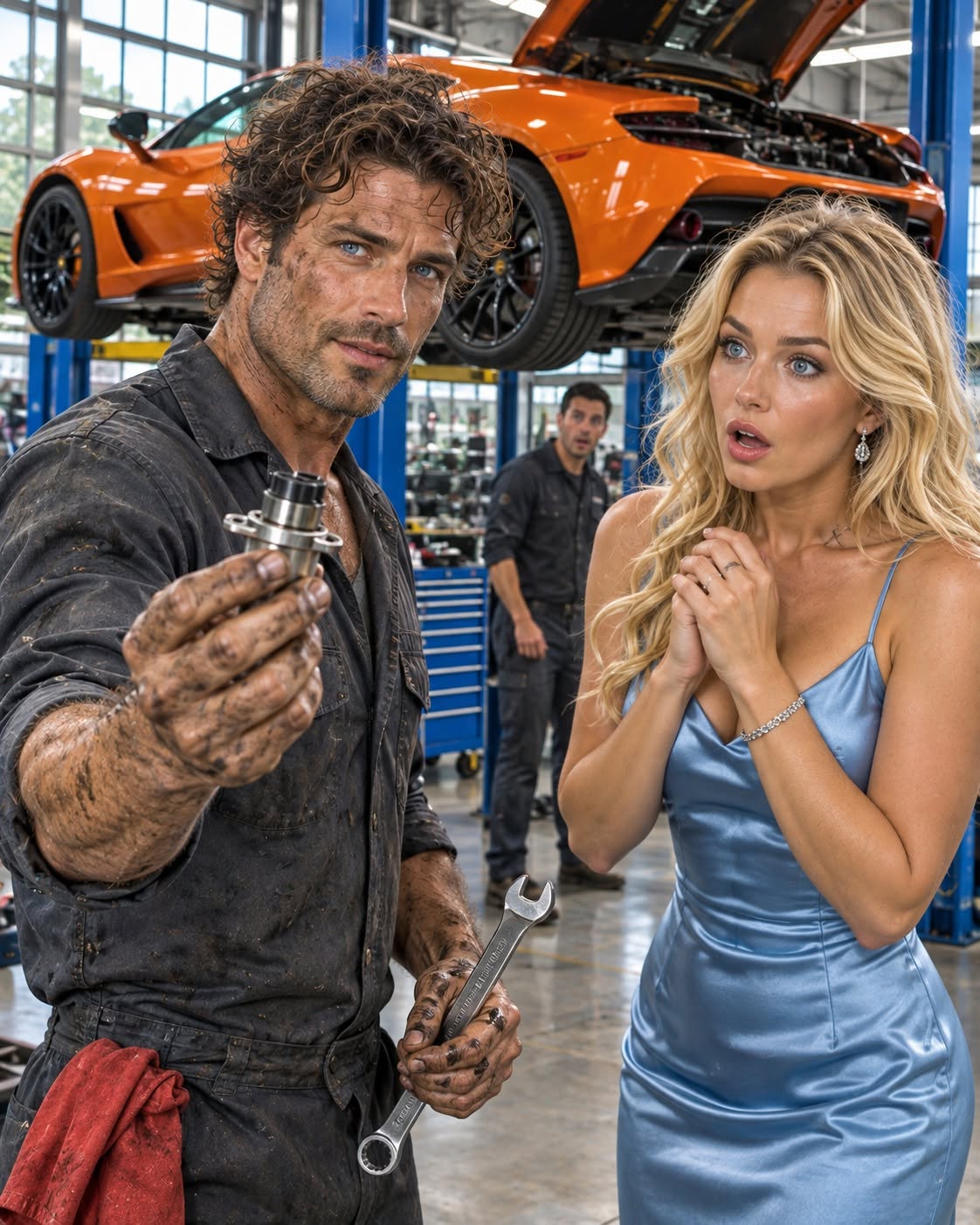
The entire repair team said the orange McLaren was beyond saving. Then I noticed one tiny detail that everyone else had missed.
The applause was still echoing through the ballroom when I noticed Tessa standing near the entrance.
She was wearing the little blue dress her mother had bought for her before she passed away. Her hair was tied back with a ribbon, and she was holding a small paper bag in both hands.
For a moment, I forgot about the guests, the expensive decorations, and the orange McLaren shining beneath the spotlights.
All I could see was my little girl.
Then I remembered.
The school breakfast.
The promise I had broken that morning.
I had told her I would make it up to her, but the day had slipped away from me again.
I walked toward her as quickly as I could.
“Tessa! Sweetheart, what are you doing here?”
She looked up at me with a smile that was trying very hard to hide disappointment.
“Mrs. Flores brought me. She said you were doing something important.”
I knelt in front of her.
“I was supposed to spend this evening with you.”
She shrugged, but I knew that gesture. It was the same one she used whenever she was trying not to cry.
“It’s okay, Dad. You were busy making the car work.”
Those words hurt more than any criticism Celeste could have given me.
I gently took her hands.
“Listen to me. That car can wait. This event can wait. Even the most important people in this room can wait. But you are never someone who should have to wait for me.”
Tessa’s eyes filled with tears.
“Then can we go home?”
I glanced toward the stage. Celeste was speaking with several important guests. She had arranged for me to meet investors and potential business partners that evening.
Walking away at that moment could have cost me an opportunity I had waited years to receive.
But I didn’t hesitate.
“Absolutely. Let’s go home.”
Before we could reach the exit, Celeste approached us.
“Leaving already?”
I nodded.
“My daughter needs me.”
Celeste looked down at Tessa, then at the little paper bag in her hands.
“May I ask what you’re carrying?”
Tessa held it out shyly.
“It’s a sandwich. I made it for Daddy because he works late sometimes and forgets to eat.”
Celeste slowly lowered her eyes.
I saw something change in her expression.
“That’s very thoughtful of you,” she said.
Then she turned toward the guests gathered around the stage.
“Ladies and gentlemen, may I have your attention for just one more moment?”
The room gradually became quiet.
Celeste stepped toward the microphone.
“I want to introduce you to someone who reminded me tonight that success is not measured by how many hours we spend working, how much money we make, or how many people know our names.”
She gestured toward me.
“This man restored a machine that three experts believed was beyond repair. But what impressed me most wasn’t his engineering ability. It was what he sacrificed to become the father his daughter needed.”
She paused.
“And I would rather build a company around someone with those values than someone who believes work is more important than family.”
The guests applauded.
I felt embarrassed by the attention, but Tessa squeezed my hand.
“Dad, they’re clapping for you.”
I smiled.
“They’re clapping for both of us, sweetheart.”
Celeste approached again after the applause faded.
“Take her home. Tomorrow, I’d like to discuss something with you. Not as an employer speaking to an employee. As two people who have learned that some things are more important than money.”
I thanked her and left.
That night, Tessa fell asleep in the passenger seat of our old pickup truck, still holding the empty paper bag.
When we arrived home, I carried her upstairs and tucked her into bed.
As I was about to turn off the light, she reached for my hand.
“Daddy?”
“Yes, sweetheart?”
“Are you going to be famous now?”
I laughed quietly.
“I don’t know about that.”
“Will you still fix cars?”
“Probably.”
“Will you still come to my school?”
I looked at her for a long moment.
“Every chance I get. And if I ever make you feel like a car is more important than you, you tell me immediately.”
She smiled sleepily.
“Okay. Good night, Daddy.”
I kissed her forehead.
“Good night, my greatest achievement.”
I thought that was the end of an extraordinary day.
I was wrong.
Because the following morning, a phone call would reveal that the little fracture I had discovered in the McLaren was connected to a much bigger problem than anyone had imagined.
And that problem would put everything I had just begun to rebuild at risk.
The next morning, I arrived at the garage earlier than usual.
I had barely finished making coffee when my phone rang.
It was Celeste.
“Can you come to my office immediately?”
Her voice sounded different.
“Is something wrong with the car?”
“The car is fine. But I need you to see something.”
Twenty minutes later, I was standing in her private office overlooking the city.
On her desk sat a thick folder containing photographs, engineering reports, and several pages of financial records.
Celeste closed the door.
“Do you remember telling me that the electrical damage looked unusual?”
“Yes. Several systems appeared to have failed simultaneously, but the secondary connection was responsible for most of the symptoms.”
She pushed a photograph toward me.
It showed the wiring harness before the repair.
“Someone deliberately damaged this connection.”
I studied the image.
At first, I didn’t understand what she meant. Then I noticed a faint discoloration around the fracture.
It wasn’t consistent with ordinary wear.
The wire had been weakened by repeated exposure to a chemical substance before it finally broke.
“Whoever did this wanted the car to appear completely dead,” I said.
Celeste nodded.
“And they knew enough about the vehicle to make the damage difficult to diagnose.”
She explained that the McLaren had been purchased through one of her company’s investment subsidiaries. It was scheduled to be displayed at the charity event, where she intended to announce a major restoration and engineering initiative.
The project involved restoring neglected performance vehicles and funding technical training for disadvantaged young people.
But someone inside her organization had been trying to stop it.
Her chief financial officer, Victor Hale, had opposed the project from the beginning. He believed the money should have been invested in a more profitable luxury development.
Two weeks earlier, Celeste had discovered irregular payments connected to several automotive contractors.
Now she suspected someone had sabotaged the McLaren to embarrass her publicly and force her to abandon the initiative.
“Do you think the car was damaged to make the entire project look incompetent?” I asked.
“That’s what I’m afraid of.”
I leaned back.
“Then you need an independent investigation. I can explain the technical evidence, but I’m not a detective.”
“I don’t need you to investigate anyone,” she replied. “I need you to help me understand exactly what happened to that vehicle.”
I agreed.
Over the next two days, I examined the damaged components again.
I found something interesting.
The secondary electrical connection had not simply failed. It had been manipulated in a way that would cause the car’s diagnostic system to produce misleading error codes.
Whoever had done it understood the vehicle’s architecture.
More importantly, the replacement component used during an earlier service had come from a contractor connected to Victor’s department.
I documented everything and gave Celeste a technical report.
She handed it to her legal team.
A week later, the company’s internal investigation uncovered evidence of fraudulent invoices and unauthorized payments. Victor was suspended pending a formal inquiry.
But the most surprising discovery had nothing to do with him.
It involved the original design of the car.
Celeste called me into her office again.
“I had my engineers review your repair notes,” she said. “They found something remarkable.”
“What?”
“You didn’t just repair the electrical system. You identified a weakness in the way the vehicle’s diagnostic architecture handled secondary failures.”
I frowned.
“That weakness has existed for years. I remember discussing something similar with another engineering team.”
Celeste opened a drawer and removed an old magazine.
The cover featured a photograph of a racing car from more than a decade earlier.
Beneath it was an article about an innovative engineer whose transmission and electrical management concepts had influenced several racing development programs.
I stared at the photograph.
It was me.
My name appeared in large letters beside it.
“Where did you find that?” I asked.
“My father collected automotive magazines. He admired your work.”
I didn’t know what to say.
Celeste continued.
“When I was younger, I wanted to become an engineer. My father told me I should focus on business because engineering was too uncertain for a woman trying to build a company.”
She smiled faintly.
“I suppose both of us spent years allowing other people to decide what our lives should look like.”
I looked at the magazine again.
For the first time in years, I wondered whether the person I had been before losing my wife was still somewhere inside me.
But there was one thing I wasn’t willing to compromise.
“My daughter comes first,” I said.
Celeste nodded.
“Then let’s build something that proves you don’t have to choose between being an excellent engineer and being a good father.”
Three weeks later, I signed a contract with her.
My position would be Director of Engineering at Celeste Automotive Restoration.
The agreement included flexible working hours, a dedicated engineering team, and a commitment to supporting employees with family responsibilities.
I also negotiated something unusual.
Every month, the company would offer free technical workshops to teenagers from low-income families.
Celeste agreed immediately.
She even suggested that Tessa should help choose the first group of students.
When I told my daughter about my new job, she jumped into my arms.
“Does that mean we’re going to be rich?”
I laughed.
“Not immediately.”
“Will we have a bigger house?”
“Maybe someday.”
“Will you still pick me up from school?”
I smiled.
“That part is nonnegotiable.”
For the first time in years, our future seemed brighter.
But happiness, I discovered, doesn’t always arrive without one final test.
The following Saturday, Tessa came home from school unusually quiet.
She placed her backpack on the kitchen table and sat down without saying a word.
I was preparing dinner when I noticed her expression.
“What’s wrong, sweetheart?”
“Nothing.”
I turned off the stove.
“Tessa, you know you can tell me anything.”
She stared at her hands.
“Today, our teacher asked everyone to bring a picture of their family for a school project.”
“That’s nice.”
“Everyone brought pictures with their moms and dads.”
I waited.
Then she reached into her backpack and pulled out a folded piece of paper.
It was a drawing.
There was a little girl standing between two adults. One was clearly me. The other had long hair and a beautiful smile.
I recognized her immediately.
It was her mother.
My throat tightened.
“That’s a beautiful picture.”
Tessa nodded.
“I wanted to bring Mommy’s photograph, but I couldn’t find one where we were all together.”
I sat beside her.
She looked at me with eyes that reminded me so much of my wife.
“Dad, why did Mommy have to die?”
The question struck me harder than anything that had happened since her passing.
I had answered it many times before, but somehow it always felt impossible.
“Your mother was very sick, sweetheart. The doctors tried everything they could, but sometimes people get illnesses that medicine can’t cure.”
“Did she know she was going to leave us?”
I swallowed.
“Yes.”
“Was she scared?”
I nodded slowly.
“I think she was. But she was also thinking about you.”
Tessa began to cry.
“Sometimes I forget what her voice sounded like.”
I pulled her into my arms.
“That’s okay. Forgetting little details doesn’t mean you love her any less.”
“But what if I forget her completely?”
I held her tighter.
“Then I’ll tell you every story I remember. I’ll show you every photograph we have. And we’ll keep her memories alive together.”
She rested her head against my chest.
“Can we look at her things tomorrow?”
“Of course.”
That night, after Tessa went to bed, I went into the storage room.
I opened an old wooden box containing my wife’s letters, photographs, and belongings.
At the bottom was a small envelope I hadn’t seen in years.
My name was written on the front in her handwriting.
I sat on the floor and opened it carefully.
Inside was a letter.
My dearest Daniel,
If you’re reading this, I hope you’ve found a way to keep living.
I know how much you love your work. I know how hard you fought to become the engineer you are.
But I also know that when our little girl looks at you, she doesn’t see an engineer, a champion, or a man with a brilliant future.
She sees her daddy.
And I hope you never underestimate how important that is.
Please don’t let losing me make you believe that you have to lose yourself, too.
You are allowed to be happy again.
You are allowed to dream again.
And you are allowed to build a life that is bigger than the sadness we left behind.
Just promise me one thing.
When Tessa grows up, I hope she remembers a father who loved her deeply, but also showed her that it was possible to follow a dream without abandoning the people who mattered.
I love you both.
Forever,
Elena.
I read the letter twice.
Then I covered my face and cried.
For years, I had convinced myself that choosing fatherhood meant burying every other part of who I was.
But my wife had understood something I hadn’t.
She had never wanted me to disappear.
She had wanted me to keep living.
The following morning, I showed the letter to Tessa.
She listened quietly as I read it aloud.
When I finished, she pointed to her mother’s name.
“Mommy knew you would be sad.”
“Yes, sweetheart.”
“Do you think she’s happy that you’re fixing cars again?”
I smiled through my tears.
“I think she would be very proud.”
Tessa thought about it for a moment.
“Then maybe we should put her picture in your new office.”
I nodded.
“That sounds perfect.”
Two months later, Celeste Automotive Restoration officially opened its doors.
The workshop was larger than anything I had ever worked in before. It had modern diagnostic equipment, specialized restoration bays, and a training area for young mechanics.
But I insisted on keeping one thing from my old garage.
My battered toolbox.
The photograph of Elena and Tessa remained attached to its lid.
On opening day, dozens of guests arrived.
Investors, automotive enthusiasts, journalists, and representatives from several charitable organizations filled the building.
Celeste stood beside me as she addressed the crowd.
“Some people believe that extraordinary talent can only flourish when someone sacrifices everything else in their life. I used to believe that, too.”
She looked toward me.
“Then I met a mechanic who reminded me that a person’s greatest achievement isn’t always something they build with their hands. Sometimes it’s the life they build with their heart.”
The guests applauded.
I was about to step forward when I noticed a young boy standing near the entrance.
He looked about fifteen.
His clothes were worn, and he held a small backpack against his chest.
He wasn’t interested in the speeches or the expensive cars.
He was staring at the training workshop.
I walked over.
“Are you here for the event?”
He nodded nervously.
“My name is Noah. Someone at school told me you were giving free mechanic lessons.”
“That’s right. Do you like working on cars?”
He looked down.
“My dad used to repair motorcycles. He passed away last year. I wanted to learn what he knew, but my mom can’t afford a technical school.”
I glanced at the workshop.
Then I looked at him.
“Would you like to see what we’re building?”
His face brightened.
“Really?”
“Really.”
I introduced him to our training coordinator and explained that he could apply for one of our first scholarships.
As I returned to the stage, I saw Tessa watching me.
She gave me a thumbs-up.
I smiled.
That was when I understood what Celeste’s project could become.
It wasn’t simply about restoring expensive vehicles.
It was about giving people another chance.
And perhaps that was why I had been brought there in the first place.
The following months were busy.
We restored classic sports cars, developed safer diagnostic systems, and trained young people who had never imagined they could work in automotive engineering.
Noah became one of our most dedicated students.
He arrived early, asked endless questions, and stayed late to understand how every component worked.
One afternoon, he approached me holding a notebook.
“Mr. Daniel, I designed something.”
He showed me a small diagram of an electrical protection system.
I studied it carefully.
It wasn’t perfect, but the idea was clever.
“Who helped you with this?”
“No one. I just remembered what you taught us.”
I smiled.
“Then you’ve got the beginning of something special. But remember, an idea is only the first step. You have to be willing to test it, fail, and try again.”
He nodded.
“Do you think I could become an engineer?”
I looked at him.
“Why wouldn’t you?”
He smiled in a way that reminded me of myself when I was young.
And suddenly, I felt something I hadn’t felt in years.
Purpose.
Not the kind that came from winning races or receiving awards.
The kind that came from helping someone else discover what they were capable of becoming.
Meanwhile, Celeste had begun changing, too.
She started leaving the office earlier whenever possible. She reconnected with her elderly father and began visiting him every Sunday.
One evening, she invited Tessa and me to dinner.
During the meal, she told us something surprising.
“My father called me last week,” she said. “He asked if I could visit him more often.”
Tessa looked up.
“Are you going to?”
Celeste smiled.
“I already started.”
“Good,” Tessa said seriously. “You shouldn’t make people wait too long.”
Celeste laughed, but I could see her eyes becoming wet.
“You’re right. I shouldn’t.”
Later that evening, while I was helping Tessa put on her coat, Celeste approached me.
“Your daughter has a way of saying things that make adults feel very small.”
I chuckled.
“She gets that from her mother.”
Celeste looked at me for a moment.
“Daniel, I wanted to thank you.”
“For what?”
“For reminding me that I still have time to become the person I should have been.”
I nodded.
“You always had that choice.”
She smiled.
“I know. I just needed someone to remind me.”
A year passed.
The company grew beyond anything Celeste had originally imagined.
Our training program expanded to three cities, and several of our students received scholarships to engineering schools.
Noah was accepted into a technical institute with a full scholarship.
On the day he received the letter, he ran into the workshop waving it above his head.
“Mr. Daniel! I got in!”
I hugged him.
“You earned it, son.”
He stepped back and wiped his eyes.
“I wish my dad could see this.”
I looked at him.
“I think he’d be proud.”
That afternoon, Tessa and I visited Elena’s grave.
We brought flowers and a small photograph of the new workshop.
Tessa placed the picture carefully beside the flowers.
“Mommy, Daddy has a new job now,” she whispered. “He fixes cars and teaches people. And he comes to all my school events.”
I stood behind her, listening.
She continued.
“I think you’d like what he’s doing.”
Then she turned toward me.
“Dad, do you think Mommy knows?”
I knelt beside her.
“I think the love we share with someone doesn’t disappear just because we can’t see them anymore.”
She nodded.
Then she took my hand.
We stood there quietly for a while.
Before leaving, I looked at the photograph of Elena on the gravestone.
For the first time, I didn’t feel that I was leaving her behind by moving forward.
I felt that I was carrying her with me.
That evening, Tessa and I returned home.
She had a school assignment due the following morning. Her teacher had asked the students to write about someone who had changed their lives.
I expected her to write about her mother.
Instead, she sat at the kitchen table and began writing about me.
When she finished, she asked me to read it.
The title was simple:
My Hero Doesn’t Wear a Cape.
She had written:
My dad fixes broken cars.
Sometimes he works late, and sometimes his hands get covered in oil. He doesn’t have a fancy office, and he doesn’t drive the most expensive car.
But he always tries to keep his promises.
When my mom died, he was sad for a long time. I thought he would never smile the same way again.
Then he started fixing cars again.
I was afraid he would become too busy, but he taught me that dreams are important and families are important, too.
My dad once told me that he repaired a car everyone thought was impossible to fix.
But I think he fixed something more important.
He helped our family feel happy again.
I don’t know if he’ll ever become famous.
But I know he’s already my hero.
I couldn’t finish reading without wiping my eyes.
Tessa looked worried.
“Is it bad?”
I shook my head.
“No, sweetheart. It’s the best thing anyone has ever written about me.”
She smiled.
“Can I read it at school?”
“You should.”
The following week, I attended her classroom presentation.
When Tessa stood in front of her classmates, she held the paper with both hands.
Her voice trembled at first, but she soon became more confident.
When she finished, the room was silent for a moment.
Then her teacher began applauding.
Other children joined in.
I sat in the back, trying unsuccessfully to hide my tears.
Afterward, Tessa ran toward me.
“Did you like it?”
I picked her up.
“I loved it.”
She wrapped her arms around my neck.
“Then I think I did a good job.”
“You did more than that.”
As we walked toward the parking lot, she suddenly asked a question.
“Dad, are you happy now?”
I stopped.
It was such a simple question.
But it deserved an honest answer.
I looked at the little girl who had once been the reason I walked away from everything.
And I realized she had also become the reason I found my way back.
“Yes,” I said. “I really am.”
She smiled.
“Good. Because I like happy Daddy.”
I laughed and kissed her forehead.
That night, after putting her to bed, I returned to the workshop.
The orange McLaren was there, parked beneath the overhead lights.
Celeste had decided to keep it as the centerpiece of our restoration program. A small plaque had been placed beside it.
It read:
Beyond Repair Is Sometimes Just Another Way of Saying We Haven’t Found the Right Person Yet.
I ran my fingers over the car’s polished bodywork.
I remembered the first day I had seen it.
The specialists shaking their heads.
Celeste’s frustration.
The broken connection hidden beneath layers of damage.
And the tiny detail that everyone else had overlooked.
I had thought that fixing the McLaren would change my life because it would give me a chance to return to engineering.
But that wasn’t the greatest thing that happened.
It brought me back to myself.
It helped me understand that I hadn’t been wrong to choose my daughter. I had only been wrong to believe that loving her meant giving up every other dream.
A few minutes later, my phone buzzed.
It was a message from Celeste.
The board approved funding for another training center. I think we can help twice as many students next year. Thank you for believing in this.
I smiled and replied:
Let’s build something worth remembering.
Then I turned off the workshop lights and headed home.
Tessa was asleep, her bedroom door slightly open.
I stepped inside, adjusted her blanket, and noticed a drawing on her bedside table.
It showed an orange sports car, a little girl, and a man holding her hand.
Above them, she had written:
WE FIX THINGS TOGETHER.
I stood there for a long time.
And I finally understood something I wish I had known years earlier.
A career can give you recognition.
Money can give you comfort.
Talent can open doors you never imagined existed.
But none of those things can replace the people who make your life worth living.
I had spent years believing that becoming a father meant putting my dreams to rest.
I now knew that the truth was much more beautiful.
Sometimes, the people we love don’t stand in the way of our dreams.
They give us a reason to pursue them differently.
The orange McLaren had arrived at my old garage as a hopeless case.
But the most important thing it helped restore wasn’t a car, an engine, or even a career.
It was a father who had forgotten that he was allowed to dream again.
And a little girl who finally understood that no matter how far her father went, he would always find his way home.
Because in the end, the greatest thing we can ever build isn’t something that makes the world admire us.
It’s a life in which the people we love never have to wonder whether they matter.